[B4] Cell transport mechanisms
 Studied by 0 people
 Call Kai
 Learn
Learn Practice Test
 Spaced Repetition
 Match
Match Flashcards
 Knowt Play
1/21

Earn XP
Description and Tags
from applied science textbook
Name | Mastery | Learn | Test | Matching | Spaced | Call with Kai |
|---|
No analytics yet
Send a link to your students to track their progress
22 Terms
What does fluid mosaic model mean?
it describes the arrangement of biological molecules
What are the four fundamentals of the fluid mosaic model?
the phospholipid bilayer
protein molecules
extrinsic proteins
intrinsic proteins
What does the phospholipid bilayer consist of?
a hydrophilic phosphate head and two hydrophobic fatty acid tails
What does hydrophobic mean?
water hating
What does hydrophilic mean?
water loving, likes water
What happens when a phospholipid molecule is mixed with water?
the heads stick into the water, and the tails stick up and out of the water.
What is the meaning of diffusion?
The movement of molecules fromhigh concentration to low concentration, down a concentration gradient.
Does diffusion need energy?
no. It moves passively and does not use energy from the cell
How are lipid based moelcules passed through the bilayer?
fat-soluble molecules can ass through becuase the bilayer has fatty acid tails. It diffuses down a concentration gradient through the membrane and into the cell
How are small molecules passed through the bilayer?
they pass through the spaces in the bilayer and are transported via diffusion
How are larger molecules passes through the bilayer?
they are passed through facilitated diffusion
What are the steps for facilitated diffusion?
The channel proteins form pores in the membrane,which have shaped so particular molecules can be let through.
The carrier proteins are shaped for a particlar molecule, and when it binds to the protein, it changes shape, so the molecules can pass across the membrane.
What are ions?
particles that have a positive or negative charge
What is active transport?
use of ATP as energy for the movement of molecules from low concentration to a high conentration, against the concentration gradient.
What is faster, diffusion or active transport?
active transport
What happens if large quantities of materials needs to be moved in and of of the cells?
it can be moved by endocytosis or exocytosis
What endocytosis?
movement of bulk material into a cell
What is exocytosis?
movement of bulk material out of a cell
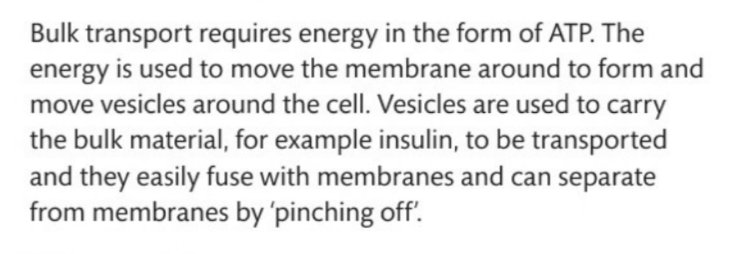
How is ATP used to carry material?
What is osmosis?
movement of water molecules from a high water potential to a low water potential, down a water potential gradient, across a partially permeable membrane
The larger the sa to voume ratio….
the more effective the transport
Why do single celled organisms have a larger surface are compared to their volume?
they rely on diffusion to meet their needs
 Note
Note  Flashcards (32)