Intro to Animal Diversity PPT
 Call Kai
 Learn
Learn Practice Test
 Spaced Repetition
 Match
Match Flashcards
 Knowt Play
1/104

There's no tags or description
Looks like no tags are added yet.
Name | Mastery | Learn | Test | Matching | Spaced | Call with Kai |
|---|
No analytics yet
Send a link to your students to track their progress
105 Terms
Choanoflagellate
earliest relative of animals
single-celled protists
collar of cytoplasmic tentacles
colonial
some special cell function
animals are:
multicellular
eukaryotes
no cell walls
heterotrophs
motile
as3xual/s3xual reproduction methods
have extracellular matrix providing structural support
cell junctions hold cells in place to implement communication
modes of nutrition of animals
heterotrophs
suspension feeding
bulk
fluid
suspension feeding
filtering particles from surrounding water
bulk feeding
eating large food pieces
fluid feeding
sucking sap or animal body fluids
animal movement mechanisms
muscle and nerve cells within tissues unique to animals
locomotion
food acquiring
escape predators
find mates
special sensory nervous system to create movement
reproduction and development
animals mostly reproduce s3xually
small sperm uniting with egg producing zygote
internal ferilization
external fertilization
some may produce as3xually
metamorphosis
internal fertilization
mechanical insertion
terrestrial species
external fertilization
sperm fertilizes a female's eggs outside of the body
aquatic or moist environments
metamorphosis
developmental phenomenon in which animal changes from a juvenile to an adult form
tadpole —> frog
reduces competition
creates dispersal
multicellularity
even relatively simple types of animals such as sponges are multicellular, in contrast to the mostly single-celled eukaryotic microorganisms, called protists
heterotrophs
animals obtain food by eating other organisms or their products
contrasts with plants and algae
10 characteristics of animals
multicellular
heterotrophs
no cell wall
nervous tissue
movement
s3xual reprod
extracellular matrix
cell junctions
hox genes
SSU rRNA
multicellularity
eukaryotic
heterotrophs
obtain food by eating other ogranisms or their products
contrasts with autotrophs
no cell walls
cells are flexible
nervous tissue
presence of a nervous system in most animals enables them to respond rapidly to environmental stimuli
movement
contain muscle systems which work with nervous system to allow them to move
s3xual reproduction
most animals reproduce s3xually with small mobile sperm and larger egg, created a fertilized egg/zygote
extracellular matrix
proteins (collagen) bind animal cells together to give added support and strength
characteristic cell junctions
anchoring, tight and gap junctions
hox genes
give instructions for patterning the body axis
SSU rRNA
animals have very similar genes that encode for the RNA of the small ribosomal subunit
history of animal life
multicellular animals emerged at the end of the Proterozoic eon
first animals were invertebrates
sudden increase in animal diversity contributed the the Cambrian explosion
Cambrian period
540-490 mya
warm and wet
abrupt diversity of animal species
marine invertebrates were present, along with others no longer existing
examples of arthropods and chordates
summary of cambrian (story)
Cambrian explosion was this huge diversification event that happened at the end of the Proterozoic eon. In this time, it was wet and marine invertebrates diversified into arthropods and chordates. There was an evolution of shells and an development of a skeleton layer contributing to this explosion of life
3 causes to the cambrain explosion
evolution of shells allowed animals to exploit new environments
increase in atmospheric and aquatic ocean levels allowed more complex body parts
production of ozone layer helped UV radiation
evolutionary arms race between predators and prey
animal classification
monophyletic animal kingdom
35 animal phyla
3 early lineages of animals
ctenophora - comb jellies
porifera - sponges
cnidaria - jellyfish
main innovation of the first animal evolutionary branch
gain of 2 germ layers = multicellularity = endo and ecto derms
ctenophora
comb jellies
main innovation = gain of mesoderm
1st to evolve
porifera / parazoa
sponges
main innovation = loss of germ layers
tissue divergence
no symmetry
cnidaria
primative radial symmetry
gain of 2 germ layers
primative radial symmetry
Central core, but over multiple divisions the species is relatively the same
5 simple patterns of phylogeny
tissue development
body symmetry
body cavities
patterns of embryo development
segmentation
tissues
most Metazoans (animals) process of development showed 2-3 layers forming tissues
tissues are groups of similar differentiated cells specialized for particular functions
3 primary cell layers in embryos
endoderm
innermost layer
forms lining of gut (digestive)
ectoderm
outermost layer
forms external coverings and nervous system
mesoderm
middle layer
forms muscles of body wall and most other structures between gut and external covering
2 types of body plans
diploblastic
based on 2 embryonic layers (endo and ecto derms)
triploblastic
based on 3 identifiable germ layers (endo, meso, ecto)
2 types of symmetry
radial
primative
body parts arranged around central axis
bilateral
mirror image along midline
most animals
leads to development of head
cephalization
development of a head
4 aspects to bilateral symmetry
dorsal - to spine
posterior - to back
anterior - to front
ventral - to belly
3 terms associated w/ bilateral symmetry
Cephalization
Dorsal and ventral
Anteriro and posteriror
3 lineages of coelom
flatworm
nematode
earthworm
flatworm
Acoelomate = improper body cavity
Blue = ecto
Red = medoderm
Yellow = endoderm
No fluid filled
Pink jelly solid derived from mesoderm --> no fluid caps coelom
nematode
Pseudocoelomate = fake
Appears to be a fluid filled cavity = not true cavity cause it doesn’t have mesoderm surrounding the cavity
Mesoderm only surrounding the blue, no the endoderm (yellow)
earthworm
Coelomate
Fluid filled
Red mesodermal layer on inside of ecto and the outside of the endoderm
Coelome is surrounded by mesoderm --> entirely, true filled fluid space
acoelomate animals
no body cavity
pseudocoelomate animals
false
cavity not completely surrounded by mesoderm
example: roundworms
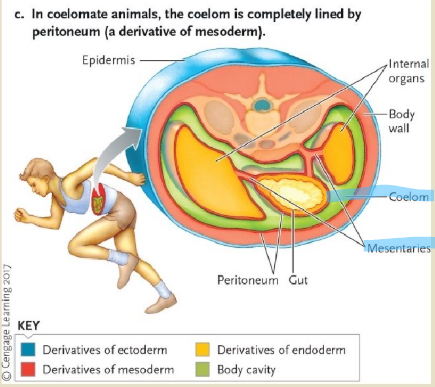
coelomate animals
coelom - fluid filled body cavity entirely lined by mesoderm
in vertebrates, this lining is the peritoneum (came from mesoderm)
mesenteries surround inner organs (protective)
8 stage cell division from zygote, cleavage and gastrula
This will keep diving by multiples of 8, until the hollow ball called the blastula is made
Blastula is hollow ball and then gastrulation occurs where inwards folding occurs
The inside yellow layer from gastrulation makes the endoderm
2 layers – ecto, pushes into endoderm
Triploblastic – ecto, endo and mesoderm (mesoderm in red)
cell division in Protostomes (worms and insects)
Blastopore in protostome, inward fold become the mouth = primary opening
Some may develop an anus
Spiral cleavage
Determinate cleavage
Development ends when the cleavage occurs, one cell /4 is removed
cell division in deuterostomes
Deuterostomes have mouth and anus
During development, blastopore becomes the anus
Therefore, we have to have formed a second opening for the mouth
Secondary = mouth, primary = anus
Radial cleavage
Indeterminate cleavage
If you take ¼ cells, now you have a single cell that was originally part of 4, which can continue developing to create a normal embryo, and the leftover 3 can also continue to make a normal embryo
I.e. identical twins
protostomes
nervous system on ventral side of body and brain surrounds opening of digestive tract
worm or insect
nervous system on front side of body
Brain – anteriror end
Runs along gut
deuterostomes
nervous system and brain are on dorsal side of the body
neural system is on dorsal side (back)Brain – anterior end
Attached to spinal cord which continues down
3 factors to proto/deuterostome bodies
Gut
runs down middle of animal in both
Heart and blood vessels
In deuterostome in ventral
In protostome in dorsal
Nervous
In deuterostome in dorsal
In protostome in ventral
Heart and nervous are inverse
segmentation
body structure that repeats along an anterior posterior axis and itself has an anterior-posterior polarity
annelid worms, lobsters, chordates
segmentation commonly associated with movement
morphological traits used In classification
past methods include presence or lack of coelom or body segmentation
molecular data is better used in describing differences in animal structure
molecular views of animal diversity
scientists now use molecular techniques to classify animals
compare similar in DNA, RNA, and AA sequences
Related organisms have less differences
6 lineages of invertebrates
ctenophores
porifera
radiata
^^ earliest evolved
lophotrochozoa
ecdysozoa
deuterostomia
Ctenophores
comb jellies
less 100 species
cilia on surface for movement/propulsion
2 sticky tentacles without singing cells
used to capture prey and don’t sting
Protostomes --> have a mouth --> have 2 anal pores (weird) --> efficient at feeding and can eat large prey --> consist of male and female reproductive parts
porifera
sponges
Multicellular
Asymmetrical
Pore bearers – many pores
8000 species
Range in sizes (very small to very big)
Porifera phylum
Adult sessile, free-swimming larvae
Sexuality of porifera
sexual
hermaphrodites - make egg and sperm
asexual
small fragment or bud may detach and form a new sponge
body plan of sponges
Choanocytes along the lining of the sponge's hollow tube
Trap and eat small plankton coming in through pores of sponge
2 forms of bodies
Polyps
Mouth/anus above
Medusas
Mouth/anus below
Proteostomes
Radiata
true tissues
sac-like body with one mouth acting as mouth and anus
simple
marine
capture prey with stinging tentacles
life cycle includes polyps, medusae or both
cnidarian body plan
aboral (end) on top
oral (anus and mouth) on bottom
epidermis - ecto
gastrodermis - endo
polyp body plan
anus and mouth at the top
Lophotrochozoa
mollusks, annelids, and several other phyla
named for the lophophore (feeding tentacles) and trochophore larva
flatworms don’t fit into the category
Ecdysozoa
nematodes, arthopods and a few other minor phyla
named for ecdysis
members secrete an exoskeleton that must be shed and regrown as the animal increases in size
Bilateria
protostomia
lophotrochozoa (lophos = crest; troch = wheel)
lophophore feeding structure in 3 phyla
trochophore type of larva in annelids and molluscs
ecodysozoa
cuticle or external skeleton secreted and periodically molted
deuterostomia
ecydsis
cuticle or external skeleton secreted and periodically molted
lophophore feeding structure
ring of ciliated feeding tentacles
or
develop from a trochophore or modified trochophore larva
flatworms: platyhelminthes
freeliving or parasitic
acoelomate
3 layers: endo, meso, ectoderms
endoderm
digestive cavity with specialized cells
mesoderm
muscles and reproductive organs
ectoderm
ciliated epidermis, nervous system and excretory flame cell system
flatworms
Cant see but detect light or darkness
If swimming upright it will see sunlight
If swimming upside down it will see darkness
phylum rotifera
ciliated crown (corona)
phylogenetic bryozoans and brachiopods
lophophore - ciliary feeling device helping with gas exchange
true coelom
u-shaped alimentary canal
answer located near the mouth but outside the lophophore
lophophores
phoronida - horseshoe worms
brachiopods - upper and lower values
bryozoan - moss animals
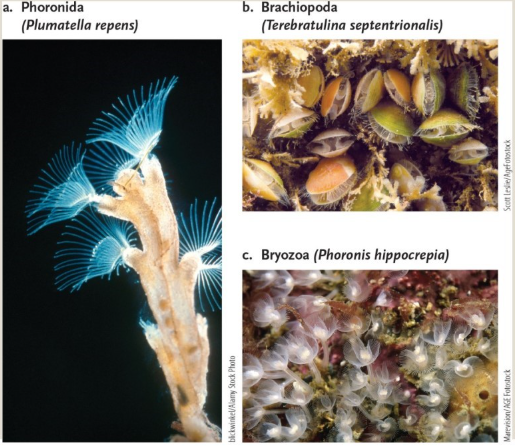
phylum bryozoa
small colonial animals
look like plants
4500
each animal secreted and lives inside zoecium
composed of chitin or calcium carbonate
phylum brachiopoda
marine animal with 2 shells
similar in appearance to clams
dorsal and ventral shells (top and bottom)
attach to substrate with a muscular pedicle
300
phylum mollusca 4 classes
bivalvia
polyplacophora
gastropoda
cephalopoda
bivalvia
marine or freshwater - shell 2 halves - primary filter feeders with siphons
clams, mussels, oysters, scallops
polyplacophora
marine, 8 plated shells
chitons
gastropoda
marine, freshwater, coiled shells
snails, slugs
cephalopoda
marine, predators, tentacles, absent shells, closed circulatory system
octopus, squids
slugs, snails and squid
fleshy bodies in hard shell
head-foot
visceral mass
radula
mantle
internal or external fertilization
bivalvia clams, scallops, oysters
hinged pair of shells, abductor muscles
cephalopoda, squid, octopus
marine predators, most intelligent, closed circulatory system
phylum Ecdysozoa
cuticle providing support and protection
allows colonialization of dry environments
functions like an external skeleton and skin
ecdysis
metamorphosis
ecdysis
molting of the cuticle to allow growth
nemantoda: round worms
second largest animal phylum
mostly microscopic
feed on decaying organic matter or parasite plants or animals
responsible for numerous parasitic diseases; elephantiasis, pinworm (itch), hookworm
classification of the coelom of a nematode
pseudocoelomate
lack mesoderm on outer wall of gut
phylum arthopoda
artho = joint
pod = foot
includes 4 groups
exoskeleton results in common rate of being fossilized
greatest species success
phylum arthopoda
segmented bodies with specialized appendages for feeding, locomotion and reproduction
exoskeleton
exoskeleton
chitin held together with fats and waxes
protects, supports and helps prevent dehydration

