Unit 3
 Call Kai
 Learn
Learn Practice Test
 Spaced Repetition
 Match
Match Flashcards
 Knowt Play
1/75

Earn XP
Description and Tags
linear kinetics
Name | Mastery | Learn | Test | Matching | Spaced | Call with Kai |
|---|
No analytics yet
Send a link to your students to track their progress
76 Terms
Newtons First Law
Law of Inertia = tendency for a body to resist change in its current state of motion
A body will maintain a state of rest or constant velocity unless acted on by an external force that changes that state
Inertia
tendency for a body to resist change in its current state of motion
• Directly proportional to mass
• Increased mass = better maintenance of current motion
Newtons Second Law
Law of Acceleration
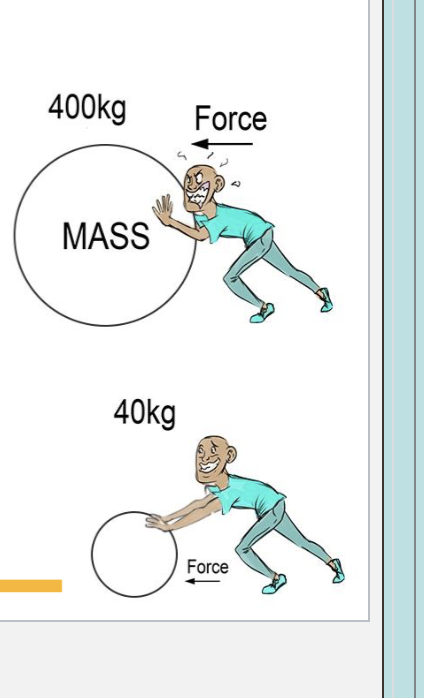
1) The force applied to the body will cause acceleration in proportion to the force
2) direction of the force
3) inversely proportional to mass (bigger mass = less acceleration)
F =MA
Newtons Third Law
Law of Reaction
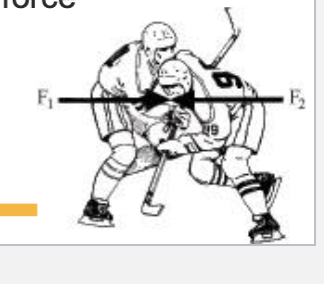
When one body exerts a force on a second body, the second will exert a force that is equal in magnitude and opposite in direction (# each action has an equal and opposite reaction)
-Assumes equilibrium
Newtons Law of Gravitation
all bodies are attracted to one another with a force proportional to the product of their masses and inversely proportional to the square of the distance between them
large the bodies = more attraction, but further apart = less attraction
Limits of Newtons Law
our world doesn’t always exist in a state of equilibrium
there is additional forces ( ex: friction )
Friction
force acting over the area of contact between two
surfaces in the direction opposite to motion or motion tendency
• Quantified in units of force (N
Coefficient of friction = (μ) and Normal reaction force (R)
F = μR
true or false: The magnitude of static friction is always larger than the magnitude of kinetic friction.
true; maximum static friction is always larger than kinetic friction, you must overcome static friction in order for kinetic friction to occur
true or false: After a collision, the objects will always move in the direction of the greatest mass.
False; they move in the direction of the greatest momentum
Different types of coefficient of friction
Coefficient of friction (μ): Unitless number serving as an index for
the interaction between two surfaces in contact
• Coefficient of static friction (μs): for motionless bodies in contact
• Coefficient of kinetic friction (μk): for moving bodies in contact
What does it mean if μ is higher
MORE FRICTION
Normal Reaction Force (R)
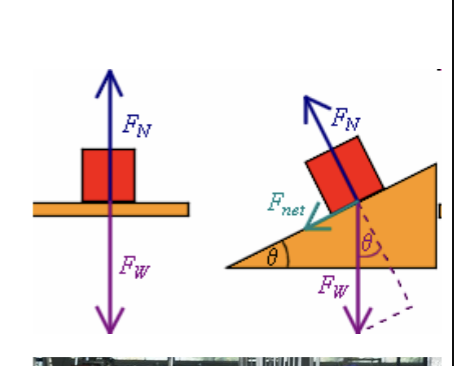
-force acting perpendicular to two surfaces in contact
-as weight increases = R increasing
How does friction influence movement
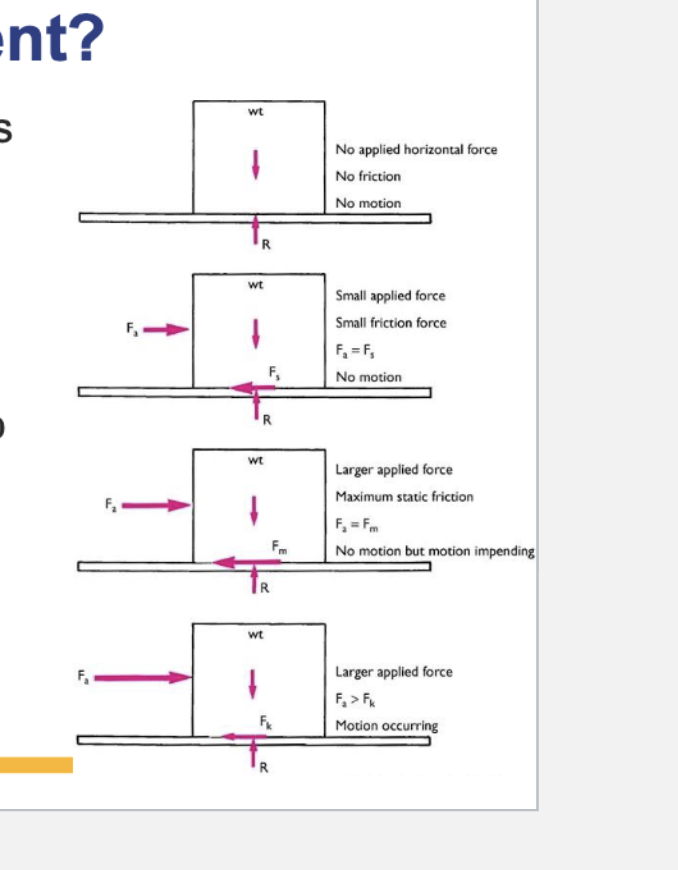
-horizontal force applied? = friction force introduced
-force increases? = increase friction force
-Fa (force of acceleration) MUST be greater than Fm (max static friction) in order for the box to move
-the type of friction adding on an object during motion = Fk (kinetic friction) that is CONSTANT despite applied force
How to manipulate R
(normal reaction force)
Increasing or decreasing force/weight
• Changing the direction force (pushing vs. pulling)
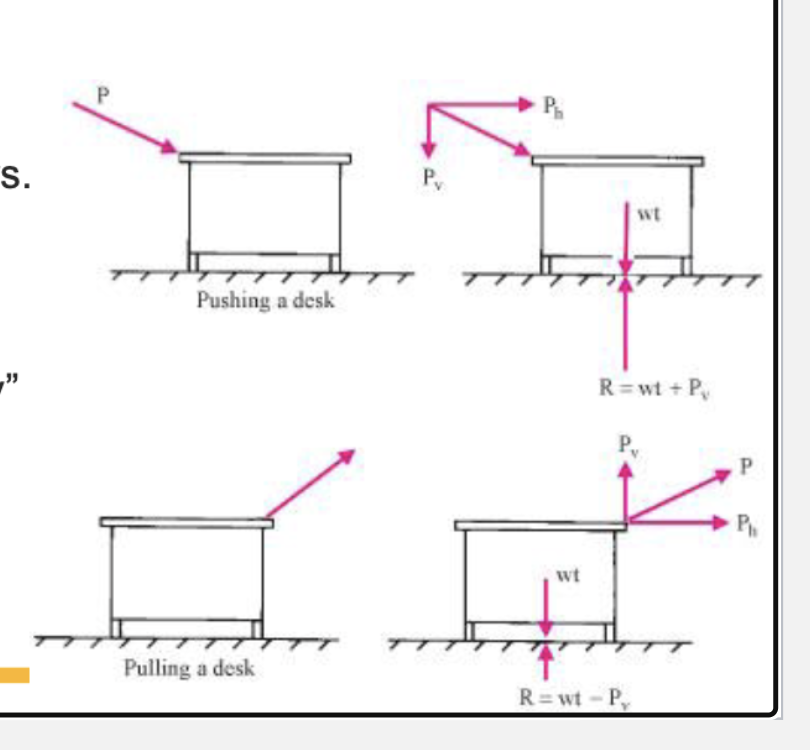
How to manipulate the coefficient of friction
Can make surfaces more or less “sticky”
Ex:
• Use of gloves in sports ↑ coefficient of friction
• Wax on skis ↓ coefficient of friction
salt on ground with ice
Common misconception of friction
-only known factors ot affect friction are coefficient of fiction and the normal force
-NO EVIDENCE on surface area, but increasing surface area often increases R (bc most of the the time increased weight)
Momentum
Linear momentum: quantity of motion an object possesses
• M=mv
• Units: kg • m/s
Change in momentum = change in mass and/or change invelocity
• Vector, so subject to vector composition/resolution
What law characterized momentum
Newton’s First Law
In the absence of external forces = the total momentum of a system remains constant (M1 = M2)
BUT EXTERNAL FORCES PRESENT = objects will move in the
direction of the greatest momentum
MOMENTUM CHANGE: m1v1 ± m2v2 = (m1 + m2)v
(+ if going same way/same direction #chase, - if going opposite ways #collision) this equation ignores other real-world factors (air resistance, friction, GRFs, collision properties etc)
Impulse
product of force and the time over which the force acts
• Impulse = Ft
• Impulse represents a change in momentum
how do changes in momentum occur
Small forces over a longer duration
• Large force over a short duration
Impact
-Collision characterized by the exchange of a large force during a short time interval
-The behavior of the bodies after the impact depends on the collective momentum and nature of the impact
Types of impact
-Perfectly plastic impact
-perfectly elastic impact
Perfectly Plastic Impact
-results in total loss of the system velocity
-at least one body deforms and doesn’t regain shape
-bodies DO NOT separate
Perfectly elastic impact
-velocity of the system is conserved
-relative velocities of he two bodies after impact are the same as their relative velocities before impact
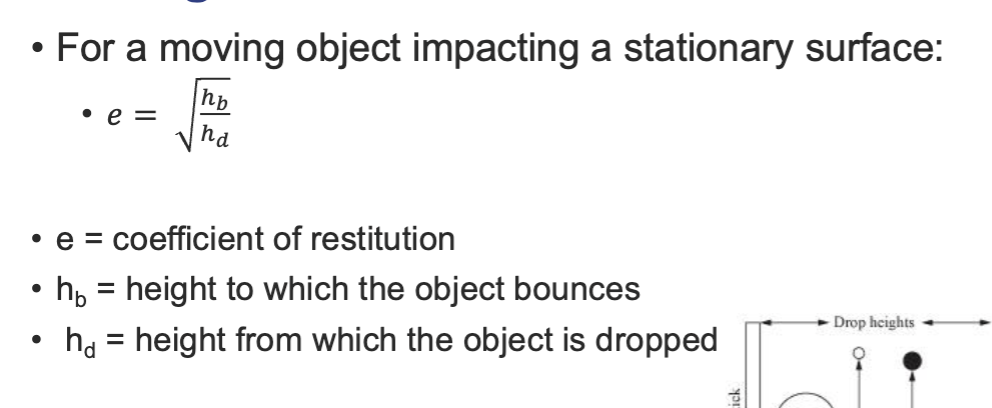
Coefficient of Restitution
-describes the elasticity between colliding bodies
-unitless between 0 and 1
0 = more plastic, 1 = more elastic
-explains relationship between 2 surfaces
What can impact coefficient of restitution (relationship between 2 surfaces)
temperature
“stiffness” surfaces and/or equipment
velocities of the surfaces, etc
WHY USE the coefficient of restitution
-to ensure “multi-use” surfaces are accommodating to multiple activities
-design various sports equipment
-crash tests
How to find coefficient of restitution
(SPECIFICALLY for a moving object and stationary surface)
Mechanical Work
-application of force along a displacement
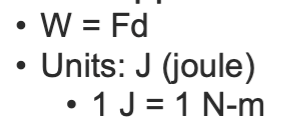
types of mechanical work
No movement = No mechanical work
• Positive work: when both the net muscle torque and the direction of
angular motion at a joint are in the same direction (predominantly
concentric contraction)
• Negative work: when the net muscle torque and the direction of
angular motion at a joint are in opposite directions (predominantly
eccentric contraction)
Power
rate of work production

What sports/activities benefit from increased power?
things that involve sprinting and running…so like every sport
WHY?
Because force and timing are needed to be successful
Peak power is strongly associated with maximum isometric strength
(Not weightlifting, same amount of work done but timing not necessarily involved)
Energy
capacity to do work
units = J
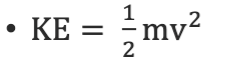
Kinetic Energy
energy of motion
influenced by velocity
Potential Energy
energy of position or ‘stored energy’

Strain Energy
elastic energy
capacity to do work by virtue of a deformed bodys return to its original shape
when an object deforms, it stores potential energy for later use (ex: pole vault, diving board, tendons, muscles)
Relationship between work and energy
-when work is applied to an object/body, the energy of that body/object changes (energy dictates how work is performed)
-if we utilize energy effectively, we can decrease the amount of mechanical work needed (BUT mechanical work does not = caloric expenditure, 25% of energy consumed by muscle is converted into work)

Equilibrium
state characterized by balanced forces and/or torques
Either motionless or moving with a constant velocity
Static equilibrium
a motionless state in which Σ𝑇 = 0
Dynamic equilibrium
A concept indicating a balance between applied forces and inertial forces for a body in motion
• All acting forces result in equal and oppositely directed inertial forces
Torque
ROTARY (or potential of rotation) effect of a force about an axis of rotation
The greater the torque, the greater the chances of rotation
T = Fd⊥
• Units: N-m
• Vector: Counterclockwise (+), Clockwise (-)
Moment Arm / Lever Arm
-perpendicular the distance between the force’s line of action and the axis of rotation
-In the human body, the moment arm is the perpendicular distance between the joint center & the muscle’s attachment
• Largest moment arm at 90°
how does the length of the moment arm affect movement?
when you have a very small moment arm the muscle has to initiate way more force to get the movement going (curls/pull-ups; it is harder to keep going if you reach the full length)
Resultant Joint Torques (agonist-antagonist relationships)
agonist (prime mover) + Antagonist (controls movement velocity) = cocontractions =increase joint stability AND net torque
concentric vs eccentric contraction
concentric = net muscle torque + joint movement occur in the same direction
eccentric = net torque in the opposite direction of joint motion
isometric = net torque is zero and stationary joint motion
How are joint torques used in real world?
-provides general estimates of muscle group contributions during various activities
-movement, execution, + injury risk; when other factors are held constant, increased movement speed increases joint torque (w inc speed, antagonist activity reduced = less stability in movement = injury risk)
-obesity; weight increases joint torque, which may increase overall joint stress and contribute to increased risk for osteoarthritis development
Lever
a simple machine consisting of a relatively rigid object that may be made to rotate about an axis through the application of force
Axis (fulcrum)
the point of support about which a lever rotates
Force (effort)
the ‘input force’ or the force applied to the lever system
Resistance (load)
the ‘output force’ or the force of the lever is attempting to move
Classes of Levers
First Class: lever positioned with the applied force and the resistance on opposite sides of the axis (ex; seesaw, nodding head)
• Second Class: lever positioned with the resistance between the applied force and the axis (ex; wheelbarrow, calf raise)
• Third Class: lever positioned with the applied force between the axis and the resistance (ex; canoe paddle, muscle bone concentric contractions)
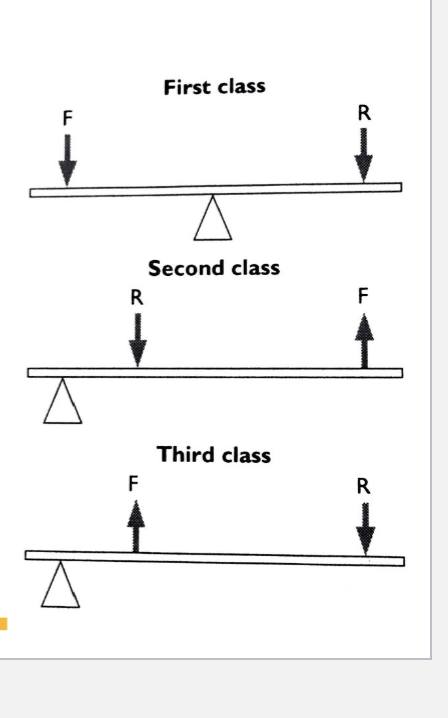
Acronyms for classes of levers
1 = FAR
2 = ARF
3 =AFR
Exception to the Rule (lever classes)
Eccentric contractions can be classified as second-class levers
• Our muscle is “resisting” an external force
Mechanical advantage
-Mechanical effectiveness of a lever system, quantified as the ratio of the force arm to the resistance arm
-the longer moment arm has the advantage
Advantage for the force = moment arm of force > of resistance, ratio > 1
Advantage for the resistance = moment arm of resistance > of force, ratio < 1

Mechanical Advantage in the body
-3rd class level system = mechanical disadvantage in many situations, BUT increased range of motion and angular speed (each lever system in the human body has an optimal range of angles at which torque is maximized *typically 90 degrees)
Why care about mechanical advatage in real world?
influences training goals and performance testing (different positions to asses and build strength)
rehab; when and how to load tissues in safe manner
impacts how equipment is designed or utilized (isokinetic machines)
Stability
ENVIRONMENT resistance to the disruption of equilibrium
• Affected by mass, center of gravity, friction, base of support, etc.
Balance
INDIVIDUAL a person’s ability to control equilibrium
center of gravity
point around which the weight of a body is balanced, no matter how the body is positioned, can be outside of the body (weight determines where CG is located)
how does center of gravity location impact things?
Determines how a body will respond to external forces
Base of Support
area bound by the outermost regions of contact between a body and support surface(s), does not just have to be just the feet (could be a balance board, crutches, etc)
larger base of support = more stability
center of gravity outside of base = instability
easier to maintain balance within the base
other factors can influence balance and/or stability
Muscle tone and muscular strength
• Joint movement/range of motion
• Proprioception
• Hearing and vision impairments
• Cognition
how do other factors that influence balance and/or stability impact activities ?
Stability
• Lower CG to increase stability (lineman, wrestlers, basketball players, etc.)
• Canes & walkers increase base of support for elderly or injured individuals
• Shift CG toward an oncoming impact
• Sprinters move CG toward the edge of base of support for take-off
Balance
• Gymnastic, dance, cheer benefit from increased balance
• Negatively impacted after concussion
• Typically, decreases with age
Newtons first law (rotation)
A rotating body will maintain a state of constant rotational
motion unless acted on by an external torque (like a top)
Newtons Second law (rotation)
1) A sized torque applied makes angular acceleration directly proportional to magnitude (small = small, large = large)
2) angular movement in the same direction of the torque
3) greater moment of inertia = smaller the acceleration (or smaller = bigger)
Newtons third law (rotation)
every torque exerted by one body on another, there is an equal and opposite torque exerted by the second body on the first (softball swing)
MOMENT of inertia
-Inertial property for rotating bodies, represents resistance to angular acceleration
-based on mass AND the distance mass is distributed from the axis of rotation (the distribution is the biggest factor)
if mass closer to axis = less inertia (easier to start/stop rotation)
if mass farther from axis = more inertia (harder to start/stop rotation)
how do we determine moment of inertia
-impractical to find the true moment of inertia
INSTEAD use Radius of Gyration = distance from the axis of rotation to a point where the body’s mass could be concentrated (aka where the bulk of muscle mass is) *CHANGES BASED ON AXIS OF ROTATION
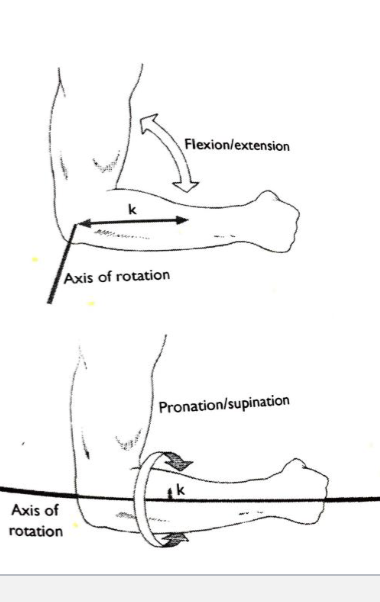
Angular momentum
-quantity of angular motion possessed by a body (or quantity of motion in an angular body)
-A change in angular momentum means a change in mass, radius of gyration (MOST INFLUENTIAL), and/or angular velocity
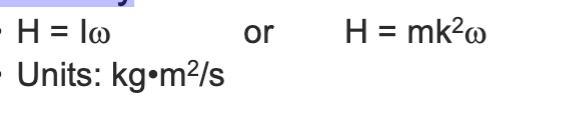
Conservation of Angular Momentum
-newtons 1st law (absence of other forces a body will just keep its angular momentum) only other thing is gravity as the only external force
-The momentum is established at the instantaneous takeoff (we just visually see trade offs between radius of gyration and angular velocity)
How does conservation look for airborne rotations?
-when entering tuck = radius of gyration decreases so angular velocity increases
-when extending to straight = radius of gyration increases, angular velocity decreases
BUT H (angular momentum) STAYS THE SAME
How is segmental rotation different that full body rotation?
-total body angular momentum is 0 (whole body not rotating)
-upper body is moving w high angular velocity and angular momentum and lower body produces equal opposite
Transfer of Angular Momentum
-Angular momentum remains constant, angular velocity can be transferred from one axis to another (ex; somersault to twisting)
Angular Impulse
change in angular momentum, product of torque and the time over which the torque is acting
-increase/decrease torque an/or time

Relationship between angular and linear quantities of momentum
inc angular momentum = inc in linear momentum (and vise versa)
Centripetal Force
-center seeking force
-force directed toward the center of rotation for a body in rotational motion
-centripetal force prevents object from leaving the circular path during rotation

