Exercise Physiology (Exam 1)
 Studied by 0 people
 Call with Kai
 Learn
Learn Practice Test
 Spaced Repetition
 Match
Match Flashcards
 Knowt Play
1/29

There's no tags or description
Looks like no tags are added yet.
Name | Mastery | Learn | Test | Matching | Spaced | Call with Kai |
|---|
No study sessions yet.
30 Terms
Chapter 3… (Neural Control of exercising muscle)
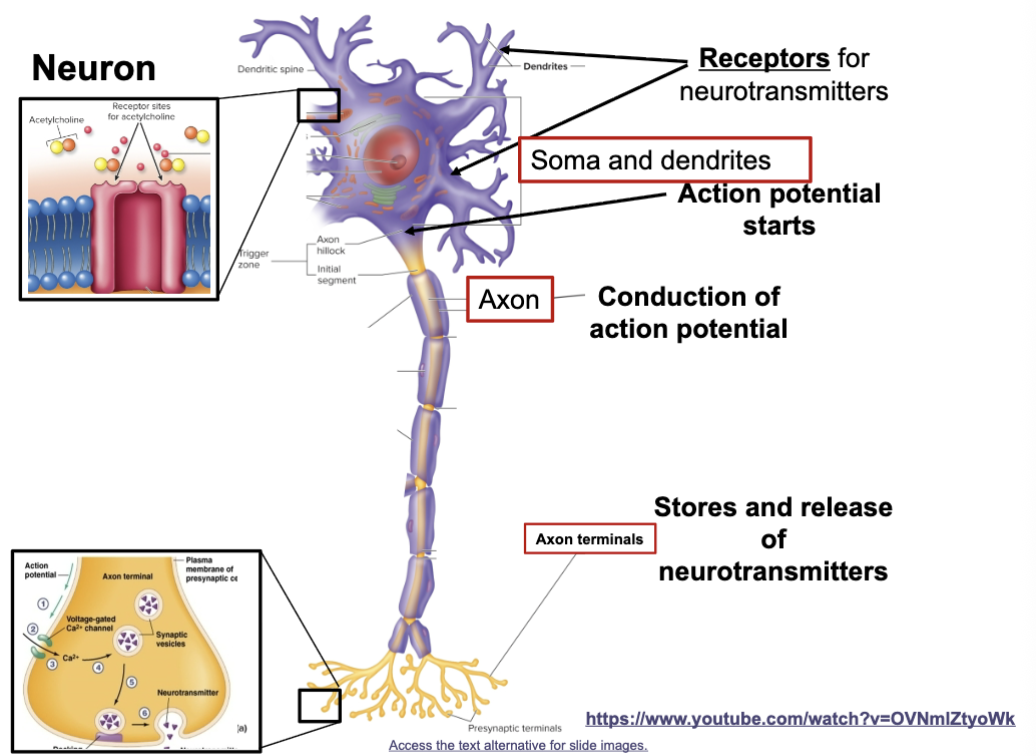
What is the structure and function of cell body?
Contains receptors for neurotransmitters
Receives impulses (have receptors)
What is the structure and function of dendrites?
Contains receptors for neurotransmitters
Receive impulses (have receptors)
What is the structure and function of the axon?
sends action potentials that starts at the axon hillock
has end branches (terminals) with neurotransmitters.
Anatomy of a neuron
What are the functions of the plasma membrane?
a boundary separating the cytoplasmic (intracellular) substances from the extracellular environment of the cells.
A main function to transport substances (ions, nutrients, gases) into and out of the cell.
it has receptors (proteins) for chemical substances (neurotransmitter and hormones)
what is the plasma membrane composed of?
fats
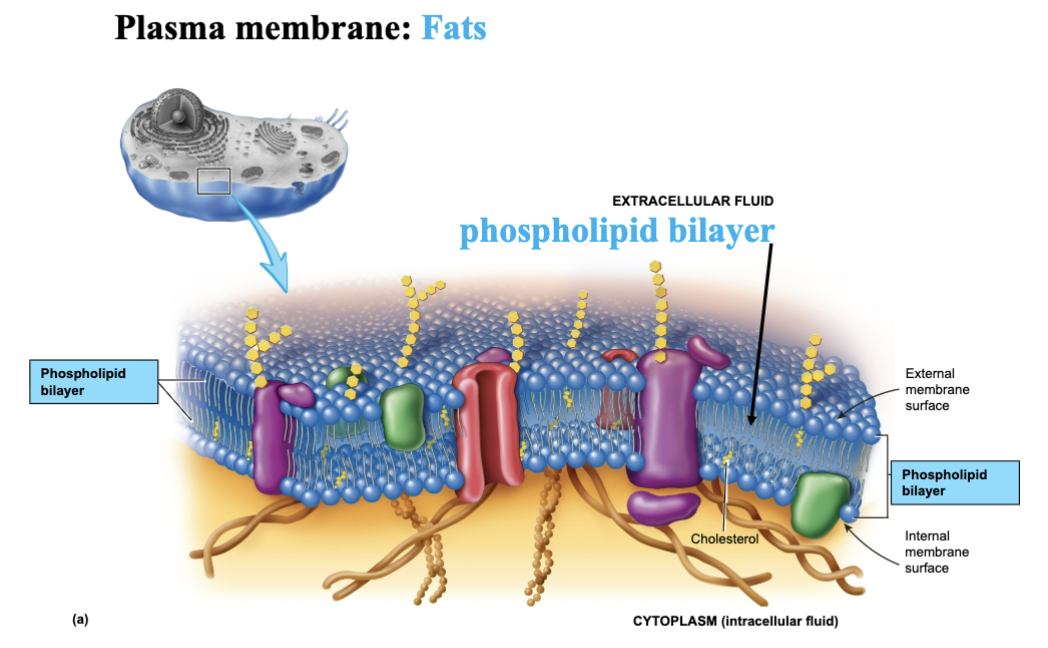
what does the lipid bilayer do?
moves lipid soluble molecules
Soluble = dissolve or mix in
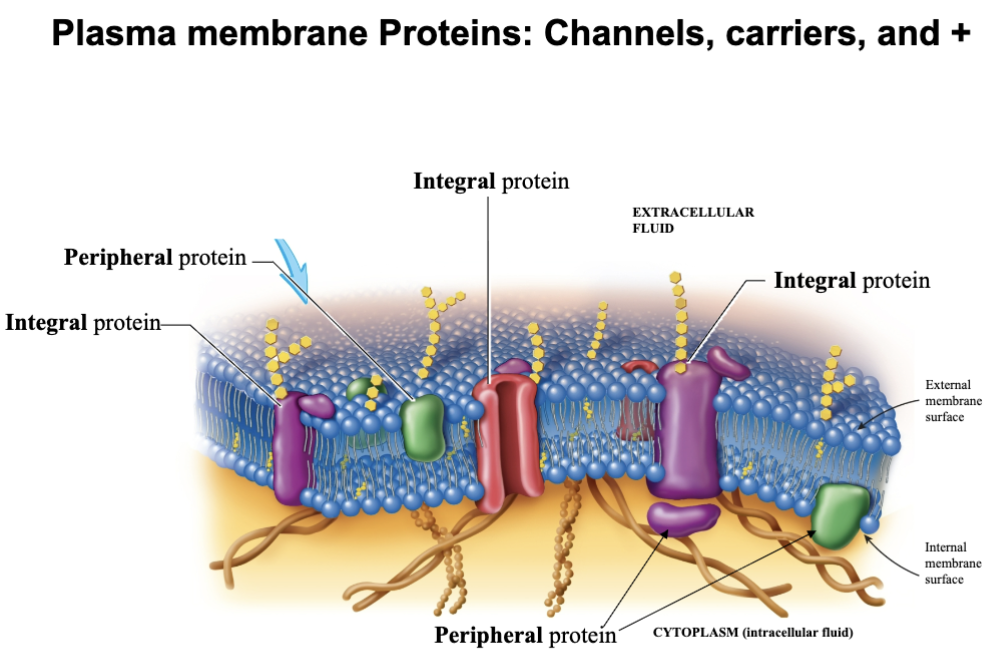
what are the different kinds of plasma membrane proteins?
peripheral
Integral
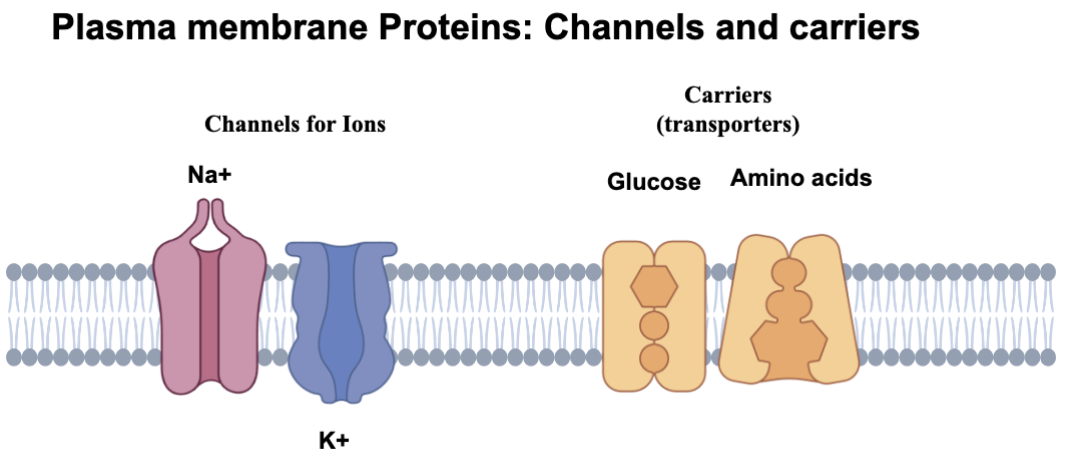
What is the difference between a channel and a carrier (transporter)
They both are proteins in the membrane AKA facilitators and helpers
Channels = Ions
Carriers (transporters) = Glucose + Amino Acids
What is resting membrane potential?
negative ions along inside of cell membrane + positive ions along outside
potential energy difference at rest is -70 mV
Resting potential exists:
concentration of ions different inside and outside
extracellular fluid high Na+ and low K+
intracellular fluid high K+ and low Na+
membrane permeability differs for Na+ and K+
What is open and closed at resting potential?
All voltage gated Na+ and most voltage gated K+ channels are closed
- 70mv
Movement through the plasma membrane – what can and cannot cross, and why?
The plasma membrane is selectively permeable, meaning it maintains homeostasis even though inside and outside compositions differ.
K⁺ is higher inside the cell (intracellular fluid), while Na⁺ is higher outside the cell (extracellular fluid).
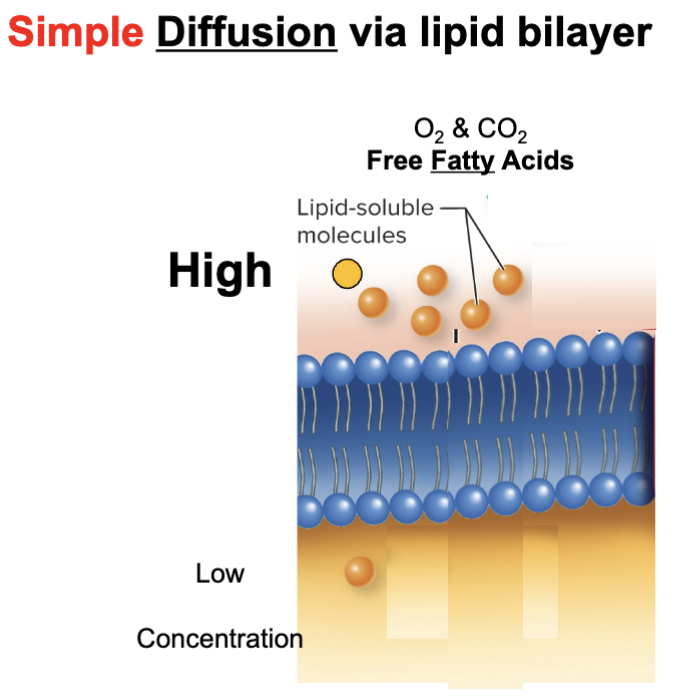
Lipid-soluble molecules (O₂, CO₂, fatty acids) diffuse directly through the lipid bilayer.
Large, non-lipid-soluble molecules (glucose, amino acids) and ions cannot diffuse freely and require transport proteins to cross the membrane.
What do both simple and facilitated diffusion rely on?
movement (diffusion) relies on using a concentration gradient
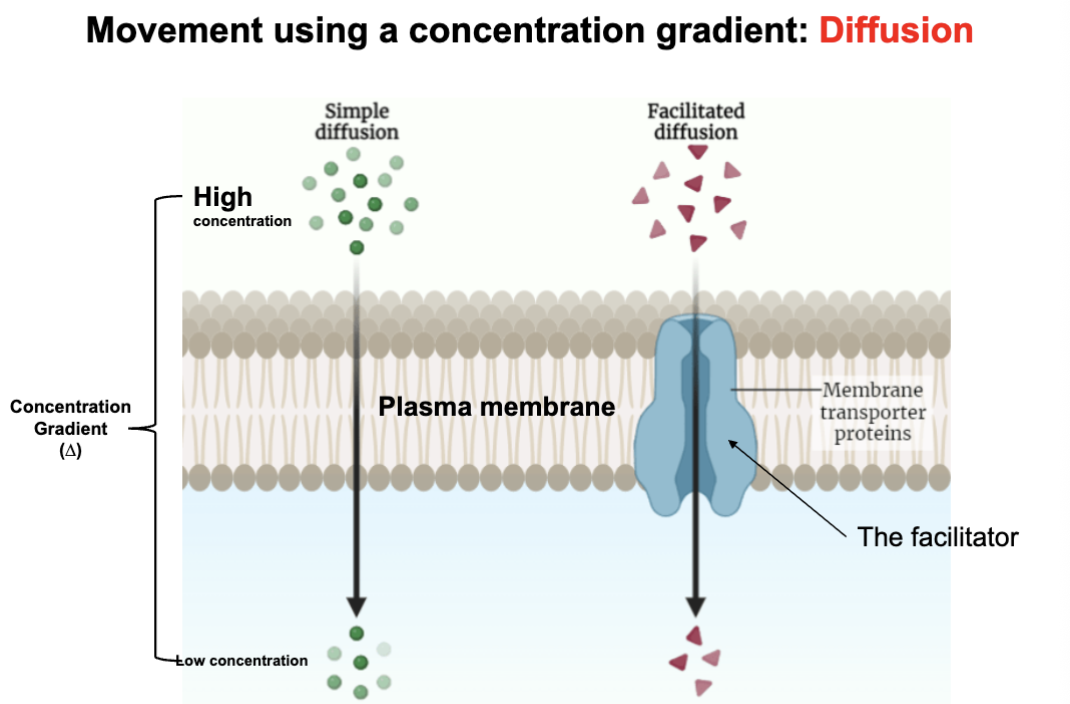
What is simple diffusion?
the passage of lipids (free fatty acids) through the plasma membrane
High to low concentration
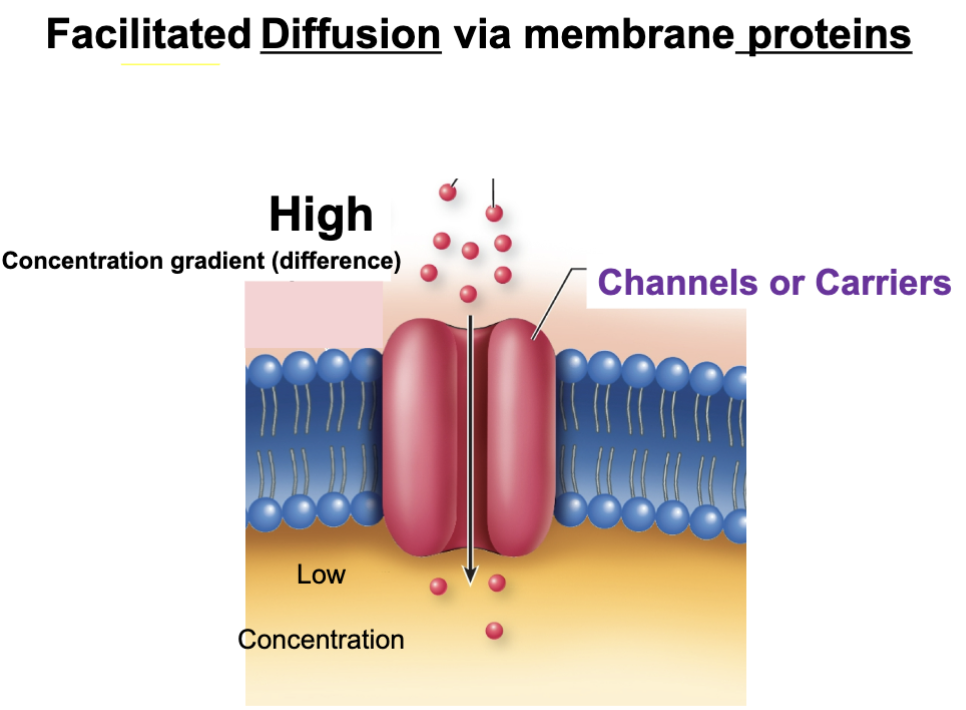
What is facilitated diffusion?
uses membrane proteins
goes from high to low concentration
uses channels or carriers (Facilitators or helpers)
facilitates movement of Ions + electrolytes
moves molecules or electrically charged molecules across the plasma membrane
What is important to remember for channels?
they are gated meaning the the neurotransmitter must bind to a receptor.
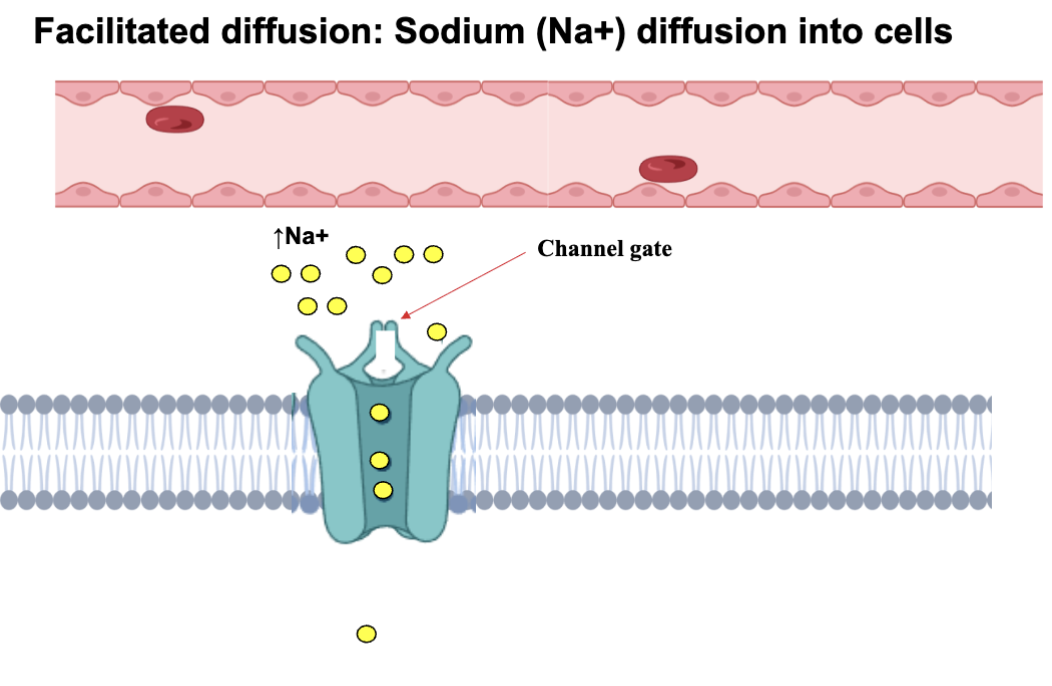
what are leak and gated ion channels?
Gated ion channels: opened or closed by certain stimuli
open in response to small molecules that bind to receptor proteins
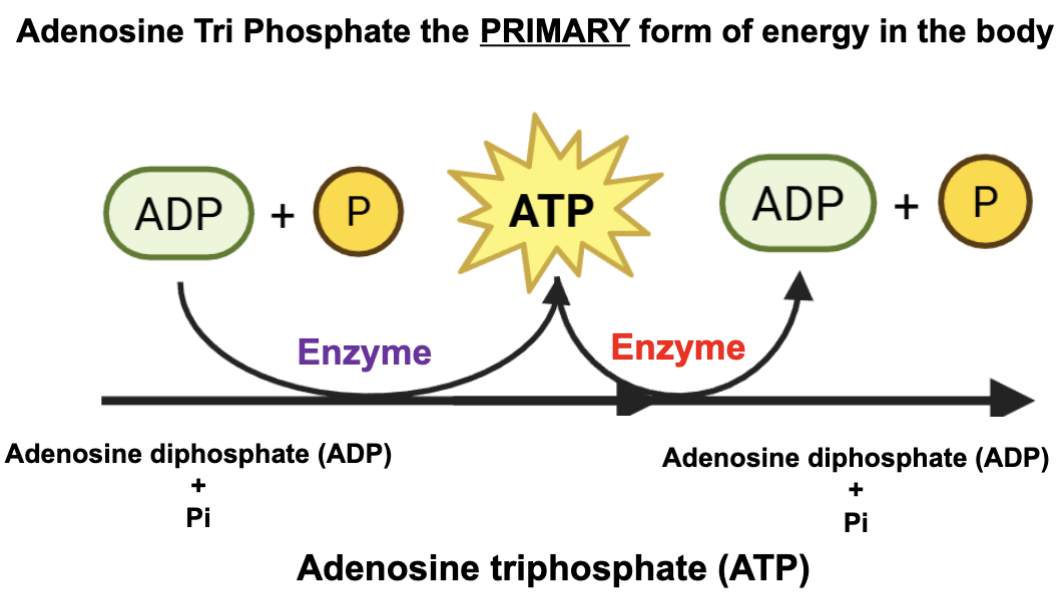
What is ATP
Adenosine Triphosphate = the primary form of energy in the body
ATPase cleaves one phosphate to create energy for the cell to use.
What kind of active transport are Action potentials?
Primary active transport
What is the purpose of ATP in action potentials?
ATP is not used during depolarization or repolarization.
ATP is used by the Na⁺/K⁺ ATPase to maintain ion gradients (3 Na⁺ out, 2 K⁺ in) after action potentials occur.
These gradients allow future action potentials to happen, but ATP does not directly cause an action potential.
Does Na⁺ concentration inside the cell ever become higher than outside during an action potential?
No.
Only a very small amount of Na⁺ enters during an action potential, so overall Na⁺ concentrations do not significantly change.
What gradients does the Na⁺/K⁺ pump work against?
Na⁺ pumped out: against both concentration and electrical gradients.
K⁺ pumped in: against the concentration gradient (with the electrical gradient).
How does Na⁺ interact with its concentration and electrical gradients during Na⁺/K⁺ pump activity?
Na⁺ concentration gradient: Na⁺ is high outside and low inside, so Na⁺ naturally wants to enter the cell.
Na⁺ electrical gradient: Na⁺ is positive and the inside of the cell is negative, so Na⁺ naturally wants to enter the cell.
Na⁺/K⁺ pump action: moves Na⁺ out of the cell.
Therefore, Na⁺ is pumped against both the concentration gradient and the electrical gradient.
How does K⁺ interact with its concentration and electrical gradients, and how does the Na⁺/K⁺ pump move K⁺?
K⁺ concentration gradient: K⁺ is high inside and low outside, so K⁺ naturally wants to leave the cell.
K⁺ electrical gradient: K⁺ is positive and the inside of the cell is negative, so K⁺ naturally wants to enter the cell.
Na⁺/K⁺ pump action: moves K⁺ into the cell.
Therefore, K⁺ is pumped against its concentration gradient but with its electrical gradient.
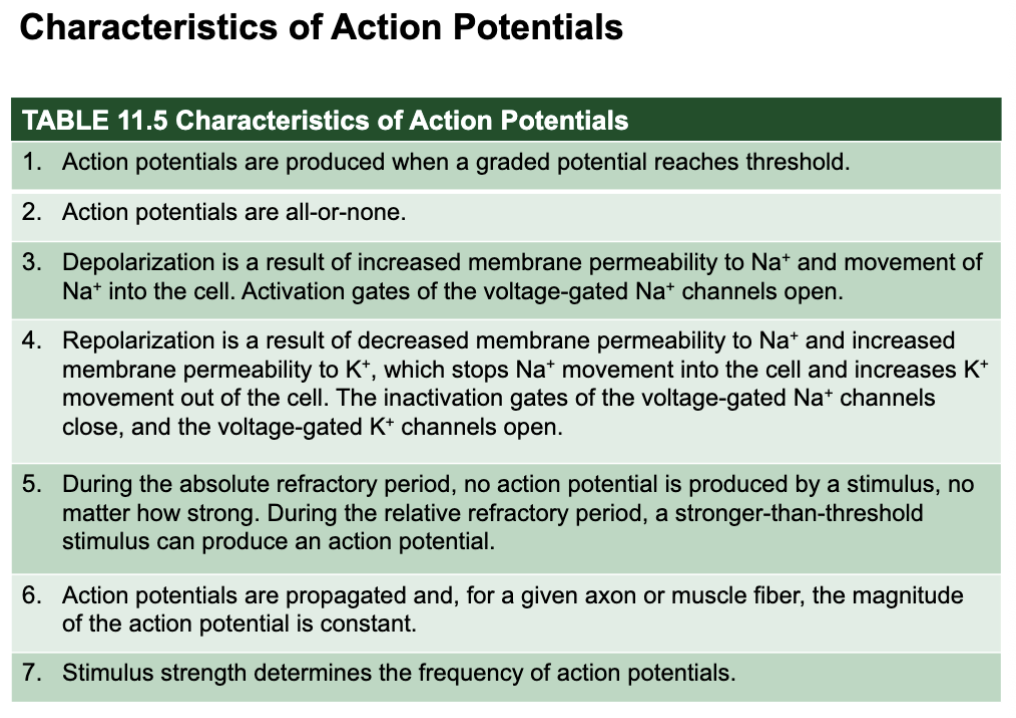
characteristics of Action Potentials
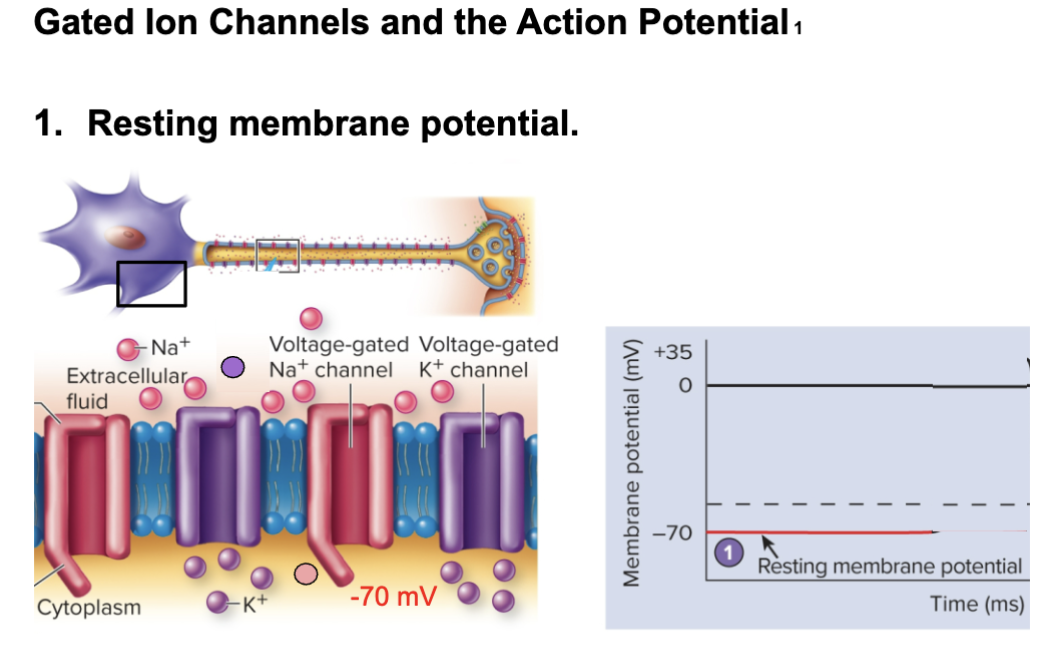
resting potential of Action Potential
Resting potential
-70mV
Na+ + K+ channels are closed
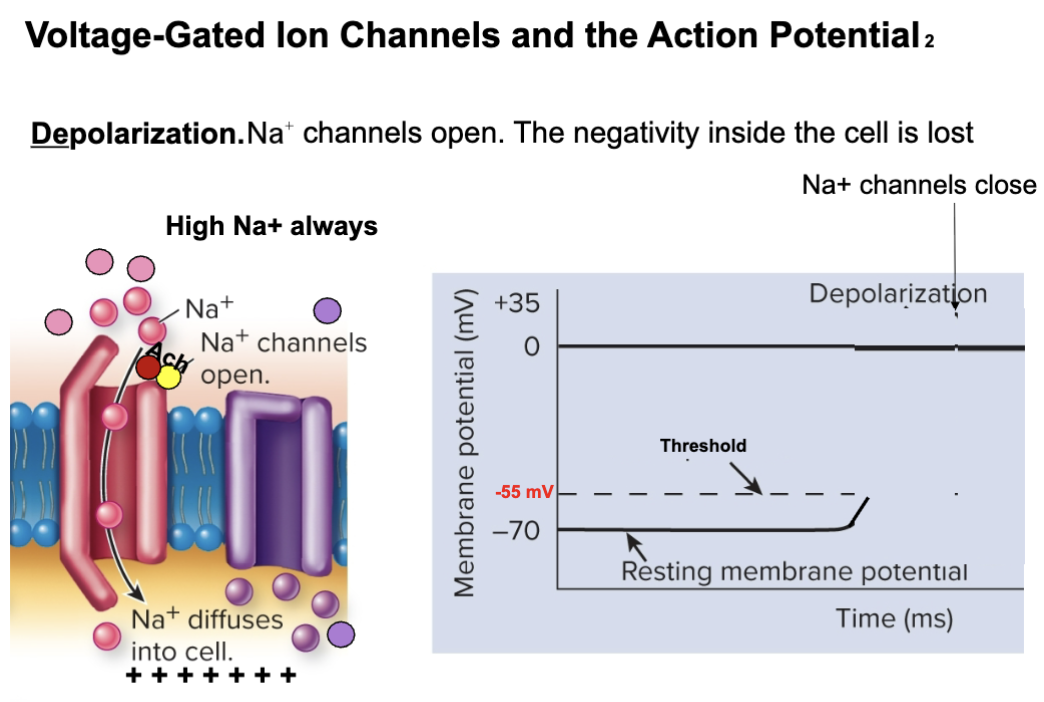
Phase 1 of action potential
Depolarization
acetylcholine binds to the receptor
channels open - the negativity inside the cell is lost
Na+ facilitate diffuses into the cell
Phase 2 of action potential
Na+ channels close
K+ channels open and facilitated diffuses out of the cell
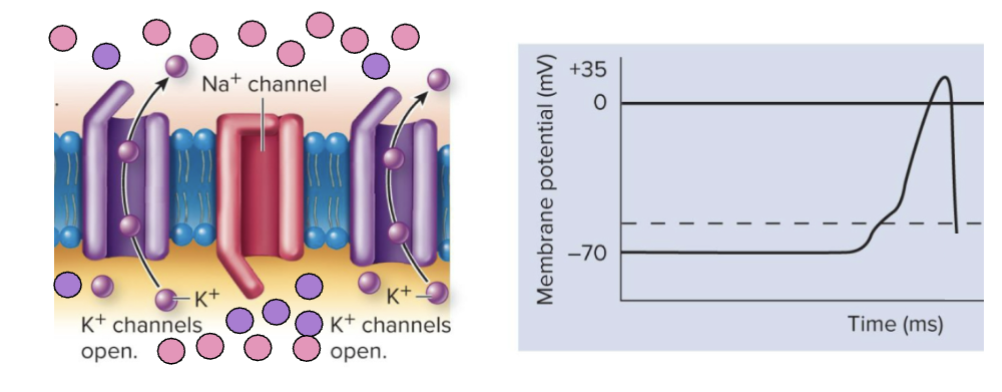
Phase 3 of action potential
returning to resting potential
hyper polarization occurs because the K+ channels take longer to close compared to the Na+ channels.
this is where primary active transport comes in so that the cell can return
the resting membrane potential is reestablished after the voltage gated ion channels close. the sodium potassium pump is used to reestablish the resting membrane potential.
 Note
Note  Flashcards (124)