Week 5 - cognitive dissonance attitudes
 Studied by 0 people
 Call with Kai
 Learn
Learn Practice Test
 Spaced Repetition
 Match
Match Flashcards
 Knowt Play
1/18

There's no tags or description
Looks like no tags are added yet.
Name | Mastery | Learn | Test | Matching | Spaced | Call with Kai |
|---|
No analytics yet
Send a link to your students to track their progress
19 Terms
The emergence of cognitive dissonance
“When prophecy fails” Festinger 1956
The seekers - doomsday cult. Belief that flood will end life on earth on 21st dec 1955. Few people saved by aliens.
Festinger saw this a test of cognitive dissonance theory - how people handle contradiction between belief and reality.
Prediction: when prophecy failed, member would experience severe psychological inconsistency and seek wats to reduce dissonance. They will look for a public display of justification and validation. They will double down on their beliefs.
Researcher Stanley Schachter infiltrated the group to observe events before and after the predicted flood.
Members were devastated when no flood occurred.
They used repetitive explanations to try to excuse their incorrect belief. e.g. clocks set wrong. Metal couldn’t be in the room etc.
They then believed that the group’s faith and goodness saved the earth from destruction. 4 am, leader claims them sitting all night showed the god of the universe spared the earth
After disconfirmation: they actively sought public validation - contacted media, printed flyers, appears on radio. Festinger’s prediction confirmed: when beliefs are disconfirmed, people often double down to regain internal consistency.
Confirmation bias
people tend to select sources of information that a re consistence with their worldview. People avoid conflicting news sources to manage discomfort.
Dealing with dissonance:
Once dissonance is aroused it creates tension that must be reduced. The greater the dissonance the higher the motivation to reduce it.
Methods of reducing:
Change behaviour to match attitude: change attitude to match behaviour: justify by adding or changing coginitions (e.g. rude to a friend so reasoned with they were rude first).
Changing attitudes - Brehm 1956: 1st experimental tests of the theory
Posited that choosing between multiple desirable options evokes dissonance because they typically require compromise and the rejection of positive features.
Closer preferences - harder decisions - more dissonance
e.g. which phone to choose. One has better gadgets but is more expensive, one is more practice but is lower quality.
Brehm 1956 - results on what ppts did to reduce dissonance
1. Changing attitudes about chosen option (its worth the investment)
2. Downplays positives of rejection option (its plain and underpowered)
3. Adds new cognitions (this will attract friends)
Results in ‘spreading of alternatives’: increased liking of chosen options, decreases liking of rejected option.
Experiment - Brehm 1956
Ppts: sophomore students from Minneapolis area
Task: rank 7 household items e.. blender, toaster
Rate each item desirability
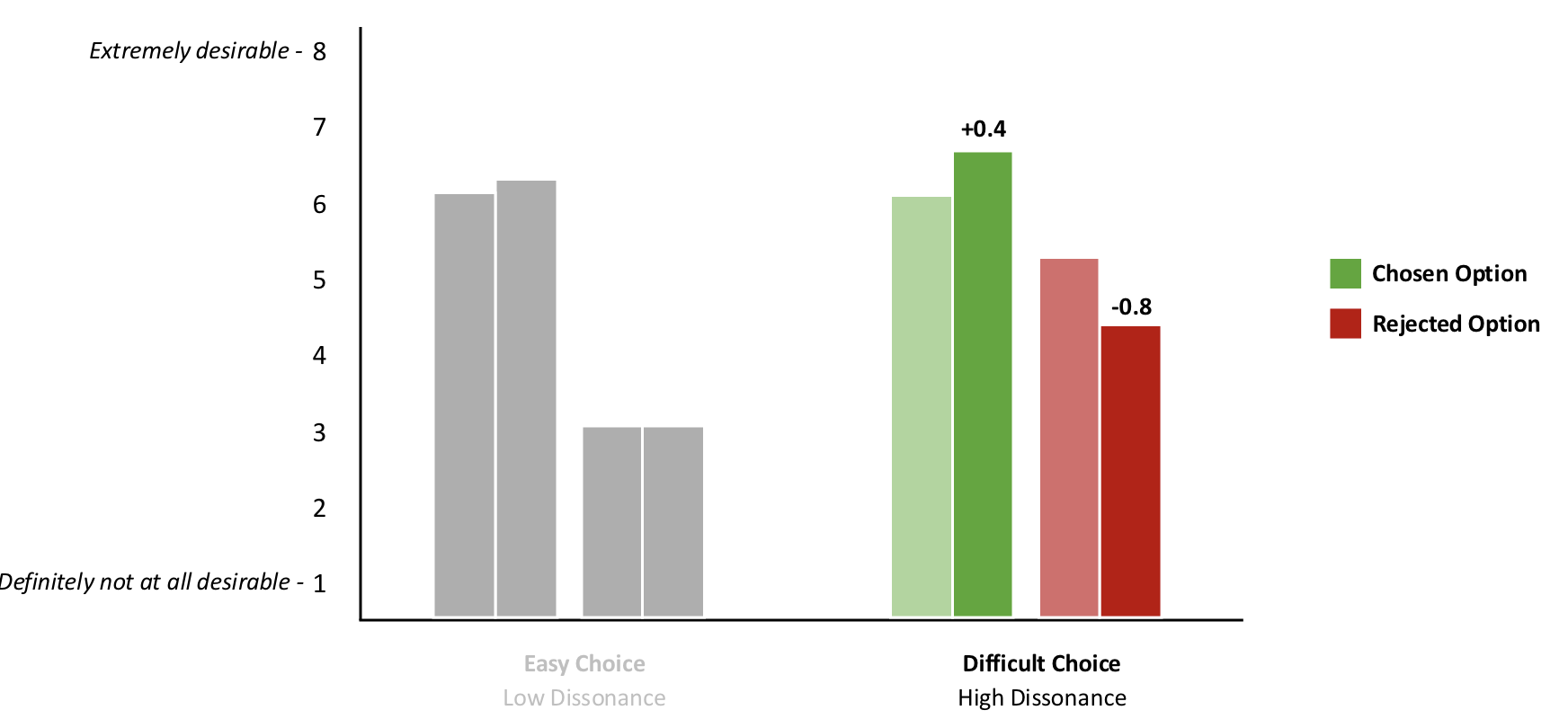
Choose one item to keep as a gift; difficult choice: out of the 2nd most and 3rd most preference (both liked). Or easy choice; between 2nd and 7th ranked items.
Found easy choice given: ranking after choosing which to take home stays similar.
After difficult choice: the one chosen increases in liking/ ranking. Rejected one decreases liking/ ranking.
Brehm 1956 - results
Replicated in chimps:
Choice between 2 sweets. First chooses one out of 2 options. Then new option given against rejected option. 60% more likely to choose new option as decided something is wrong with rejected option as it wasn’t chooses.
Replicated with attraction:
Type | Amount | Example Responses |
Confabulations | 72% | She's radiant. I would rather have approached her at a bar than the other one. I like earrings! She looks like an aunt of mine I think, and she seems nicer than the other one. Yes, well, [laughter] she looks very hot in this picture. Just a nice shape of the face, and the chin. I thought she had more personality, in a way. She was the most appealing to me. |
Uncertainty | 12% | Eh... I don't know. I’m not sure. [laughter] I can’t seem to remember. |
![<table style="min-width: 75px;"><colgroup><col style="min-width: 25px;"><col style="min-width: 25px;"><col style="min-width: 25px;"></colgroup><tbody><tr><td colspan="1" rowspan="1"><p class="p1"><strong>Type</strong></p></td><td colspan="1" rowspan="1"><p class="p1"><strong>Amount</strong></p></td><td colspan="1" rowspan="1"><p class="p1"><strong>Example Responses</strong></p></td></tr><tr><td colspan="1" rowspan="1"><p class="p1"><strong>Confabulations</strong></p></td><td colspan="1" rowspan="1"><p class="p1">72%</p></td><td colspan="1" rowspan="1"><p class="p1"><em>She's radiant. I would rather have approached her at a bar than the other one. I like earrings!</em></p><p class="p1"><em>She looks like an aunt of mine I think, and she seems nicer than the other one.</em></p><p class="p1"><em>Yes, well, [laughter] she looks very hot in this picture.</em></p><p class="p1"><em>Just a nice shape of the face, and the chin.</em></p><p class="p1"><em>I thought she had more personality, in a way. She was the most appealing to me.</em></p></td></tr><tr><td colspan="1" rowspan="1"><p class="p1"><strong>Uncertainty</strong></p></td><td colspan="1" rowspan="1"><p class="p1">12%</p></td><td colspan="1" rowspan="1"><p class="p1"><em>Eh... I don't know.</em></p><p class="p1"><em>I’m not sure.</em></p><p class="p1"><em>[laughter] I can’t seem to remember.</em></p></td></tr></tbody></table><p></p>](https://knowt-user-attachments.s3.amazonaws.com/a2f65be7-12ea-4665-9dd5-0c0eaf2e58a5.jpg)
Festinger and Carlsmtih 1958: Changing attitudes
Task - extremely boring pegboard sorting task
Designed to create negative attitudes
Procedure: ppts told they might act as a confederate to convince other student the task was fun. Most agreed and publicly states the task was fun.
Goal: reate counter-attitudinal behaviour (saying task is fun when it was actually boring)
Ppts paid either $1 or $20.
$20 condition: large external justification -> less dissonance -> smaller attitude change.
$1 condition: small external justification -> more dissonance -> greater attitude change.
Later questionnaire: how enjoyable was this task: those paid $1 said it was more enjoyable to those paid $20 due to attitude change from cognitive dissonance.
Experiment 2: Brehm ad Cohen 1962.
Festinger and carlsmith 1959 created novel attitudes in the lab.
More relevant to everday life.
Got ppts to write statement of harsh opinions on new haven police
Had people write essays supporting or condemning police
Small incentive (1$) -> greater attitude change
Large incentive (20$) -> smaller attitude change
dissonance in effortful voluntary activities
Effort and punishment are undesirable. Traditional expectation: suffering and effort = disliking
Cognitive dissonance: suffering and effort = liking.
Freely choosing to engage in an effortful or painful activity which of no value -> dissonance. To reduce dissonance, raise evaluation of the activity.
Aronson and Mills 1959 - experiment 3
Ppts: female uni students at Minnesota uni
Activity: join a psychology of sexuality discussion group
Initiation conditions: high embarrassment: read aloud sexually explicit words
Low embarrassment: read aloud mild words like love and petting
Group discussion: listen to boring tape recorded conversation.
Rate their liking of the discussion and their group members.
Cognitive dissonance; rating of liking higher as needs to make embarrassment worth while
Traditional: rate liking higher as no uncomfort.
Findings: consistent with cognitive dissonance:
Those who went through embarrassment said they enjoyed task more than those who had no embarrassment. Reduces dissonance as attitudes have to change to make the event more worthwhile.
Experiment 4: Norton et al 2012
Ikea effect: people value self-made products more than equivalent pre assembled items
Mechanism: dissonance between effort and value
I worked hard on this therefore this has value and was worth while.
Norton et al - ppts assembled IKEA boxes, origami or lego structures.
Participants valued their own creations more than identical creations made by others.
Everyday examples
Therapy: free therapy can reduce effectiveness.
Rewarding children for creative endeavours can devalue them.
Rewarding or punishment doesn’t always result in simple and expected outcomes.
when is dissonance most powerful
Dissonance is most powerful and upsetting when people behave in ways that threaten their self-esteem (Aronson, 1969)
Dissonance of self:
Average rating of a skill is always higher than the scale middle. e.g. rate yourself from 1 - 10. Average is 6
People are strategic about how they resolve dissonance. More often than not in the direction of self-enhancement. Many dissonance-related effects are reduced if people are given the change to increase self esteem. Steele 1988.
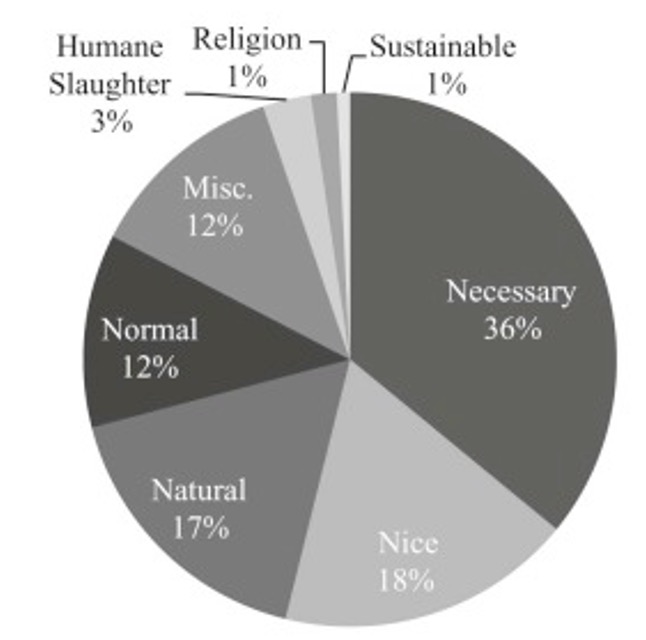
Reasonings given to justify dissonance:
 Note
Note  Flashcards (102)