Models of Memory
 Studied by 0 people
 Call Kai
 Learn
Learn Practice Test
 Spaced Repetition
 Match
Match Flashcards
 Knowt Play
1/27

There's no tags or description
Looks like no tags are added yet.
Name | Mastery | Learn | Test | Matching | Spaced |
|---|
No study sessions yet.
28 Terms
Atkinson & Shiffrin’s (1968) multi‐store model of memory.
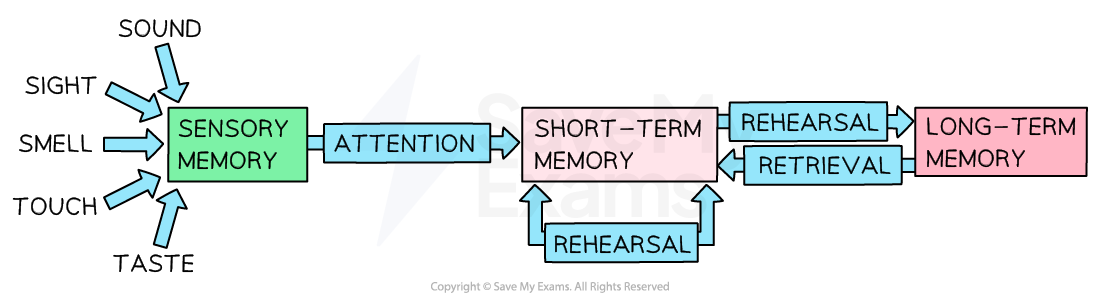
capacity
Sensory Register- unknown but large
STM- Limited (7+/-2 'chunks' of information)
LTM- Unlimited
duration
Sensory Register- Limited (approx. 250 MS)
STM- Limited (20 seconds)
LTM- Lifetime
coding
Sensory Register- Raw/unprocessed information from all 5 senses
STM- Acoustic (sound)
LTM- Semantic (meaning)
Miller 1956
Miller's work: he reviewed literature of published investigations into perception and STM from the 1930s and 1950s. This existing research suggested that organising stimulus input into a series of chunks enabled the STM to cope with about 7 chunks and this was why more than seven digits, words or even musical notes could be remembered successfully. When remembering information with more digits we group the information into larger chunks to break it up.
He concluded that encoding can extend the capacity of the STM and enable more information to be stored there
evaluation of Miller
Support: Jacobs (1887) conducted an experiment using a digit scan test to examine the capacity of STM for numbers and letters. He used a sample of 443 females (aged 8-19) from the North London Collegiate School. Participants had to repeat back a string of numbers or letters in the same order and the number of digits was gradually increased , until the participants could no longer recall the sequence. He found that students had an average span of 7.3 letters and 9.3 words, which supports Miller's notion of 7+/-2
Conflicting: although his theory is supported by psychological research, he did not specify how large each 'chunk' of information could be and therefore we are unable to conclude the exact capacity of the STM. Further research is required to determine the size of information 'chunks' to understand the exact capacity.
Conflicting: his research does not take into account other factors that affect capacity. For example Jacobs (1887) study showed that STM gradually improved with age.
Peterson & Peterson (1959)
Experiment: They investigated how different short intervals containing an interference task affect the recall of items presented verbally, and to infer the duration of STM. The participants were 24 male and female university students. The verbal items tested for recall were 48 three-consonant nonsense syllables (PYG), these are known as trigrams, spelled out letter by letter as well as three digit numbers. The researcher spelled the syllables out then immediately said a three-digit number. The participant had to countdown in either 3s or 4s from that number . This was to prevent repititon of the trigram by the participant. At the end of the preset interval of between 3-18 seconds a red light went on and the participant has to recall the trigram.
They found that the longer the interval, the less accurate the recall. At 3 seconds there was 80% accuracy whereas at 18 seconds there was only 10%.
Therefore they concluded that STM has a limited duration of around 18 seconds and if we are unable to rehearse information it cannot be passes to the LTM, providing further support for the MSM.
evaluation of Peterson and Peterson
Evaluation:
Conflicting: his sample of 24 psychology students is problematic as they may have come across the MSM previously and therefore showed demand characteristics. Additionally the memory of the students may be different from that of other people, especially if they has previously studied strategies for memory improvement. Therefore we are unable to generalise the results of this study to non- psychology students.
Conflicting: it could be argued that the study has low levels of ecological validity. Memorisation of trigrams lakes mundane realism. We are therefore unable to apply these results to every day examples of memory and unable to conclude if the duration of STM may be longer for more important information such as a phone number.
Support: the study was highly controlled and took place in a laboratory of Indiana University. As a result they had a high degree of control over extraneous variables which increases the reliability of the study.
Bahrick (1975)
Experiment: to investigate the duration of LTM he used 392 American university graduates were shown photographs from their high school yearbook and for each photograph participants were given a group of names and asked to select the name that matched the photograph.
90% of the participants were unable to correctly match the names and faces 14 years after graduating and 60% of the participants were able to correctly match the names and faces 47 years after graduation.
He concluded that people could remember certain types of information, such as names and faces, for almost a lifetime. These results support the MSM and the idea that our LTM has a lifetime duration (at least 47 years) and is semantically encoded.
support for the MSM (Clive wearing)
contracted a virus that caused severe amnesia. Following the virus he could only remember information for 20-30 seconds but he could recall information from his past. He was unable to transfer information from STM to LTM but could retrieve successfully. His case supports the idea that memories are formed by passing information from one store to the next in a linear fashion and that damage any part of the MSM can cause memory impairment.
support for the MSM (Miller 1956)
supports the idea of a limited capacity of 7+/-2 chunks of information in the STM
support for the MSM (Peterson and Peterson)
supports the idea of a limited duration in STM of approximately 20 seconds
support for the MSM (Barrick)
supports the idea of a lifetime in LTM
conflicting for the MSM (Baddeley and Hitch 1974 )
developed the working memory model as an explanation of the complexity of STM and a way of explaining some of the research findings that could not be accounted for by the MSM, for example parallel processing.
support for the MSM
evidence from brain scans has shown that different areas of the brain are active when performing STM tasks (hippocampus and subiculum) and LTM tasks (motor cortex). The hippocampus is also involved in transferring short-term memories into long term memories which suggests that different brain regions are responsible for the different components of the MSM, supporting the idea that our memory is made up of discrete stores.
working memory model
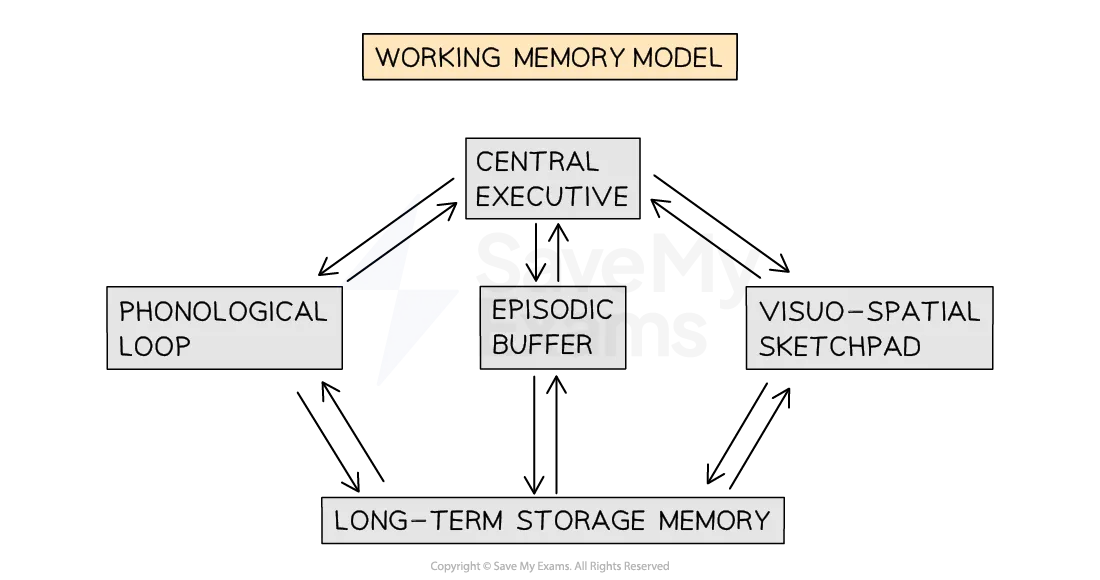
WMM
The WMM focuses on short-term memory and consists of a multicomponent system, which consists of a central executive, phonological loop and visuo-spatial sketchpad.
central executive
the 'boss' of the WMM. It controls attention and directs information to the two slave systems. It can process information from any sensory modality.
the phonological loop
temporary storage system for verbal and spatial information (held in speech based form) which has two components, the articulatory control process (the 'inner voice') and the phonological store (the 'inner ear'). The articulatory control process allows for subvocal repetition of acoustic information and the phonological store is a temporary storage space for coding acoustic information, which has a limited capacity.
the Visuo-spatial sketchpad
temporary storage system for visual and spatial information which also has two components, the inner scribe and the visual cache. The inner scribe deals with the manipulation of mental images and the visual cache has a limited capacity for coding visual and spatial information
the episodic buffer
binds and integrates information from all of the components and passes the information to the long-term memory. It therefore codes both visual and acoustic information, but also has a limited capacity.
functions
central executive- Control centre of the WMM, supervisory functions and controls the slave systems
phonological loop-Temporary storage system for verbal information, held in speech based form.
visa-spatial sketchpad- Temporary storage system for visual and spatial information.
capacity
central executive- limited
phonological loop-limited
visuospatial sketchpad-limited
coding
central executive- Any sensory modality
phonological loop-Acoustic
visuospatial sketchpad-Visual and spatial
support for the WMM : (patient KF)
injured in a motorcycle accident and afterwards was able to recall stored information from his LTM but had issues with his STM. He was able to remember visual images, including faces, but was unable to remember acoustic information. This suggests that there are at least two components within the STM (one for visual and one for acoustic) this therefore supports the idea of the two slave systems.
Support for the WMM: (Duel task studies by Baddeley and Hitch 1976)-
duel task studies require participants to complete two tasks at the same time. in one condition, participants may be required to complete two acoustic based tasks, in another one acoustic and one visual task. When both tasks require the participants to use their phonological loop, their ability is impaired. This therfore is evidence of the existence of multiple components in the STM.
Conflicting WMM :( Focus on STM
the link between the WMM and the LTM is not fully explained. The WMM no description on how information Is processed and transferred from the STM to Ltm and back again. It is an incomplete model of memory and other models are required to gain a complete picture of this complex cognitive Phenonomen
evaluate the WMM
Experimental reductionism: it attempts to examine complex behaviour by relying on isolated variables operationalised in laboratory experiments.
Nomothetic approach: it attempts to generate universal laws regarding how the STM processes information, based on duel-task studies conducted under laboratory conditions.
 Note
Note  Flashcards (34)