BIOL LAB Practical Exam #2 Review
 Call Kai
 Learn
Learn Practice Test
 Spaced Repetition
 Match
Match Flashcards
 Knowt Play
1/44

There's no tags or description
Looks like no tags are added yet.
Name | Mastery | Learn | Test | Matching | Spaced | Call with Kai |
|---|
No analytics yet
Send a link to your students to track their progress
45 Terms
The purpose of cellular respiration is to produce _____________.
ATP energy
Aerobic Respiration is unique in that it requires the presence of ___________.
Oxygen
Glycolysis
Glucose is oxidized (broken down) into two pyruvate molecules
Krebs cycle
CO2 is a by-product of this step, while also electrons are being removed to carry off to the last stage.
Electron Transport Chain
Electrons received from the previous steps will be used to generate large amounts of ATP; water is also produced here as a by-product.
________ is a molecule in which the cell can store readily available energy that can be used by the cell as needed.
ATP
True or False:
Some organisms can still produce ATP energy even if oxygen levels are low.
True
_____ are segments of DNA that contain the code to make proteins.
Genes
The physical and/or behavioral features of an organism is called the _______
Phenotype
How many total chromosomes do human diploid cells have?
46
What cellular process produces gametes (i.e. sperm/egg cells) in humans?
Meiosis
The term allelic interaction applies to/focuses on individuals with which genotype?
Heterozygous
By the end of mitosis, how many daughter cells should there be?
2
Which phase of mitosis does the cytoplasm (i.e. the fluid of the cell) divide?
Cytokinesis
Which phase of mitosis do the chromosomes align down the middle of the cell?
Metaphase
What phase does the DNA become replicated?
Interphase
Which of the following terms is used to imply the two replicated/identical DNA strands, that remain attached to one another through several steps of mitosis?
Sister chromatids
Aerobic Respiration
Where do your cells get oxygen from?
Utilizes oxygen to break down sugars and other organic molecules.
From the environment in a biochemical pathway called Cellular Respiration
What is the “goal” of cellular respiration?
To take chemical energy found in food and transform it to a ‘useable’ form of energy that are cells can use called ATP.
What organisms undergo cellular respiration?
ALL living things
Overall reaction of aerobic cellular respiration:
C6H12O6 + O2 —> CO2 + H2O + ATP
C6H12O6 + O2 —> CO2 + H2O + ATP
What are the reactants and products?
Reactants: Glucose (C6H12O6) and Oxygen (O2)
Products: Carbon Dioxide (CO2), Water (H2O), and Adenosine Triphosphate (ATP)
Aerobic Respiration Steps:
Where do they occur and how many ATP are produced?
Glycolysis; occurs in cytosol; NO oxygen; 2 Pyruvate, 2 NADPH, Net 2 ATP
Pyruvate Oxidation; occurs in mitochondria; produces Co2, 2 NADH, 2 Acetyl CoA.
2. Citric Acid Cycle; 6 NADH and 2 FADH2 (from 2 Acetyl CoA); Net 2 ATP
Oxidative Phosphorylation (Electron Transport Chain); occurs in mitochondria; produces 28 ATP
What do your cells do with Co2?
Release into bloodstream
What is the job of NADH and FADH2?
Electron carriers that pick up electrons and deliver them to the Electron Transport Chain during last step of cellular respiration
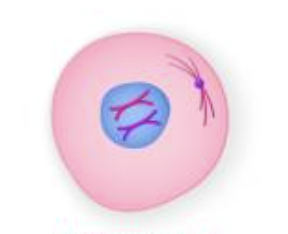
What phase is this cell in?
Interphase
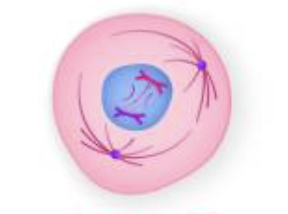
What phase is this cell in?
Prophase
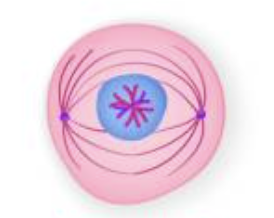
What phase is this cell in?
Metaphase
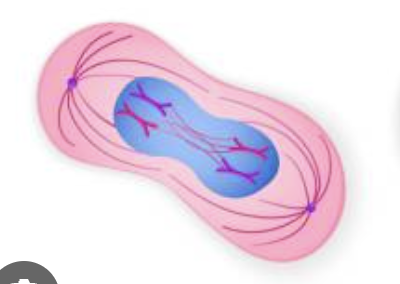
What phase is this cell in?
Anaphase
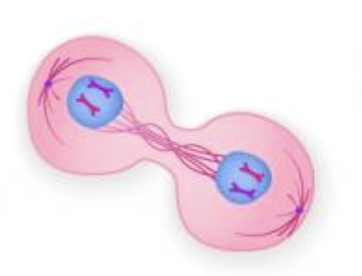
What phase is this cell in?
Telophase
Do animal cells form a cell plate? Why?
No, they lack a cell plate
What is the difference between mitosis and cytokinesis?
Mitosis - cell prepares itself and the DNA to divide
Cytokinesis - cell is completely divided into 2
What is the difference between chromatin and chromosomes?
Chromatin - loosely coiled DNA (will look “spotty” under the microscope)
Chromosomes - tightly coiled DNA (will looked more like “noodles” under the microscope)
Why do organisms use cell reproduction, specifically mitosis?
Helps organisms grow in size and repair damaged tissue
Gametes
Sperm (male) or egg (female)
Chromosome
Made up of long strands of nucleic acid called DNA.
Gene
Segments of DNA that contain the information to make proteins.
Allele
Variants of the same gene that result in specific traits.
Difference between character and trait?
Character - refers to a heritable feature or observable characteristic of an organism
Trait - specific variation of that character
Genotype
An organism’s genetic makeup (all their genes/combinations of alleles).
Phenotype
Physical, physiological, and behavioral features that result from the genotype.
Homozygous
4/4 B
Same versions of a genomic marker from each biological parent.
Heterozygous
2/4 B, 2/4 b
2 different versions of a particular gene, one inherited from each parent.
What cells are haploid?
Gametes
Allelic Interaction
The “interaction” that occurs between two alleles in a given genotype, that will determine how the phenotype is expressed.

