👍 Positive Welfare + Emotions + 5 Domains
 Call Kai
 Learn
Learn Practice Test
 Spaced Repetition
 Match
Match Flashcards
 Knowt Play
1/14

There's no tags or description
Looks like no tags are added yet.
Name | Mastery | Learn | Test | Matching | Spaced | Call with Kai |
|---|
No analytics yet
Send a link to your students to track their progress
15 Terms
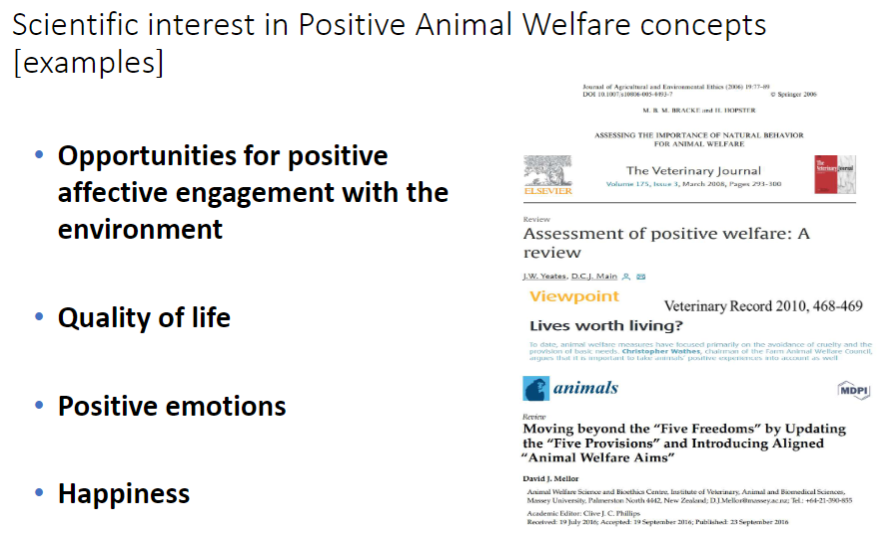
Positive Animal Welfare – Scientific Interest
Opportunities for positive affective engagement
Animals interacting with their environment in ways that generate positive experiences
Quality of Life
Overall balance of positive and negative experiences
Positive Emotions
Examples include pleasure, contentment, curiosity, social bonding
Happiness
Focus on an animal’s well-being and positive affective states
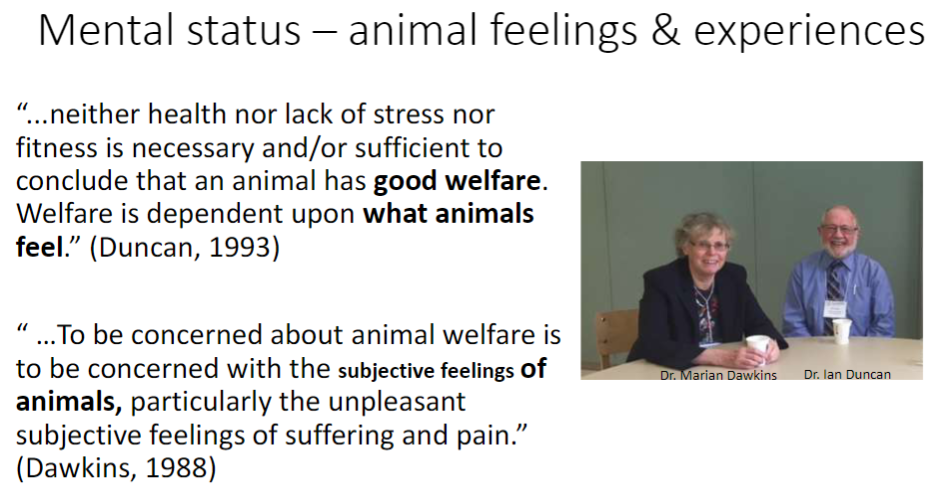
Animal Mental Status – Feelings & Experiences
Welfare not solely physical
Health, stress levels, and fitness alone are not enough to determine good welfare
Subjective experience matters
Welfare depends on what animals feel
Focus on unpleasant feelings
Particularly suffering and pain are key concerns in assessing welfare
Key Researchers
Dr. Ian Duncan – emphasizes feelings over just physical state
Dr. Marian Dawkins – emphasizes unpleasant subjective experiences
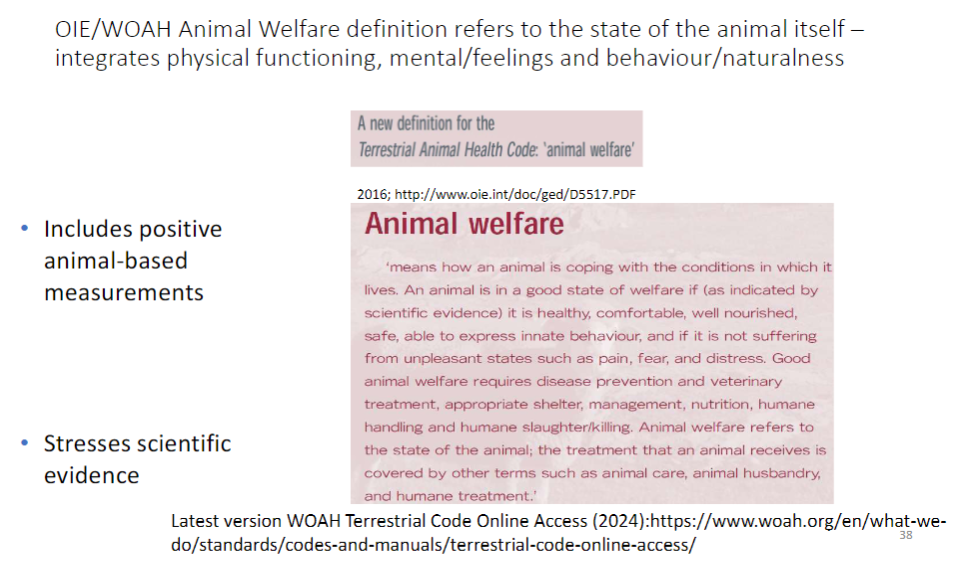
OIE/WOAH Animal Welfare Definition
Definition
Refers to the state of the animal itself
Integrated components
Physical functioning – health, growth, reproduction
Mental/feelings – emotions, suffering, pleasure
Behaviour/naturalness – ability to express normal behaviour
Positive measurements
Includes positive animal-based indicators of welfare
Scientific emphasis
Stresses use of scientific evidence to assess welfare
Capacity for Affective/Positive Emotions in Animals
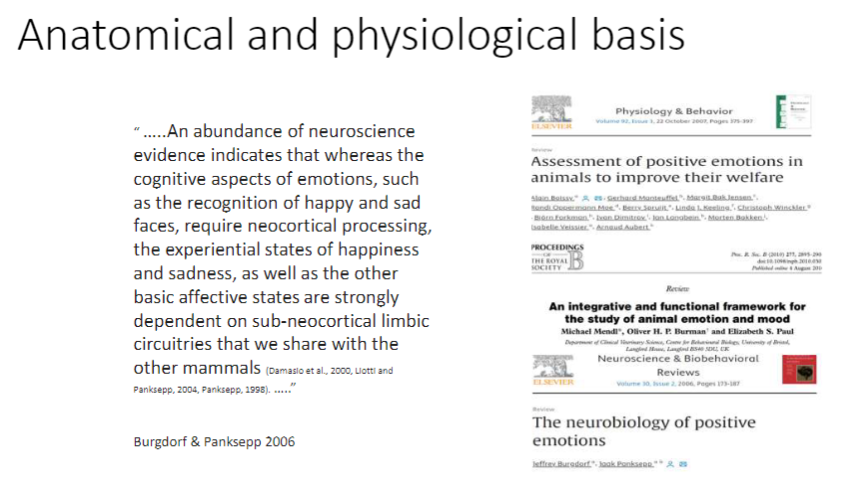
Anatomical & Physiological Basis
Neuroscience evidence shows:
Cognitive aspects of emotions (e.g., recognizing happy/sad faces) require neocortical processing
Experiential states of happiness, sadness, and other basic affective states depend on sub-neocortical limbic circuits
Shared with mammals
These limbic circuits are common across mammals, supporting the idea that animals can experience emotions
Animal Welfare In Legislation
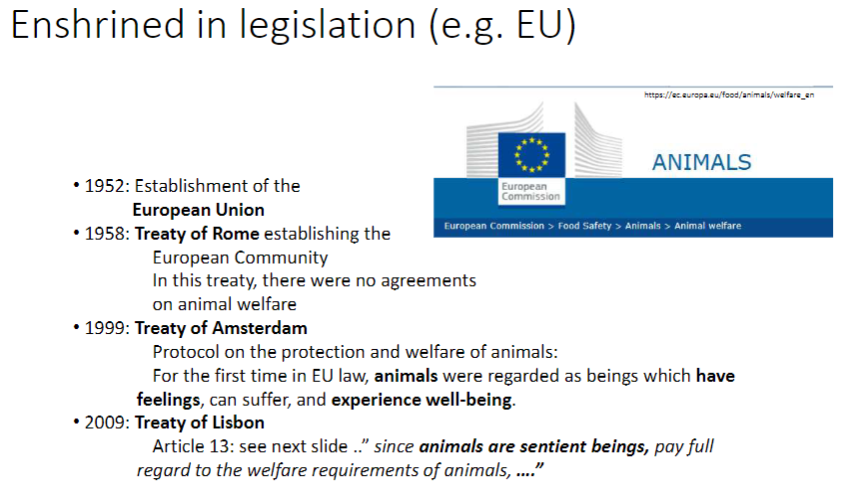
European Union Milestones
1952 Establishment Of The European Union
No specific animal welfare agreements
1958 Treaty Of Rome
Established European Community
No agreements on animal welfare
1999 Treaty Of Amsterdam
Introduced Protocol on Protection and Welfare of Animals
Recognized animals as sentient beings that can feel, suffer, and experience well-being
2009 Treaty Of Lisbon
Article 13 emphasizes animals as sentient beings
Requires full consideration of welfare requirements
Positive Animal Welfare
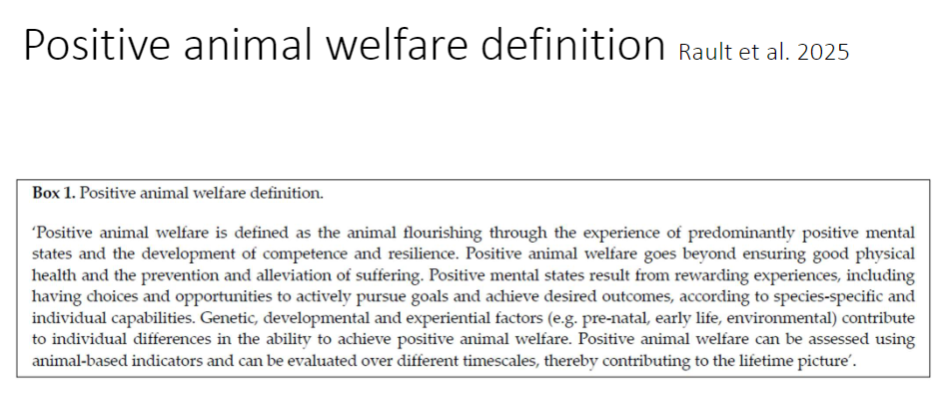
Definition
Defined by Rault et al. 2025
Animals flourish through predominantly positive mental states
Includes development of competence and resilience
Goes beyond good physical health and prevention of suffering
Sources Of Positive Mental States
Rewarding experiences
Opportunities for choice and to actively pursue goals
Achieve desired outcomes based on species-specific and individual capabilities
Individual Differences
Influenced by genetic, developmental, and experiential factors
Examples: pre-natal, early life, and environmental experiences
Assessment
Measured using animal-based indicators
Evaluated over different timescales for a lifetime picture
Positive Animal Welfare – Limitations
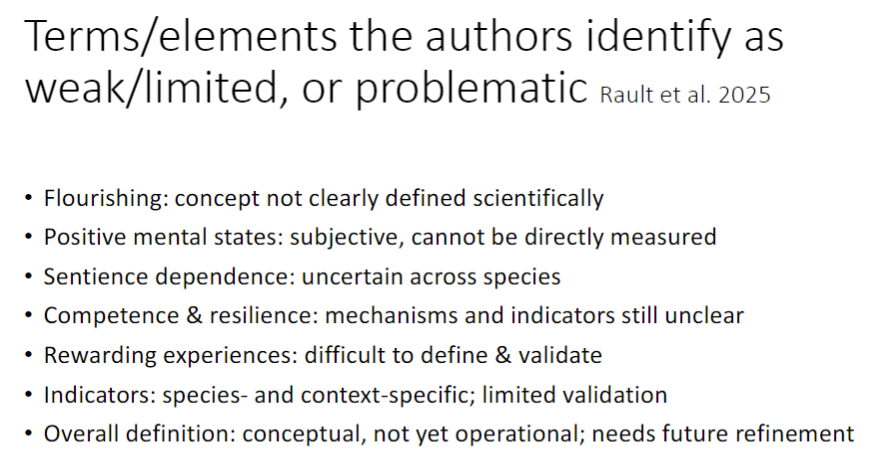
Flourishing
Concept not clearly defined scientifically
Positive Mental States
Subjective, cannot be directly measured
Sentience Dependence
Uncertain across species
Competence & Resilience
Mechanisms and indicators still unclear
Rewarding Experiences
Difficult to define and validate
Indicators
Species- and context-specific, limited validation
Overall Definition
Conceptual, not yet operational, needs future refinement
Positive Animal Welfare – Benefits
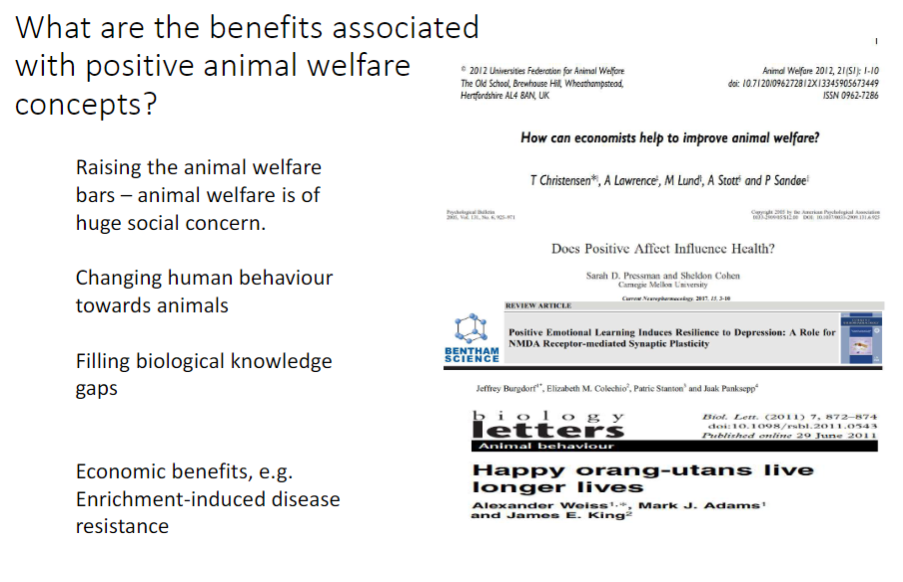
Raising Animal Welfare Bars
Animal welfare is of huge social concern
Changing Human Behaviour
Promotes better treatment of animals
Filling Biological Knowledge Gaps
Improves understanding of animal needs
Economic Benefits
Enrichment-induced disease resistance
Take Home Message – Animal Welfare
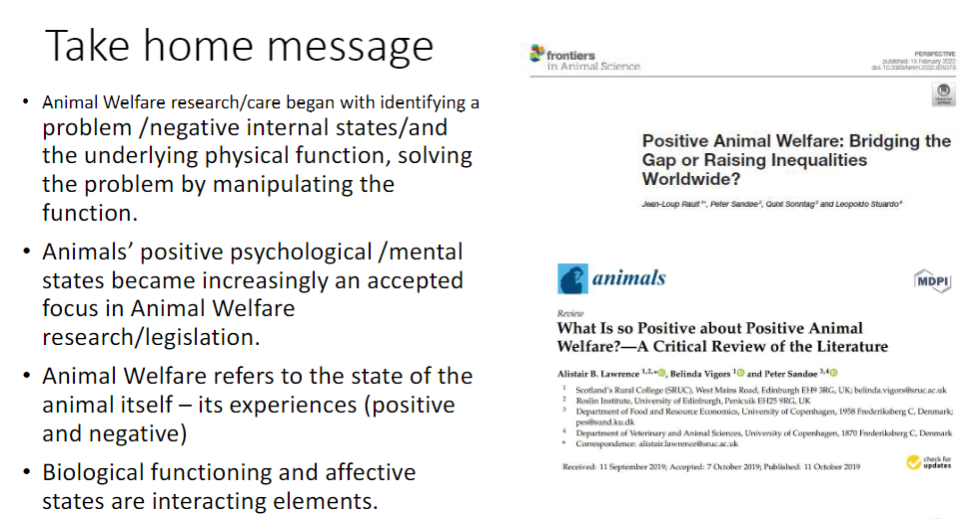
Origins of Animal Welfare Research
Began with identifying problems, negative internal states, and underlying physical functions
Solved problems by manipulating function
Shift to Positive States
Animals’ positive psychological / mental states became an accepted focus in research and legislation
Definition of Animal Welfare
Refers to the state of the animal itself – includes positive and negative experiences
Interaction of Elements
Biological functioning and affective states interact to determine overall welfare
The Welfare Shift
Five Freedoms
Focus on avoiding suffering and negative states
Quality of Life
Balance of positive and negative experiences, emphasizes a good life
Five Domains
Framework for assessing welfare, includes physical and mental/affective aspects
The Five Domains Model
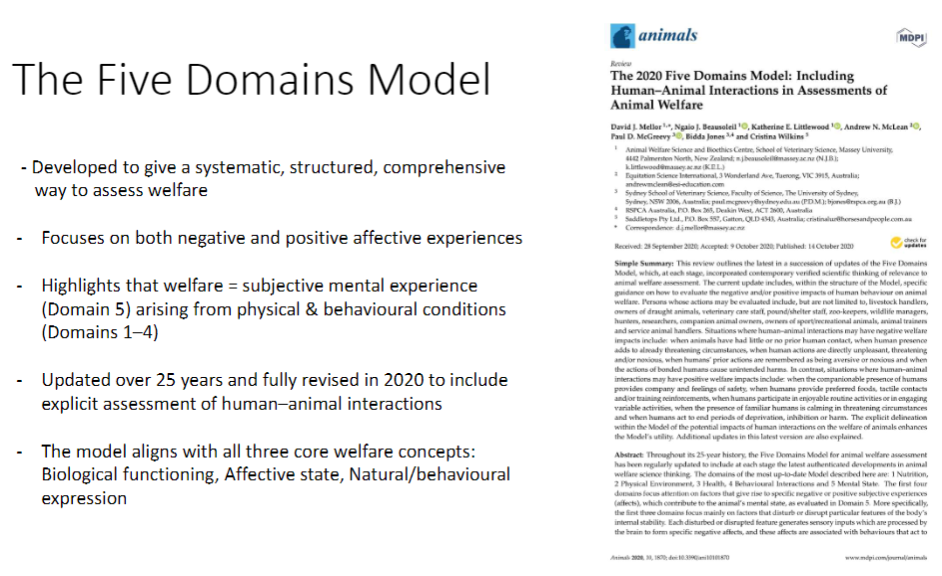
Purpose
Provides a systematic, structured, comprehensive way to assess animal welfare
Focus
Considers both negative and positive affective experiences
Structure
Domain 5: Subjective mental experience
Domains 1–4: Physical and behavioural conditions influencing mental states
Updates
Revised over 25 years, fully updated in 2020 to include human–animal interactions
Alignment
Supports the three core welfare concepts: biological functioning, affective state, natural/behavioural expression
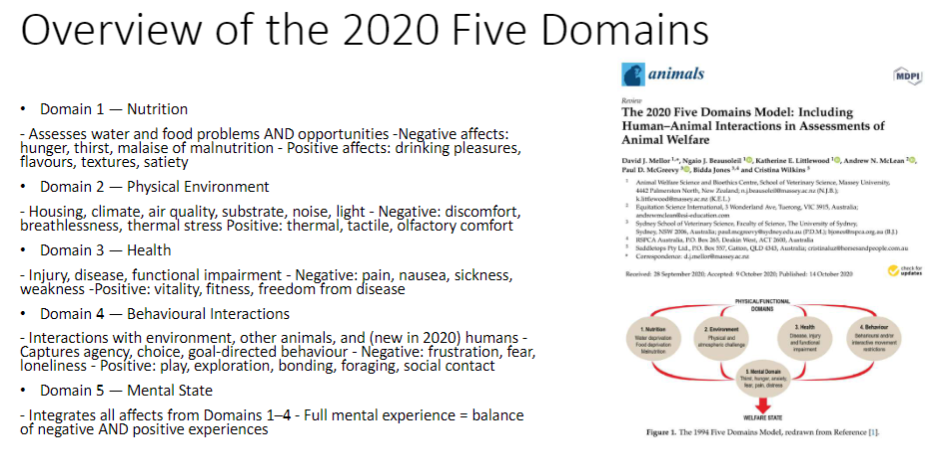
Overview Of The 2020 Five Domains
Domain 1 — Nutrition
Assesses water and food problems and opportunities
Negative affects: hunger, thirst, malaise of malnutrition
Positive affects: drinking pleasures, flavours, textures, satiety
Domain 2 — Physical Environment
Includes housing, climate, air quality, substrate, noise, light
Negative affects: discomfort, breathlessness, thermal stress
Positive affects: thermal, tactile, olfactory comfort
Domain 3 — Health
Covers injury, disease, functional impairment
Negative affects: pain, nausea, sickness, weakness
Positive affects: vitality, fitness, freedom from disease
Domain 4 — Behavioural Interactions
Interactions with environment, other animals, and humans (new in 2020)
Captures agency, choice, goal-directed behaviour
Negative affects: frustration, fear, loneliness
Positive affects: play, exploration, bonding, foraging, social contact
Domain 5 — Mental State
Integrates all affects from Domains 1–4
Full mental experience = balance of negative and positive experiences
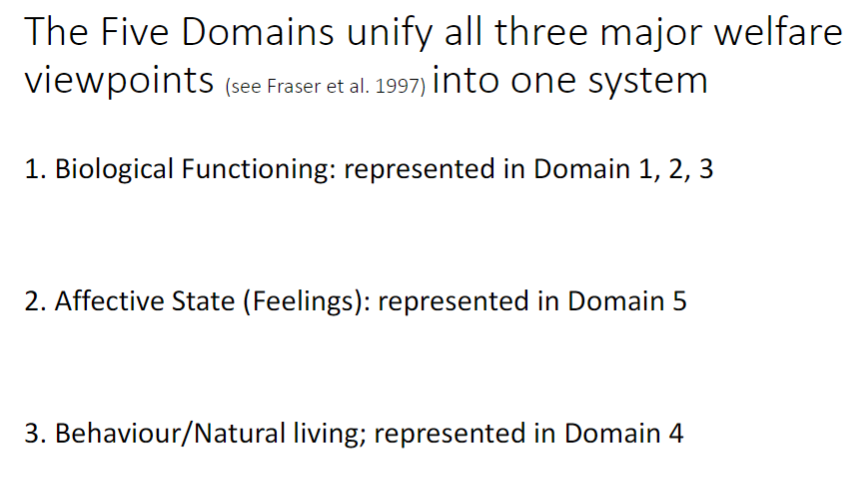
The Five Domains Unify All Three Major Welfare Viewpoints
1. Biological Functioning
Represented in Domains 1, 2, 3
2. Affective State (Feelings)
Represented in Domain 5
3. Behaviour / Natural Living
Represented in Domain 4
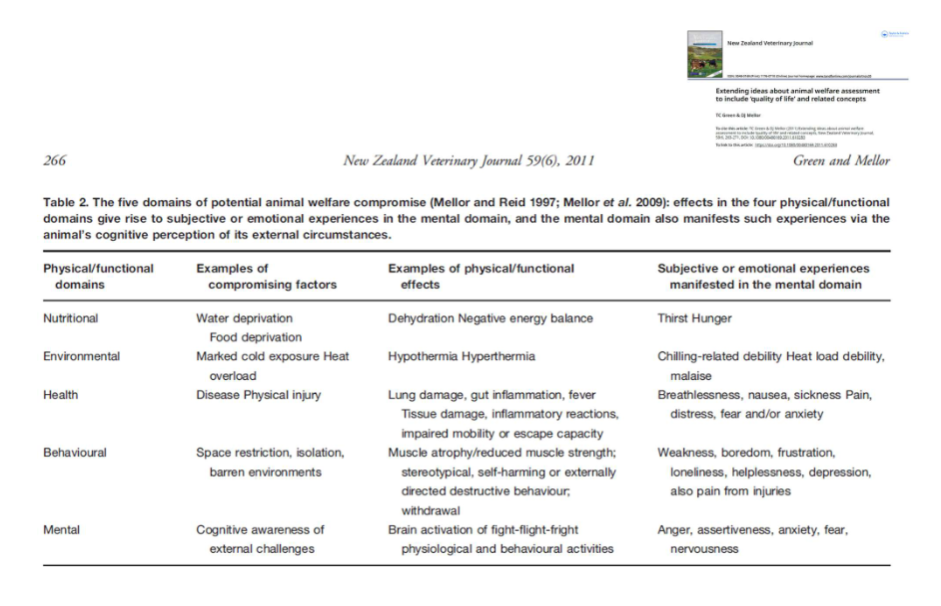
Five Domains Table
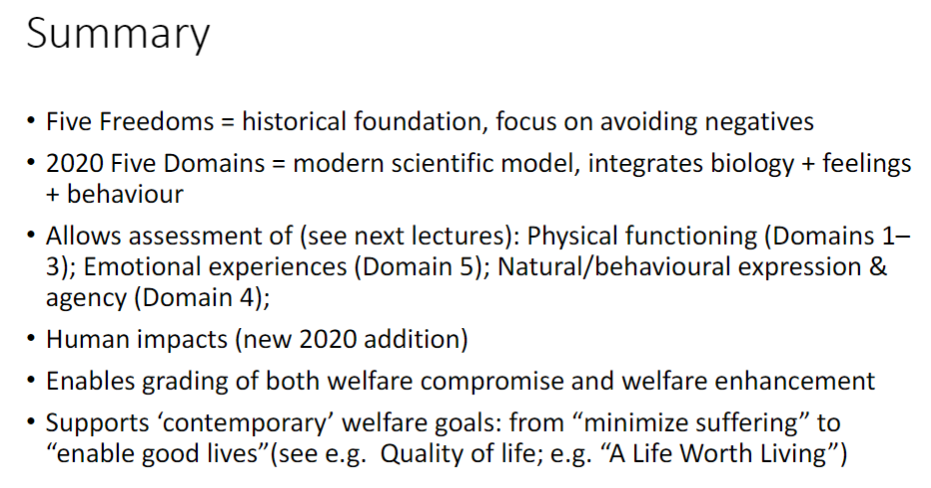
Summary – Animal Welfare Frameworks
Five Freedoms
Historical foundation
Focus on avoiding negatives
2020 Five Domains
Modern scientific model
Integrates biology, feelings, and behaviour
Assessment of:
• Physical functioning – Domains 1–3
• Emotional experiences – Domain 5
• Natural/behavioural expression & agency – Domain 4
Includes human impacts (new 2020 addition)
Enables grading of welfare compromise and enhancement
Supports contemporary goals: from minimize suffering to enable good lives (e.g., Quality of Life, “A Life Worth Living”)