(2) 5 different powerpoints lol
 Studied by 0 people
 Call with Kai
 Learn
Learn Practice Test
 Spaced Repetition
 Match
Match Flashcards
 Knowt Play
1/13

There's no tags or description
Looks like no tags are added yet.
Name | Mastery | Learn | Test | Matching | Spaced | Call with Kai |
|---|
No study sessions yet.
14 Terms
Key components & features of quality assurance (QA) program
QA = total process ensure certain level of QUALITY is maintained
QC = systematic actions → ensure products/process performs accordingly
1) establish standards/procedures (action/tolerance levels)
2) simple & reliable tests
3) appropriate equipment to perform QC checks
4) systemic monitoring of equipment (hardware & software)
5) double check tx & tx plans, verification of dose delivery
What are needed by staff for a good QA program
1) communication
2) involvement of all staff (assign responsibilties)
3) knowledgebale staff (continuing education)
4) adequate # of staff (hard to ensure QA if you don’t have enough staff members)
5) document & reporting system
investigate unusual cases
collect/analyze statsitical info w/ reccs
regulatory body (ensure standards are met)
What are rules for recording patient information?
Enter:
- accurately
- concisely
- immediately
- chronological order of events
- proper terminology
Should be:
- signed/signed by person who made entry
- do NOT enter editorial comments (should be objective, no need for subjective comments)
What is a therapists role in a QA program?
1) perform warm up procedures
2) perform quality CONTROL tests on simulation + Tx units
3) *key: verify presence of completed & signed prescription & consent forms (everyday when you treat, review the tx plan w/ patient)
4) deliver accurate Tx adhering to prescription
5) record Tx delivered
6) evalulate health status of patient
7) patient/family education
8 provide care/comfort/needs of patient
9) immobilization devices
10) treatment planning
LO1: define the performance objectives & criteria for RT equipment
making sure the system works the way its meant to.
just as it did when first bought, to throughout the rest of its life
objectives =
- tolerance level
- action level
- functional

LO2: define & discuss:
1) tolerance level
2) action level
3) functionality
1) difference b/w measured value & expected value is AT or BELOW tolerance level → no action needed
2) difference b/w measured value & expected value is EXCEEDS action level → action is needed
→ bring back to tolerance level
→ ask for physicist to fix
3) it either WORKS or DOES NOT WORK
All equipment in RT is subject to __
What are the 3 types?
Maintenance
1) scheduled maint = procedures on a day, weekly, monthly basis
2) preventative maint = planned, replacement of parts
3) non-scheduled = break downs, requires technician
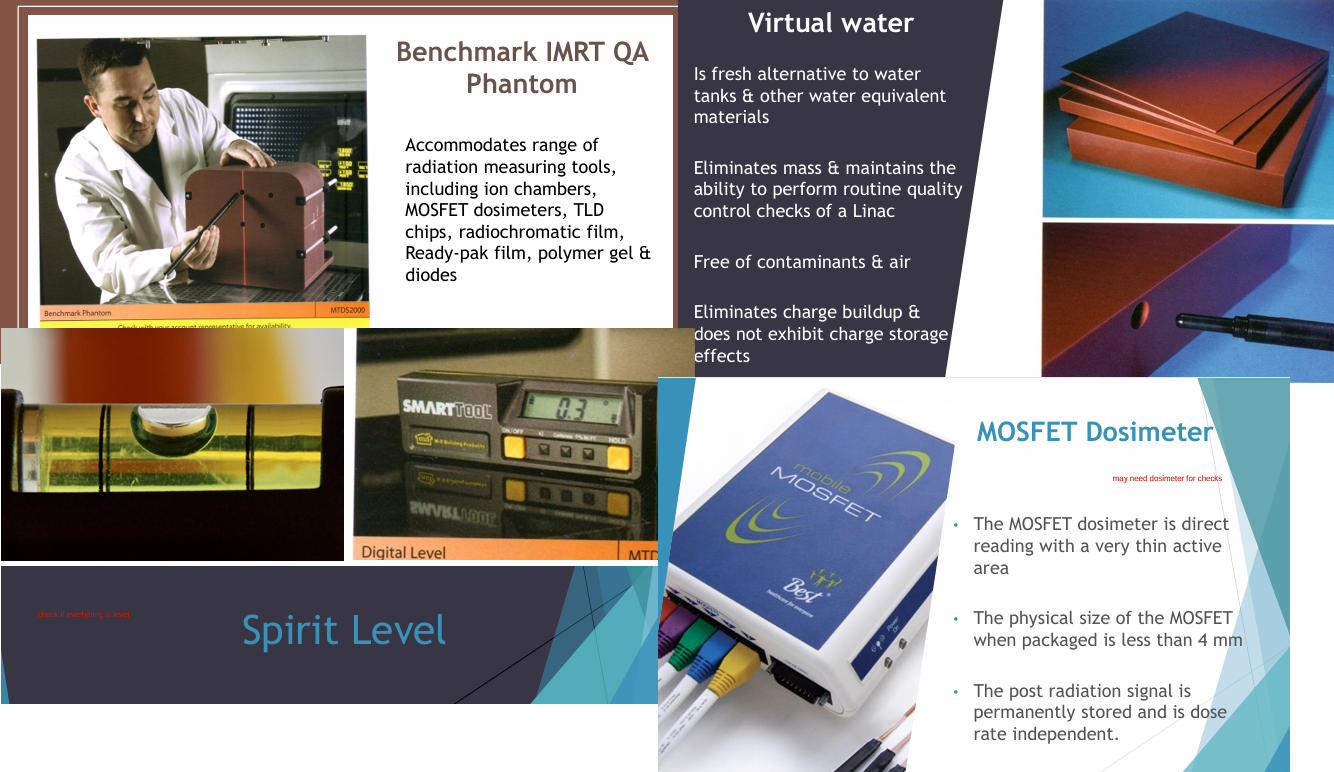
Eqipment used in RT for QC check:
- MOSFET Dosimeter
- Spirit Level
- QA phantom
- Virtual water

LO1: How do we ensure all equipment adhere to the highest quality?
We do:
A) acceptance testing (physicist)
- check what exactly were getting
- equipment meets performance specs & safety standards
- examine manufacturer specs & detect systematic errors
- accept the unit → then pay
- takes long time
B) commissioning (physicist)
- check everything (field size)
- distances etc
- takes long time
C) Regularly scheduled quality control
- medical physicist/radiation therapist
just remember yellow; more on this below
LO2: Identify the CRITERIA for evaluation of RT equipment
1) Functionality = equipment work or NOT
2) Reproducibility = are routine tests same as those produced when machine first set-up
3) Accuracy = do results deviate from expected or defined value
(eli: are results close to what they’re supposed to be?)
4) Characterization = performance of unit be characterized by measurements
(can we measure and describe how well the equipment is performing - we want 10Mv, is it actually giving 10mV)
5) Completeness = are procedures performed, reviewed, analyzed, documented?
Describe ACCEPTANCE TESTING
What’s the PURPOSE?
Purpose:
- units meet specs
- establish baseline for QC program (what we RT’s refer to)
- familiarize customer w/ new unit
- establish compliance w/ radiation safety codes
Others:
- Radiation survey = make sure radiation levels outside room are safe, room barrier strong enough to contain beam
- test of interlocks, warning lights, emergency switches
Describe COMMISIONING
What’s the PURPOSE?
Preparing for clinical service (use on ppl)
- collect additional beam data
→ used for benchmark for all future beam testing + calculation of radiation dose
Discuss the role of RT in QC standards
RT does:
regular & repetive contact w/ pt, tx units, tx records
assess units day to day
assess units day to day
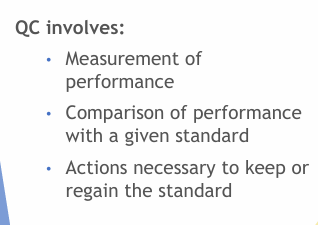
- measure performance
- compare performance to given standard
- perform actions necessary to KEEP/REGAIN standard
- create QA standards based on national/internation bodies
- implement guideliens/standards
What is QC?
quality control = system of routine technical activities to measure & control the quality of the product or service
QC standards based on recommendations by national/international bodies
-there are slight variations in values to be expected, therefore tolerance & action levels are determined
 Note
Note  Flashcards (38)