P2.6 - Forces in Action (Ai generated with instructions by me)
 Call Kai
 Learn
Learn Practice Test
 Spaced Repetition
 Match
Match Flashcards
 Knowt Play
1/22

There's no tags or description
Looks like no tags are added yet.
Name | Mastery | Learn | Test | Matching | Spaced | Call with Kai |
|---|
No analytics yet
Send a link to your students to track their progress
23 Terms
What is mass?
The amount of matter in an object. Measured in kg. Greater mass = harder to change motion. Mass is the same everywhere
What is weight?
The effect of a gravitational field on a mass. It is a force measured in Newtons (N). Weight = mass × gravitational field strength
What is the equation for weight and its units?
W = mg. W = weight (N), m = mass (kg), g = gravitational field strength (N/kg). On Earth g = 9.8 N/kg
How does weight differ from mass?
Mass is the amount of matter (scalar, same everywhere). Weight is a force due to gravity (vector, varies by location). They are very different quantities
What is gravitational field strength on Earth and the Moon?
Earth: g = 9.8 N/kg. Moon: g ≈ 1.6 N/kg. Mass stays the same on both — only weight changes
What is free fall?
When an object falls under gravity with no other forces acting. All objects in free fall accelerate at the same rate regardless of mass — equal to g
What is gravitational potential energy (GPE) and its equation?
Energy stored when an object is raised in a gravitational field. GPE = mgh. m = mass (kg), g = gravitational field strength (N/kg), h = height (m)
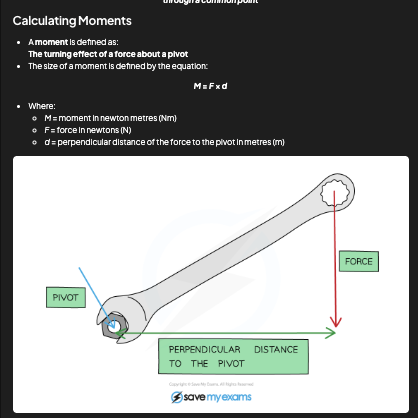
What is a moment?
The turning effect of a force about a pivot. Moment (Nm) = Force (N) × perpendicular distance from pivot (m). M = Fd
What does perpendicular distance mean in moments?
The distance from the pivot to the line of action of the force — must always be at 90° to the force
What is the principle of moments?
For an object in equilibrium: total clockwise moments = total anticlockwise moments about any pivot
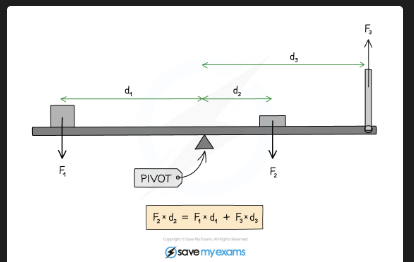
What is the direction convention for moments?
Clockwise is defined as the same direction as clock hands turning. Anticlockwise is the opposite
What do levers do?
Levers use moments to reduce the force needed to move an object. By increasing the distance from the pivot, a smaller force can produce a larger moment
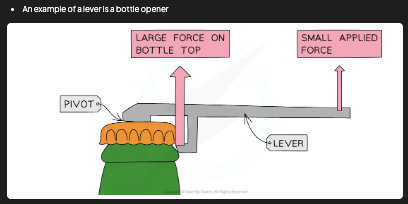
What is the principle behind a lever?
A small force applied at a large distance from the pivot can produce the same moment as a large force applied at a small distance — reducing the effort needed
What are gears and what do they do?
Gears are interlocking toothed wheels that transmit and amplify moments. Two gears rotate in opposite directions. A larger gear rotates slower but has a larger moment; a smaller gear rotates faster but has a smaller moment
How do you calculate gear rotations?
Ratio of teeth on each gear. E.g. if gear P has 24 teeth and gear Q has 12 teeth, ratio = 2:1 — so Q rotates twice for every one rotation of P
What is pressure in a fluid?
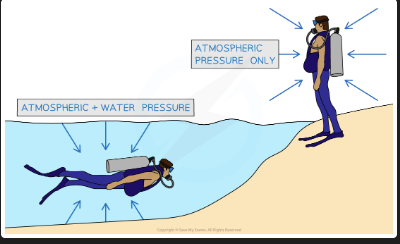
A fluid (liquid or gas) exerts pressure on all surfaces it is in contact with. Pressure acts equally in all directions and at right angles to the surface
How does pressure in a fluid change with depth?
Pressure increases with depth. The greater the depth, the greater the weight of fluid above — so the greater the pressure
What is the equation for pressure in a fluid?
p = hρg. p = pressure (Pa), h = depth (m), ρ = density of fluid (kg/m³), g = gravitational field strength (N/kg)
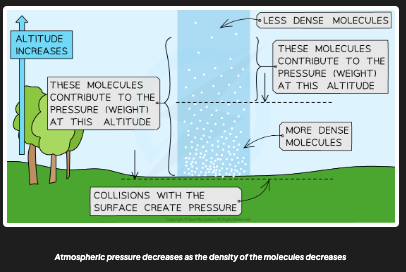
What is atmospheric pressure and how does it change with altitude?
The atmosphere exerts pressure due to the weight of air above. Atmospheric pressure decreases with increasing altitude — less air above means less weight and lower pressure
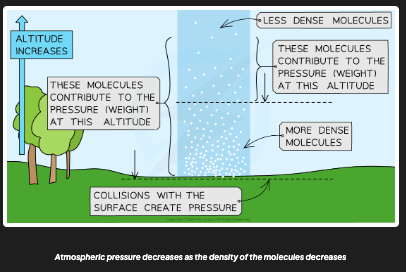
Why does atmospheric pressure decrease non-linearly with altitude?
There is always less atmosphere above than below any point, and air density also decreases with altitude — so the rate of decrease slows down
What is the equation for pressure in solids and its units?
p = F/A. p = pressure (Pa), F = force (N), A = area (m²). Pressure is measured in Pascals (Pa)
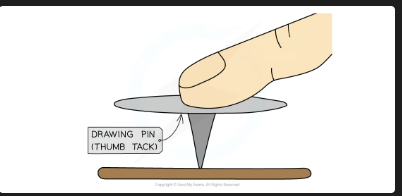
What does the pressure equation tell us about area?
For the same force: a smaller area = larger pressure; a larger area = smaller pressure. E.g. a drawing pin concentrates force on a tiny area to create very high pressure
[HIGHER] What is the upthrust on an object in a fluid?
An object submerged in a fluid experiences greater pressure on its bottom than its top — the difference in pressure creates a net upward force called upthrust