Nervous and Endocrine System and other questions
 Call Kai
 Learn
Learn Practice Test
 Spaced Repetition
 Match
Match Flashcards
 Knowt Play
1/153

There's no tags or description
Looks like no tags are added yet.
Name | Mastery | Learn | Test | Matching | Spaced | Call with Kai |
|---|
No analytics yet
Send a link to your students to track their progress
154 Terms
explain nerve transmission across a synapse (4 steps)
action potential arrives at axon terminal
voltage-gated Ca+2 channels open and Ca+2 enters the axon terminal
Ca+2 entry causes the neurotransmitter- containing synaptic vesicles to release their contents by exocytosis
neurotransmitter diffuses across the synaptic cleft and binds to receptors on the postsynaptic membrane, initiating and action potential
Define all or none response
A response of a constant size regardless of the strength of the stimulus; with respect to nerve cells, a nerve impulse is transmitted at full strength or not at all
How can we tell the difference between a small pat and a hard slap on the back (2 reasons)
a strong stimulus causes depolarisation of more nerve fibres than a weak stimulus
strong stimulus produces more nerve impulses in a given time than a weak stimulus
Dependent variable
The variable that is measured or changes in response to the independent variable.
Compare the transmission on a nerve impulse in a myelinated and an unmyelinated neuron
myelinated fibres conduct impulses much faster (140m/s) than unmyelinated neurons (2m/s) due to insulation by a myelin sheath
Myelinated fibres undergo Saltatory Conduction while unmyelinated fibres undergo Continuous Conduction.
list the 3 types of neurons according to their function
motor neurons- A nerve cell that carries messages from the C.N.S to effectors.
sensory neurons-A nerve cell that carries messages from receptors to the C.N.S for interpretation.
connector neurons- A nerve cell in the C.N.S that sends messages between sensory and motor neurons.
describe the difference between an axon and a dendrite
Dendrites- short extensions of the cytoplasm of the cell body, highly branched
Axon- a single long extension of the cytoplasm (usually longer than dendrites)
describe the difference between sensory and motor neurons
sensory neuron- carry messages from the receptors to the CNS
motor neuron- carry messages from the CNS to the effectors
the difference between a synapse and a neuromuscular junction
synapse- A junction between the branches of 2 adjacent neurons
neuromuscular junction- The junction between the branches of a motor neuron and a muscle fibre
define potential difference
a difference between electrical charge between two locations
define resting membrane potential
the membrane potential of unstimulated nerve cell (-70)
define polarised
describes the situation when the inside of a nerve cell has a negative charge compared with the outside
define depolarised
describes the membrane of a nerve cell when there is no difference in electrical charge between the inside and outside of the membrane
what are the 2 types of voltage channels and when do they open/close
voltage gated sodium ion channel- opens when membrane potential reaches -55mV, it closes during repolarisation
voltage gated potassium ion channel- opens when repolarisation occurs, close during hyperpolarisation
what happens during refractory period? Why is it important?
During the action potential and for a very brief period afterwards, that part of the nerve fibre cannot be stimulated again to respond.
It is important in the transmission of the impulse along a fibre and ensures that the impulse traves in one direction only.
difference between interpolation and extrapolation of data
Interpolation is predicting a value within the sequence of data points, while extrapolation is predicting a value beyond the sequence of data points.
How to improve reliability of an experiment
Having a large sample size (replication)
principals an experiment needs to be considered Ethical
-voluntary participation
-informed consent
-no risk of harm
-confidentially
case study
An in-depth investigation of one particular person or situation
Independent variable
The variable that is deliberately changed to determine its effect.
Controlled variables
Variables that are kept the same for both the control and experimental group in an experiment.
Experimental group
The group with the independent variable.
Experimental control
The group without the independent variable that provides a baseline for comparison.
Placebo
Any medical treatment that is inert or inactive, often used as a control in an experiment.
Controlled experiments
Sometimes called "fair tests" they involve changing one variable while all other variables are kept the same.
what is a neurotransmitter and how does it work?
messages are transmitted across a synapse by chemicals are called neurotransmitter
A neurotransmitter is a chemical released from the axons that fill the synapse and allow the transmission to be carried between 2 adjacent neurons
What are the 2 main divisions of the nervous system and their constituents
CNS or central nervous system- The part of the nervous system that consists of the brain and spinal cord.
PNS or peripheral nervous system- The part of the nervous system which connects the central nervous system with muscles, glands and receptors.
describe the 3 main protective structures of the CNS
bone- cranium and vertebral canal
meninges- dura mater, arachnoid mater and pia mater
cerebrospinal fluid- occupies the space between the middle and inner layers of the meninges, also in the canal of the centre of the spinal cord.
describe the layers of the meninges
Dura mater-the outer layer, is tough and fibrous connective tissue, lies next to the skull and vertebrae
Arachnoid mater- the middle layer consisting of thin web like strands which connect to the innermost layer
Pia matter- the innermost layer, closest to the brain and spinal cord, very thin, follows contours of the brain and spinal cord
Components of Cerebrospinal fluid
a clear, watery fluid containing very few cells and some glucose, protein, urea and salts,
the difference between grey and white matter and where they are both found
Grey matter- The part of the brain and spinal cord made up of cell bodies and unmyelinated fibres.
White matter-The part of the brain and spinal cord made up of myelinated fibres.
Why is the corpus callosum white in colour
because it is composed of myelinated nerve fibres
what is the symptoms of a severed corpus callosum? (4)
An inability to name objects in the left visual field, "alien hand" syndrome (uncoordinated hand movements), split visual perception, and difficulties with bimanual tasks.
the 3 important centres in the medulla obligate and what they control
cardiac centre- regulates rate and force of the heartbeat
respiratory centres- controls rate and depth of breathing
vasomotor centre- regulates the diameter of blood vessels
Cerebral hemisphere
one of the 2 half’s of the Cerebellum
Define insula
a part of the brain that is buried deep inside the brain, considered the 5th lobe of each cerebral hemisphere
Origin and number of cranial nerves and spinal nerves
cranial nerves- 12 pairs, arises from the brain
spinal nerves- 31 pairs, arises from the spinal cord
difference between afferent and efferent nerves
Afferent- fibres that carry impulses into the CNS
Efferent- fibres that carry impulses away from the CNS
Difference between somatic sensory and visceral sensory divisions
somatic sensory- brings impulses from the skin and muscles
visceral sensory- which bring impulses from internal organs
Distinguish between Somatic Nervous system and Autonomic Nervous system (7)
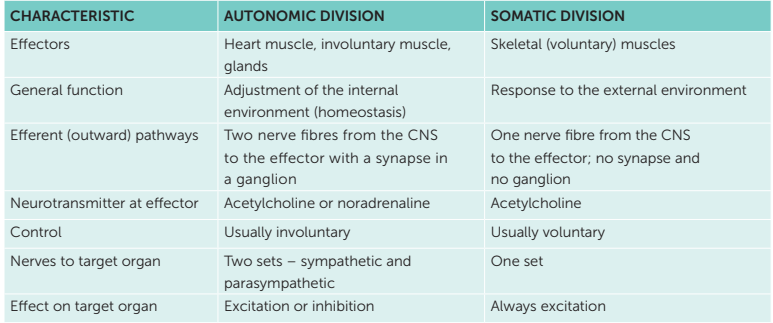
Distinguish between sympathetic and parasympathetic divisions
parasympathetic division generally produces responses that maintain the body during relatively quiet conditions, also nerve ending cells release acetylcholine
sympathetic division tend to produce responses that prepare the body for strenuous physical activity, also nerve ending cells release noradrenaline
Compare the effect of sympathetic and parasympathetic stimulation on the heart, lungs, eye, and boold vessels in the skin
Literature review
A survey of all of the material written about a subject under consideration.
Uncontrolled variables
Variables that are difficult or impossible to keep the same between experimental group and control group.
Repetition
Doing the same experiment many times.
Replication
Having a large number of identical experiments running together or performing an experiment on a large number of subjects at the same time.
Validity
The degree to which an experiment tests what it is supposed to test.
Reliability
The degree to which an experiment gives the same results each time it is performed.
Quantitative data
Data that is expressed in numbers and involves measurement.
Qualitative data
Data or observations that do not involve numbers or measurement.
Hypothesis
A single idea to be tested usually written as an "If..then" or "That" statement.
Conclusion
A statement referring to the original hypothesis as to whether the experiment conducted supported or did not support the hypothesis.
Outliers
A measurement well beyond the range of the rest of the measurements in a set of data.
Secondary data
Data collected by someone else other than the person using the data.
Trial and error
A method of problem solving in which one attempt to solve a problem is followed by another until the investigator gradually finds a solution.
Longitudinal studies
A study conducted over a long period of time, sometimes years or decades.
Average
Calculated by dividing the total measurements in a group, byt the number of measurements taken. Often called the "mean".
Frequency
The number of times an event occurs.
Percentage change
Calculated by taking the actual change multiplied by 100 and then dividing it by the original value.
Axon
A single long extension of cytoplasm transmitting nervous impulses away from the cell body.
Dendrite
Short extensions of cytoplasm transmitting information into the cell body.
Myelin
A white fatty sheath that helps to insulate and protect the axon.
Neurilemma
A thin membranous sheath around the myelin that helps to repair damaged fibres.
Node of Ranvier
A gap in the myelin sheath of a nerve fibre.
Gyri
Convolutions in the surface of the brain.
Sulci
Shallow downfolds in the surface of the cerebrum separating convolutions.
Cerebrum
The largest part of the brain responsible activities such as thinking, reasoning, learning, intelligence and voluntary muscle control.
Cerebellum
The second largest part of the brain responsible for maintaining balance, motion, muscle tone and coordination of fine muscle movements.
Medulla
A continuation of the spinal cord containing the cardiac, respiratory and vasomotor centres.
Fissures
Deep downward folds in the surface of the cerebrum.
Corpus callosum
An area of white matter in the brain that allows the left and right hemispheres to communicate.
Hypothalamus
The control centre for body temperature, maintaining water levels (thirst), patterns of sleeping and the regulator for many hormones.
Reflex
A rapid, automatic response to a change in internal or external environment to restore homeostasis.
Action potential
The rapid depolarisation and repolarisation of a membrane transmitted as a nerve impulse.
Refractory period
A short period following a stimulus in which a nerve fibre cannot be stimulated to respond again.
Saltatory conduction
The conduction of a nervous impulse along a myelinated fibre in which the impulse jumps from one node of Ranvier to the next.
Synapse
A junction between the branches of 2 adjacent neurons.
Neuromuscular junction
The junction between the branches of a motor neuron and a muscle fibre. Also known as a motor end plate.
Grey matter
The part of the brain and spinal cord made up of cell bodies and unmyelinayed fibres.
White matter
The part of the brain and spinal cord made up of myelinated fibres.
Central Nervous System
The part of the nervous system that consists of the brain and spinal cord.
Peripheral Nervous System
The part of the nervous system which connects the central nervous system with muscles, glands and receptors.
Multipolar neuron
A nerve cell with one axon and many dendrites. The most common type of neuron.
Bipolar neuron
A neuron with one axon and one dendrite arising from opposite sites of the cell body.
Unipolar neuron
A neuron with a single extension.. an axon.
Schwann cell
A cell that wraps around a nerve fibre and forms the myelin sheath.
Cell body
Part of the neuron that contains the nucleus and cell organelles.
Dorsal root
The back part of the spinal cord containing the axons of sensory neurons.
Ventral root
The front part of the spinal cord containing the axons of motor neurons.
Acquired reflex
A reaction that has been learned as a result of a stimulus.
Alzheimer's disease
The most common form of dementia, usually diagnosed in people over the ages of 65. Characterised by memory loss, confusion and mood swings.
Ascending tracts
Sensory nerve fibres that carry impulses towards the brain.
Central canal
A hollow that runs through the centre of the spinal cord that is filled with cerebrospinal fluid.
Cranial nerves
The 12 pairs of nerves that arise from the brain.
Descending tracts
Motor nerve fibres that carry impulses away from the brain.
Hypophysis
Another name for the pituitary gland.
Infundibulum
Stalk like structure that joins the pituitary gland to the hypothalamus.
Meninges
The membranes covering and providing protection for the brain and spinal cord.
Spinal nerves
31 pairs of of nerves that arise from the spinal cord; joined to the spinal cord by dorsal and ventral roots.
Spinal reflex
A reflex carried out by the spinal cord without brain involvement.

