Vibrio cholerae "Cholera"
 Studied by 0 people
 Call Kai
 Learn
Learn Practice Test
 Spaced Repetition
 Match
Match Flashcards
 Knowt Play
1/33

There's no tags or description
Looks like no tags are added yet.
Name | Mastery | Learn | Test | Matching | Spaced | Call with Kai |
|---|
No analytics yet
Send a link to your students to track their progress
34 Terms
What is the nickname for cholera?
Blue Death
Is Vibrio cholerae gram - or gram +?
Gram -
What shape is vibrio cholerae?
Curved rod
Is V. cholerae a faculative anaerobe?
Yes, it is a facultative anaerobe.
Why is V. Cholerae called the “Blue Death”?
Because it makes the skin turn blue-grey due to dehydration.
What effect of severe dehydration of cholera have on your bowl movements?
You have diarrhea. Shit 20 litres per day.
How soon after symptoms can you die from cholera?
Within 2-3hr of symptoms.
What is the V. cholerae reservoir?
humans, marine environments, shellfish
What is the transmission of V. cholerae?
Water contaminated with human feces, marine environment
What is NOT the transmission of v. cholerae? Why?
V. cholerae is not spread directly from person to person. Your body sheds the bugs 1-10 days after symptoms reside.
What is the disease caused by V. Cholerae?
Cholera
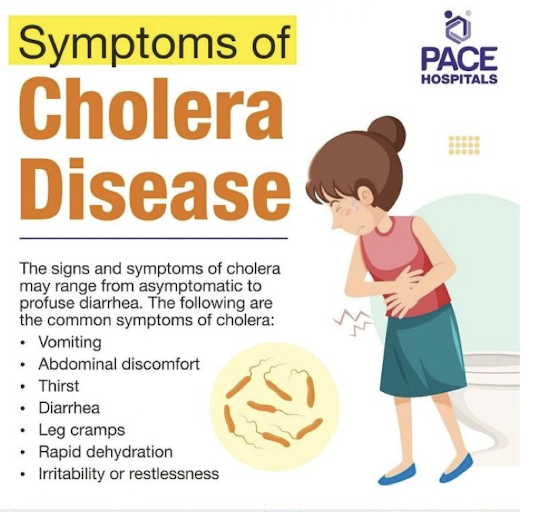
What are the main symptoms of V. cholerae?
severe watery diarrhea
intense thirst, abdominal cramps, blue-grey skin
cardiac failure (low K+, K+ is needed for heart rhythm)
What are the general steps of pathogenesis for v. cholerae?
bacteria is ingested
bacteria colonizes small intestine
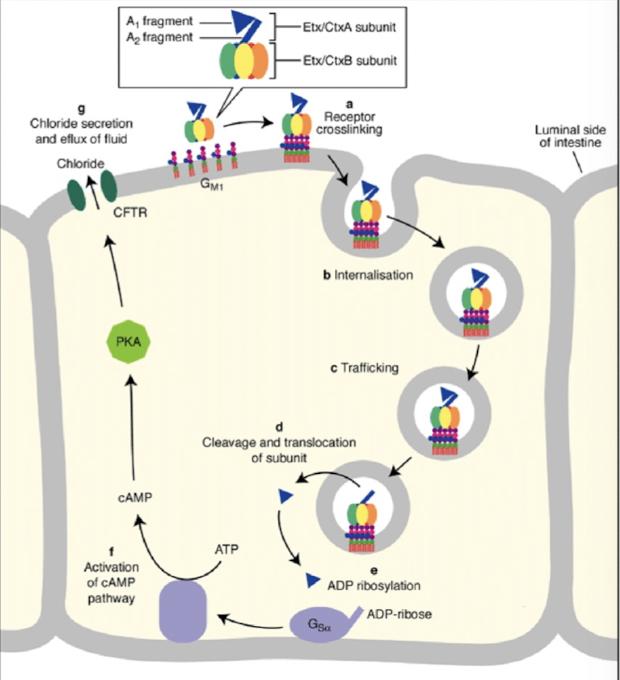
CT (cholera toxin) is produced
CT acts on mucosal cells, leading to diarrhea
rice water stool (flecks of mucosal cells)
dehydration, circulatory collapse, death
What are the virulence factors of v. cholerae?
Adherence toxins (Tcp, neuraminidase), CT: AB toxin, CT: ADPR Gs
What three virulence factors act as the first step to V. cholerae pathogenesis (Adherence)?
Tcp- toxin co-regulated pilus
Neuraminidase
CT
What does the Tcp- toxin co-regulated pilus do?
Binds to small intestinal mucosa and facilitates bug to bug attachment.
What does neuraminidase do and how does it help V. Cholerae?
It cleaves sialic acid from the intestinal mucosal surface. This "remodels" the cell surface to create more GM1 receptors, allowing more Cholera Toxin to bind and enter the cells.
How many toxins does CT have?
6 subunits: 1A, 5B (like PT)
What do the B subunits of v. cholerae do?
Attach to mucosal surface sugars
What does the A subunit of V. cholerae do?
It does ADP-Ribosylation of G proteins.
What does the ADPR of G proteins by CT lead to?
No inhibition of ACase by Gi, this leads to uncontrolled Cl- secretion into intestine, causing diarrhea.
What is the CT mechanism?
GPCR-Gs: G-protein-coupled receptor
CT → ADPR-GS-GTP; rise in ACase and cAMP
rise in cAMP activates PKA
PKA phosphorylates CFTR uncontrollably
rise in Cl- secretion; rise in Na+ and K+ ions
efflux of fluid (water) into intestine
What is the treatment for cholera?
ORS: Oral Rehydration Solution
glucose stimulates uptake of salts and water by mucosal cells
What is the vaccine for cholera?
VAXCHORA: a live, attenuated oral vaccine
deletion of ctxA gene (no toxin)
retain ctxB (Ab prevent bug binding)
What is the difference between Pertussis toxin and Cholera toxin in terms of ADPR?
CT ADPRs Gs while PT ADPRs Gi. When Gs is ADPR, Gi can’t inhibit it.
 Note
Note  Flashcards (94)