Teas 7 Human Anatomy and Physiology
 Call Kai
 Learn
Learn Practice Test
 Spaced Repetition
 Match
Match Flashcards
 Knowt Play
1/46

There's no tags or description
Looks like no tags are added yet.
Name | Mastery | Learn | Test | Matching | Spaced | Call with Kai |
|---|
No analytics yet
Send a link to your students to track their progress
47 Terms
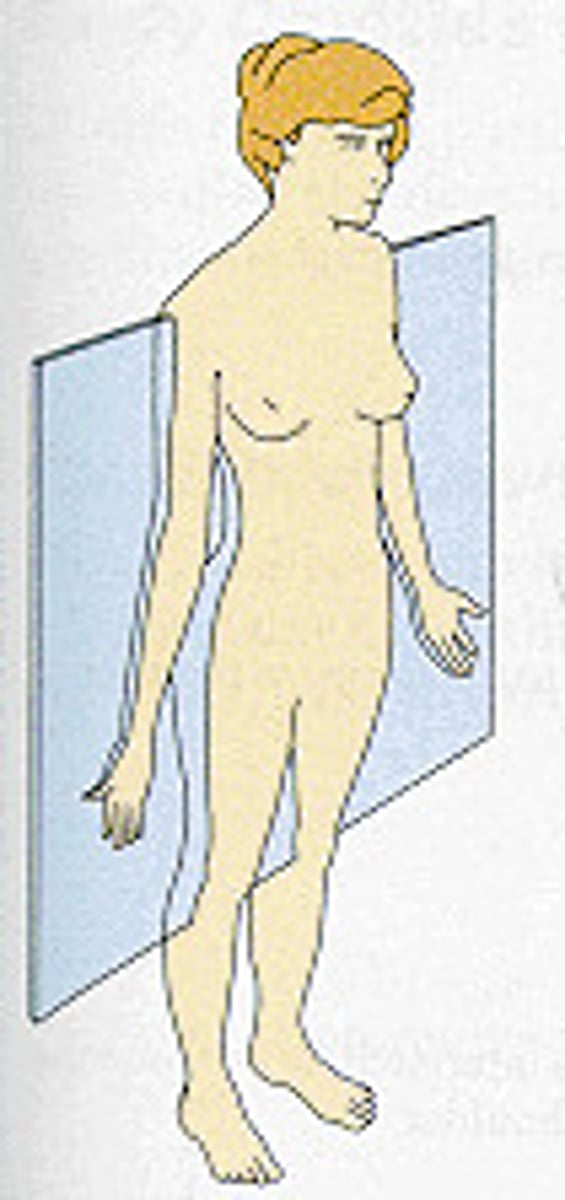
Sagittal Plane
Divides the body, or any body part, vertically into and left sections. Runs parallel to the midline of the body
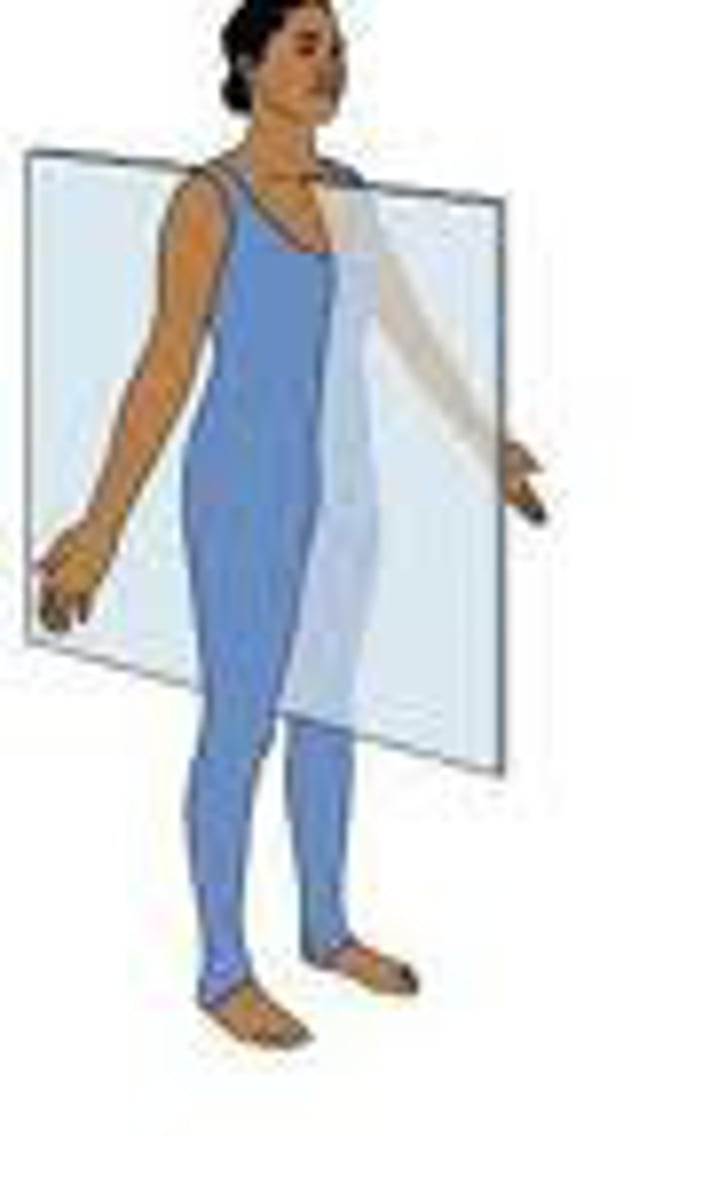
Coronal(frontal) Plane
Divides the body, or any body structure, vertically into front and(anterior and posterior) sections. Runs vertically through the body at right angle to the midline.
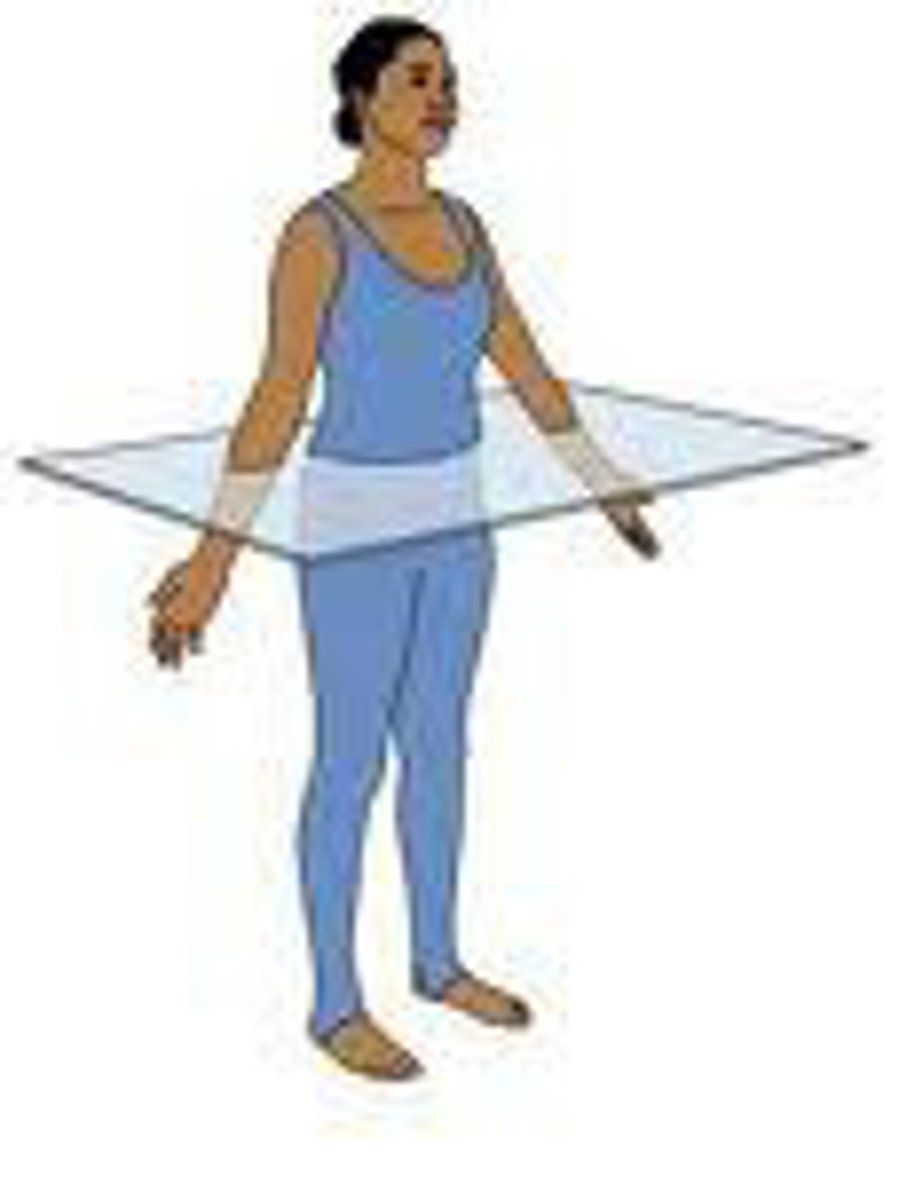
Transverse(horizontal) Plane
Divides the patient's body into imaginary upper(superior) and lower(inferior) halves.
Medial
means nearer to the midline of the body
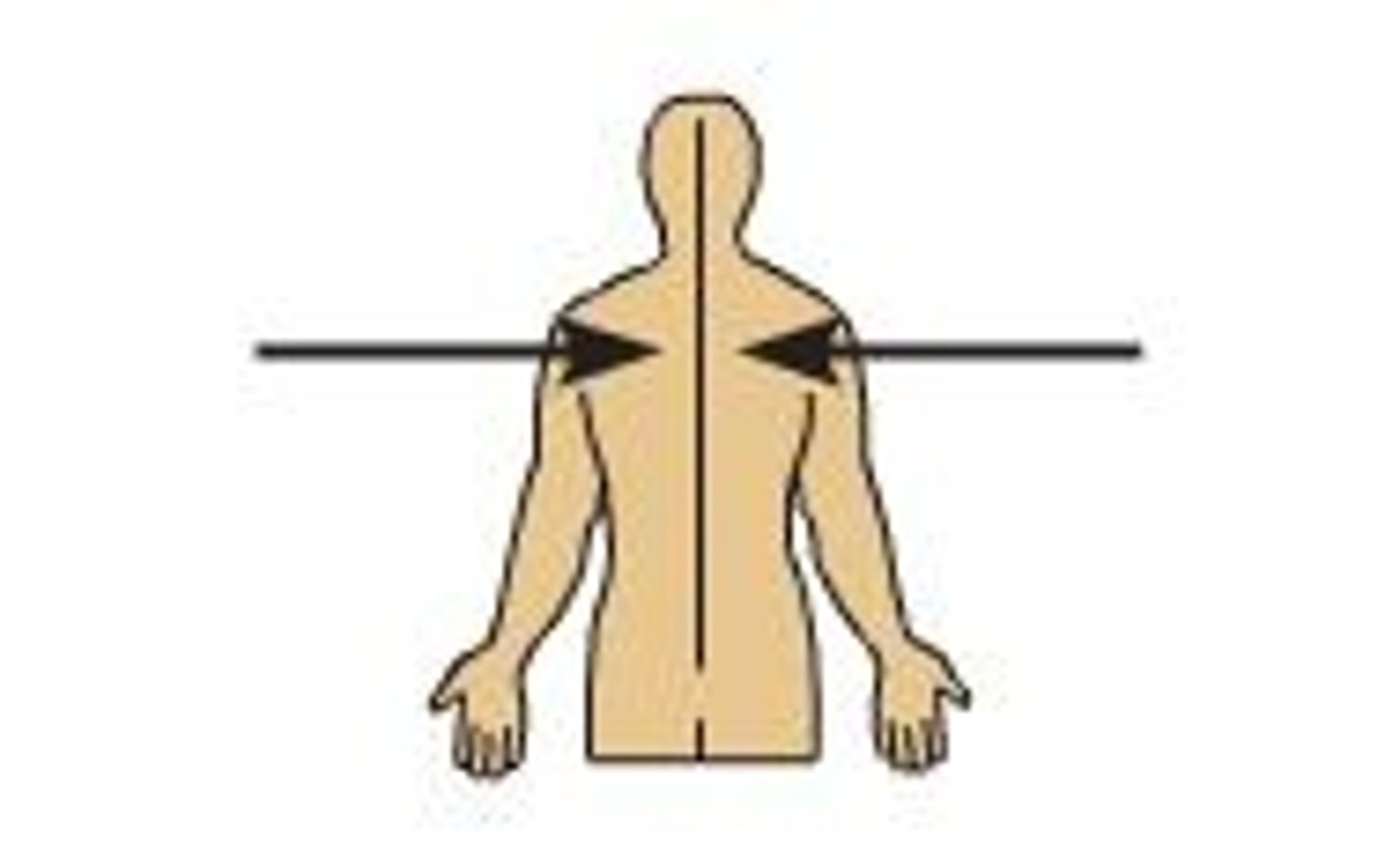
Lateral
is the opposite of medial. Refers to structures further away from the body's midline, at the sides
Proximal
refers to structures closer to the center of the body
Distal
Refers to the structures further away from the center of the body
Anterior
Front body structures
Posterior
Back body structures
Cephalad or cephalic
are adverbs meaning towards the head.
Cranial is the skull
Caudad
Is an adverb meaning towards the tail or posterior.
Caudal means hindquarters
Superior and Inferior
above, closer the head
below, closer the feet
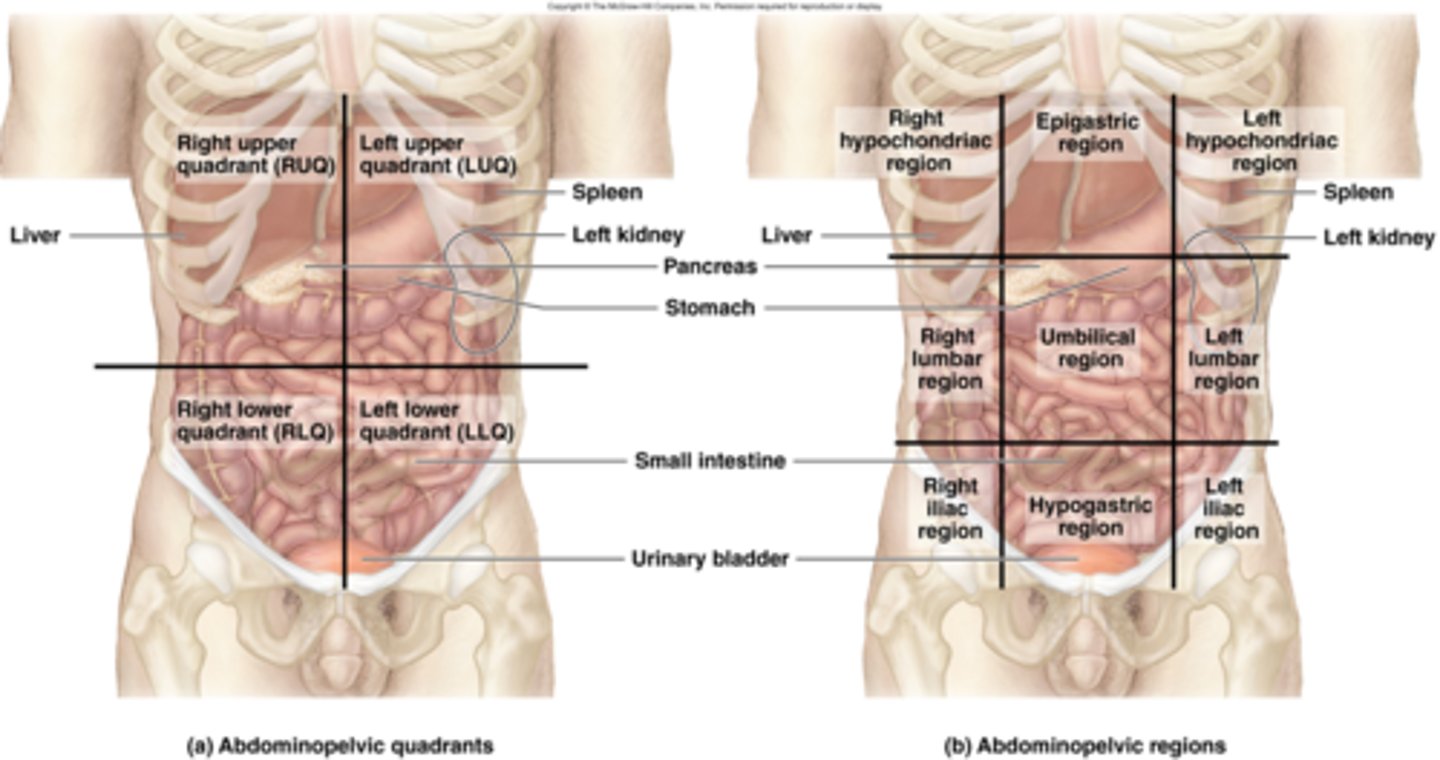
Abdominal Regions
Right Hypochondriac- right kidney, liver, gallbladder, and small intestines
Epigastric- stomach, liver, adrenal glands, pancreas, spleen
Left Hypochondriac- left kidney, spleen, pancreas, colon
Right Lumbar- ascending colon, liver, gallbladder
Umbilical- small intestines, duodenum, umbilicus
Left Lumbar- descending colon, left kidney
Right lilac- cecum, appendix
Hypogastric- bladder, female internal reproductive organs, sigmoid colon
Left iliac- descending and sigmoid colon
Abdominal Quadrants
Right upper quadrant- Duodenum, part of the ascending and transverse colon, hepatic flexure, liver, gallbladder, pancreas(head) right kidney, and right adrenal gland
Right lower quadrant- cecum, appendix, right ureter, right fallopian tubes, and right ovary
Left upper quadrant- stomach, liver, pancreas, left kidney, left adrenal gland, splenic flexure, spleen, part of transverse and descending colon
Left lower quadrant- left ureter, left fallopian tube, left ovary, part of descending colon, and sigmoid colon
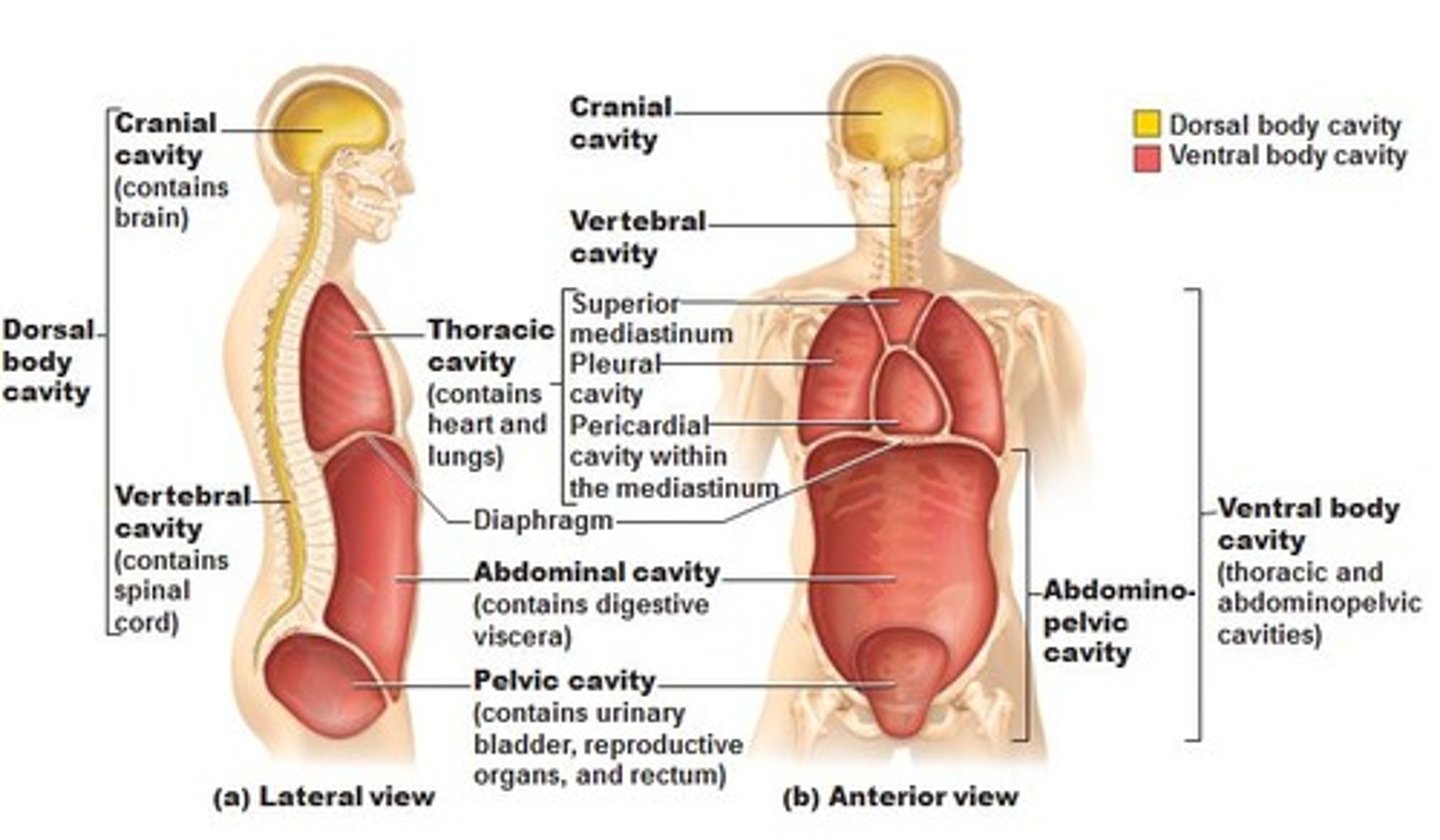
Ventral Cavity
Thoracic Cavity- is above the diaphragm and contains the lungs and the mediastinum, which separates the cavity into right and left compartment. The heart, trachea, esophagus, and thymus gland lie within the mediastinum.
Abdominopelvic cavity- extends below the diaphragm to the pelvic floor, contains the upper abdominal cavity and the lower pelvic cavity. The organs within the abdominal cavity include the stomach, liver, gallbladder, spleen, kidneys, pancreas, intestines. The pelvic cavity, encased in the pelvic bones, contains the internal reproductive organs, the bladder, and the distal part of the colon.
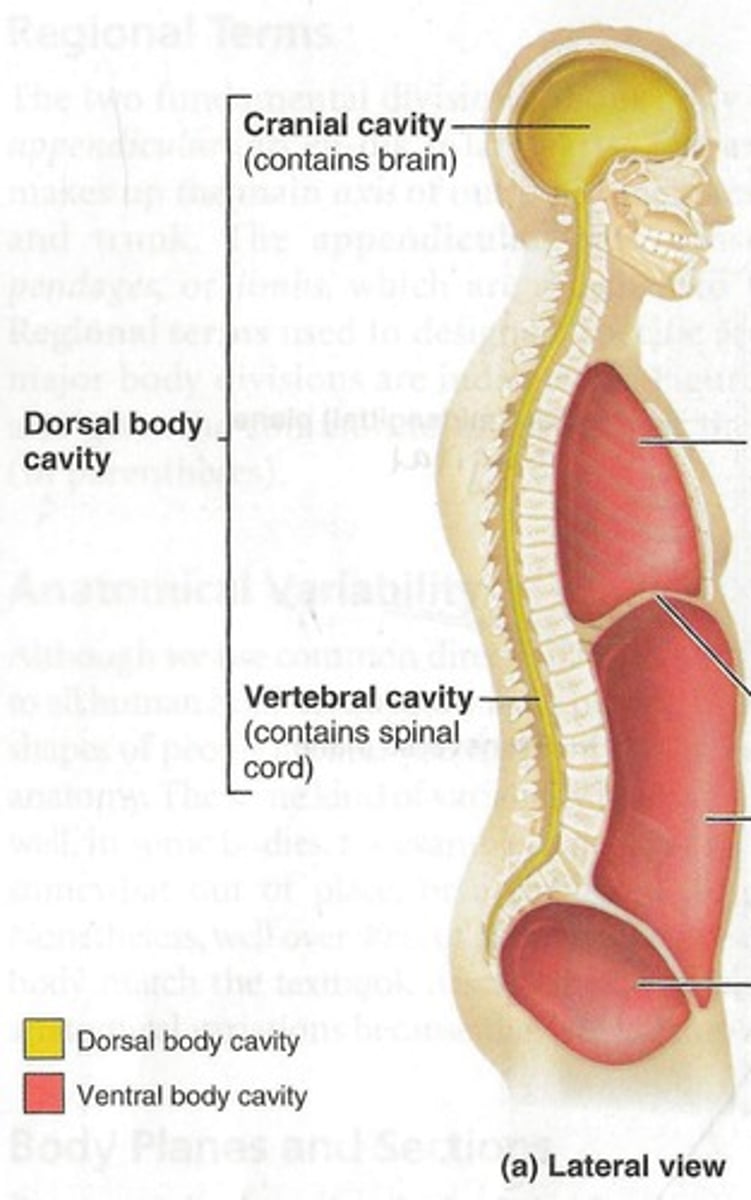
Dorsal Cavity
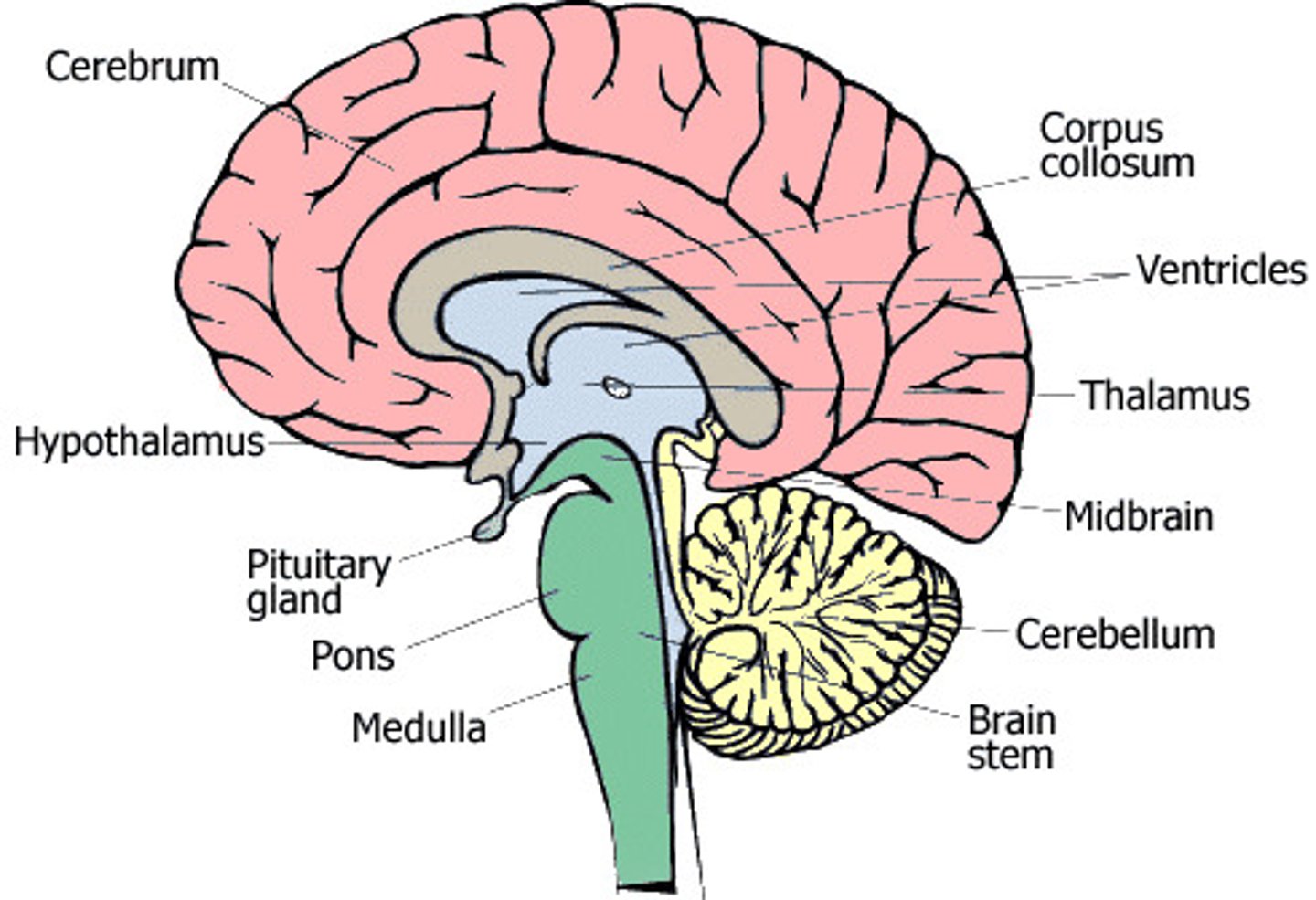
Cranial cavity- encased in cranial bones at the bottom and the skull cap the top, this cavity contains the brain, the 12 cranial nerves, and the pituitary gland. The meninges line the cavity and surround the brains and the spinal cord and contain CSF between the arachnoid mater and pia mater in the subarachnoid space. The meninges and CSF protect and cushion the dorsal cavity.
Vertebral cavity- contains the vertebrae and the spinal cord. The meninges extend from the cranial cavity to enclose the vertebral cavity.
Cardiovascular system
Transport oxygen, nutrients, hormones, ions, and fluids throughout the body and removes metabolic wastes.
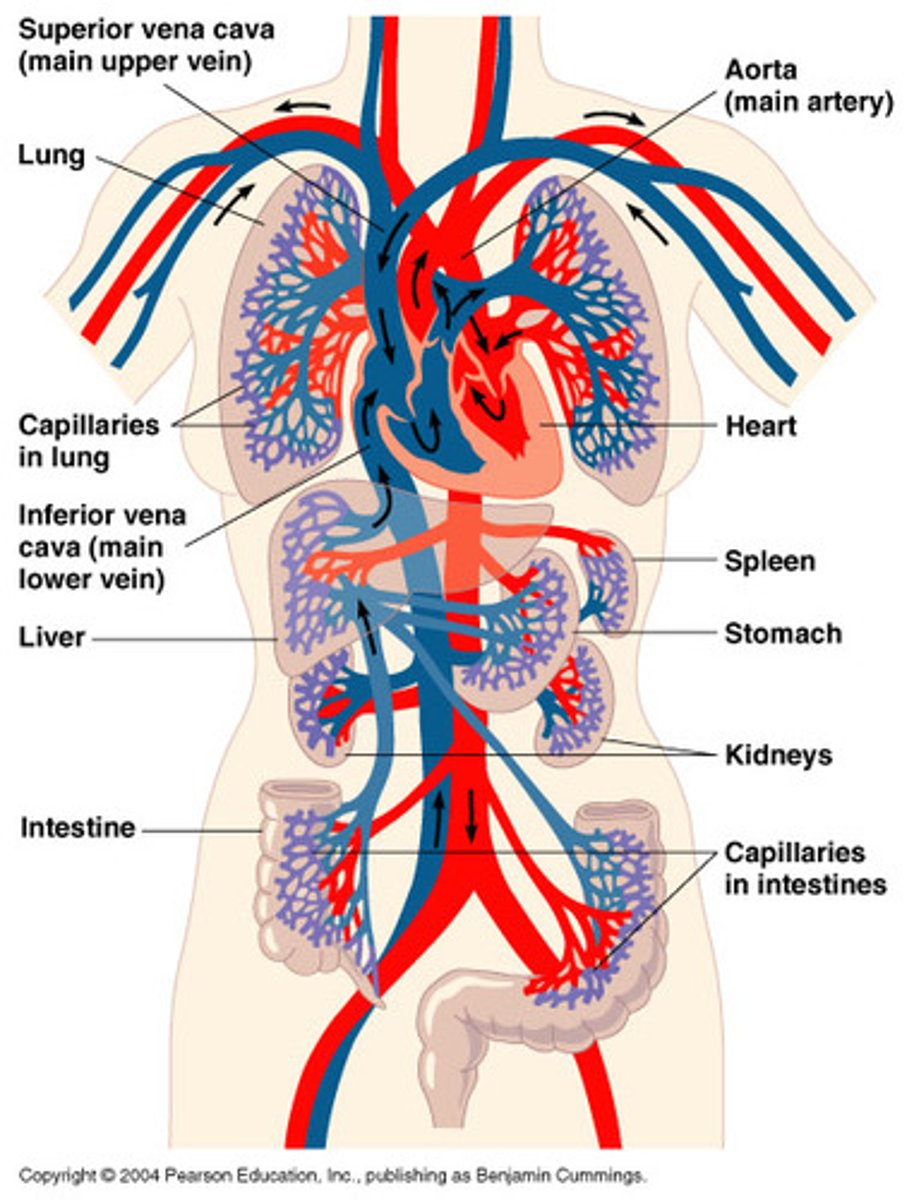
Heart function
Epicardium-outer layer, which protects the heart and secretes lubricating serous fluid
Myocardium-middle layer, which contracts to pump blood.
Endocardium- innermost layer, which lines the chambers and valves
Chambers of the heart and their function
The superior "receiving" chambers are the atria
Right atrium- receives blood from the vena cava
Left atrium- receives blood from the pulmonary veins
The muscular "discharging" chambers are the ventricles
Right ventricle- pumps blood into the pulmonary trunk
Left Ventricle- pumps blood into the aorta.
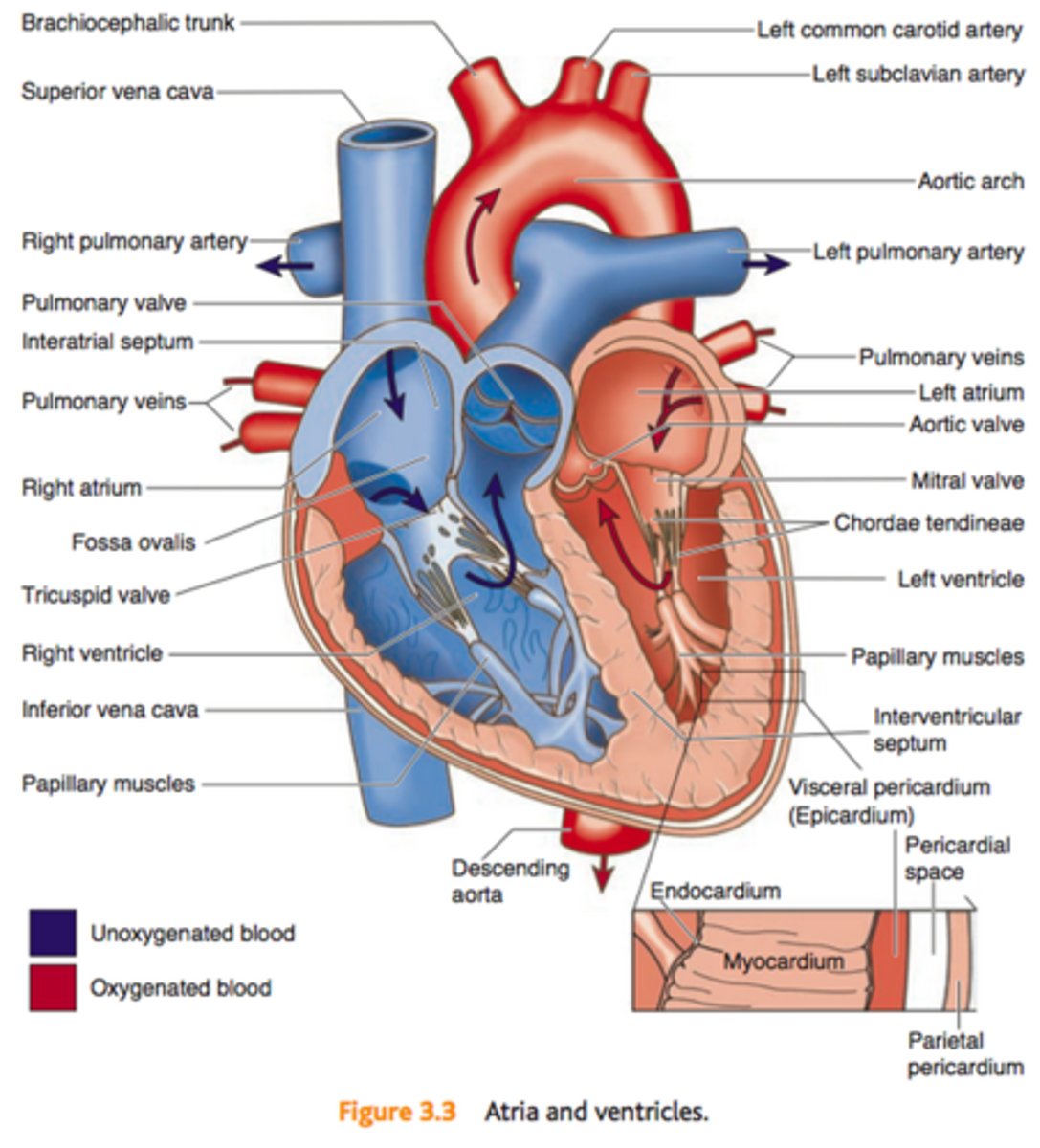
Tricuspid valve (right AV valve)
Prevents back flow of blood into the right atrium when the ventricle contracts
Pulmonary semilunar valve
prevents the return of blood into the right ventricle.
Bicuspid valve(left AV valve)
prevents blood from entering the left atrium when the ventricle contracts.
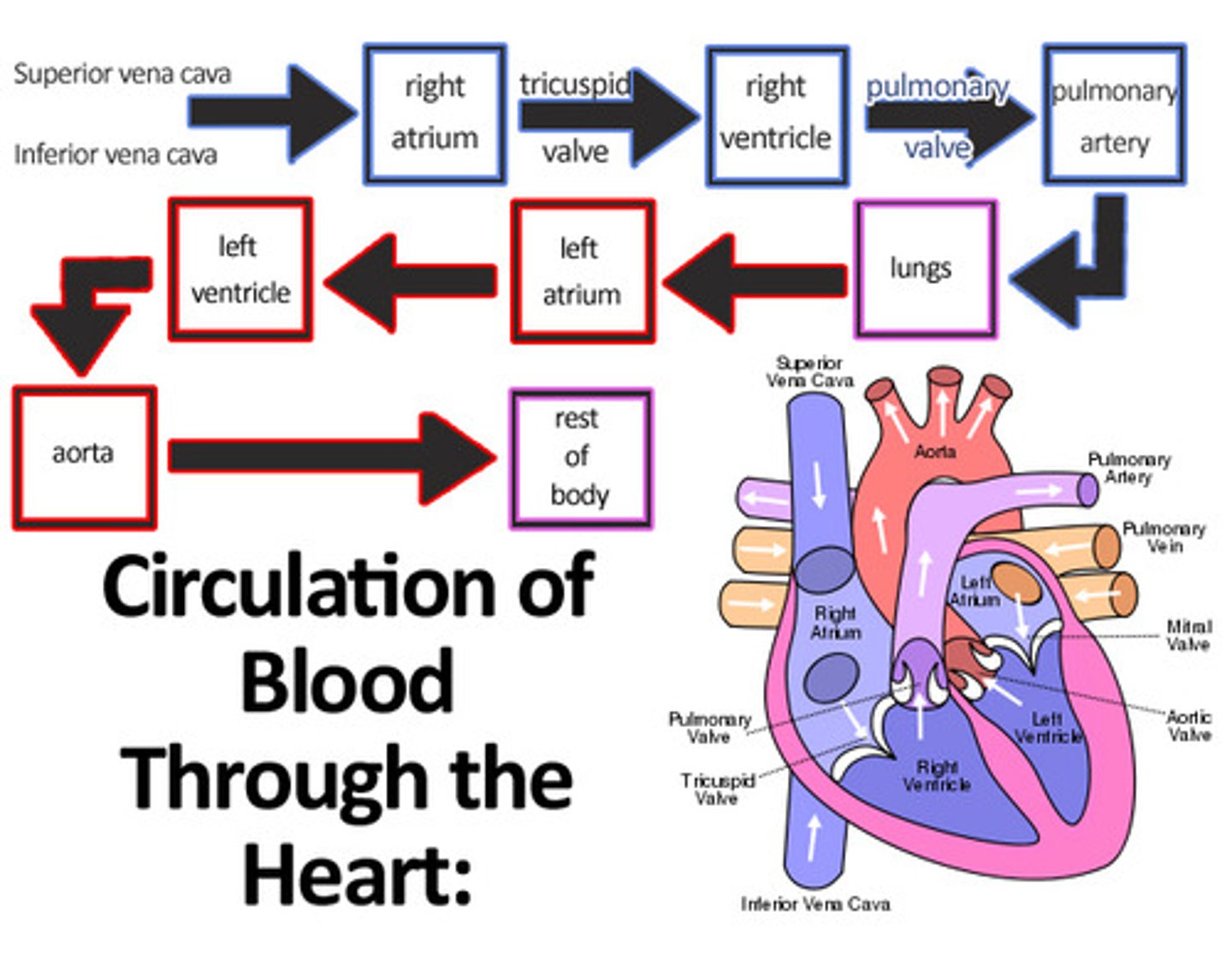
Blood flow in the heart
-Oxygen poor blood enter right atrium and flows into right ventricle via vena cava
-Blood is pumped from right ventricle into pulmonary artery (goes into lungs)
-Oxygen rich blood returns to heart via pulmonary vein and enters left atrium and flows into left ventricle
-Blood is pumped into the aorta and circulated to body
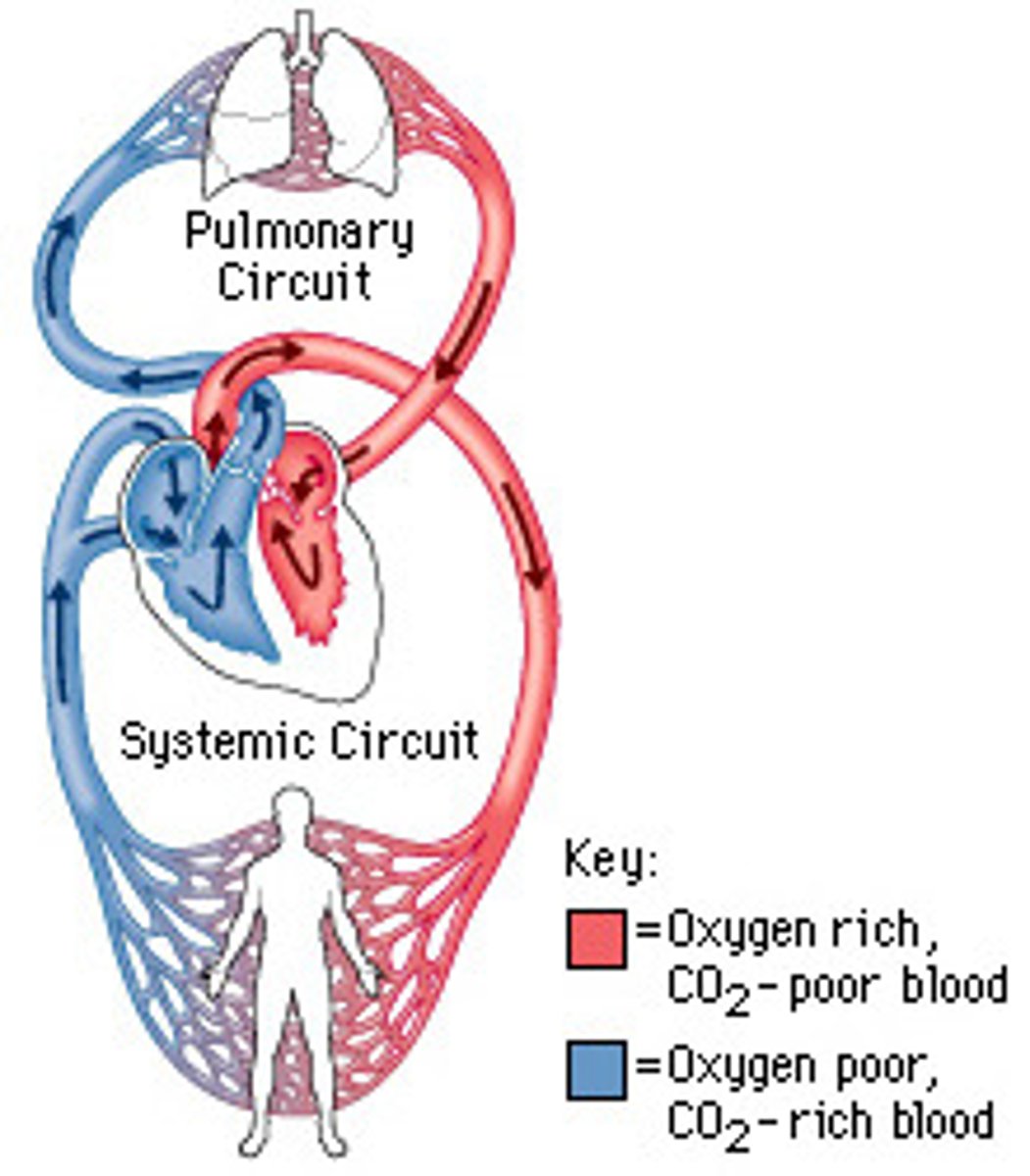
Circuits of the heart
Systematic- carries blood from the muscular left ventricle of the heart to the aorta.
Pulmonary- carries blood from the heart to the lungs and back to the heart. Arteries have less oxygen than the veins.
Cardiac cycle
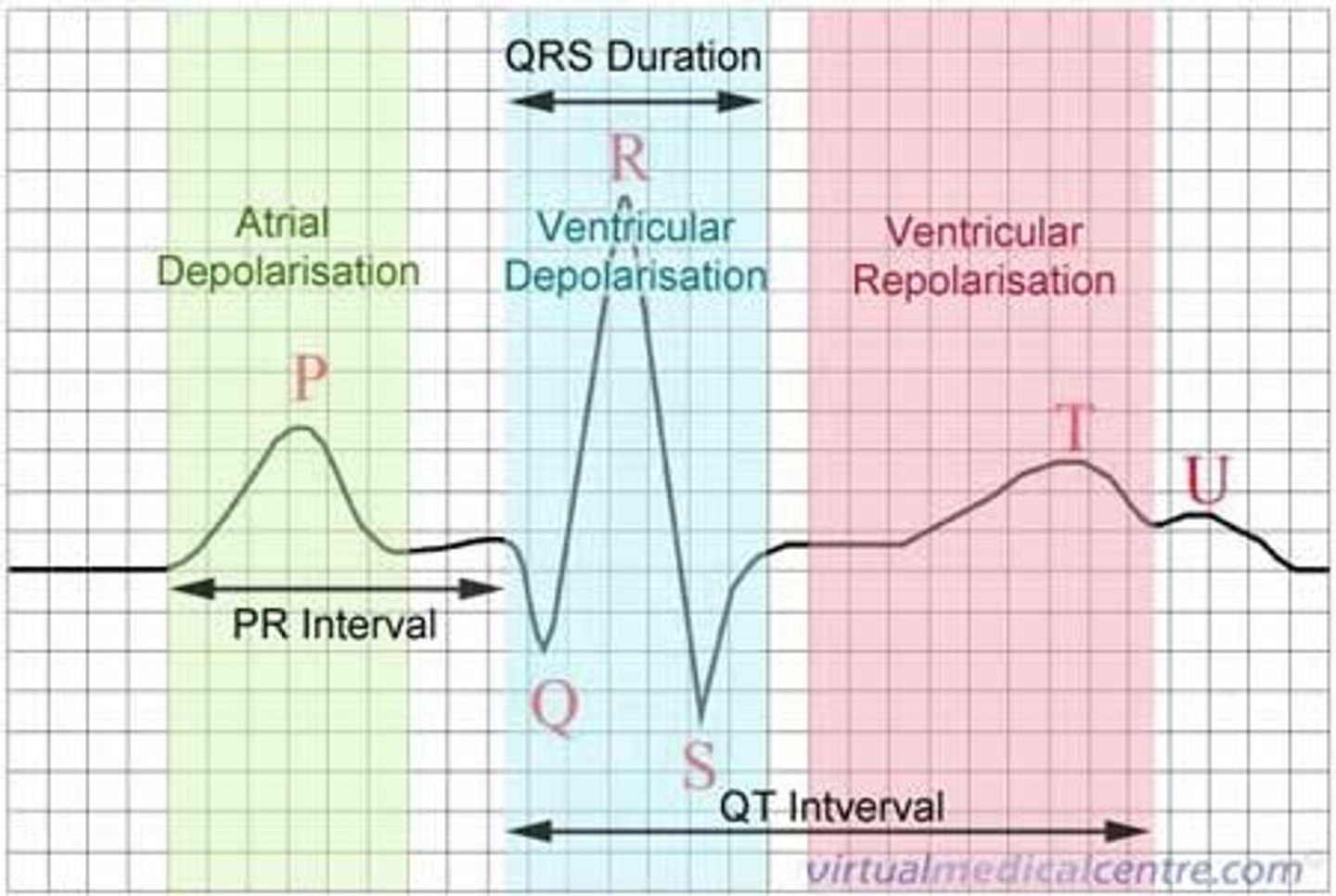
P wave- first phase of the cycle and corresponds to the wave of depolarization that spreads from the sinoatrial node to the atria.
Q wave- is seen as the negative wave on ECG, small duration. second phase.
R wave- is a positive wave and is the predominant portion of the QRS complex and is followed by the S wave.
T wave- represents ventricular repolarization, or recovery of the ventricle. It is longer than the QRS complex and is followed by U wave.
Arterial and venous systems
Tunica intima- innermost layer, Tunica media- consists of smooth muscle cells and elastic fibers. Tunica adventitia- outermost layer.
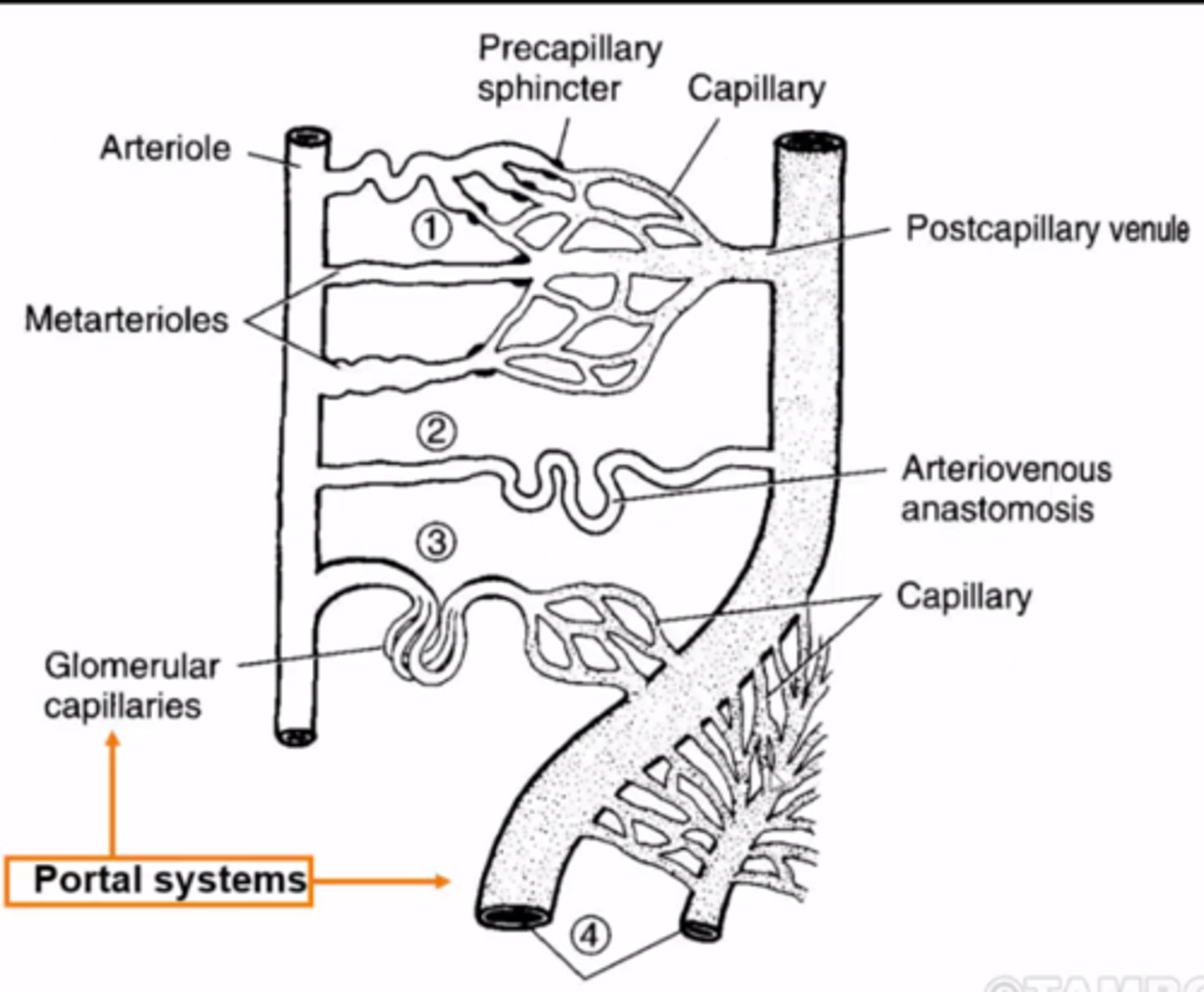
Elastic arteries- includes the aorta and major branches. Tunica media has more elastin, and are the largest vessels. Recoils under low pressure
Muscular arteries- arteries that branch off the elastic arteries. Regulates blood flow by vasoconstriction/dilation.
Arterioles- tiny vessels that lead to the capillary beds. Primary vessels involved in vasoconstriction/dilation, control blood flow to capillaries.
Venules- Empty blood into larger veins
Veins- carry blood back to the heart
Mechanoreceptors
respond to changes in pressure or tension. Meissner's corpuscles, Merkel's disks, Pacinian corpuscles, and Ruffini endings are mechanoreceptors.
Chemoreceptors
olfactory and taste receptors detect the presence of chemicals
Photoreceptors
rod and cone cells of the eye respond to light.
Thermoreceptors
sense both absolute temperature and changes in temperature
Nociceptors
detect pain
brain function
patterns of brain activity
Cranial Nerves
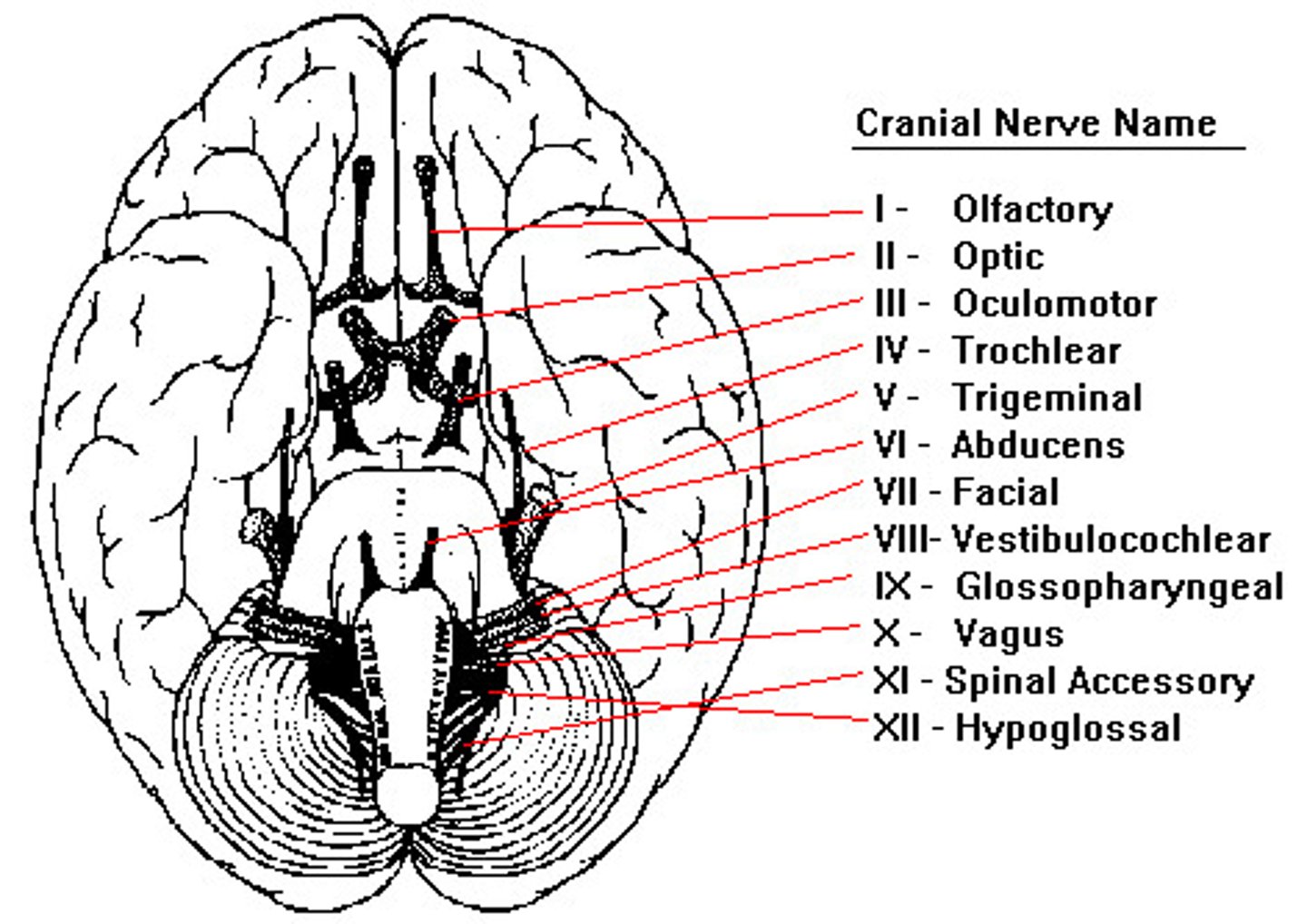
Olfactory- smell
Optic-sight
Oculomotor- moves the eye up and down, left to right
Trochlear- moves the eye up and down, left to right, and diagonally
Trigeminal- largest of the cranial nerves; chewing, face sensation
Abducens- moves the eye up, down, left, right, and diagonally
Facial- facial expression and anterior two-thirds of the tongue
Vestibulocochlear- sound
Glossopharyngeal- swallowing, saliva, and taste
Vagus- control of the PNS
Accessory- swallowing and movement of the head and neck
Hypoglossal- speech and swallowing; tongue muscles
Neurotransmitters
Acetylcholine(ACH)- stimulates skeletal muscle
Norepinephrine(NE)- influences mood and sleep patterns
Dopamine- associated with mood, attention, reward system, and movement
Histamine- works with the hypothalamus, promotes wakefulness
Serotonin- many roles- mostly inhibitory. Influences sleep, mood, hunger, arousal
GABA- the major inhibitory neurotransmitter
Glutamate- the major excitatory neurotransmitter
Range of motion(Sagittal)
Flexion- decrease the angle between two body parts(bending the elbow)
Extension- increasing the angle between two body parts(straightening the elbow)
Dorsiflexion( ankle flexion(moving the toes toward the shin)
Plantar flexion- ankle extension( moving the toes toward the ground)
ROM(Frontal)
Adduction-toward the body
Abduction-away from the midline
Elevation- scapula movement, superior movement
Depression-scapula movement, inferior movement
Inversion- lifting the medial border of the foot
Eversion- lifting the lateral border of the foot
ROM(transverse)
Pronation- rotating the hand and wrist medially from the bone.
Supination- rotating the hand and wrist laterally from the bone
Horizontal adduction- the angle between two joints decrease on the horizontal plane
Horizontal abduction- the angle between two joints increases on the horizontal plane
Rotation- pivoting or twisting on the axis
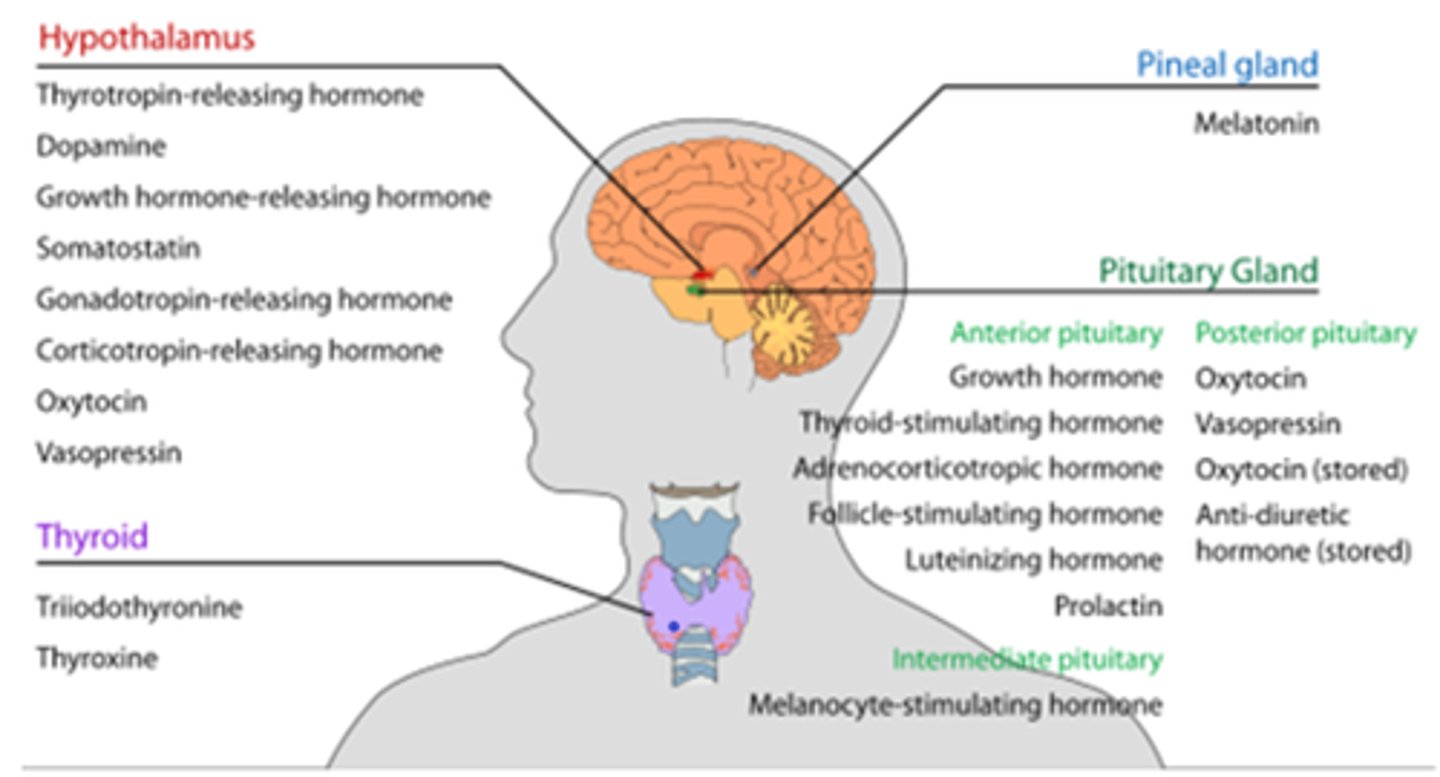
Hormones of the head and neck
GnRH(gonadotropin RH)- stimulates anterior pituitary to release LH and FSH
GHRH(growth hormone RH)- stimulates anterior pituitary to release GH
GHIH(Growth hormone IH)- inhibits the release of GH from the anterior pituitary
TRH(thyrotropin RH)- stimulates anterior pituitary to release thyrotropin(TSH)
PRH(prolactin RH)- stimulates anterior pituitary to release prolactin
PIH(prolactin IH)- inhibits the release of prolactin from the anterior pituitary
CRH(corticotropin RH)- stimulate anterior pituitary to release ACTH
Oxytocin- targets the uterus to stimulate contractions, targets the mammary glands for milk secretion
ADH- targets the kidneys and blood vessels to increase water retention
Pituitary Gland Hormones(anterior)
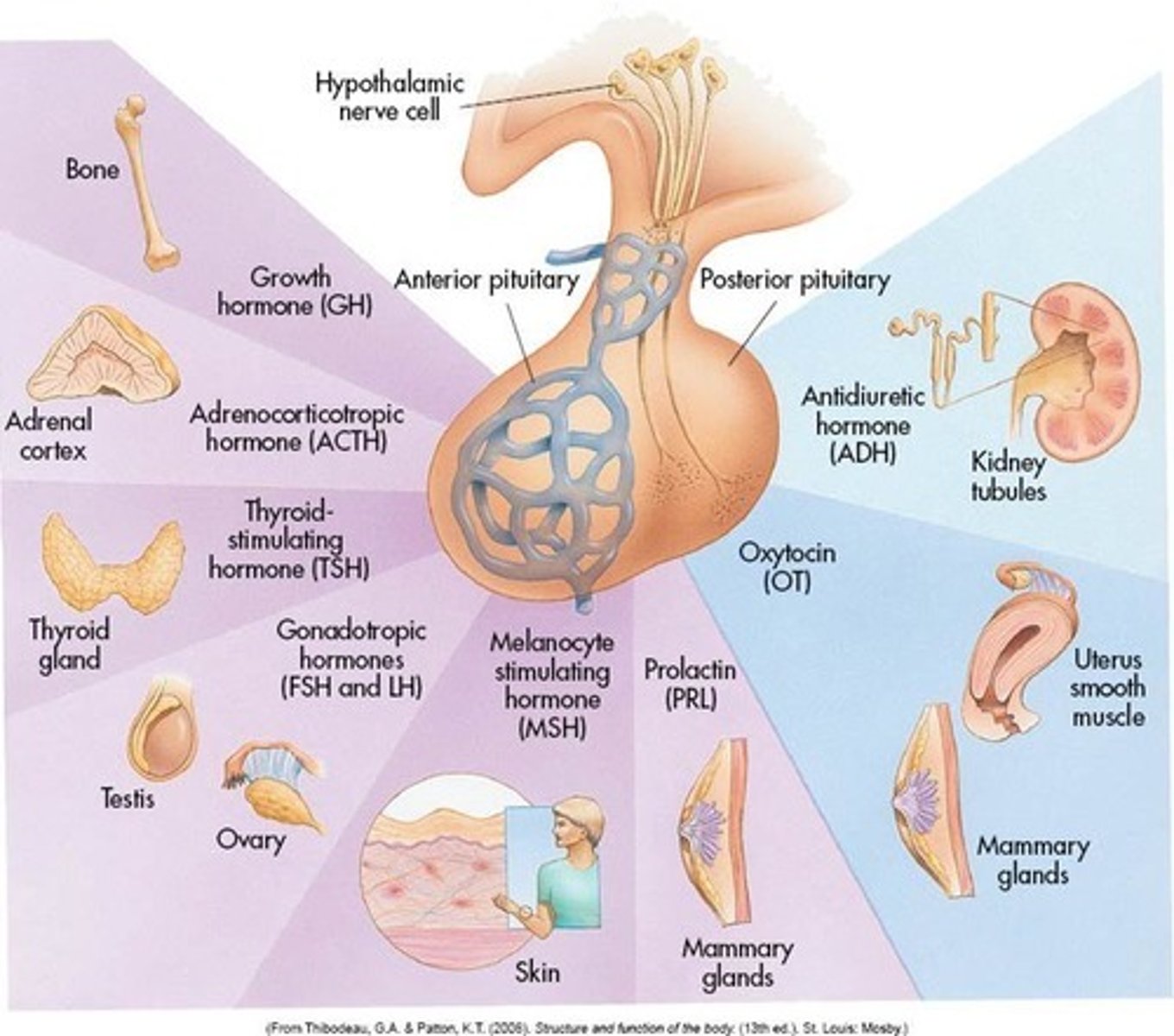
TSH(thyroid stimulating hormone)- targets the thyroid, stimulates the secretion of thyroid hormones
ACTH(adrenocorticotropic hormone)- targets the adrenal cortex, stimulates the release of glucocorticoids and mineralocorticoids
GH(Growth hormone)- targets muscle and bone, stimulates growth
FSH(follicle stimulating hormone)- targets the gonads, stimulates the maturation of sperm cells and ovarian follicles
LH(Luteinizing hormone)- targets the gonads, stimulates the production of sex hormones, surge stimulates ovulation in females
PRL(prolactin)- targets the mammary glands, stimulates production of milk
Pituitary gland hormones(posterior)
Oxytocin(produced in hypothalamus, stored and released by posterior pituitary)- targets the uterus, stimulates contractions, targets the mammary glands, stimulates milk secretion
ADH(antidiuretic hormone vasopressin)- targets the kidneys and blood vessels, increases water retention
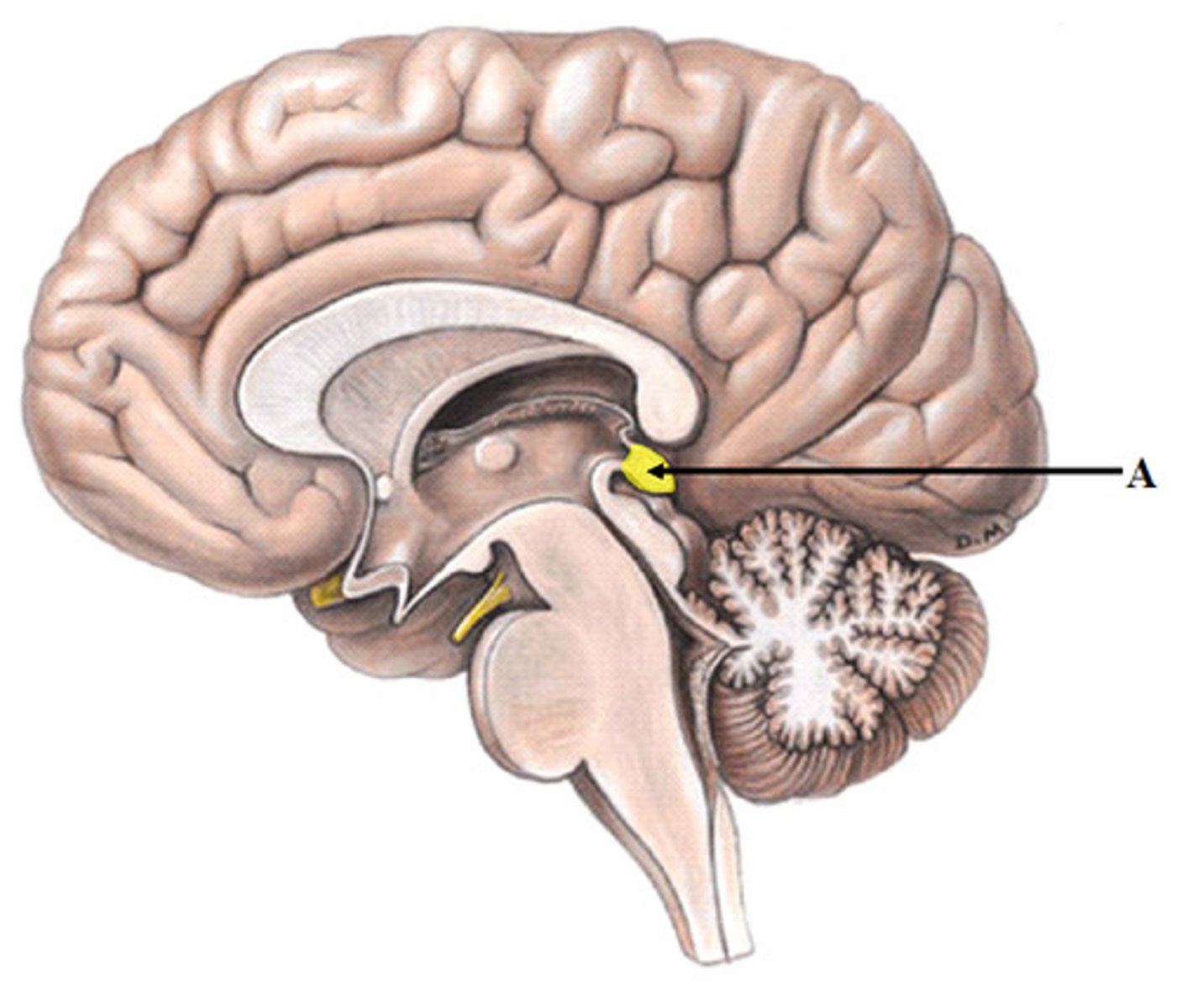
Pineal Gland
situated between the two hemispheres of the brain where the two halves of the thalamus join
Hormone Melatonin- targets the brain and regulates daily rhythm(wake and sleep)
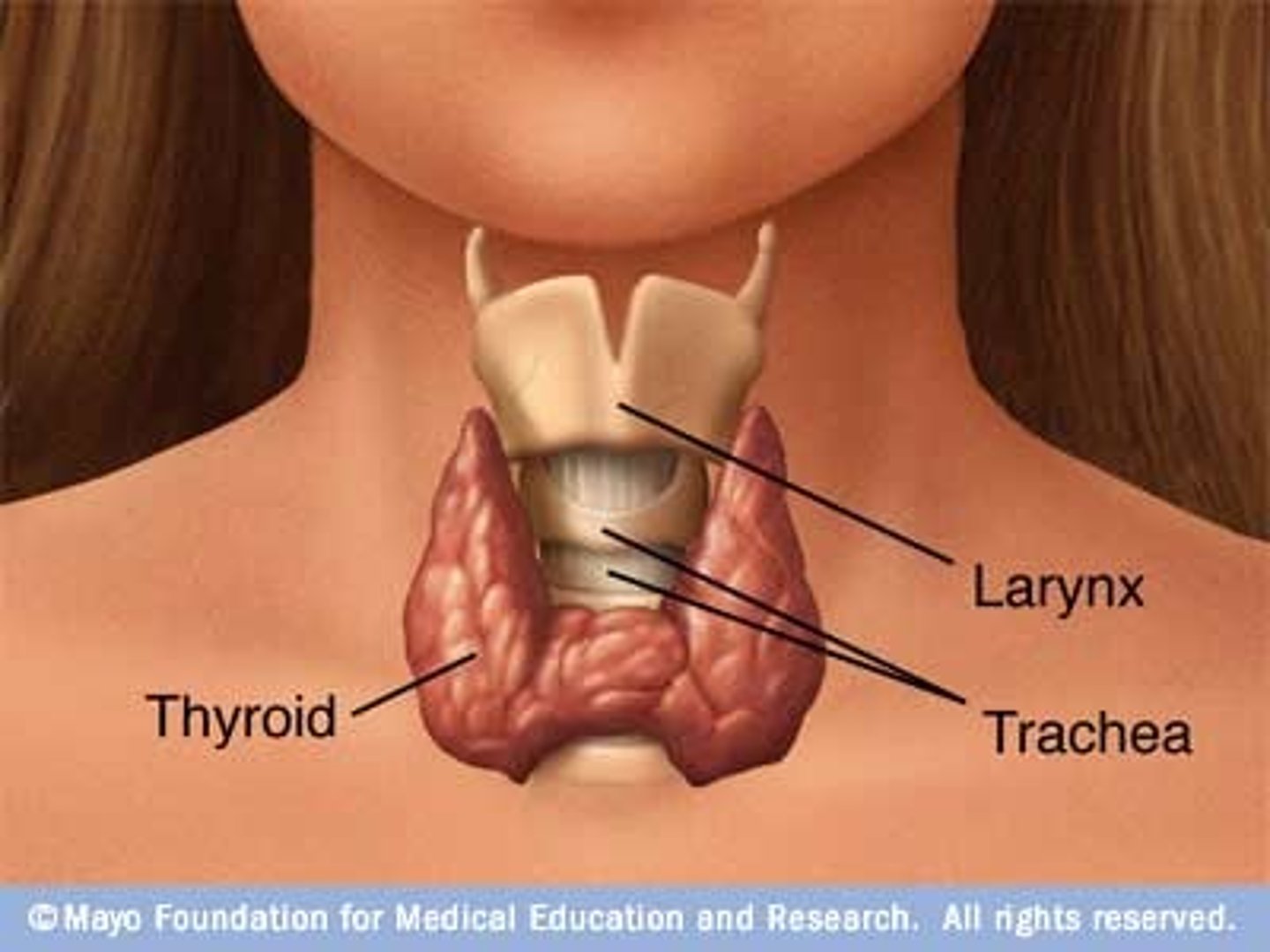
Thyroid Gland
a butterfly-shaped glands that lies on either side of the larynx, just below the thyroid cartilage.
T3(triiodothyronine)- targets most cells, stimulates cellular metabolism
T4(thyroxine)- targets most cells, stimulates cellular metabolism
Calcitonin- targets bone and kidneys, lowers blood calcium
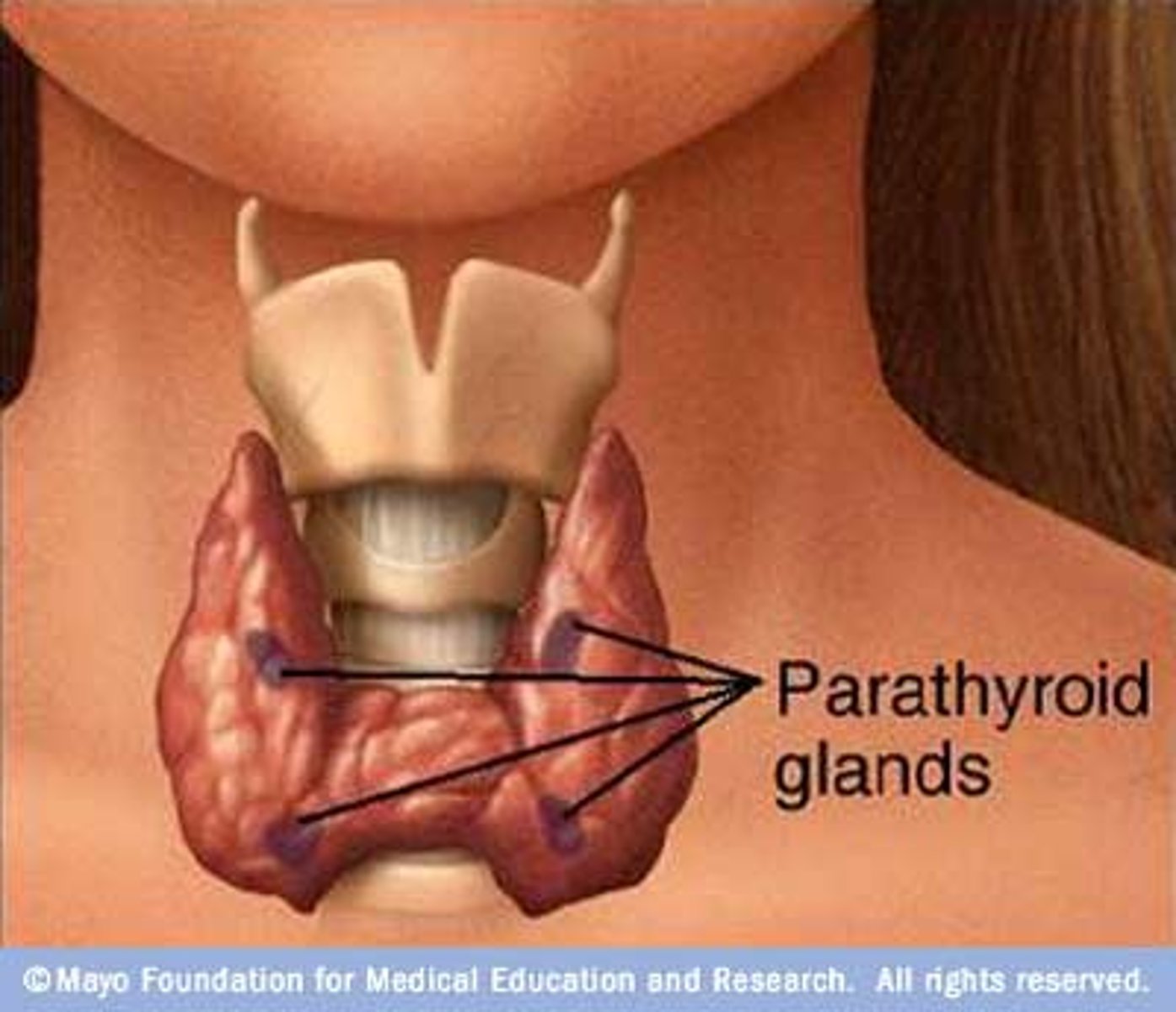
Parathyroid gland
four small glands that are embedded in the posterior aspect of the thyroid
PTH(Parathyroid hormone)- targets bone and kidneys, raises blood calcium
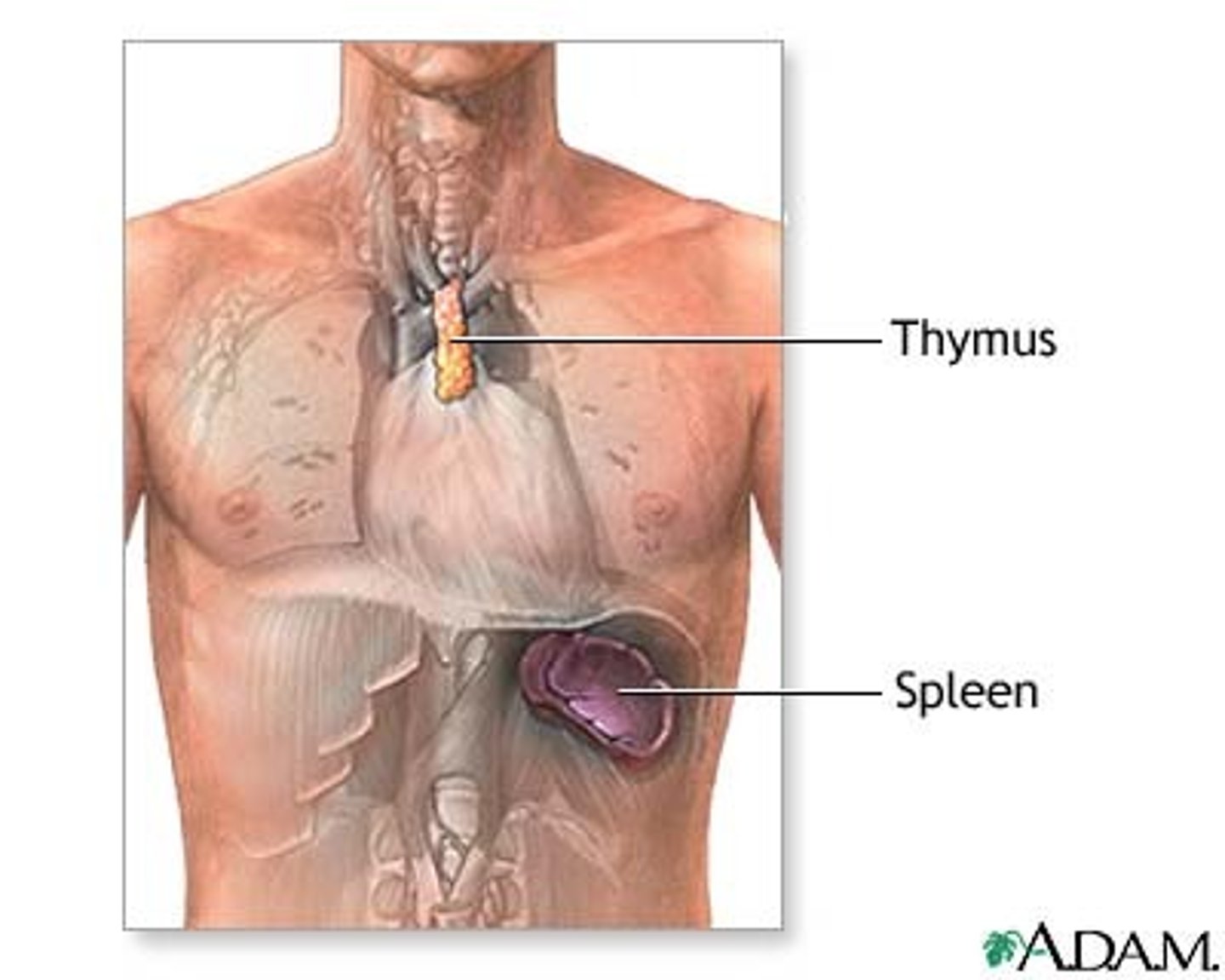
Thymus Gland
located between the sternum and the heart, embedded in the mediastinum.
Thymosin- targets lymphatic tissues, stimulates the production of T-cells
Panceras
the head of the pancreas is situated in the curve of the duodenum and the tail points toward the left side of the body.
Insulin- targets the liver, muscle, and adipose tissues, decreases blood glucose
Glucagon- targets the liver, increases blood glucose
GHIH(growth hormone IH)- inhibits the secretion of insulin and glucagon
Adrenal Medulla
located on top of the kidneys.
Epinephrine and norepinephrine- target heart, blood vessels, liver and lungs, increase heart rate, increase blood sugar
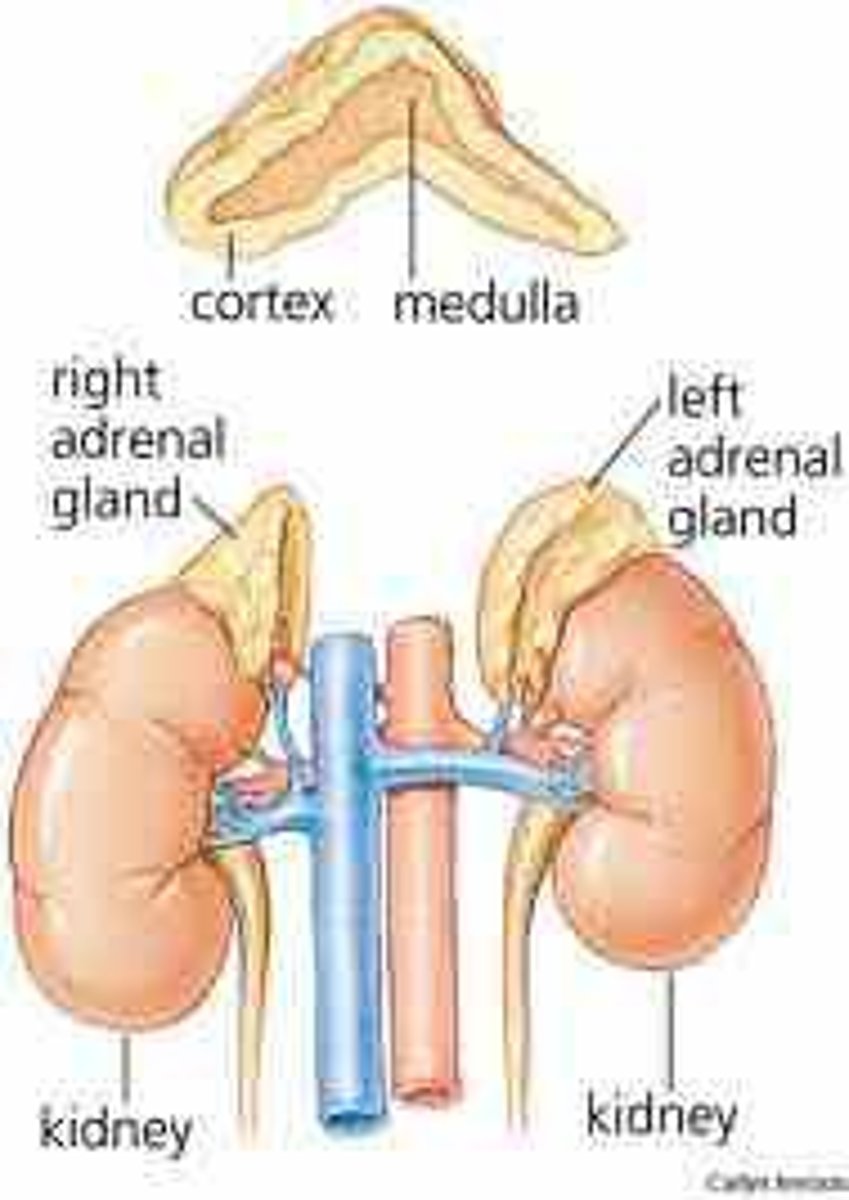
Adrenal cortex
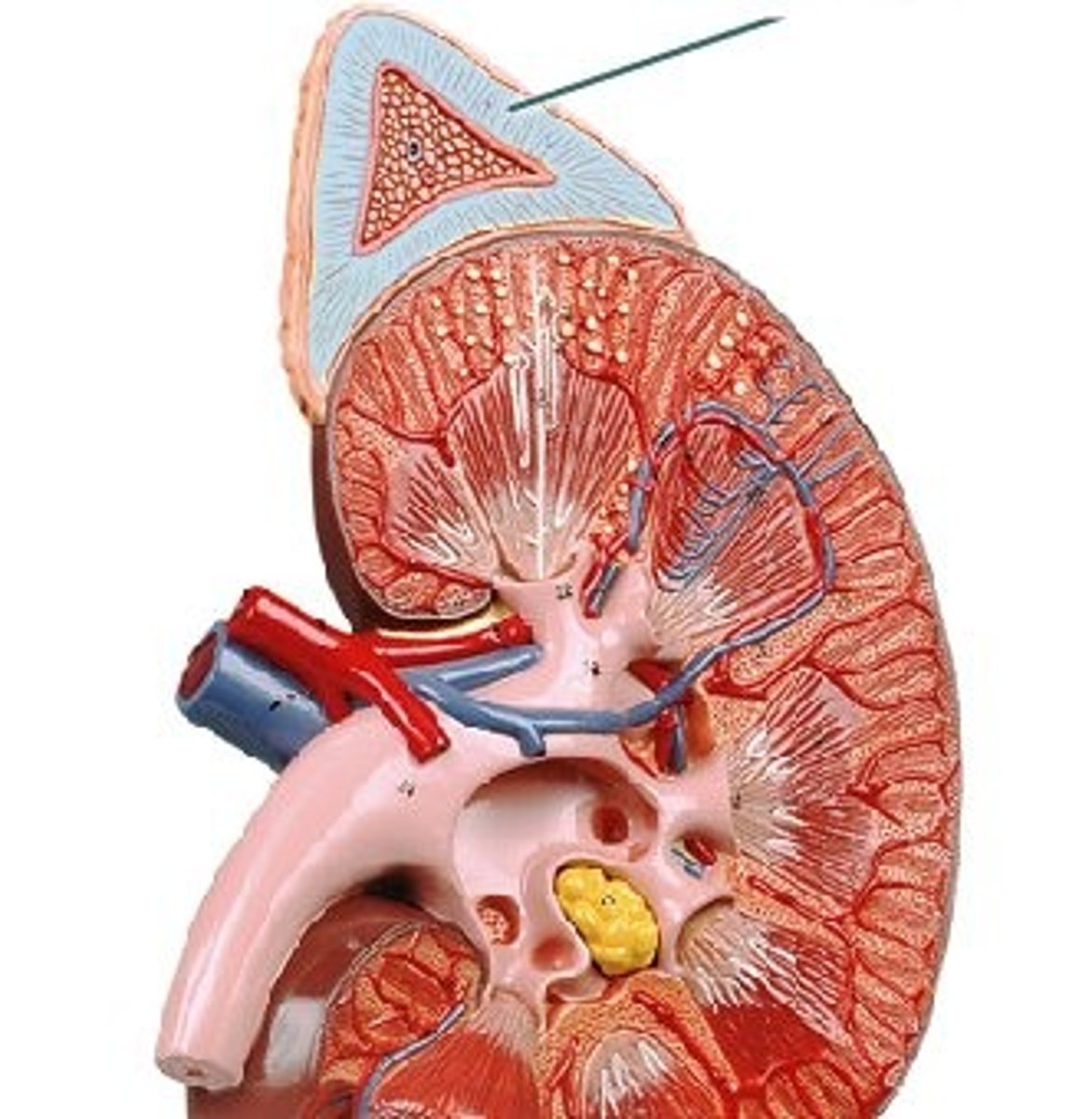
outer section of each adrenal gland; secretes cortisol, aldosterone, and sex hormones.
Mineralocorticoids- target the kidneys, increases the intention of NA and excretion of K
Glucocorticoids- target most tissues, released in response to long-term stressors, increase blood glucose
Androgens- target most tissues, stimulates development of secondary sex characteristics