OCNG 251 Exam 4
 Studied by 0 people
 Call with Kai
 Learn
Learn Practice Test
 Spaced Repetition
 Match
Match Flashcards
 Knowt Play
1/52

There's no tags or description
Looks like no tags are added yet.
Name | Mastery | Learn | Test | Matching | Spaced | Call with Kai |
|---|
No analytics yet
Send a link to your students to track their progress
53 Terms
What are autotrophs and heterotrophs? What is primary production?
- Autotrophs: organisms that make their own food from inorganic compounds by using an external source of energy
- Energy used by autorophs comes from solar radiation (photosynthesis) or chemical reactions (chemosynthesis)
- Heterotrophs: organisms that cannot make their own food (convert inorganic compounds to organic compounds) and instead rely on consuming other organsims to get energy
- Primary Production: the synthesis of organic matter (carbon compounds) from inorganic carbon dioxide
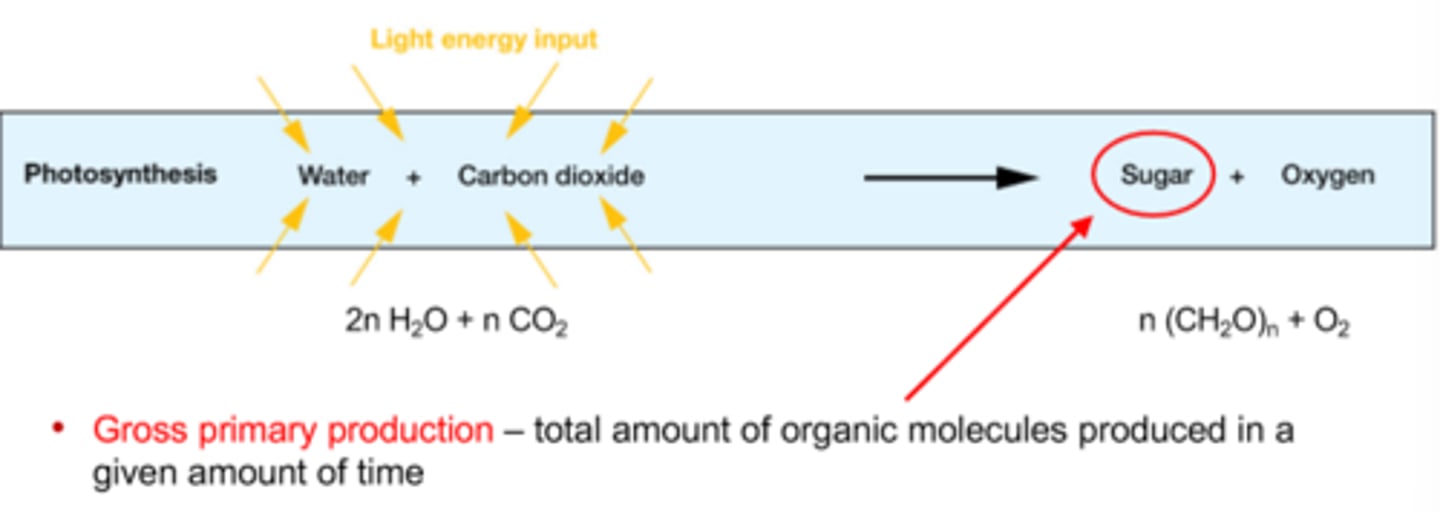
What is photosynthesis? What is the equation for photosynthesis, and how do marine organisms obtain the 'inputs'?
- Photosynthesis: sunlight energy is chemically stored in carbon-based organic molecules such as sugars (and can be used later)
- Energy is used to fuel life processes through respiration
- Energy is used to build organic structure and tissues
- The equation for photosynthesis is as pictured:
- The raw materials (carbon dioxide, water, and nutrients) are all available in sea water
- The energy (sunlight) is avialbale in the surface layer of the ocean
What are plankton, phytoplankton, zooplankton, and nekton?
- Plankton: animals that float with the ocean surface waters and are unable to swim against currents
- Examples: diatoms, dinoflagellates, jellyfish, etc.
- Includes phytoplankton and zooplankton
- May also include baby life stages of necton, like baby lobsters
- Phytoplankton: plankton that are photosynthesizing organisms
- Zooplankton: heterotrophic plankton that consume phytoplankton
- Nekton: animals that are active swimmers and are able to swim against the ocean currents
Why is photosynthesis important? What is biomass? What are the domiannte marine photosyntehsiszing organisms? What is gross primary production and how is measured?
- Photosynthesis is the main mode of primary productivity that marine organisms depend on
- Biomass: the mass of living things
- 99.9% of marine biomass relies direclty or indirectly on photosynthesis for food
- Carbon-based organic molecules (and their energy) made by photosynthesizing oragnsims is transferred to zooplankton and nekton that eat phytoplankton
- The dominant marine photosynthesizing organisma rea lagae and cyanobateria
- Gross primary production: the total amount of organic molecules produced in a given amount of time
- Sometimes gross primary production is also decribed as the amount of energy store
- Gross priamry production can be meausred by looking at the biomass produced (sugars)
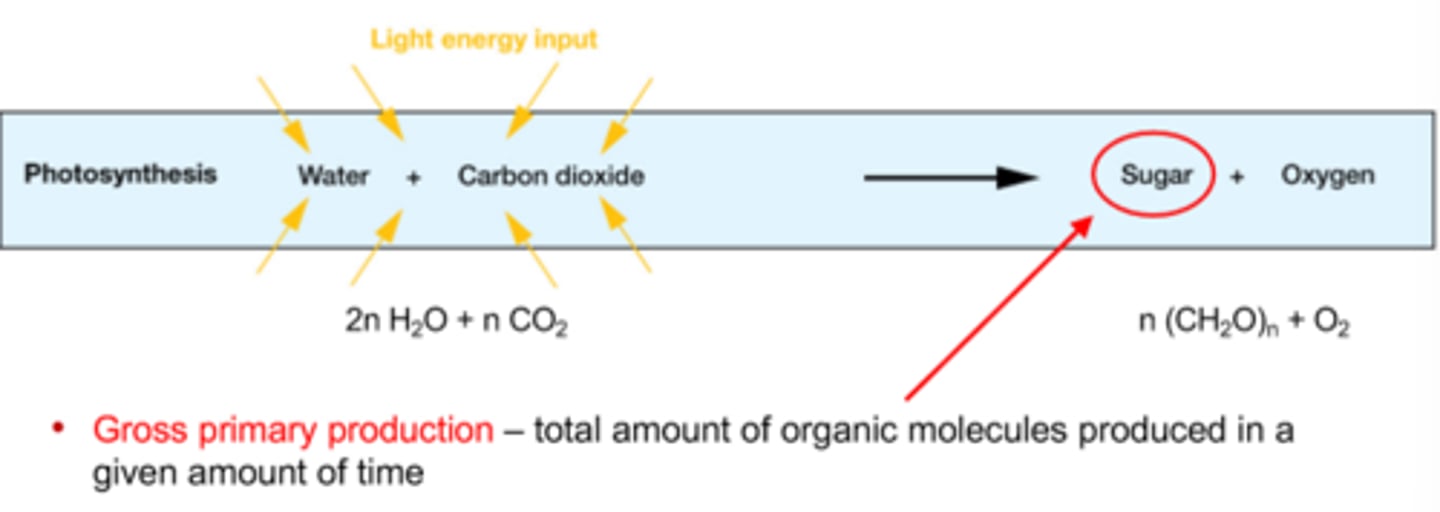
What is cellular respiration? What is the formula for cellular respiration? How does cellular respiration differe betwee autotrophs and heterotrophs?
- Respiration: the chemical reaction that releases energy from organic molecules when they are metabolized by chemical reactions with oxygen (creates usable ATP)
- The energy is used to run cellular machinery
- The formula for cellular respiration is as pictured:
- Carbohydrates and oxygen are chemically combined, and the process releases heat energy which can be used to run cellular machinery
- Respiration is done by both autotrophs and heterotrophs:
- Autotrophs: use energy they previously stored through photosyntehsis
- Heterotrophs: use energy gained by consuming autotrophs
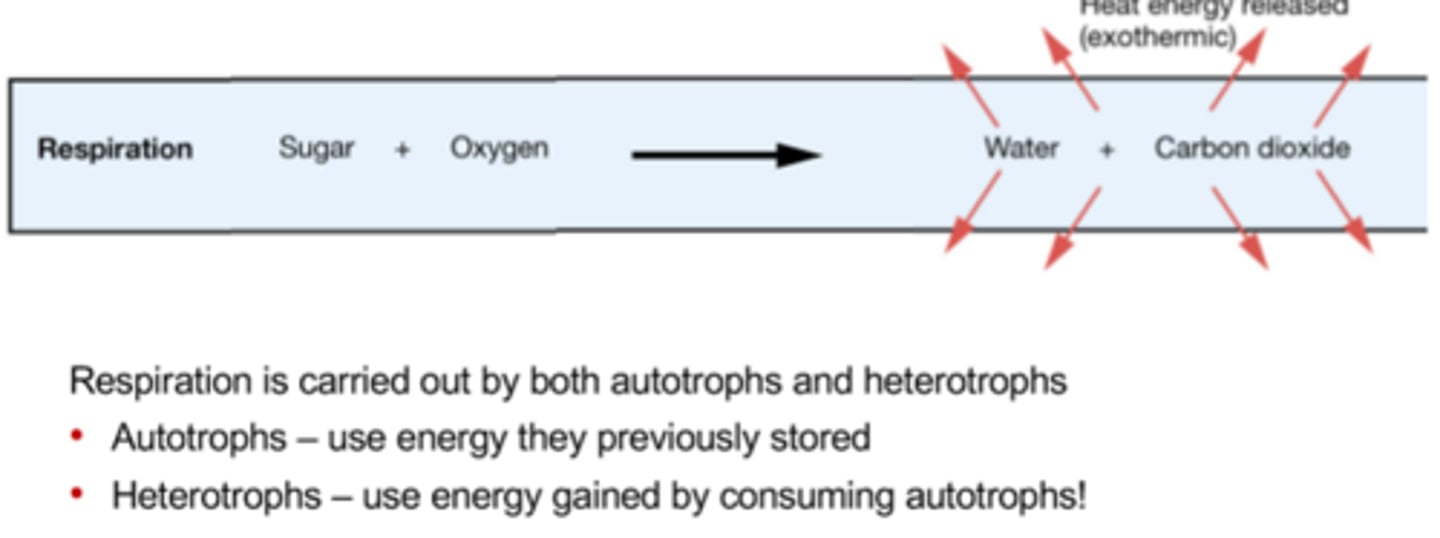
Okay the professor's slides for the equations on respiration and photosynthesis are kiund of confusingly written so here's a better equation
What is net primary production and how does it differ from gross primary production?
- Gross primary production: the total amount of organic molecules produced by photosynthesis/chemosynthesis in a given amount of time
- Net primary production: gross primary production minus loss to cellular respiration
- i.e the amount of produced organic matter that remains after it is converted to energy during respiration
- Net primary productivity (leftover organic molecules after respiration) by autotrophic organisms supports the entire ecosystem
What are the 3 main types of macroscopic marine photosynthetic organisms?
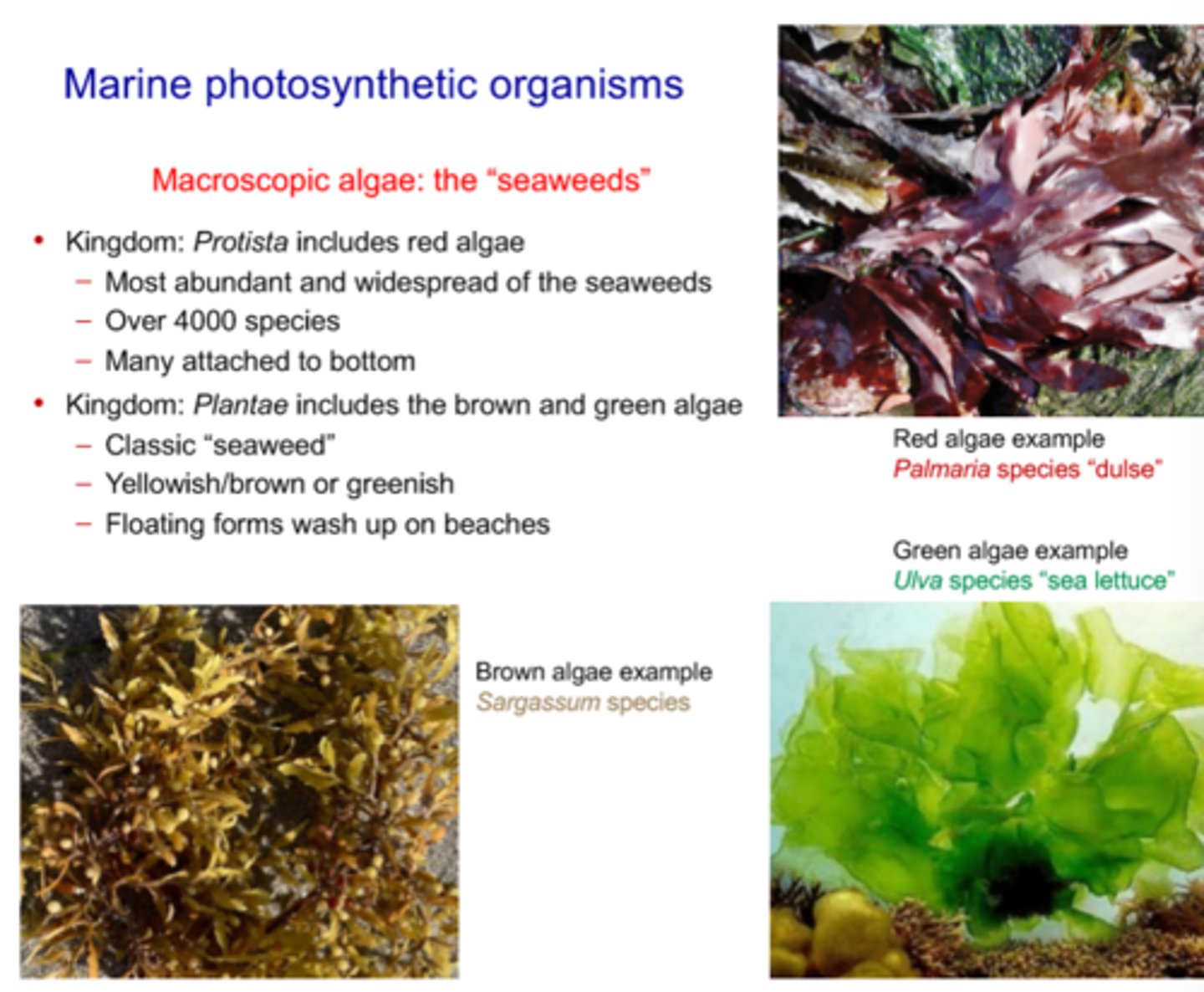
- The 3 main macroscopic algaes ("seaweeds") are red algae, green algae, and brown algae
- Red Algae Overview:
- In Kingdom protista
- Most abudnant and widespread of the seeweeds
- Over 4000 species
- Many attatched to bottom (of ocean, presumebly?)
- Brown and Green Algae Overview:
- In kingom Plantae
- Classic "Seaweed"
- Yellow/brown or greenish
- Floating forms that wash up on beachs
- Red Algae Example: Palmaria species "dulse"
- Edible
- Green Algae Example: Ulva species "sea lettuce"
- Edible
- Named after green apperance
- Brown Algae Example: Sargassum species
- Forms the "sargassum sea" in the western north atlantic where subtropical gyres form
- The floating algaes floats int he ocean and gets caught in subtropical gyres
- Sargassum is also common in the fulg of mexico and is very abudant during certain times of year
Why are microscopic marine photosyntheic organisms important? What are the defining features of diatoms, coccolithophores,. cyanobacteria, dinoflagelletaes, and green algae?
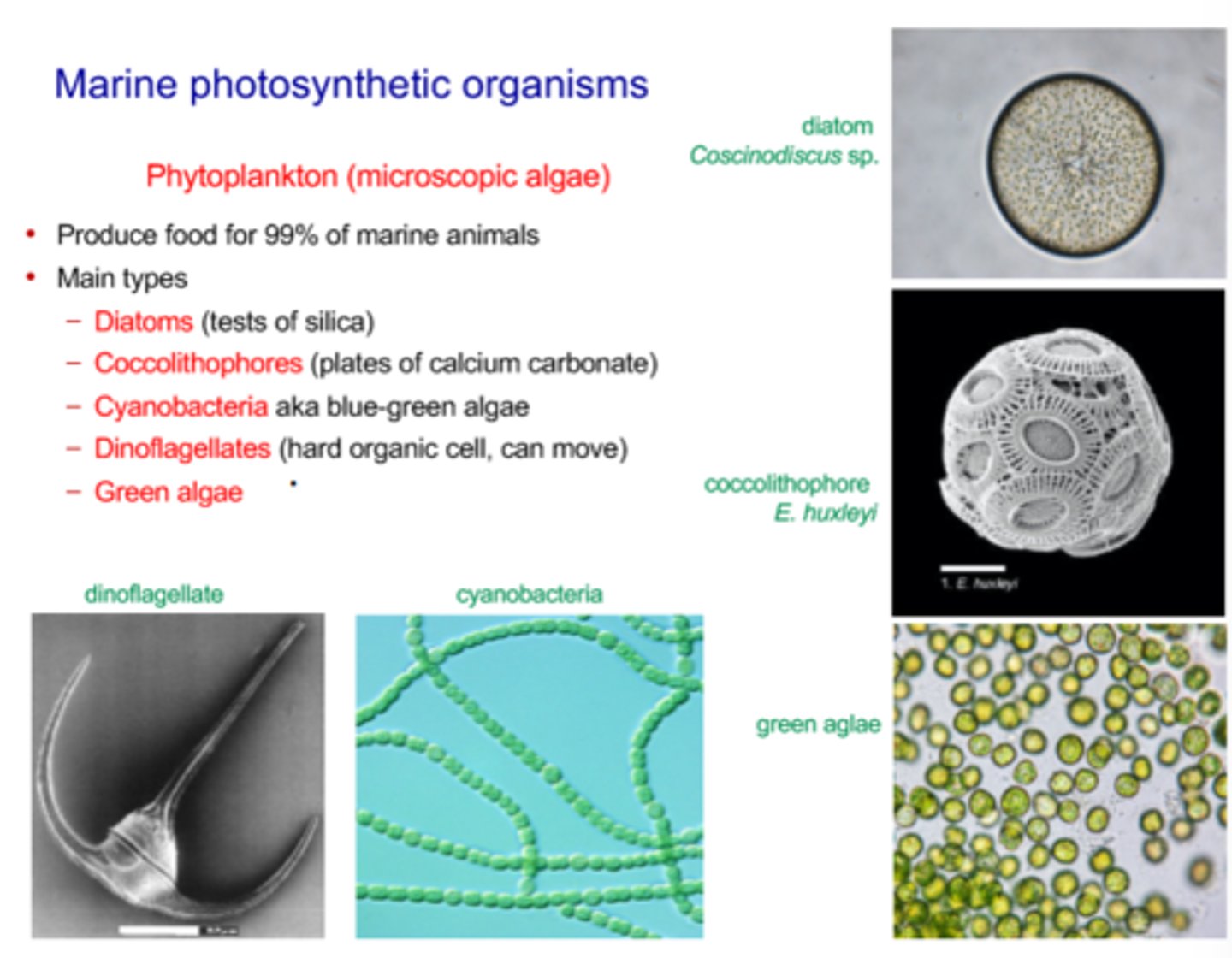
- Microscopic marine photosynthetic organisms are very quantatively important, as they produce food for 99% of marine animals
- Diatoms:
- Single-celled algae with a glass-hard frustule ("glass coating") made of silica
- Can be round or pennate shaped
- They often spread by budding, wherein they split into multiple cells but do not let go of each other, creatign big long chains/mats that float int he ocean
- The hard parts of coolithophores and diatoms sink to the saefloor and accumulate
- Coccolithophores:
- Single-celled algae covered in small circles called coccolithes, which are plates made of calcium carbonate
- Very prolific, making them important primary producers
- The hard parts of coolithophores and diatoms sink to the saefloor and accumulate
- Cyanobacteria:
- Also called Blue-Green algae
- Divided and attach to one another, like Diatoms
- Includes hair green algaes
- Have cellulose (like green algae)
- Dinoflagellates:
- An unsuaul organism that is single celled and photosynthesis, but also uses a protien-like hair/fiber that they wiggle to move
- Have two hair/flagella, one is horizontal across the crossection and the other which sticks out the back
- Have complex protiens that are resistant to breaking down
- Green Algae:
What causes red tides? What are some effects of red tides?
- Some dinoflagellates contain a red pigment that they use for photosynthesizing, and when they bloom, they form a red tide
- There are up to 2 million dinoflagellates per liter of seawater in red tides
- Some dinoflagellates produce nuerotoxins, so red tides are often classified as harmful algal blooms (HABs)
- Filter feeding marine organisms accumulate and concnetrate the toxins, then if a person eats the filter feeders, they could die
What are the 3 methods of measuring primary production?
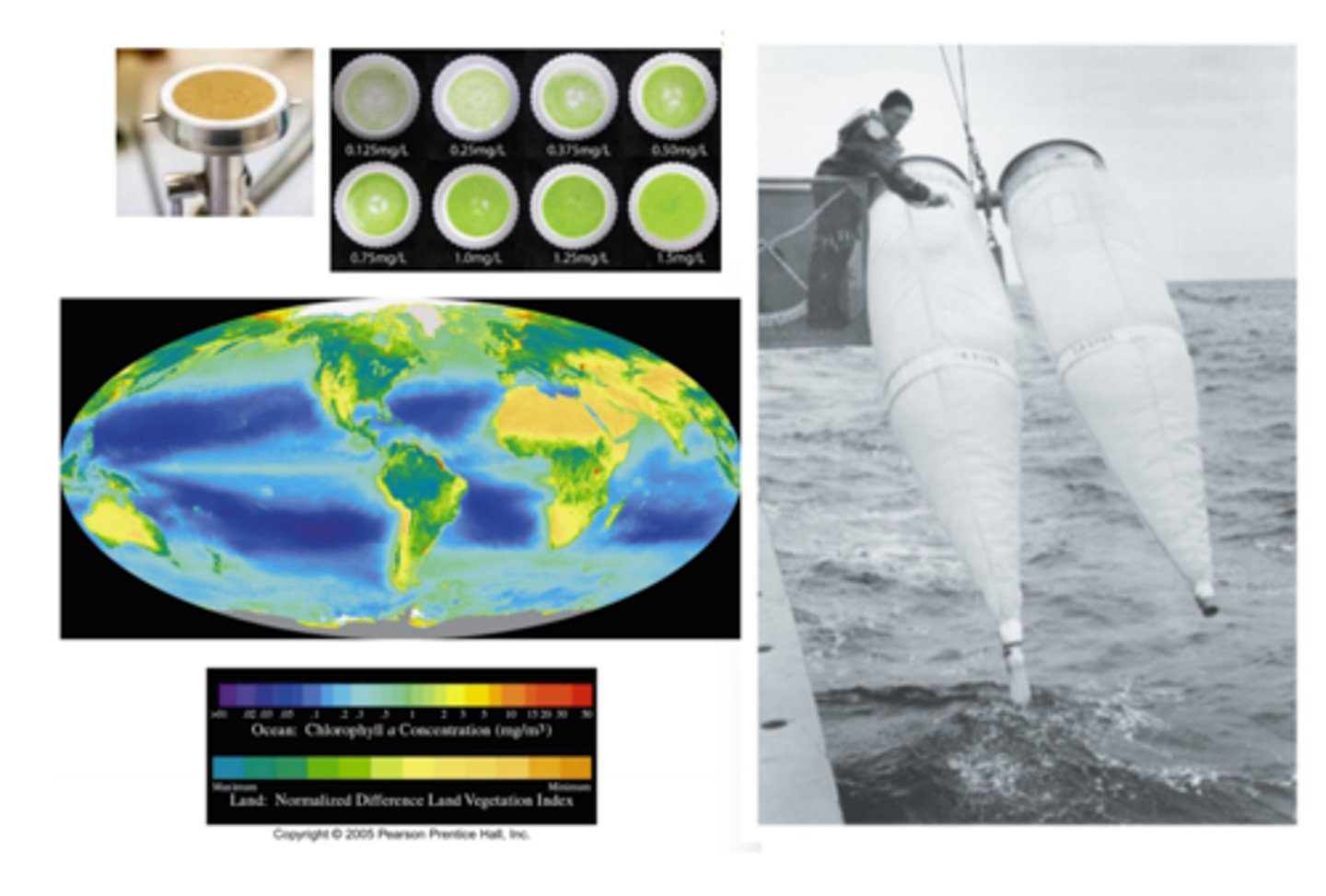
- Plankton Nets:
- Most direct measurement method
- Plankton nets are towed behind boats at various depths to strain water and collect plankton
- The amounts and types of organisms collect by the nets are analyzed
- The amount of biomass collected by the nets is used to measure the amount of primary productivity
- Chlorophyll measurements:
- Measures primary producitivty by meausring the amount of chlorophyll produced
- Seawater is collected by a pump or niskin bottle then filtered to monitor how much green photosynthetic pigment is present per volume of seawater
- The amount fo green is associated with productivity, greener --> more productive
- In situ sensors can also be used to measure chlorophyll
- In situ sensors pump water through the device while a light is shined through it, and some of the chlorophyll will floresce
- The more florescent light --> more chlorophyll
- Satellites:
- Satellites can measure ocean color (chlorophyll green) as a proxy for phytoplankton biomass (productivity)
- When light hits the land or ocean surface, different types of chlorophyll absorb different types of light (?)
- The satellite can figure out how much light is absorbed by the chlorophyll, and the more light abosrbed, the more chlorophyll there is
- The SeaWiFS (sea viewing Wide Fiwld-of-view Sensor) radiometer aboard the SeaStar satellite once provided ocean color from 1997-2010, but we now use MODIS satellite
What are the 3 main factors that detemine the amount of primary production in an ocean region?
- 1. Availability of solar radiation
- 2. Availability of nutrients (and oxygen)
- 3. Temperature (smallest impact)
How does the amount of incoming light that can be used for photosynthesis change based on latitiude and ocean depth? What are the euphotic zone and compensation depth? What colors of light travel the furthest in ocean water?
- Light is required for photosynthesis
- The higher the latitude, the more light is reflected
- Some light is also scattered at the air-sea interface
- In the clearest ocean water, light is absorbed by the water and only reaches a maximum of ~1000 meter depth
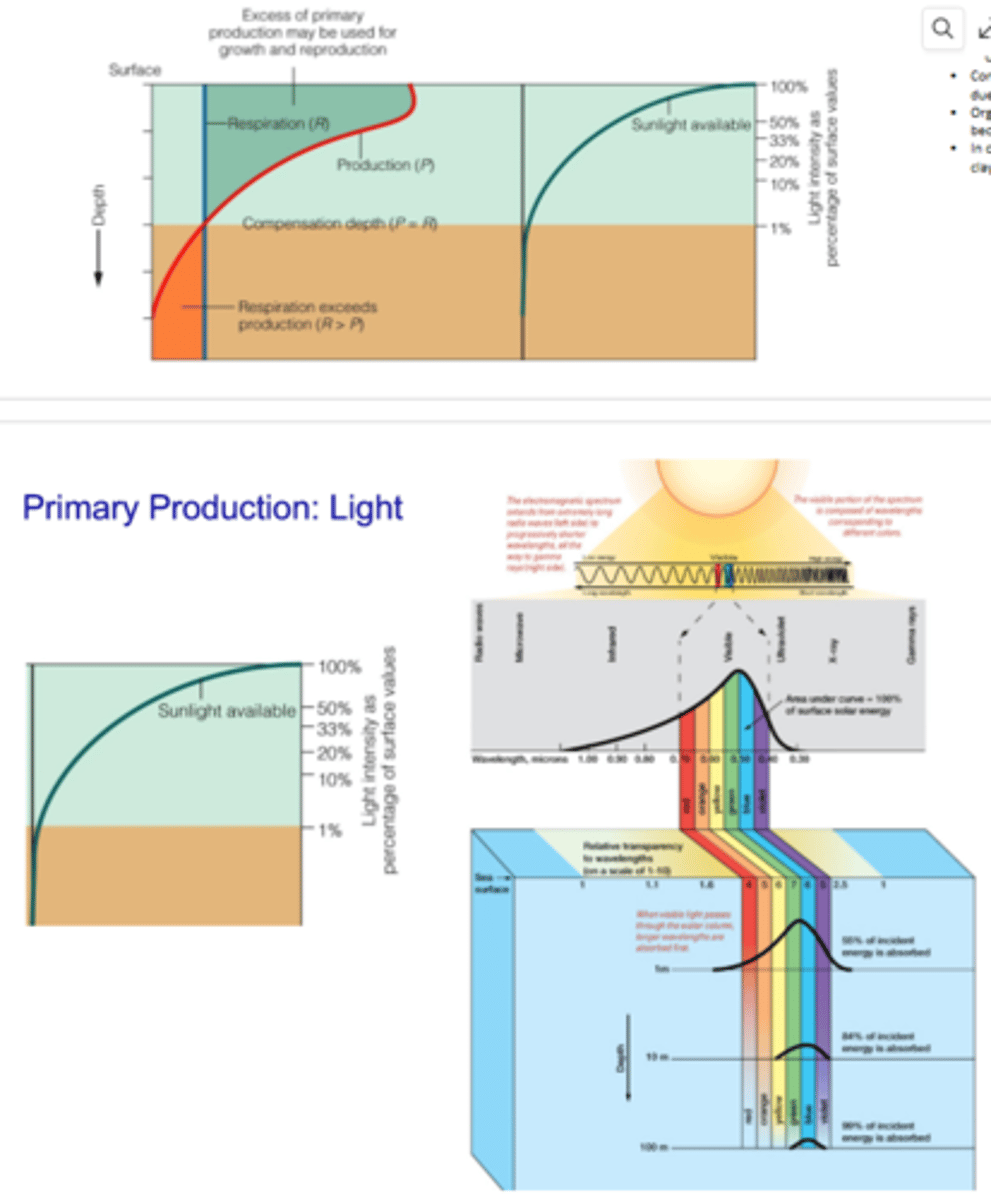
- < 1% of light reaches below ~100 m depth, so most photosynthesis happens within 100 m
- Photosynthesis only occurs in the euphotic zone, which extends from the surface to the compenseation depth for photosynthesis
- Compensation depth for phootysnthesis is the depth where there is enough light for photosynthesis to equal respiration (zero net primary production)
- In coastal waters, compensation depth shifts upwards because you have more particles (like clay and other inorganic matter) in
the water that reflect, scatter, and absorb light
- Light from the sun is compsoed of a bunch of different wavelengths that have different amounts of energy, and as the wavelengths enter the ocean, they are absorbed differently at different depths
- Most of the incoming light is abosrbd within the first few meters of water, and the vast majority of light is abosrbed by 10 m
- Blue and violet light can travel deeper into the ocean than other light colors, which why the ocean looks blue
What are some important nutrients for marine photosynthesizers? How do nutrients enter the ocean? Where does there tend to be more nutrients, the open ocean or near continets?
- Nutrients: life int he oceans depends ont he availability of nutrients such as nitrate, phosphate, silicate, and iron
- While CO2 is also important for photosynthesis, there is a lot of it in the ocean so it is generally not considered a limiting factor
- How nutrients enters the ocean depends on the element
- N, P, and Si: rocks containing these minerals are waethered away by rain and carried by river water or precipaiton runoff to ocean
- Iron: brought into the ocena via continental material, dust, or hydrothermal vents
- There are more nutrients closer to continents, which allows for more primary production
What regions tend to have the highest primary production?
- Areas where rivers empty out, draining nutrients into the ocean
- River runoff causes high producivtiy along continental margins
- Areas where wind-driven upwelling occurs, such as continental upwelling and equitorial upwelling
- Ekman transport offshore causes upwelling of deep, cold water that is rich in nutrients and dissolved gases
- Nutrients are brought into shallower waters from colder, deeper, waters
- Higher latitudes during the spring (nutrients accumulate during winter)
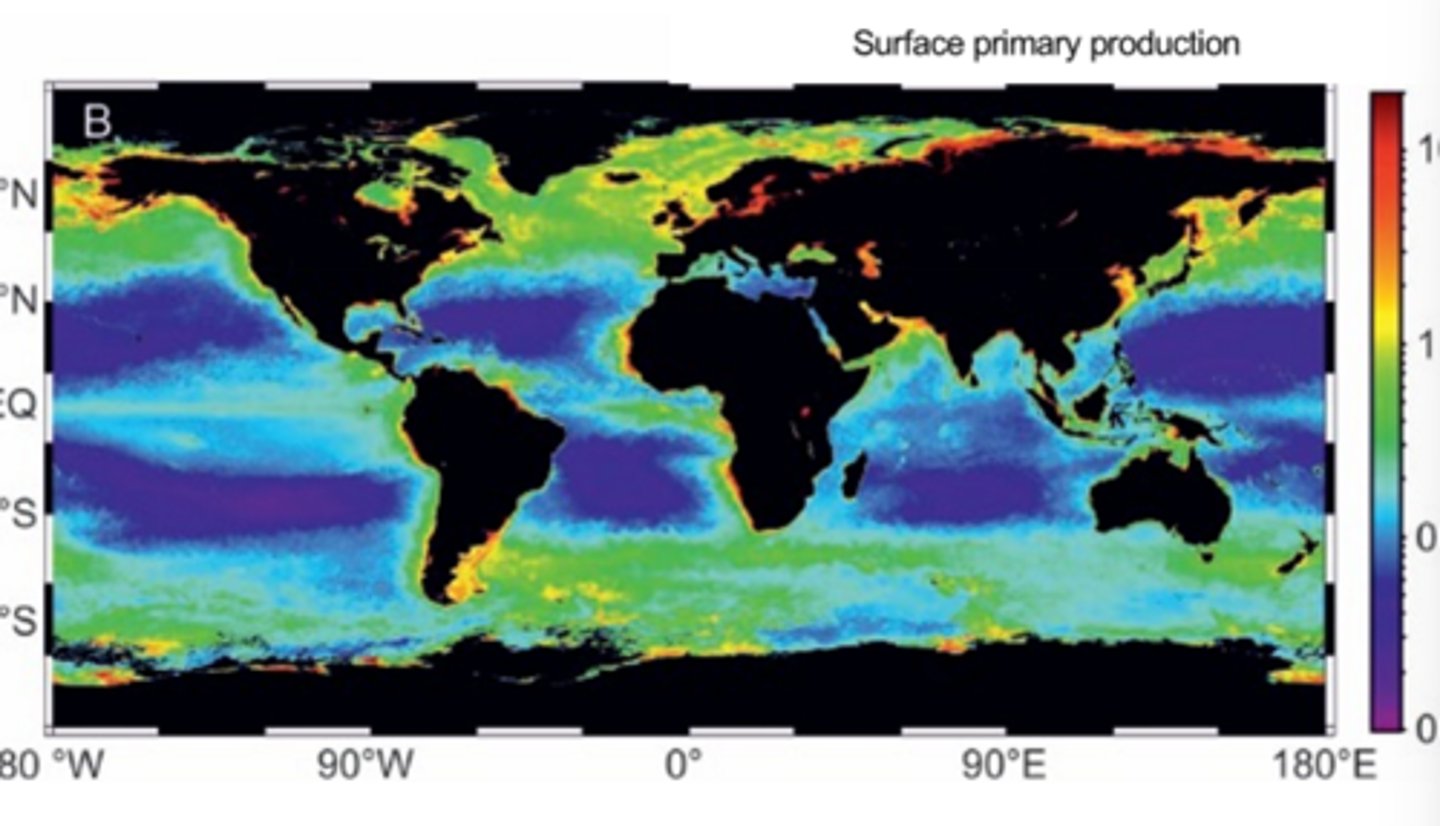
What factor is more important, nutrients or solar radiation?
- Whether nutrients or solar radiation is more important depends on the situation and location
- In the open ocean, light is plentiful but nutrients are in low concentrations and are limiting
- In coastal regions water can be murky and suspended particles ca lead to light scattering rather than being transmitted thorugh the water to deeper depths
- Light penetration is lower, but nutrients tend to be more plentiful
- The coastal zones are more productive, so nutrient availability must be the more important factor
- Coastal areas have rivers emptying out into the ocean, supplying nutrients picked up from the soil, land, and living things to the sealife
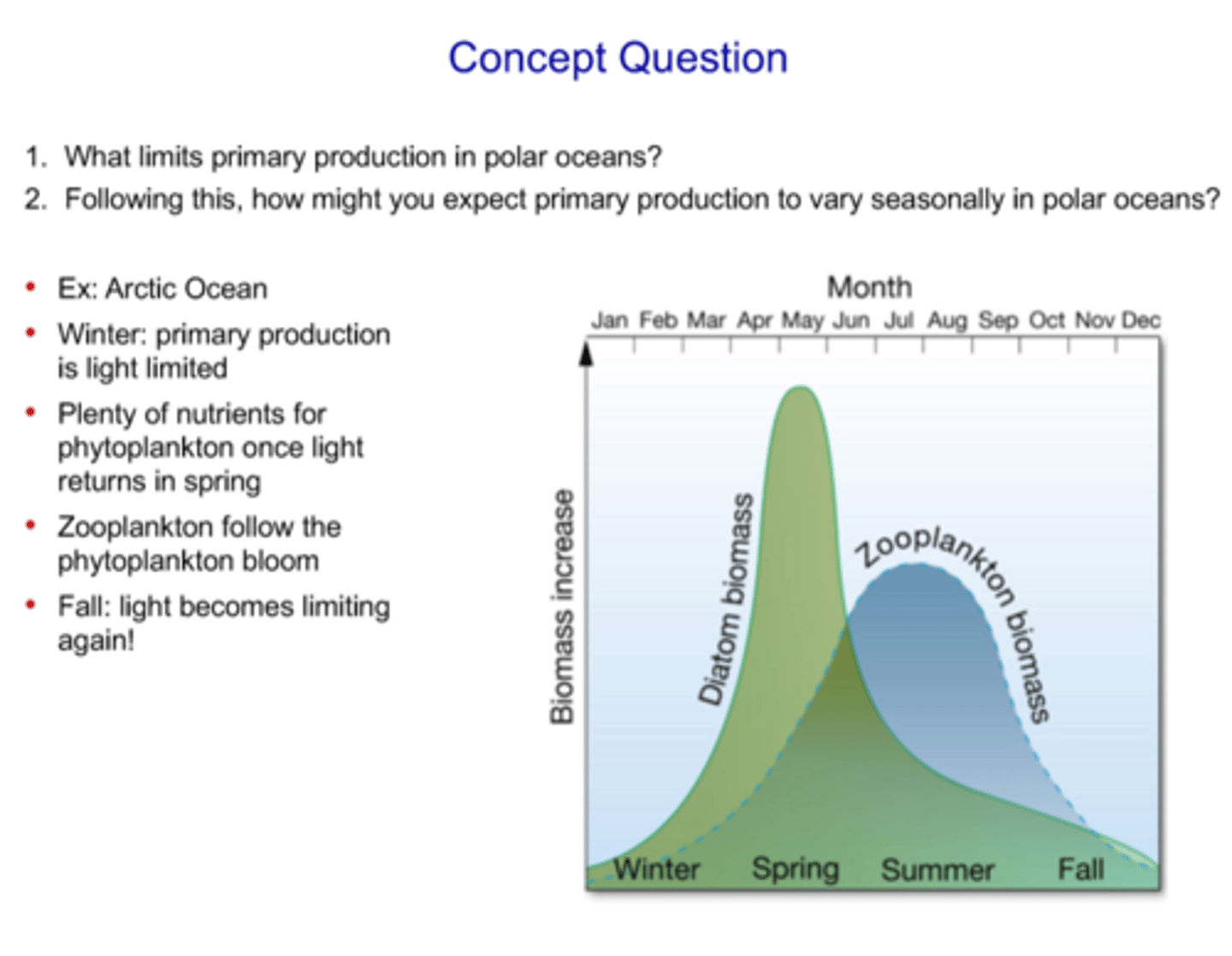
What limits primary production in polar oceans and how does primary productivity vary seasonally in polar oceans? How does zooplankton mass change over the seasons?
- At high latitude oceans (polar oceans) there is tradeoff between light and nutrients during different seasons
- Winter:
- Primary production is limited by light, as daylight hours decrease
- Nutrients build up in the water because there is not neough light for phytoplankton to actually use it
- Spring:
- Light levels increase dramatically
- When spring arrives, phytoplankton can utilize the nutrients that built up during the spring
- There is a "bloom," leading to a rapid increase in phytoplnakton biomass
- Once phytoplankton biomass increases, the zooplankton that consume phytoplankton also see an increased in mass, though it is slightly delayed behind the phytoplankton bloom
- An early spring bloom of phytoplankton and a dealyed spring bloom of zooplankton
- Summer:
- Light levels are high, but much of the nutrients start to be used up
- Zooplankton conumption of phytoplankton also leads to a decline in phytoplankton biomass
- Fall:
- Light becomes limiting again
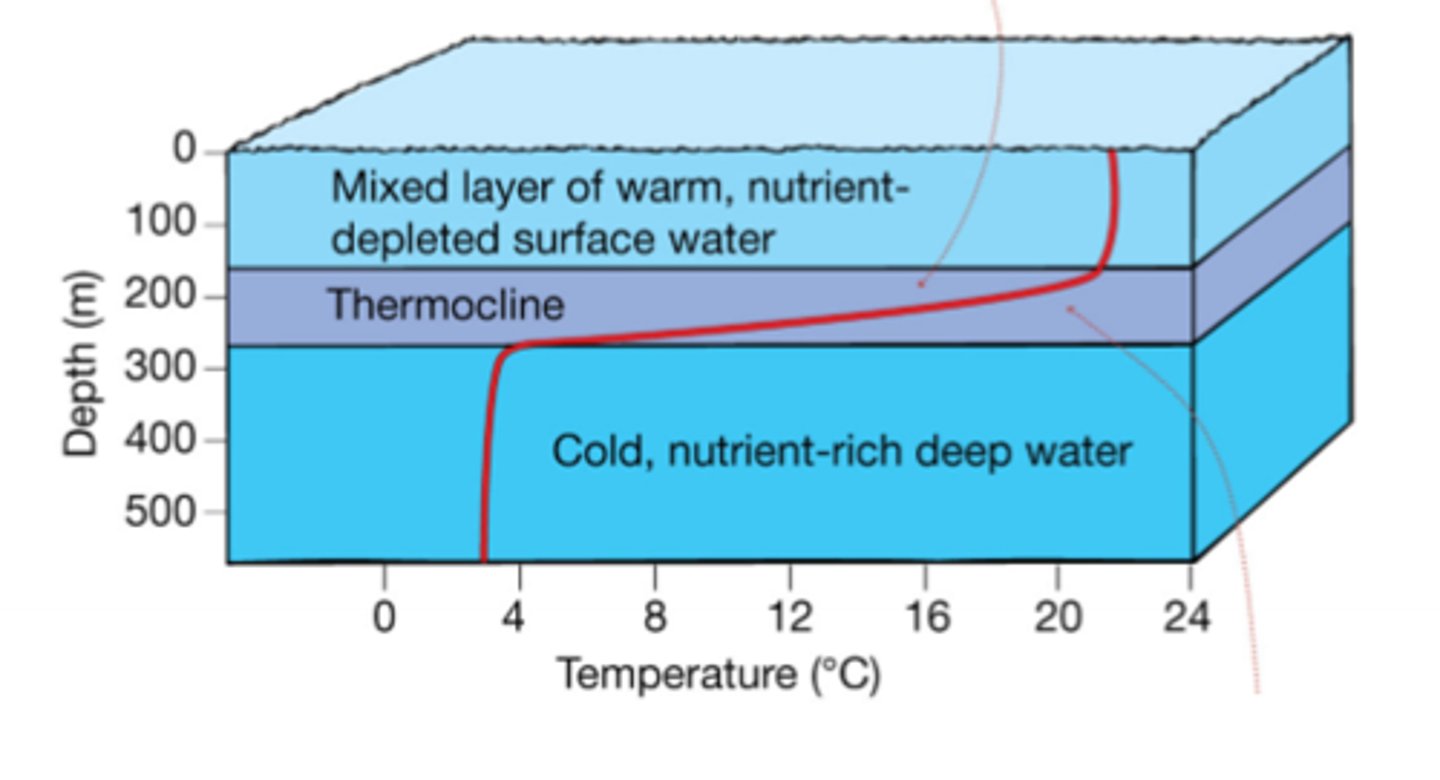
What limits primary production in tropical oceans? Where are some exceptions?
- Solar radiation is high but nutrients are low
- Mixing between nutrient poor surface waters and nutrient rich deeper waters is inhibited because of the permanent deep thermocline
- The upper portion of the surface is well mixed from winds with a fairy uniform temperature, but ekman's transport spiral doesn't go much deeper than ~100 meters, so the water below has differnt temperatures and densities that prevent mixing
- Productivity proceeds at a steady but low rate
- Exceptions are areas of equitorail upwelling, coastal upwelling, and coral reef ecosystems
- If water is shallow enough, a 'chlorophyll maximum; may form where in the chlorophyll reaches a peak right at the thermocline because there is the best balance of light and nutrients
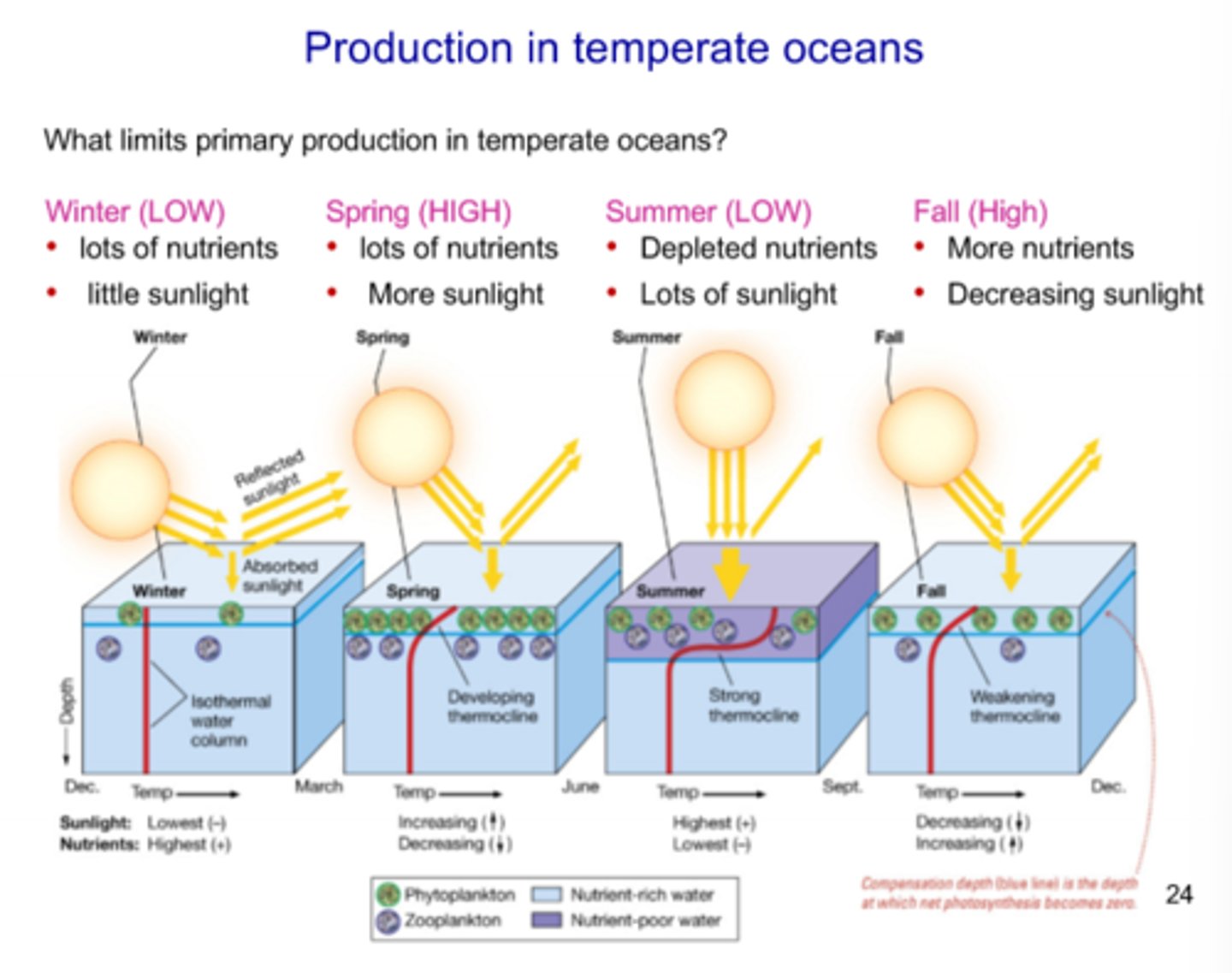
What limits primary production in temperate oceans? How does tropical productivity vary seasonally in temperate oceans? How does zooplankton mass change over the seasons?
- Limitations vary depending on time of year
- Winter:
- Lots of nutrients but less light
- Surface water temperature is cooler and becomes around the same temperature as the nutrient rich deeper waters, creating a smaller/weaker thermocline and allowing nutrients to reach the surface water
- Spring:
- Lots of nutrients and lots of light
- Leads to a spring bloom of phytoplankton and delayed bloom of zooplankton
- Summer:
- Depleted nutrients and lots of light
- Warming waters heat surface waters, creating a strong thermocline that makes it more difficult fro deeper nutrient-rich water to mix upwards
- Even though there is lots of sunlight, nutrients limits production
- Fall:
- More nutrients and decreasing sunlight
- The density difference becomes less and less, allowing for a mix-up of deeper nutrient rich waters and surface water
- A second, smaller bloom of phytoplankton and delayed bloom of zooplanton occurs
If you were to graph phytoplankton biomass, zooplankton biomass, nuteints, and sunshine for temperate oceans through the seasons, what would the graph look like?
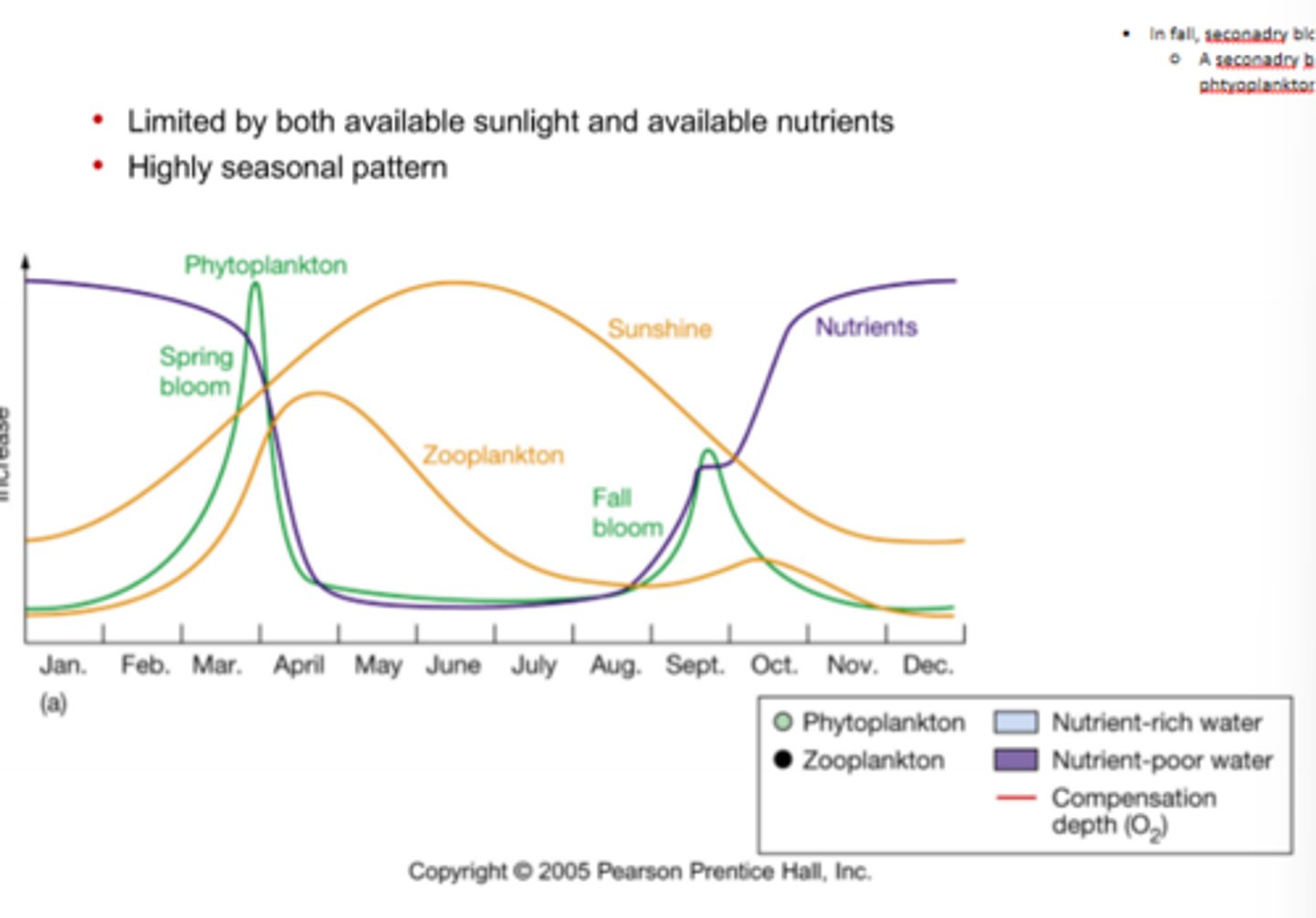
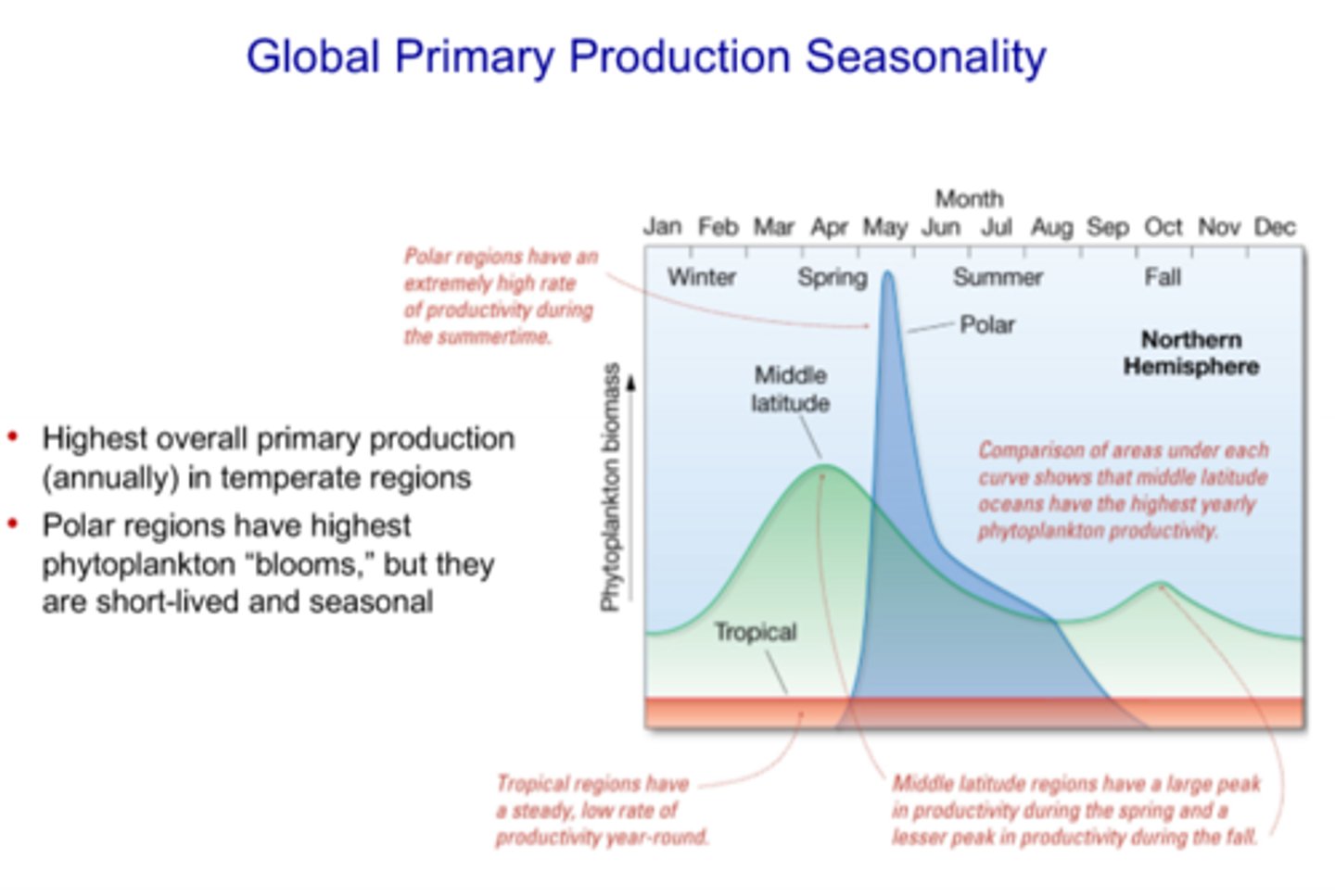
What reigons (polar, temperate, tropical) have the highest overall primary production annually? How does priamry productivity compare between these regions?
- Temperate regions have the highest overall primary production annually in temperate regions
- Polar regions have the higest phytoplankton "blooms" but they are short-lived and seasonal
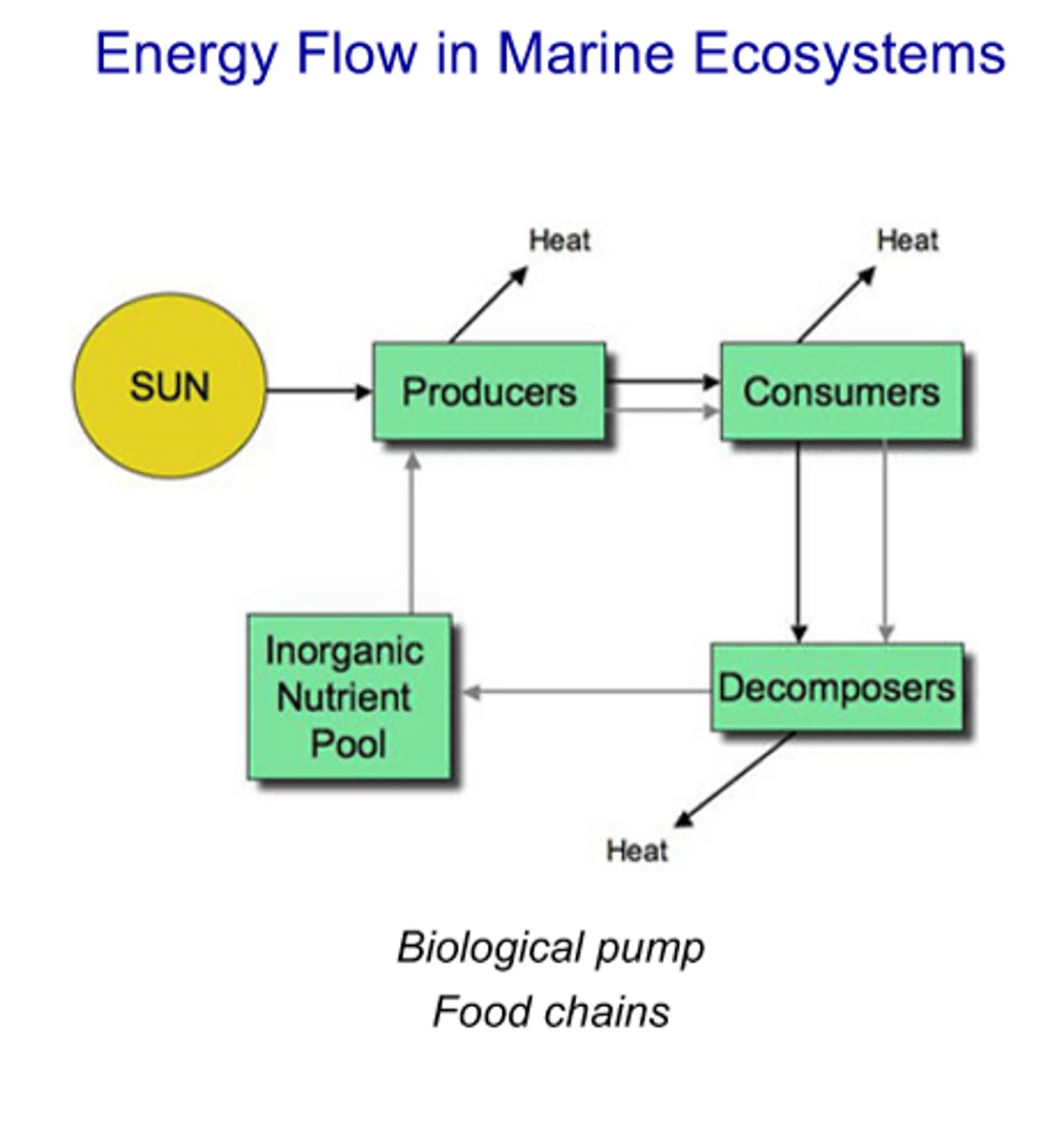
What does the "biological pump" energy float chart look like? How is each step related?
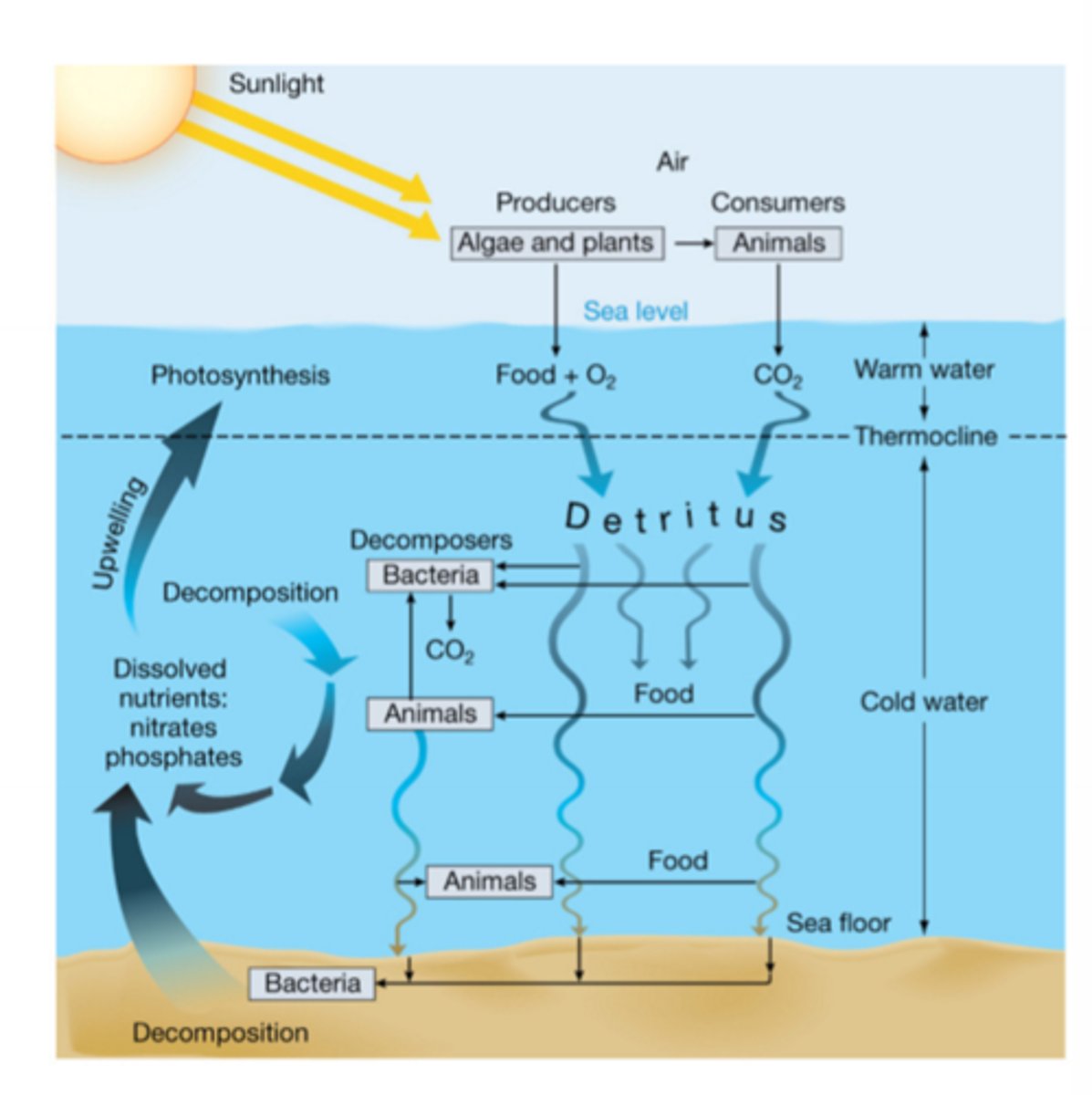
- Sunlight energy is converted into energy for primary producers, that energy is then transferred to consumers who each the producers, and then once the consumers (and producers) die, their energy is trasnferred to decomposers who return the nutrients back to the inorganic nutrient pool for producers to use once again
- When consumers die, their bodies sink down further into the ocean and they are broken down by decomposers, which is why nutrients tends to build up in deep water
- In each step, some energy is lost (such as being given up as heat) because it is used up to maintain an organism's body and function
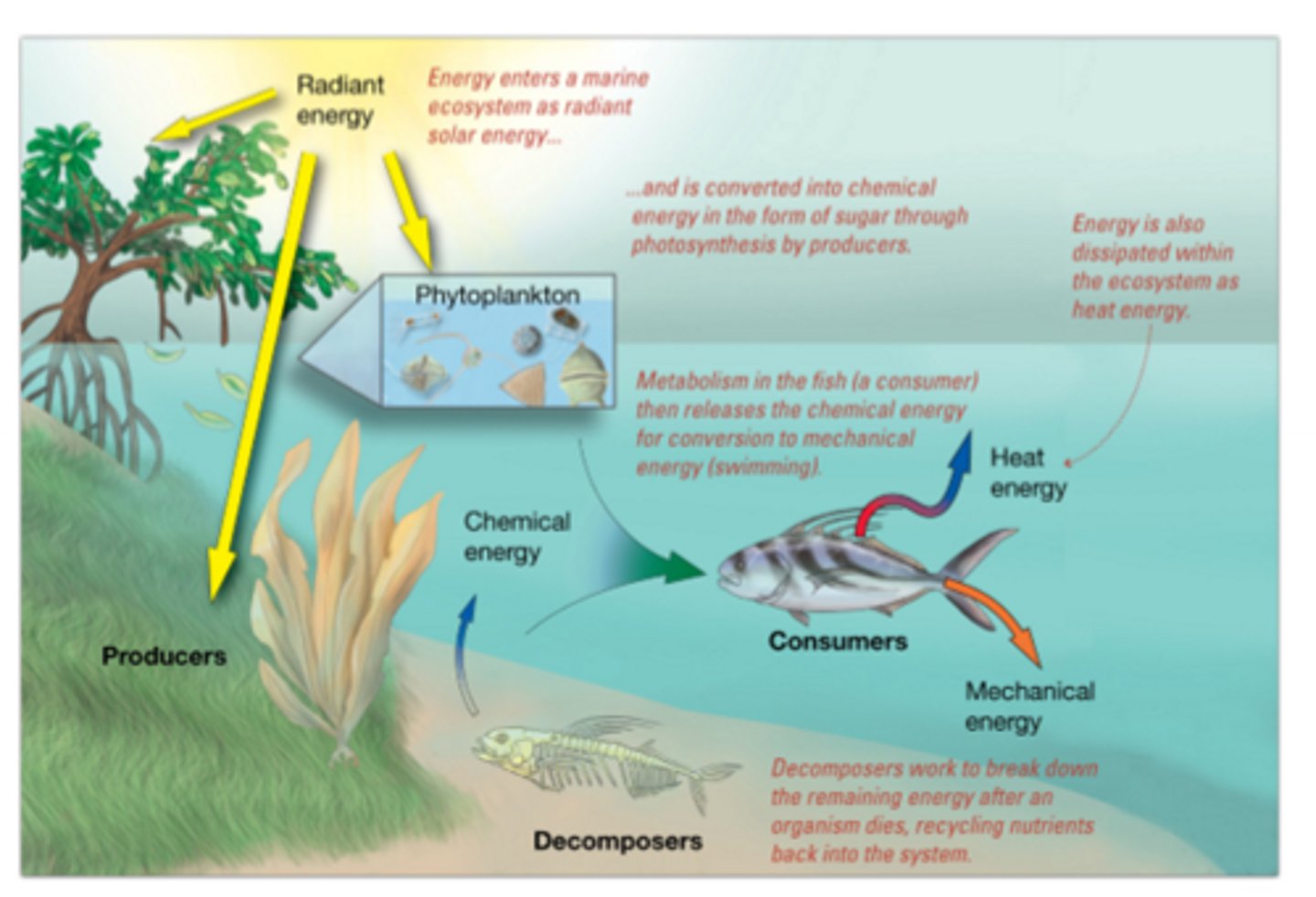
How does energy travel throughout an ecosystem? What two categories do hetertophs fall into?
- Energy flow in photosyntehtic ecosystems is unidirectional, NOT cyclic
- Producers convert solar radiaiton into chemical energy, which is then transfered and used by the entire ecosystem (when consumed by heterotrophs)
- Solar energy --> chemical energy --> up through food chain
- Heterotrophs fall into two categories: consumers and decomposers
- Consumersw: eat other live organisms, includes herbivores, canrivores, omnicores, bacteriovores
- Decomposere: eat dead/decaying organisms (detritus)
What is biogeochemical cycling? How is nutritent transfer differ from energy transfer? How do nutrients move through an ecosystem?
- Biogeochemical cycling: the recycling of nutreints through the ecosystem (and through the ocean)
- Unlike energy, nutrients trasnfer is cyclic, meaning that nutrients are never truely lost
- Nutrient transfer in Marine Environemnts:
- 1. Nutrients are fixed by producers into organic matter
- 2. Some nutrients are transfered from producers to consumers, and the rest of the nutrients are decomposed when a producers/consumers die, become detritus, and are eaten by detritvores
- 3. Nutrients released back into the deep ocean (remineralization)
- 4. Upwelling can bring these nutrients back to the surface to be recycled back into producers
-
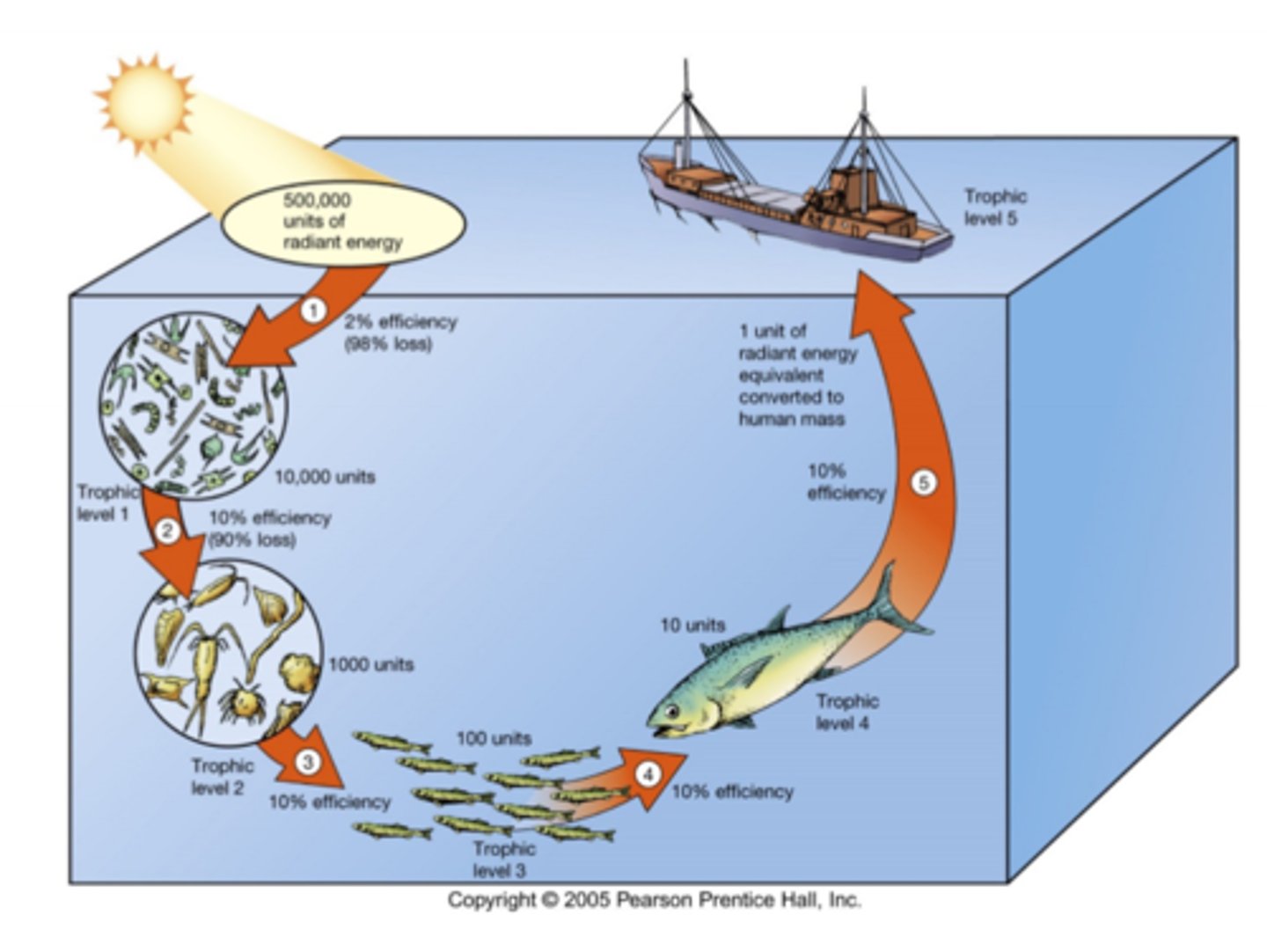
What are trophic levels? How much solar energy is converted to chemical energy during photosynthesis and how much energy is passed between trophic levels? If you start with 500,000 units of radiance energy that passes thorugh 5 trophic levels with humans at the end, how much energy is the human recieving? Do larger animals prefer to lower or higher trophic level creatures and why?
- Trophic levels are successive links in a food chain
- Primary producers are the first trophic level
- Herbivores that consumer primary producers are the second trophic level
- Carnivores that consumer herbivores are the third trophic level (and so and do forth)
- There are typically only 4 or 5 trophic levels, with an apex predator being at the final level
- Only 2% of solar energy is converted to chemical energy during photosynthesis
- At each trophic level, only 10% of the energy is transferred to the next level
- The rest of the energy is used by respiration or goes uneaten (deposited to sediments)
- If you start with 500,000 units of radiant energy and 10% is lost at each stage, then by the fifth human stage, they are only recieving 1 unit of radaint energy
- Larger animals tend to prefer to eat at lower trophic levels becasue they get more units of energy (like how large whales will eat krill)
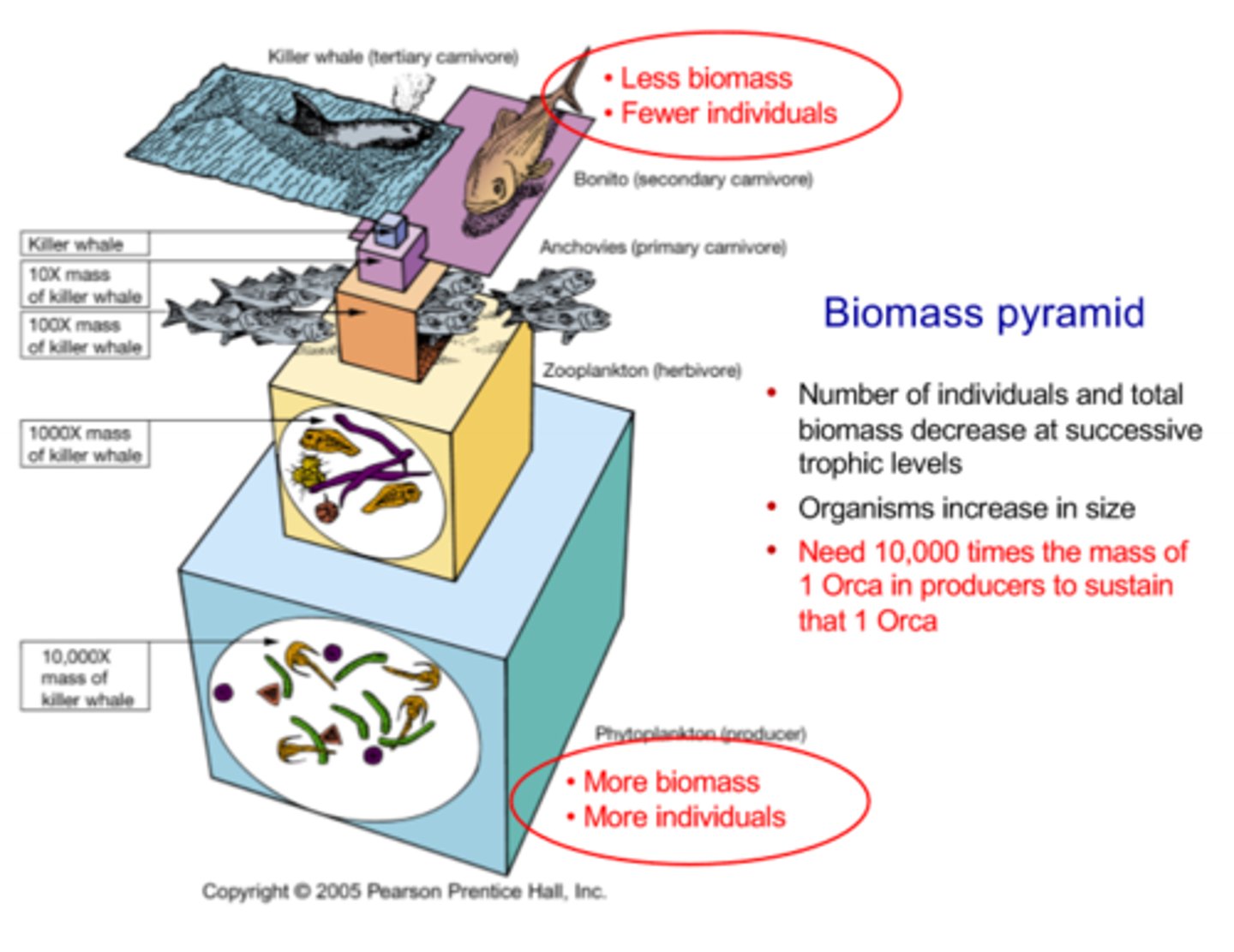
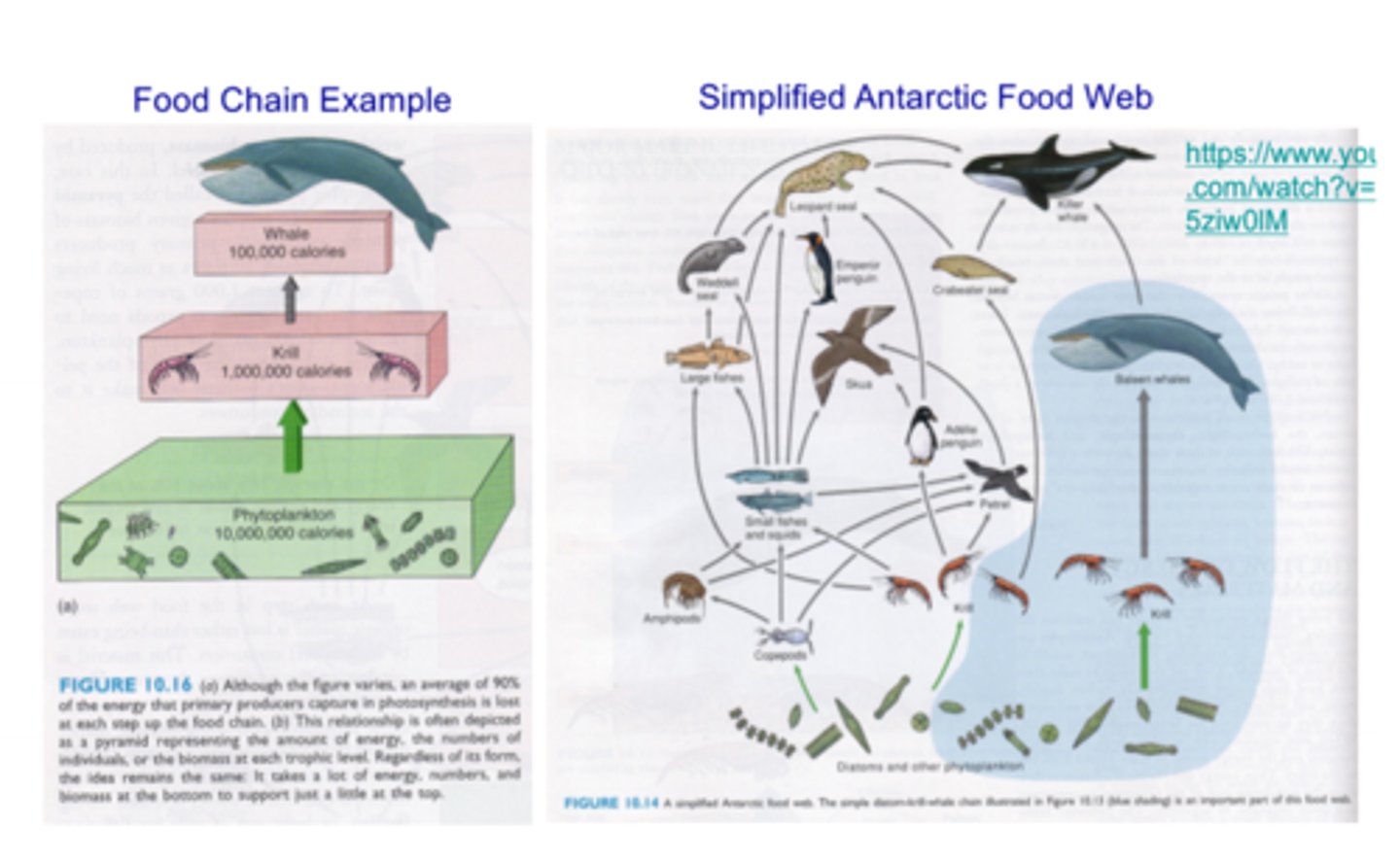
What is the pattern of the biomass pyramid? How much mass of producers is needed to sustain an orca at the top of the biomass pyrmaid?
- The biomass pyramid shows how biomass changes throughout trophic levels
- The number of individuals and the total biomass decrease at successive trophic levels, however, organisms increase in individual size at successive trophic levels
- At the base of the pyrmic, there is a larger amount of biomass that is spread among numerous very small organisms
- At the top of the pyramid, there is a lesser amount biomass that is spread among a few larger organisms
- A single killerwhals need a number of producers that is equal 10,000 times the mass of a single orca in order to sustain itself
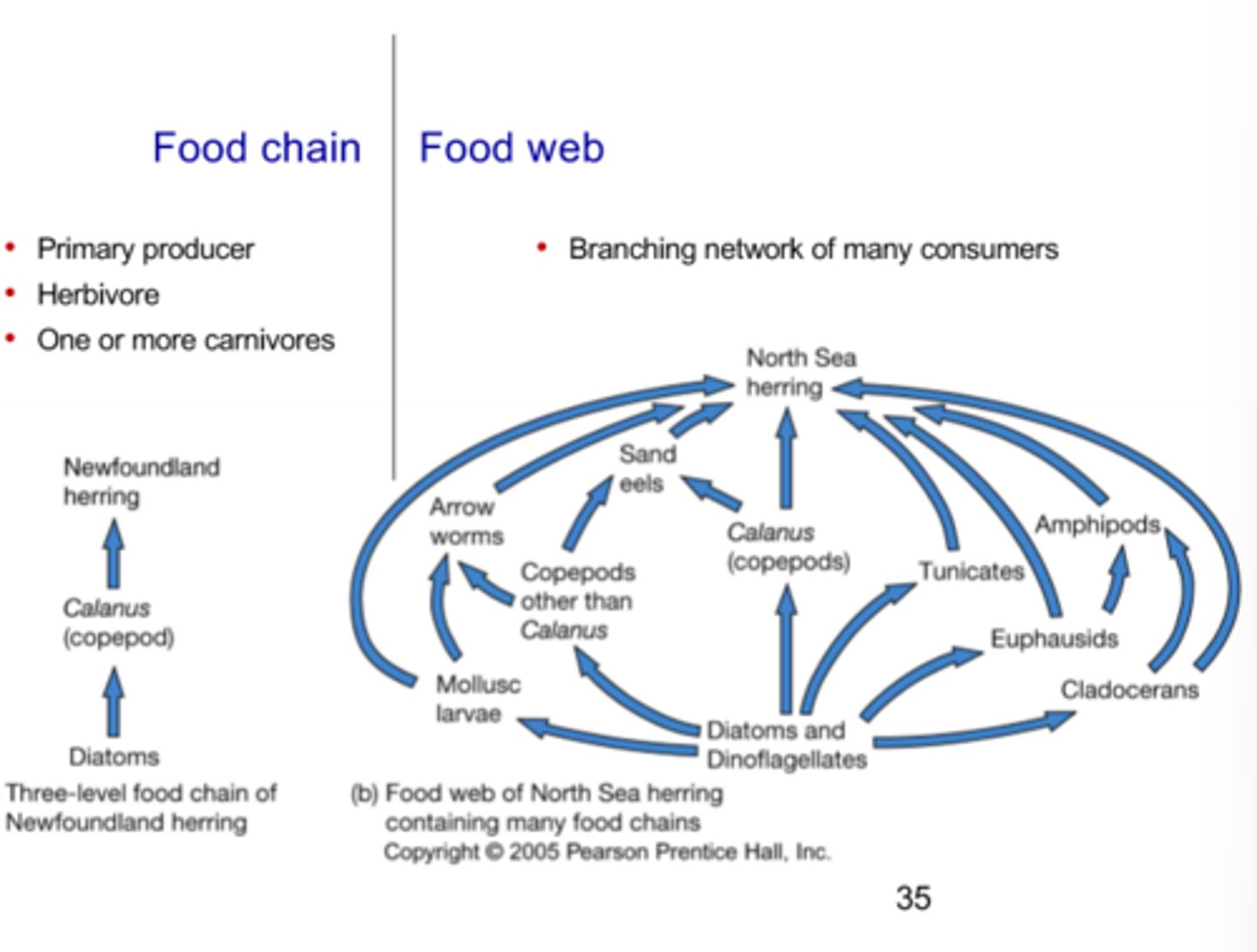
How do food chains and food webs differ?
What would the food chain a baleen whale look like? What would a food chain invovling baleen whales look like?
What percentage of protien intake fo marine fisheries provide for the globe and for less-developed nations? Where are most fihseries located along? How are marine fisheries distributed along non-tropical shelves, tropical shelves, upwellings, coastal and coral reef regions, and in the open ocean? Is it more efficient (in terms of the solar energy) to catch smaller, lower trophic level or larger, higher trophic level fish?
- Marine fisheries provide 20% of the global protien intake and 27% of the protien intake for less-developed nations
- The majority of fisheries are located along contientenal shelves
- Contiental shelves are shallow water areas 0-200m deep off of coastlines
- Open ocean areas do not have as many fisheries because nutrient levels are lower
- Marine Fisheries distribution:
- Non-tropical shelves = 35.6%
- Tropical shelves = 21.0%
- Upwellings = 20.9%
- Coastal and Coral Regions = 18.7%
- Open Ocean = 3.8%
- Since there's about a 10% transfer of energy alogn each step of the food chian, it is more energy efficient to catch smaller fish who are closer to trophic producers
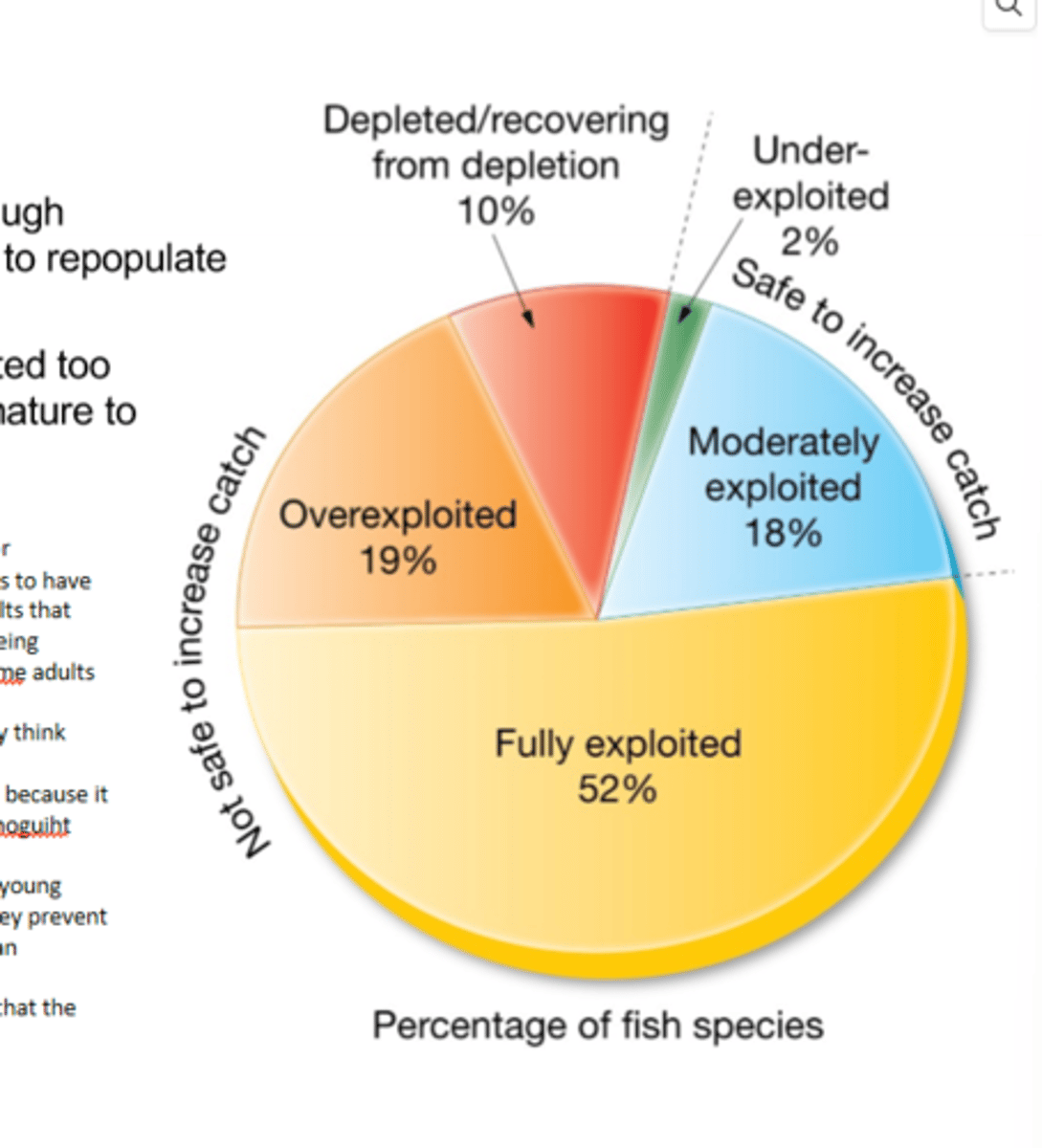
What are sustianble fisheries defined by? What is over-fishing? What percentage of fish are under-exploited, moderately exploited, fully exploited, overexploited, and depleted/recovering from depletion.
- Sustainble fisheries leave enough individuals from the standing stock (the total biomass of organisms living in a particular area at a given time) to repopulate the ecosystem after harvest
- If you fish up too many individuals then there will not be enough left to repopulate and replace the individuals who were removed
- Overfishing: fish stock is harvested too rapidly and juveniles are not sexually mature enough to reproduce
- One way to prevent overfishing is to restrict or ban the fishing of large adults that are capable of reproducing
- Some species such as Atlatnic Cod and Atlantic Halibut are overfished
- Underexploited (safe to increases catch): 2%
- Moderatley exploited (safe to increase catch): 18%
- Fully exploited (not safe to increase catch): 52%
- Overexploited (not safe to increase catch): 19%
- Depleted/recovering from depletion (not safe to increase catch): 10%
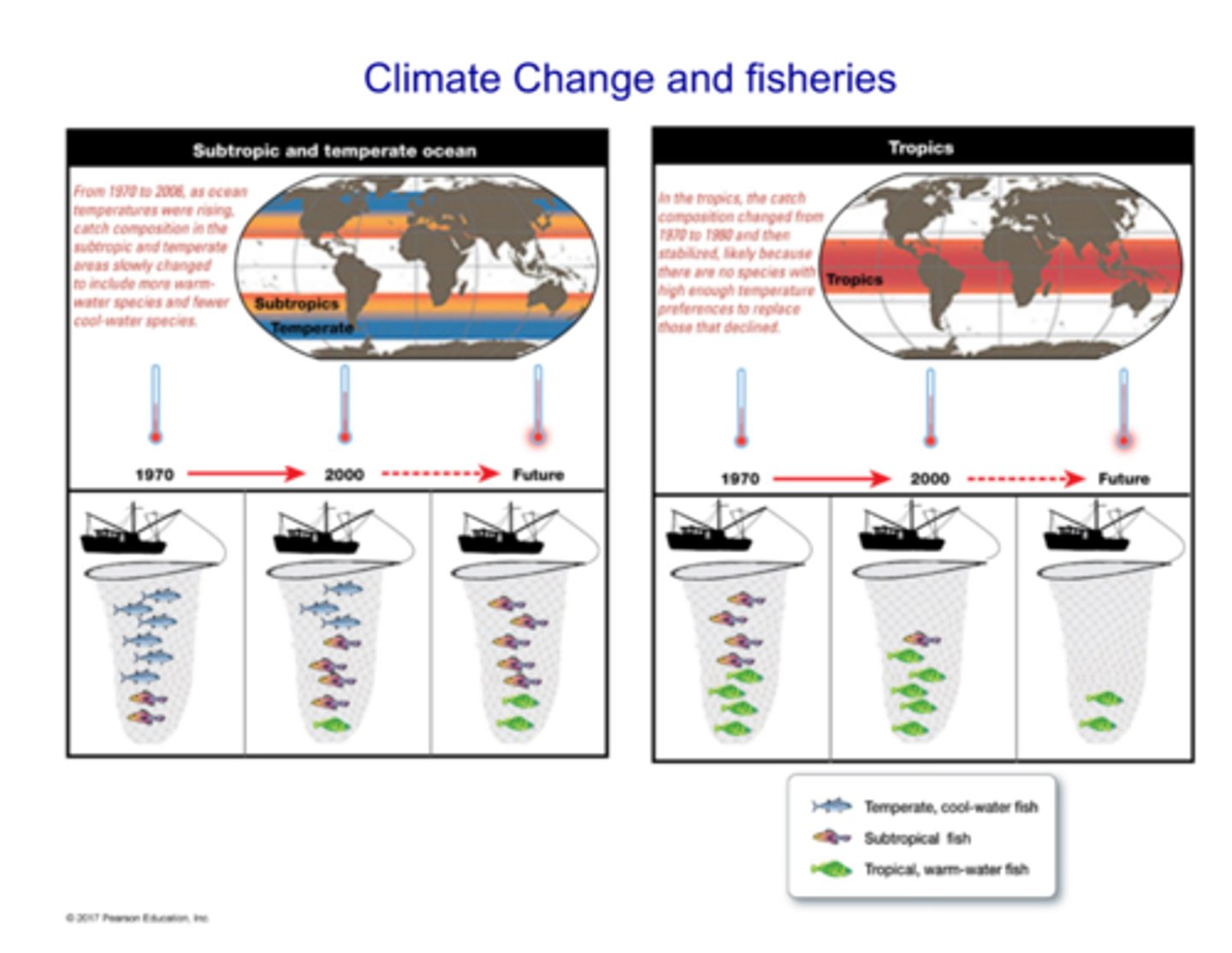
How has climate change affected catch composition in the temperate regions, subtropical regions, and tropical regions? What non-anthropeneic climate change events may also affect
- From 1970 to 2006, as ocean temperatures were rising, catch composition in the subtropic and temperate areas slowly changed to include more warm-water species and fewer cool-water species
- In the tropics, catch composition changed from 1970 to 1980 and then stablized, likely because there are no species with high enough temperature prefrences to repalce thos that declines
- Generally, as warm water ranges expand, the amount of productivity and biomass that is sustianed in those ranges decreases
- Organisms are capable of adapting the enviornmental change like temperature changes, but the difficulty is in the rate that enviornmental change occurs, and ocean temperatures are rising rapidly compared to rates of adaptation and evolution
- Natural cliamte change like la nina and el nino affect temperature, weather, and things like upwelling
- Since these events infleunce things like the amount of upwelling of cold, nutrient rich waters, this also affects things, phytoplankton and zooplankton blooms, which in term have affects all the way of the foodchain and foodweb
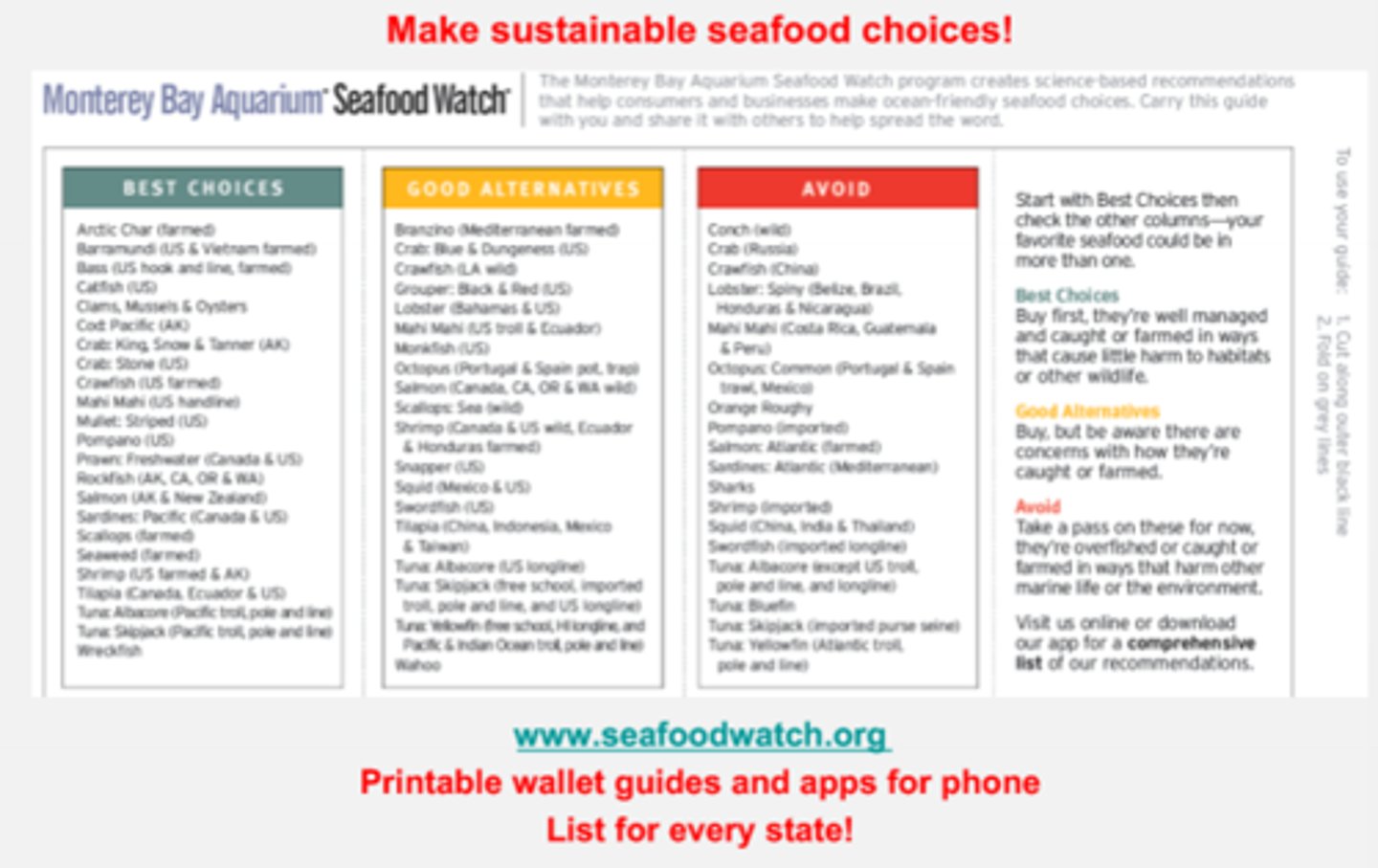
What are examples of sustainable and unsustainable seafood choices?
- The best example of non-sustianble food choices are sharks, as many species have long life histories and are slow to reproduce
- Some fisheries can also be unsustainable
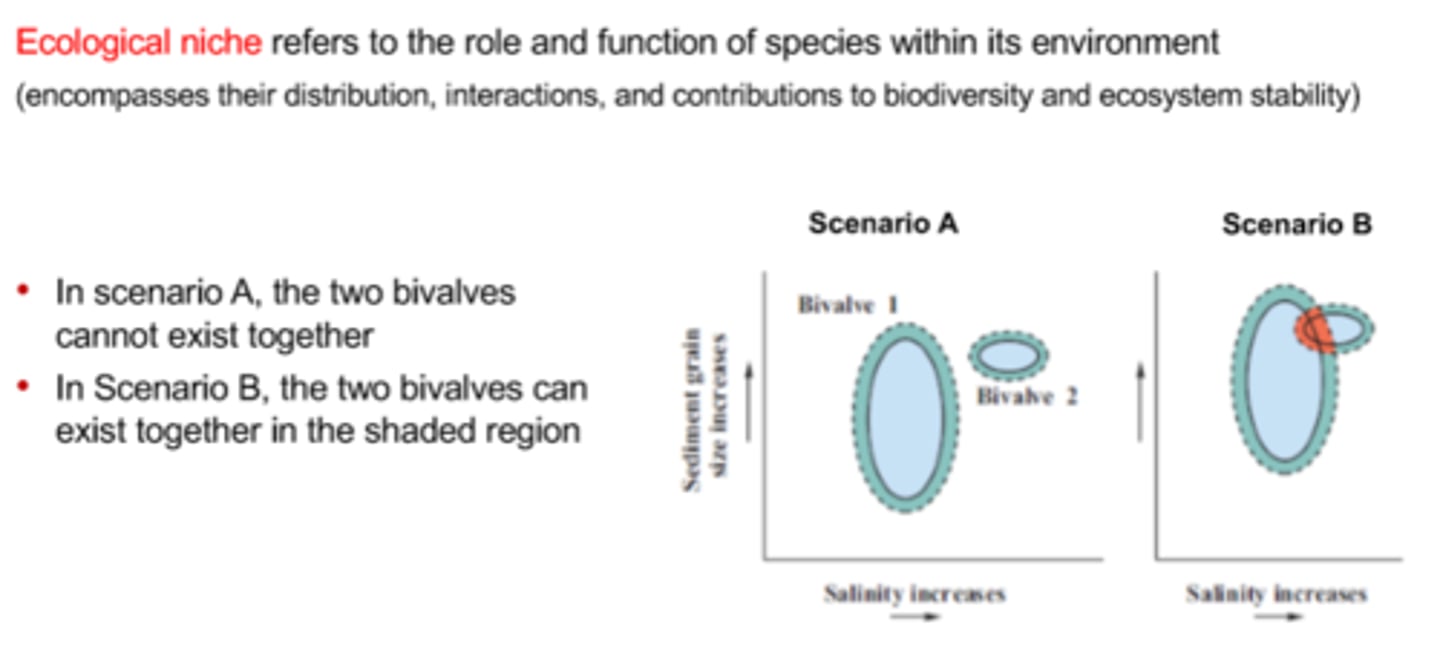
What is a niche and what factors help to detemine a niche? What is an ecological niche?
- Each species has a range of environemntal factors that control where it can survive
- A niche is the position of the species within an ecosystem, describing the persistence (???) and role
- Niche depend on both abiotic and biotic factors
- Biotic: living things within the system, including the presnce of predators and prey
- Abiotic: physical properities of the enviornment (temperature, salinity, light, etc.)
- Ecological niche refers to the role and function of species within its environemnt
- An ecologicla niche encompasses an organism's distribution, interactions, contirbutions to biodiversity, and contributions to ecosystem stability
- Organisms with some overlap in their niches can coexist within the same place/habitat, but may have to compete with each other for resources
- Organisms with the exact same ecological niche cannot coexist within the same place/habitat, as competition will eventually drive one species to extinction
What are keystone species? What types of animals tend to be keystone species? What is a trophic cascade, and what is an example of it?
- Keystone are the wedges in archways that hold up structures
- Keystone species are species that keep an ecosystem together and functioning, as they have a disproptional effect on the ecosystem relative to their abundance/population size
- Predators of frequently keystone species as they help to maintian the population of prey species
- Trophic Cascade: an irreversible shift in ecosystems resulting from the addition/removal of apex predators
- Trophic cascades may rquire human intervention to correct
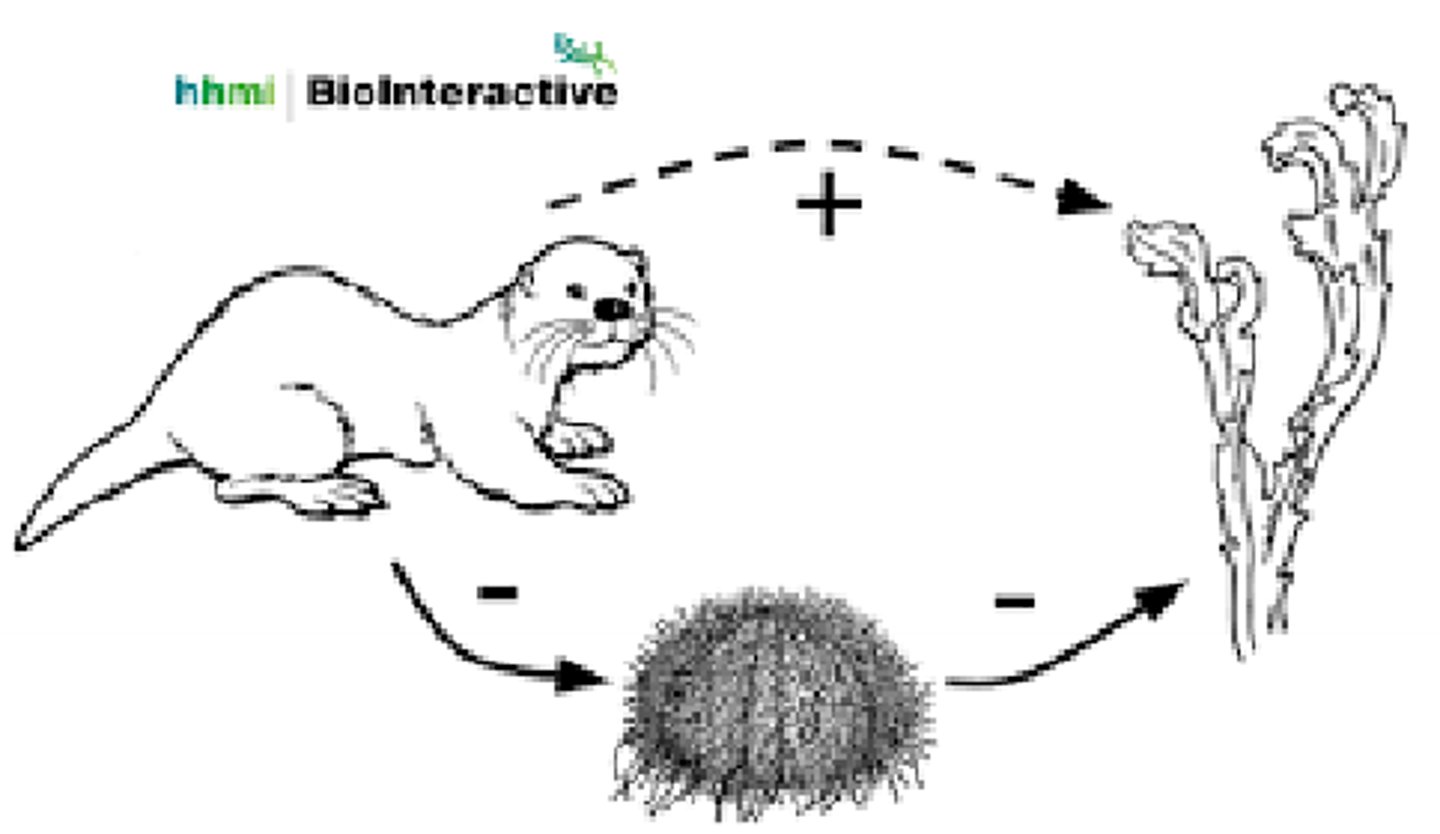
- Example of Trophic Cascade: sea otters, urchins and kelp
- Sea otters (keystone species) tend to live along the northern pacific coast in kelp forests
- Sea urchins feed on the kelp and sea otters feed on the urchins
- Sea urchins breed very rapidly, and when sea otter populations are reduced, the sea urchins breed and eat the kelp so rapidly that it causes a major decline the kelp population
- This ultimately also has a negative effect on the sea urchins as they run out of their food source
- Sea otters directly reduce the sea urchin population, which indirectly helps to maintain the kelp populations
- TLDR; Sea otters decrease due to hunting ---> sea urchin populations explode due to decreased predation ---> kelp forests are consumed and collapse
Why are prey so important and what is an example? What is an ecosystem engineer and what is an example? What is a habitat provider and what is an example?
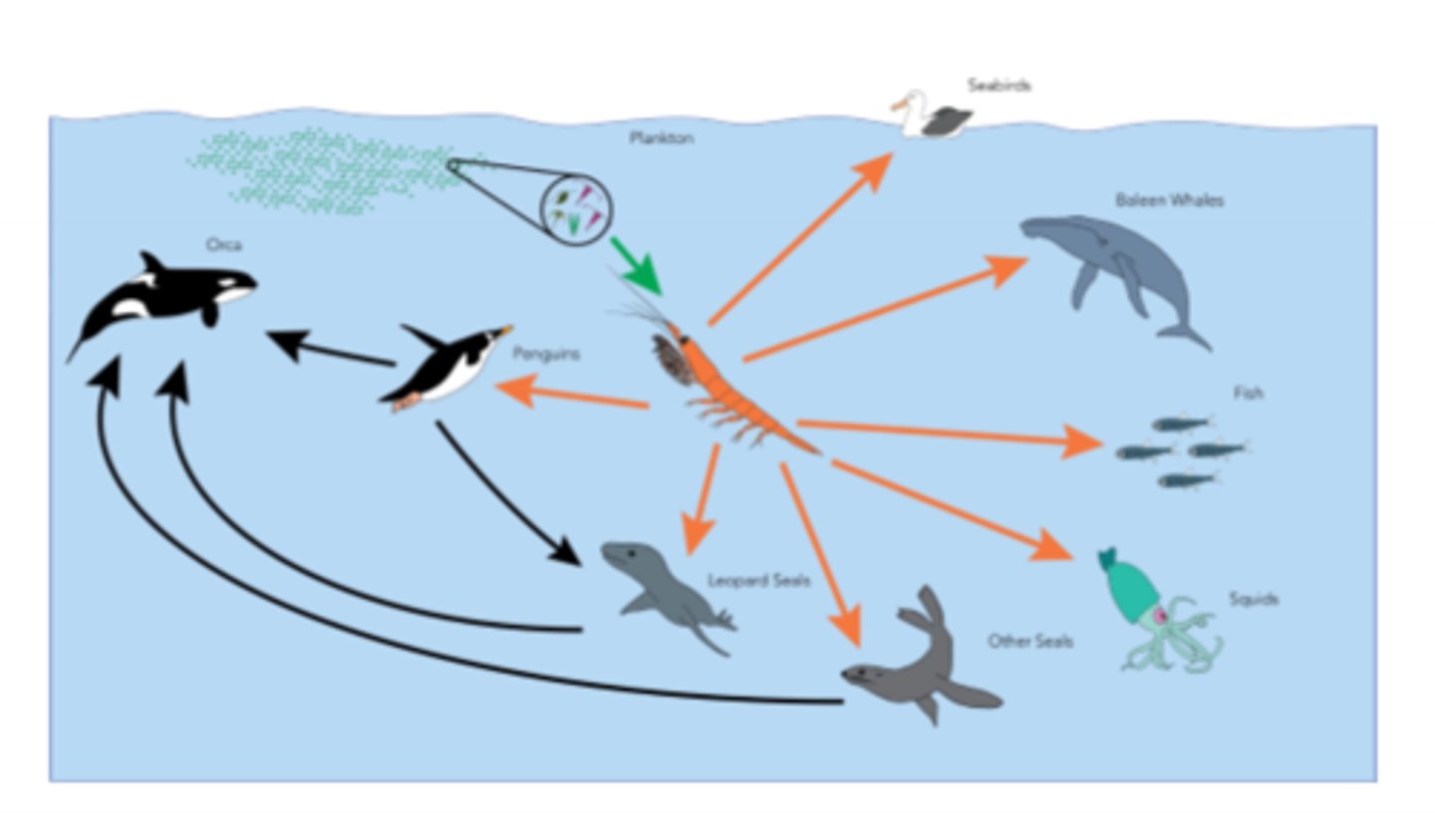
- Prey act as a critical food source
- Example: krill (keystone species) in arctic ocean act as the basis of the entire ecosystem as many animals are dependent on them for food
- Ecosystem engineers modify the ecosystem
- Example: oysters (keystone species) filter many gallons of water each day, which increases light availability and decreases sediment
- Habitat providers modify the physical enviornment in ways that affect other creatures
- Some coral species make skeletons out of calcium carbonate, which form the physical framework for coral reefs and help to protect the coastline from incoming waves
What does it mean for an animal to be pelagic? What structures help fish to inhabit the pelagic environment?
- Pelagic refers the upper layers of the open oceans
- When animals are pelagic, it means they inhabit the upper layers of the open oceans
- Swim bladders help fish control their bouyancy so that they can stay within the pelagic zone without having to exert much pressure
- Other animals, like humans, have a lot of water in our bodies that cause us to float due to our densities being similiar to the ocean water
What are the two types of hunting strategies marine predators may employ, and what are examples of organisms that employ each strategy?
- Marine predators hunting strategies are primarily determined by mobility
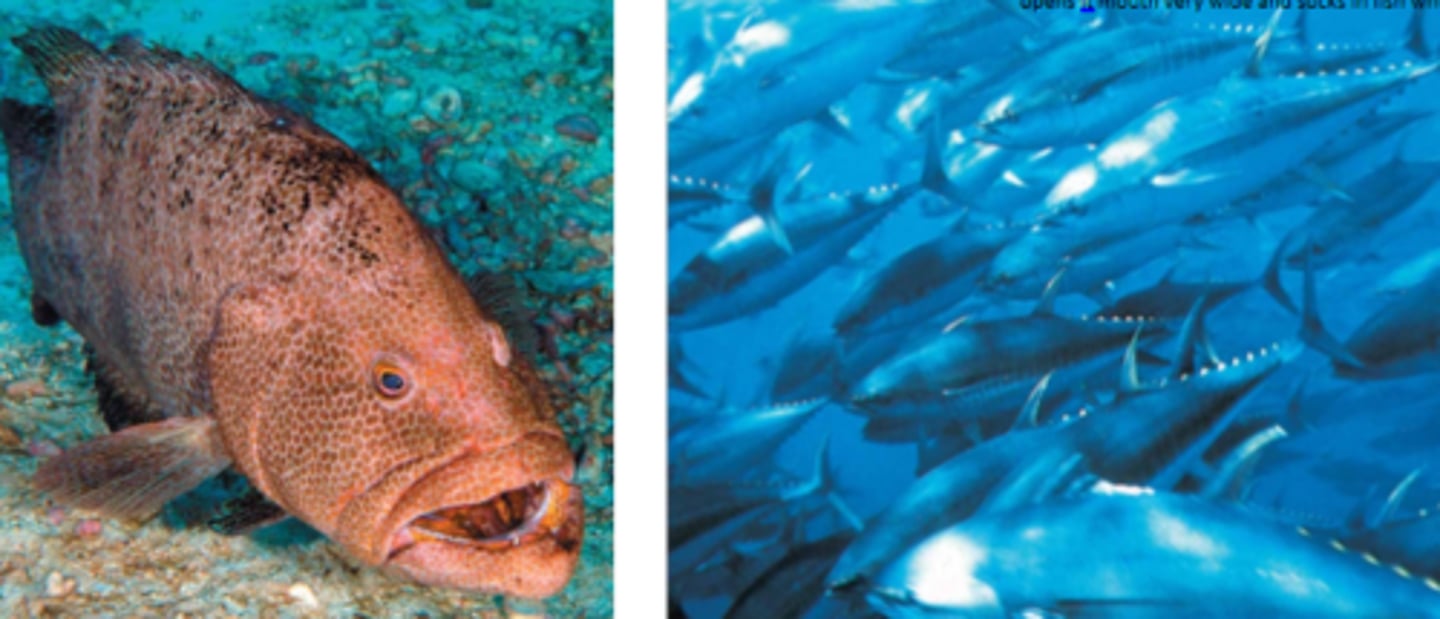
- Lungers: sit and wait for prey, then pounce once prey gets close to them
- Example: groupers will sit vey still in crevices, then once a small fish swims by, they will quickly open their mouth very wide, causing the smaller fish to be sucked in
- Cruiser: actively seek and pursue prey
- Example: tuna are very fast and can chase after their prey to catch them
- Tuna are also 'warm-blooded' which helps to boost their muscles and be speedy
- Cruisers are also more difficult for other things to catch and eat
- Swimming speed is generally (but not always) proportional to the size of the organisms
- Cruisers normally swim slowly unless there is something they want to catch or to escape from
- Cruisers can move very fast for short periods of time
- Examples: yellowfin tuna clocked at 74.6 km/hr, spotted dolphins clocked at 40 km/hr, orca clocked at 55 km/hr
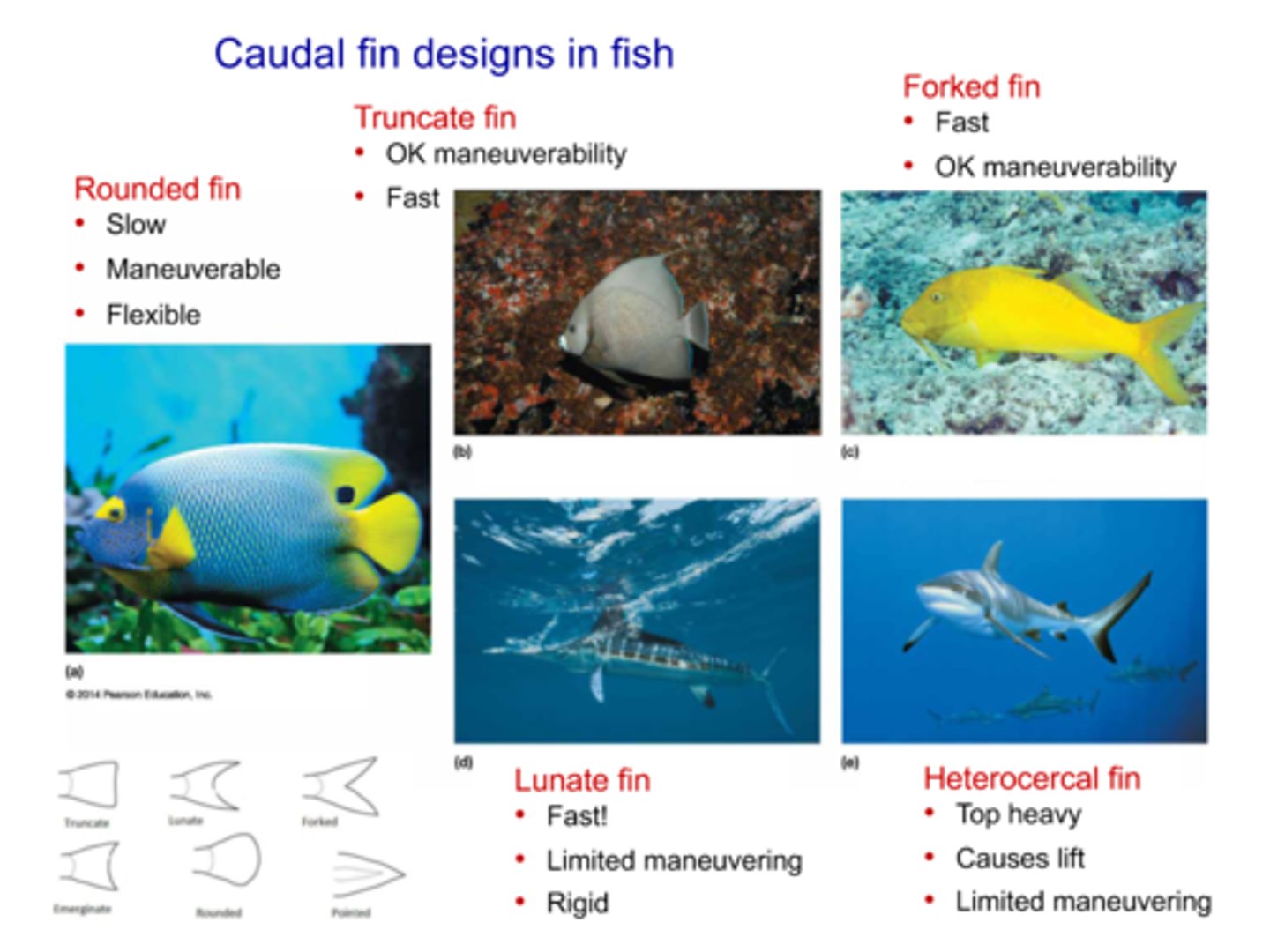
What are the 5 caudal fin designs, and how does each affect speed and maneuverability?
- Rounded Fin: slow, manueverable, and flexible
- Truncate Fin: okay maneurvaribility and fast
- Forked Fin: okay maneuverability and fast
- Lunate fin: very fast, but rigid with limited maneurvaribility
- Heterocercal fin: top heavy, causes lift (useful for sharks as they do not have swim bladders), limited maneuverability
How can body temperature be an adaptation to finding prey?
- Marine orgnaisms are iether poikilothermic or homeothermic
- Poikiliothermic: cold-blooded, body temperature is nearly the same as their enviornment
- Most fish are poikilothermic
- Most common in slow moving fish
- An advantage is that they do not have to spend energy internally regulating their body temperatures
- Homeothermic: warm-blooded, body temperature above sea water temperature
- Mainly found in fast-swimming fish
- Homeothermy increases the power output of their muscles to help seek and capture prey
- Modifications in the circulatory system allow for homeothermy
What are the different pelagic zones and what are they characterized by? Where is the twilight zone located?
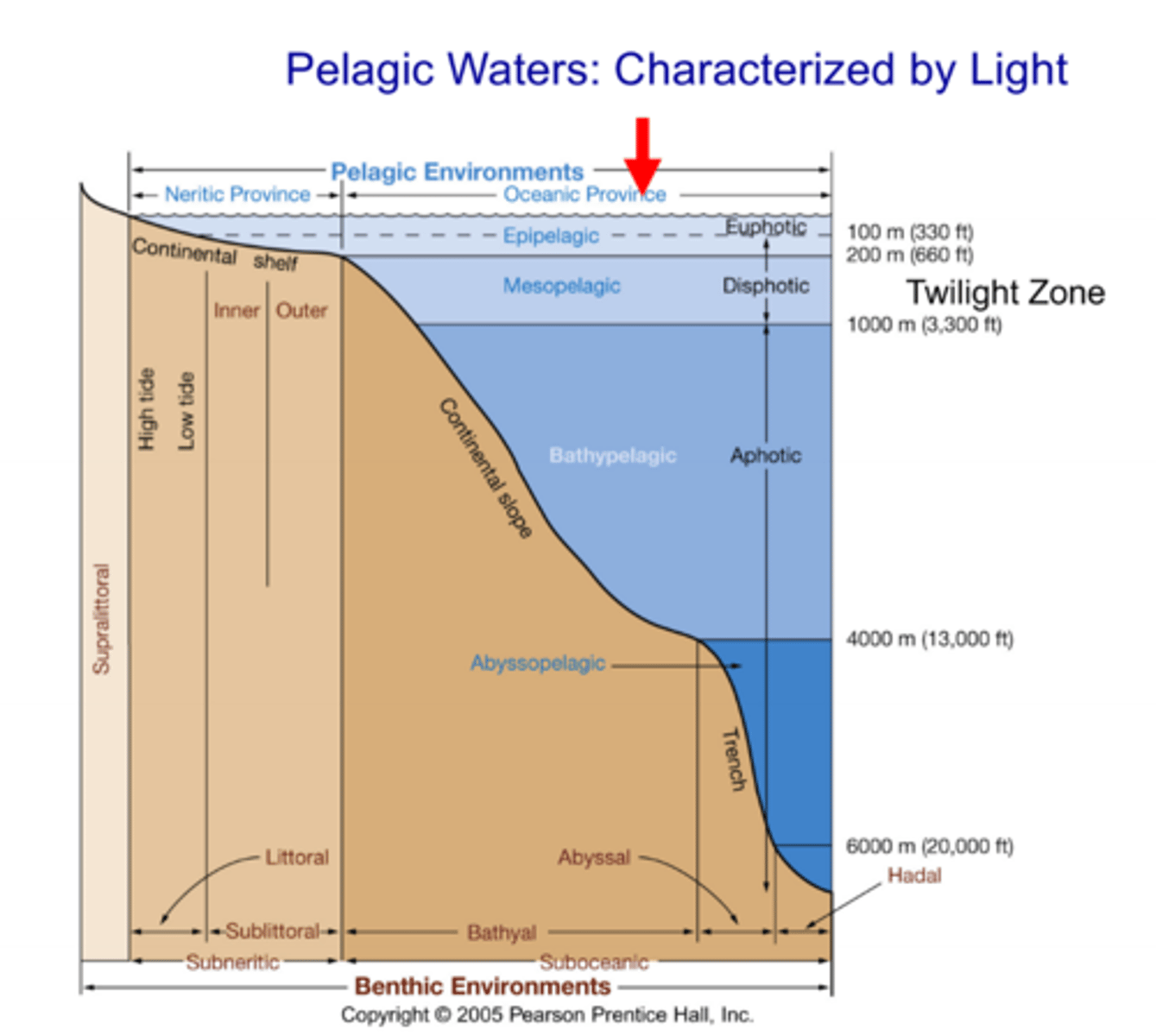
- The different pelagic zones are characterized by light:
- Epipelagic: 100-200 m deep, depth depends on how many particles are scattering and fragmenting light
- Where most organisms live
- Mesoplegaic zone: 200-1000 m deep, has very low light levels
- Some organisms stay in the mesoplaegic zone during the day to eavoid predators, then rise to the epipelagic zone during night to feed
- Includes the "Twilight zone
- Bathypelagic zone: 1000-4000 m deep, basically no light
- Aphotic, meaning no light reaches there
- Abyssoplegaic zone: 4000m-6000 m deep
How is food and energy sourced in the deep ocean where there is little to no light for photsynthesis?
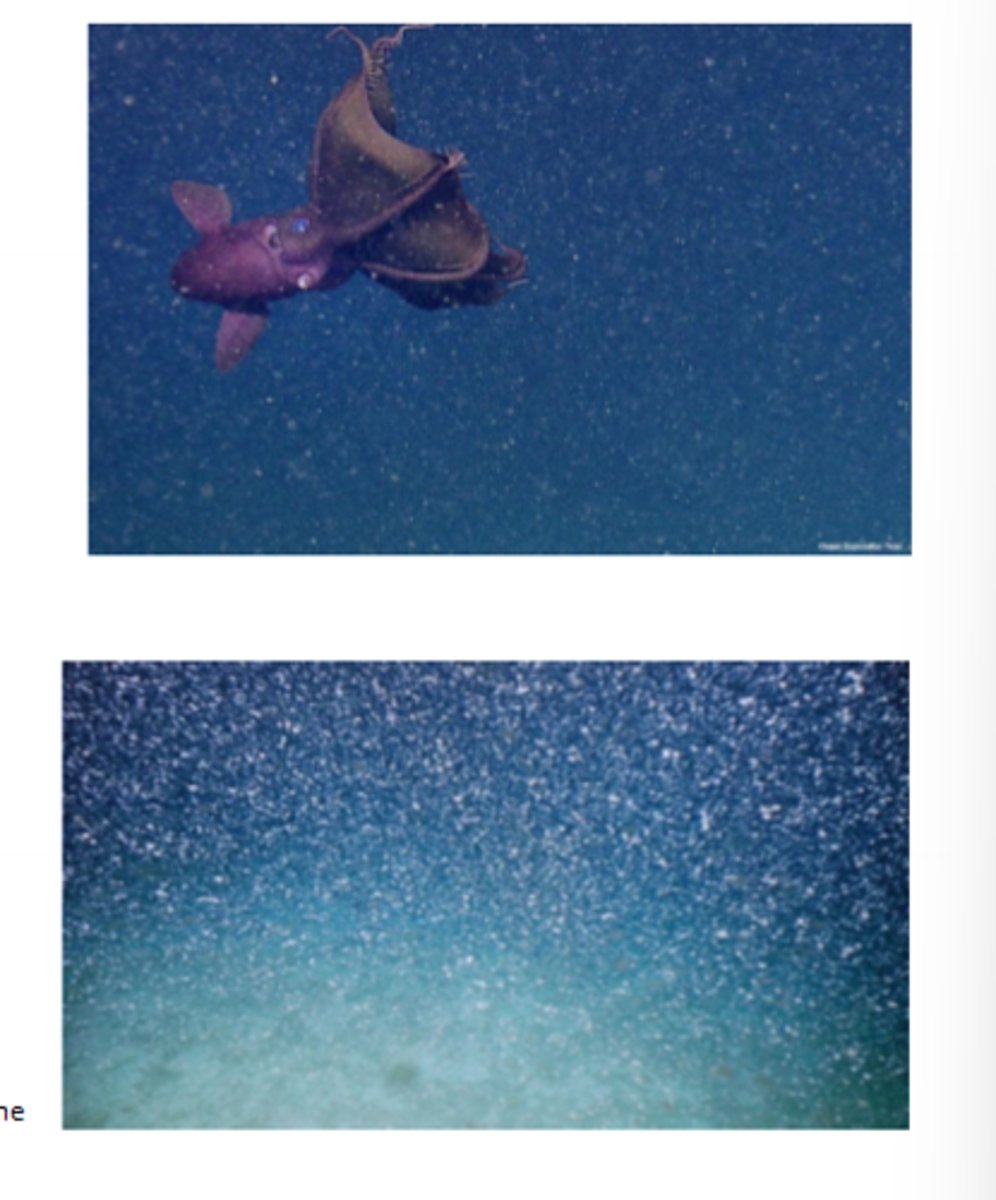
- Almost all of the energy in deep ocena is sourced from the surface ocean, such as marine snow and whale falls
- Marine snow: fallign detritus (dead organisms & tissue from dead organisms) that eventually settles on the seafloor
- There are many deposit and suspension feeders that live at the sea floor
- Whale falls: when whales die and their carcasses sink to the sea floor
- A large source of sudden food into the deep ocean
- Organisms that rely on whale falls are often episodic feeders who use very little energy to survive and will enter a dormant state while waiting for the next whale fall to arrive
What challenges do deep-water nekton face? How does bioluminesence help deep-water nekton
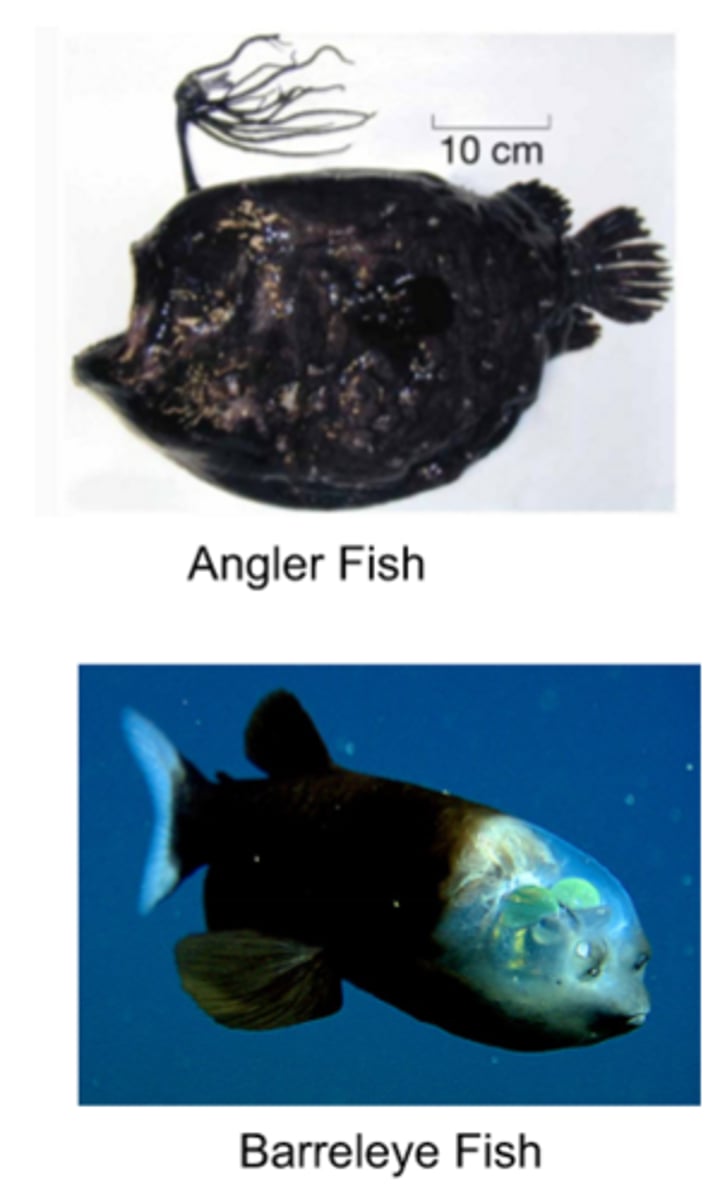
- Deep-water nekton lack abudnant food and mainly consume detrius or each other
- This limits the size and number of organisms that can survive in the deep sea
- Bioluminescence:
- Bioluminescence can be used to lure in food or find mates
- Photophores are structures used to produce bioluminescne
- Some animals use chemical reactions to produce light themselves while others have symbyotic relationships with other organisms like dinoflagellates, which produce light for them
- Large, sensitive eyes that can pick up on light produced by other creatures
- Large, sharp teeth that clamp down on prey to prevent them from escaping
- Expandable bodies that allow nekton to ingest species that are larger than they are
- Hinged Jaws that allow nekton to capture and swallow large prey
What are the 6 ways in which bioluminescence may help deep water ogranisms?
- 1. Helps to search for food items in the dark
- 2. Attracting prey
- 3. Patrolling territory
- 4. Communication
- 5. Seeking a mate
- 6. Escaping predators by ejecting bioluminescnet chemicals that blind or distract them
What are the different stages of Whale Fall?
- Step 0: Whale dies and floats at the top of the ocean
- Pelagic fish and sharks eat the dead whale
- Step 1: Whale settles to bottom and large scavengers eat abundant pieces of organic matter
- Sleeper sharks and hagfish eat fish
- Step 2: Larger pieces of tissue are consumed, leaving only smaller pieces of tissue that are eaten by smaller organisms
- Crabs and polychete worms eat leftover tissues
- Step 3: Sulphophilic Stage where many bones have 'disintigrated' and there is a lower density of scavengers, but there is still material like lipids trapped in bones
- Chemosynthetic organisms and worms feed on bones
- Step 4: Reef Stage where skeleton provides a hard spot on the seafloor for sessile organisms to attatch to
- Soft sediments prevent sessile organisms from finding a surface to attatch to
What are some examples of abyssal organisms?
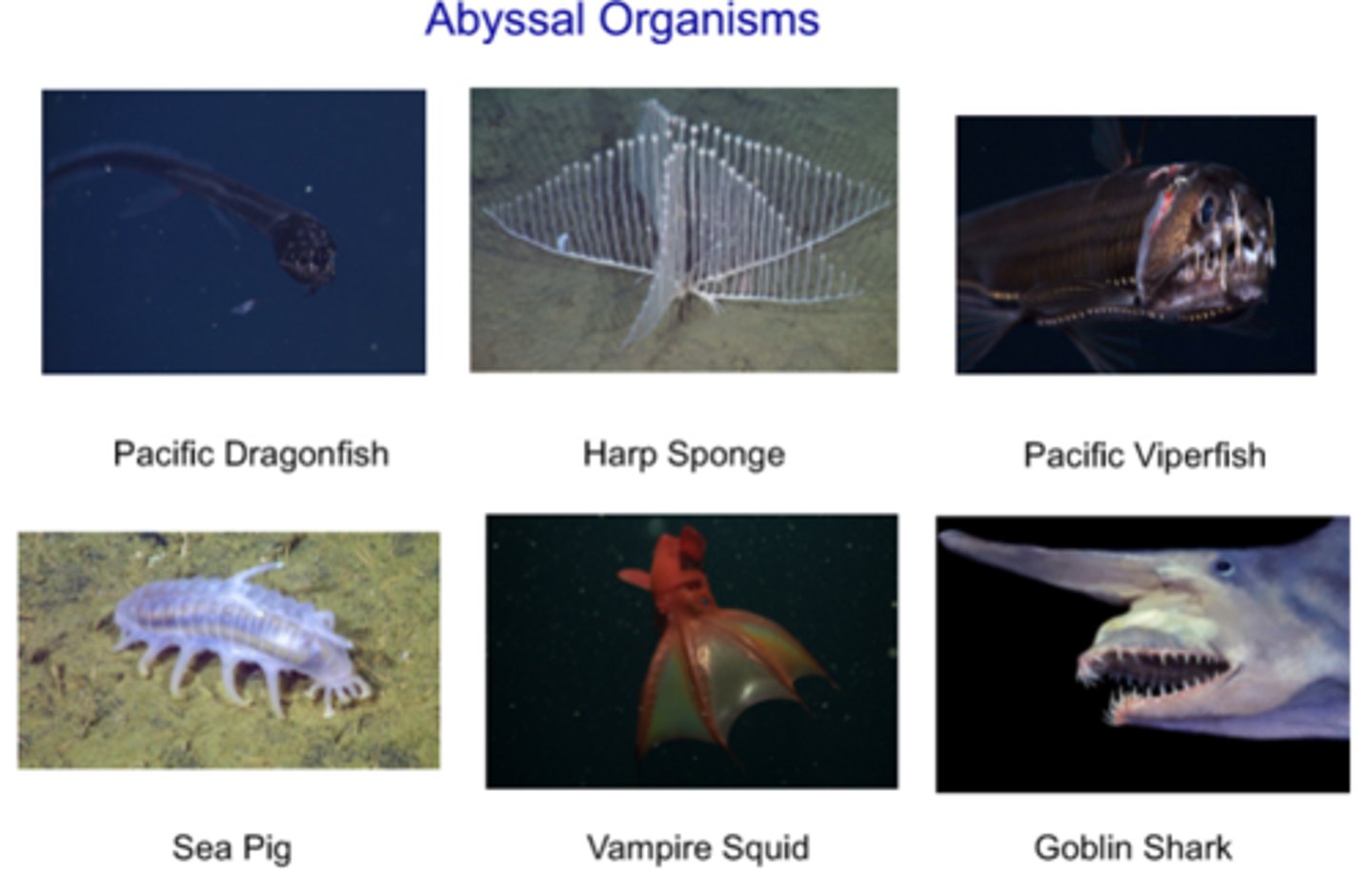
What is deep sea gigantism? What is deep sea gigantism likely due to?
- Deep Sea Gigantism: Tendency for animals in the deep ocean to be larger than their shallow water counterparts
- Likely due to:
- Food scarcity -- more efficient metabolism
- Reduced predation -- not as many things are capable of consuming larger creaters
- Increased dissolved oxygen
- Lowered ocean temperatures -- cold-blooded, so they do not need to waste energy on regulating body temperature (bergmann's rule also applies)
What is schooling and what organ allows fish to efficently school? What benefits does schooling provide?
- Schooling: fish move in the same direction and are evenly spaced, "safety in numbers"
- Fish lateral lines detect changes in water pressure which allows them to sense when predators move near them and respond by having the entire school move away
- Schooling helps fish to avoid predation
- Schools may appear as a single larger organism
- Schooling manuervers can also confuse predators
- Schools also help with reproduction by ensureing males are present to fertilize the eggs released by the females
What are examples of organisms that use spines, armor, and poison/venom to defend themselves?
- Spines: urchins
- Urchin spines are made of calcium carbonate
- Urchin spines vary across species with some being long, sharp and fragile, and others being strong and dull
- Some urchins have spines that break off and get stuck in predators' skin
- Some urchin spins may be venomous
- Armor: Crabs
- Can create strong exoskeleton to protect themselves
- Poison and Venom: Blue Ring Octopus
- Very strong nuerotoxins
What are the 6 different types of camoflauge and examples of each?
- 1. Reflection: reflect incoming light to look like sunlight reflected
- Example: Lookdown fish
- 2. Countershading: dark on top, light on the bottom
- Matches either the surface (from below) or deep ovean (from above)
- Example: Penguins and sharks
- 3. Distraction: break up outline or deceive predators
- Example: Butterfly fish have false eye on tail that distracts predators, and have diagonal stripes which break up their outline
- 4. Red Coloration: red light is absorbed quickly
- Makes deep sea fish invisible since they appear very dark
- Example: frogfish
- 5. Adaptive/Active Camouflage: control skin pigments and texture to match the environment
- Example: flounders will cover themselves in sediemnt to blend in
- Really, I think a better example would be octopi or cuttlefish because they actually change color and texture but whatever
- 6. Transluscence: little to no pigment can cause the animal to be see through/difficult to see
What is symbiosis? What are the 3 types and examples of each?
- Symbiosis: close and prolonged assocaited between two organisms of different species
- 3 Types of Symbiosis:
- Parasitism:
- When one species benefits from the assocaition and the other is at a disadvantage
- Tend to live in or on th ehost
- Steals the host's food or consume's the host's tissue
- Example: cymothoid isopods replace the tongue of fish host and eaither steal their food or consume the host's tongue and feeds on blood
- Mutualism:
- When both species benefit from the association
- Example: some coral have symbiotic algae which produce food for the coral while the coral provides protection for the algae with their stinging cells
- Example: fire shrimp clean parasites from other fish's mouths, providing a meal for the shrimp and a health benefit for the fish
- Example: anemones provide clownfish with protection due to their stinging cells and clownfish clean anemones and provide them with food
- Commensalism:
- When one species benefits from the association and the other is not benefitted or harmed
- Example: Remoras hitching a ride on a larger fish (typically shark) provides them protection and may bring them to food
- Example: hermit crab shell covered in anemones provides the crab with protection due to the anemone's tingin cells
- Example: barnacles on whales are provided protection and access to filter feeding (though too many barnacles can eventually hurt the whale)
How many species of sea turtle are there? What are some distinguishing characteristics of sea turtles?
- 7 distinct species of sea turtle: Green, loggerheads, hawksbills, olive ridleys, kemps ridleys, flatbacks, and leatherbacks
- Sea turtles do not have many natural predators as an adult, but are very vulnerbale as hatchlings and juveniles
- 1 in 1,000 sea turtles reach adulthood
- Sea turtles have temperature-dependent sex determination
- The powerpoint says "Warmer temperatures --> male, Colder temperatures --> female" but afaik this isn't true and it's typically the opposite
How do corals reflect changes in the ocean climate, and how do they collect information from corals? How can we tell how old corals are, and how far back can coral information go?
- Corals build skeletons as they grow, and as they secret their skeletons, they will take in chemicals from the sea water based on the conditions they are growing in
- Specific chemicals can tell information about temperature. PH, salinity, etc.
- To collect a coral climate record, scientists drill a core through coral skeleton
- Example: the amount of strontium a coral takes up into itse skeleton is directly related to the temperature it grows in (warmer water = less strontium)
- Example: rainfall above the reef changes the ratio of normal and heavy isotopes of oxygen in the water, and the temperature of the water also affects how much of the heavy isotop will be taken in the skeleton (warm and wet climates = less heavy isotops)
- Corals grow similiarly to trees, and for each year they are alive, they produce a growth band in their skeleton
- Living corals can go back 500 years and Fossil corals can go back through the last 10,000 years
Why is coral important?
- Important for biodiveristy
- Provides coastal protection from storms
 Note
Note  Flashcards (102)