PSYC426 Quiz 4
 Call Kai
 Learn
Learn Practice Test
 Spaced Repetition
 Match
Match Flashcards
 Knowt Play
1/23

There's no tags or description
Looks like no tags are added yet.
Name | Mastery | Learn | Test | Matching | Spaced | Call with Kai |
|---|
No analytics yet
Send a link to your students to track their progress
24 Terms
How is attachment security/insecurity measured in adolescents?
Answered in two questions(?):
How to tap attachments to specific people?
New to adolescence: how to tap broader, generalized attachment orientations?
attachment to parents
Teens remained attached to parents, and we can still measure attachment to individual parents
What changes or stays the same when an adolescent is attached to parents/parent?
most teens view parents as main attachment figure
can be securely attached to one parent, and insecurely attached to the other
teens still have many of the same needs (comfort me; help me); the specifics look different
still defined in same way: confidence in the availability and responsiveness of the person when needed — based on experiences
rather than watch behavior, ask adolescent directly about use of parent as a secure base
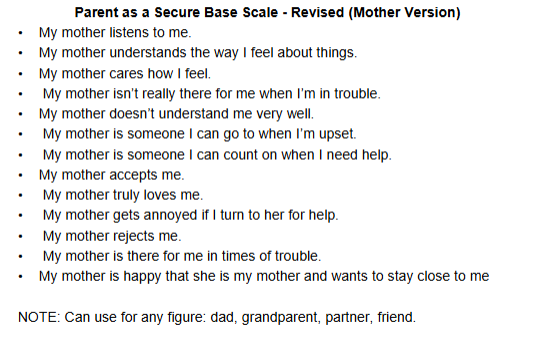
parent as a secure base scale
a 13-item measure designed to assess children’s or adolescents’ perceptions of their parents as a source of sensitivity, availability, and support.
*view image
What are the two measurements of adolescent attachment?
“secure base scripts:” Attachment Script Assessment
“attachment style” Experiences in Close Relationships (ECR) scale
what are secure base scripts
a knowledge structure containing a sequence of events that typically occurs in a particular situation, such as going to the movies
a series of if-then contingency statements based on experience
Example of secure base script
If I go to the movies…
Then I’ll wait in line to buy popcorn
Then I’ll watch some previews
Then my popcorn will run out and I’ll be sad about it
and so on…
why are attachment-related scripts important?
They are more complex secure internal working models.
Help researchers understand internal working models of attachment because People vary in the extent to which they have knowledge of a secure base script.
If one has repeated experiences of caregivers providing secure base:
They would have access to a clear “secure base script”
If one does NOT have repeated experiences of caregivers providing a secure base:
They would NOT have access to a clear “secure base script”.
How do we measure individuals’ knowledge of secure base scripts?
procedure taps scripts by using word sets to elicit narratives
shows adolescents a set of 12 words for each narrative
asks for a story using these words
6 different word sets; asked to tell 6 stories
easily understand the task
tape-recorded and coded for transcripts
what are Experiences in Close Relationships scale [ECR]
dimensions reflecting thoughts, feelings, and behaviors in relationships with close others
two dimensions of attachment style
attachment avoidance
attachment anxiety
attachment avoidance
18 items
discomfort with closeness and dependence, a tendency to deactivate the attachment system
example item (1-7 scale strongly disagree to strongly agree)
“I prefer to not show a partner how I feel deep down.”
attachment anxiety
18 items
strong desires for closeness. Intense fears about rejection and abandonment. Tendency to hyperactive, heighten the attachment system.
Example item (1-7 scale, strongly disagree to strongly agree)
“I worry about being rejected or abandoned”
ECR and Bronfenbrenner
Likelihood of attachment avoidance/anxiety
does the likelihood of becoming avoidant/insecure/anxious vary as a function of SES, or neighborhood violence, or x?
Context and functioning
pick an attachment style, then pick a factor — schools, culture, policy, workplace, etc.
Example: attachment style x, when faced with factor (y), might have a harder time because z.
Through what mechanisms do caregiving experiences shape long-term physical outcomes?
The mechanisms act as moderators, answering the “why” that leads to the outcome
what is “biological embedding of social experience”
social experiences are happening under the skin.
What are the 3 models of caregiving experiences —> long-term physical health outcomes?
Felitti’s ACES model
Life History Theory: HPA Axis
Ehrlich, Miller, & Chen’s Inflammation model
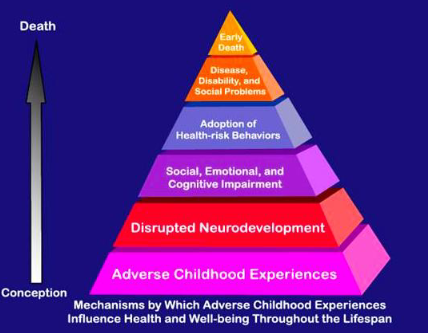
Felitti’s ACES model: aspects of development
mechanisms by which adverse childhood experiences influence health and well-being throughout the lifespan
*shows the increases of risk in adverse childhood experiences, it does not lead to outcomes up the pyramid
Life History Theory: HPA axis
stressful or uncertain environments
chronic HPA-axis activation (release of glucocorticoids)
faster life history strategy
earlier puberty
earlier sexual behavior
earlier age of 1st reproduction
lower parental investment
faster biological aging
faster cellular aging
earlier mortality
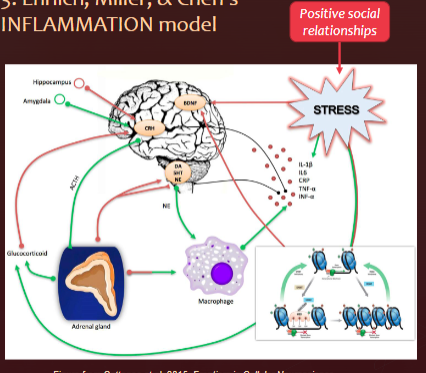
Ehrilich, Miller, & Chen’s Inflammation model
caregiving adversity —> stress —> INFLAMMATION —> poor immune function —> poor health & risk for disease
Are attachment-related differences in physical health and disease risk?
short answer: yes
quality of attachment in childhood and adolescence —> health outcomes in adulthood (promotive effects)
secure attachment/sensitive parenting may also BUFFER against negative effects of stress on health (protective effects)
Can parenting interventions in adolescence promote long-term physical health?
yes

