AVS 472 pt 2

0.0(0)
Studied by 0 people
call kaiCall Kai
learnLearn
examPractice Test
spaced repetitionSpaced Repetition
heart puzzleMatch
flashcardsFlashcards
GameKnowt Play
Card Sorting

1/114

flashcard set

Earn XP

Description and Tags

IM BACK IN THE FUCKING BUILDING

Last updated 12:27 AM on 3/19/26
Name
Mastery
Learn
Test
Matching
Spaced
Call with Kai

No analytics yet

Send a link to your students to track their progress

115 Terms

1
New cards

What is the purpose of the scrotum?

  • Thermosensor

  • Dark pink

  • Radiator (expands surface area when warm + wrinkles together when cold)

  • Protective

  • Is made of stratified squamous cells to protect from lacerations and blunt force
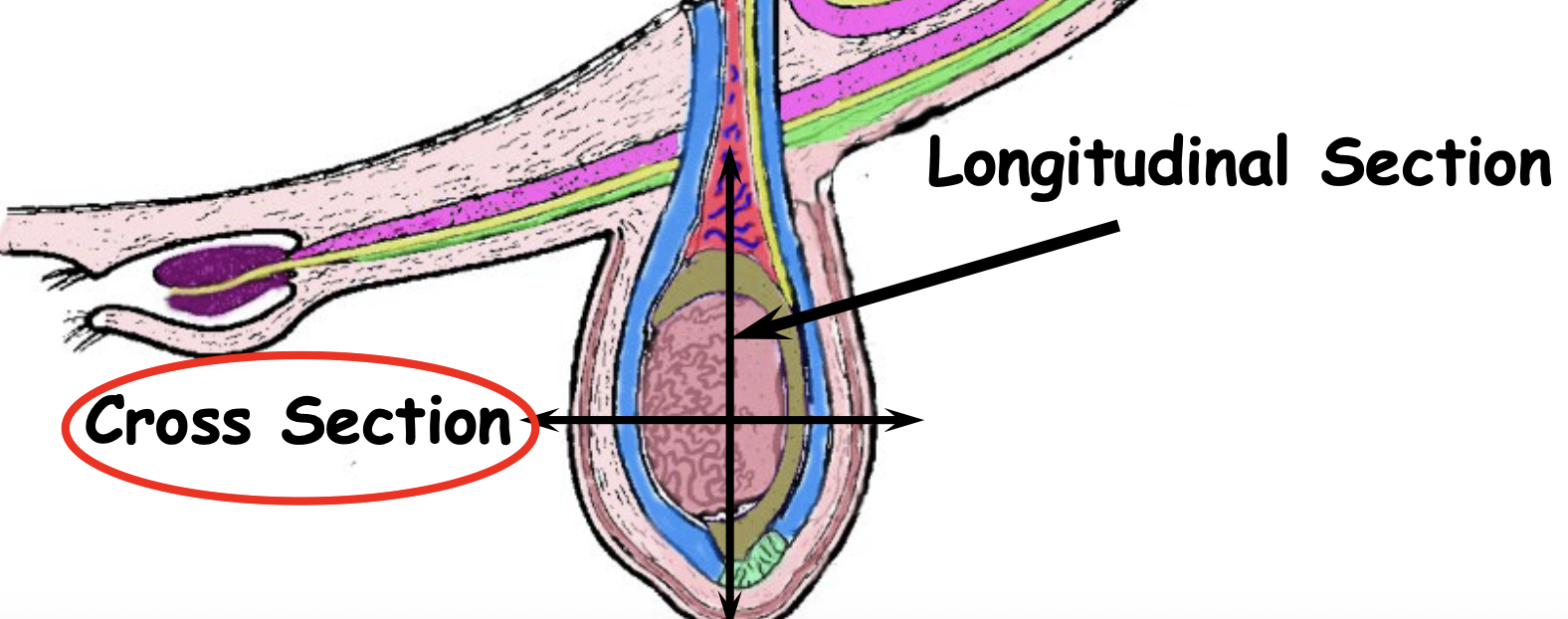
<ul><li><p>Thermosensor</p></li><li><p>Dark pink</p></li><li><p>Radiator (expands surface area when warm + wrinkles together when cold)</p></li><li><p>Protective</p></li><li><p>Is made of stratified squamous cells to protect from lacerations and blunt force</p></li></ul><p></p>
2
New cards

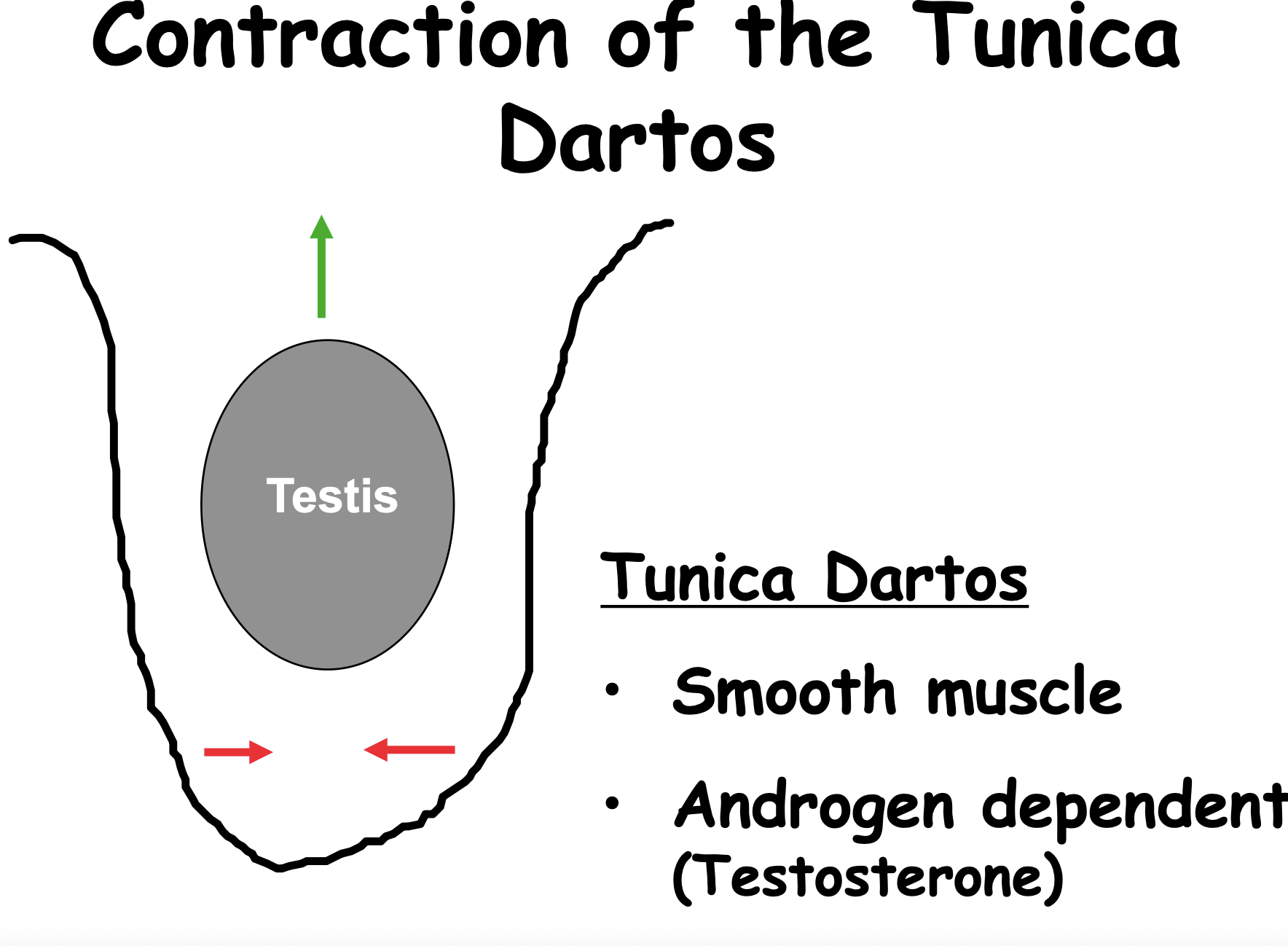
What is the purpose of the tunica dartos?

  • Smooth muscle that regulates temperature of testes

    • Need to be a couple of degrees lower than average body heat

  • Has the ability to contract and stay contracted without fatigue, forces testes to push ups closer to body and descend when warmer

  • Androgen dependent (testosterone)

<ul><li><p>Smooth muscle that regulates temperature of testes</p><ul><li><p>Need to be a couple of degrees lower than average body heat</p></li></ul></li><li><p>Has the ability to contract and stay contracted without fatigue, forces testes to push ups closer to body and descend when warmer</p></li><li><p>Androgen dependent (testosterone)</p></li></ul><p></p>
3
New cards
<p>What is a gubernaculum?</p>

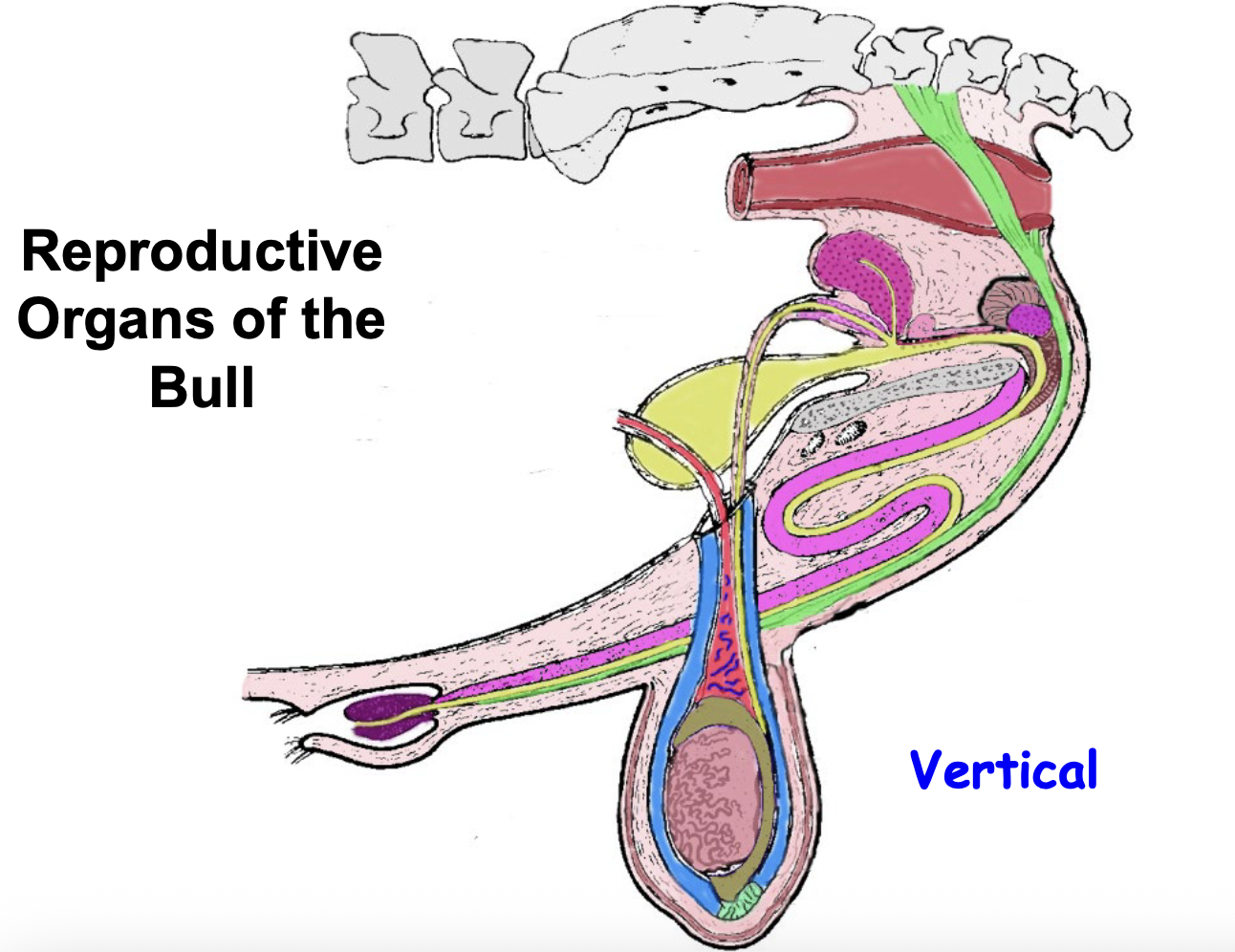
What is a gubernaculum?

  • Adhesive structure/connective tissue that’s anchored at distal end of testes

  • Prevents testes from spinning (prevents testicular torsion

  • Green blob at bottom

4
New cards

What’s a sigmoid flexure and purpose?

  • Pink line

  • Can react penis within the body and erect
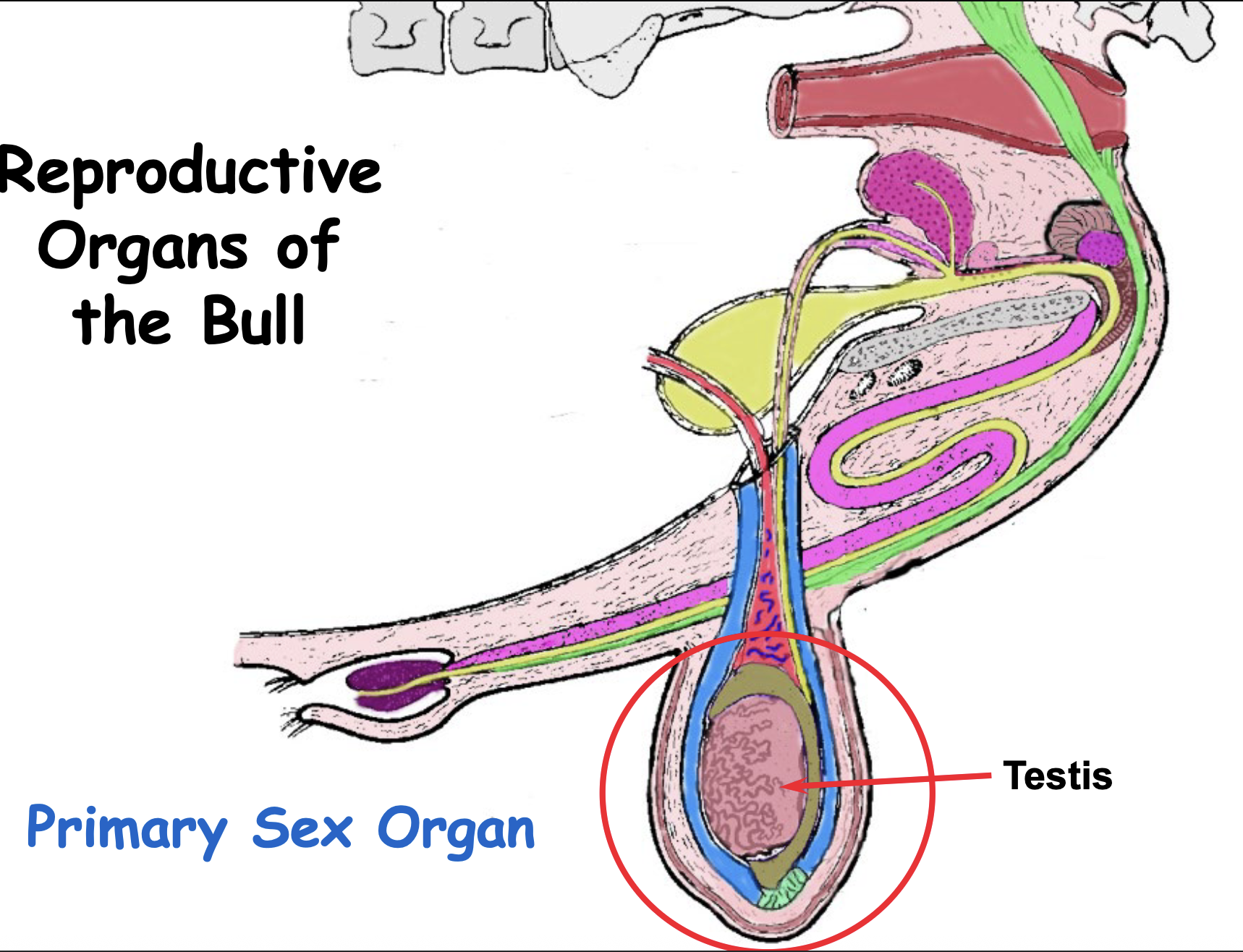
<ul><li><p>Pink line</p></li><li><p>Can react penis within the body and erect</p></li></ul><p></p>
5
New cards
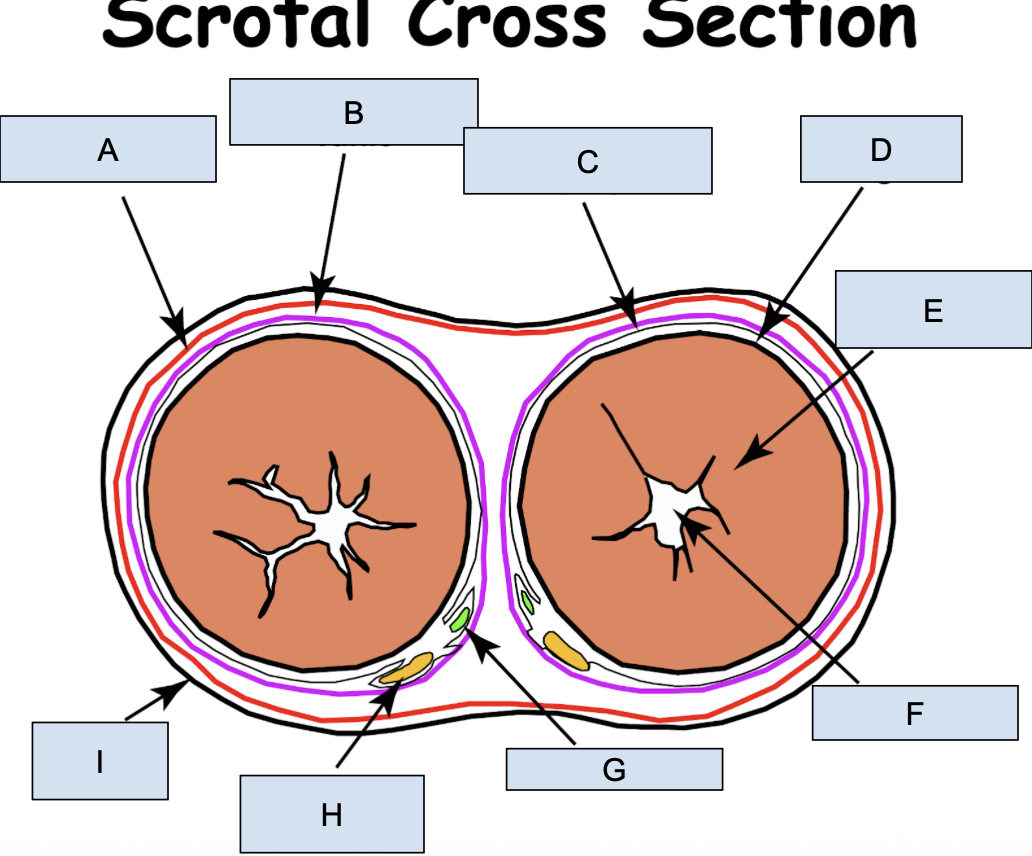
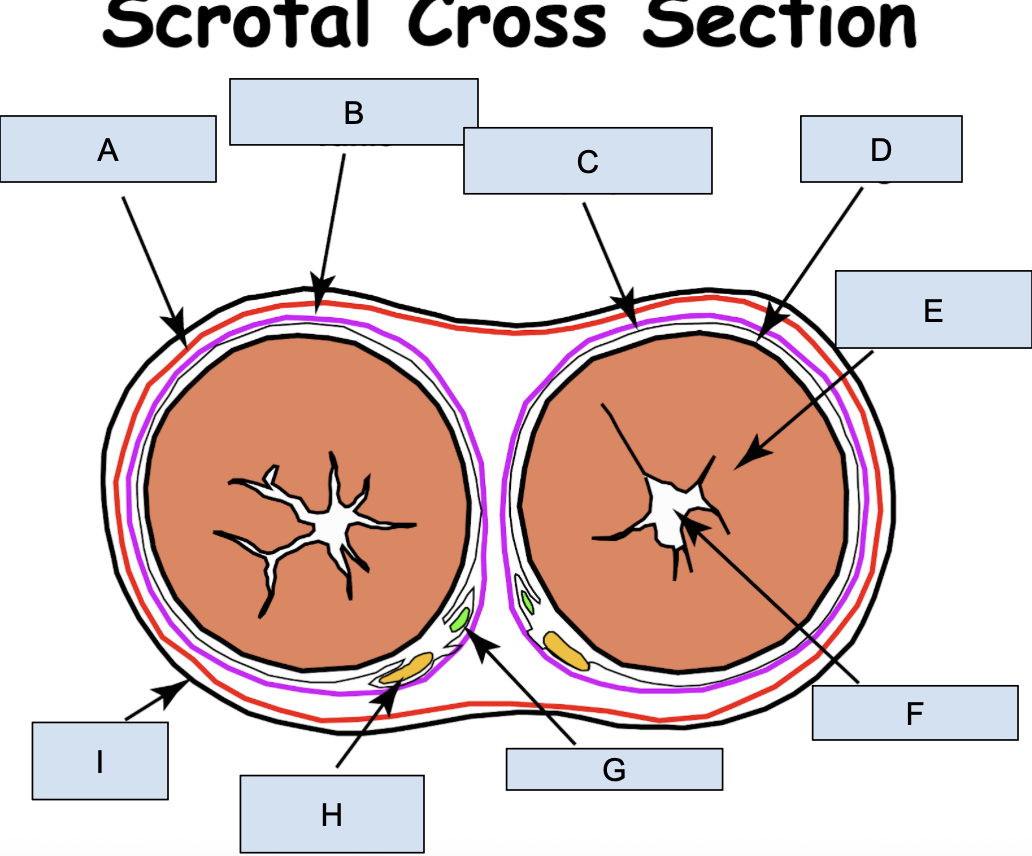
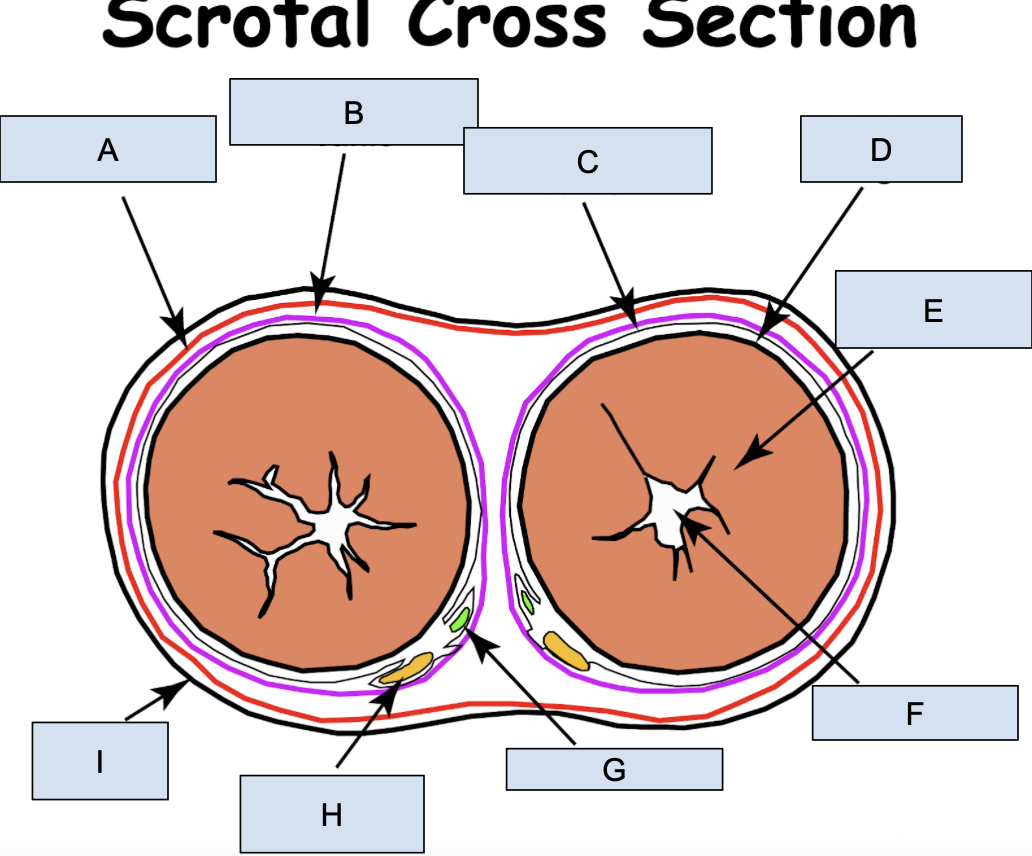
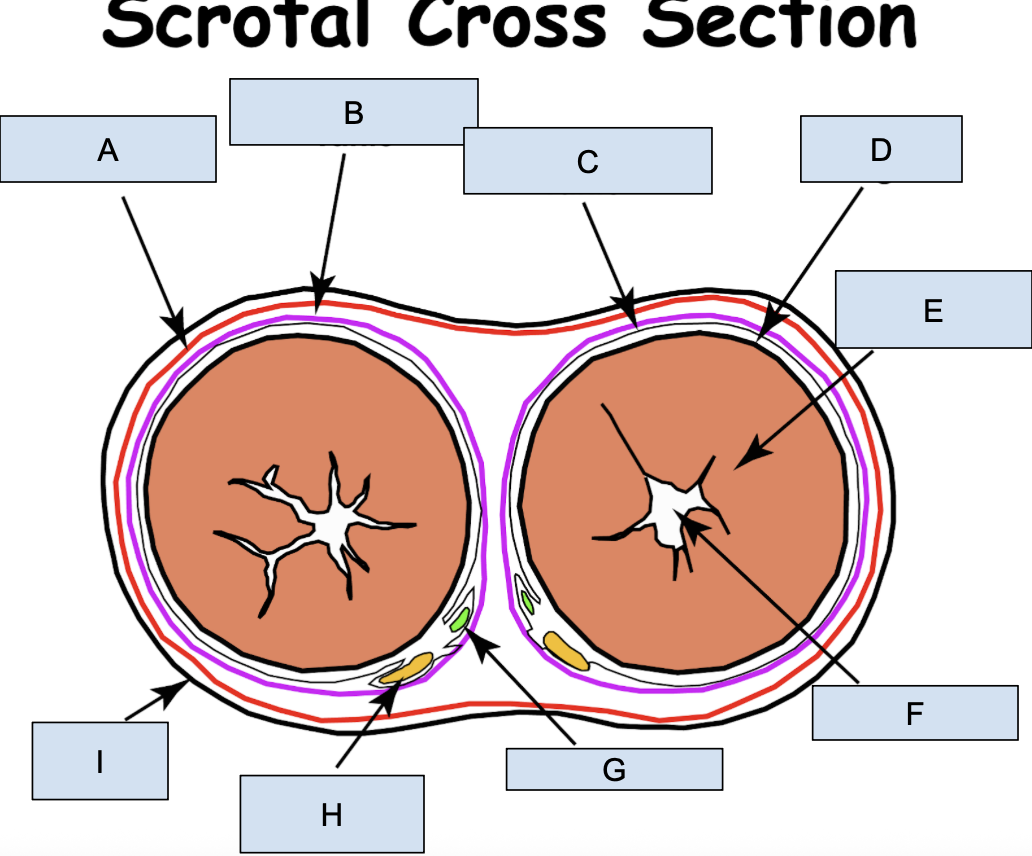
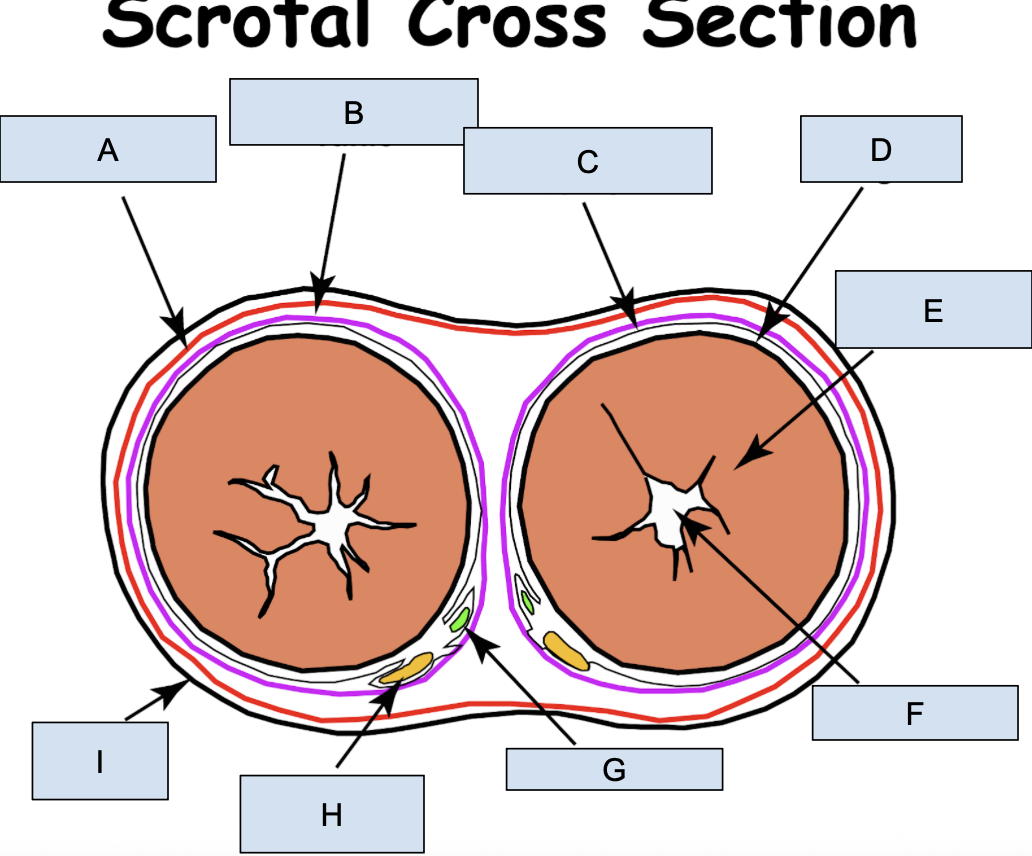
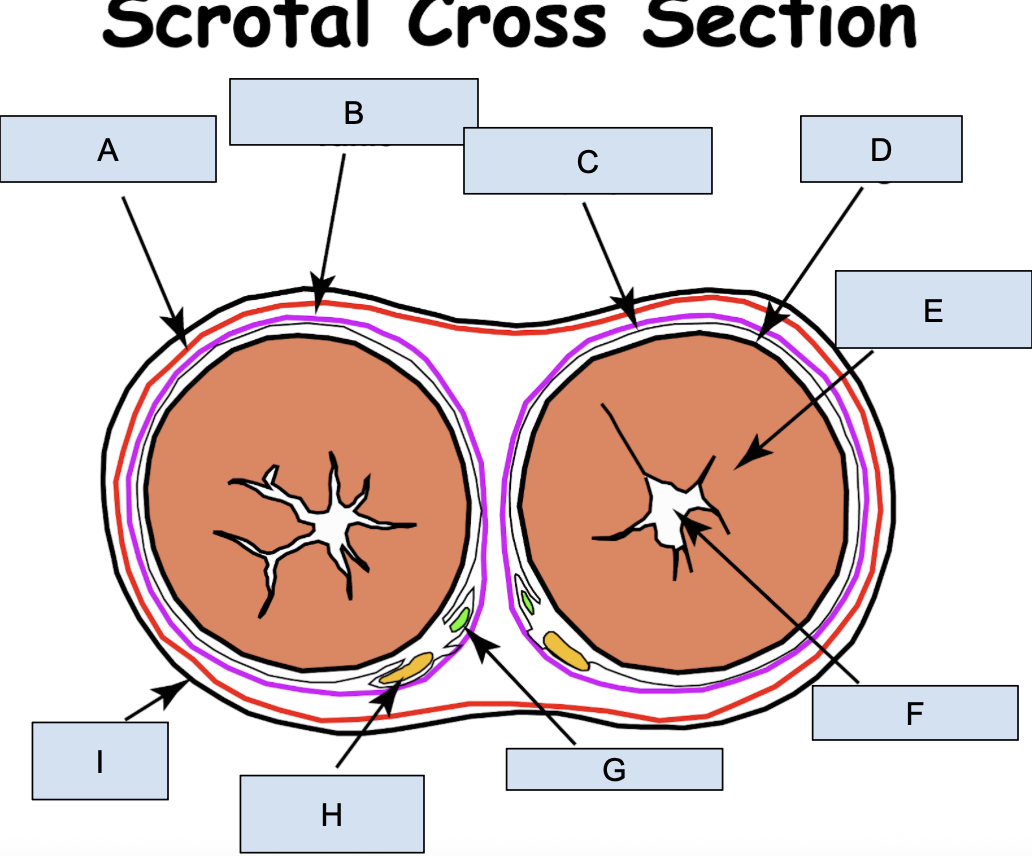
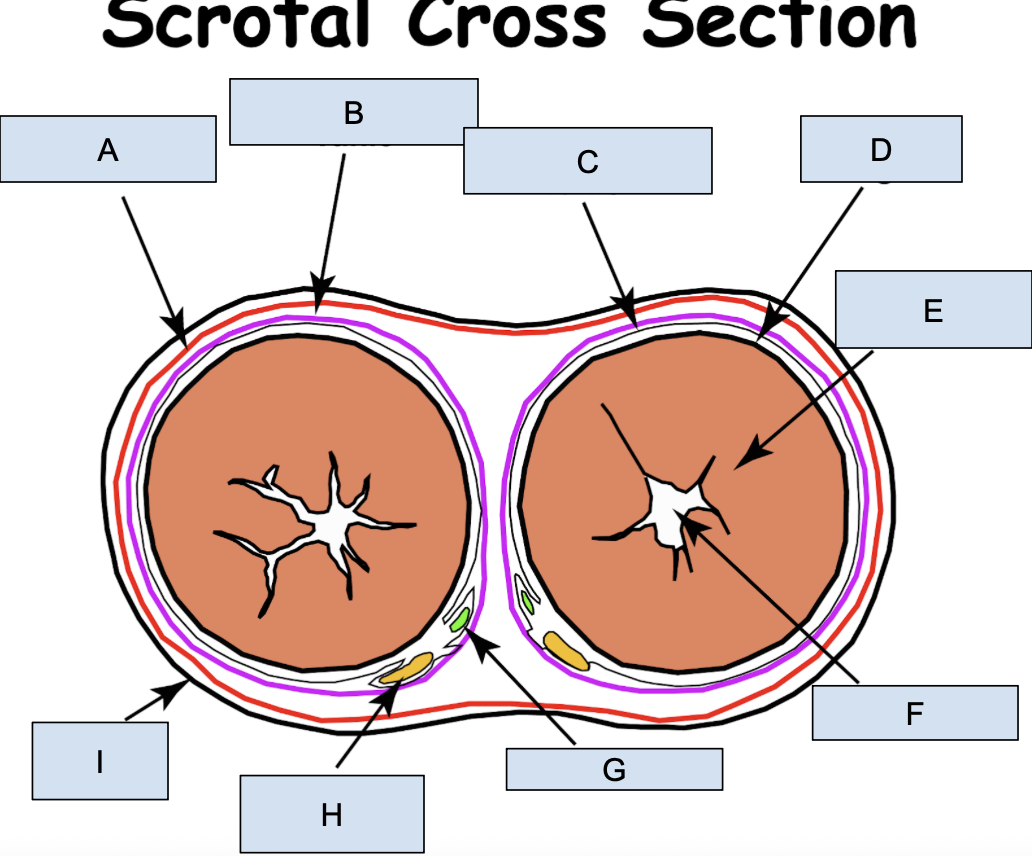
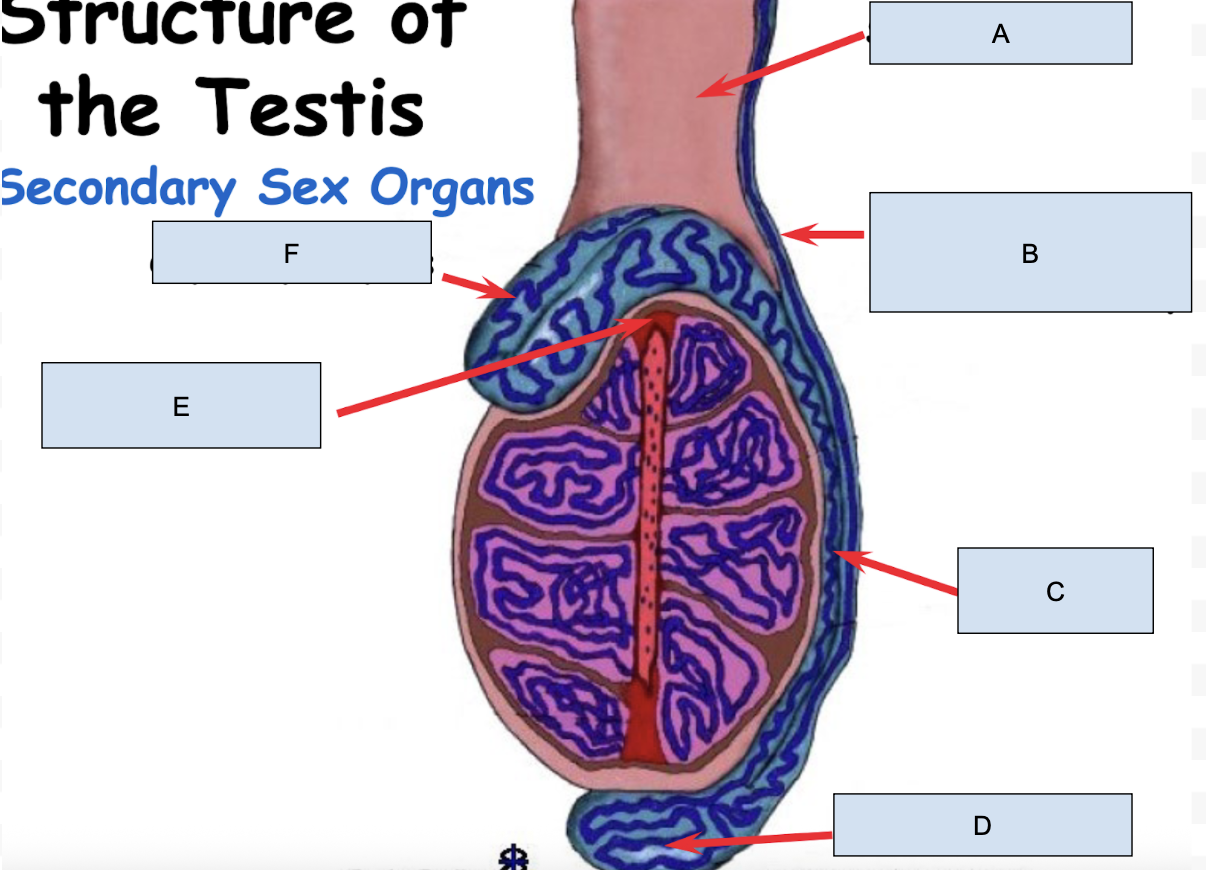
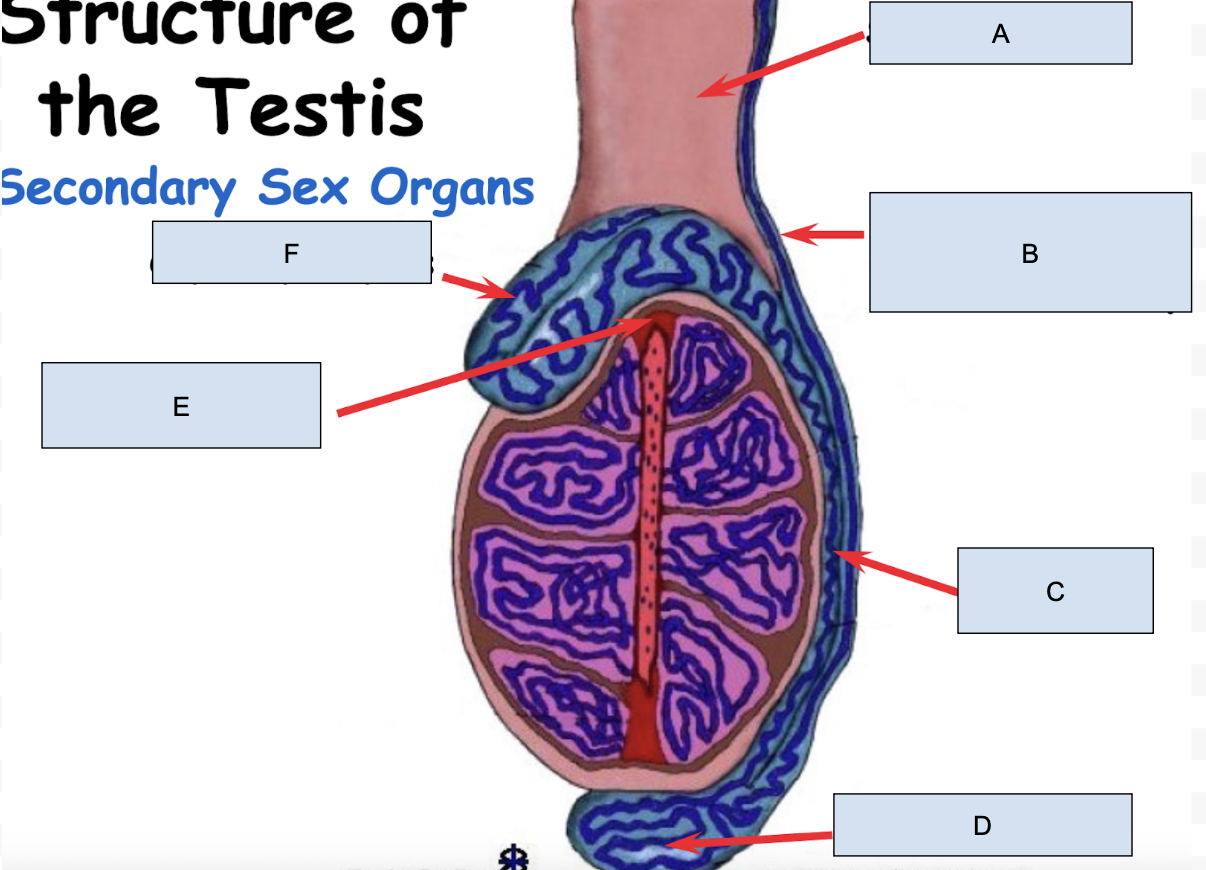
<p>What is A?</p>

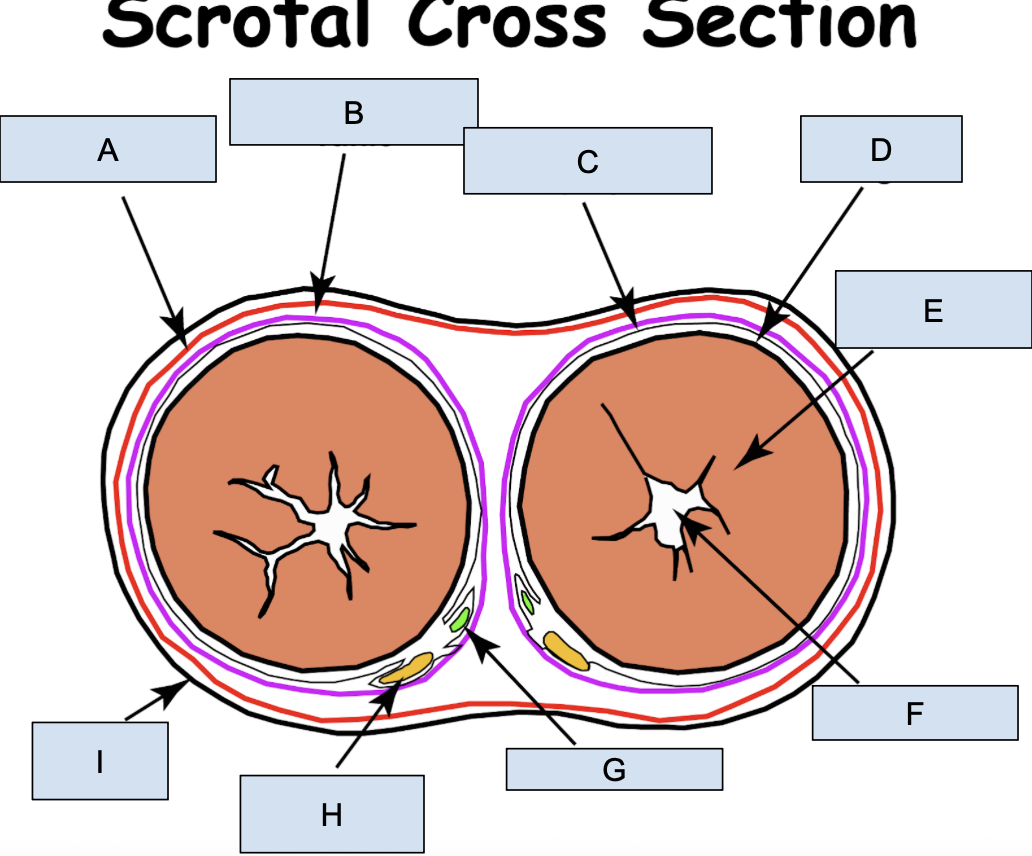
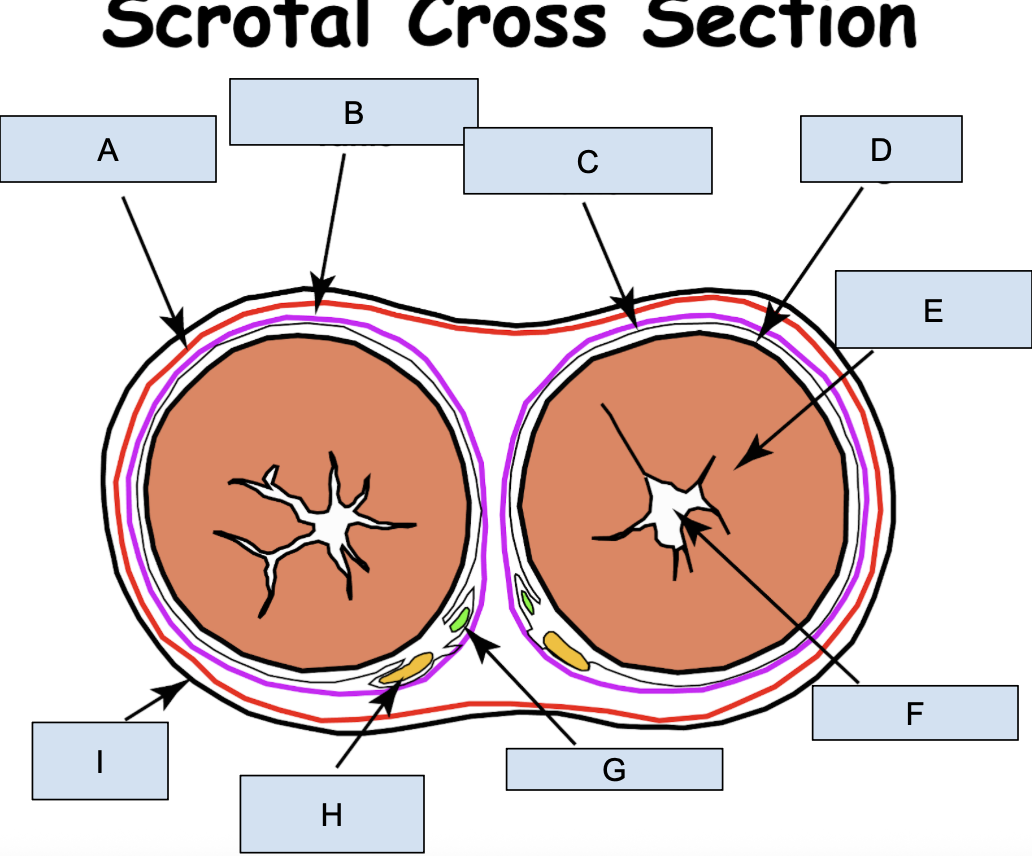
What is A?

Tunica dartos muscle

6
New cards
<p>What is B?</p>

What is B?

Parietal vaginal tunic

7
New cards
<p>What is C?</p>

What is C?

Visceral vaginal tunic

8
New cards
<p>What is D?</p>

What is D?

Tunica albuginea

  • Compared to ovary

9
New cards
<p>What is E?</p>

What is E?

Testicular parenchyma

10
New cards
<p>What is F?</p>

What is F?

Mediastinum

11
New cards
<p>What is G?</p>

What is G?

Vas deferens

12
New cards
<p>What is H?</p>

What is H?

Epididymis (corpus)

13
New cards
<p>What is I?</p>

What is I?

Scrotal skin

14
New cards

Why is there space between the parietal and visceral vaginal tunic?

Allow them contract/slide up/down

Space called perennial cavity
15
New cards
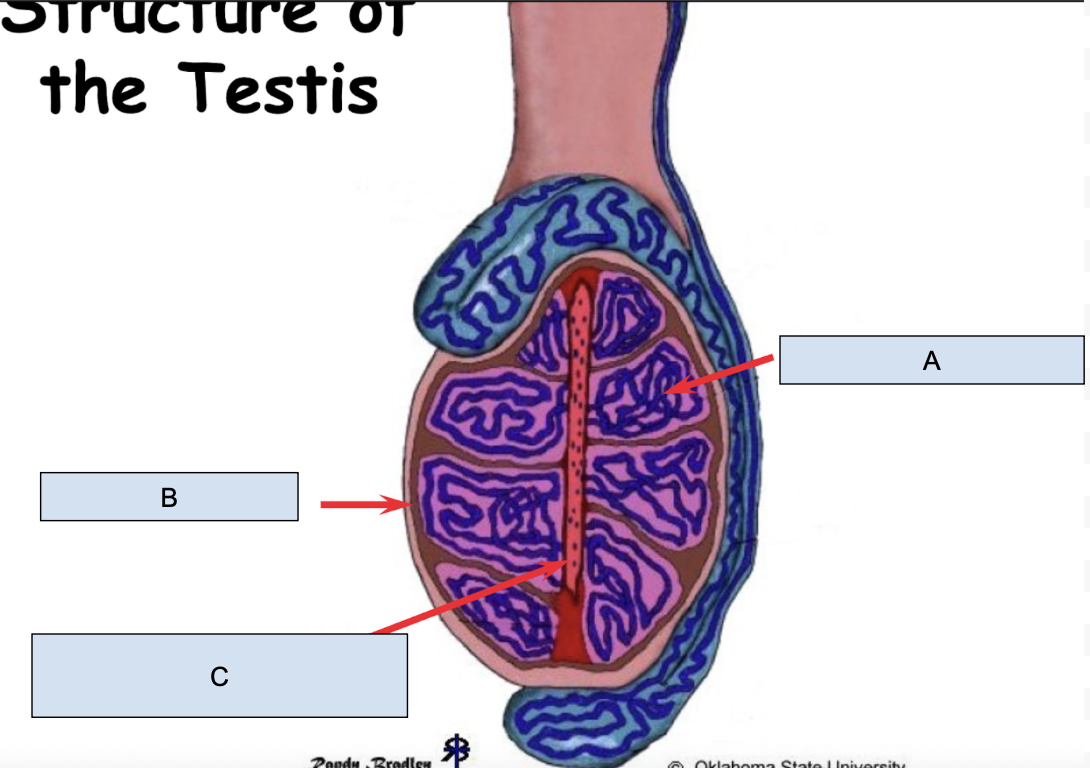
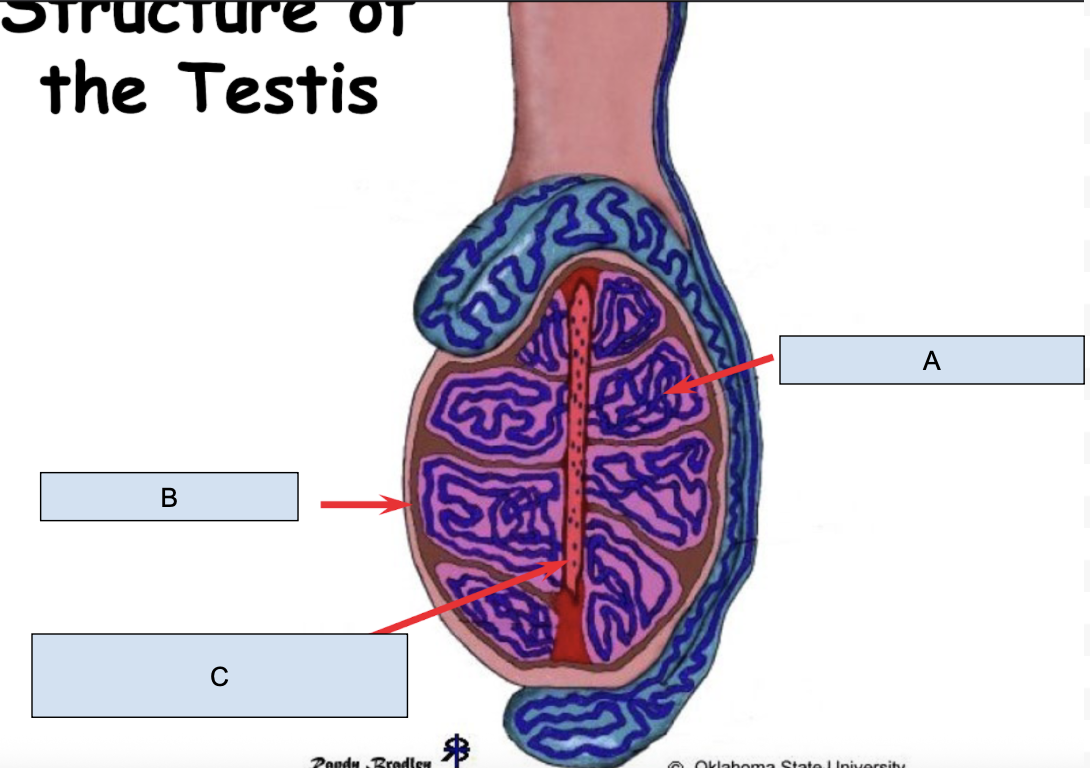
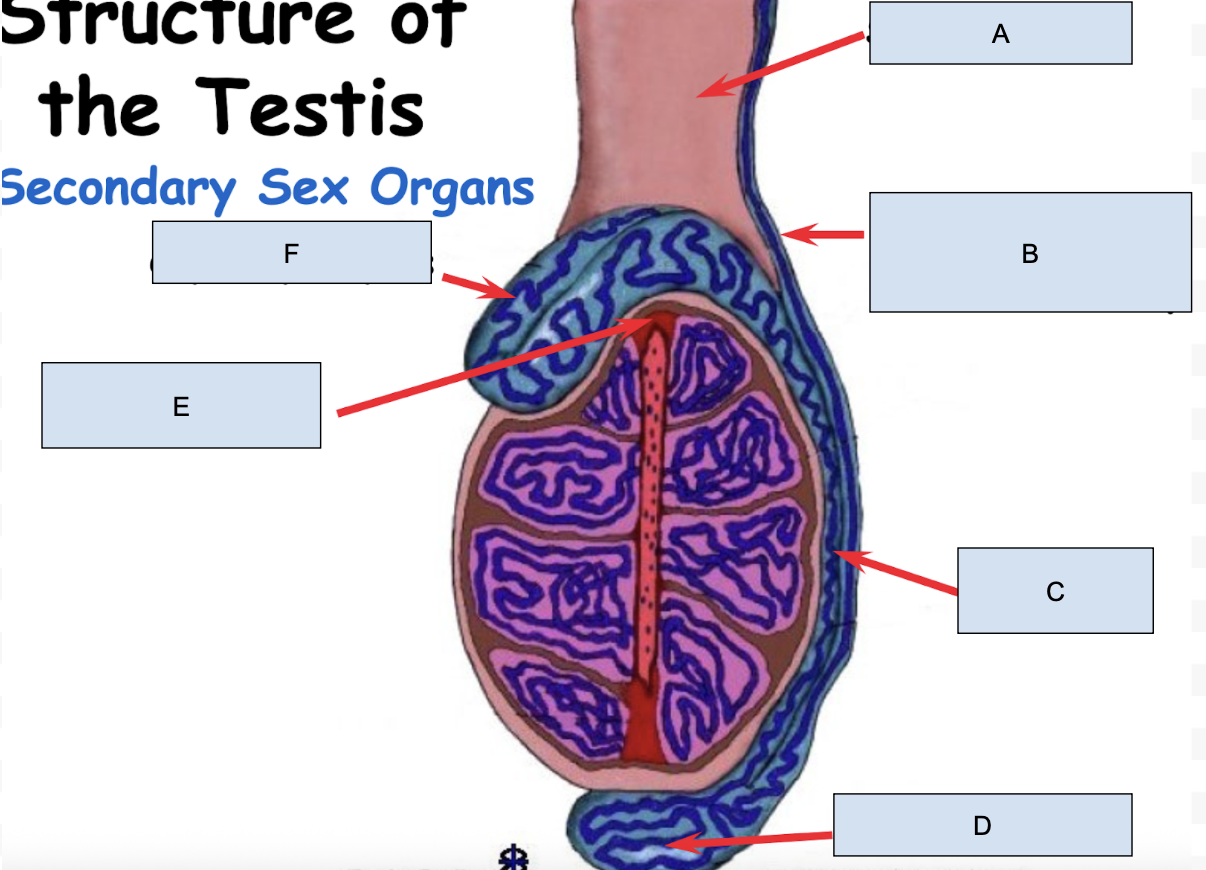
<p>What is A?</p>

What is A?

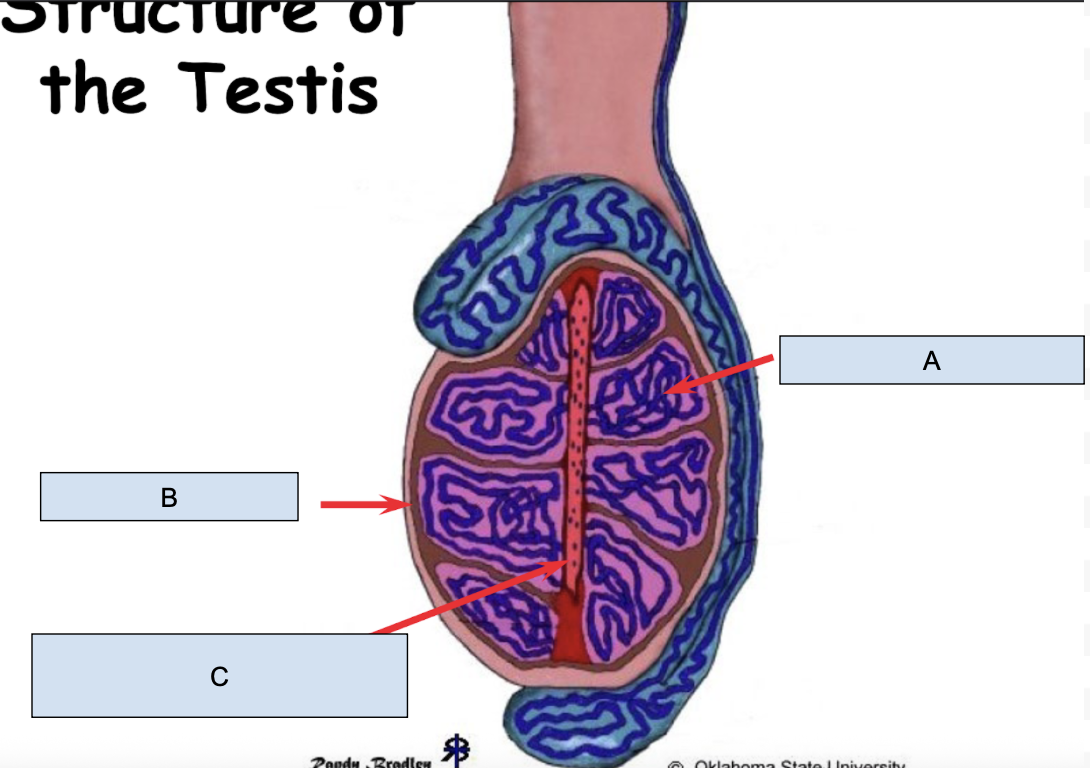
Seminiferous tubule

16
New cards
<p>What is B?</p>

What is B?

Tunica albuginea

17
New cards
<p>What is C?</p>

What is C?

Rete testes (within mediastinum)

18
New cards

What is the parenchyma?

  • Where sperm is formed

  • Made up of serminferous tubules

    • Where sperm develops

19
New cards
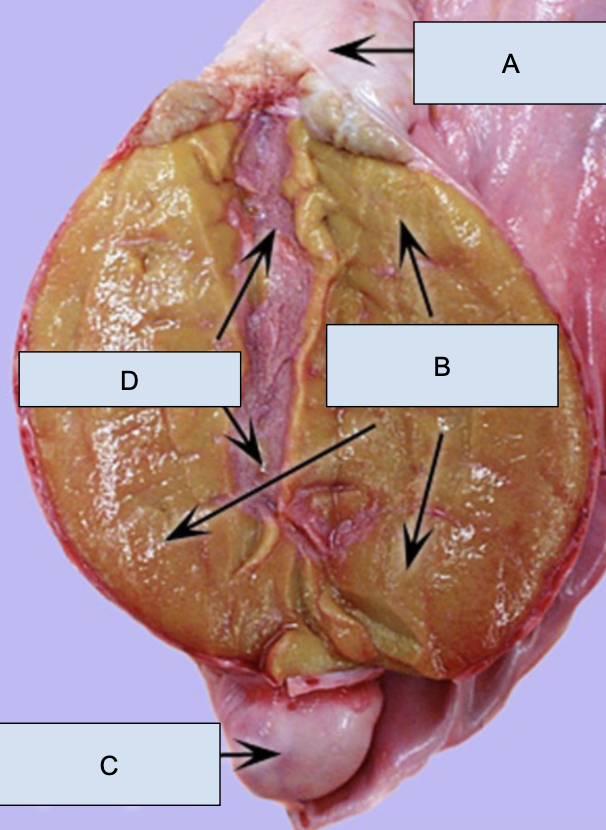
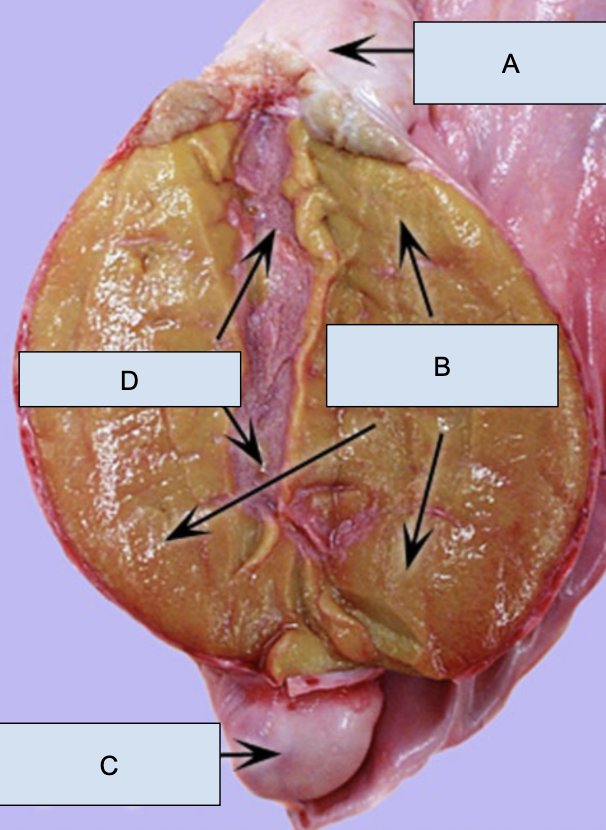
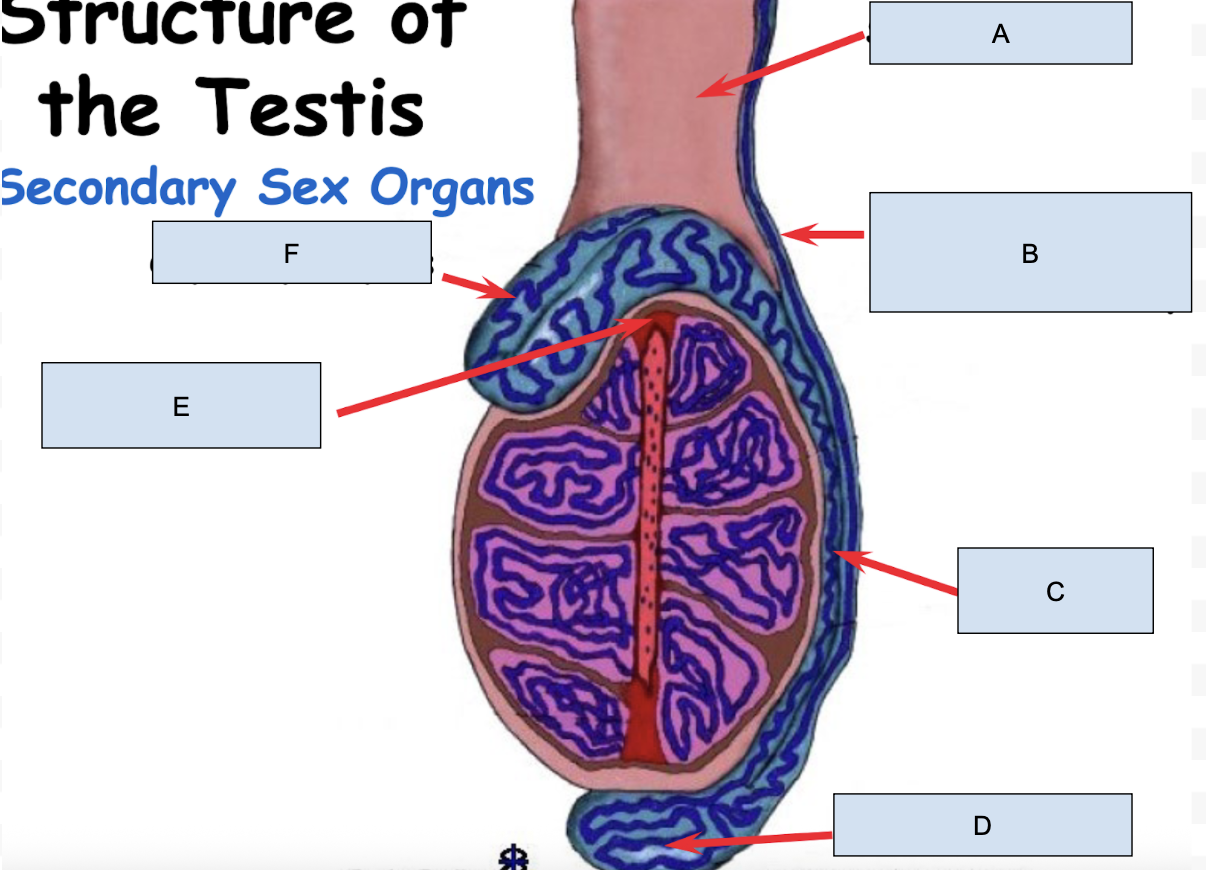
<p>What is A?</p>

What is A?

Caput epididymis

20
New cards
<p>What is B?</p>

What is B?

Testicular parenchyma

21
New cards

What is C?

Cauda epididymis

<p>Cauda epididymis</p>
22
New cards
<p>What is D?</p>

What is D?

Mediastinum

23
New cards
<p>What is A?</p>

What is A?

Spermatic cord

24
New cards
<p>What is B?</p>

What is B?

Vas deferens

  • Where vasectomy happens

25
New cards
<p>What is C?</p>

What is C?

Corpus epididymis

26
New cards
<p>What is D?</p>

What is D?

Cauda epididymis

27
New cards
<p>What is E?</p>

What is E?

Vas efferentia

  • 6-12 tubules

28
New cards
<p>What is F?</p>

What is F?

Caput epididymis

29
New cards

How does sperm mainly move within the the epididymis in the testis?

Smooth muscle contractions

30
New cards

Where is sperm temporarily stored within the testis?

Cauda epididymis

  • Holds 4-5 ejaculates worth of sperm

  • Where sperm matures

31
New cards

How does sperm move through the vas deferens?

By fluid or perilstalsis

32
New cards

What is the spermatic cord?

  • Made up of vascular, lymphatic, and nerve cells

  • Heat exchanger

  • House cremaster muscle (skeletal muscle)

    • Fight or flight, bring up testes to avoid damage

33
New cards

What is the pampiniform plexus?

  • Counter current exchange

  • Reduce amplitude of arterial pulses

  • Helps create a high —> concentration/gradient to bring testosterone in for spermatogenesis
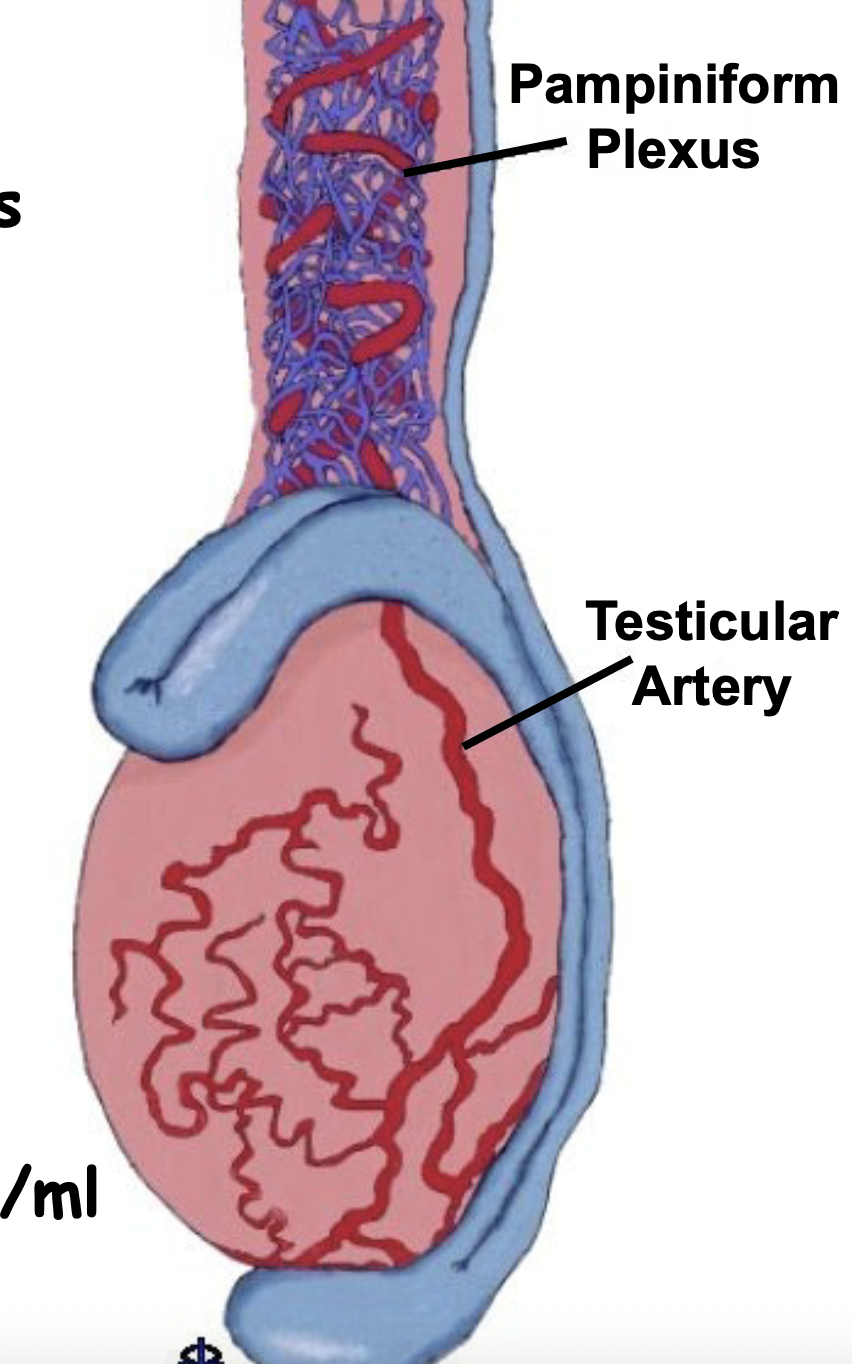
<ul><li><p>Counter current exchange</p></li><li><p>Reduce amplitude of arterial pulses</p></li><li><p>Helps create a high —&gt; concentration/gradient to bring testosterone in for spermatogenesis</p></li></ul><p></p>
34
New cards
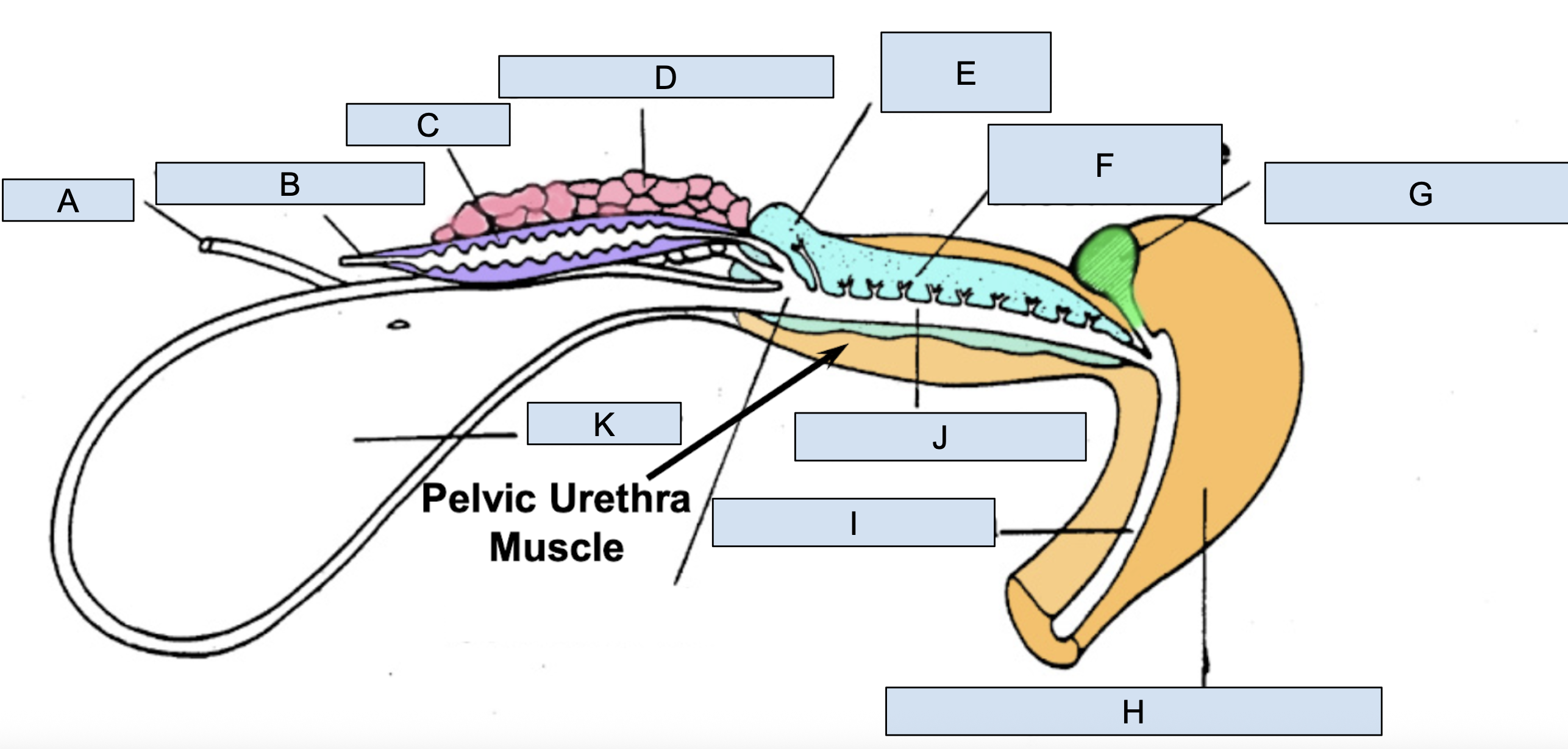
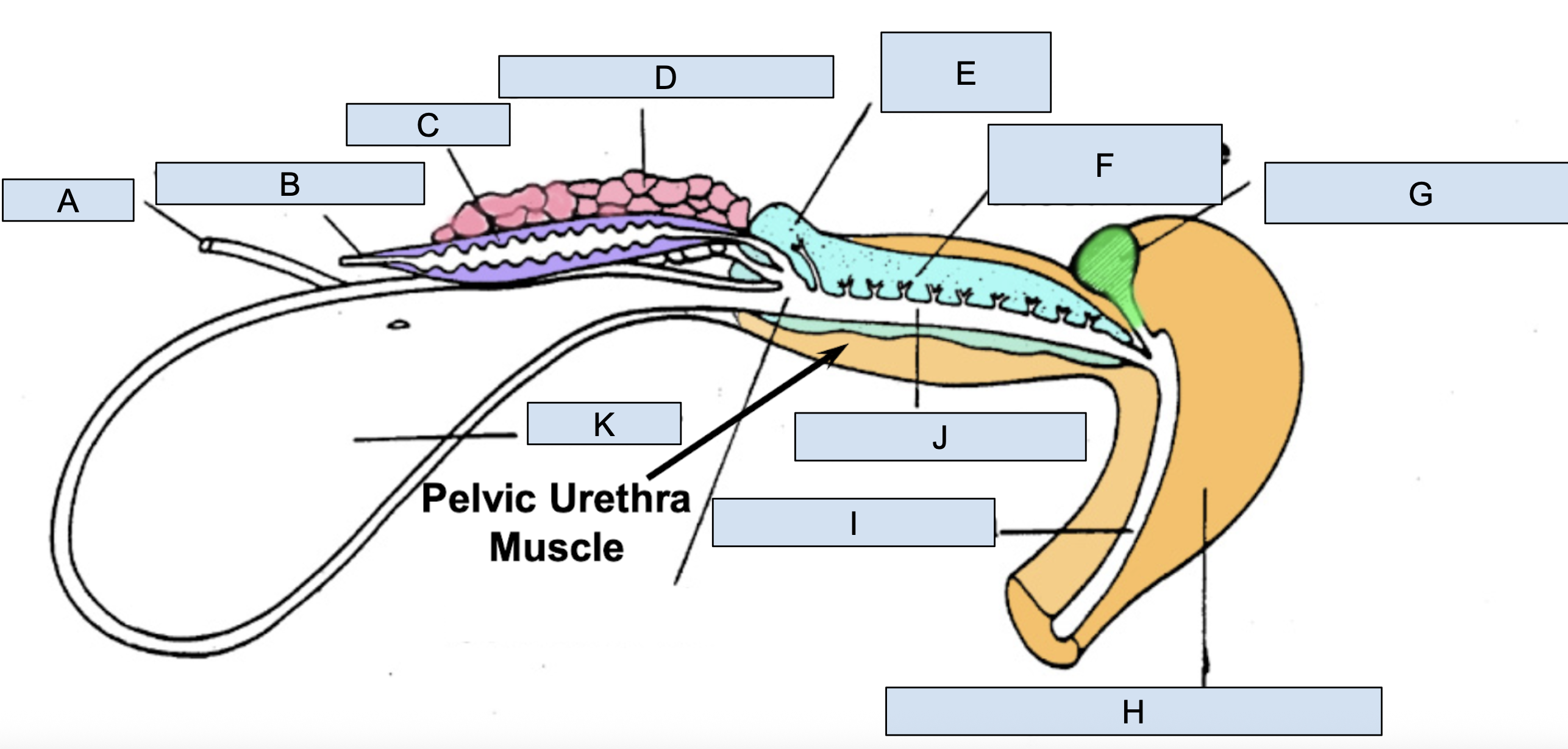
<p>What is A?</p>

What is A?

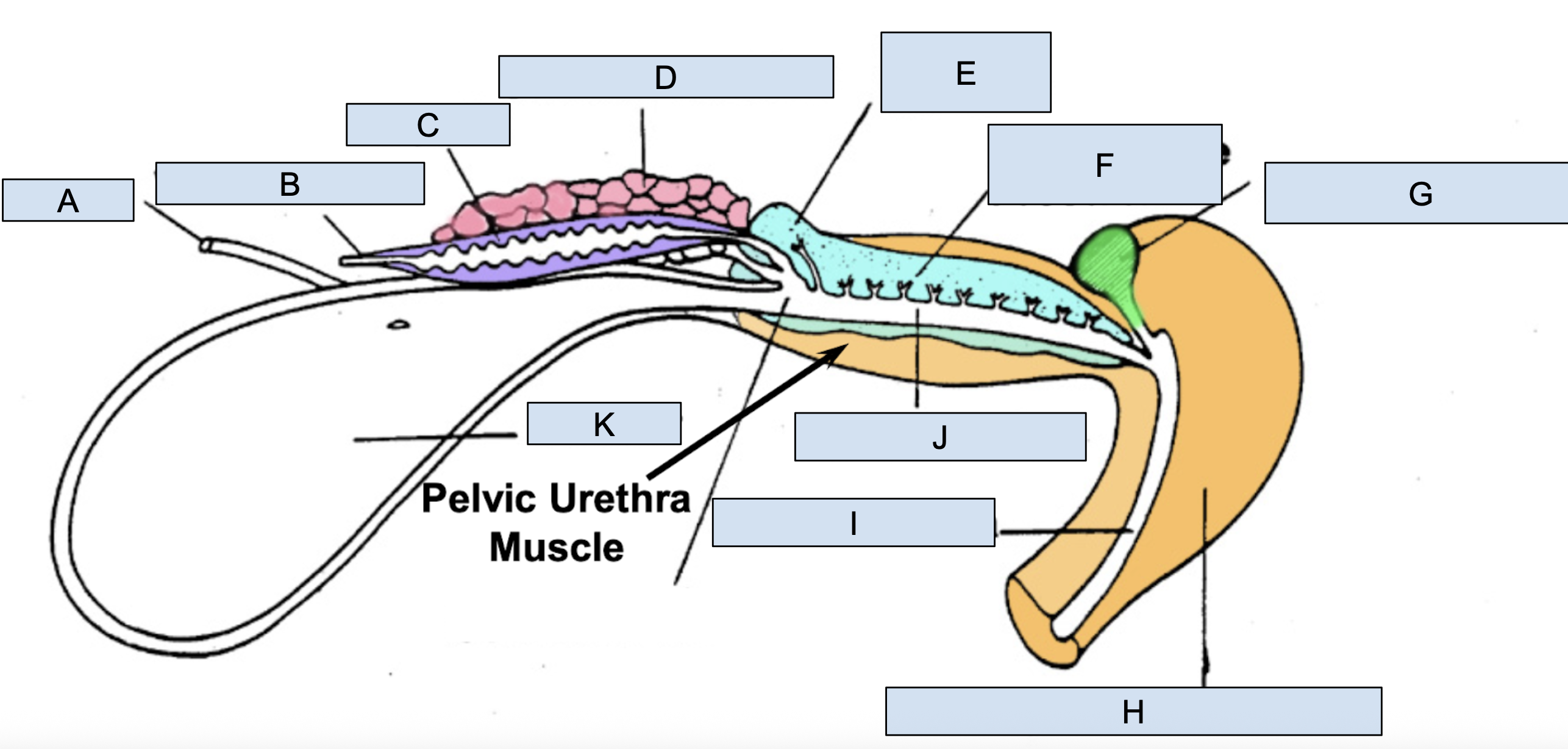
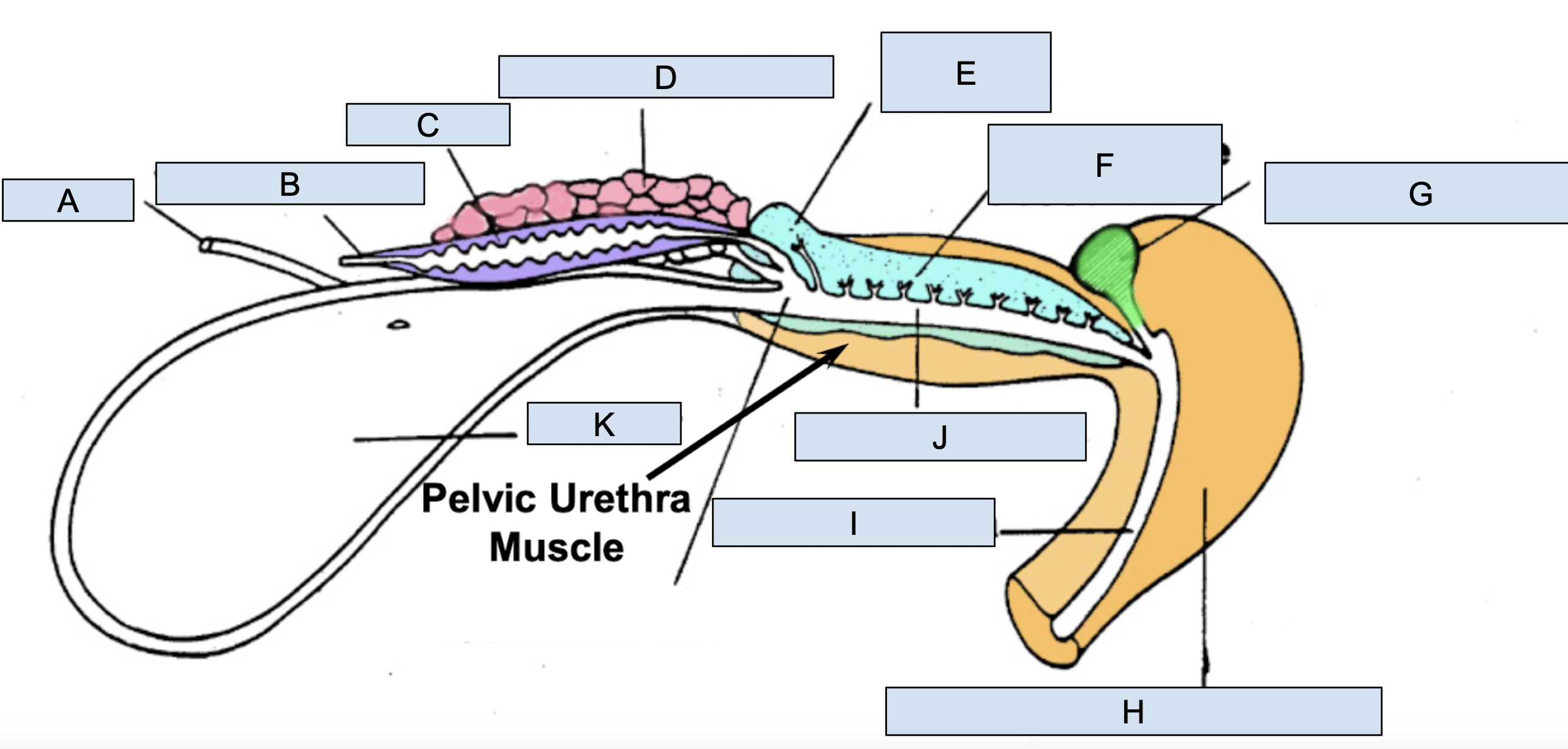
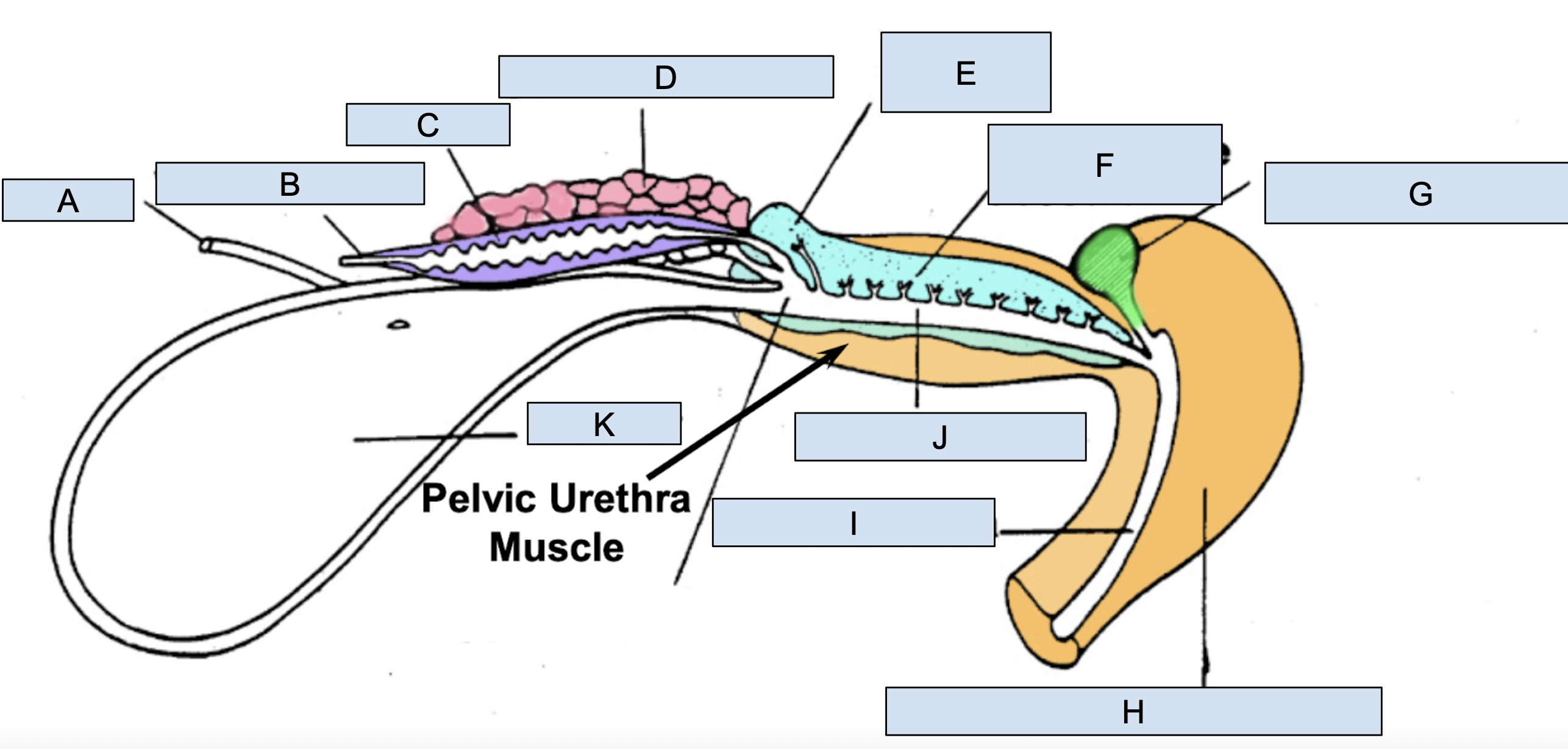
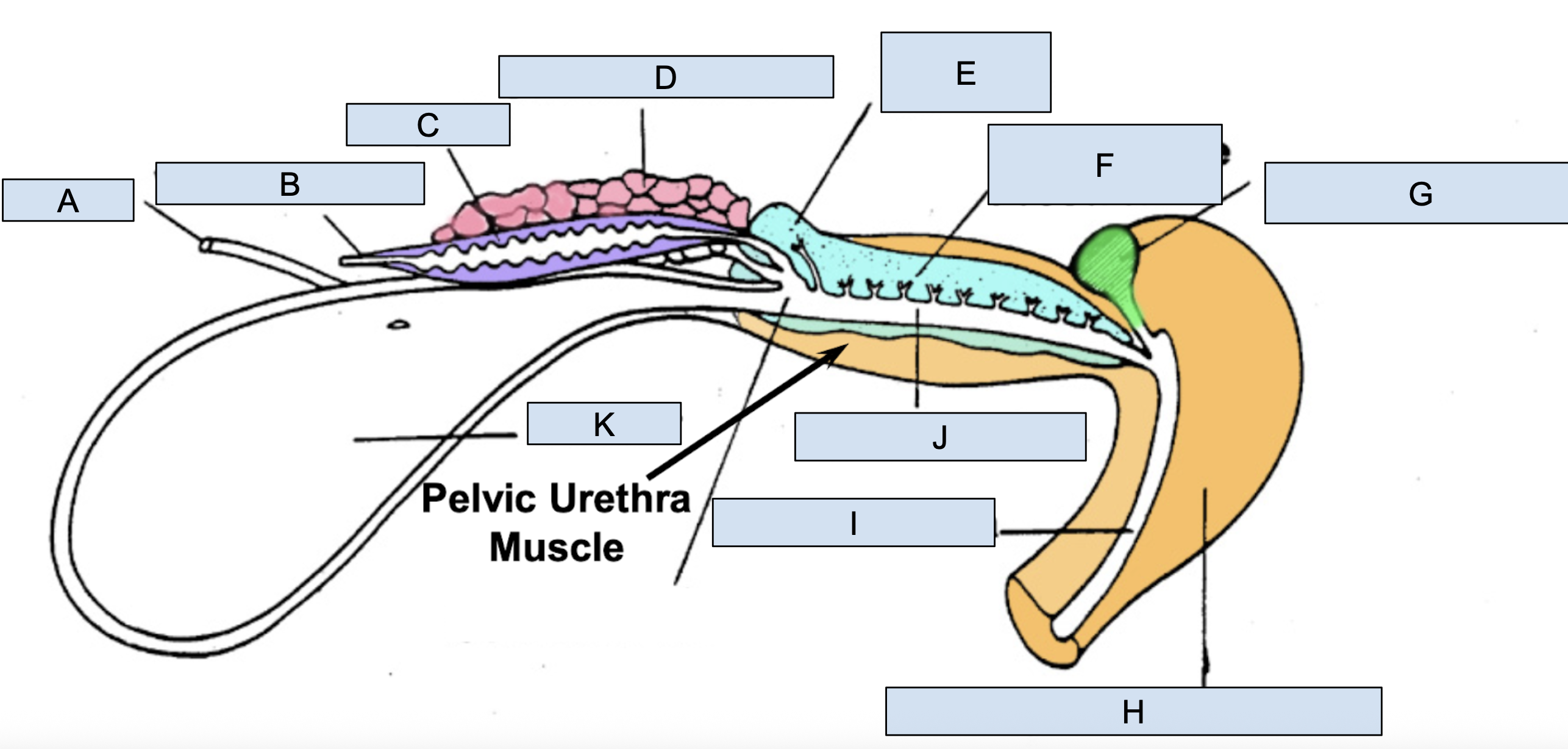
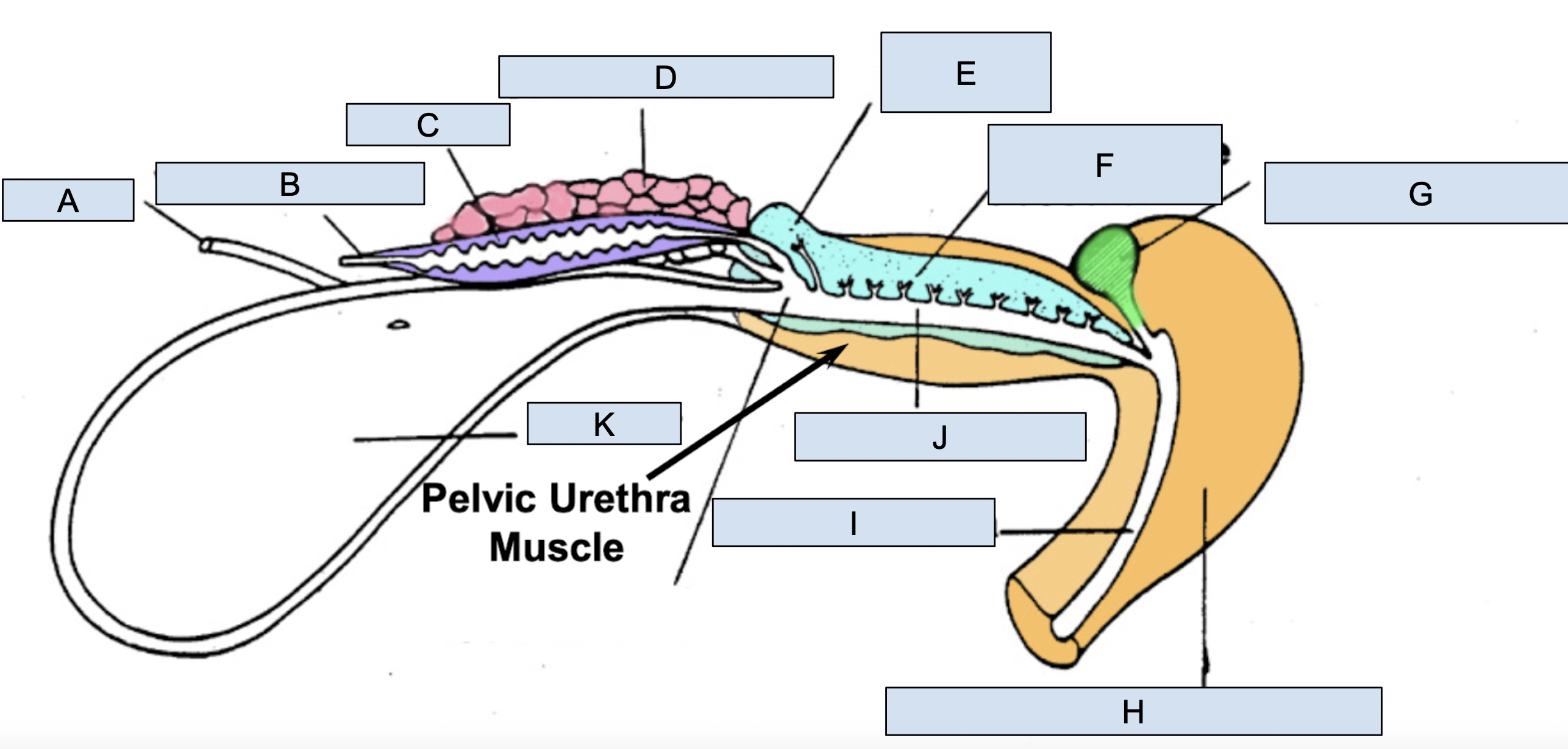
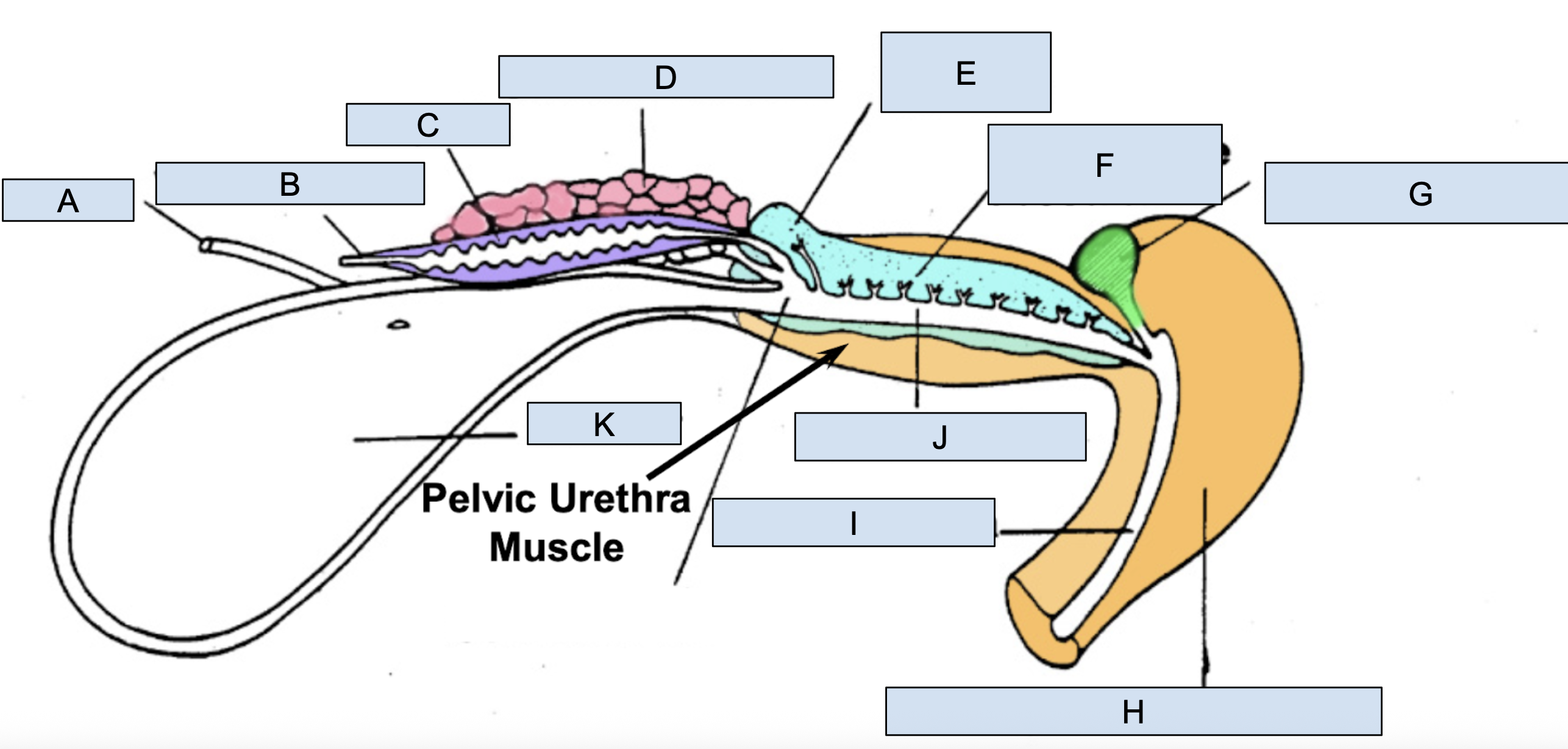
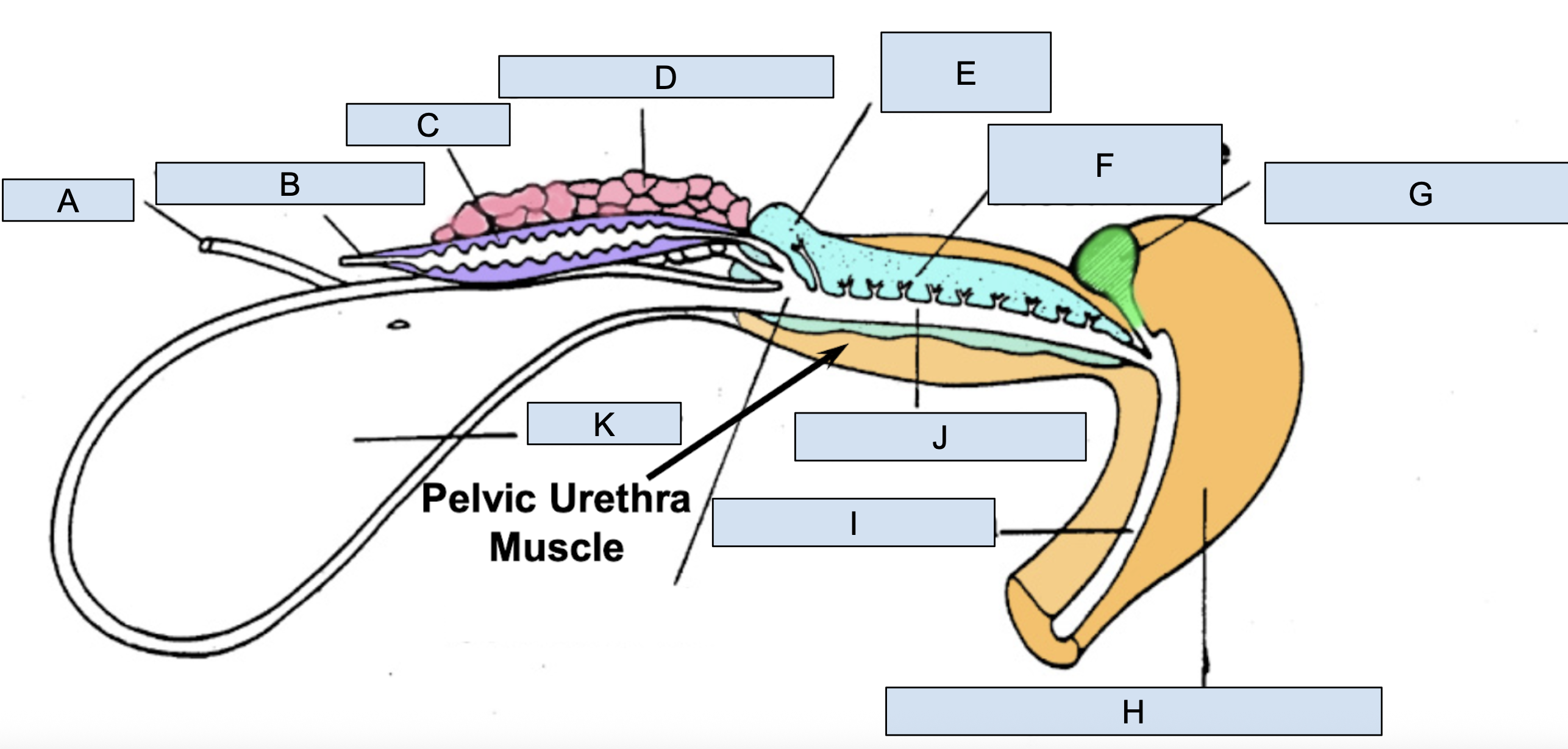
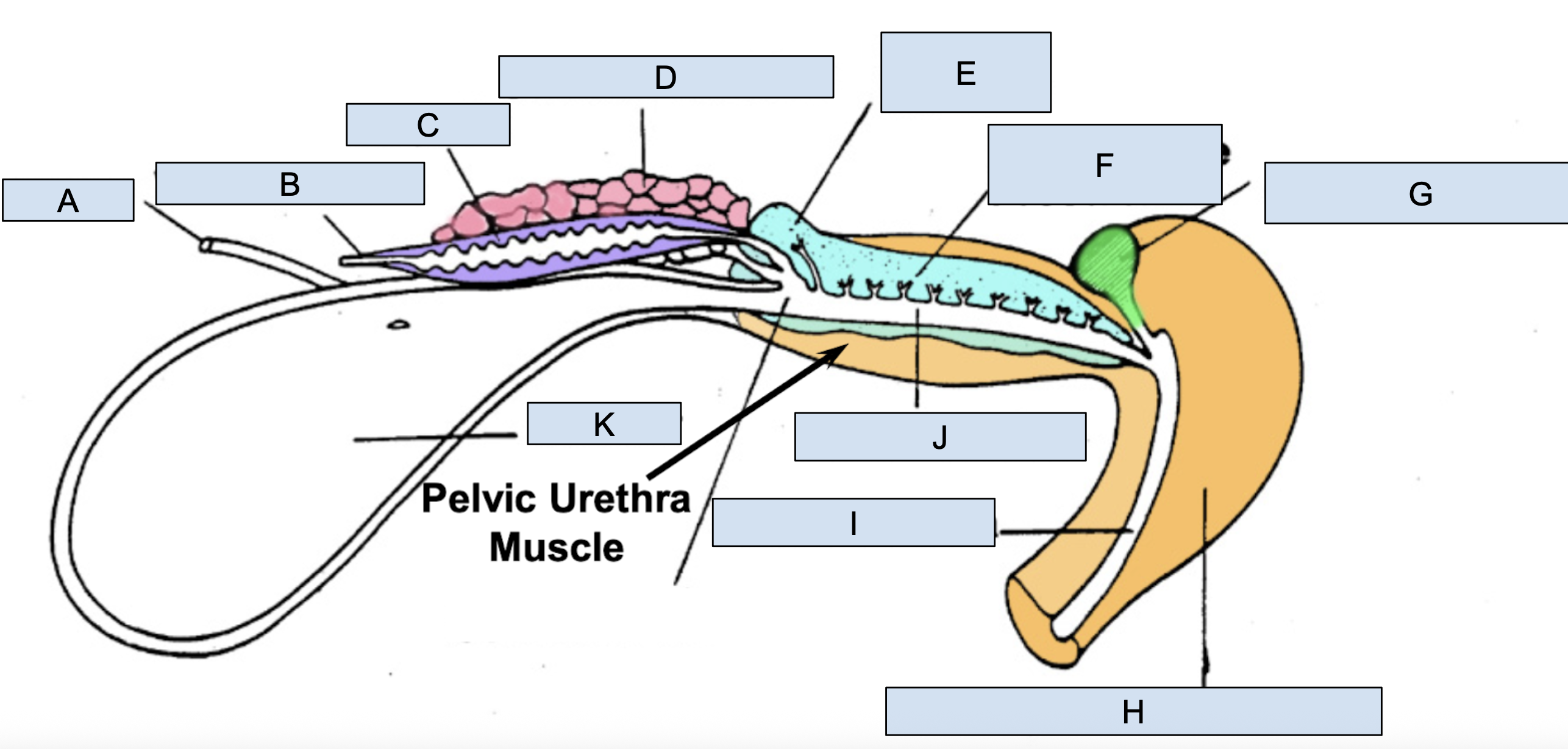
Ureter

35
New cards
<p>What is B?</p>

What is B?

Vas deferens

36
New cards
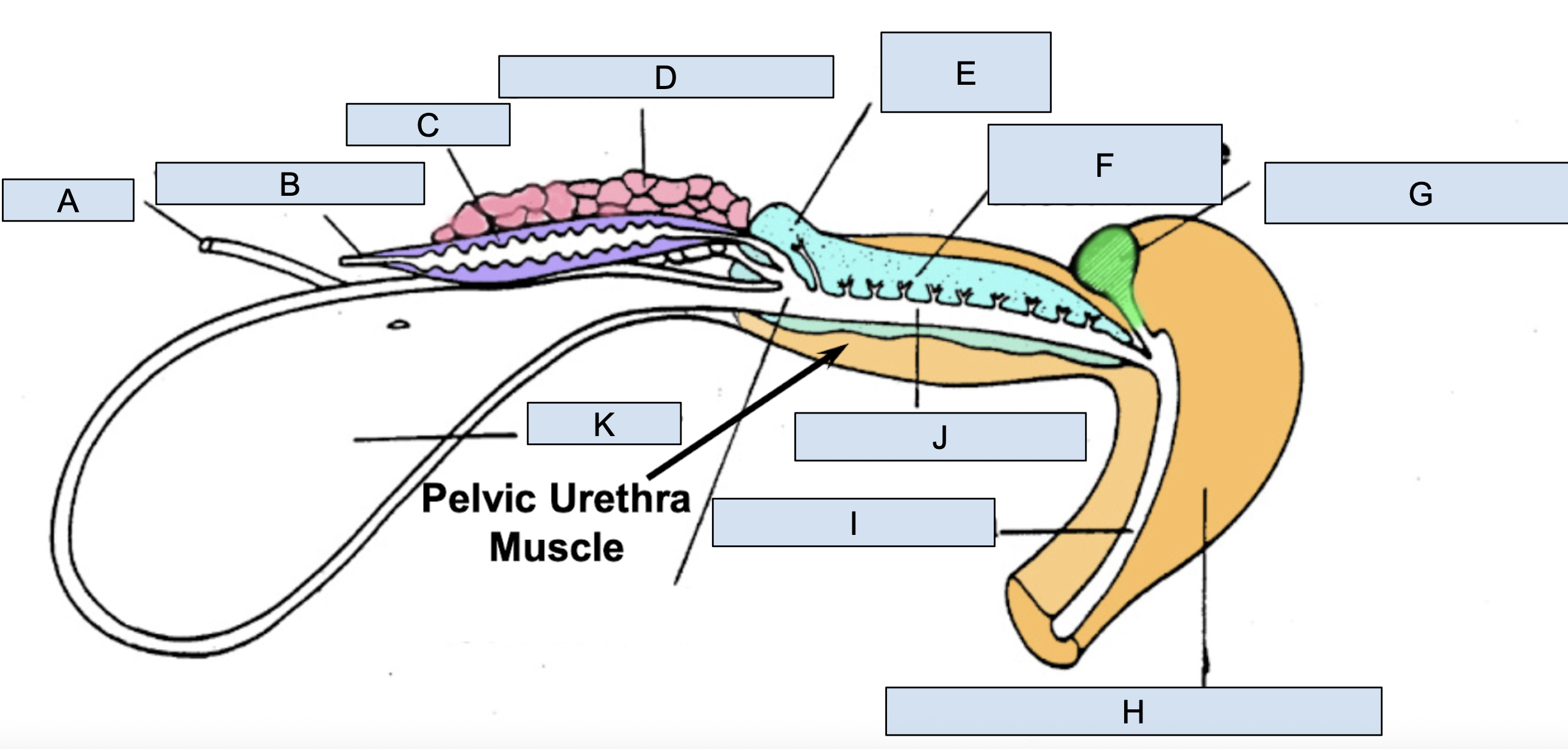
<p>What is C?</p>

What is C?

Ampulla

  • Larger version of vas deferent

37
New cards
<p>What is D?</p>

What is D?

Seminal vesicles

  • Secretes fluid + semen

38
New cards
<p>What is E?</p>

What is E?

Body of prostate

  • Controls which tube is open (vas deferens vs bladder)
39
New cards
<p>What is F?</p>

What is F?

Disseminate prostate

40
New cards
<p>What is G?</p>

What is G?

Cowper’s gland

41
New cards
<p>What is H?</p>

What is H?

Bulbospongiosus muscle

  • Erection

42
New cards
<p>what is I?</p>

what is I?

Penile urethra

43
New cards
<p>What is J?</p>

What is J?

Pelvic urethra

44
New cards
<p>What is K?</p>

What is K?

Bladder

45
New cards

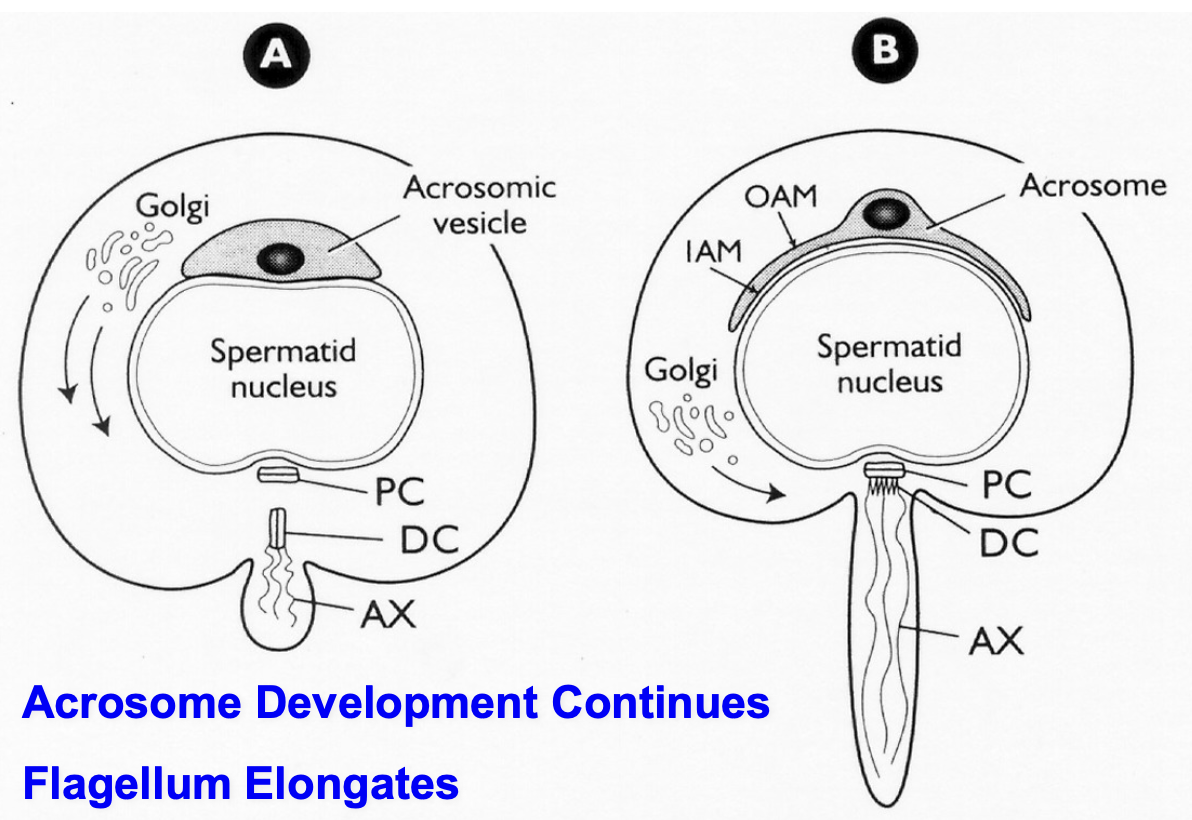
What is the cap phase?

  • Acrostic vesicles spreads/flattens around top/nucleus, still contains digestive enzymes

  • Golgi goes closer to where tail is

  • Centrioles separate, one becomes head and other half becomes tail itself

  • Acronyms

    • AX — adenoma (tail)

    • OAM — outer acrosomal membrane

    • IAM — inner acrosomal membrane

<ul><li><p>Acrostic vesicles spreads/flattens around top/nucleus, still contains digestive enzymes</p></li><li><p>Golgi goes closer to where tail is</p></li><li><p>Centrioles separate, one becomes head and other half becomes tail itself</p></li><li><p>Acronyms</p><ul><li><p>AX — adenoma (tail)</p></li><li><p>OAM — outer acrosomal membrane</p></li><li><p>IAM — inner acrosomal membrane</p></li></ul></li></ul><p></p>
46
New cards

What happens when sperms release digestive enzymes?

  • Inner acrosomal membrane (IAM) and outer acrosomal membrane (OAM) fuses with one another

  • The fusion itself releases these enzymes

47
New cards

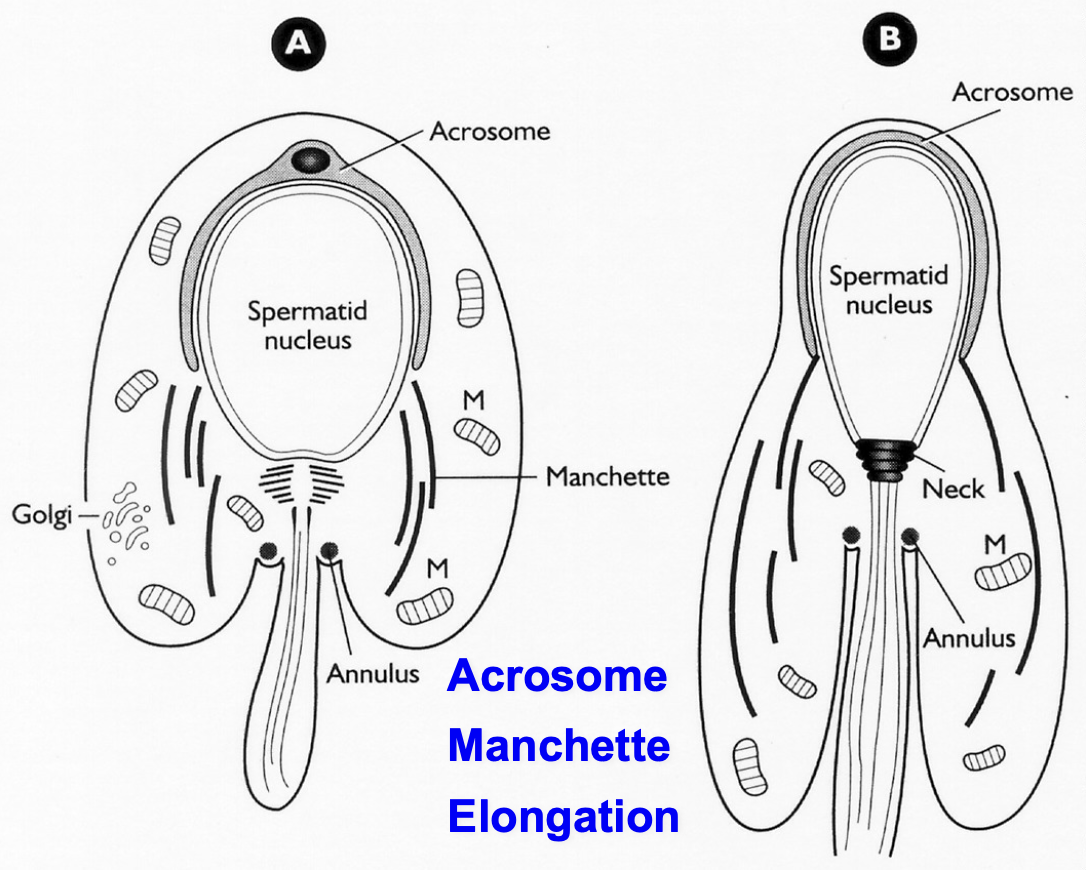
What is the acrosomal phase?

  • Maturation of the head

  • Acrosome now covers ¾ of nucleus

  • Starts to elongate (image B)

  • Microtubules more evident (tail)

  • Annulus on either side of tail

  • Manchette — remaining mitochondria + cytoskeletal structures

  • No organelles on top

<ul><li><p>Maturation of the head</p></li><li><p>Acrosome now covers ¾ of nucleus</p></li><li><p>Starts to elongate (image B)</p></li><li><p>Microtubules more evident (tail)</p></li><li><p>Annulus on either side of tail</p></li><li><p>Manchette — remaining mitochondria + cytoskeletal structures</p></li><li><p>No organelles on top</p></li></ul><p></p>
48
New cards

What is a manchette?

Series of microtubules, associated with nuclear elongation

49
New cards

What is the maturation phase?

  • Manchette disappears

  • Mitochondria migrate

  • Dense fibers form its tail + sheath

  • Postnuclear cap is formed

  • Middle piece — generates lots of ATP to allow tail to work when motile
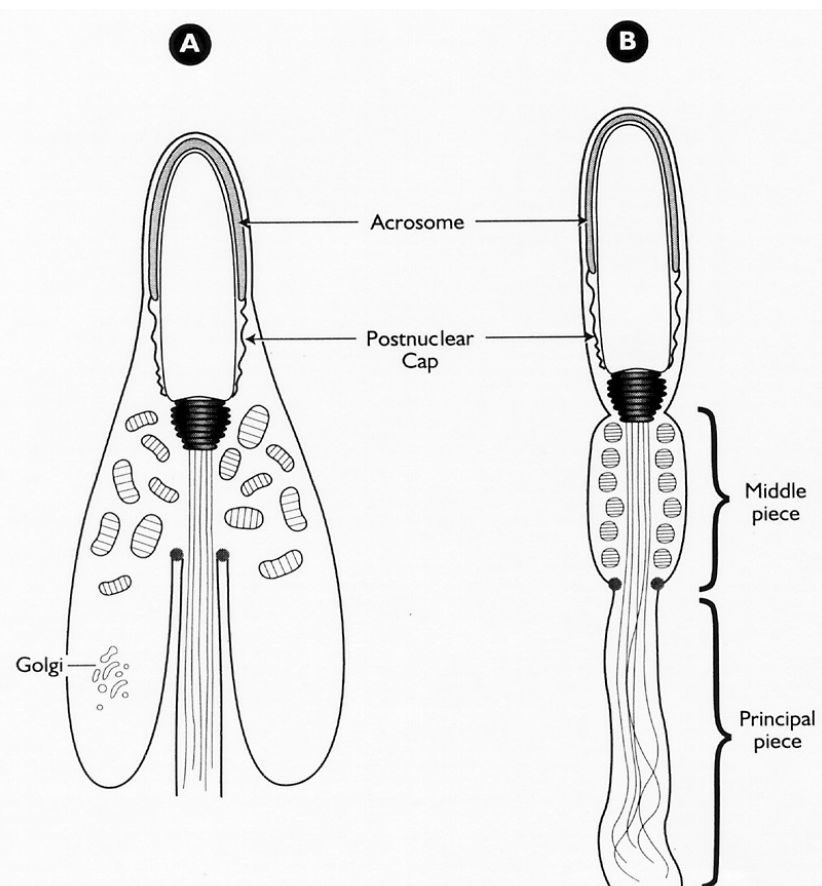
<ul><li><p>Manchette disappears</p></li><li><p>Mitochondria migrate</p></li><li><p>Dense fibers form its tail + sheath</p></li><li><p>Postnuclear cap is formed</p></li><li><p>Middle piece — generates lots of ATP to allow tail to work when motile</p></li></ul><p></p>
50
New cards

What is the order of sperm maturation?

  1. Golgi phase — formation of Golgi apparatus

  2. Cap phase (acrosome development continues, flagellum elongates)

  3. Acrosomal phase (maturation of head, acrosome + machete + elongation)

  4. Maturation phase (manchette disappears, mitochondria migrate, postnuclear cap formed)
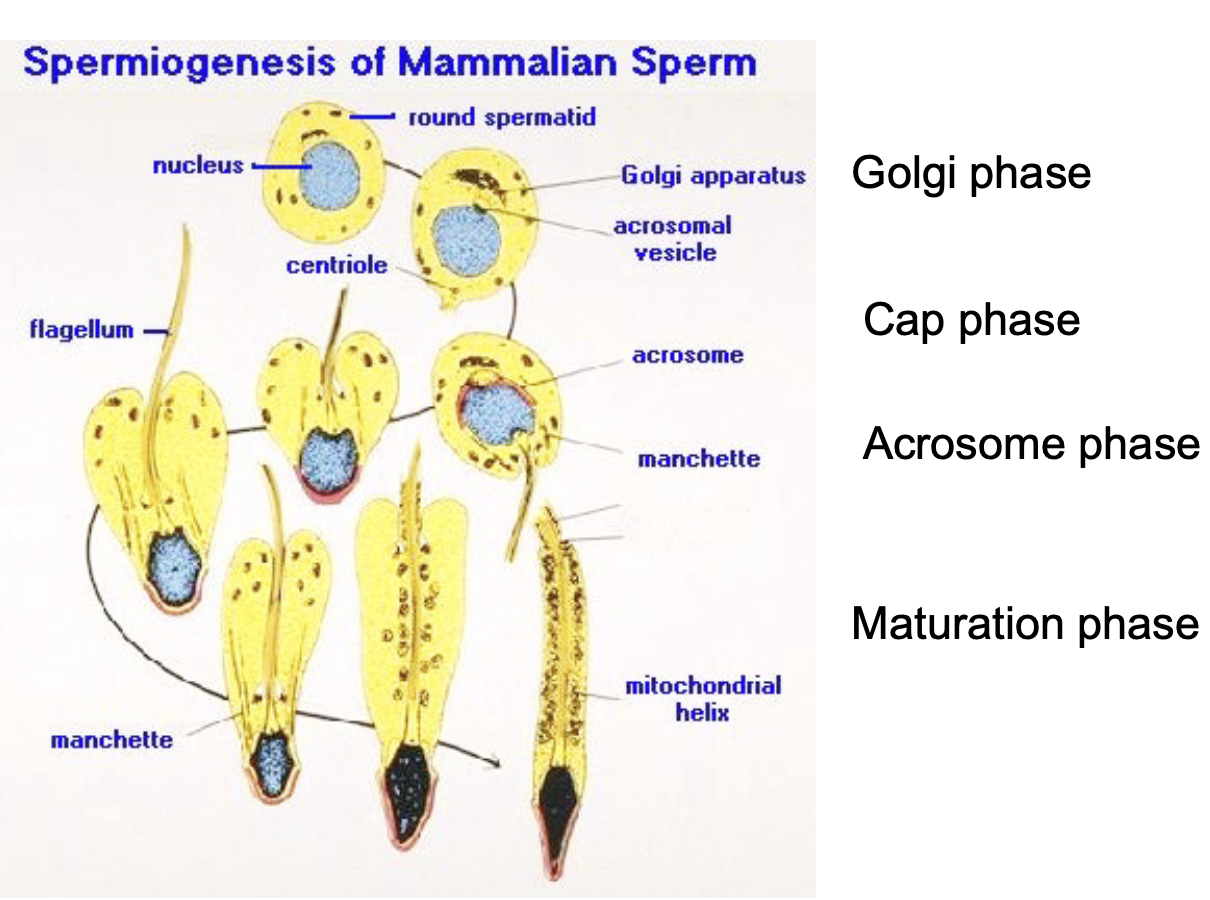
<ol><li><p>Golgi phase — formation of Golgi apparatus</p></li><li><p>Cap phase (acrosome development continues, flagellum elongates)</p></li><li><p>Acrosomal phase (maturation of head, acrosome + machete + elongation)</p></li><li><p>Maturation phase (manchette disappears, mitochondria migrate, postnuclear cap formed)</p></li></ol><p></p>
51
New cards

What is spermation?

When sperm is released

52
New cards

What is cytoplasmic droplet?

  • Is in mid piece of sperm when moving to epididymis

  • Attached to immature sperm

  • If collecting sperm too quickly/too much, there will be cytoplasmic droplet
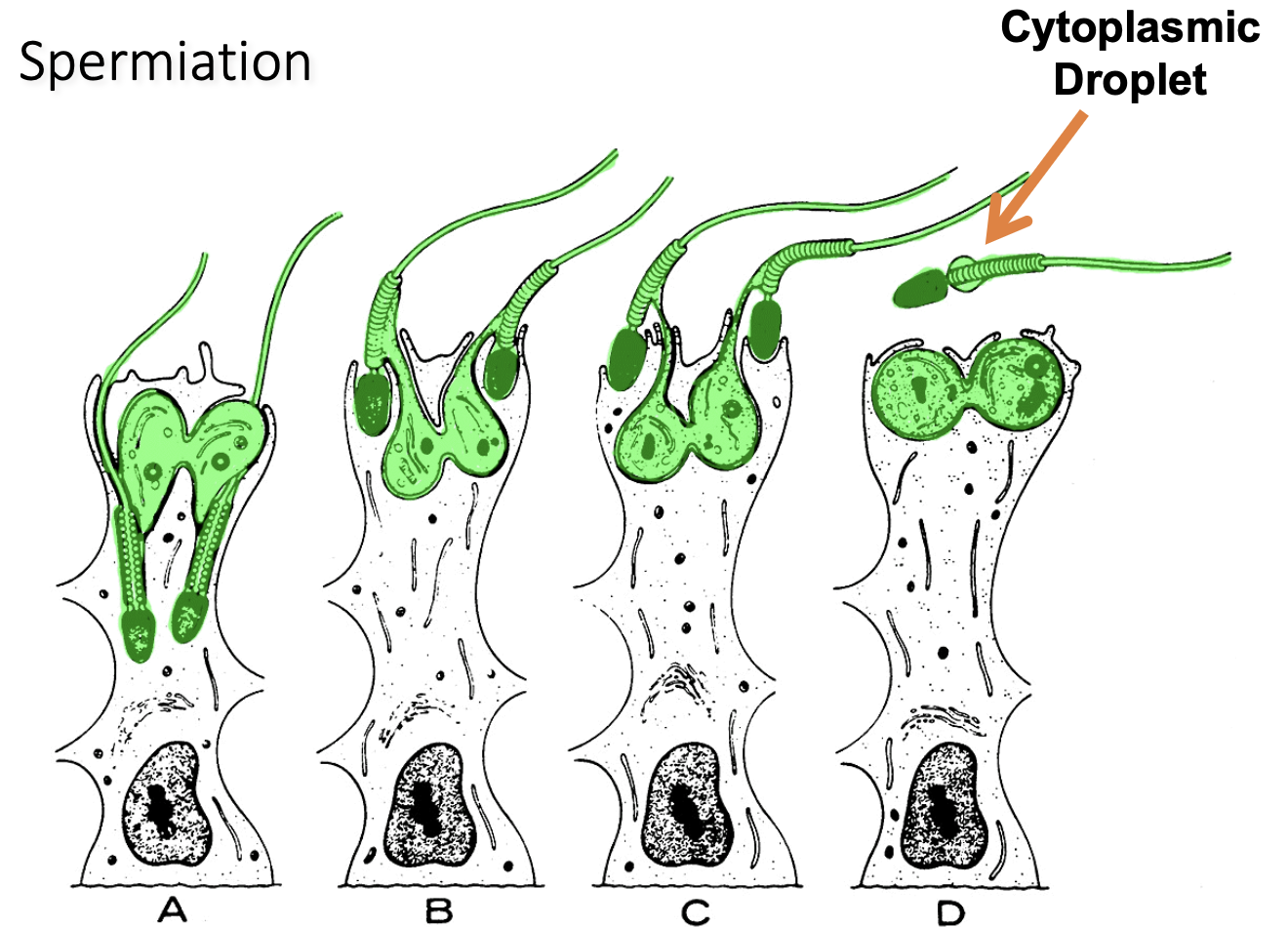
<ul><li><p>Is in mid piece of sperm when moving to epididymis</p></li><li><p>Attached to immature sperm</p></li><li><p>If collecting sperm too quickly/too much, there will be cytoplasmic droplet</p></li></ul><p></p>
53
New cards

What is the function of epididymis?

  • Fluid absorption

  • Membrane changes

  • Nuclear + flagellar stabilization

  • Motility, fertility

  • Cytoplasmic droplet translocation

54
New cards

What is the function of of tail of epididymis>

Store sperm temporarily, smooth muscle contraction upon sexual stimulation

55
New cards

What are functions for accessory sex glands?

  • Alterations + packacging

    • Metabolic substrates

    • Surface coatings

    • Transport for sperm

56
New cards

How long does it take to make sperm?

2-3 months

57
New cards

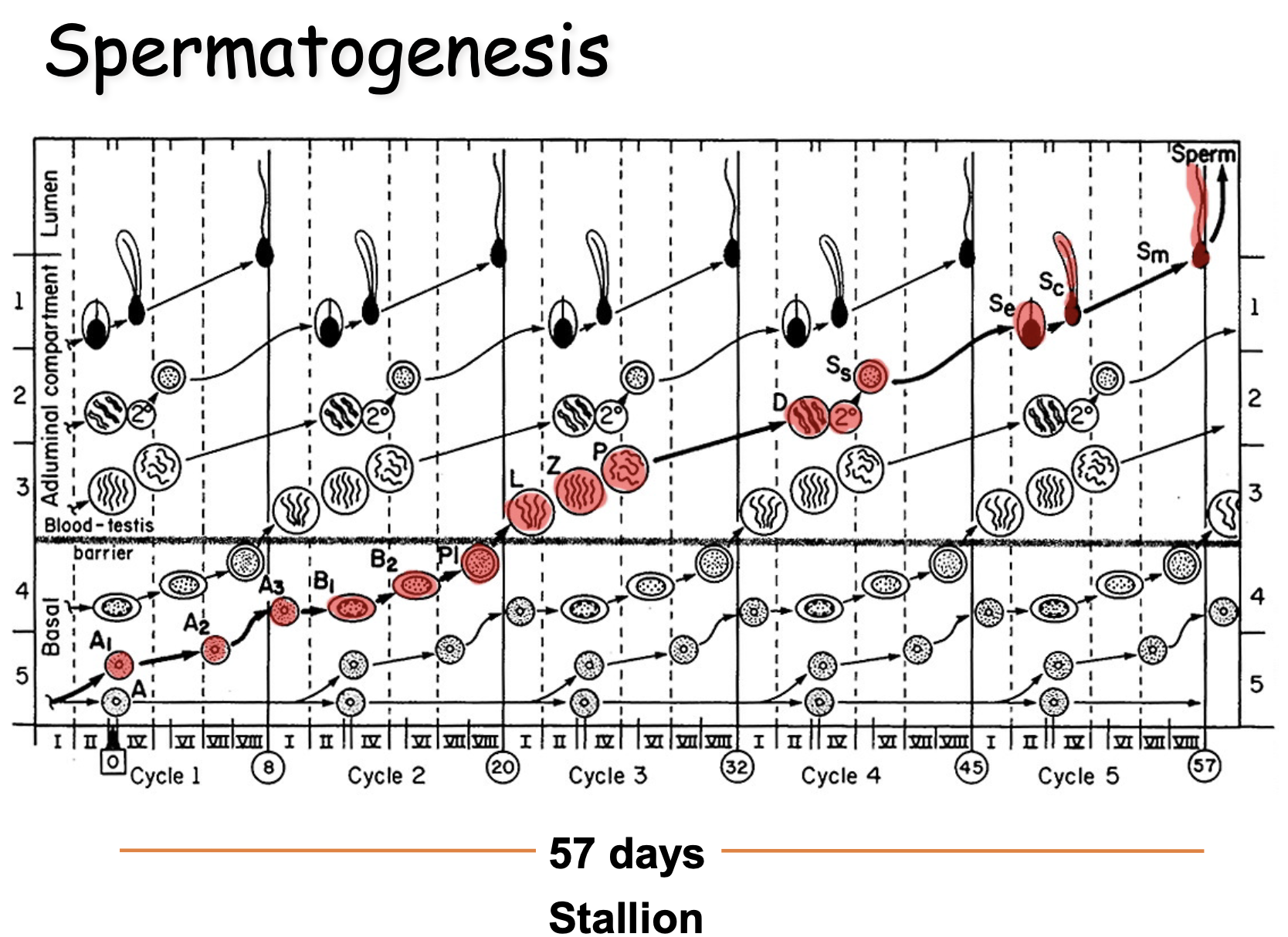
How does spermatogenesis work?

  • Sperm goes through 7 stages

  • All sperms in different stages of development, don’t move while developing

  • Multiple locations in tubules go through same stages

  • Stages — specific cellular associations within small segment of the seminiferous tubule (stages differ in different length of time)

    • A’gonia

    • I’gonia

    • 1’cyte

    • 2’cyte

    • Spermatid

<ul><li><p>Sperm goes through 7 stages</p></li><li><p>All sperms in different stages of development, don’t move while developing</p></li><li><p>Multiple locations in tubules go through same stages</p></li><li><p>Stages — specific cellular associations within small segment of the seminiferous tubule (stages differ in different length of time)</p><ul><li><p>A’gonia</p></li><li><p>I’gonia</p></li><li><p>1’cyte</p></li><li><p>2’cyte</p></li><li><p>Spermatid</p></li></ul></li></ul><p></p>
58
New cards

What do you call the time required for sperm maturation?

Duration of cycle of the seminiferous epithelium

  • Species dependent

  • Typical 4.5 cycles required for A1 spermatogonia to become mature spermatozoa

  • Some species variation (different length of stages)
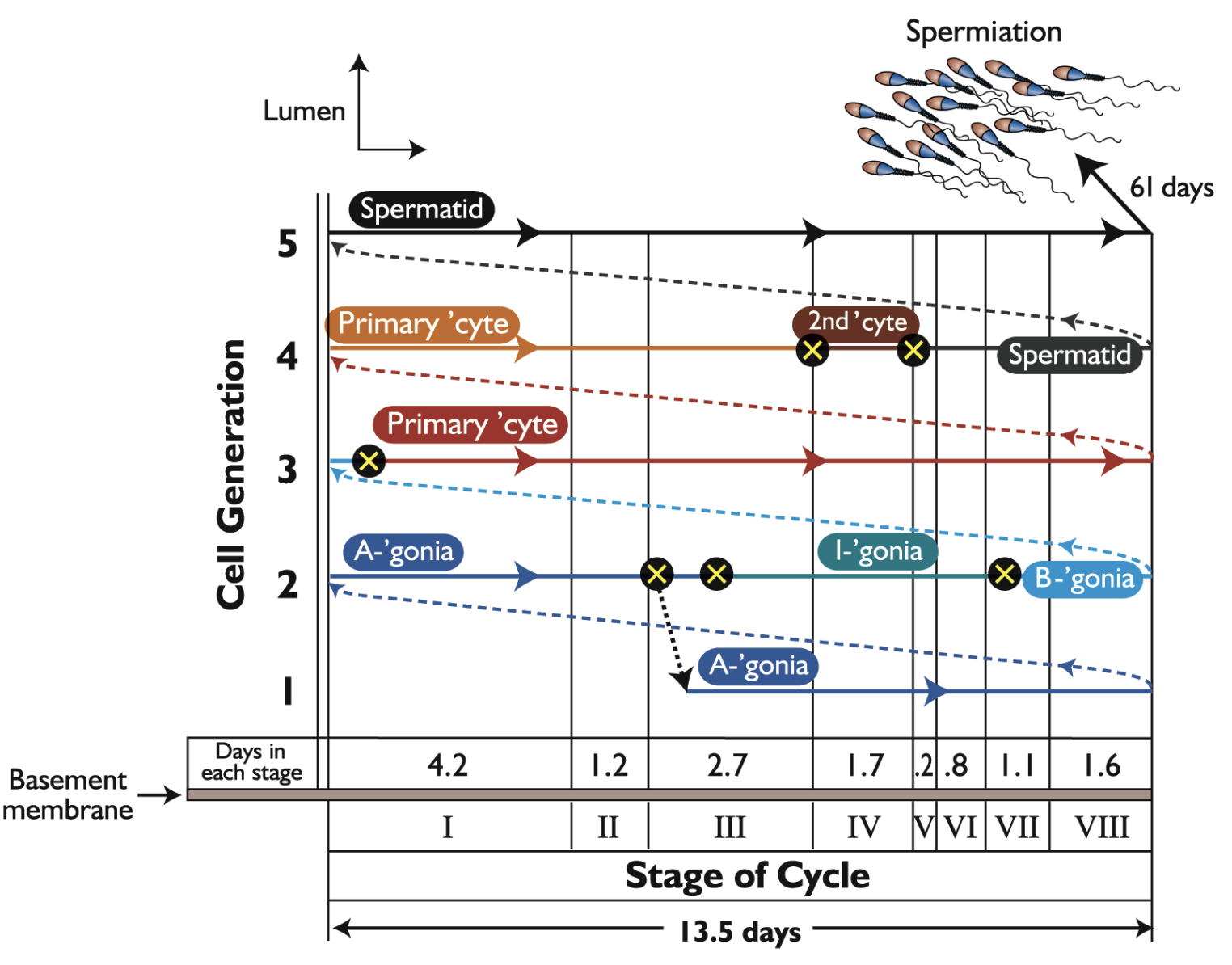
<p>Duration of cycle of the seminiferous epithelium</p><ul><li><p>Species dependent</p></li><li><p>Typical 4.5 cycles required for A1 spermatogonia to become mature spermatozoa </p></li><li><p>Some species variation (different length of stages)</p></li></ul><p></p>
59
New cards

What is the bull’s spermatogenesis like?

  • Takes 13.5 days

  • Creates 61 mil sperm

60
New cards

What is the ram’s spermatogenesis like?

  • Takes 10.4 days

  • Creates 47 mil sperm

61
New cards

What is the boar’s spermatogenesis like?

  • Takes 8.3 days

  • Creates 39 mil sperm

62
New cards

What is the stallion’s spermatogenesis like?

  • Takes 12.2 days

  • Creates 57 mil sperm

63
New cards

What is the man’s spermatogenesis like?

  • Takes 16 days

  • Creates 75 mil sperm

64
New cards

What is the math to figuring out the spermatogenesis?

  • Add all stage lengths

  • Times it by 4.5 cycle

65
New cards

What is the spermatogenic wave?

Helps move sperm without overloading the “entrance” of rete testis

  • Spermatozoa constantly formed + released into duct system

  • Timing of spermatogenesis is staggered throughout seminiferous tubule to prevent overloading exit

  • Site of spermiation constantly changing, creates “wave” of sperm release
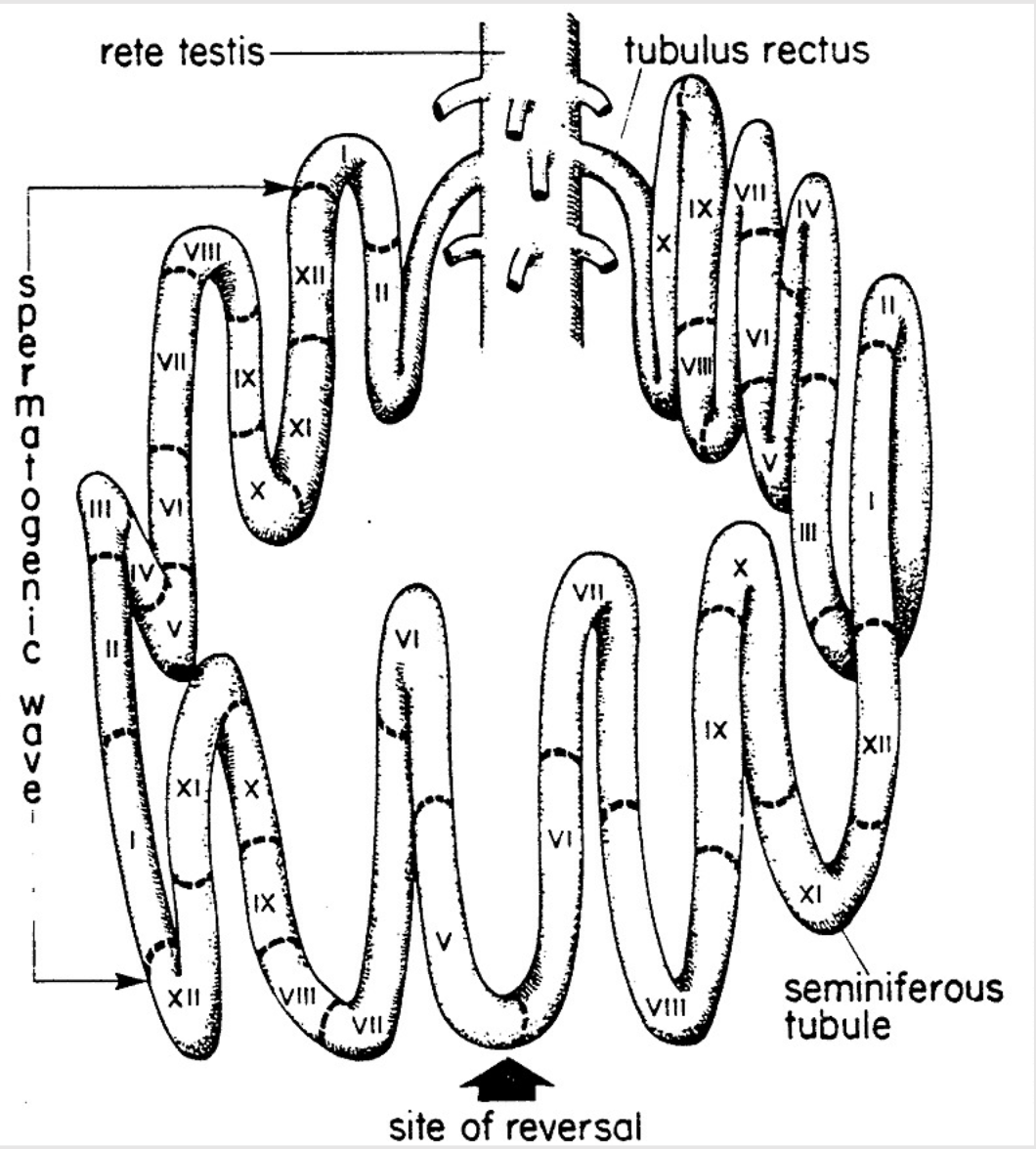
<p>Helps move sperm without overloading the “entrance” of rete testis</p><ul><li><p>Spermatozoa constantly formed + released into duct system</p></li><li><p>Timing of spermatogenesis is staggered throughout seminiferous tubule to prevent overloading exit</p></li><li><p>Site of spermiation constantly changing, creates “wave” of sperm release</p></li></ul><p></p>
66
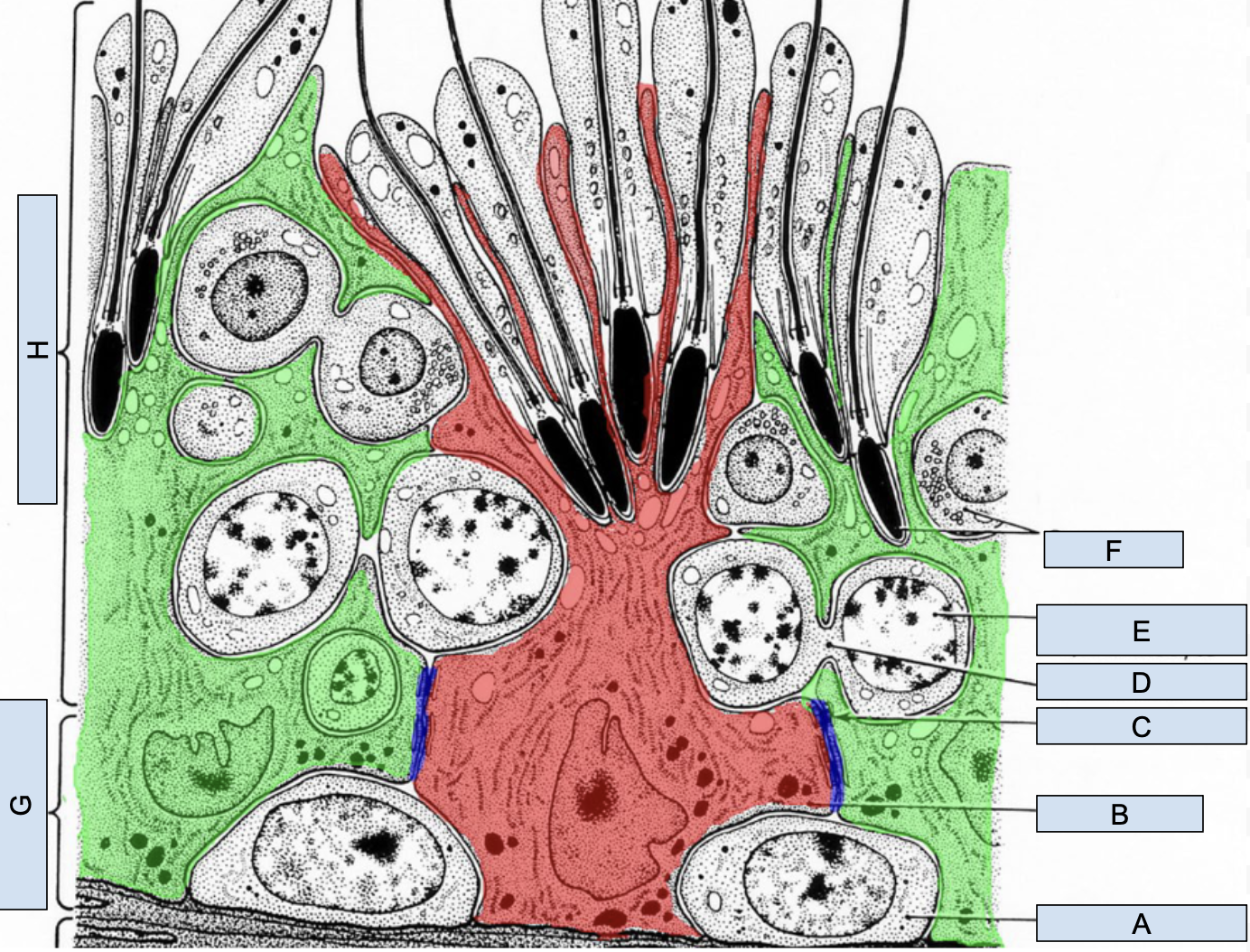
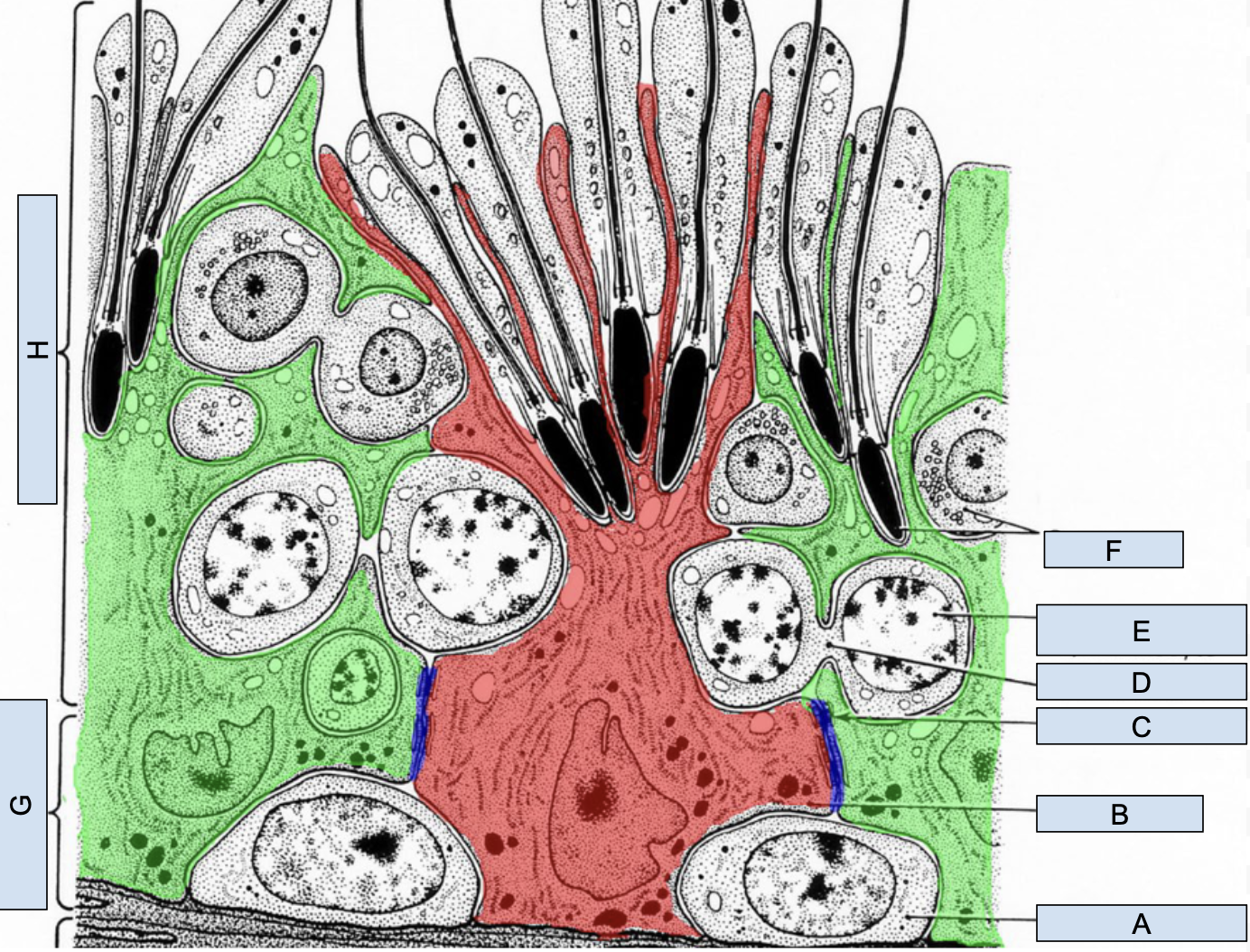
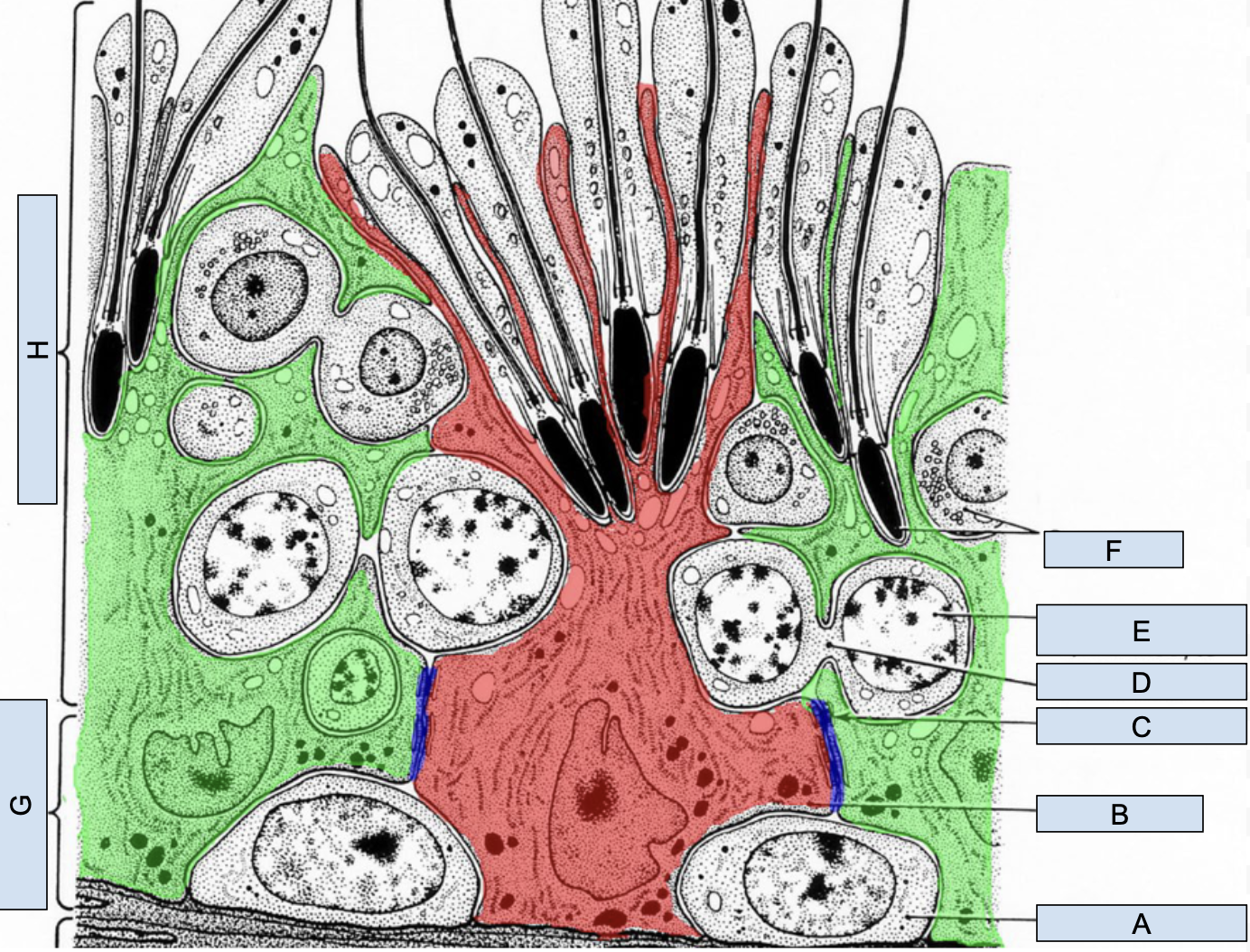
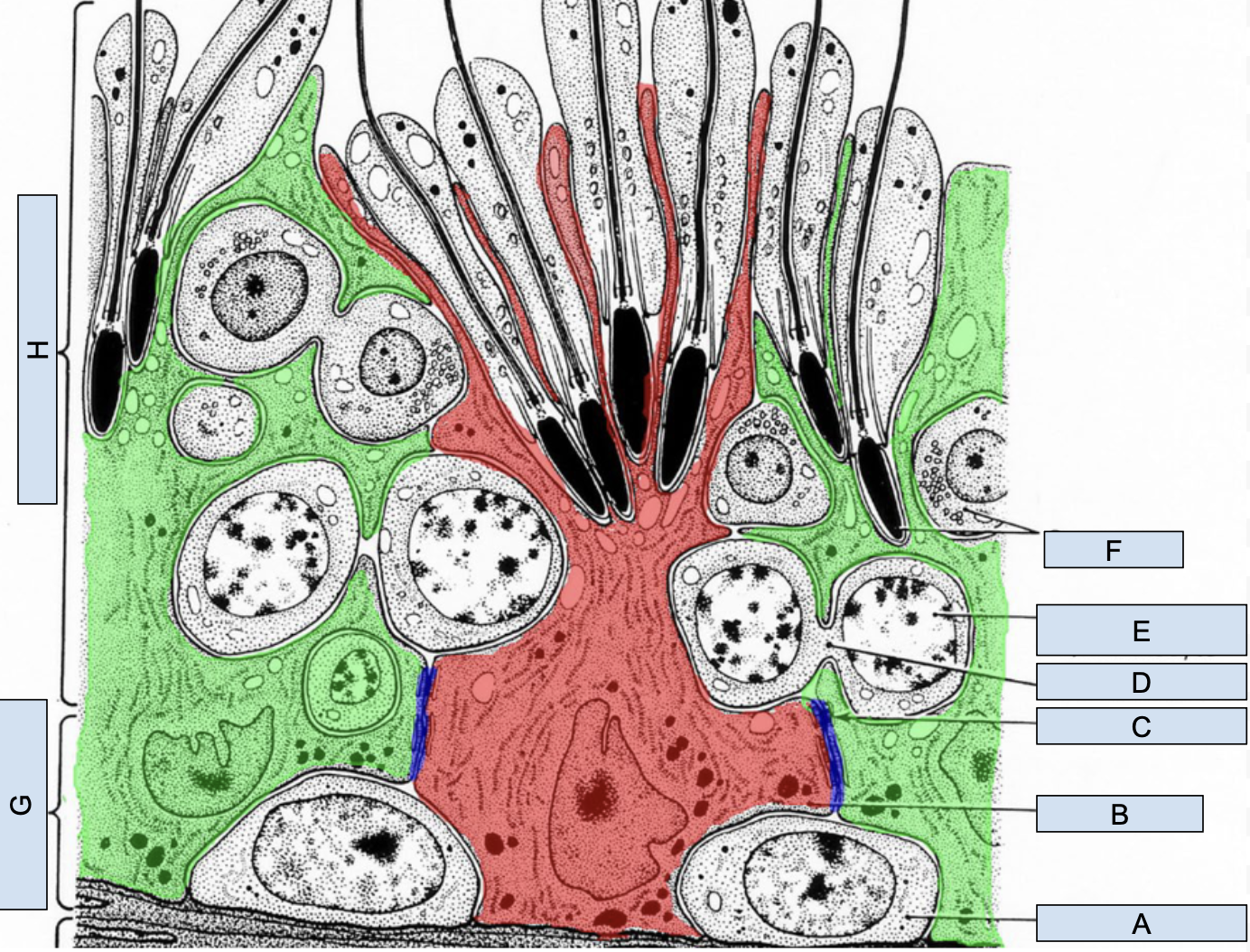
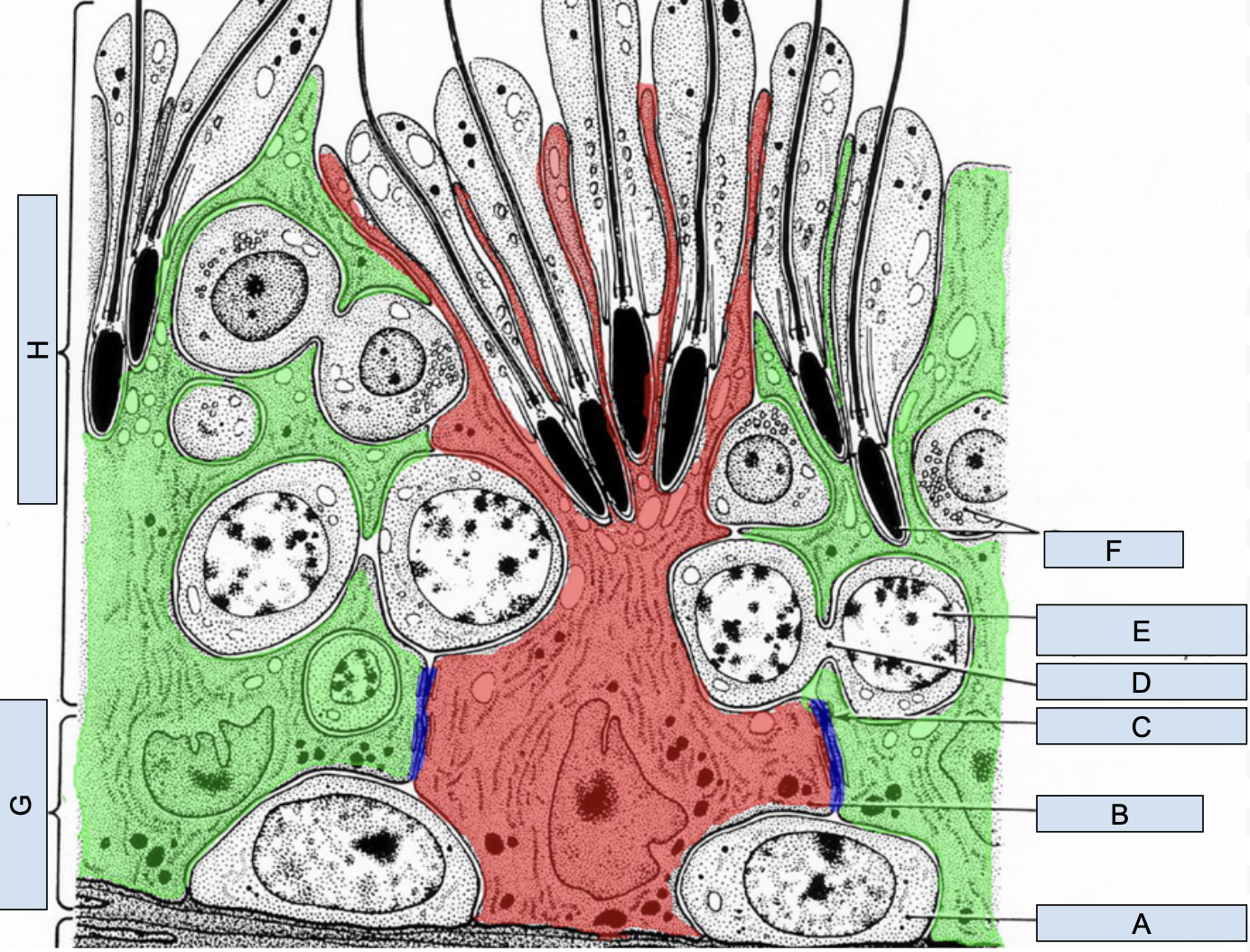
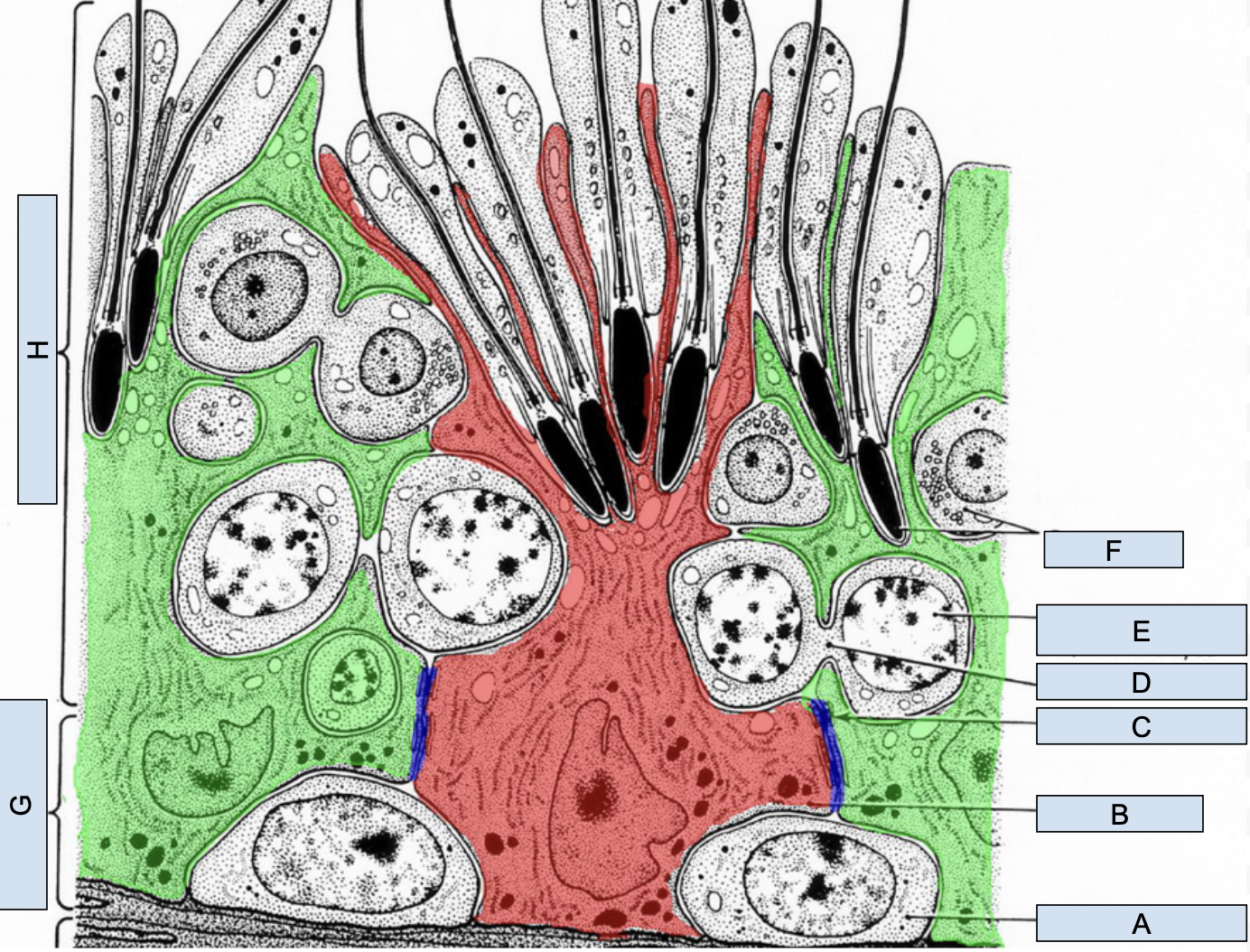
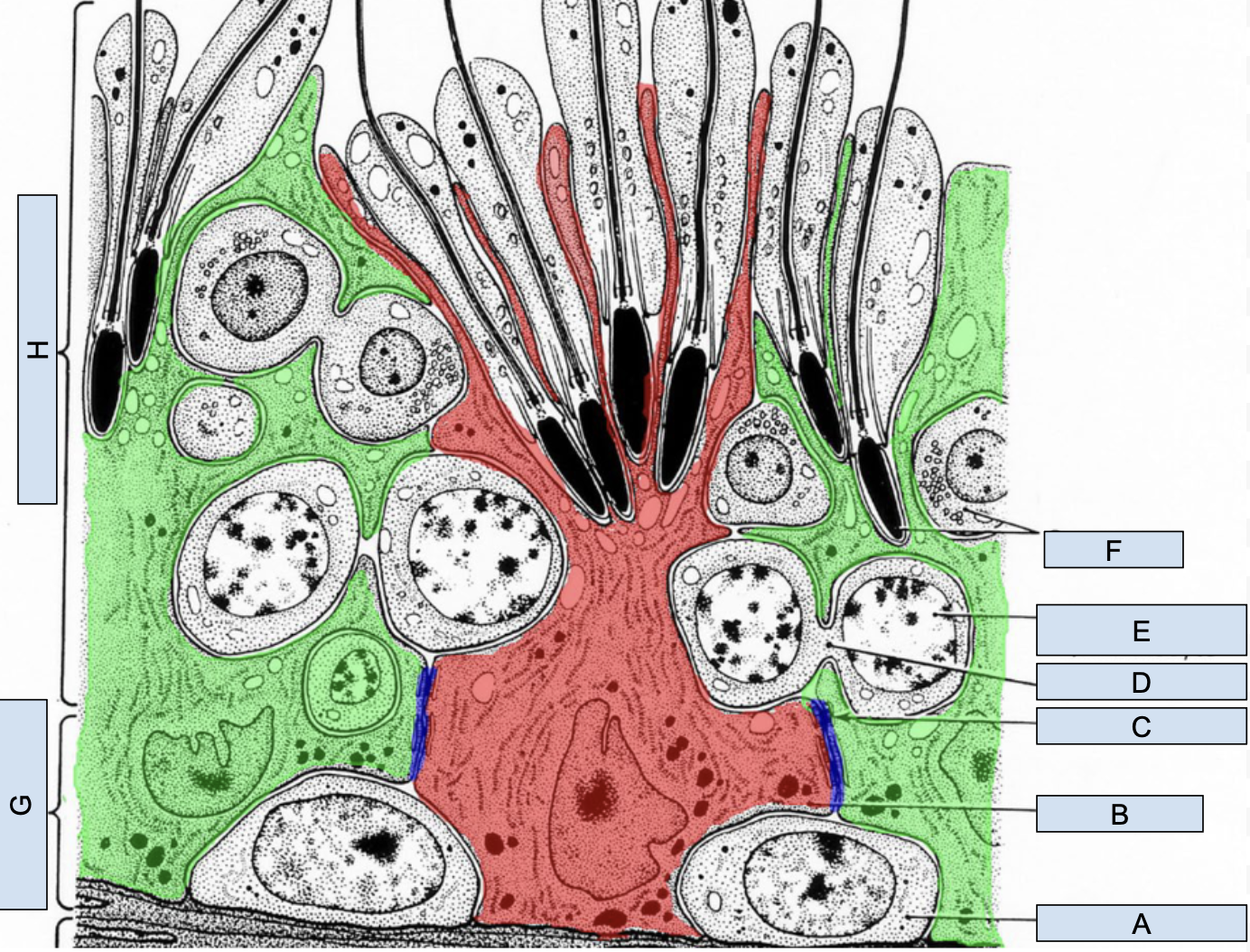
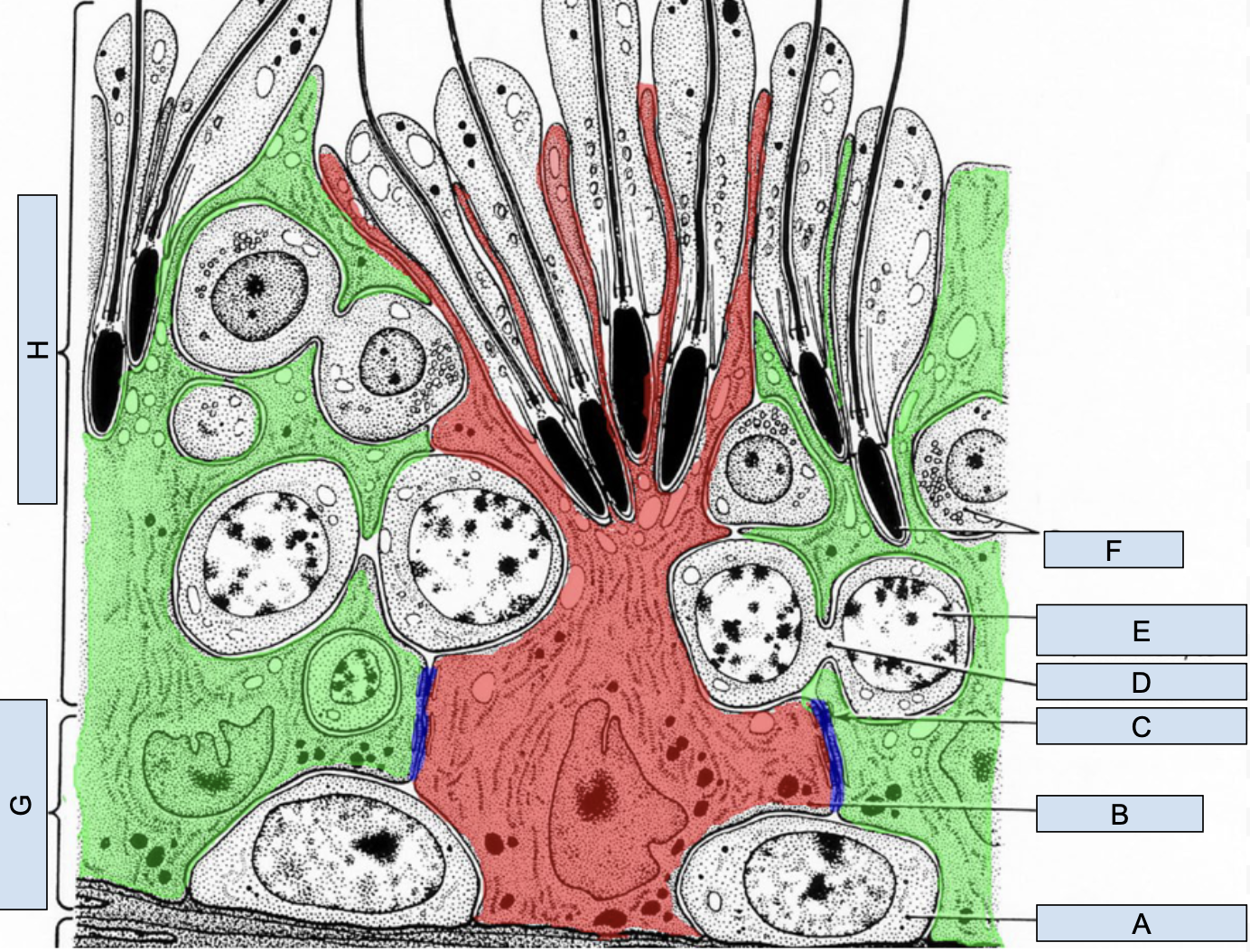
New cards
<p>What is A?</p>

What is A?

Spermatogonium

67
New cards
<p>What is B?</p>

What is B?

Sertoli cell

68
New cards
<p>What is C?</p>

What is C?

Junctional compartment

69
New cards
<p>What is D?</p>

What is D?

Intercellular bridge

70
New cards
<p>What is E?</p>

What is E?

Primary spermatocyte

71
New cards
<p>What is F?</p>

What is F?

Spermatids

72
New cards
<p>What is G?</p>

What is G?

Basal compartment

73
New cards
<p>What is H?</p>

What is H?

Adluminal compartment

74
New cards

What is the interstitial tissue?

Vascular system that provides nutrients, oxygen, growth factors, and hormones
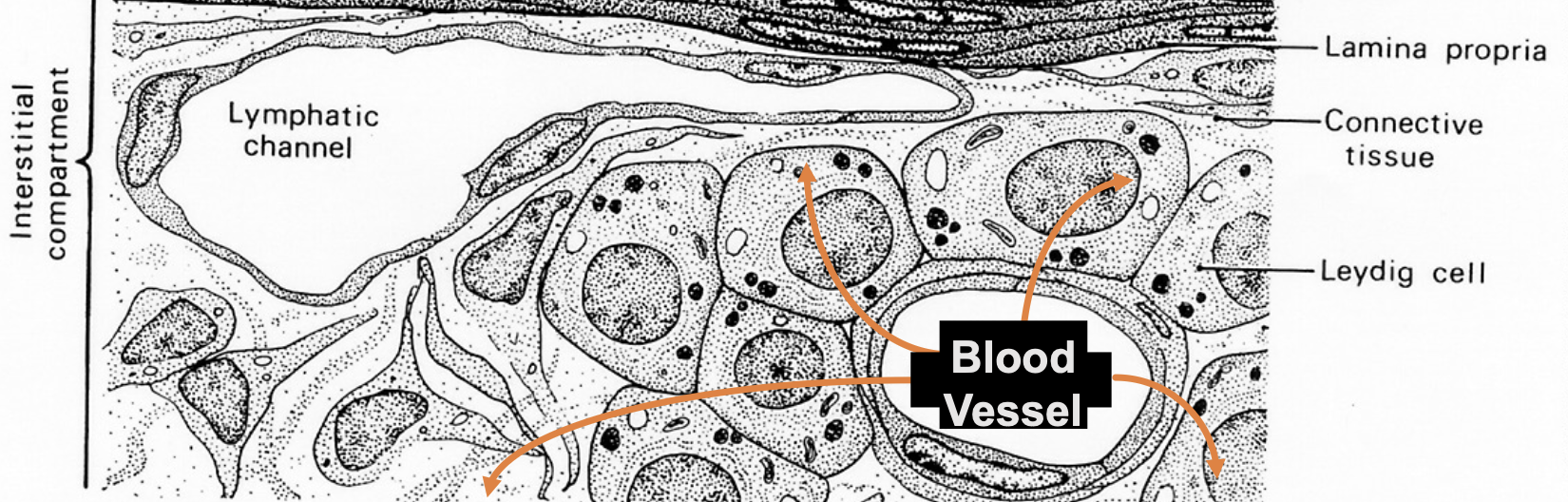
<p>Vascular system that provides nutrients, oxygen, growth factors, and hormones</p>
75
New cards

What is the blood testis barrier?

  • Sertoli cells + associated tight junctions

  • Essential for meiosis

  • First appears at puberty

  • Induced by FSH

  • After puberty, maintained by FSH and/or testosterone

76
New cards

What is the tight junction role in meiosis?

  • Controls amount of Sertoli cells inside, can manipulate environment

    • Sertoli can enter + complete meiosis

  • Destruction of TJ can cause impairment of meiosis (IE heat, heavy metals, endocrine disruptors, pesticides, lack of FSH/testosterone)

77
New cards

What are variations that change sperm production?

  • Testis size (larger size testes = more fertile)

  • Efficiency of spermatogenesis (mitotic division, degeneration of germ cells)

  • Length/time of spermatogenesis

78
New cards

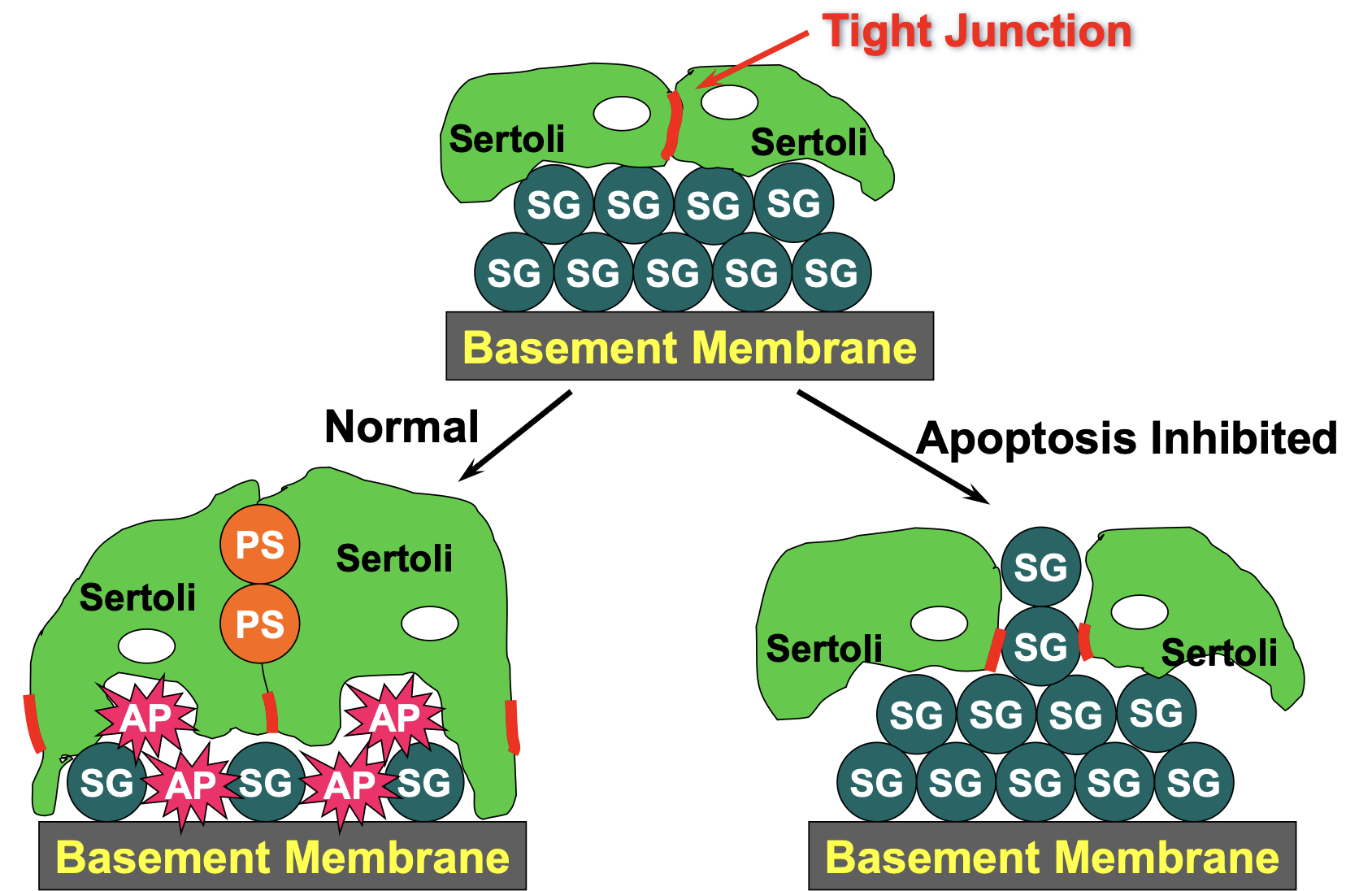
What causes and happens in overpopulation of spermatogonia?

  • If there’s no apoptosis (death of sperm)

  • Breaches sertoli/tight junctions, kills those cells

  • Happens in basal compartment

<ul><li><p>If there’s no apoptosis (death of sperm)</p></li><li><p>Breaches sertoli/tight junctions, kills those cells</p></li><li><p>Happens in basal compartment</p></li></ul><p></p>
79
New cards

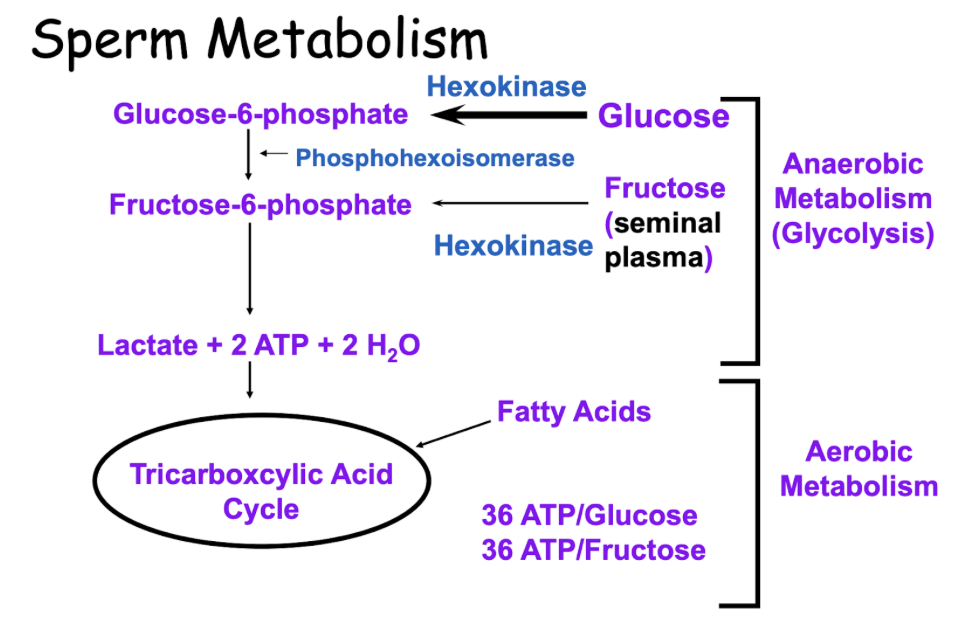
What are the steps for anaerobic metabolism/glycolysis for sperm metabolism?

  • Fructose with hexokinase (adds phosphate) turns to fructose-6-phosphate

    • Glucose can also be used to make glucose-6-phosphate, however sperm prefers fructose

    • Phosphate enzyme can convert glucose-6-phosphate to glucose, which makes it available for another time (futile cycle

  • Makes lactate + 2 ATP + 2 H2O

<ul><li><p>Fructose with hexokinase (adds phosphate) turns to fructose-6-phosphate</p><ul><li><p>Glucose can also be used to make glucose-6-phosphate, however sperm prefers fructose</p></li><li><p>Phosphate enzyme can convert glucose-6-phosphate to glucose, which makes it available for another time (futile cycle</p></li></ul></li><li><p>Makes lactate + 2 ATP + 2 H2O</p></li></ul><p></p>
80
New cards

What are steps for aerobic metabolism for sperm metabolism?

  • Goes through tricarboxcylic acid cycle

  • Makes 36 ATP fructose or glucose

<ul><li><p>Goes through tricarboxcylic acid cycle</p></li><li><p>Makes 36 ATP fructose or glucose</p></li></ul><p></p>
81
New cards

What is ATP used for in sperm?

  • Motility (60%) — not needed until after ejaculation

  • Substrate cycling (40%) — wasted, futile cycle

  • Transcription + translation — there is none after condensation of nucleus (spermatogenesis) and loss of residual body

82
New cards

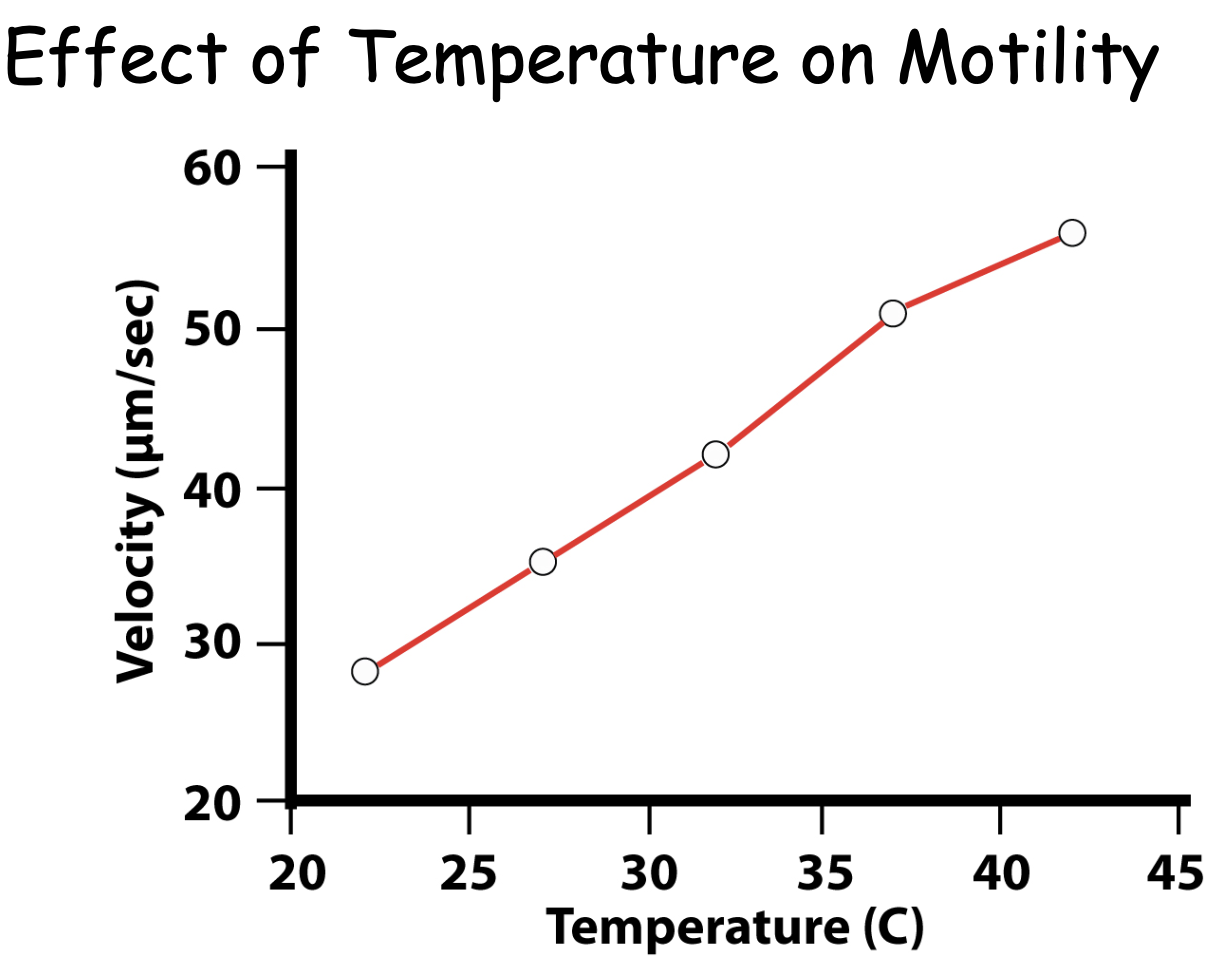
What is sperm metabolism reliant on?

Temperature

  • ATP production increases as temp increases

  • Motility increases with temperature

<p>Temperature</p><ul><li><p>ATP production increases as temp increases</p></li><li><p>Motility increases with temperature</p></li></ul><p></p>
83
New cards

What is the order of transportation of sperm?

  1. Seminiferous tubule (made here)

  2. Moves to rete testis via bulk fluid flow

  3. Goes into vas efferentia via fluid flow and cilia

    1. Where water gets reabsorbed, sperm gets concentrated in cauda, smooth muscle contractions used to move it up to vas deferens

  4. Moves through caput through smooth muscle contractions

  5. Moves down corpus via contractions

  6. Stored temporarily in cauda, moved through contractions

  7. From cauda to vas deferens via peristalsis
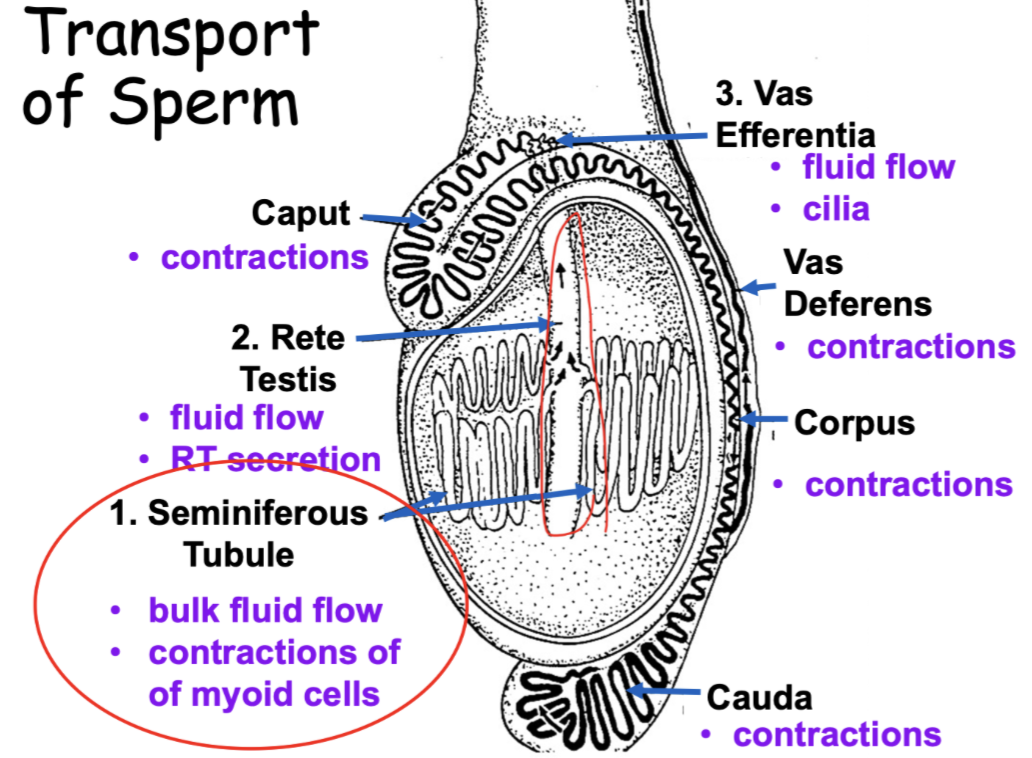
<ol><li><p>Seminiferous tubule (made here)</p></li><li><p>Moves to rete testis via bulk fluid flow</p></li><li><p>Goes into vas efferentia via fluid flow and cilia</p><ol><li><p>Where water gets reabsorbed, sperm gets concentrated in cauda, smooth muscle contractions used to move it up to vas deferens</p></li></ol></li><li><p>Moves through caput through smooth muscle contractions</p></li><li><p>Moves down corpus via contractions</p></li><li><p>Stored temporarily in cauda, moved through contractions</p></li><li><p>From cauda to vas deferens via peristalsis </p></li></ol><p></p>
84
New cards

What is the function of the epididymis?

  • Maturation

    • Change in fertility (changes in proteins on surface of sperm head)

    • Develop motility

    • Nuclear condensation

    • Cytoplasmic droplet

  • Concentration — removes water (in vas efferens + caput)

  • Secretion

    • Testosterone —> dihydrotestosterone (DHT) (influences epididymal function)

      • 5-reductase does this transition

    • Energy substrates (GPC, free fatty acids, carnitine)

    • Glycoproteins, lipids, enzymes

  • Transportation — smooth muscle contractions

  • Storage — in cauda

85
New cards

What are the hormonal cibtriks

86
New cards
87
New cards
88
New cards
89
New cards
90
New cards
91
New cards
92
New cards
93
New cards
94
New cards
95
New cards
96
New cards
97
New cards
98
New cards
99
New cards
100
New cards

Explore top notes

note
Chapter 5 | Migration
Updated 1128d ago
0.0(0)
note
Zoella - Introduction
Updated 488d ago
0.0(0)
note
Buddhism
Updated 1156d ago
0.0(0)
note
AP EURO- AMSCO Textbook Topic 1.2
Updated 422d ago
0.0(0)
note
Unit 10 - Acids & Bases
Updated 725d ago
0.0(0)
note
Kaduceus CW101 - Unit 2 | PT 1
Updated 1269d ago
0.0(0)
note
Spanish 2H chapter 6 vocab
Updated 513d ago
0.0(0)
note
Malak´s Ultimate Review Sheet
Updated 673d ago
0.0(0)
note
Chapter 5 | Migration
Updated 1128d ago
0.0(0)
note
Zoella - Introduction
Updated 488d ago
0.0(0)
note
Buddhism
Updated 1156d ago
0.0(0)
note
AP EURO- AMSCO Textbook Topic 1.2
Updated 422d ago
0.0(0)
note
Unit 10 - Acids & Bases
Updated 725d ago
0.0(0)
note
Kaduceus CW101 - Unit 2 | PT 1
Updated 1269d ago
0.0(0)
note
Spanish 2H chapter 6 vocab
Updated 513d ago
0.0(0)
note
Malak´s Ultimate Review Sheet
Updated 673d ago
0.0(0)

Explore top flashcards

flashcards
Drug Cards 7
20
Updated 1119d ago
0.0(0)
flashcards
English IV vocabulary list 8
20
Updated 922d ago
0.0(0)
flashcards
Human Geo Unit 1 Vocab
23
Updated 939d ago
0.0(0)
flashcards
Emotion and Cognition
42
Updated 799d ago
0.0(0)
flashcards
Section 1 Lectures 4-6
56
Updated 1078d ago
0.0(0)
flashcards
Chapter 12 Review Questions
20
Updated 19d ago
0.0(0)
flashcards
AP Psych Unit 2
152
Updated 1010d ago
0.0(0)
flashcards
Drug Cards 7
20
Updated 1119d ago
0.0(0)
flashcards
English IV vocabulary list 8
20
Updated 922d ago
0.0(0)
flashcards
Human Geo Unit 1 Vocab
23
Updated 939d ago
0.0(0)
flashcards
Emotion and Cognition
42
Updated 799d ago
0.0(0)
flashcards
Section 1 Lectures 4-6
56
Updated 1078d ago
0.0(0)
flashcards
Chapter 12 Review Questions
20
Updated 19d ago
0.0(0)
flashcards
AP Psych Unit 2
152
Updated 1010d ago
0.0(0)