class 12
 Call Kai
 Learn
Learn Practice Test
 Spaced Repetition
 Match
Match Flashcards
 Knowt Play
1/17

There's no tags or description
Looks like no tags are added yet.
Name | Mastery | Learn | Test | Matching | Spaced | Call with Kai |
|---|
No analytics yet
Send a link to your students to track their progress
18 Terms
Advantages of muticellularity (5):
Larger size
Cell specialization
Longer life span
Development of complex structures
Resource storage (to help overcome stress)
Multicellularity evolved many times...why?
Evolved because trait was very advantageous
Filamentious cyanobacteria...example of multicellularity in prokaryotes
What is it? - multicellular prokaryotes
2 cell types:
Vegetative cells (oxygenic photosynthesis: fix carbon)
Heterocysts (nitrogenase)
Nitrogenase...what does it do....inhibited by O2...why?
Converts N2 into ammonia
In prokary cells only
Nitrogenase in inhibited by O2 because it evolved way before oxygen was a thing.
Structure and function of different cells along cyano filament....
Vegetative cells:
Photosynthetic cells
Perform oxygenic photosynthesis (fixing and releasing )
Heterocysts:
Nitrogen fixing cells
receive carbohydrates from neighboring vegetative cells and provide fixed nitrogen in return
Gene duplication as a mechanism of developing novelty.
By producing an extra copy of a gene, this process creates genetic redundancy, allowing one copy to maintain the original, essential function while the other is freed from selective constraints to accumulate mutations, potentially leading to new functions.
Genome doubles which creates genetic redundancy
Allows for one copy to maintain original essential function while other is free from any selective constraints, potentially leading to new functions
Differences between a Chlamy cell and Volvox...lots of differences.
Chlamy:
single celled
small
every cell is identical
simple cell division
smaller genome size
Volvox:
multicellular
large
has different types of cells
sexual and asexual reproduc.
larger genome size
Role of and evolution of GlsA in Chlamy vs Volvox.
In chlamy: general cell division or housekeeping, as Chlamydomonas lacks cell differentiation
Volvox: trigger asymmetric cell divisions that produce small somatic cells and large reproductive cells (gonidia)
Role of RegA in Chlamy and how it has been co-opted by Volvox.
In chlamy:
shuts down growth due to stress
is a transcriptional repressor
How its been co opted by volvox:
to establish a division of labor between reproductive cells (germ) and motile, terminal cells (soma).
Volvox somatic cells are in a permanent state of "stressed" growth (small), preventing them from turning into reproductive cells
what are you trying to solve by using organisms that have fast generation times.
Can see evolution in real time
Distinction between Deleterious, neutral, advantageous mutations.
Deleterious = bad (common)
Advantageous = good (rare)
Neutral = neutral (MOST common)
Advantageous is rlly rare but since it divides super fast the chances are better
Evolution of Snowflake yeast from unicellular ancestor
evolved from the unicellular S.cerevisiae by adapting to the environmental pressure that favoured sinking clusters
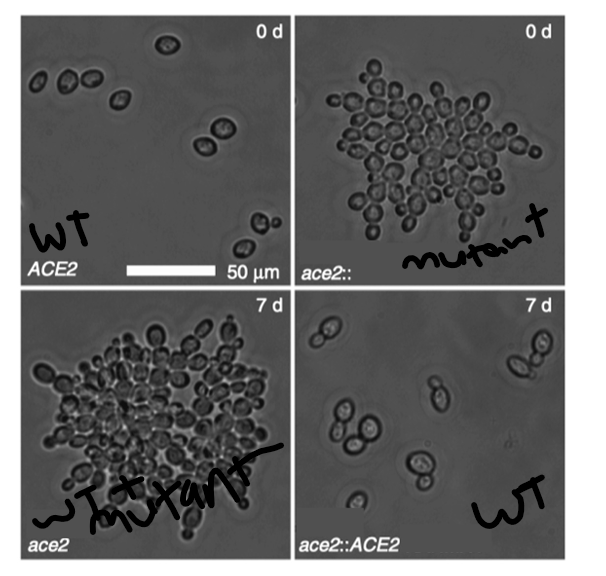
Role of ACE2 gene in cell function and shift to multicellularity
ACE2 is a transcription factor that regulates key genes
These genes are downregulated and are involved in daughter cell separation
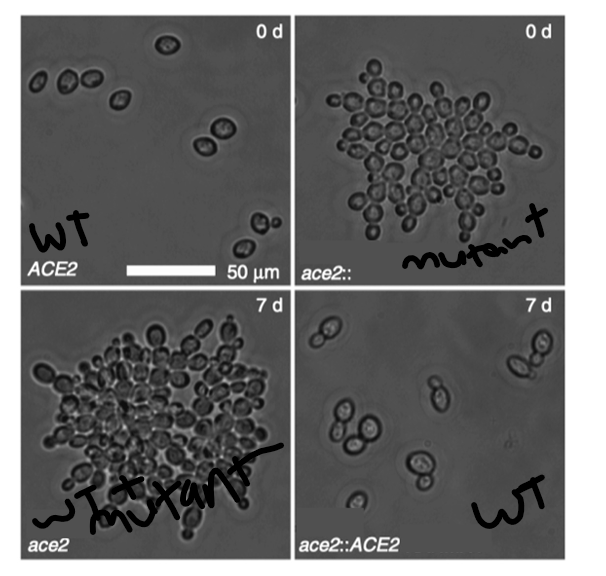
The evolution of snowflake yeast is a result from a loss of func. mutation in ACE2, causing there to be no separation
Importance of single-cell bottlenecks in many multicellular organisms.
Single cell bottleneck meaning: When multicellular organisms begin life as a single cell
This process surpresses internal competition by removing cheater cells (cancer cells),reduces mutation load, reduces selfish cells since they all share same DNA
What is a cheater cell (e.g. cancer).
: Rouge cell that does not cooperate and prioritizes own reproduction at the expense of the body
ignores apoptosis signals, divides uncontrollably, hogs nutrients
Role of cell death in snowflake yeast
Apoptosis acts as a form of altruistic, suicidal reproduction, which allows for multicellular cluster to divide
“death is how new life is created”
analogy :
If the yeast cluster just kept growing and growing, it would become a giant, tangled mess that couldn't easily spread to new places.
To solve this, some cells "sacrifice" themselves to create a snap line.
The Sacrifice: A few cells in the middle of a branch die on purpose.
The Break: Because those cells are now dead and brittle, that branch snaps off easily.
The Result: That broken piece floats away and grows into a brand new yeast colony.
Study of choanoflagellates as a way to understand animal (metazoa) evolution.
Choanoflagellates: closest known relative to animals
unicellular, flagellated eukaryotes
Chaonoflagellates share similar proteins which were thought to only be possessed by mwtazoans.
Role of ECM and incomplete cytokinesis in the multicellular lifestyle of choanoflagelates
Incomplete cytokenesis= cells don’t completely divide, resulting in clusters
ECM is a secreted mesh that acts as glue and holds the colony together

