Biology 225 - Unit 3
 Call Kai
 Learn
Learn Practice Test
 Spaced Repetition
 Match
Match Flashcards
 Knowt Play
1/194

There's no tags or description
Looks like no tags are added yet.
Name | Mastery | Learn | Test | Matching | Spaced | Call with Kai |
|---|
No analytics yet
Send a link to your students to track their progress
195 Terms
Hormone
Chemical substances produced by specialized organs called endocrine glands and transported through the blood stream to other tissues where they act to elicit a specific physiological response
aldosterone
steroid hormone procuded in adrenal gland that acts as key regulator of BP and fluid balance
FSH
follicle-stimulating hormone
produce by pituitary to manage sexual development and fertility
LH
leuteninizing hormone
regulates reproduction
triggers ovulation and testosterone production
GH
growth hormone
essential for stimulating growth, cell reproduction, and regeneration in children
in adults regulates body composition, metabolism, and muscle growth
Hasimotos disease
immune system attacks thyroid gland leading to chronic inflammation and hypothyroidism
Primary hypothyroidism
thyroid gland fails to produce sufficient T3/T4 and is usually caused by hashimotos or iodine deficiency
Thyroid tumor
usually non cancerous, highly curable through surgery or radioactive iodine bc you can live w/o thyroid
hyperthyroidism
speeds body’s metabolism, usually caused by graves disease
goiter
abnormal enlargement of the thyroid gland, usually caused by iodine deficiency, hasimotos or graves
AVP and ADH
peptide hormone that regulates water retention, BP and urine production
example of 1st order endocrine loop
Oxytocin
peptide hormone that regulates uterine contraction during labor, stimulates milk let -down, and promotes social bonding
example of 1st order endocrine loop
example of positive feedback
TRH
thyrotropin-releasign hormone
tripepetide
stimulates TSH release
GnRH
gonadotropin-releasing hormone
decapepetide
stimulates FSH and LH release
CRH
ACTH-releasing hormone
peptide
T4 & T3
thyroid hormones
amines but hydrophobic
Graves disease
immune system disorder that resutls in overproduction of thyroid hormones
Hypothalamus
tells pituitary which hormones to release
TRH
CRH
GnRH
GHRH
somatostatin
dopamine
ADH
oxytocin
How do hormones communicate with so many diff cells/targets?
use bloodstream as distribution network and also use highly specific receptors on target cells to ensure precision
HAP axis
Hypothalamic -Pitutiary-Adrenal
manages stress response, metabolism and immune
1. hypo releases CRH
2. pituitary to release ACTH
3. adrenal releases cortisol
HPT axis
hypo-pituitary-thyroid
regulates metabolism, growth, and development. negative feedback loop
1. hypo releases TRH
2. pituitary releases TSH
3. thyroid release T3/T4
direct signaling
secretion or hormones into bloodstream which then act as logn distance messenger for distant target cells
transmembrane receptors
GPCRs
enzyme linked receptors
ion-channel receptors
Exocrine Gland
external environment
have ducts
poorly vascularized
(salivary, mammary, mucosal)
Endocrine glands
internal environment
no ducts
highly vascularized
(pituitary, thyroid, adrenal)
Autocrine & paracrine signaling
signaling cell released chemical messenger directly to receptor
Endocrine signaling
signaling cell release chemical or neuronal messenger through circulatory system before reaching receptor
Limitations of hormone definition
not all substances that have hormonal activity are produced from specialized tissues
many hormones have multiple source
Some hormone act locally without releasing into circulation
Hormones are ________ &___________
hydrophobic; hydrophillic
Pepetide/protein hormones
hydrophilic
bind to transmembrane receptors (transduction)
rapid effects of target cell
peptide/protein hormone synthesis
synthesized in rough ER often as preprohormones (cleavage)
stored in vesicles as prohormones (cleavage)
secreted by exocytosis (cleaved into all componentes)
Amine hormones
Chemicals that possess amine group like ach, seratonin, meltonin
some are true endocrin hormones, others are neurotransmitters, some both
most are hydrophiulic, but thyroid are hydrophobic
Steroid Hormones
Derived from cholesterol
synthesized by smooth ER or mitochondria
Three classes of steroid hormones
Mineralocorticoids - electrolyte balance
Glucocorticoides - stress hormones
reproductive hormones - regulate sex-specific characteristics
Steroid Hormone features
hydrophobic - can diffuse though plasma membrane, cant be stored in cell, must be synthesized on demand
transported to target cell by carrier proteins
slow effects on target cell (gene transcription)
cortisol has rapid non-genomic effects
Hydrophilic messengers bind….
transmembrane receptors
Hydrophobic messengers bind…
intracellular receptors
Agonist binding
causes a response
Antagonist binding
does not cause a response
Ligand-receptor binding
Law of Mass Action
formation of L-R complex causes response
more free ligand (L) or receptors (R) will increase the response
Receptors can become saturated at high L - theres a limit
Lower kd =
higher affinity
Inactivation of ligand-receptor complex
complex must be inactivated to allow responses to changing conditions
Ligand-receptor interactions
A ligand may bind to more than one type of receptor
receptor isoforms
expressed on different target cells
diff responses to the same ligand
A single cell may have receptors for many diff ligands
Intracellular receptors
ligand diffuses across cell membrane
binds to receptor in cytoplasm or nucleus
L-R complex binds to specific DNA sequences
regulates the transcription of target genes - can make transcription factors or have effects on biochem paths
Signal amplification
amplification goes in waves like pyramid
Guanylate cyclase receptor-enzyme
ligand binds, changing its conformation
activated receptor catalyzes conversion of GTP to cGMP
cGMP acts as second messenger and bonds to PKG
activated G-kinase phosphorylates proteins on serine or threonine residues
receptor tyrosine kinase (RTK)
ligand binds receptor
receptors dimerize and autophosphorylate
phosphorylated receptors interact with protein kinases
protein kinases signal to Ras protein
Ras switches between the active and inactive forms
MAP-Kinase phosphorylation cascade
Ras-GTP stimulates phosphorylation of MAPKKK until only MAPK
Serine/threonine kinase receptor
Ligand bonds the type II TGF-beta receptor
bound receptor dimerizes with the type I receptor
type I phosphorylates the type II, activating it
activated receptor phosphorylates a SMAD protein
activated SMADs enter the nucleus and regulate gene expression
Anterior pituitary
hypothalamus synthesizes and secretes neurohormones —> hypothalamic-piuitary portal system —> anterior pituitary releases hormones
tropic hormones - cause release of another hormone
third-order endocrine pathway
Anterior pituitary 6 major hormones
growth hormone (GH)
Prolactin (PRL)
Thyroid stimulating hormone (TSH)
Adrenocorticotropic hormone (ACTH)
Luteinizing hormone (LH)
Follicle stimulating hormone (FSH)
IGF mediate GH actions
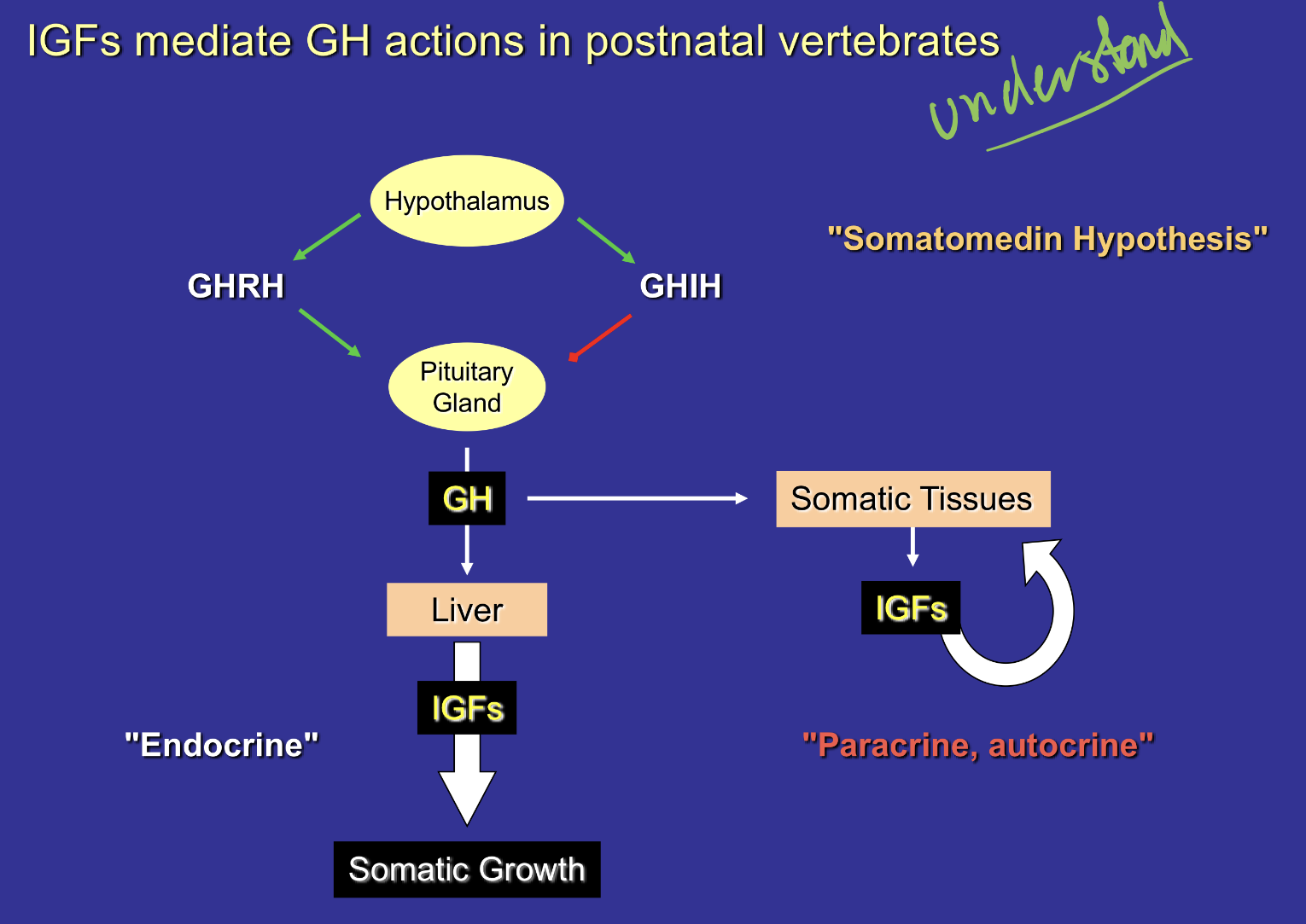
prolactin (PRL)
stimulates milk synthesis and important for promoting maternal behavior. found in vertebrate even without mamary glands
Other PRL actions (6)
osmoregulation - most primative action. in fishes it is freshwater adapting hormone. amniotic fluid of mamals its for embryonic osmoregulation
reproduction - concerned with consequneces fo reproduction like development of mamary gland
development - for tadpole growth
metabolism - affects lipid and glucogen metabolism
integument - (skin) affects on hair growth, sebaceous glands, feather pattern in birds, pigmentation
behavioral effects - meternal behavior
TSH
controls secretion of thyroxine by the thyriod gland
ACTH
regulates the secretion of corticosteriods by the adrenal cortex. part of the stress response system
anterior pitutary hormones
GH
PRL
TSH
posterior pituitary hormones
Oxytocin
AVP/vassopressin/ADH
pancreas
exocrine gland - produces pancreatic enzymes and sodium bicarbonate
endocrine gland - produces insulin and glucagon
insulin - lowers blood glucose level under hyperglycemia
glucagon - raises blood glucose levels under hypoglycemia
Alpha cell
produces insulin
Beta cell
glucagon production
Islet of langerhans cells
alpha and beta cells
Insulin
anabolic
regulates the metabolism of carbs, fats and proteins
Promotes the absirption of glucose from the blood
promotes glyogenesis and lipogenesis
triggered by high blood glucose
glucagon
catabolic
regulates metabolism of carbs
promotes glycogenolysis, lipolysis, gluconeogenesis
triggered by low blood glucose
Somatostatin
D cells
Major inhibitory hormone. Inhibits -
GH
TSH
Adenylyl cyclase
prolactin
release of insulin and glucagon
suppresses the exocrine secretions of the pancreas
Gastrin
triggeres stomach cells to produce HCl
Vasoactive intestinal peptide (VIP)
stimulates the intestine to release water and salts back into the intestinal tract
Additivity
when two or more hormones work in the same way on the same target
Synergism
When two or more hormones work together to increase target cell response much more than expected by additivity
Type 1 Diabetes
endocrine effect:
loss of beta cells in pancreas
little or no insulin produced
cuased by
gentics
pancreatic radiation or removal of pancreas
toxins that damage islets
T1 Diabetes consequences
whole body affected
hypo and hyper glycemia
chronic vascular diseases
T1 diabetes treatment
control of diet and exercise
insulin replacement
new insulin agonists
pancrease transplant
T2 Diabetes
caused by insulin reisitence
deficiency in response of pancreatic beta cells to glucose
T2 diabetes charecteristics
insensitive to endogenous insulin
correlates with excess abdominal fat
inflated fat cells and over-nourished liver/muscle cells
proliferation of pancretic beta cells
Complications of T2 Diabetes
heart disease
stroke
kidney disease
eye problems
diabetic neuropothy and nerve damage, especially in feet
depression
Stress Response
hypothalamus secretes corticotropin-releasing hormone (CRH)
anterior pituitary secreates ACTH
Adrenal cortex secretes cortisol and stimulates target cells to increase blood glucose level
they all go back and negative feedback eachother
Adrenal gland
medulla - produces catecholamines like epi and norepi
cortex - corticosteroids like glucocorticoids (cortisol), mineralcorticoids, and adrogens
Effects of cortisol
proteins and fats broken down and converted to glucose, leading to increased blood glucose
possible suppression of immune system
Addison’s Disease
primary adrenocortical insufficiency
mosyly autoimmune
results in weakness, weight loss, nausea, hypotension, hypoglycemia
associated with high ACTH (loss of neg feedback)
get hyperpigmentation bc melanin production no longer inhibited
Cushings disease
hypercortisol
can occur from adrenal of pituitary abnormalities
ACTCH independent or dependent
symptoms - obestiy, skin changes, increase hair, hypertension, gonadal dysfunction, psycological disorders, muscle weakness
Short term stress response
effects of epi and norepi
glycogen break down to glucose so increase blood sugar
increased BP
increated breathing rate
increased metabolic rate
change in blood flow patterns, leadign to increase alertness and decreased digestibe, excretory, and reproductive system activity
Isoreceptor
bind same hormone but are diff proteins
epi binds:
beta -1 receptor- glycogen breaks down and glucose released
beta 2 receptor - vessel dialates
alpha receptor - vessel constricts
In marine environments…
animals tend to gain salt, lose water
in freshwater
animals lose salts and gain water
in terrestrial environments
animals tend to lose water
Osmoconformer
internal and external osmolarity similar
Osmoregulator
osmolarity constant regardless of external environment
Ionoconformer
exert little control over ion profile within extracellular space
exclusivly in marien animals
ionoregulator
control ion profile of extracellular space
Stenohaline
can tolerate only narrow range of external salinities
Euryhaline
can tolerate wide range of external salinities
Euryhaline osmoconformer
allows osmolarity to decrease in parallel with water until death
Stenohaline osmoconformer
dies ager very modest osmotic disruption
Euryhaline osmoregulator
defends a nearly constant internal state but eventually succumbs
stenohaline osmoregulator
can defend its internal osmolarity over a narrow range of external osmolarities
Four features of transport epithelia
asymetrical distribution of membrane transporters - solutes selectivly transported across membrane
cells interconnected to form impermeable sheet of tissue - little leakage between cells
High cell diversity within tissue
abundant mitochondria - large ATP supply
Transcellular transport
tight epithelia can transfer solutes across the cell using transporters on the apical and basolateral plasma membrane
Paracellular transport
In elaky epithelia, small solutes can also move between cells, passing through the tight junctions that interconnect cells
Osmoregulation in saltwater fish
gain of water and salt ions from food and water
excretion of salt from gills
excretion sof salt and some water in urine
osmotic water loss though gills and body surface
Osmoregulation in freshwater fish
uptake of water and some ions in food
uptake of salt in gills
osmotic water gain though gills and other body surfaces
excretion of large amounts of water in urine

