Psychoactive drugs
 Studied by 0 people
 Call Kai
 Learn
Learn Practice Test
 Spaced Repetition
 Match
Match Flashcards
 Knowt Play
1/23

There's no tags or description
Looks like no tags are added yet.
Name | Mastery | Learn | Test | Matching | Spaced | Call with Kai |
|---|
No analytics yet
Send a link to your students to track their progress
24 Terms
types of drugs
Psychotrophic – mind bending
Psychoactive – something that has an effect on the mind
Psychomimetics – mimic psychosis
psychoactive drugs
Pharmacological models for schizophrenia include LSD, PCP, ketamine and amphetamine as the hallucinations bear similarities with psychosis
Psychoactive drugs may be a treatment for neuropsychiatric disorders
Psilocibin may be prescribed for psychedelic assisted treatment for depression
But this can be challenging to proceed past clinical trial – people know if they’ve taken a psychedelic
Also not regulated by the FDA so is often rejected. E.g: MDMA
pyschomimetic drugs
Used to create models of psychosis
nterface between neurology and psychology
Biochemical basis for changes in perception, mood and behaviour
By studying these drugs what can they tell us about how the brain operates normally and in disordered states
hallucinogens
Hallucinogens
Many naturally occurring
Ayahuasca – active ingredient harmaline
Peyote – active ingredient mescaline
Magic mushrooms – active ingredient psylocibin
Synthetic halluconagens
E.g: LSD – lysergic acid diethylamide
Dose is much lower, much more potent so is more likely to directly bind a receptor
Rye bread contaminated with fungus caused ergotism (peripheral vasoconstriction) known as St Anthony’s fire
Aim was to derive ergot alkaloids like compounds (which were causing the vasoconstriction) to treat haemorrhage —> didn’t work, discovered LSD
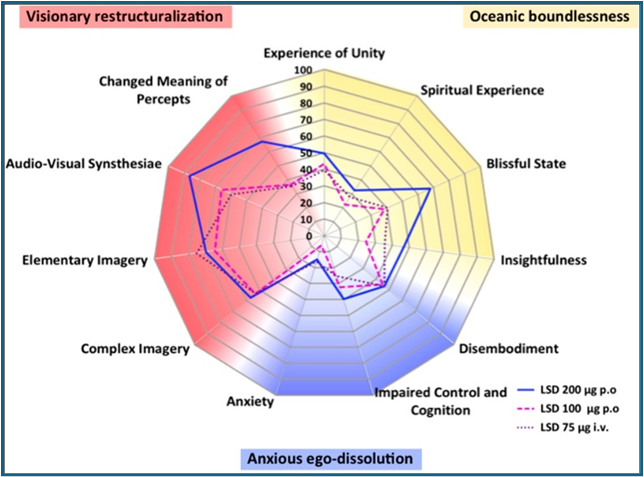
effects of LSD
mechanism of action for LSD
in the peripheral vasculature LSD binds to the 5HT2A receptor acting as an antagonist, but can act as an agonist on other receptor types such as 5HT2B
in the brain LSD is a 5HT receptor agonist
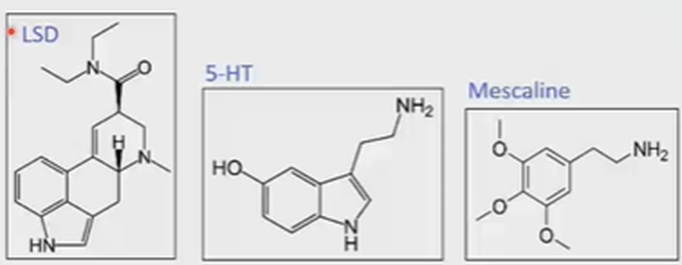
Cross tolerance of LSD and mescaline – if you take lots of LSD develop a tolerance, means you also need to take higher doage of mescaline
Suggests that they both work through the same pathway
how does LSD alter perception
LSD binds to serotonin receptors which increaase glutamatergic input to the locus coeruleus therefore increasing activity
adrenaline is sent throughout the brain which causes increased actitivy in certain areas of the cortex
NOTE:
originally observed that LSD decreases the firing rate of Raphe neurons (5HT1A receptors) and Raphe neurons send extenisve projections to the forebrain
BUT mescaline doesnt affect Raphe neuron firing but shows a cross tolerance with LSD —> doesnt support this theory
what kinds of serotonin receptors are important?
Expect that if receptor responsible for psychedelic effects of LSD it would also be bound by mescaline
A meta-study mapped the correlation of affinity for 5HT receptor subtype with hallucinogenic potency – found that most hallucinogenic compounds have the highest affinity with 5HT2A receptors
5HT2A receptors highly expressed in pyramidal neurons —> 5HT2A receptor signalling seems to be present in the more recently evolved regions of the brain
human LSD imaging
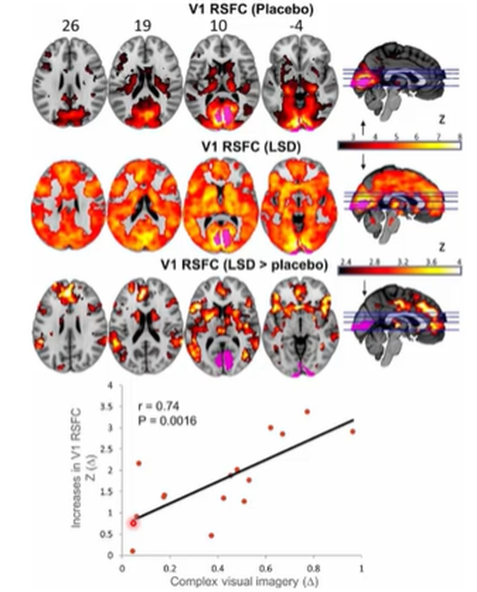
Discovered that LSD increased visual cortex cerebral blood flow
Expanded primary visual cortex functional connectivity
Correlated strongly with ratings of visual hallucinations
Decreased connectity between the parahippocampus and the retroslpenial cortex (responsible for spatial navigation, scene construction and memory) which is correated strongly with self ratings of “ego-dissolution” and “altered meaning”
addiction
Persistent disorder of brain function in which compulsive drug use occurs despite serious negative consequences for the affected individual
Features
Compulsion to take the drug
Tolerance – if a drug elicits a response on a system the brain tries to downregulate that system to counteract it
Withdrawal syndrome – opposite effects of those experienced in the presence of the drug as the receptors in the brain have been downregulated as a maladaptation to the drug
These different stages of the addiction cycle implicate different brain regions
reward
Addiction essentially hijacks the reward system
Reward drives your behaviour towards things that are essential for survival
E.g: drinking water when youre really thirsty is pleasurable
Inappropriate activation of the reward system drives us to seek out things that are not necessarily good for us, leading to addiction
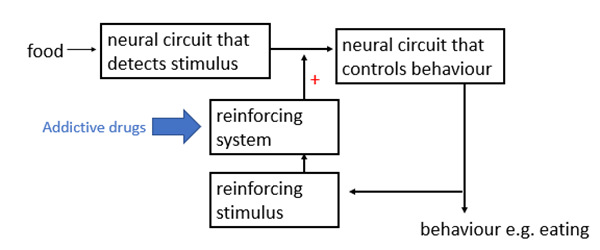
A stimulus activates a neural circuit which drives behaviour causing you to seek out something (E.g: eating). This is then followed up by a reinforcing system telling you something was pleasurable.
Addictive drugs hack into the reinforcing system without something actually being good for you.
Reward centres in the brain - medial forebrain bundle
experiment where rats were placed in operant chambers show repeated self stimulation behaviour when the electrode is placed in certain regions of the brain
occured most notably in septal area, also known as medial forebrain bundle
No clear understanding of where the medial forebrain is in humans, but well characterised in rodents
Medial forebrain bundle is a large bundle of axons:
Variety, bidirectional, some myelinated, some unmyelinated
Number of pathways involved (green = dopaminergic, red = glutamatergic, blue = GABAergic)
Innervates areas of the brain such as
5HT axons from raphe nuclei
Noradrenergic axons from LC neurons
Dopaminergic axons from VTA
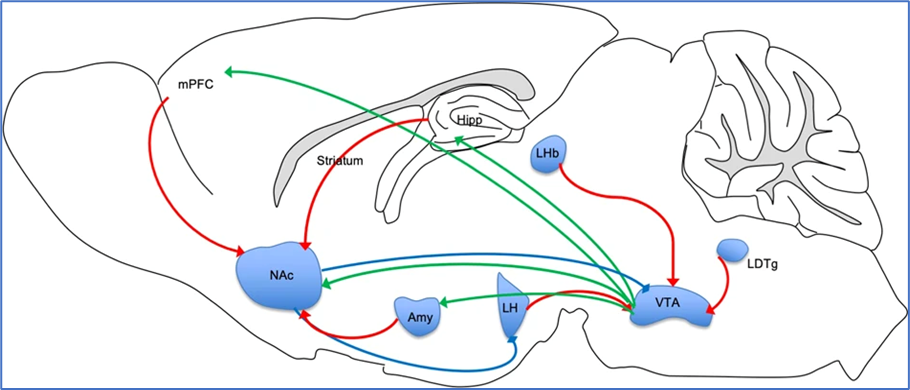
Striatum
Divided into 2 main regions, the dorsal striatum and the NAcc
The NAcc is typically associated with limbic areas, regulates affective components of behaviour, including motivational and emotional processes
The dorsal striatum regulates habit behaviours
neurons important for reinforcing behaviour
no reinforcing (repeated self stimulation) behaviour if you have problems with dopamine → suggests dopamine is important
6-hydroxydopamine taken up by dopaminergic neurons and kills them —> once contaminated with drugs and caused chemically induced Parkinson’s
If you administer spiroperidol then you no longer get these reinforcing behaviours —> is a DA2 receptor antagonist
optogenetics
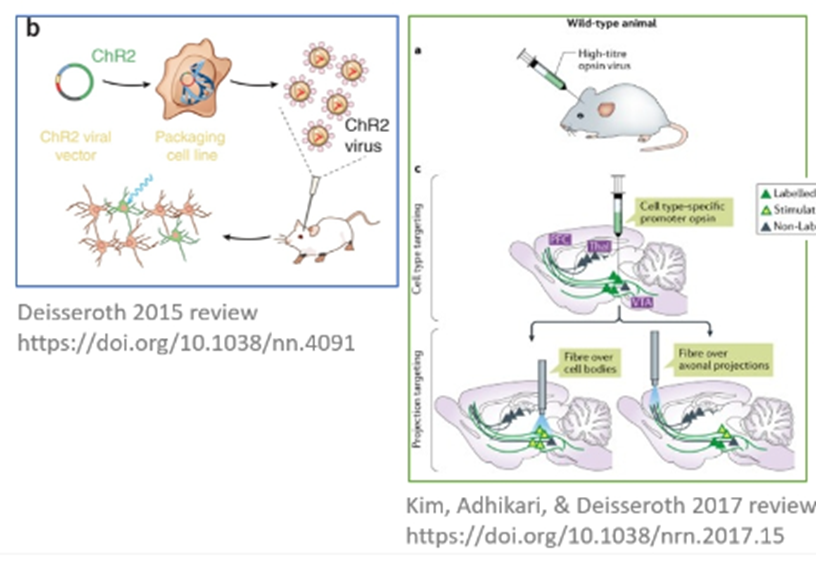
temporally precise non-invasive control of activity in well defined neuronal populations
Channel rhodopsin isolated from algal populations inserted into specific neurons via adenovirus vector —> integrated into genome so now the cell responds to blue light
Can be controlled by a cell-type specific promoter so is only expressed in a specific subset of neurons
Cre/Lox systems
Another way of optogenetically controlling neurons
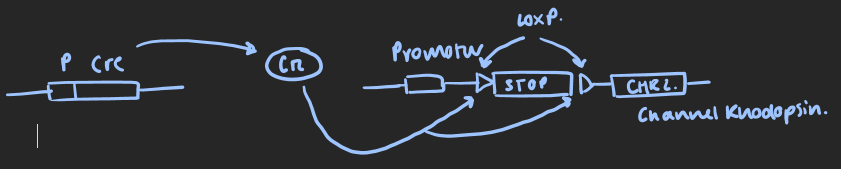
Cre is a site specific recombinase which acts on LoxP sites
LoxP is a 34bp sequence which Cre binds to
Cre and channel rhodopsin inserted into dopaminergic neurons
Cre controlled by cell-specific promoter
Cre bind to LoxPforming stite specific recombination – removing the intervening STOP sequence. When Cre is bound it allows channel rhodopsin to be transcribed, controlled by the promoter
Cells where Cre is not expressed, channel rhodopsin is also not expressed as theres a STOP cassette between the promoter and channel rhodopsin
Cre/lox systems in reward experiments
Cre under the control of a tyrosine hydroxylase promoter which is specifically expressed in DA neurons (so Cre only found in DA neurons)
Two nose ports – when they press one of them it stimulates the dopaminergic neurons with blue light, the other one nothing happens
Total nose pokes at the active port (one that delivers stimulation of DA neurons) increases drastically over number of days
An extinction phase is introduced – where if either port is pressed, nothing happens —> as a result the rats stop this behaviour and as soon as the posrt is activated again, nose pokes increase rapidly
proving that it’s not simply a learned behaviour
cocaine and amphetamines linked to reward
In operant chambers where rats are allowed to self-administer cocaine or amphetamine straight into the ventricles, they will self-stimulate to the point of toxicity
Alternative lever activates the blue light optogenetic activation. They dont choose to self administer this
Proves that they do like the drugs rather than just the stimulation of these reward pathways
Flies don’t like cocaine because its bitter, if they knock out this bitter taste receptor, flies will choose to ingest the cocaine
cocaine
Comes from the coca plant
Appetite suppressant
Stimulant – causes this euphoric feeling
Local anaesthetic and has vasoconstrictive properties so used in some eye, ear nose and throat surgeries
Binds to voltage gated sodium channels and blocks them to exhibit anaesthetic effects
but highly toxic – tremors, convulsions, CNS depression
Wears off quickly
Modern anaesthetics like lidocaine come from our understanding of cocaine
Highly addictive

Effects
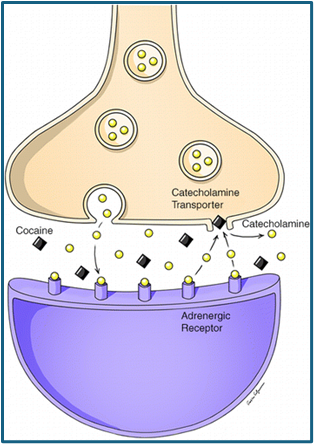
Binds to a high affinity transporter on presynaptic terminals
Prevents recycling of catecholamines
Increased levels of catecholamine in synaptic space
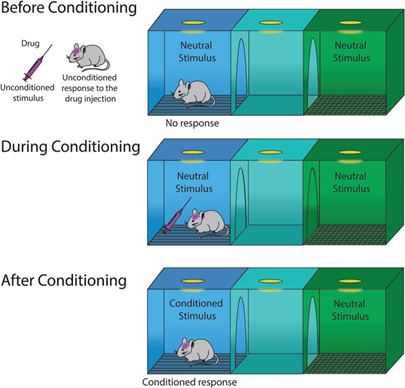
conditioned place preference tasks
3 chambers which rodents are allowed to explore – they look different so the rodent can tell the difference
When the rodent goes into one of the chambers you administer the drug
If they like the drug they’ll have a bias for the chamber they were originally administered the drug
If they don’t they’ll wander round all 3 chambers
Results
Since cocaine binds to dopamine transporter channels, made mice which lack this dopamine transporter (emulating the block in cocaine)
If you gave these mice cocaine, you would expect It to have no effect as they dont have this uptake transporter to block
Mice with dopamine transporter knockout have chronically elevated synaptic dopamine and increased locomotor activity (what you would expect to see with cocaine)
BUT they do show conditioned place preference to cocaine as well as self-administration behaviour
Might be a reinforcing stimulus other than dopamine
improvements to this experiment
BUT these animals have has this knockout all their life —> not the same as how cocaine is administered to humans or mice
Tweaked by replacing a mutated (cocaine insensitive) dopamine transporter with mutations at F105, and at positions 104 and 109
The transporter can transport dopamine but can no longer bind cocaine
Dopamine knockin mice have no elevated dopamine in the synaptic cleft —> don’t exhibit elevated locomotion
Cocaine in the mutant DAT knockin mice did not produce reinforcement as measured by CPP —> they were unaffected by the cocaine
The same experiment was done with amphetimaine to prove that the receptor still worked, did show a sensitivity and preference for amphetamine
can we apply this to humans?
Is dopamine important in human drug abuse
Use PET imaging —> 11C radiolabelled carbon binds to D2 receptors to see receptor availability
Uses fluorosprioperidol (DA receptor antagonist)
2 theories to explain the decrease in D2 receptors in barins of cocaine users
A)
In cocaine users D2 receptors in the basal ganglia downregulated: when cocaine administered you get blocking of reuptake at presynaptic cleft —> more dopamine in synaptic cleft —> downregulation of receptors
Even if you’ve been a regular cocaine user and stopped, you still have the downregulation of D2 receptors up to 4 months
B)
However, we view this as a consequence but could this be a cause —> another hypothesis is maybe everyone has variable levels of D2 receptors and if you have lower levels it makes you more vulnerable to addiction
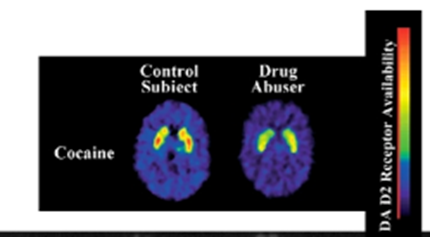
theory B - natural variation in D2 receptors
Evidence disproving thsi hypothesis
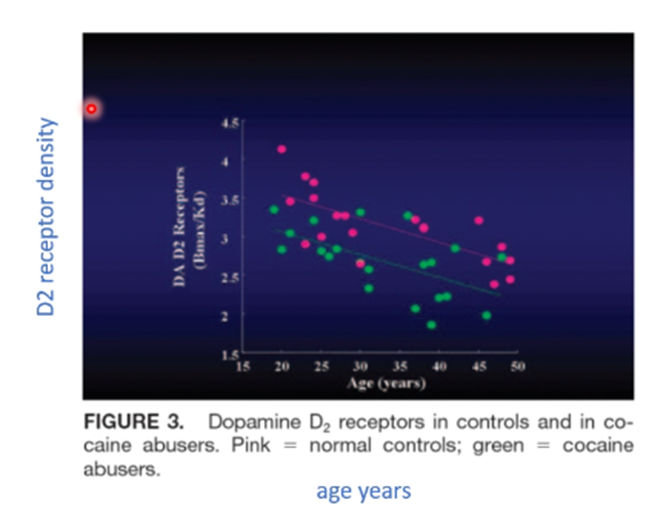
D2 receptors and Age Insigh
D2 receptors are mapped from birth and the number of D2 receptors declines with age
Pink is control, green is drug users —> pink consistently above the green
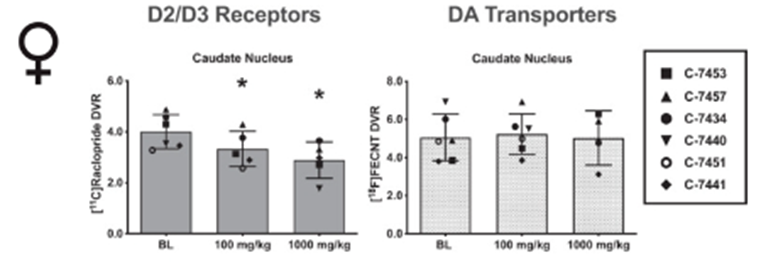
Also found that in the experiment which proves thqt drug administration downregulates these receptors (next slide) thqt in male monkeys decreased initial receptor levels resulted in increased succeptibility to addiction, but in female monkeys the opposite was true
theory A - cocaine causing downregulation
evidence for this hypothesis
Measutre the levels of D2 receptors using 11C PET
Allow them to self-administer cocaine
Gradually increase the dosage of cocaine given and measure the number of D2 receptors
Found that with increased dosage causes the decrease in D2 receptors.
This gives evidence for the hypothesis that cocaine causes this downregulation of D2 receptors
 Note
Note  Flashcards (24)