Bio test 3
 Call Kai
 Learn
Learn Practice Test
 Spaced Repetition
 Match
Match Flashcards
 Knowt Play
1/145

There's no tags or description
Looks like no tags are added yet.
Name | Mastery | Learn | Test | Matching | Spaced | Call with Kai |
|---|
No analytics yet
Send a link to your students to track their progress
146 Terms
Shoot system
contains both the vegetative/non reproductive parts of the plant (leaves and stem) and the reproductive parts of the plant (flower and fruit)
root system
supports the plant, absorbs water and minerals, and usually underground
types of tissue that plants have
dermal, ground, and vascular tissues
dermal tissues (plants)
protection and prevents water loss. contains the epidermis and stomata
epidermis (plants)
outer layer (skin like). Protects from diseases and absorbs water and nutrients
stomata
allows a plant to take up carbon dioxide and release oxygen and water vapor (flanked by two guards cells that regulate its opening and closing)
leaf
contains the lamina (leaf blade)
two types of attachments
synthesizes sugars during photosynthesis
ground tissues
used for metabolism, storage and support
contains parenchyma, collenchyma, sclerenchyma
parenchyma (ground tissue)
Structure: cube shaped, loosely packed, thin walled, contains chloroplasts
Functions: photosynthesis, cellular respiration, storage
Collenchyma
Structure: elongated, unevenly thickened walls
Functions: support, wind resistance
Sclerenchyma
Structure: thick, double cell walls containing lignin
Functions: support, strength
how is vascular tissue arranged in monocots vs dicots?
Monocots: the vascular tissue is unorganized and random
Dicots: the vascular tissue is aligned in a circle (planned)
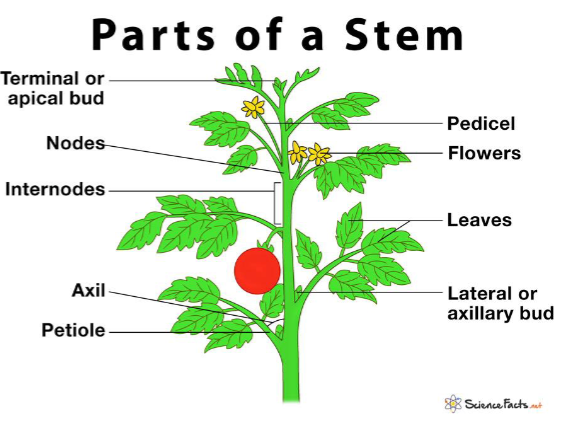
node
point of attachment for leaves, aerial roots, and flowers
Internode
region between 2 nodes
petiole
stalk extending from stem to the base of the leaf
Axillary bud
usually found in the axil (area between the base of a leaf and the stem) where it can give rise to a branch or flower
Apical bud
the apex (tip) of the shoot contains the apical meristem (location for vertical growth)
parts of a stem
tap roots v fibrous roots
Tap root systems: have a main root that grows down
Fibrous root systems: consist of many small roots
root cross section
n
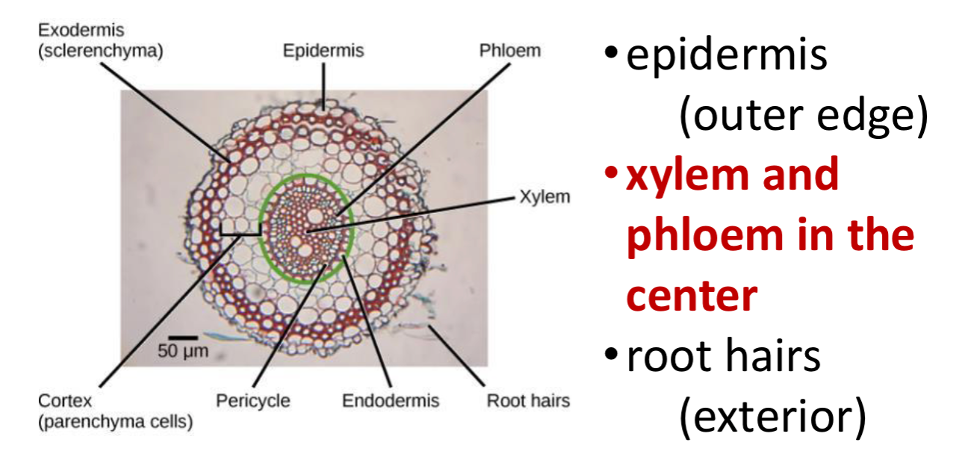
root hairs
tubular extensions of epidermal cells (increase surface area of roots for better water/nutrient absorption)
how are vascular bundles arranged in the roots of monocots vs dicots
Monocots: xylem and phloem cells form a ring around the central path
Dicots: vascular tissue forms an X shape in the center of the root
two attachments for leaves
o Attached by a petiole
o Attached to the plant stem (sessile)
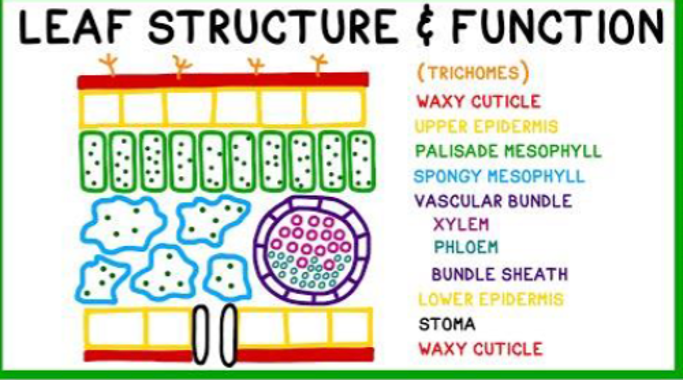
palide mesophyll
upper layer of photosynthesis cells, just below upper epidermis
spongy mesophyll
lower layer of photosynthetic cells
leaf structure
n
how do carnivorous plants eat?
Insects are digested by bacteria; the plant then absorbs the smaller molecules
What four things do plants need from their environment?
· Water
· Sunlight
· Carbon dioxide
· Essential inorganic nutrients/minerals
macronutrients vs micronutrients
plants need a lot of macronutrients, plants only need a little bit of micronutrients
what makes something essential
it is obtained from the environment (cannot be made by the organism)
humus (topsoil)
top-most layer of soil that is key for plant nutrient uptake. Contains high levels of water and nutrients from decomposing materials
How are minerals absorbed by plants?
Minerals are absorbed into the roots using active transport (uses energy in form of ATP)
root nodules
mutualistic relationship with bacteria for nitrogen fixation
mycorrhizae
increases surface area for mineral absorption (interaction between fungi and roots)
xylem
transports water and nutrients from the roots to leaves (UP ONLY). Strong, non-living cells at maturity that contain lignin and provide structure to plants
Contains tracheids and vessel elements
tracheids
tapered at both ends, ends overlap and pits allow water to pass from one to the next
vessel elements
long tubular with perforation plates at each end, run end to end to look like a pipeline
water potential
the mechanical energy of water, tendency of water to move from one area to another due to
· Osmosis
· Gravity
· Mechanical pressure
· Matrix effects such as capillary action (surface tension)
pressure potential
effect of pressure on water, water moves from HIGH pressure potential to LOW pressure potential
solute potential
effect of osmotic movement on water, water moves from LOW solute to HIGH solute
water will….
ALWAYS move from areas of higher water potential to areas of lower water potential
why does water move into roots
plants accumulate high concentrations of minerals just inside the root epidermis. Water is pulled into the root and, as water enters the root, it adds pressure to existing water pushing it upward.
how is root pressure created?
Ions are higher inside of the root than outside of the root causing osmosis to force water through root cells (osmotic pressure)
As water enters the root, it adds pressure to existing water and pushes it upward, referred to as root pressure and manifests are guttation. Different than transpiration
transpiration
as stomata open, water escapes into the air via evaporation
cohesion
the ability of water to stick to itself
adhesion
the ability of water to stick to other molecules
what two processes allow water to reach to the tops of trees?
cohesion and adhesion
These particles allow water to stick to the sides of xylem vessels and pull a continuous column of water upwards against gravity
is the phloem alive?
yes, alive at maturity
two parts of the phloem
sieve tube members and companion cells
sieve tube members
end walls have sieve plates with many pores and are connected by strands of cytoplasm with no nuclei
companion cells
next to sieve tube members with many pores
connected by strands of cytoplasm with no nuclei
load/unload sugars into sieve tubes
pressure flow model
1. Sucrose is actively transported from source cells to the companion cells and then the sieve tube elements
2. Water potential is reduced, causing water to enter the phloem from the xylem
3. The resulting positive pressure forces the sucrose-water mixture down toward the roots, where the sucrose is unloaded
4. Transpiration causes water to return to the leaves through the xylem vessels
photomorophogenesis
growth and development of plants in response to light that allows plants to optimize their use of light and space
photoperiodism
ability to use light to track time, plants can tell the time of day and time of year by sensing and using various wavelengths of light
Phototropism
directional response that allows plants to grow towards, or even away from, light
how do plants protect themselves from herbivores?
Bark, waxy cuticle, thorns, and spines
Secondary metabolites
secondary metabolites
not necessary for respiration or plant growth/development and can be toxic. some discourage predators with noxious odors or repellant tastes
alternation of generations
Plants have two distinct stages (gametophyte and sporophyte)
Haploid gametophytes produce the male and female gametes by mitosis in distinct multicellular structures. These gametes fuse into a diploid zygote, which develops into the sporophyte.
Diploid sporophytes produce spores by meiosis, which then divide by mitosis to produce the haploid gametophyte.
The new gametophyte produces gametes, and the cycle continues.
layers/whorls (of flowers)
sepals: outermost whorl
petals: second whorl
stamens: third whorl
carpels: innermost whorl
carpel
female part of the flower
ovary
contains ovule (megagametophyte)
Ovary becomes fruit
Ovule becomes seed
stigma
tip where pollen lands (sticky)
style
neck or stalk leading to ovary
stamen
male part of the flower
anther
contains pollen grains (microgametophytes)
filament
holds anther up
pollination
the mechanical transfer of pollen from anther to stigma that may or may not be followed by fertilization.
double fertilization
means there are 2 sperm; one sperm unites with egg to form a diploid zygote, while the other sperm unites with the two polar nuclei to form the triploid endosperm (provides nutrients to the embryo)
self-pollination
pollen from the anther is deposited on the stigma of the same flower, or another flower on the same plant
cross pollination
transfer for pollen from the anther of one flower to the stigma of another flower on a different individual of the same species
biotic agents
insects (bees, flies, butterflies), bats, birds, and other animals
abiotic agents
wind and water (most species and many conifers by wind)
how can plants prevent self pollination?
· Pollen and ovary mature at different times
· Physical features on the flower prevent self pollination
· Male and female flowers are located on different parts of the plant
· Male and female flowers are on different plants (dioecious)
what are the 3 generations/parts of a seed
integument, endosperm, embryo
integument
parent sporophyte (protective covering)
o Encloses the dormant embryo and stored food
o Germinates when conditions are favorable
endosperm
parent gametophyte
embryo
new offspring
what are the adaptations that seeds have?
· Maintains dormancy under unfavorable conditions
· Protect young plant when it is most vulnerable
· Provide food for the embryo until it can produce its own food
· Facilitate dispersal of the embryo
what are the adaptations that seeds have for dispersal/surviving/timing
Seeds can be dispersed by animals, water, and wind. Specific adaptations ensure that seeds will germinate only under appropriate conditions (such as seeds sealed by wax in tough cones that do not open until exposed to fire- serotinous cones)
what are fruits and the layers?
fruits: mature ovaries
pericarp: ovary wall
exocarp: skin or rind
mesocarp: flesh or pulp
endocarp: surrounds seeds (pit)
asexual reproduction
production of seeds without fertilization
apomixis
ovule or part of the ovary that gives rise to a new seed
stolon
stem that runs along the ground that forms adventitious roots and buds that grow into a new plant
grafting
two plant species are used: used of the stem is tied onto a rotted plant called the stock. The part that is grafted or attached is called the scion
cuttings
a portion of the stem containing nodes and internodes is placed in moist soil (or water) and allowed to root
layering
a stem is bent and covered with soil
radial symmetry
body parts arranged around central axis that can be bisected into two equal halves in any 2-D plane
Bilateral symmetry
body has right and left halves that are mirror images, with only the midsagittal plane bisecting the animal into two equal halves
front/coronal
separates ventral (front) from dorsal (back)
transverse
akin to cross-section of a stem
sagittal
divides left from right, at the midsagittal plane, left and right sides are mirror images
what factors limit the body size of animals?
· Cell size is constrained by the surface area to volume ratio
· Gravity
· Drag (in water)
· Skeleton weight (endoskeletons allow for larger body size than exoskeletons
· Surface area: volume ratio for heat dissipation
ectotherms vs endotherms (basal metabolic rate)
ectotherms: absence of insulation increases their dependence on the environment
endotherms: maintain a relatively constant body temperature (fat, hair, feathers to insulate)
small vs large (basal metabolic rate)
Smaller organisms have a higher basal metabolic rate because they have a larger surface area relative to their mass. Active animals have a higher basal metabolic rate than inactive ones
acclimatization
changes in one organ system to maintain a set point in another organ system
positive feedback loop
maintains and potentially strengthens the response to a stimulus (blood clotting) not many biological systems
negative feedback loop
counteracts changes and reverses the direction of the change. most biological systems (temperature, glucose, pH, blood calcium levels)
what methods can animals maintain thermoregulation homeostasis
· Radiation (heat released)
· Convection (air/water removing heat)
· Conduction (heat transfer form surface)
· Evaporation (sweating)
parazoa
lack defined tissues + organs and can disaggregate and aggregate their cells (sponges)
Eumetazoa
· have distinct and well-defined features
· have irreversible differentiation for most cell types
· possess unique tissues which allow coordination of movement
· nerve tissue and muscle tissue (not in fungi and plants)

