SEMESTER 1 FINAL Syllabus Statements
 Studied by 5 people
 Call Kai
 Learn
Learn Practice Test
 Spaced Repetition
 Match
Match Flashcards
 Knowt Play
1/345

There's no tags or description
Looks like no tags are added yet.
Name | Mastery | Learn | Test | Matching | Spaced | Call with Kai |
|---|
No analytics yet
Send a link to your students to track their progress
346 Terms
Outline the procedure for DNA electrophoresis.
Prepare the agrose gel
Place gel into electrophoresis chamber
Load dna samples
Apply electric current
Dna fragments are separated by size
Stain the gel
Visualize bands
Describe how and why DNA fragments separate during electrophoresis.
Dna is negatively charged, so it moves towards the positive electrode
Small fragments move quickly and travel farther
Big fragments move slowly and travel slowly
Outline the process of DNA profiling.
Collect dna samples
Extract dna
Amplify str regions using pcr
Cut dna
Separate fragments using gel electrophoresis
Compare band lengths
List applications of DNA profiling.
Forensic investigations
Paternity tests
Disease gene tracking
List example sources of DNA that can be used in DNA profiling.
Blood
Saliva
Semen
Skin cells
Hair
Urine
Sweat
The units for measuring genome size are Mb (mega bases). 1 Mb = 1,000,000 bp (base pairs). Use a database to compare genome sizes to determine if there is a relationship between the number of genes in a species and the species complexity in structure, physiology and/or behavior.
Genome size does not consistently correlate with complexity. This known as c-value paradox. The regulation of genes is what drives complexity, not the number of genes.
Chromosome number is a distinguishing characteristic of a species. Explain why the typical number of chromosomes in a diploid cell is an even number.
A dipoloid has chromosomes in homologous pairs. One chromosomes comes from the mother, and the other comes from the father. Because the chromosomes are inherited in pairs, the total number must be even. Having an even number ensures the proper pairing during meiosis, correct formation of gametes, and equal separation of chromosomes.
Humans have 46 chromosomes and chimpanzees have 48. Evaluate the evidence for the hypothesis that chromosome 2 in humans arose from the fusion of chromosomes 12 and 13 with a shared primate ancestor.
Telomeres normally occurs only at the ends of the chromosomes. Humans chromosomes 2 contains internal degenerated telomere sequences in the middle of the chromosomes
One nomal chromosome has one centromere. A human chromosome 2 shows one active centromere, and a second inactive centromere
The top half of human chromosome 2 matches one chimp chromosome. The bottom half matches the other
Define karyotype and karyogram.
A karyotype is the number and types of chromosomes in an organism. A karyogram is a photograph or arrangement of chromosomes in homologous pairs.
List the characteristics by which chromosomes are paired and arranged on the karyogram.
Length
Centromere position (metacentric - centric, submetacentric - off center, acrocentric - near one end)
Banding patters after staining
Prescient of homologous pairs
Describe the process of creating a karyogram.
Inhibition of mitosis with drugs
Separate the chromosomes
Staining
Photography
Karyotype preparation
Define autosomes and sex chromosomes.
Autosomes
Chromosomes 1-22 in humans
Do not determine sex
Homologous pairs with matching size and banding
Sex chromosomes
The 23 pair
Determines sex
X is large and metacentric, y is small and acrocentric
Define “DNA barcode” and “environmental DNA.”
Dna barcode - a short dna sequence that is unique to each species and can be used to identify organisms Environmental dna - genetic material collegected from soil, water, air, or surfaces which include cells shed by organism, secretions, saliva, waste, etc. |
Outline the use of “DNA barcoding” to identify species from environmental DNA.
College enviormental sample
Extract dna
Amplify barcode regions using pcr
Sequence the pcr
Compare sequences to BOLD
Identify species in the enviorment
List applications of DNA barcoding using environmental DNA.
Biodiversity
Invasive species
Detections
Endangered animals monitoring
Food chain and tropic studies
Water quality and ecosystem health
Outline the mechanism by which the presence of lactose regulates the expression of genes related to digestion and use of lactose in E. coli.
The lac operon enables e. Coli to digest lactose only when lactose is present, and glucose is low.
When lactose is absent:
Repressor protein binds to operator region
Rna polymerase is blocked
Genes for lactose metabolism is off
When lactose is present:
Lactose is converted to allolactose
Which then binds to the lac repressor, causing it to change shape
The repressor detaches from the operator
Rna polymerase binds the promotor
The lac genes are transcribed
Outline the mechanism by which the presence of oestrogen in a cell’s environment regulates the expression of genes related to endometrium development and maintenance during the uterine cycle.
Ostergeon enters the cell
It binds to the oestrogen receptor
The receptor changes shape and formas a hormone-receptor complex
This moves in the nucleus
It binds to specific dna sequences (oestrogen response elements)
Binding recruits transcription factors and rna polymerase
The target genes involved endometrical growth, blood vessel formation, and nurtirent secreation are activated
Increases transcription of genes
Define phenotypic plasticity
The ability for a single genotype to produce different phenotypes in response to environmental conditions, due to changes in patterns of gene expressions. These are reversible within the organisms lifetime.
Outline an example of phenotypic plasticity.
Himalayan rabbit:
Temperature sensitive gene for melanin production
Cold areas activate the enzyme and calls for darker fur
Warm areas deactivate, with calls for while fur
Describe the inheritance of epigenetic tags in differentiated cells of a multicellular organism.
Differentiated cells have specific patters of gene expression controlled by dna methylation and histone modifications. They are inherited during dna replication, maintenance methyltransferase, and histone modifications. This results in the daughter cells inheriting the same epigenetic patter, maintain the same cell identity, and allow tissues to keep their specialized function throughout life
No change in dna sequence, only in expression.
Discuss the consequences of reprogramming and imprinting of epigenetic tags in haploid gametes.
Reprogramming - before gametes form, most epigenetic tags are erased; this is to reset the genome so that the next embryo can develop normally.
Imprinting - some genes retain methylation after reprogramming; the consequence of this is that only one allele is expressed while the other is silences (either maternal or paternal); this affects growth, metabolism, and development
Explain the reason why monozygotic twin studies are often used to measure the impact of the environment on gene expression.
Monozygotic twins comes from a single fertilized egg, have identical dna sequences and starts with identical epigenetics patterns.
This leads scientists to hold genetics constant so the differences myst be due the environment; compares the lifestyle, nutrition, stress, etc.
All in all, identical twins are the best experiment for isolatiing environmental influences on gene expression.
Outline the impact of air pollution on the epigenetic regulation of genes associated with the immune response.
Increased dna methylation on promotor of genes involved in immune signaling, inflammation, and antioxidant.
Decreased expression of these genes; reduces ability to fight infections, higher inflammation is respiratiory tract
Hypomethylation of inflammatory genes leads to higher risk of autoimmune disorders, and overactivation of immune responses.
Discuss how imprinting of epigenetic tags impacts gene expression in a diploid cell.
Imprinting - one allele is silenced by methylation and the other is active
The cells behave as if it only has one functional copy of the imprinted genes. These genes regulate growth and development. If imprinting is abnormal (silencing the wrong allele), disease occurs.
Outline the epigenetic origins in the difference in size between tigons and ligers (lion–tiger hybrids).
Liger = male lion and female tiger
Tigon = male tiger and female lion
Paternally expressed genes = growth (ligers - growth promototing genes, so they grow extremely large)
Maternally expressed genees = suppresses growth (tigons - limit growth so they are smaller than either parent species)
Outline evidence that viruses evolved after the origin of cells.Outline evidence that viruses evolved after the origin of cells.
Viruses depend on host cells for replication that cannot reproduce → suggests that they originated after the cell already exists
Viral genomes contain genes that are derived from host cells indiciating that they evolved through reduction
No viruses have ribosomes or metabolic pathyways, which are evolved early in life. So the virus must have diverged later
The genetic code shared by viruses mirror the host organisms, showing they adopted the code from cells rather than evolving it independently.
Outline the progressive and regressive hypotheses for the origin of viruses.
Progressive (escape) = viruses evolved from mobile genetic elements. These elements escaped cells and gained the ability to move between cells. This allows them to be infectious particles
Regressive (reduction) = viruses originated from once-free-living cells that became parasitic. Over time, they lost genes that was unnecessary for the life, and eventually lost all metabolic and structural genes.
Outline how convergent evolution could result in the commonality of some structures shared by viruses.
Different viral linages evolved independently but faced similar selective pressures like enteing host cells, protect genomes, and replicate efficiently
The could have lead to the evolution of similar structural features
Outline three reasons for rapid evolution in viruses.
1 - High replication rate/short generation time - produces billions of virions per day in the affected person
2 - Lacks proofreading - introduces many mutations into the DNA
3 - Short generation time - leads to the formation of many different genetic variants within an affected individual
4 - small genome
Discuss the consequences of rapid virus evolution on treating diseases caused by viruses (influenza and HIV).
Influenza
Antigenic drift (constant small mutations) alters surface proteins (HA and NA) which leads to the immune system no longer recognizing the virus
This leads to producing highly infectious strands which could be pandemics. So antiviral drugs have to become not effective and vaccines must be updated annually.
Hiv
Extremely high mutation rate which leads to evolution of drug-resistant strains
Requires communication therapy to reduce resistance
Rapid evlolition could allow hib to evade immune detention and contribute to infection.
State that gametogenesis involves mitosis, cell growth, two divisions of meiosis and differentiation.
Mitosis - to create many parent cells
Cell growth - the growth of these parent cells
Two divisions of meiosis - producing haploid cells
Differentiation - turning the haploid cells into sperm or eggs
Define oogenesis and spermatogenesis.
Oogenesis - the production of female gametes (eggs) in the ovaries
Spermatogensis - the production of male gametes (sperm) in the testes
Compare the processes of spermatogenesis and oogenesis, including the number of gametes, size of games, the timing of formation and release of gametes.
Spermatogensis - in the testes, begins at puberty and continues throughout life, it has 4 functional sperm per spermatocyte, it divides equally to small cells, it is a continout production, and they are flagellum
Oogenesis - in the ovaries, it beings before birth and stops at menopause, 1 functional ovum and 2-3 polar bodies prodicts per parent cell, it divides unequally into 1 large egg, it releases 1 egg per menstrual cycle
Outline unequal cytokinesis during human oogenesis.
In oogensis, cytosis during meiosis 1 and 2 is unequal. Almost all of the cytoplasm goes to one daughter cell which then produces the primary oocyte in meiosis 1, and the secondary oocyte in meiosis 2. The other cells are called polar bodies, and they recieve almost no cytoplasm and eventually break down due to no structural support. This ensures that one large egg with enough nutrients and organelles are there to support early embryo development.
Compare motility, size, energy reserves and production rate of male and female gametes of animals.
Sperm - high motile (it swims using a flagellum), it is very small in size, little to none energy reserves as it depends on the surrounding fluids, produces millions per day, and its main role is to deliver DNA quickly to the egg.
Egg - non motile (stays in reproductive tract), it is much larger in size, has large energy reserves in the cytoplasm, produces typically one per month during menopause, and its job is to provide DNA and cytoplasm to support the embryo
Define “carrier” as related to genetic diseases.
A carrier is a person who has one recessive allele for a genetic disease but doesn’t show symptoms of that disease. They can pass along the allele to their offspring.
Explain why genetic diseases usually appear unexpectedly in a population.
Recessive alleles are usually hidden in carriers. The disease appears when a child inherites two recessive alleles, where one comes from each parent. Parents may not know that they carry the allele, which is why the disease seems to appear out of no where in the population.
Outline the genetic cause of phenylketonuria.
It is caused by a recessive mutation in the gene for phenyalaine hydroxylase. Which is an enzyme that converts phenyalanine to tyrosine. Without this enzyme, phenylalanine builds up to harmful levels.
List consequences of phenylketonuria if untreated.
Brain damage
Seizures
Behavioral problems
Light skin/hair
State how phenylketonuria is treated.
Having a strict low-phenyalanine die, medical prescriptions, and regular blood tests to monitor phenyalanine levels are used to treat phenylketonuria.
Compare continuous to discrete variation.
Continuous variation - traits vary along a range with many possible values
Discrete variation - traits fit into categories with no intermediates
State that a normal distribution of variation is often the result of polygenic inheritance.
Polygenic inheritance, where many genes control one trait, often produces a normal distrubution of phenotypes (bell shaped curve)
Explain polygenic inheritance using an example of a two gene cross displaying incomplete dominance.
Capital letters = more skin pigment
Lowercase letters = less skin pigment
Each of the dominant alleles contributes additively
With incomplete dominance:
AA BB is the darkest skin color
Aa Bb is the intermediate skin color
aa bb is the lightest skin color
Because so many of these combinations exist, the phenotypes fall along a gradient, like a continuous variation.
State example human characteristics that are associated with polygenic inheritance.
Skin color
Height
Eyecolor
Body mass
Outline two example environmental factors that can influence phenotypes.
Sun exposure - increases the melanin production which affects skin color
Nutrition - influences height, weight, and cognitive development
State the direction of movement of gases exchanged in leaves.
Carbon dioxide is from the atmosphere to the leaf into the spongy mesophyll cells
The oxygen goes from the lead to the atmosphere out the leaf
Epidermis
thin and transparent, and allows light to reach mesophyll and gases to diffuse efficiently
Waxy cuticle
waterproof layer, reduces excessive water loss while still allowing gas exchange through the stomata
Stomata
pores mainly on the lower epidermis, allow diffusion of co2 into the leaf and o2 out of the leaf
Guard cells
controls opening and closing of the stomata, regulate gas exchange and water loss
Air spaces
large intercellular spaces inside the leaf, increase surface area for gas diffusion
Spongy mesophyll
loosely packed cells, short diffusion distance between air spaces and photosynthesizing cells
Veins
xylem supplies water needed for photosynthesis, phloem removes sugars produced during photosynthesis
A plan diagram shows the distribution of tissues, but not individual cells. Draw and label a plan diagram to show the distribution of tissues in a transverse section of a leaf. Include upper and lower epidermis, palisade and spongy mesophyll, xylem and phloem.
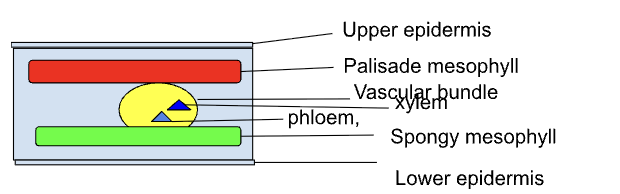
Calculate stomatal density from a leaf cast or micrograph.
Stomatal density = number of stomata / area of lead surface (mm^2)
Interpret micrographs or cast of leaf surfaces to compare stomatal density on different leaf surfaces.
Lower epidermis - higher stomatal density, reduces water loss while maintain gas exchange
Upper epidermis - lower stomatal density, limits direct water loss from sunlight exposure
Stomata are usually more numerous on the lower surface of leaves to balance efficient gas exchange with reduced transpiration
Draw a plan diagram to show the distribution of tissues in a stem, including vascular bundles, xylem, phloem, cambium, cortex, pith and epidermis.
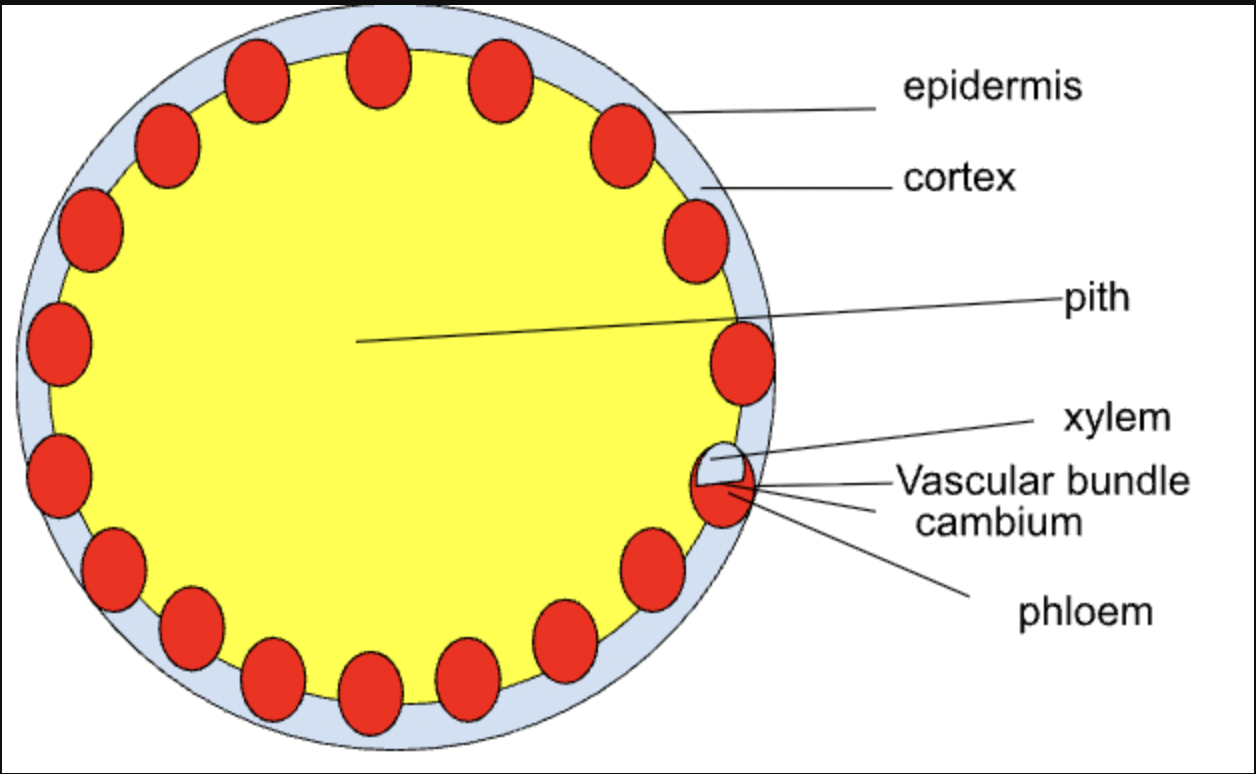
Outline the function of tissues in a stem, including vascular bundles, xylem, phloem, cambium, cortex, pith and epidermis.
Epidermis - protects stem and reduces water loss
Cortex - storage of carbohydrates, structural support
Vascular bundles - transport system of the plant
Xylem - transports water and mineral ions upward, provides mechanical support
Phloem - transport sugars and organic nutrients (translocation)
Cambium - produces new xylem and phloem, allows secondary growth
Pith - storage of nutrients, help maintain stem rigidity
State two ways xylem and phloem can be differentiated in cross sections of stem.
Position - xylem on the inside, phloem on the outside of vascular bundles
Structure - xylem has thick and lingified walls, phloem has thin non lingnified walls
Draw a plan diagram to show the distribution of tissues in a root, including vascular bundles, xylem, phloem, cortex and epidermis.
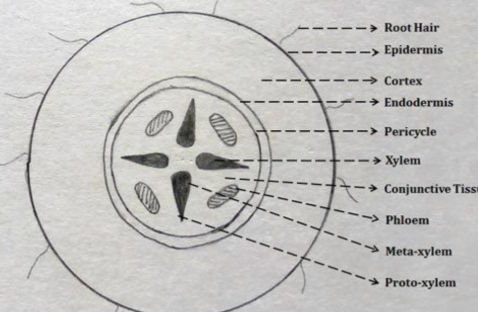
Outline the function of tissues in a root, including vascular bundles, xylem, phloem, cortex and epidermis.
Epidermis - absorbs water and mineral ions, often has root hairs
Cortex - stores carbohydrates, allows movement of water to xylem
Xylem - transports water and mineral ions upward
Phloem - transports sugars to root tissues
Vascular bundle - conducts materials throughout the plant
Describe how the structure of xylem vessels are adapted for the transport of water under low pressure.
No cytoplasm = minimal resistance to flow
No or incomplete end walls = continuous water column
Narrow diameter = maintains cohesion of water
Pits allow movement of water between vessels
Outline how xylem is able to maintain rigidity even under low pressure or mechanical disturbance.
Lignified walls strengthened vessels
Prevent collapse under tension
Provide resistance to mechanical stress
List conditions in which a plant may generate root pressure to transport water.
High humidity
Nighttime
Early spring
Low transportation rates
Outline the mechanism by which roots maintain a positive pressure potential when evaporation from leaves is insufficient to move water through a plant.
Mineral ions actively transported into xylem
Water enters xylem by osmosis
Positive pressure develops in xylem
Water is pushed upward through the stem
Define translocation, phloem sap, source and sink.
Translocation - movement of organic nutrients through phloem
Phloem sap - sucrose rich solution
Source - tissue that releases sugars
Sink - tissues that use or stores sugar
List example source and sink tissues.
Sources - leaves, storage organs releasing sugars
Sinks - roots, fruits, seeds, growing shoots
Phloem transport is bidirectional. Outline the stages of phloem translocation including loading of carbohydrates at a source, transport of carbohydrates through the plant, and unloading of carbohydrates at a sink.
Loading - sucrose actively loaded into sieve tubes at source
Transport - water enters by osmosis which leads to a mass flow
Unloading - sugars removed at sink for respiration or storage
Outline the structure and function of sieve tube cells, with specific mention of the rigid cell wall, reduced cytoplasm and organelles, no nucleus and sieve plates.
Rigid cell walls → support
Reduced cytoplasm and organelles → low resistance
No nucleus → more space for sap
Sieve plates → allow flow between cells
Outline the structure and function of companion cells, with specific mention of mitochondria and plasmodesmata.
Many mitochondria –> Atp for active transport
Plasmodesmata → direct transfer of sugars to sieve tubes
Contrast positive and negative tropism.
Positive tropism - growth toward a stimulus
Negative tropism - growth away from a stimulus
Outline phototropism and gravitropism in roots and stems.
Phototropism
Shoots = positive photoropism (grow toward light)
Roots = negative phototropism (grow away from light)
Gravitropism
Roots = positive gravitropism (grow downward, toward gravity)
Shorts = negative gravitropism (grow upward, away from gravity)
Outline the cause and consequence of positive phototropism in a plant shoot.
Causes - light detected by the shoot tip, auxin redistrubtes to the shaded side of the shoot
Consequences - cells on the shaded side elongated more, shoot bends toward the light source, maximizes light absorption for photosynthesis
|
Auxin
Cytokinin
Gibberellin
Ethylene
Abscisic acid
Outline role of phytohormones in plant growth, development and response to stimuli.
Controls cell division and elongation
Regulate development (roots, shoots, flowers)
Coordinate responses to environmental stimuli
Integrate growth across different tissues
State two roles of the hormone auxin.
Prompts cell elongation in shoots
Controls directional growth (phototropism and gravitropism)
Describe the mechanism of movement of auxin into and between plant cells.
Auxin diffuses into plant cells freely
Auzin cannot diffuse out
Auxin efflux carriers actively pimp auxin out on one side of the cell
Coordinated placement of carriers creates directional transport
Results in auxin concentration gradients within tissues
Explain how auxin concentrations allow for phototropism.
Auxin accumulates on the shaded side of the shoot
Higher auxin concentrations causes faster cell elongation
Unequal growth rates cause bending toward light
Describe the mechanism of action of auxin in the phototropic response, including the role of H+ ions and cellulose crosslinks.
Auxin simulates proton pumps in the cell membrane
Hydrogen ions enter the apoplast
Cell wall ph decreases
Acidic conditions loosen cellulose cross-links
Cell wall becomes more extensible
Cell elongates under turgor pressure
Outline the source and transport of auxin and cytokinin in plants.
Auxin - produced in shoot tips, transported downward to roots
Cytokinin - produced in root tips, transported upward to shoots
Explain how root and shoot growth are regulated by the interaction of auxin and cytokinin.
High auxin : cytokinin ration = promotes root growth
High cytokinin : auxin ration = promotes shoot growth
Interaction ensures balanced development
Coordinates growth between roots nd shoots
Outline the lifecycle stages of flowering plants.
Seed dispersal
Germination
Growth of seedling into mature plant
Flower formation
Pollination
Fertilization
Seed and fruit development
Identify the location of gametogenesis in flowers.
Male gametes - formed in pollen grains in the anthers
Female gametes - formed in ovules inside the ovary
Contrast pollination and fertilization.
Pollination - transfer of pollen from anther to stigma
Fertilization - fusion of male and female gametes to form a zygote (embryo)
Draw and label an insect pollinated flower, including: petals, sepals, stamen, anthers, filaments, pollen, carpel, stigma, style, ovary and ovule.
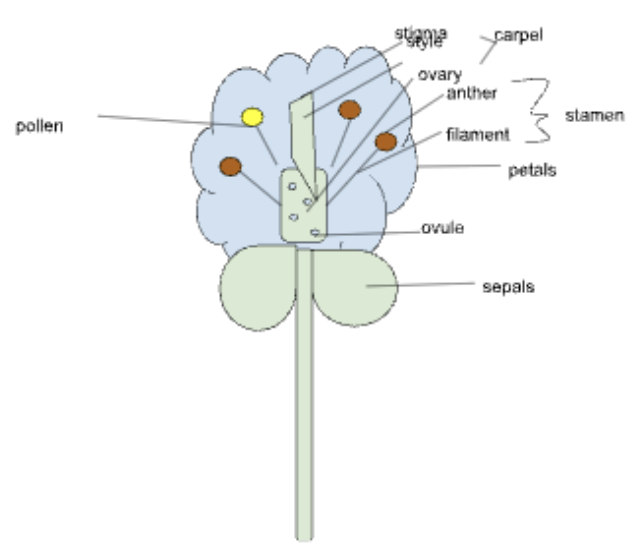
State the function of the different parts of the animal-pollinated flower.
Petals - attract insects
Sepals - protect flower bud
Anther - produces pollen
Filament - holds anther in position
Pollen - contains male gametes
Stigma - receives pollen
Style - supports stigma and guides pollen tubes
Ovary - contains ovules
Ovule - contains female gametes, becomes seeds after fertilization
Outline structures of insect-pollinated flowers that aid in the attraction of insects and transfer of pollen between flowers.
Brightly colored petals
Scent
Nectar
Sticky or spiky pollen
Stigma positioned to brush insects
Outline the reason for homologous structures in flowers.
Flowers share a common evolutionary ancestor
Same basic structures adopted for different pollination methods
Cross-pollination is the transfer of pollen from the anther (male part) of a flower on one plant to the stigma (female part) of a flower on a different plant of the same species. Outline the benefits of cross-pollination and self-incompatibility in flowering plants
Increases genetic varuation
Produces more vigorous offspring
Reduces risk of inherited defects
Improves adaptability to environmental change
List methods for promoting cross-pollination in flowering plants
Different maturation times of pollen and stigma
Separate male and female flowers
Male and female plants
Wind pollination
Animal pollination
Outline why self-pollination is generally avoided, even in hermaphroditic plants.
Leads to inbreeding
Reduces genetic diversity
Decreases survival and vigor
Outline the mechanism that promotes self-incompatibility in flowering plants.
Stigma recognizes pollen from the same plant
Chemical recognition prevents pollen tube growth
Fertilization only occurs with pollen from a different plant
Distinguish seed dispersal from pollination.
Pollination - movement of pollen
Seed dispersal - movement of seed away from parent plant
The primary function of a seed is to propagate and disperse a plant species to new locations and ensure its survival through periods unfavorable for growth. List mechanisms of seed dispersal.
Wind
Water
Animals (inernal and external)
explosion
Germination is the process by which a plant grows from a seed or spore after a period of dormancy. Outline why water, oxygen and warmth are required for germination
Water - activates enzymes and metabolism
Oxygen - for aerobic respiration
Warmth - optimum enzyme activity
Outline the role of gibberellin during germination.
Released by embryo
Stimulates aleurone layer to produce amylase
Amylase breaks starch into sugars
Sugars fuel embryo growth
The primary functions of fruits are to protect the developing seeds and to facilitate their dispersal away from the parent plant. List changes that occur to a fruit as it ripens.
Fruit softens
Starch converted to sugars
Color changes
Aroma develops
Describe the positive feedback mechanism of fruit ripening.
Ethylene simulates ripening
Ripening increases ethylene production
Increasing ethylene accelerates ripening further
Outline why fruit ripening has evolved to be rapid and synchronized.
Ensures efficient seed dispersal
Attracts animals at the same time
Reduces risk of seed loss
What properties of RNA suggest it was the first genetic material?
RNA can store information, self-replicate, and catalyze reactions (ribozymes). It is versatile and central in modern cells (mRNA, tRNA, rRNA), supporting the “RNA world” hypothesis.
 Note
Note  Flashcards (73)