Consumer Choice and Behavioral Economics HW
 Studied by 0 people
 Call Kai
 Learn
Learn Practice Test
 Spaced Repetition
 Match
Match Flashcards
 Knowt Play
1/17

There's no tags or description
Looks like no tags are added yet.
Name | Mastery | Learn | Test | Matching | Spaced | Call with Kai |
|---|
No analytics yet
Send a link to your students to track their progress
18 Terms
Identify the one statement that does not demonstrate how social effects influence consumer choice.
| |
In the ultimatum game, allocators usually offer recipients at least a 40 percent share of the money, and recipients almost always reject offers of less than a 10 percent share. Which of the following does not explain why allocators offer recipients a relatively generous share and why recipients reject meager offers?
Allocators can count on recipients to ignore all considerations except financial benefit.
Optimal decisions are made
at the margin.
If the marginal utility Ida Mae receives from eating chicken wings is negative then
her total utility from eating chicken wings has fallen.
Sunk costs
are costs that have already been paid and cannot be recaptured in any significant way.
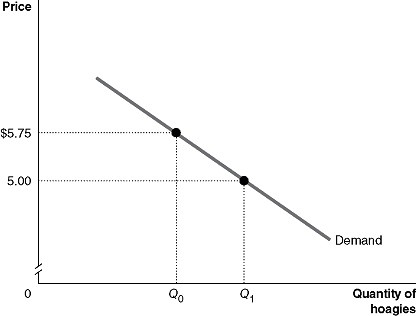
Refer to Figure 10-1. Which of the following statements is true?
Quantities Q0 and Q1 are the utility-maximizing quantities of hoagies at two different prices of hoagies.
Consider the following hypothetical scenarios:
Scenario A: You are about to purchase a pair of 7 for All Mankind jeans for $175 and a t-shirt for
$45. The sales attendant at the store tells you that the pair of jeans you wish to buy is on sale for $160 at another store, located about a 20-minute drive away.
Scenario B: You are about to purchase a pair of 7 for All Mankind jeans for $175 and a t-shirt for
$45. The sales attendant at the store tells you that the t-shirt you wish to buy is on sale for $30 at another store, located about a 20-minute drive away.
Based on standard economic theory, under which scenario would you make the 20-minute trip to the other store?
in either scenario if I think a $15 savings is worth the 20-minute trip
Firms that automatically enroll their employees in retirement plans, giving them the option to opt-out instead of to opt-in, is an example of a form of behavioral economics known as
nudges
Which of the following is an experiment which tests whether fairness is important in consumer decision making?
the ultimatum game
Many economists do not believe that network externalities lock consumers into the use of products that have technology inferior to other, similar products. These economists believe that
in practice, the gains from using a superior technology exceed the losses consumers incur from switching costs.
Suppose you pre-ordered a non-refundable movie ticket to Joker: Folie a Deux. On the day of the movie you decide that you would rather not go to the movie. According to economists, what is the rational thing to do?
Since you do not want to go to the movie and the cost of the movie ticket is a sunk cost, how much you paid for the ticket should not influence your decision.
Which of the following statements is correct?
The income effect explains why a price change causes a movement along a given demand curve.
In order to derive an individual's demand curve for salmon, we would observe what happens to the utility-maximizing bundle when we change
the price of the product and hold everything else constant.
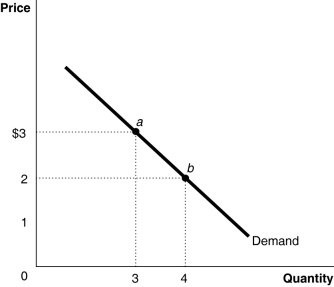
Figure 10-2 represents the demand for ice cream cones.
Refer to Figure 10-2. Which of the following statements is true?
Point a could be a utility-maximizing choice if the price is $3 but point b may not be because we have no information on the marginal utility per dollar when price changes.
Alan Krueger conducted a survey of fans at the 2001 Super Bowl who purchased tickets to the game for $325 or $400. Krueger found that (a) 94 percent of those surveyed would not have paid $3,000 for their tickets, and (b) 92 percent of those surveyed would not have sold their tickets for $3,000. These results are an example of
the tendency of people to be unwilling to sell a good they already own even if they are offered a price that is greater than the price they would be willing to pay if they did not already own it.
We can derive the market demand curve for gold earrings
by adding horizontally the individual demand curves of each gold earring consumer.
Consider a good whose consumption takes place publicly. Your decision to buy that good depends
both on the characteristics of the product and on how many other people are buying the good
Which of the following is used to explain why a consumer's willingness to buy Microsoft Office increases as the number of other people who use Microsoft Office increases?
network externalities
 Note
Note  Flashcards (117)