Bio exam 2
 Call Kai
 Learn
Learn Practice Test
 Spaced Repetition
 Match
Match Flashcards
 Knowt Play
1/44

There's no tags or description
Looks like no tags are added yet.
Name | Mastery | Learn | Test | Matching | Spaced | Call with Kai |
|---|
No analytics yet
Send a link to your students to track their progress
45 Terms
Compact Bone
o Out portion of bone.
o Surrounds spongy bone
o Also called osseous bone
o Covered by periosteum
o 80% of bone
Spongy Bone
o Inner portion of bone
o Helps absorbs shock
o Location of bone marrow
o Also called cancellous bone
o Called diploe in flat bones
o 20 % of bone
Hydroxyapatite Bone
70% to 80% of bone composition
Types of Bones
Long Bone
Short Bone
Irregular Bone
Flat Bone
Sesamoid Bone
Long Bone
o Longer in length than width
o Femur, humerus
Short Bone
o Length and width about the same.
o Carpal bones are examples
Irregular bones
o No definite shape
o Vertebral bone is an example
Flat Bone
o Flat like the name indicates
o Examples are bones of the cranium, sternum
Sesamoid bones
o Bones found within a tendon
o Example is the patella
Bone cells
Osteoprogenitor
Osteocytes
Osteoblast
Osteoclast
Osteoprogenitor
Stem cells that give rise to more specialized cells.
E.g osteoblasts.
Osteocytes
o Major osteoblasts
o Reside in the lacunae of bone
Osteoblast
o Specialized cell that helps with bone build up
o Give rise to osteoclasts due to low blood calcium
Osteoclast
o Help to break down bones
o Derived from osteoblasts
Parts of a bone
Diaphysis
Epiphysis
periosteum
Endosteum
Osteons
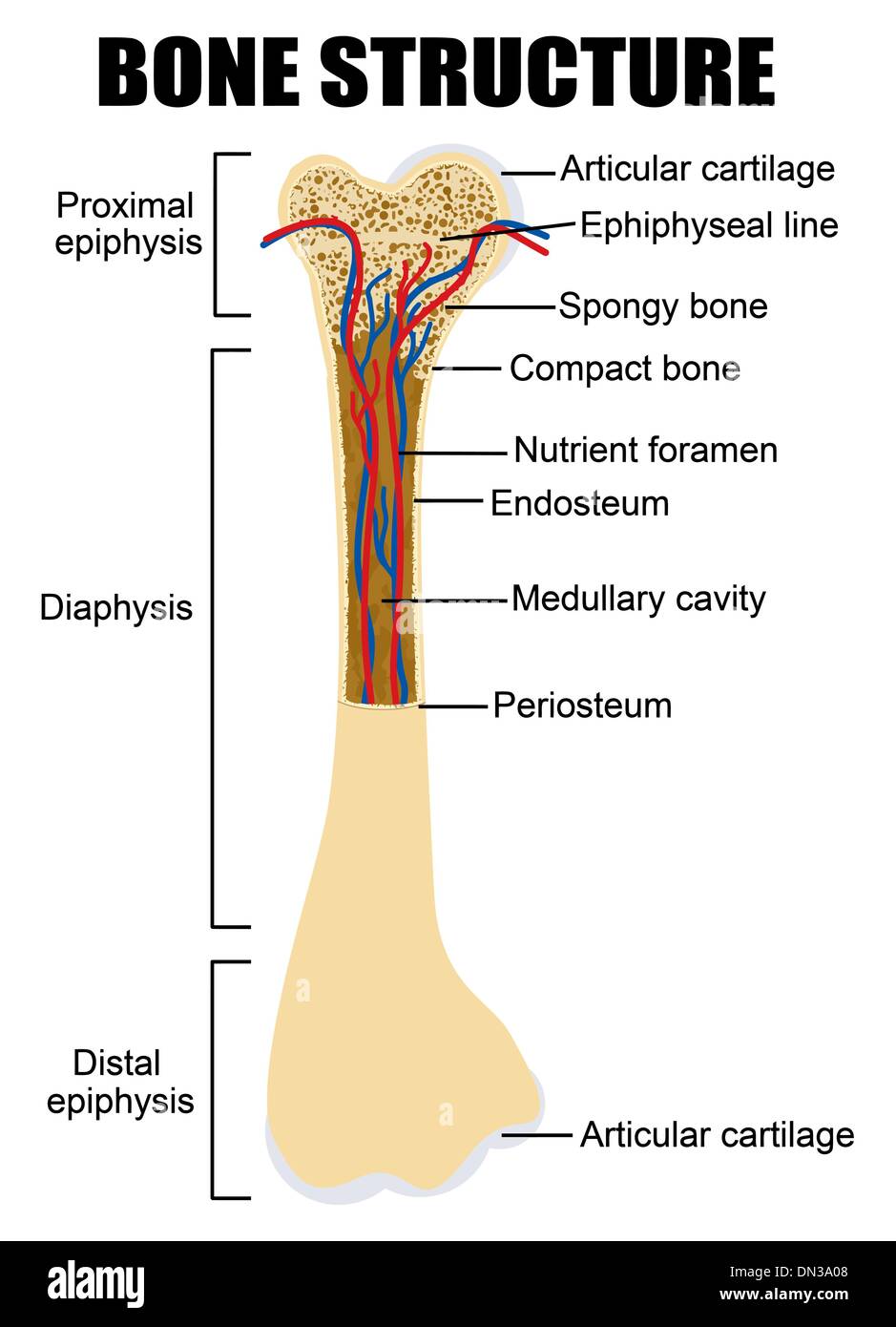
Diaphysis
Shaft
Epiphysis
Ends of long bone
Periosteum
Fibrous sheet that surrounds out part of bone
Endosteum
Lines in the inner portion of bone
Osteons
Basic structural and function al unit of mature compact bone
Central canal
Parallel to center of osteon
Concentric lamellae
Surround central canal
Rings of bone Connective tissue
Osteocytes
Mature osteoblasts
Resides in lacunae
Canaliculi
Extends from each lacuna and connects to central canal.
Allow exchange of nutrients, minerals etc. between blood vessels and osteocytes.
Perforating canals
Perpendicular to central canals
Circumferential lamellae
External- rings of bone rune immediately internal to periosteum
Internal- rings of bone run internal to the endosteum
Interstitial lamellae
Components of compact bone between osteons or partially resorbed osteons
Hyaline Cartilage
· Resilient and flexible
· High percentage of water
· Highly compressible and good shock absorber
· Avascular and contains no nerves
Cartilage cells
Chondroblasts
Produce cartilage matrix
Chondrocytes
Mature chondroblasts
Perichondrium
Covers cartilage and helps maintain its shape
Fractures
Pathological fracture
Caused by disease
Simple fracture
Broken bone but does not penetrate skin
Green stick
Fracture in children
Buckles with a peaked crack on one side
Fracture healing
Hematoma formation
Soft callus formation
Hard callus formation
Bone remodeling
Function of skeleton
Support
Protection
Calcium homeostasis
Hematopoiesis
Movement
Axial Bones
80 bones
Skull
22 Bones
Cranial Bones
Parietal
frontal
occipital
magnum foramen (pathway for spinal cord)
Temporal
sphenoid
Keystone bone (articulates with all other cranial bones)
Ethmoid
Sutures
Lambdoid - Divided occiput and parietal
Sagittal - divides parietal
Squamous - Divides parietal and temporal
coronal - divides frontal and parietal
Facial Bones
Paranasal Sinuses
frontal
maxillary
Ethmoidal
Sphenoid
— Mandible biggest facial bone
Ribcage
12 ribs
1-7 - True ribs
8-12 - False ribs
11-12 - floating ribs
Spinal column
Cervical
· 7 Segments
· Lordotic curve
Thoracic
· 12 segments
· Kyphotic curve
Lumbar
· 5 segments
· Lordotic curve
Sacrum
· 1 segment
· Kyphotic curve
Coccyx
4 segments
Appendicular
Upper extremity
Scapular
clavicle
humerus
radius
ulna
carpal bones
scaphoid
lunate
triquetrum
pisiform
trapezium
trapezoid
capitate
hamate
Metacarpals
5
Phalanges
14
Lower Extremity
pelvis
illium
ischium
pubis
Femur
longest and heaviest bone of the body
tibia
fibular
tarsal Bones
3 cuneiform - medial cuneiform, Middle cuneiform, Lateral cuneiform
cuboidal
navicular
calcaneus
talus
metatarsals
5
phalanges
14
Joint
· Also called articulations
· Usually named after bones/structure forming the joint
· A joint is were two bones meet
· Acts as a lever system
· Arthrology is the study of joints
Structural classes of joints
fibrous
cartilaginous
synovial
Fibrous
Gomphosis
Joint between tooth and mandible
synarthrosis
Sutures
Synostosis
found in cranium
Syndesmosis
Interosseous membrane
Found between ulna and radius and between tibia and fibular
Provides pivot for two long bones
Cartilaginous
Synchondrosis
Hyaline cartilage can be found in rib attachment to sternum
Can be found at the growth plate of long bones
Symphyses
Fibrocartilage
Shock absorber
Can be found at the intervertebral disc and pubic symphysis
Synovial
o Diarthrosis
o Majority of joints
o Synovial joints
§ Articular capsule
· Fibrous layer
o Outer
· Synovial membrane
o Inner layer
§ Synovial fluid
§ Joint cavity
· Lubricates articular cartilage on articulating surfaces
· Nourishes chondrocytes
· Acts as shock absorber
§ Articular cartilage
§ Ligaments
· Connect bone to bone
§ Tendon
· Connects muscle to bone
§ Bursae
· Saclike structure filled with synovial fluid
Helps to reduce friction
Functional classes of joints
Synarthrosis
o Immobile
o Can be fibrous or cartilaginous
Amphiarthrosis
o Slightly movable
o Can be fibrous or cartilaginous
Diarthrosis
o Freely moveable
o Synovial
Classification of synovial joints
Uniaxial
o Moves in one plane or axis
Example- flexion/extension of elbow
Biaxial
o Moves in two planes or axis
Example- Flexion/extension and adduction/abduction of wrist
Multiaxial
o Moves in multiple planes or axis
Example- Circumduction of the shoulder and hip
Types of Synovial joints
Plane
o Carpal/tarsal
Hinge
o Elbow/knee
Pivot
o Radioulnar joint
Ball and socket
o Hip and shoulder
Saddle
Condylar
Lever systems
Effort
o Efforts applied at one point
Resistance
o Resists efforts
Fulcrum
o Lever rotates around this point
First class
o Fulcrum is between effort and resistance
o EFR
Scissors is an example
Second class
o Resistance is between effort and fulcrum
o ERF
Example would be a wheel barrow
Third class
o Effort is between fulcrum and resistance
o FER
Example would be the elbow joint
Gliding movement
Angular Movement
Rotation Movement
Special Movement

