BIS 2B Midterm 2
 Call Kai
 Learn
Learn Practice Test
 Spaced Repetition
 Match
Match Flashcards
 Knowt Play
1/202

There's no tags or description
Looks like no tags are added yet.
Name | Mastery | Learn | Test | Matching | Spaced | Call with Kai |
|---|
No analytics yet
Send a link to your students to track their progress
203 Terms
paleontologist, anatomist, and anti-evolutionist
Cuvier
Cuvier believed that the sequential changes of fossils in different rock layers were caused by ____________________.
catastrophes
Cuvier believed that new species appeared in more recent layers by re-populating from elsewhere. (T/F)
T
____________’s Theory of Uniformitarianism presents the idea that the Earth is/was being continuously modified, which is contrast to Cuvier’s belief of Catastrophism.
Hutton
an advocate for Hutton’s Theory of Uniformitarianism, stated that “the key to the present is in the past”
Lyell
Lyell believed that what happened in the ________ are natural and similar to events that occur now. He states that changes in the earth take place _____________, so the Earth must be very old.
past, slowly
a different version of something
variation
“perfect” representation of an organism, used to compare other variations with it
type specimen
Organisms that lived very far from each other could also look the same. (T/F)
T
a form of selection that the decider chooses which individuals to breed—not natural
artificial selection
Darwin learned that _______________ breeding creates rapid change.
controlled
Darwin found a band of shells that were obviously once under the ocean. They were ordered in a layer so perfectly that it would not make any sense that more violent movements of the Earth caused this—they would have broken up this line of shells. Whose theory did this shell band support?
Lyell
On the ______________ Islands, Darwin found finches with varying beak size and shape that diversifies to match their environment.
Galapagos
wrote the Essay on the Principle of Popultion, more organisms are born than resources permit to survive
Malthus
Famine, disease, space, and other things eventually limit all populations. These are examples of what type of factors?
density-dependent
If more organisms are born than will survive, what mechanism results in the fit between organisms and their environment?
natural selection
“If you accept that natural traits are variable, that variation is heritable and that there is struggle for existence, evolution by _________________ ___________ must follow.” - Charles Darwin
natural selection
exchanged similar ideas with Darwin, concluded that natural selection must follow a population, similar to Darwin
Wallace
The three conditions for natural selection:
individuals vary with respect to _____________
phenotypic variation is ____________
phenotypic variation results in differential survival and reproduction—there will be differences in the __________ _________ of organisms
phenotype, heritable, relative fitness
the number of ones offspring that survive to reproduce themselves, in comparison the avg. number of such offspring for the population
relative fitness
Organism A has 5 offspring to survive to reproduce, organism B has 3, and organism C has 1.
The population mean is 3. Which organism and the characteristics they possess will represent an increased fraction of the next population?
A
Organism A has 5 offspring to survive to reproduce, organism B has 3, and organism C has 1.
Which organism has the highest relative fitness (highest survival)?
Which organism has the lowest relative fitness (lowest survival)?
A, C
a factor that decides who lives and who dies, does not only have to be an organism, could be a physical trait, etc.—determines the difference in relative fitness
agent of selection
A population has pale and purple beetles. A bird finds and eats only the pale beetles.
In future generations, which phenotype of beetles is more prevalent?
What is the agent of selection?
purple, bird
Can natural selection operate if there is no variation within populations? (Y/N)
N
An environment must see ___________ in order to determine natural selection.
variation
Non-Dispersing vs. Dispersing Seeds
In an urban, fragmented, man-made habitat, which seeds will be prevalent in future generations?
non-dispersing
In the case of bears, there are white and black bears. An inactive _________________ receptor in pigment cells results in the white fur of bears.
protein
White fur is caused by an inactive pigment cell. When might the version of the gene that leads to an inactive pigment cell become more common in a population?
A. if salmon is just one of many food items
B. if salmon fishing is correlated with increased risk of drowning
C. if catching more salmon is correlated with more surviving offspring
D. if catching more salmon results in lower relative fitness
C
There are white bears and black bears in a population. Bear coat color is the ______________ traits and the white spirit bears and black bears are ______________.
phenotypic, variants
What protein in the membrane of skin cells makes pigments?
MC1R
a string of amino acids that acts as an enzyme, as a structural substance, as a signal receptor, etc.
protein
DNA is _________________ into RNA and RNA is ________________ into protein, which is visible as the __________________.
transcribed, translated, phenotype
the roadmap for making proteins that produce phenotypes
central dogma
Where does transcription (RNA synthesis) take place?
nucleus
Where does translation (protein synthesis) take place?
cytoplasm
The DNA in the nucleus of pigment cells contains the instructions for the _______________ protein.
MC1R
_____________________ use the mRNA info made from transcription to make proteins.
ribosomes
______________ has a twisted double helix backbone.
DNA
In DNA, the ________ are connected to each other in the center of the strand.
bases
What are the four bases in DNA?
adenine, guanine, cytosine, thymine
What does A base pair with?
What does C base pair with?
T, G
Each strand of DNA is a string of ___________ that acts as information and instructions for making a _________.
bases, protein
Each strand of DNA is complementary and holds the same information. (T/F)
T
(Two/One) DNA strand is used to make a correct sequence of RNA.
one
RNA is made up of 4 bases as well, but instead of the base _____ (in DNA), it has the base _____.
T, U
During pre-mRNA processing, the transcript contains exons and introns. The ______________ are spliced and cut out and the ____________ are placed together to make instructions for protein creation.
introns, exons
mRNA is another version of the same instructions we find in DNA. (T/F)
T
Information flows from DNA to RNA; mRNA is transcribed into a string of amino acids that make up a protein. (T/F)
F
We read RNA in 3-letter groups called __________ or ___________. They tell us which _______________ _________ to add to a protein.
triplets, codons, amino acid
More than one triplet can be used to specify a particular amino acid. (T/F)
T
Amino acids are bound to ___________ RNA to move into a protein.
transfer
How does a cell create a protein? Arrange the following events in order to get a number (i.e. 12345)
1. Proteins are produced on ribosomes
2. DNA is transcribed to messenger RNA
3. Transfer RNA brings in amino acids
4. Messenger RNA is read in triplets
5. Messenger RNA leaves the nucleus
25431
changes in the chemical structure of a base can convert one base into another, thus altering the DNA, which will alter the protein
mutation
Mutations will always negatively affect an organism. (T/F)
F
different version of a gene
allele
Allelic ________________ is present within naturally occuring populations for almost all characters.
variation
______________ selection operates on the variation present in populations.
natural
A mistake in chromosome duplication alters the DNA resulting in a two amino-acid difference between the original protein product and new product. In comparison to the old protein, the new protein functions 20% less well at low temperatures, but 35% better at high temperatures. What has happened here?
A. a new gene has been made
B. a defective gene has been made
C. the gene has a new allele
D. genetic variation has been lost
C
Humans with different phenotypes have different chromosomes. (T/F)
F
Humans with different phenotypes have different genes on the chromosomes. (T/F)
F
Humans with different phenotypes have the same genes, but different versions of genes. (T/F)
T
the source of all novel genetic variation
mutation
Many mutations are ____________ and do not persist. They are knocked out by natural selection of their environment.
deleterious
A diploid organism carries at most _____ alleles.
2
Humans have _____ different chromosomes, Different means that chromosomes carry _______ for different things.
23, genes
Every diploid organism has _____ copies of each type of chromosome—they have these amount of copies of every ______.
gene
Organisms always have different alleles in each copy of genes. (T/F)
F
A ________________ pair of chromosomes contains 2 copies of each of these genes.
homologous
In a homologous pair of chromosomes, the two copies of each gene can have different or two of the same alleles. (T/F)
T
Every gene can produce a product. It depends whether it affects the phenotype. (T/F)
T
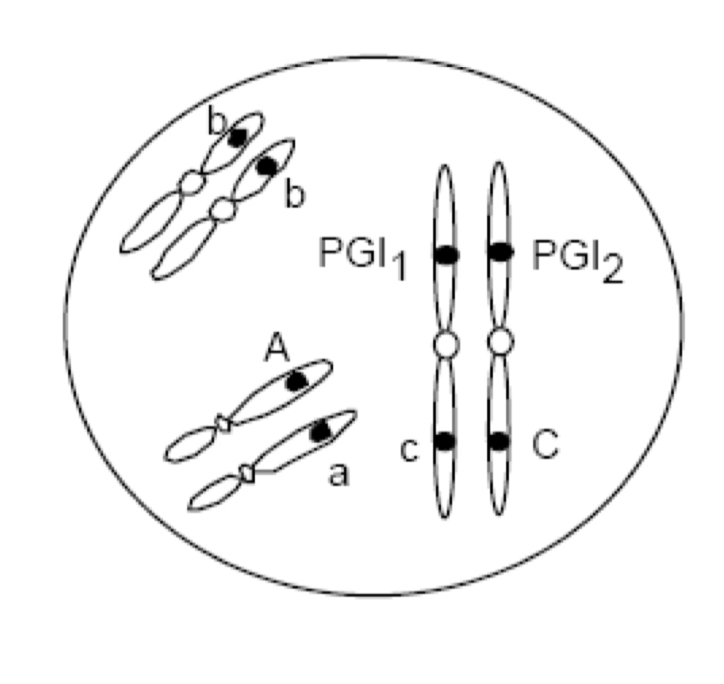
How many pairs of chromosomes are shown?
How many genes are shown? Input numbers.
3, 4
genetic composition of an organism, in diploids, it consists of 2 alleles
genotype
2 identical alleles
homozygote
2 different alleles
heterozygote
copies cells for growth, results in two identical daughter cells
mitosis
separates cells into gametes; haploids
meiosis
During mitosis, when the chromosomes replicate as sister chromatids, there are ____ chromosomes present for each type (in a diploid organism).
4
Adults have ______ copies of every gene. This is called _____________ as in YY or Yy.
2, diploid
the number of chromosome copies; i.e. diploid = 2N, haploid = 1N
ploidy
To make offspring, adults make eff or sperm which are _____________.
haploid
When a haploid sperm meets a haploid egg, they fuse to form a ____________, which is a new _____________ offspring.
zygote, diploid
Sexual reproduction will bring two gametes together to make a new diploid offspring. The gametes can be diploid as well. (T/F)
F
How are haploid gametes made?
meiosis
In meiosis, the four copies of each gene may not be identical. (T/F)
T
In meiosis, each pair of chromosomes lines up __________________.
independently
Will every meiotic event yield the same two gametes (Y/N)
N
Mendel’s 1st Law of Heredity is the Law of __________________.
segregation
Law of Segregation indicates when any individual produces gametes, the 2 copies of a gene ______________, so that each gamete receives ______ (number) copy.
segregate, 1
Gametes are (diploid/haploid).
haploid
Mendel’s 2nd Law of Heredity is the Law of __________________ _______________.
independent assortment
Law of Independent Assortment indicates when any individual produces gametes, the __________ of one gene sort into gametes _______________.
alleles, independently
no surprised in offspring, receive expected offspring, same to parental generation
true-breeding
first filial general, resulting offspring of P generation
F1
self-pollinate or cross F1 plants to produce second filial generation
F2
Mendel learned that traits disappear in one generation and never resurface in future generations. (T/F)
F
used to predict the outcomes of genetic crosses; i.e. gamete types from mother x father
Punnett Square
Mother : yy, Father: Yy
When these gamete types are crossed, there is 50% each of _____ and _____ offspring.
Yy, yy
mate an organism of unknown genotype to a homozygous recessive individual
test cross
AabbCcDd could be a parental genotype for 4 genes of interest. How many different gametes are there?
How many times will each gamete be present? (fraction)
8, 1/8

