Lecture 4 - Acetylcholine Neurochemistry + Muscarinic and Nicotinic Receptors
 Call Kai
 Learn
Learn Practice Test
 Spaced Repetition
 Match
Match Flashcards
 Knowt Play
1/33

There's no tags or description
Looks like no tags are added yet.
Name | Mastery | Learn | Test | Matching | Spaced | Call with Kai |
|---|
No analytics yet
Send a link to your students to track their progress
34 Terms
sites of neurotransmission
All ganglia of the ANS
Postganglionic parasympathetic junctions
Neuroskeletal muscular junction
Adrenal medulla
Postganglionic sympathetic nerve junctions at sweat glands
CNS
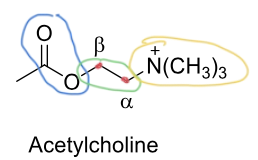
structure of acetylcholine
consists of ester (blue), ethylene bridge (green), and 4° ammonium (yellow)
chemical properties of ACh (acid/base, potential binding interactions, stability)
acid/base: neutral
binding interactions: H-bond acceptor (ester), ion-dipole and ionic (4° ammonium)
stability: unstable (due to ester)
neutransmitter function steps
biosynthesis in presynaptic neuron
storage in presynaptic neuron
release to synapse
receptor activation (pre- or post- synaptic) (generation of second messenger after binding to receptor)
termination of neurotransmission in synapse (metabolic breakdown/reuptake)
substrate
molecule that undergoes a chemical change or reaction, often being acted upon by an enzyme or catalyst
enzyme
biological catalyst, typically a protein, that speeds up specific biochemical reactions in living organisms without being consumed
biosynthesis of ACh chemistry steps
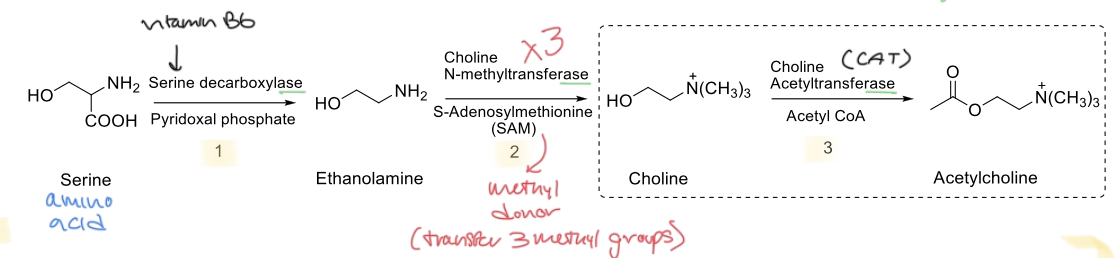
co-factor
non-protein substance (like a metal ion or organic molecule) essential for an enzyme's catalytic activity, helping it bind substrates or facilitate reactions by stabilizing structures or transferring groups
why do we need to store ACh
1. Maintain a ready supply of the neurotransmitter (acetylcholine)
2. Protect neurotransmitter (acetylcholine) from premature enzymatic degradation
second messenger of action potential
calcium (and its influx)
what makes nicotine and muscarine like ACh
available group to be ionized
group that can do H bonding
Nicotinic Acetylcholine Receptors (nAChRs)
ligand-gated ion channels activated by the neurotransmitter acetylcholine, famously also by nicotine, playing crucial roles in the central and peripheral nervous systems
ligand
molecule, ion, or atom that binds to another, often larger, molecule (like a protein or central metal atom) to form a complex, acting as a signaling molecule in biology
ligand-gated ion channel
transmembrane protein that forms a pore, opening or closing (gating) in response to a specific chemical signal (ligand), like a neurotransmitter or second messenger, binding to it, thereby controlling the flow of ions across a cell membrane
how does ACh work on nicotinic receptors
Originally, The channel pore is closed, preventing ion flow
2 ACh molecules bind to the two binding sites on the receptor
binding acts as a "1st messenger" in which receptor undergoes a conformational change and opens
Ions flow through: primarily Na⁺ (sodium) flows INTO the cell and K⁺ (potassium) flows out; Ca²⁺ (calcium) may also enter, acting as "2nd messengers"
ion influx depolarizes the cell membrane, triggering cellular responses
when ACh disassociates, channel closes
desensitized nAChR state
Ligand is still bound to the receptor but the channel has closed despite ACh still being attached; he receptor becomes temporarily unresponsive and prevents overstimulation
where are nAChR located
all autonomic ganglia, neuromuscular endplate of striated muscle, adrenal medulla
LGIC stands for…
ligand-gated ion channel
where does ACh binding on nAChR actually occur
on the two alpha-subunits
Nm (Nicotinic, neuromuscular) receptors
specialized ligand-gated ion channels found at the neuromuscular junction (NMJ) of skeletal muscles, activated by acetylcholine (ACh) to trigger rapid muscle contraction via end-plate depolarization
Nn (Nicotinic, neuronal) receptors
ligand-gated ion channels for fast neurotransmission in the autonomic nervous system (ANS) and central nervous system (CNS), mediating responses to acetylcholine (ACh) and nicotine from neuron to neuron
general structure of GPCR
Seven transmembrane helices
Extracellular binding domain (neurotransmitter binds here)
Intracellular effector domain (interacts with G-protein and activates it)
Heterotrimeric G-protein (dissociates upon activation)
Effector (activated by the G-protein)
Second messenger(s) - produced by activated effector
Biological response
how does ACh work on muscarinic (GPCR) receptors
Binding of ACh to the m1, m3, and m5 receptors results in the activation of G-proteins (Gq and G11)
G protein’s alpha site activate the effector phospholipase C (an enzyme)
Phospholipase C catalyzes the hydrolysis of phosphoinositide to form the second messengers inositol triphosphate (IP3) and diacylglycerol (DAG)
second messengers cause an increase in calcium influx (into the cell) at the endoplasmic reticulum, as well as protein kinase C activation
cell response occurs
1st messenger in GPCR signaling for ACh
ACh! it also acts as the ligand
what happens when ACh binds to M2 and M4 receptors?
Activation of the Gi G-protein inhibits the effector adenylate cyclase (AC, an enzyme) that causes a decrease in the conversion of ATP to cAMP, the second messenger that normally produces a biological response (generally muscle contraction);There is therefore less cAMP (second messenger) available and there is a corresponding decrease in muscle contraction.
Activation of the Gi or Go G-protein that regulates K+ channels (typically opens it)
effector
substance or molecule that binds to a target (like an enzyme or receptor) to change its activity, thereby producing a cellular or physiological response
what interaction(s) occur between ACh and muscarinic transmembrane unit 1
ion-dipole (as ion) —> presence of threonine with secondary alcohol + near ionized amine
what interaction(s) occur between ACh and muscarinic transmembrane unit 2
ion-dipole (as ion) —> presence of serine with primary alcohol + near ionized amine
what interaction(s) occur between ACh and muscarinic transmembrane unit 3
ion-dipole (as ion) —> presence of tyrosine with phenol + near ionized amine
ionic —> presence of asparagine with ionized amide + near ionized amine
what interaction(s) occur between ACh and muscarinic transmembrane unit 4
n/a
what interaction(s) occur between ACh and muscarinic transmembrane unit 5
H-bonding —> presence of threonine with secondary alcohol + near ester
what interaction(s) occur between ACh and muscarinic transmembrane unit 6
H-bonding —> presence of tyrosine with phenol + near ester
ion-dipole (as ion) —> presence of tyrosine with phenol + near ionized amine
what interaction(s) occur between ACh and muscarinic transmembrane unit 7
ion-dipole (as ion) —> presence of tyrosine with phenol + near ionized amine
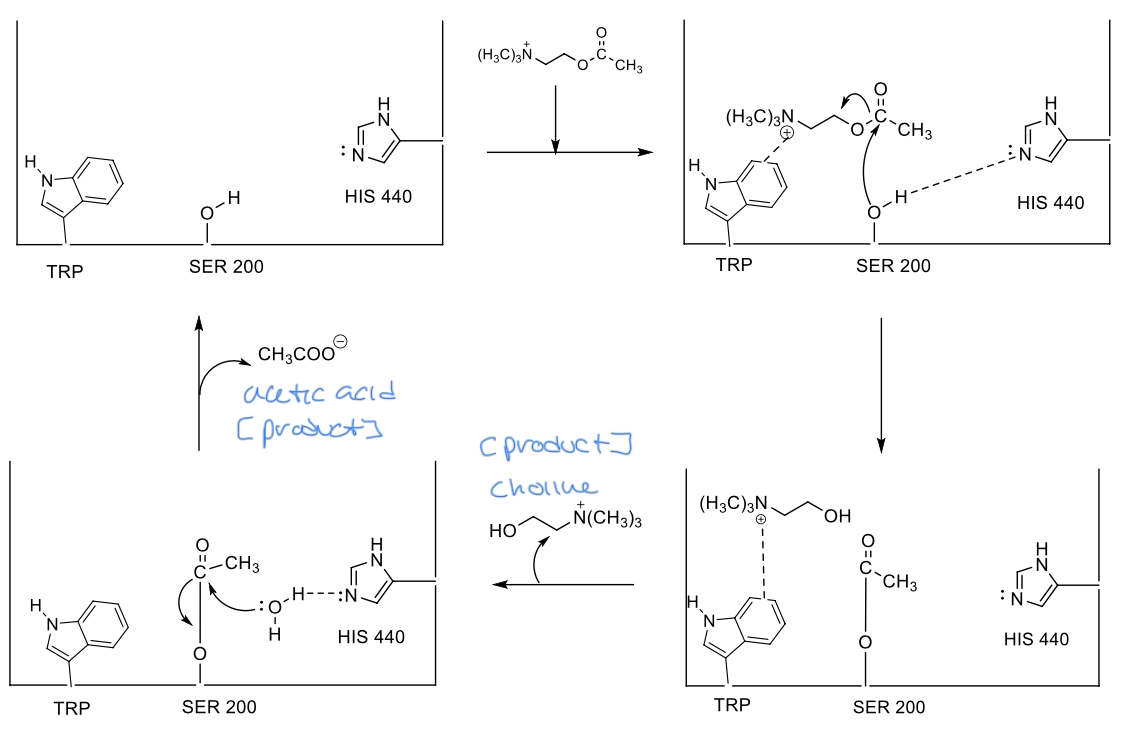
Mechanism of AChE hydrolysis of acetylcholine
Acetylcholine enters the active site of AChE
The ester bond of ACh (connecting acetyl group to choline) is positioned near SER 200
SER 200's oxygen attacks the carbonyl carbon of the acetyl group, breaking the bond between acetyl and choline
Choline (HO-CH₂-CH₂-N(CH₃)₃) leaves as the first product, while Acetyl group stays attached to SER 200
Water attacks the acetyl group attached to SER 200, which breaks the bond between acetyl and SER 200
Acetic acid (CH₃COO⁻) leaves as the second product
Enzyme is free and ready to work again