Honors Bio preparation for big tests!!!
 Studied by 4 people
 Call Kai
 Learn
Learn Practice Test
 Spaced Repetition
 Match
Match Flashcards
 Knowt Play
1/51

There's no tags or description
Looks like no tags are added yet.
Name | Mastery | Learn | Test | Matching | Spaced | Call with Kai |
|---|
No analytics yet
Send a link to your students to track their progress
52 Terms
Module 1 DNA Basics
What is the full name for DNA
Deoxyribonucleic acids
What is the full name for RNA
Ribonucleic acids
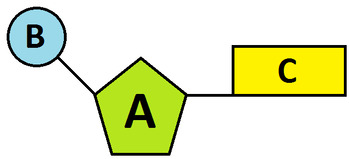
This is a nucleotide structure, the next 3 questions will go with this
What is A
the sugar
What is c
the nitrogeous base
What is B
the phosphate
How many bases does each nucleotide have?
4 bases (the T,A,C, and G bases)
What is T?
Thymine
What is A?
Adenine
What is C?
Cytosine
What is G?
Guamine
Which base does A match with?
T
What does C match with
G
What shape is DNA in?
A double helix
What are pyrimidines
they’re one ring bases where C and T match
What are purines?
they’re two ring bases where A and G match each other
DNA replication
What is the original DNA helix (think family tree)
The parent DNA
What is a topoisomerase? (it’s like a checkpoint)
an enzyme that loosens out the supercoiled DNA before it goes into the replication fork
What is a helicase?
A ring shaped enzyme that unzips the DNA by breaking up the hydrogen bonds causing the replication fork
What is the replication fork?
The Y shaped structure where the DNA is unzipped
What is DNA polymerase?
its an enzyme responsible for adding nucleotides to the new growing complimentary strand
What are ozaki fragments?
The lagging strand in replication that leaves behind small peices that are the okazaki fragments
What is DNA ligase?
an enzyme responsible for connecting the strands of okazaki fragments together
What are the leading and lagging strands?
The parent helix makes 2 copies called helices that contain new and old strands which commonly are referred to as the leading and lagging strand
Overview of protein synthesis
What happens in step 1 (transcription)
DNA is combined with mRNA as DNA goes from 3’ to 5’ and RNA goes from 5’ to 3’
What happens in step 2 (Post-Transcriptional Modifications)
The introns are removed while the exons are pulled together to create a blueprint while adding a 5’ cap and a poly a tail for stability. (these first 2 steps take place in the nucleus)
What happens in step 3 (translation)
The RNA leaves the nucleous to go to a ribosome as codons enter the ribosome in what's called transfer. RNA (tRNA) then brings proper amino acids and matches the codons with the anti-codons.
What happens in step 4 (Post-Translational Modifications)
Amino acid chain is folded to make a protein as even a carbohydrate lipid or another protein could be added
What are the three types of RNA?
tRNA, mRNA, and RNA
Transcription vs Translation!
Easiest part ever!
What is transcription/ how do you use it?
Transcription makes mRNA and what you do is you replace all A’s with a U in the sequence
What is translation/ how do you use it?
Translation divides the codons from mRNA into amino acids and what you do is use the chart Mr. E gave you (find first 2 letters going horizontally to diagnaly and it will tell you everything!)
Mutations
What are mutations?
A mutation is a change in the DNA
How do mutations happen?
They’re random and increase risk due to mitogens
What is substitution?
The base is changed to a different base (GAC, ATT) —→ (GAC, AAT) (Adenine is exchanged for the 5th base)
What is Insertion
Base is added to DNA (GAC, ATT) —→ (GAC, GATT) (Guamine is added)
What is deletion
Base is removed from DNA (GCA, ATT) —→ (GCA, TT) (Adenine is removed)
Effects of Mutations
What is silent mutation?
The base changes however the amino acid and protein are the same (Original mRNA and A.A: CAC/UAU/GCG—>His/Tyr/ala. Mutated mRNA chain: CAC/UAU/GCA. A.A chain: His/tyr/ala.)
What is Missense Mutation?
One amino acid is changed (Original mRNA and A.A.: CACUAUGCG—> His/Tyr/ala. Mutated mRNA: CUC/UAU/GCG. A.A. Chain: Leu/tyr/ala.)
What is frameshift mutation?
Codons get shifted due to insertion or deletion (Original mRNA: CAC/UAU/GCG. Mutated mRNA: CAC/UUG/ CG (missing the A.) A.A. Chain: His/ Lev/ Stop!)
What is nonsense mutation?
An early stopping codon. (Mutated mRNA: CAC/UAA/UGCG. A.A. Chain: His/Stop.)
Chromosomal Mutations
What is a chromosomal mutation?
A change in a piece of chromosome
What is duplication?
Section of a chromosome is copied x2
What is immersion?
Two sections of a chromosome are flipped
What is deletion?
Section of a chromosome is removed
What is translocation?
A piece of a chromosome is removed and added to another
 Note
Note  Flashcards (66)