International Trade and Protectionism
 Call Kai
 Learn
Learn Practice Test
 Spaced Repetition
 Match
Match Flashcards
 Knowt Play
1/26

There's no tags or description
Looks like no tags are added yet.
Name | Mastery | Learn | Test | Matching | Spaced | Call with Kai |
|---|
No analytics yet
Send a link to your students to track their progress
27 Terms
What is international trade?
The exchange of goods and services between one country and another.
What is a closed economy?
An economy that doesn’t engage in international trade
What is an open economy?
An economy that engages in international trade.
Why does international trade occur?
Production of different kinds of goods requires different kinds of resources, such resources are not available in every country
Variety, choice, tastes and branding
Efficiency reasons, some countries can produce the good/service at a lower cost
What is trade theory?
The theory of absolute and comparative advantage
Give an example of trade theory
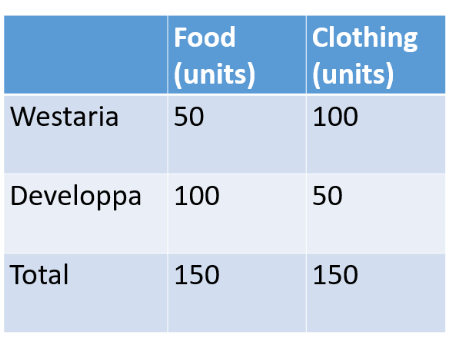
Country A is better at producing: Clothing
Country B is better at producing: Food
Why could this be?:
Better environment
Differences in land available
Better technology
What is a comparative advantage?
Occurs when a country can produce a good or service at a lower opportunity cost than another country.
What is an absolute advantage?
When a country can produce a particular good or service more efficiently than another country using the same resources.
What are the terms of trade?
The rate at which one country exchanges one good for another with another country.
What are trading possibility frontiers?
The possible consumption levels available to two nations when they engage in international trade.
What are the limitations of trade theory?
Assumption of no transport costs, any transport costs may eliminate any comparartive production cost advantage
FoPs are assumed to be perfectly mobile within a country, allowing the country to produce where the CA lies and react to any changes in CA
CA can change over time
What is protectionism?
Occurs when governments intervene in international trade in order to protect their domestic markets
What are methods of protectionism also known as?
Barriers to trade
What are some examples of protectionism?
Tariffs
Quotas
What are barriers to trade?
Methods used by governments to restrict international trade
What are tariffs?
Tax on imports
What are quotas?
Limit on the quantity of a particular import that is allowed into the country within a period of time
What is free trade?
Occurs when international trade is not restricted nor encouraged by direct government intervention
What is the impact of free trade?
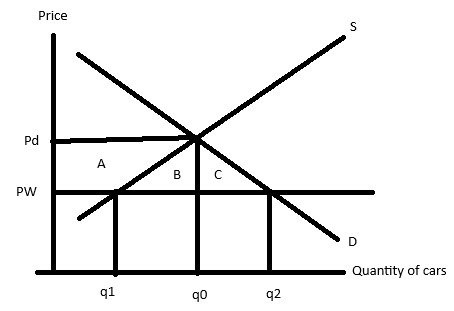
Initially economy is closed, equilibrium P in the domestic market for cars is Pd and output q0
Economy opens up to international trade, domestic car producers now have to compete with foreign producers
Pw is the global market P for cars, domestic demand rises to q2 for the lower P
Domestic supply falls to q1 as there are fewer domestic producers that can compete
q2-q1 represents the level of imports
A represents the loss of domestic producer surplus
A+B+C represents the increase consumer surplus
What is the impact of a tariff?
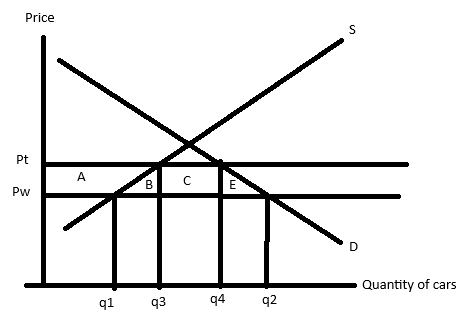
Imposition of a tariff will raise the world market price to Pt, vertical distance between the prices is = to the tariff per unit
Domestic demand will fall from q2 to aq
Domestic producers now able to compete and domestic supply rises from q1 to q3
As a result the level of imports has fallen from q2-q1 to q4-q3
A+B+C+E = loss of consumer surplus
A the gain of domestic producer surplus
C the total tariff revenue gained by the gov
Overall welfare loss is B+E
B represents the part of the producers revenue necessary to cover the higher costs faced by domestic firms
What are the advantages of tariffs?
Expenditure switching, domestic consumers buy fewer imports
Rising employment
Revenue is raised for the gov
Domestic AD is boosted
What are the disadvantages of tariffs?
Domestic consumers lose out
Retaliation
Allocative and productive inefficiency
What are non-tariff barriers?
All measures employed to protect domestic production other than tariffs
What are some examples of non-tariff barriers (NTBs)?
Import quotas, limiting the quantity of a particular good that is allowed into the country over a period of time
Voluntary export restraints (VERs), reciprocal agreements between countries to limit the exports of particular goods to each other
Subsidising domestic production, reduces the prices of domestic goods
Excessive health and safety regulation and quantity standards
What are the benefits of protectionism?
Allowing infant industries to grow, becoming more competitive in the LR
Protections against unfair foreign competition, dummping/artificially depreciating r/e
Revenue, potentially applicable to developing countries What
What are the limitations of the infant industry argument?
Why should the government do it?
Track record of picking winners is very poor for most govs, can become reliant on protectionism
What are the problems with protectionism?
Reduction in competition and the benefits that stem from it
Possibility of retaliation
The loss of gains from specialisation and trade, CA and AA

