cell signaling
 Call Kai
 Learn
Learn Practice Test
 Spaced Repetition
 Match
Match Flashcards
 Knowt Play
1/63

There's no tags or description
Looks like no tags are added yet.
Name | Mastery | Learn | Test | Matching | Spaced | Call with Kai |
|---|
No analytics yet
Send a link to your students to track their progress
64 Terms
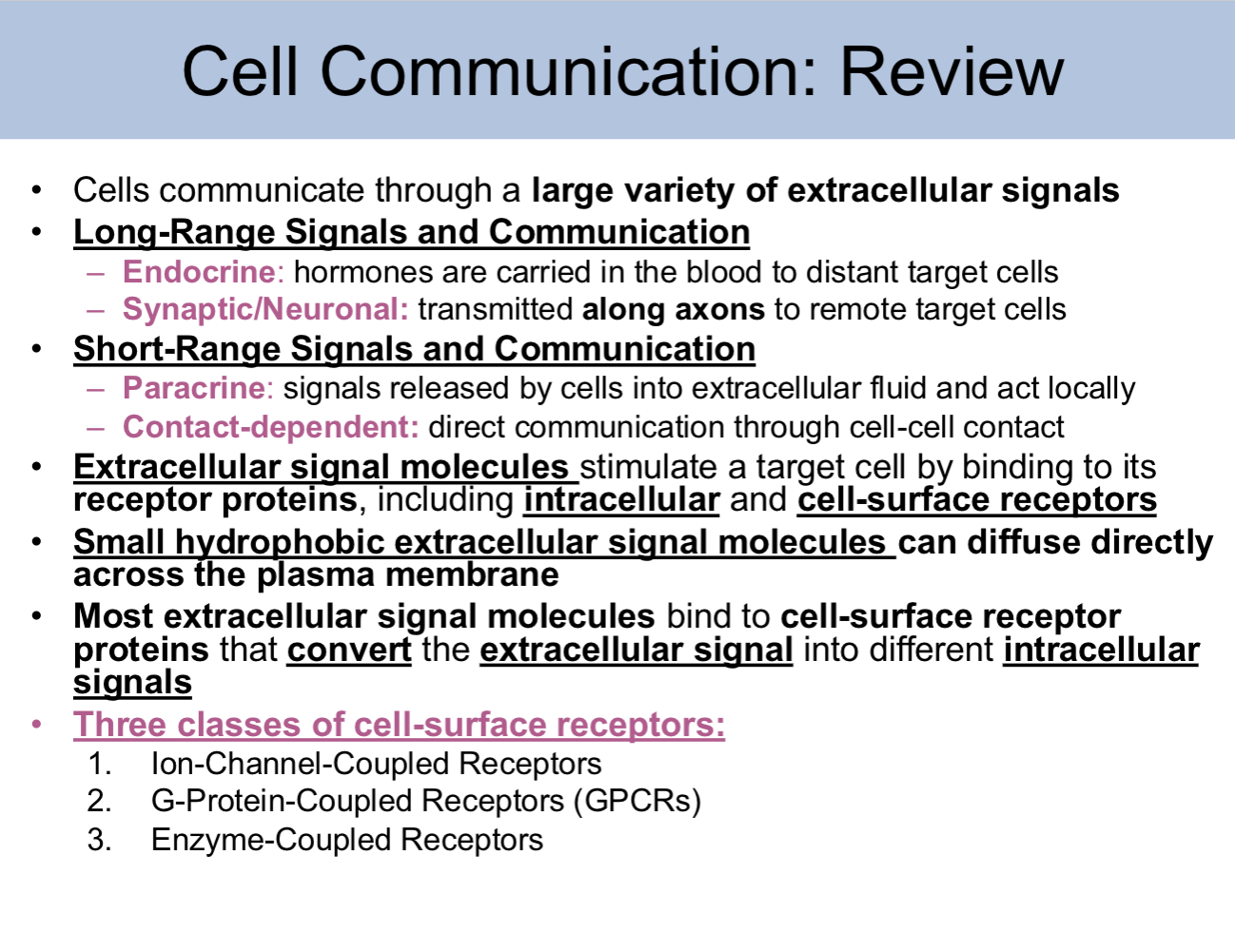
there are a lot of different - pathways
cell signaling
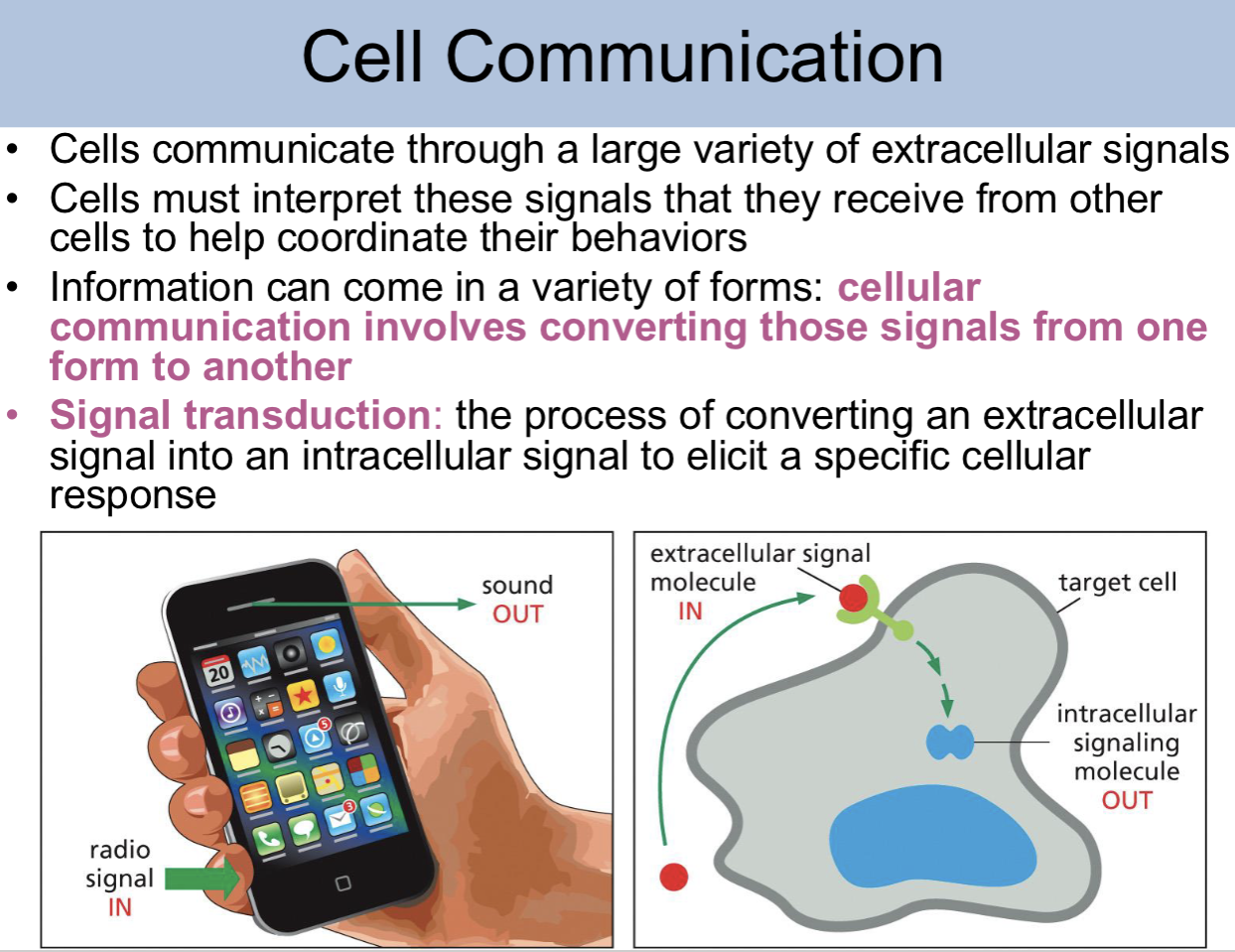
information can come in a variety of forms: cellular communication involves
cellular communication involves converting those signals from one form to another
signal transduction
the process of converting an extracellular signal into an intracellular signal to elicit a specific cellular response
cell communication
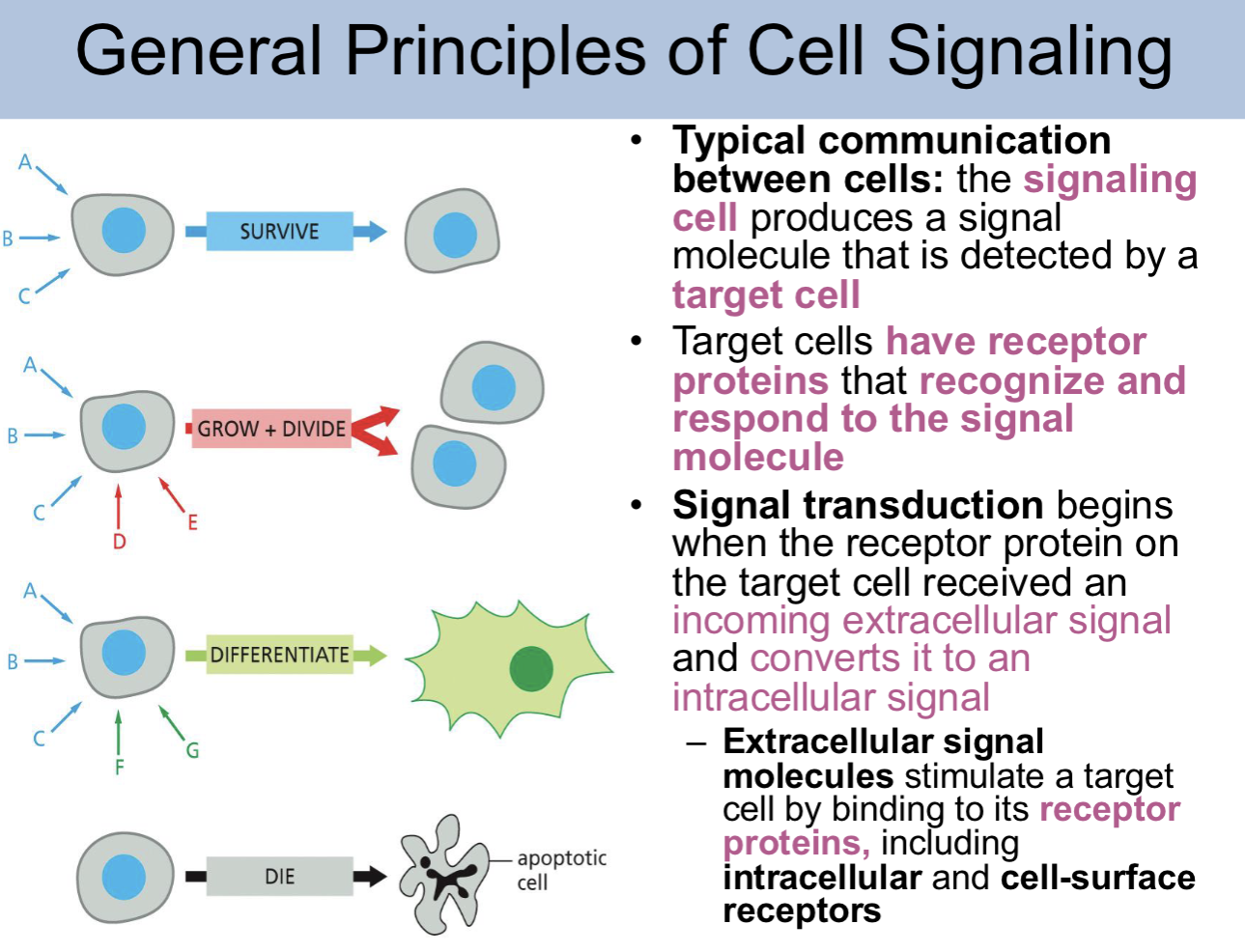
typical communication between cells
signaling cell produces a signal molecule that is detected by a target cell
target cells have receptro proteins that recognize and respond to the signal molecule
signal transduction begins
when the receptor protein on the target cell received an incoming extracellular signal and converts it to an intracellular signal
Extracellular signal molecules stimulate
a target cell by binding to its receptor proteins, including intracellular and cell-surface receptors
general principles of cell signaling slide
extracellular signals can act _ or -
slowly or rapidly
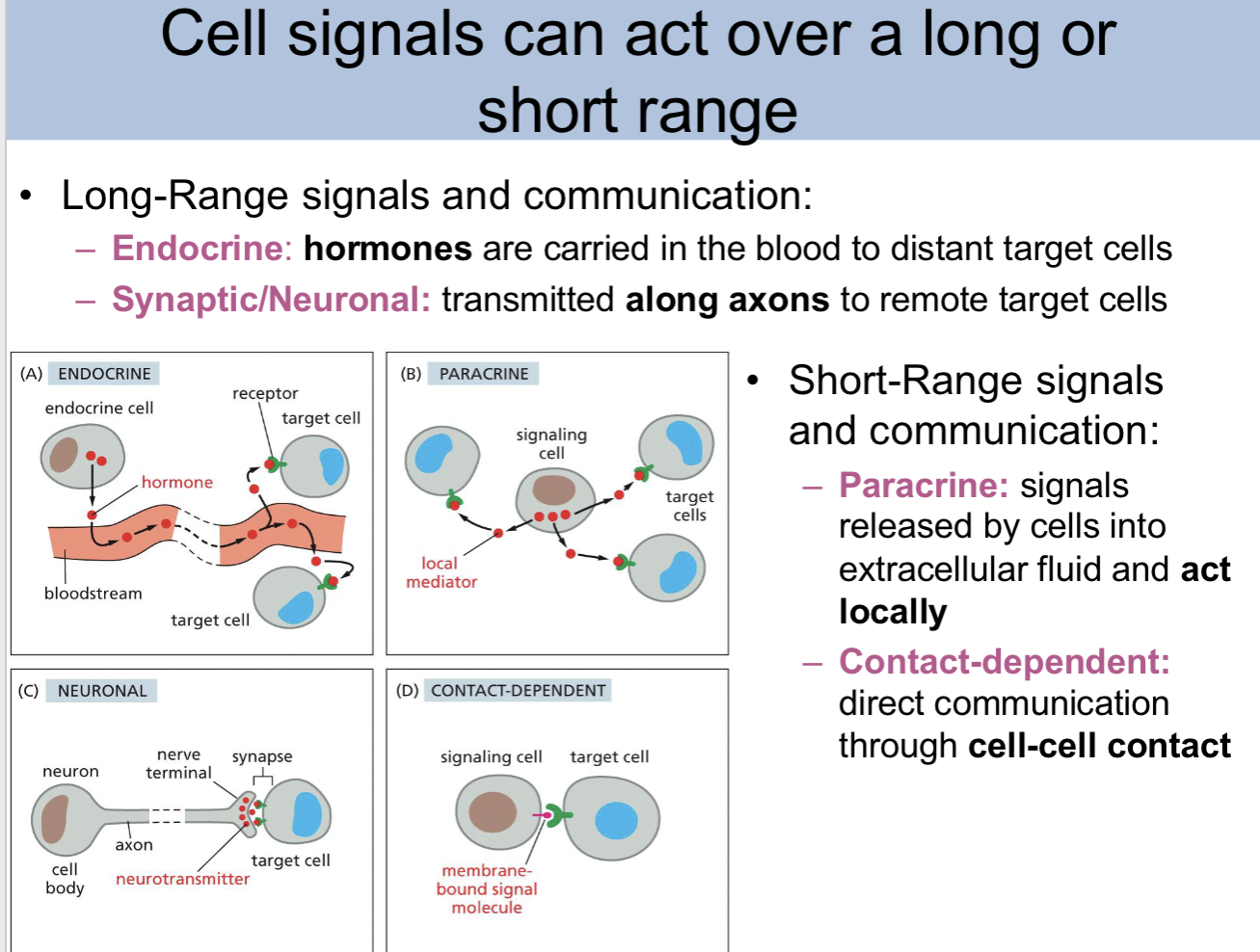
cell signals can act over a - or - range
long or short
long range signals and commication:
endocrine, synaptic/neuronal
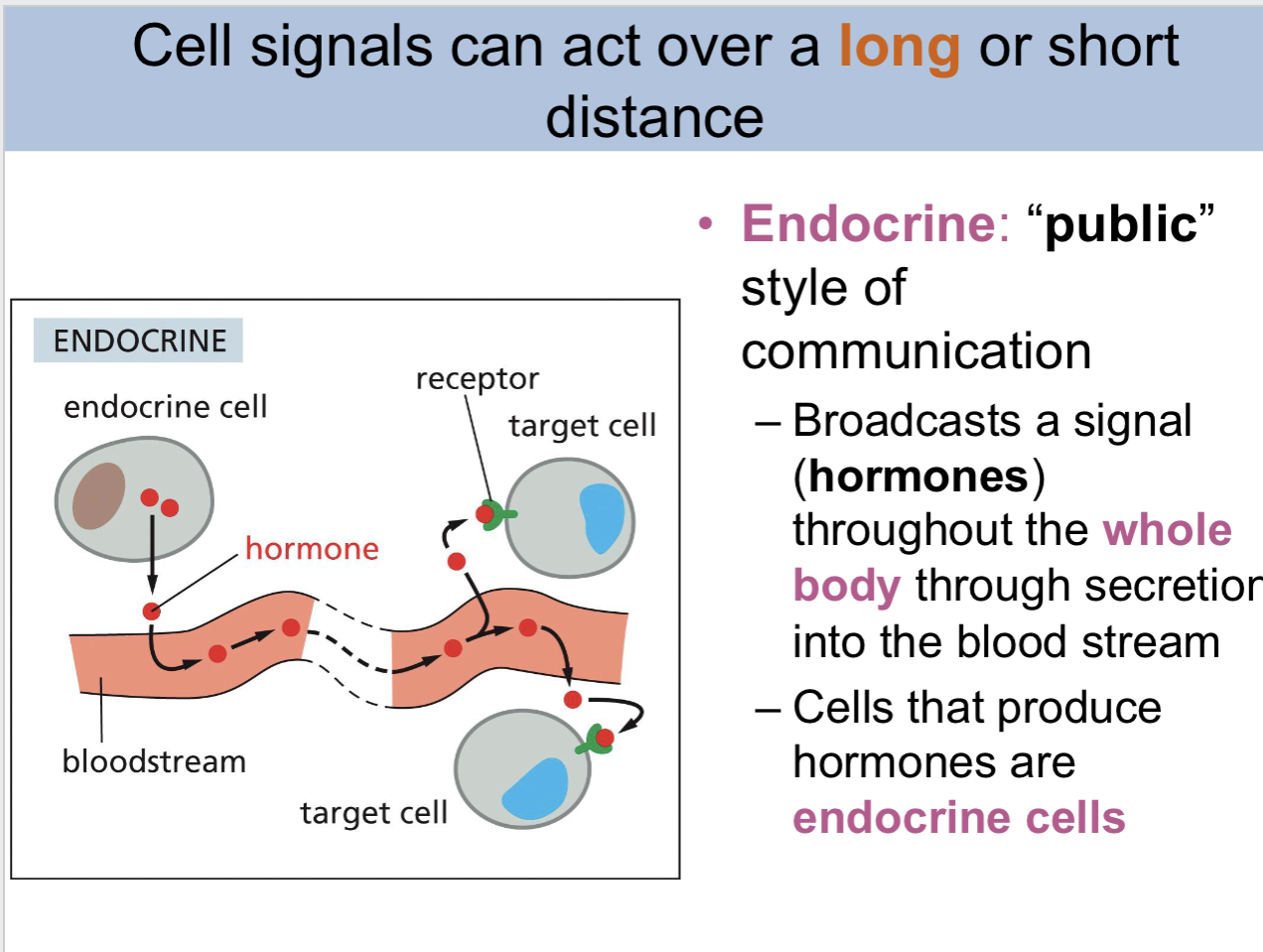
endocrine:
hormones are carried in the blood to distant target cells
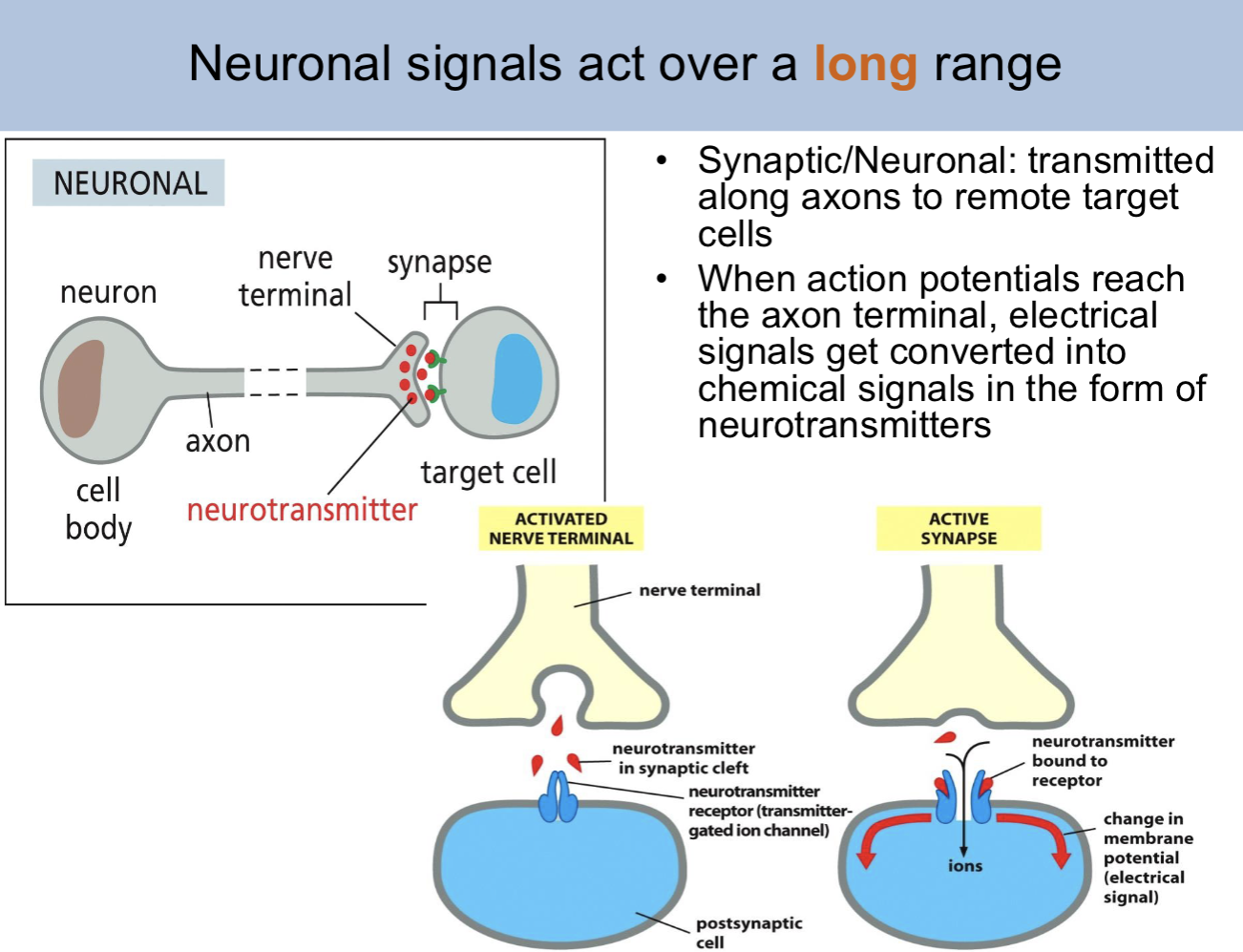
synpatic/neuronal:
transmitted along axons to remote target cells
Short-Range signals and communication:
paracrine, contact-dependent
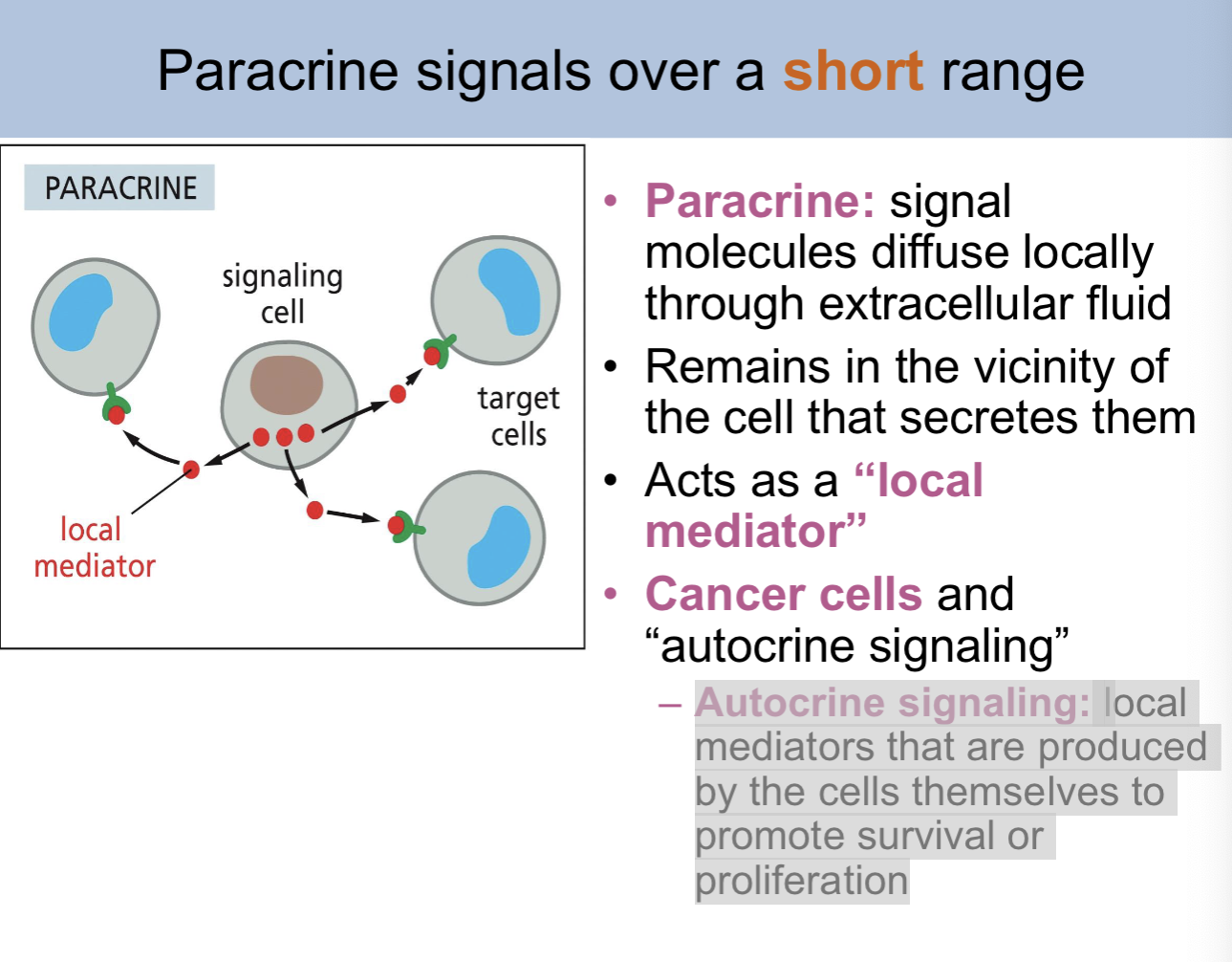
paracrine
signals released by cells into extracellular fluid act locally
contact dependent
direct communication through cell-cell contact
cell signaling slide
endocrine is ‘‘_” style of communication
public
endocrine system works how
broadcasts a signal (hormones) throughout the whole body through secretion into the blood stream
cells that produce hormones are _ cells
endocrine cells
endocrine slide
When action potentials reach the axon terminal, —- signals get converted into — signals
electrical, chemical signals in the form of neurotransmitters
neuronal/synaptic slide
Paracrine: signal molecules diffuse
locally through extracellular fluid
in paracrine signals he signal molecules remain
in the vicinity of the cell that secretes them
Autocrine signaling:
local mediators that are produced by the cells themselves to promote survival or proliferation
what type of signaling do cancer cells perform
Autocrine signaling
paracrine signaling slide
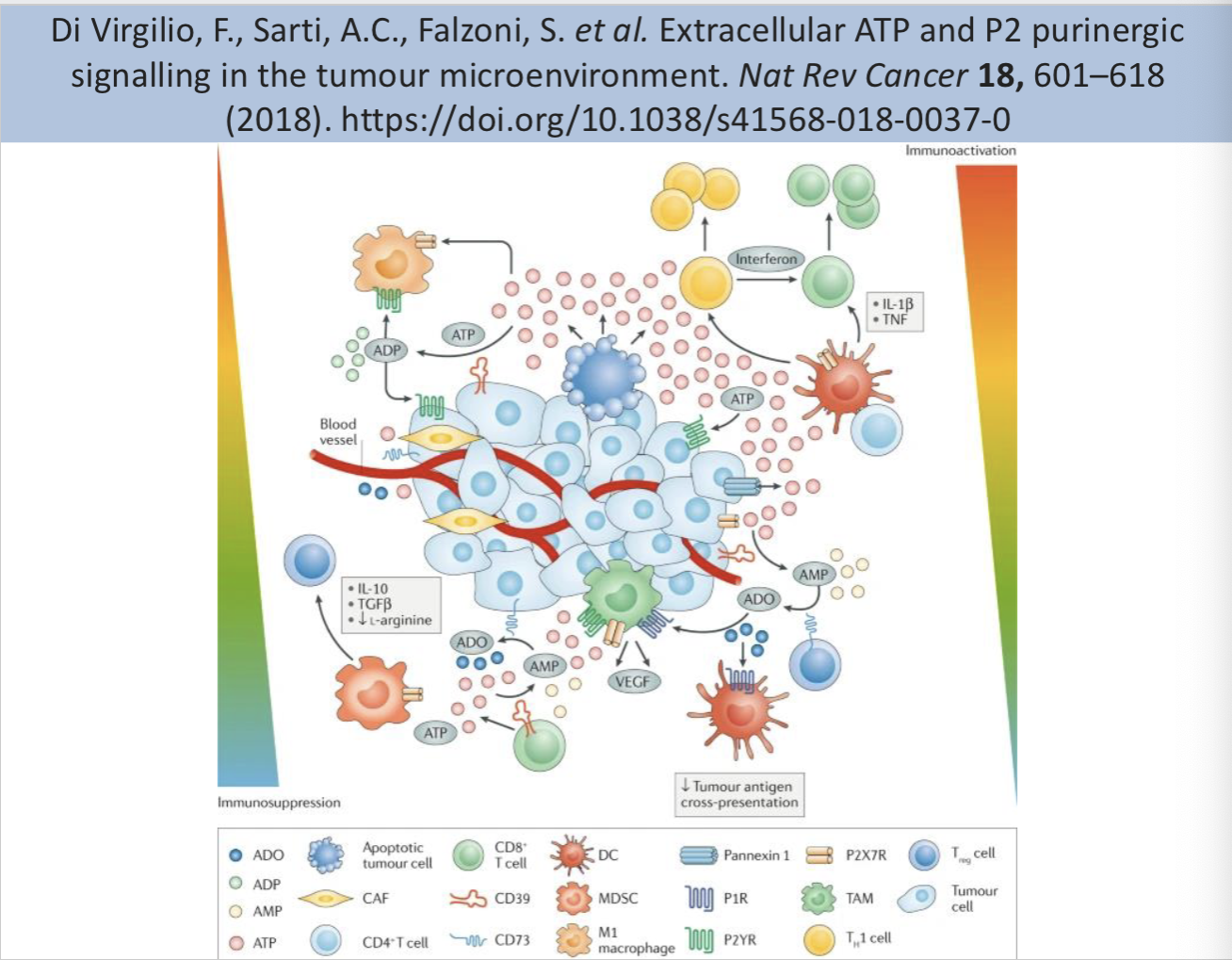
tumor microenvironment slide
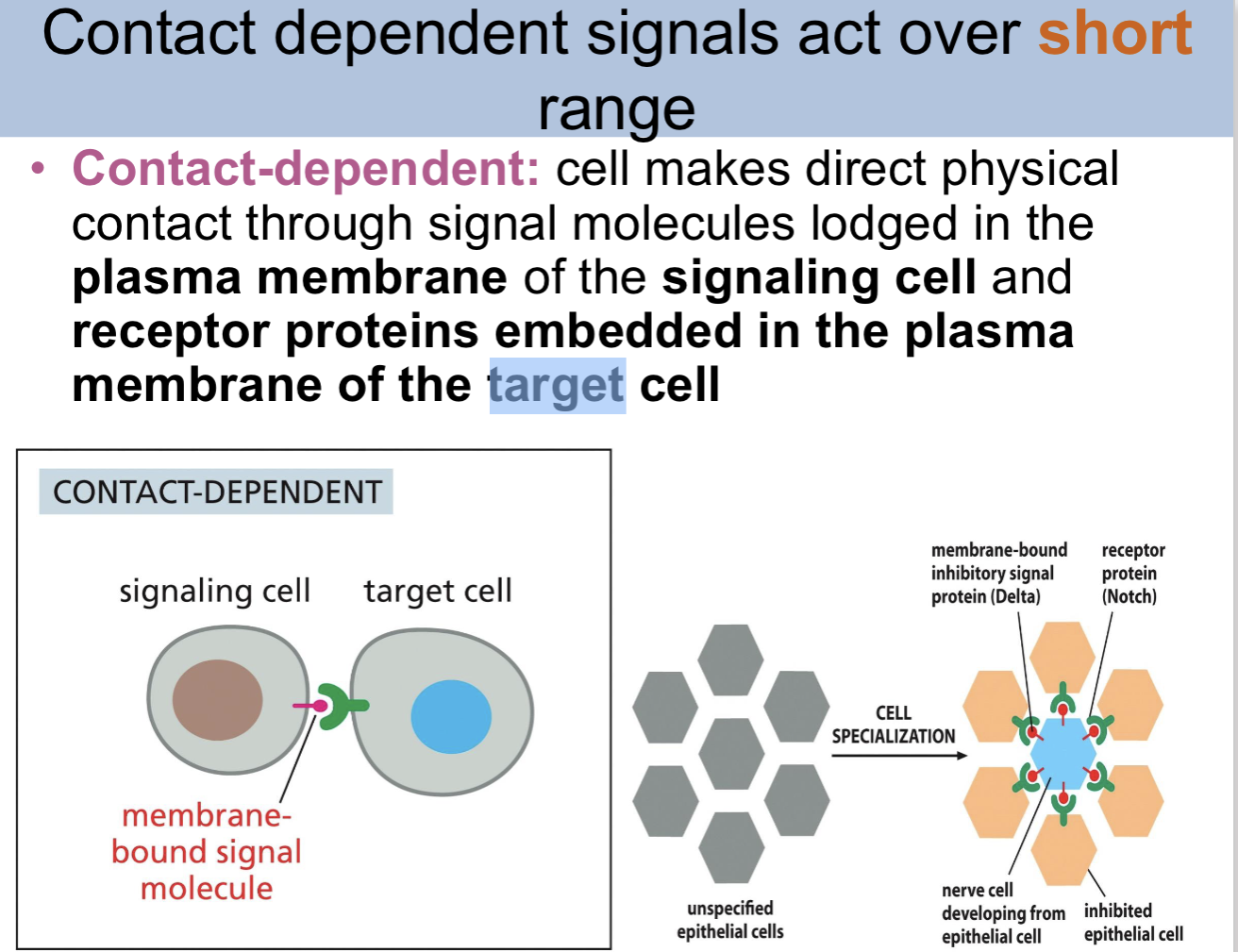
Contact-dependent:
cell makes direct physical contact through signal molecules lodged in the plasma membrane of the signaling cell and receptor proteins embedded in the plasma membrane of the target cell
contact dependent slide
paracrine signaling is
slow
paracrine signaling relies on
signals diffusing into local environment
tumor environment is very
complex and heterogeneous
angiogenesis
the physiological process of forming new blood vessels
cancer cells signal outward to induce
angiogenesis to create blood vessels through tumor
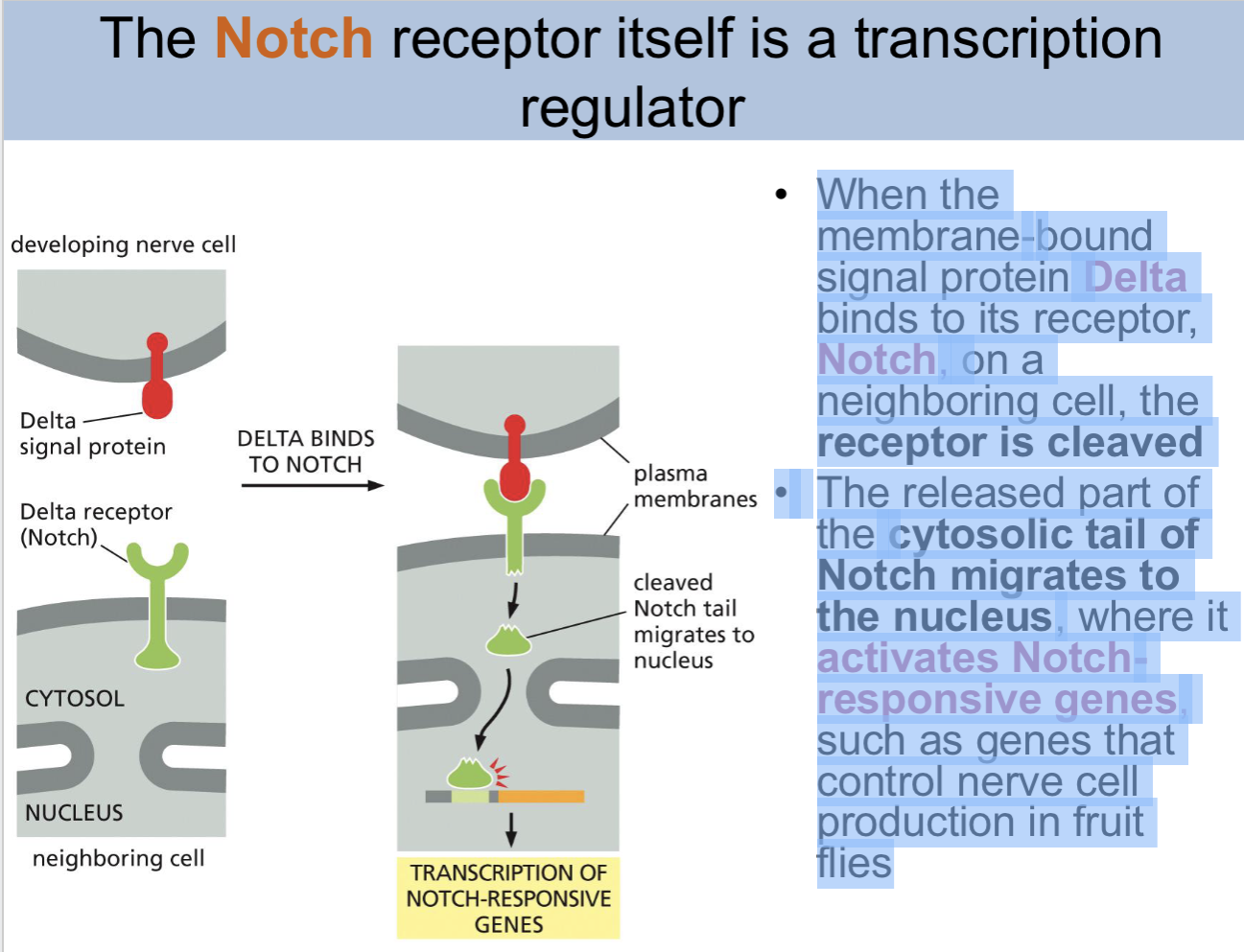
the notch receptor itself is a
transcription regulator
When the membrane-bound signal protein Delta binds to its receptor, Notch, on a neighboring cell, the receptor is
cleaved
When the membrane-bound signal protein Delta binds to its receptor, Notch, on a neighboring cell, the receptor is cleaved The released part of the cytosolic tail of Notch migrates to the
nucleus, where it activates Notch- responsive genes, such as genes that control nerve cell production in fruit flies
notch receptor slide
cells are exposed to a wide variety of
signals
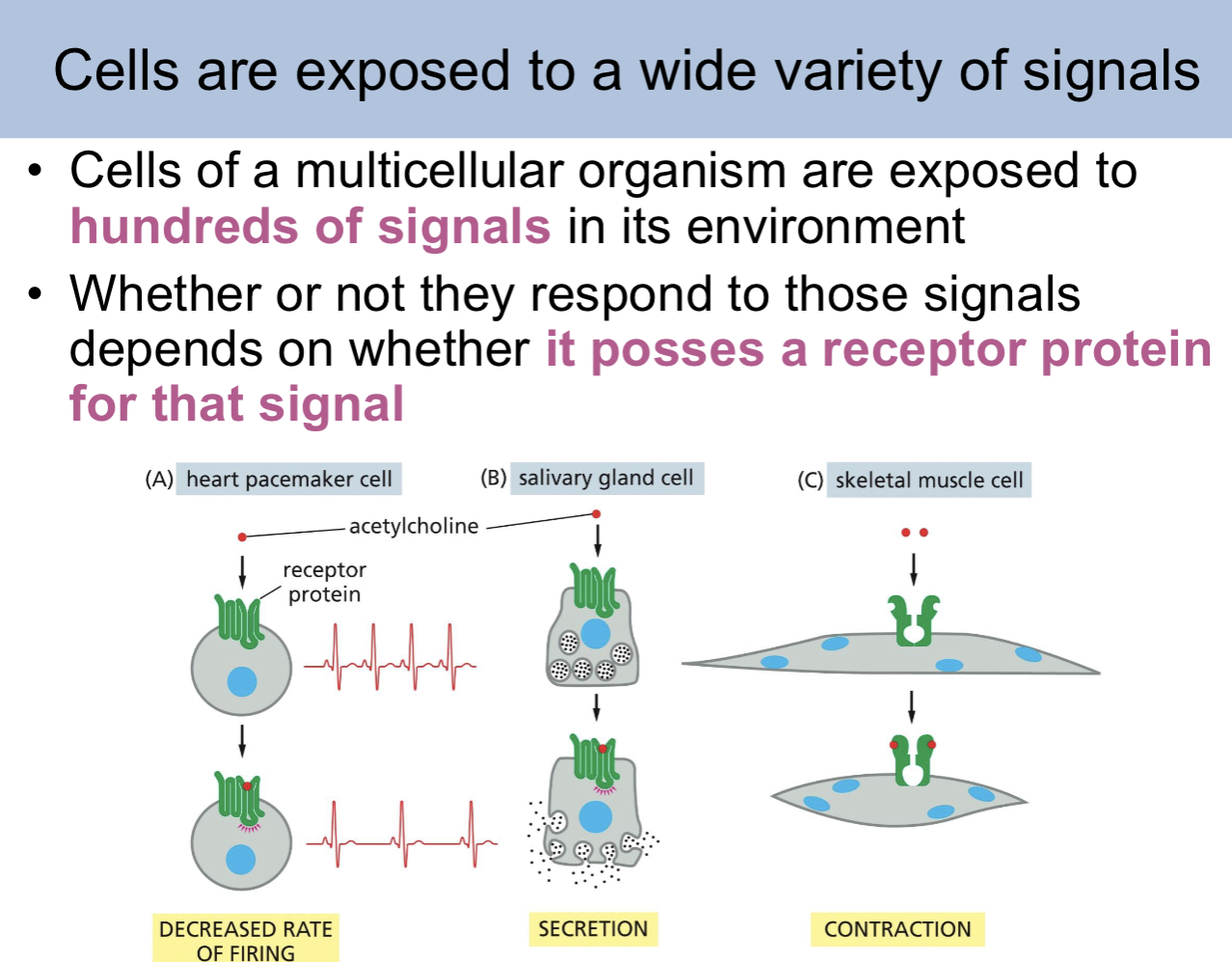
cells of a multicellular organism are exposed to
hundreds of signals in its environement
whether or not a cell responds to a signal depends on
whether it posseses a receptor protein for that signal
cell exposure to signals slide
extracellular signals can bind to
cell-surface receptors or to intracellular enzymes or receptors
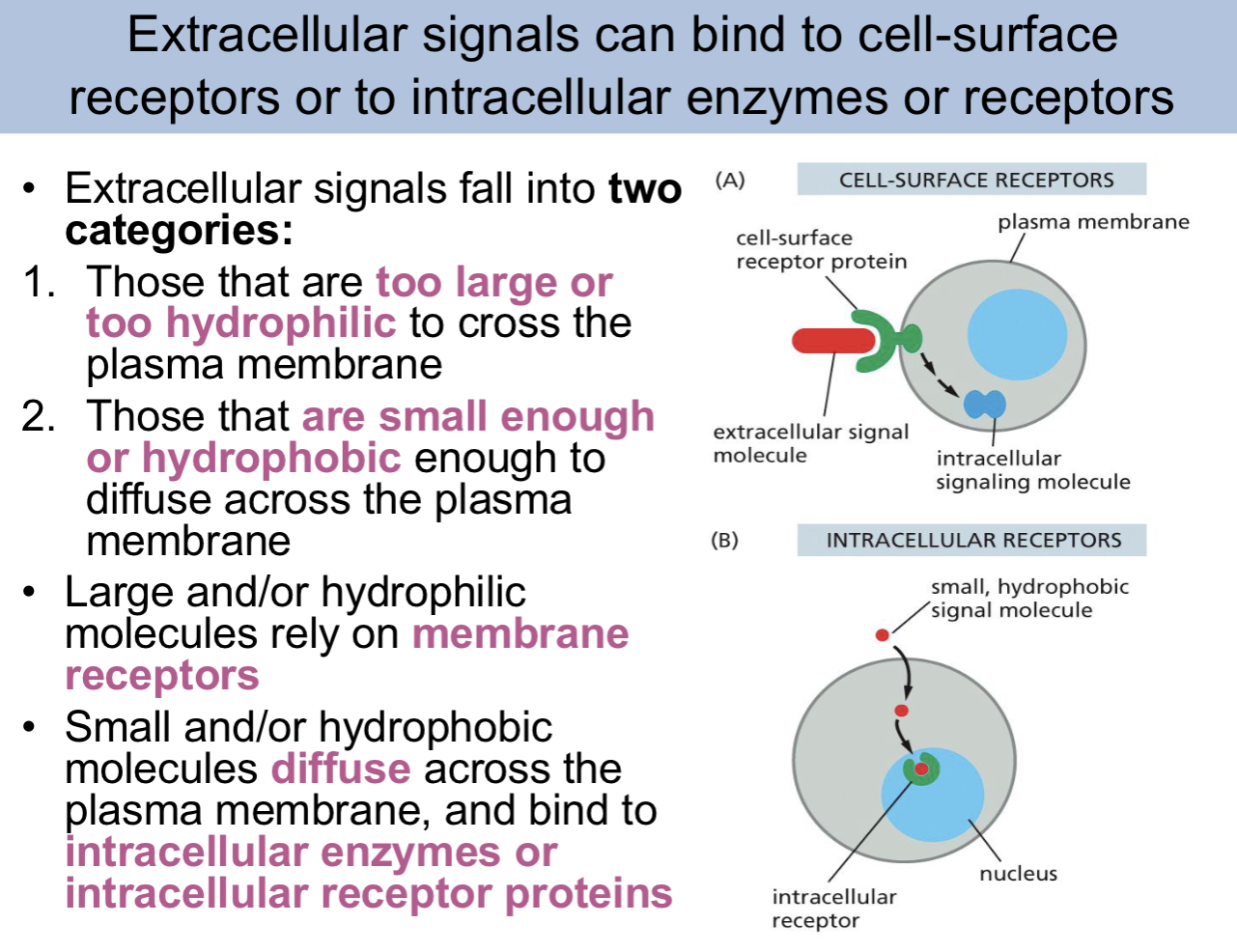
Extracellular signals fall into —- categories
two
two categories of extracellular signals
1.Those that are too large or too hydrophilic to cross the plasma membrane
2. Those that are small enough or hydrophobic enough to diffuse across the plasma membrane
Large and/or hydrophilic molecules rely on — receptors
membrane
Small and/or hydrophobic molecules —-
diffuse across the plasma membrane, and bind to intracellular enzymes or intracellular receptor proteins
types of extracellular cell signaling slide
Cell surface receptors relay extracellular signals via
intracellular signaling pathways
1st signal transduction step by receptor proteins
Binds the primary messenger and generates new secondary messengers
Signals get passed downstream from one intracellular signaling molecule to the next until
the response has been completed
relaying extracellular signaling slide
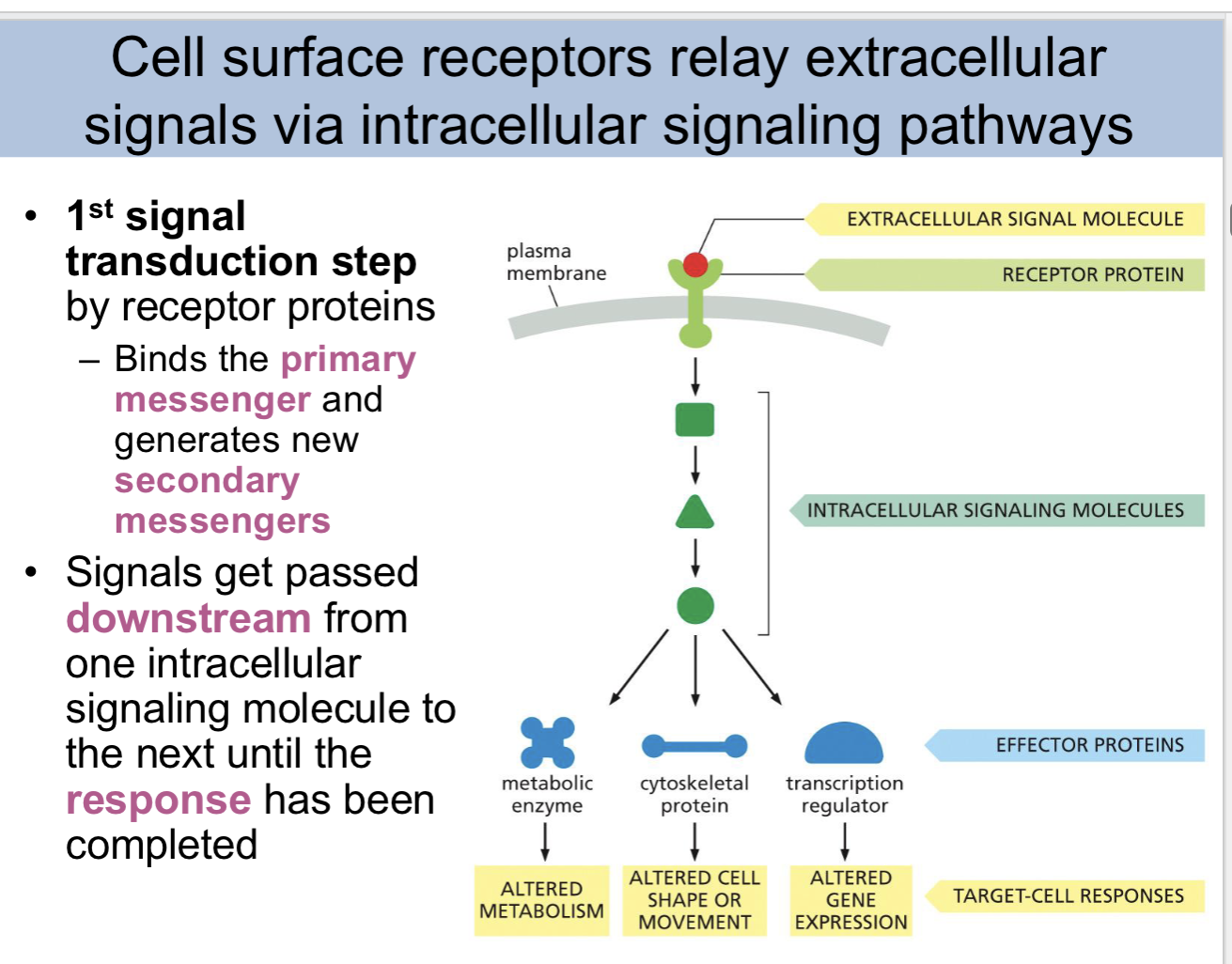
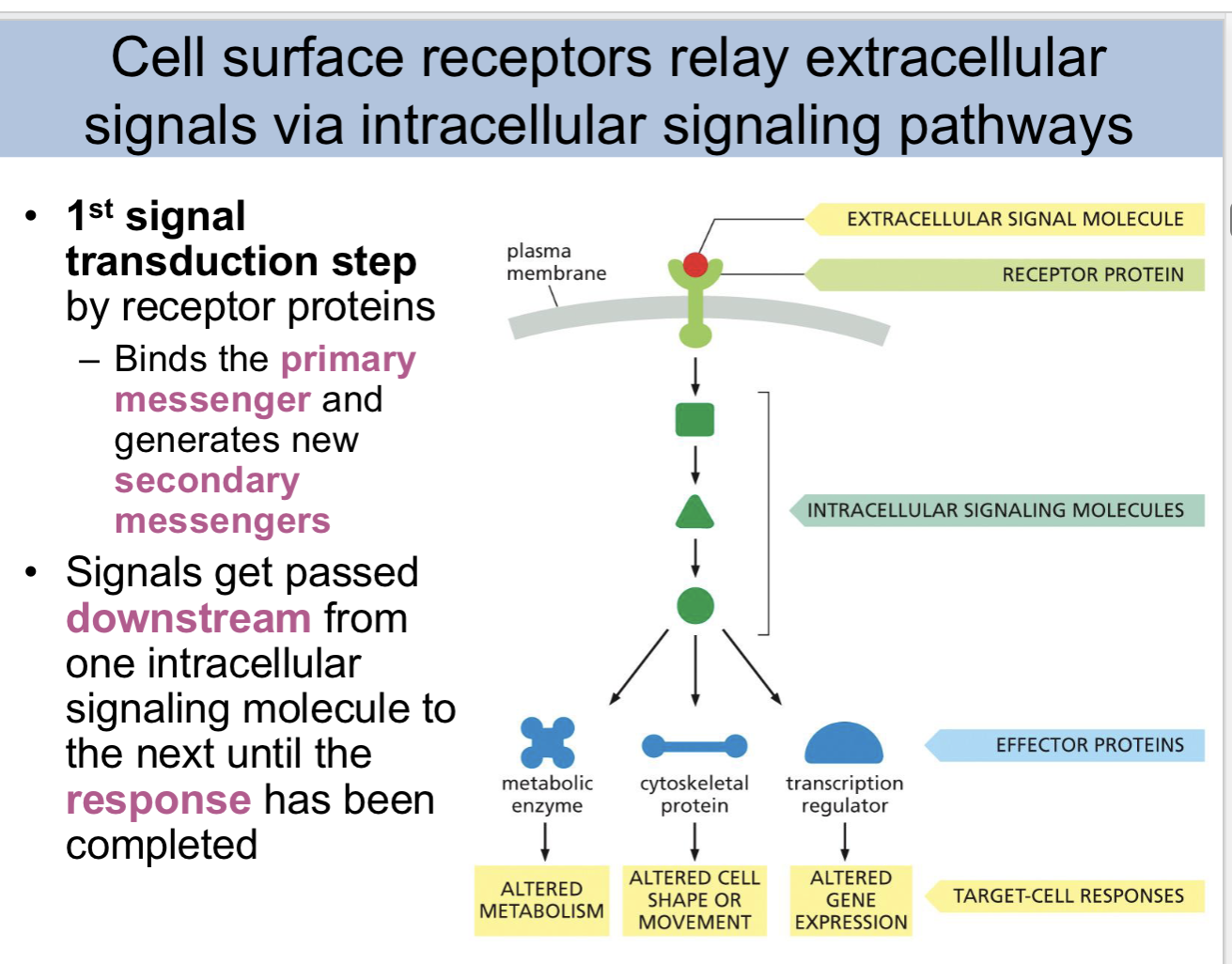
square is _ to triangle
upstream
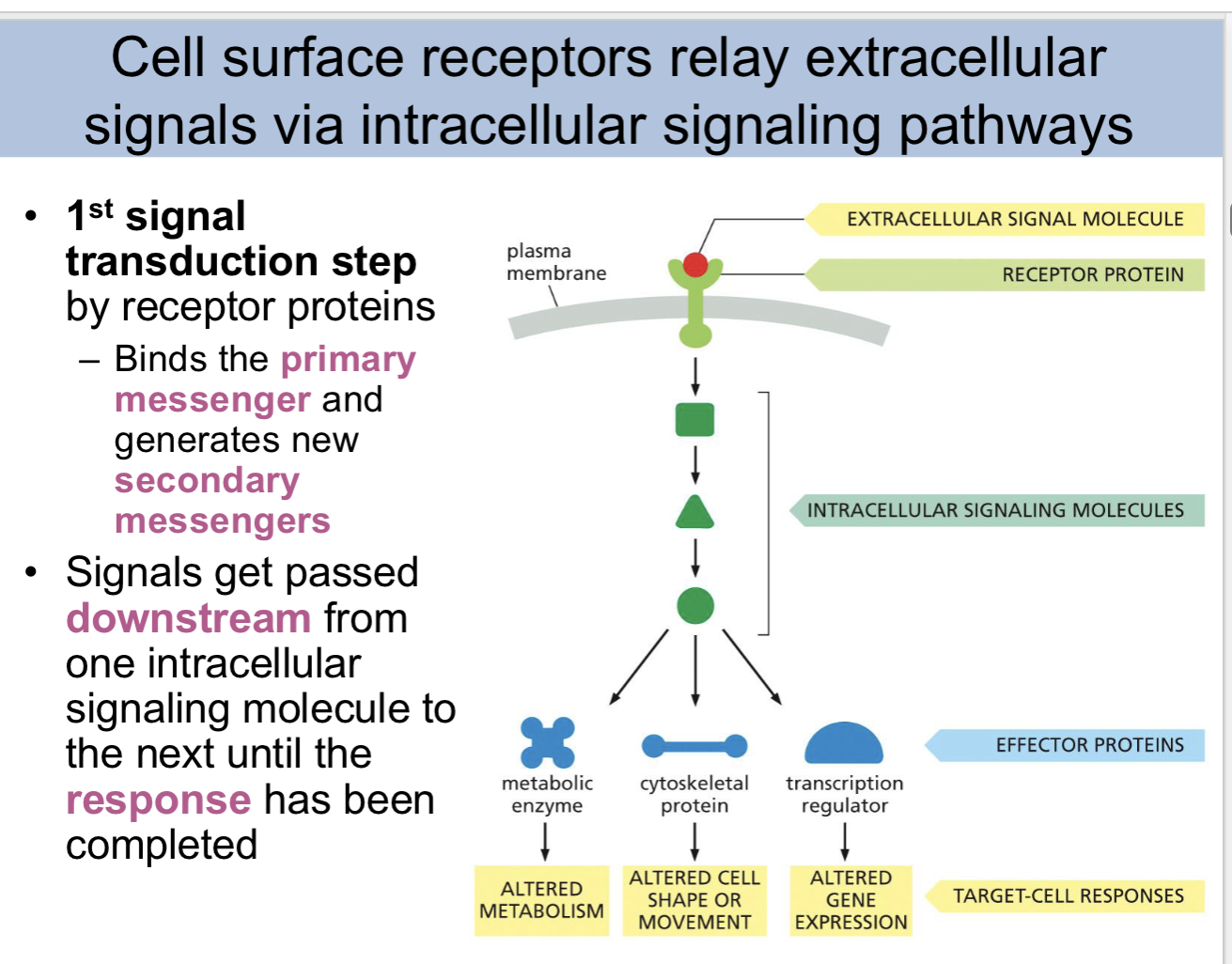
circle is _ to triangle
downstream
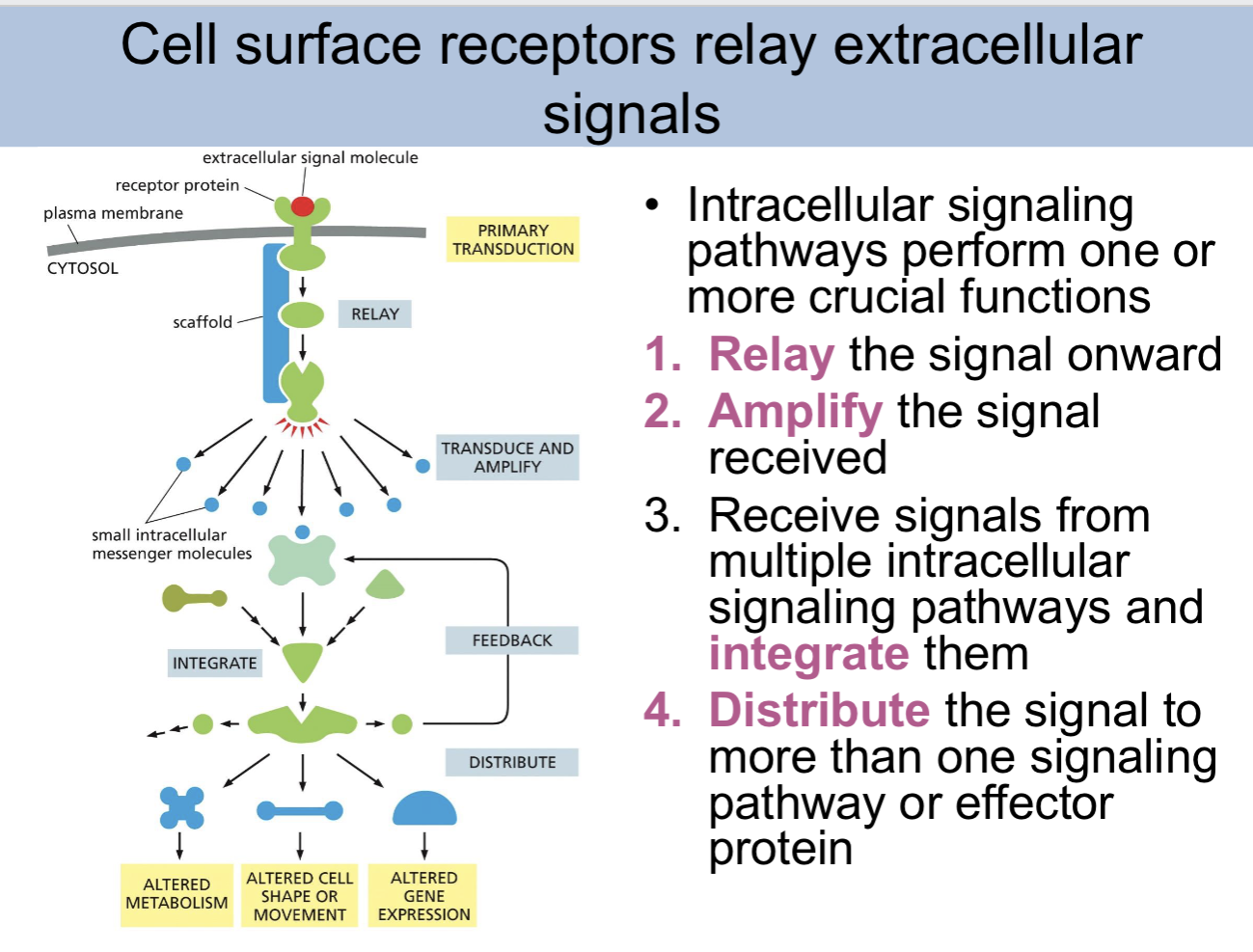
Intracellular signaling pathways perform one or more crucial functions including
1. Relay the signal onward
2. Amplify the signal received
3. Receive signals from multiple intracellular signaling pathways and integrate them
4. Distribute the signal to more than one signaling pathway or effector protein
cell surface receptor slides
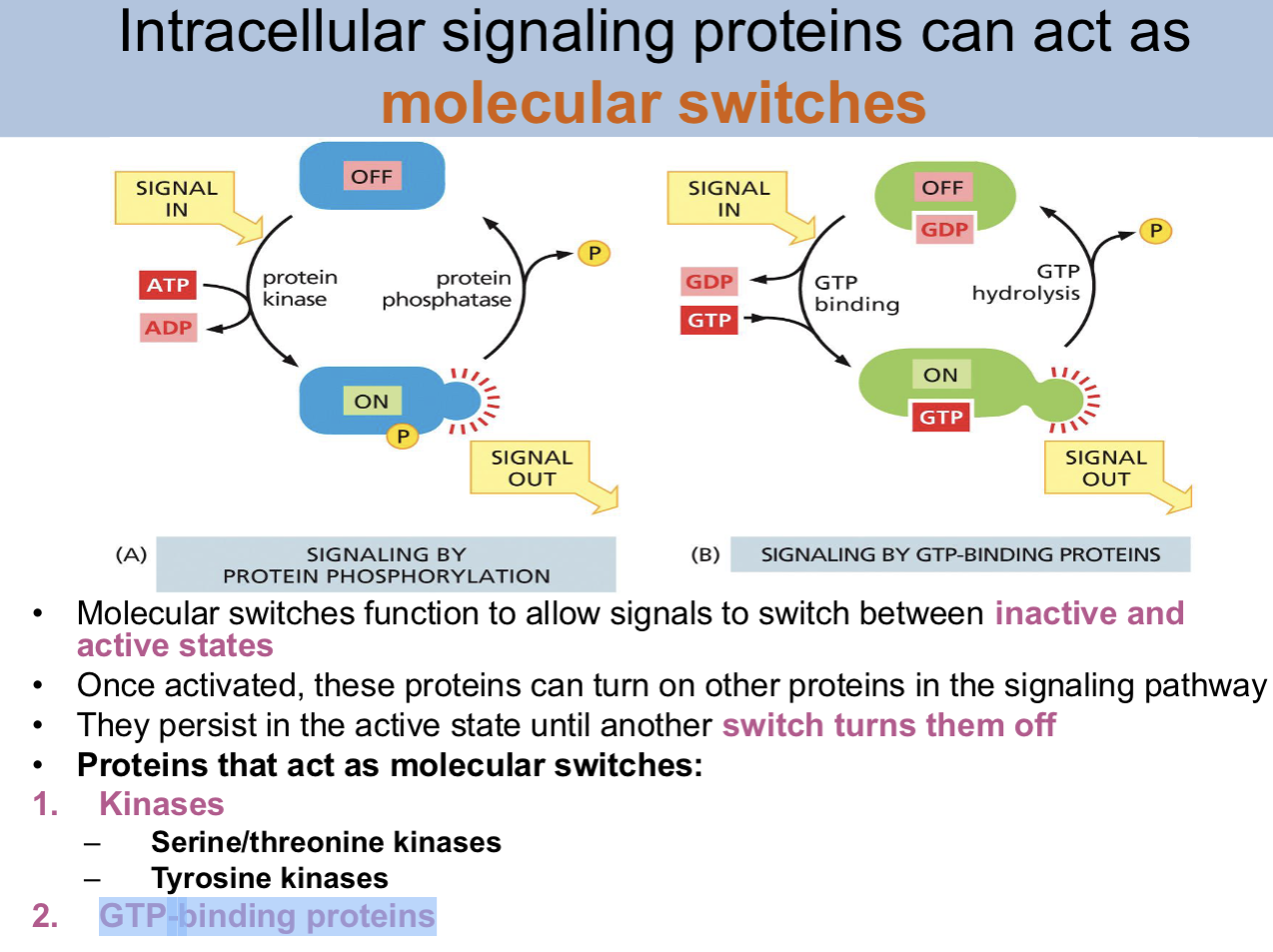
intracellular signaling proteins can act as
molecular switches
Molecular switches function to allow signals to switch between i
inactive and active states
Once activated, these proteins can
turn on other proteins in the signaling pathway. They persist in the active state until another switch turns them off
Proteins that act as molecular switches:
Kinases, GTP-binding proteins
molecular switches slide
cell communication review