Exam 3
 Call Kai
 Learn
Learn Practice Test
 Spaced Repetition
 Match
Match Flashcards
 Knowt Play
1/121

There's no tags or description
Looks like no tags are added yet.
Name | Mastery | Learn | Test | Matching | Spaced | Call with Kai |
|---|
No analytics yet
Send a link to your students to track their progress
122 Terms
How many carbons does formate have?
1
How many carbons does acetate have?
2
How many carbons does propionate have?
3
How many carbons does butyrate have?
4
How many carbons does valerate have?
5
How many carbons does caproate have?
6
How many carbons does octanate have?
8
How many carbons does decanoate have?
10
How many carbons does laurate have?
12
How many carbons does myristate have?
14
How many carbons does plamitate have?
16
How many carbons does stearate have?
18
How many carbons does archadonate have?
20
Draw a triacylglycerol
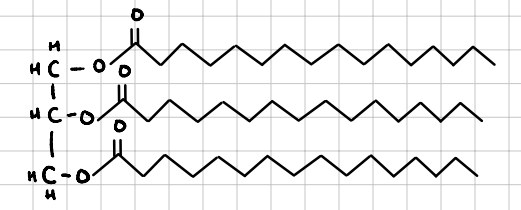
Saturated fats =
no double bonds
Unsaturated fats =
have double bonds (they are not saturated with carbons)
What is a monounsaturated fat?
1 carbon to carbon double bond
What is a polyunsaturated fat?
more than 1 carbon to carbon double bond
Draw 18:1 omega 3
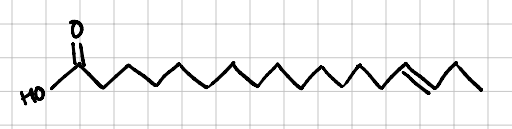
Draw 18:1 omega 6
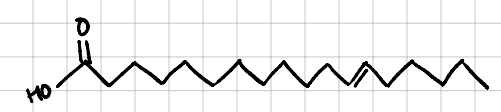
Draw 18:3 omega 9,6,3 as a trans fat
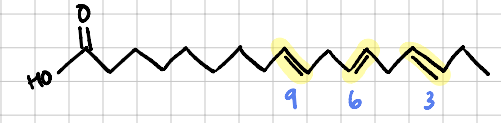
Draw 18:3 omega 9,6,3 as a cis fat
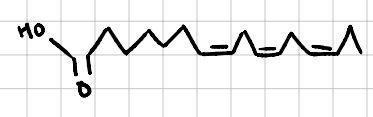
Draw linolenic acid
has 3 double bonds (18:2 delta cis 9,12,15)
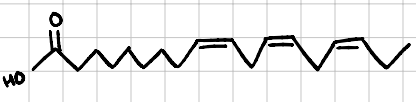
Draw linoleic acid
has 2 double bonds (18:2 delta cis 9.12)
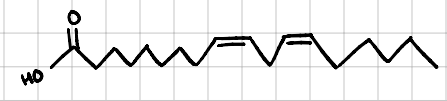
Liquidity ______ with an increase in chain lengths
decreases
Liquidity _____ with cis double bonds
increases
Liquidity _______ with trans double bonds
decreases
Bile salts are beneficial for docking
co-lipase
Bile salts _______ and __________
neutralize chyme
lipid emulsifying
Enzymes produced in the active form are called
zymogens
What does gastric lipase do?
cleaves short/medium chain fatty acids from carbons 1 and 3
What is in the pancreas during lipid digestion?
pancreatic alpha amylase
co-lipase
pro-pancreatic lipase
pro-phospholipase A2
trypsinogen
What does enteropeptidase do?
breaks peptide bonds between amino acids
What does lingual lipase do?
cleaves short/medium chain fatty acids from carbon 3 in glycerol
Draw 20:4 cis omega 3,6,9,12

Name 20:4 cis omega 3,6,9,12 in delta nomenclature
20:4 cis delta 8,11,14,17
What is the lipoprotein that carries lipids from intestines to body?
chylomicron
What apolipoprotein distinguishes a chylomicron?
Apo B48
What is the difference between lipoprotein and apolipoprotein?
Lipoproteins are complex particles that transport lipids (cholesterol and triglycerides) through the blood, acting as the "vehicle". Apolipoproteins are the specific proteins that form the outer shell of these particles, acting as the structural "driver" and organizer, guiding metabolism and receptor binding
What apolioprotein is important for lipid uptake into skeletal muscle?
Apo CII
What enzyme does Apo CII interact with?
lipoprotein lipase
What is the “equation” for beta oxidation cycles?
number of carbons/2 - 1
How many FADH2, NADH2, and acetyl CoA are leftover in beta oxidation?
7 FADH2
7 NADH2
8 Acetyl CoA
How many FADH2, NADH+H+, and GTP are leftover in the TCA cycle?
1 FADH2 per 1 Acetyl CoA * 8 Acetyl CoA = 8 FADH2
3 NADH+H+ per 1 Acetyl CoA * 8 Acetyl CoA = 24 NADH+H+
1 GTP per 1 Acetyl CoA * 8 Acetyl CoA = 8 GTP
How many ATP per palmitate are between beta oxidation and the TCA cycle?
15 FADH2 * 1.5 ATP/FADH2 = 22.5 ATP
31 NADH+H+ * 2.5 ATP/NADH2 = 77.5 ATP
8 GTP * 1 ATP/GTP = 8 ATP
22.5 + 77.5 + 8 = 108 ATP/Palmitate
Ketogenesis
occurs in liver only
occurs in mitochondria
acetyl CoA → Acetoacetate or B-OH butyrate
FA synthesis
occurs in liver
occurs in cytosol
citrate → FA (fatty acid)
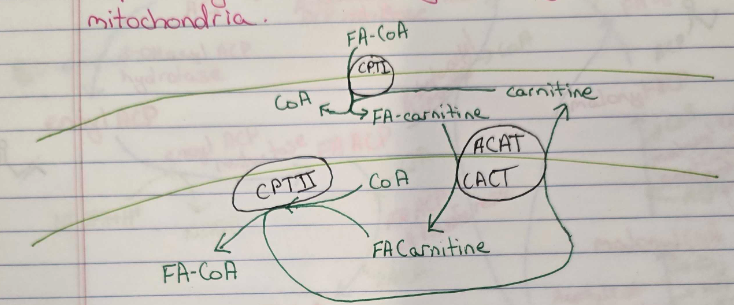
Explain/diagram the entry of fatty acids into the mitochondria.
What pathways occur in the cytosol of the cell?
glycolysis
lipogenesis
FA synthesis
glycogenesis
What pathways occur in the mitochondria?
ketogenesis
beta oxidation
Lipolysis
occurs in cytosol
TAG (triacylglycerol) → 3 FAs (fatty acids) + glycerol
Beta oxidation
occurs in mitochondria
FA (fatty acid) → Acetyl CoA
Lipogenesis
occurs in cytosol
3 FA (fatty acids) + glycerol → TAG
Ketolysis
occurs in mitochondria
Acetoacetate or B-OH butyrate → acetyl CoA
What (organ) are ketones made?
liver
What is more acidic propionate or stearate and why?
propionate
fewer carbons; the hydroxyl group that is giving up the hydrogens makes up a bigger proportion of the total molecules in the solution. this means there are more hydrogens that can be donated
Saturated fats
have no double bonds
Unsaturated fats
have double bonds
meaning they are NOT saturated with hydrogens
Lipids are
waxy or oily substances; soluble in non-polar solvents
Functions of lipids
energy dense
insulators
good for forming membranes
C=O is what type of group?
carboxyl
CH3 is what type of group?
methyl
What enzyme breaks down carbohydrates in the mouth?
salivary alpha amylase
Fatty acids are stored as….
triacylglycerols (also known as triglycerides)
Double bonds cause ____ in fatty acids which influence ______
“kinks”
membrane fluidity
Cis double bonds ____ bends in fatty acids while trans do not
induce
Short/easy description of digestion/absorption of lipids
(1) Lipid digestion begins in the mouth with lingual lipase, which targets short- and medium- chain fatty acids.
(2) Gastric lipase in the stomach continues lipid digestion, functioning optimally at pH ~3
(3) The pyloric sphincter regulates stomach emptying; fat sensing triggers hormones (e.g., C P-1, CCK) that delay emptying
(4) In the small intestine, bile (bile salts, cholesterol esters, phospholipids) emulsifies fats to facilitate enzymatic digestion by pancreatic lipase and colipase
Pro-pancreatic lipase breaks down what?
lipids (triacylglycerols)
Pro-phospholipase A2 breaks down
phospholipids
Trypsinogen is an enzyme that breaks down what?
proteins
What happens when lipids are emulsified?
a micelle is created which has a bunch of triglycerols in the middle
Where are bile salts produced?
made in the liver by cells called cholangiocytes
they are stored in the gallbladder
Where in the body do chylomicrons go?
lymphatic system then they enter the blood at the thoracic duct
What are high density lipoproteins (HDLs)?
they are produced by the liver and scavenge fat so there is not too much fat in your blood, then they bring it back to the liver
they are protein dense
What does a lipoprotein lipase do?
removes lipids from lipoproteins
When do you want your adipose tissue to take up lipids?
after consuming a meal
Examples of zymogens
trypsinogen, pro-pancreatic lipase, pro-phospholipase A2
they are produced to inactive to prevent self-digestion
What does enteropeptidase do?
it activates trypsinogen to trypsin
What is the role of trypsinogen?
It is a zymogen (produced in their inactive form) and it is first acted on by enteropeptidase to form trypsin
This trypsin can then self-activate more trypsinogen
When does the pancreas release insulin?
during the fed state
When is adipose tissue releasing fats?
during the fasted state
When is adipose tissue taking up fats?
during the fed state
Glucose induces insulin release but it can only occur in response to
eating a high protein meal
this is because of histidine, arginine, and lysine are positively charged and when they enter the cell, they make the inside of the cell less negative. This causes depolarization which stimulates insulin release
What has to be on the cell surface of adipose tissue in order to take up fatty acids and glycerol?
LPL (lipoprotein lipase)
What does pancreatic lipase do?
removes fatty acids from triacylglycerols, producing fatty acids and monoacylglycerols
What transporter are fatty acids absorbed through?
CD36
What does LPL (lipoprotein lipase) do?
hydrolyzes triglycerides in chylomicrons to fatty acids and glycerol for uptake by skeletal muscle and adipose tissue
Ketogenesis occurs in the brain during what state?
the fasted state
Fatty acids enter mitochondria as
fatty acyl CoA interacting with CPT1, converting to fatty acyl carnitine
Fatty acyl carnitine is transported into the mitochondria via
CACT and reconverted to a fatty acyl CoA by CPT2
In fasting or ketogenic diets, excess acetyl-CoA from beta-oxidation cannot enter the TCA cycle due to
low OAA availability
Acetyl-CoA converts to
ketone bodies
acetoacetate and B-OH butyrate
When do we make ketones?
fasted state
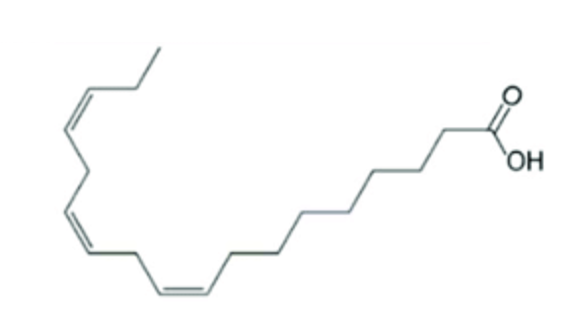
Name this fatty acid (include cis/trans in the name) using the n/Ω nomenclature.
18:3 Ωcis 3,6,9
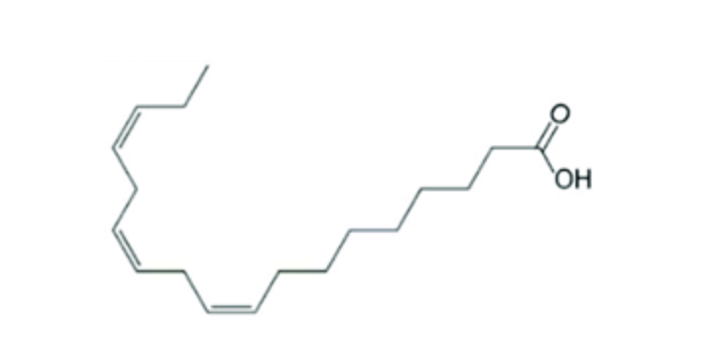
Name this same fatty acid using the Δ nomenclature (include cis/trans in the name)
18:3 Δcis 9,12,15
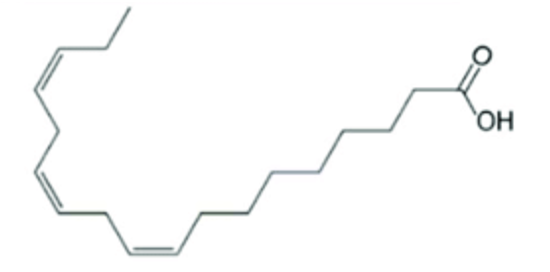
What essential fatty acid is this? (HINT: 18:3 Ωcis 3,6,9 OR 18:3 Δcis 9,12,15)
linolenic acid
Which lipid is more likely to be solid?
16:1 or 16:4
16:1
they both have the same chain length (16 carbons) but the difference is the amount of double bonds. the fewer the double bonds = straighter chains = tighter packing = more solid
Which lipid is more likely to be solid?
20:1 cis n(Ω)-6 or 20:1 trans n(Ω)-6
20:1 trans n-6
this is because trans fats are more linear (ie. they just have a regular double whereas cis fats have the trapezoid shape) and this allows them to be more tightly packed
Which lipid is more likely to be solid?
butyrate or octanoate
octanoate
has more carbons
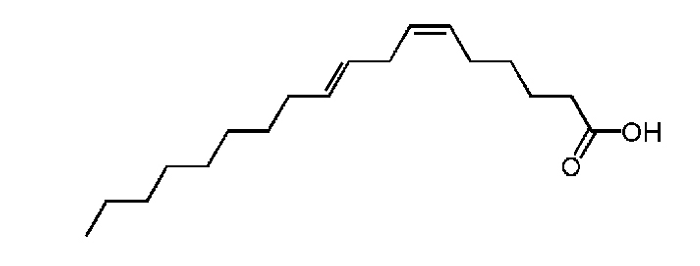
Name this fatty acid (include cis/trans in the name) using the Ω nomenclature.
18:2 Ωcis 9,12
also known as linoleic acid
Explore top notes

