erly lit exam 1 study guide (spring 2026)
 Call Kai
 Learn
Learn Practice Test
 Spaced Repetition
 Match
Match Flashcards
 Knowt Play
1/44

Earn XP
Description and Tags
**refer to quiz 1 study guide for knowledge about - "reading and the brain", "emergent literacy", & "phonological awareness"
Name | Mastery | Learn | Test | Matching | Spaced | Call with Kai |
|---|
No analytics yet
Send a link to your students to track their progress
45 Terms
phonics
the systematic instruction of teaching students how to associate sounds with letter patterns
pre-alphabetic phase
Children have little or no alphabet knowledge.
They recognize words using visual cues like pictures, logos, or word shapes.
Words are treated like pictures rather than decoded.
They rely on context clues and guessing to identify words.
They notice meaning (semantic clues) more than sounds (phonological clues).
This is a normal early stage of reading development before phonics instruction.
partial alphabetic phase
Children begin using letter–sound (grapheme–phoneme) connections.
This stage is called phonetic cue reading, but the connections are incomplete or unreliable.
Children often use the first letter sound and context to guess words.
They may occasionally use the last letter or other letters to help identify a word.
This phase is more reliable than visual cue reading, but children still cannot easily read new words.
Instruction should focus on strengthening letter–sound knowledge and phonemic awareness and using all letters in a word.
full alphabetic phase
Readers pay attention to every letter in a word.
They use phonological recoding (converting letters into sounds) to read words.
Children have stronger letter–sound knowledge and phonemic awareness.
They decode words sequentially, often slowly, especially unfamiliar words.
This stage is more reliable than earlier guessing strategies.
Typically develops by late kindergarten or early first grade.
Instruction should focus on segmenting and blending sounds and attending to every letter.
Repeated exposure to words helps build orthographic mapping (linking spelling, sound, and meaning in memory).
consolidated alphabetic phase
Readers decode using chunks of letters instead of individual sounds.
Recognize letter patterns such as blends, digraphs, vowel teams, and word families.
Also recognize syllables, prefixes, suffixes, and morphemes as units.
Orthographic mapping strengthens, making word recognition faster.
Considered the most advanced stage of reading development.
Typically begins around second grade and continues to improve with practice.
Instruction should focus on recognizing patterns and chunks within words.
automatic phase
Final stage of word-reading development.
Word reading becomes quick and effortless.
Most words are recognized automatically as sight words.
Unfamiliar words can be decoded quickly and efficiently.
Readers can focus mainly on understanding the meaning of the text.
Most proficient adolescents and adults are in this phase.
phonological & orthographic processor
which two processors are involved when learning phonics?
synthetic phonics
(part to whole) students transform letters and letter combinations in sounds and blend them together (segmenting & blending)
systematic & explicit
practice materials
decodable books
analogy phonics
(analogizing) the teacher starts with a phonogram or rime a student knows to make the connection to a new, unknown word
example – student knows my but doesn’t know why
decoding
when phonics is used to read words
encoding
when phonological awareness AND phonics are used to write/spell words
graphemes
a letter or group of letters that represent one speech sound
example high = 2 graphemes ( h igh)
mad 3 graphemes (m a d)
neighbor has 4 graphemes (n eigh b or)
true
t/f: the number of phonemes & graphemes will always be the same in a word
alphabetic principle
the understanding that there 26 squiggly things (upper & lowercase) called letters that make sounds
alphabetic principle
the _______ _______ is essential for matching speech to print
single constants
Definition | Example |
Any letter that is not a vowel. | b, c, d, f, g, h, j, k, l, m, n, p, q, r, s, t, v, w, x, y, z |
short vowels
Example |
ă, ĕ, ĭ, ŏ, ŭ (short vowel mark is called a breve). |
beginning consonant blends
Definition | Example |
2 or more consonants, you hear both sounds, comes at the beginning of a word. The word can have a long or short vowel. | 2 letter blends …
3 letter blends …
|
ending consonant blends
Definition | Example |
2 or more consonants, you hear both sounds, comes at the end of a word. The word will have a short vowel | st, sk, sp, nd, nt, nk, ng, mp, rd, ld, lp, rk, lt, lf, pt, ft, ct, xt |
consonant digraphs and trigraphs
Definition | Example |
2 or 3 consonants that come together to make one sound. |
|
digraphs
has 2 letters
trigraphs
has 3 letters
long vowels |
Definition | Example |
The sound made when the vowel says its name | ă, ē, ī, ō, ŭ (long vowel mark is called a macron) ** ū can make 2 sounds ū like in mule, and /oo/ like in ruler |
vowel teams/pairs
Definition | Example |
Two to four letters to work together to make a long vowel sound. | 2 letters
3 letters
4 letters
|
R controlled vowels
Definition | Example |
The vowel precedes the r and the presence of the r distorts the sound of the vowel | er, ir, ur, ar, or |
L controlled vowels
Definition | Example |
The vowel precedes the l and the presence of the l distorts the sound of the vowel. | all, cold, bell, bull, pill, pencil, animal, camel, colt, roll, halt, chalk, milk |
dipthongs
Definition | Example |
When two vowels are combined and it starts as one vowel sound and moves into the other vowel sound. You can hear both vowel sounds |
|
word families
the purpose of _____ ________ is to help students see patterns between different words. (Think analogy phonics)
this helps students to begin seeing words in chunks
think consolidated alphabet stage in Ehri’s Phases
ex: ake
cake
flake
lake
rake
brake
stake
fake
make
word chain
help students see patterns/relationships among words (NOT rules)
helps students become flexible with building words
helps students to continually review what has been previously learned
ex: pat, cat, fat, fit, fig, pig, peg, pet, met, let, lit, pit, pat
activity in class = decoding using blending boards
word sorts
help students see patterns among words
is a higher order thinking skill and increases their problem solving (when doing open sorts)
two types: closed sorts & open sorts
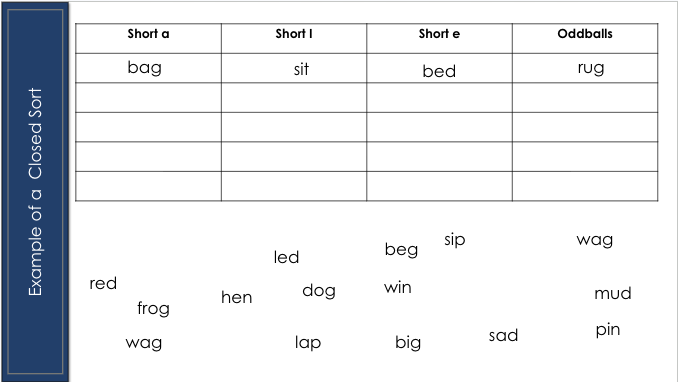
closed sorts
where the categories are given to the students
open sorts
when students look at the set of words, determine the patterns they see in the set of words, and categorize them based on those patterns
oddball open sorts
an open sort with words that don’t fit the patterns
Know the difference between heart words and high frequency words (Week 5 PPT Slide 28)
heart words
can be considered temporarily irregular, but when students learn different letter patterns the word can become regular (saw, she, might)
emphasize that parts of the word are regular, and there are some parts that just have to be learned by heart
high frequency words
most commonly found sight words found in reading materials for grades 3-9
instruction is not explicit (let’s learn this word by continual practice)
instruction does not emphasize irregular/regular parts
Understand how to teach heart words (See your script in Canvas Week Five)
i
which of the following are activities to help in building fluency?
a. grapheme visual drill (learning symbols to match sounds)
b. word chains
c. word building w/letter tiles (electronic or actual cards)
d. phonograms (word families) (remember onsets/rimes)
e. word sorting
f. Elkonin boxes w/letters
g. spelling
h. dictation
i. all of the above
grapheme visual drill
learning symbols to match sounds
word chains
helps students to see minute changes between words
helps them to be flexible readers
dictation
make up sentences using your target words
have students write the sentences
invented spelling
when students use their phonemic awareness skills to spell words
although the words are not spelled conventionally, then make sense with the sound/spelling relationships
examples …
luv = love
is crem= ice cream
gam = game
true
t/f: invented spelling is an appropriate strategy that is to be used TEMPORARILY
letter patterns
as students knowledge of ______ ______ increases, the expectation is that their spelling reflects their new knowledge
e
which of the following are reasons that we want students to use invented spelling?
a. we want students to not be intimidated by the writing process
b. invented spelling helps students with their encoding skills
c. it also helps students to practice their letter-sound correspondences
d. invented spelling decreases as students learn & practice new spelling patterns – so don’t worry!
e. all of the above

