Chapter 6: Cell Communication
 Studied by 0 people
 Call Kai
 Learn
Learn Practice Test
 Spaced Repetition
 Match
Match Flashcards
 Knowt Play
1/60

Earn XP
Description and Tags
EENG304, LIU
Name | Mastery | Learn | Test | Matching | Spaced | Call with Kai |
|---|
No analytics yet
Send a link to your students to track their progress
61 Terms
Why must cells in a multicellular organism communicate?
To maintain homeostasis.
How do organisms communicate with others of their species?
By secreting chemical signals.
Why is the ability to perceive and respond to the microenvironment important?
It underlies development, tissue repair, immunity, and normal tissue homeostasis.
What can errors in cellular information processing lead to?
Diseases such as cancer, autoimmunity, and diabetes.
What is the first step in cell signaling?
Synthesis, release, and transport of signaling molecules (ligand) like neurotransmitters and hormones.
What is a ligand?
An ion, molecule, or molecular group that binds to another chemical entity to form a larger complex.
What is the second step in cell signaling?
Reception of information by target cells.
What is the third step in cell signaling?
Signal transduction — the receptor converts the extracellular signal into an intracellular signal, causing a change in the cell.
What is the fourth step in cell signaling?
Cellular response:
• Protein →Altered membrane permeability → e.g., ion channels open or close.
• Enzyme →Altered metabolism → enzymes are activated or inhibited.
• Protein that regulates a gene → Altered gene activity → genes are turned on/off, affecting protein production.
The three types of signaling molecules are…
– local regulators
– neurotransmitters
– hormones
2 Types of Local Signaling are…
-Direct contact
-Paracrine regulation
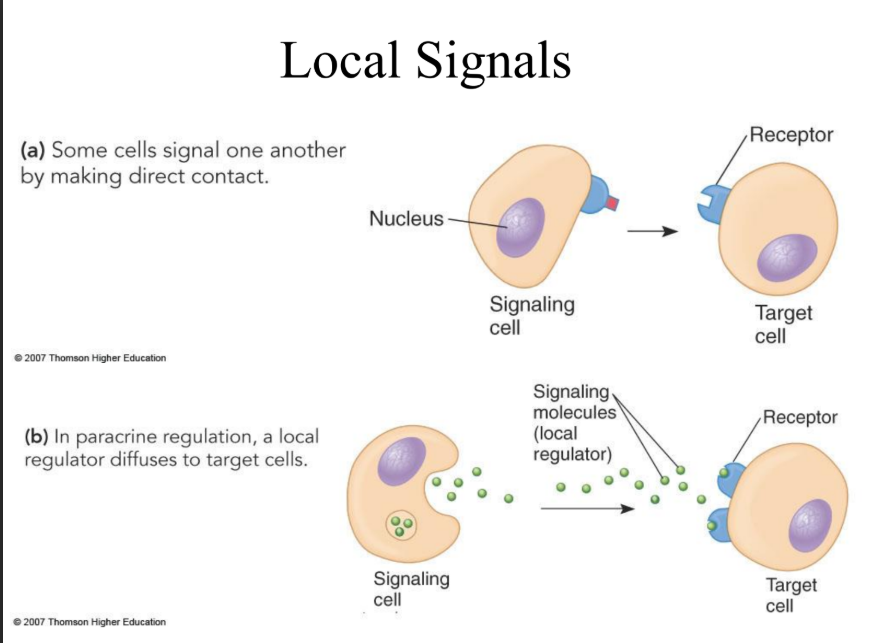
Paracrine regulation
A form of cell signaling where local regulators (molecules) diffuse through interstitial fluid and act on nearby cells.
What are examples of local regulators?
• Histamine: Released in response to allergic reactions.
• Growth factors: Stimulate cell division.
• Prostaglandins: Stimulate smooth muscle contraction.
• Nitric oxide: Relaxes smooth muscles in blood vessel walls.
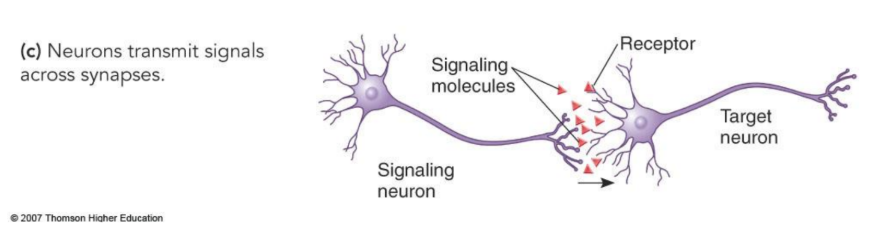
Neurotransmitters
Are chemical signals released by neurons.
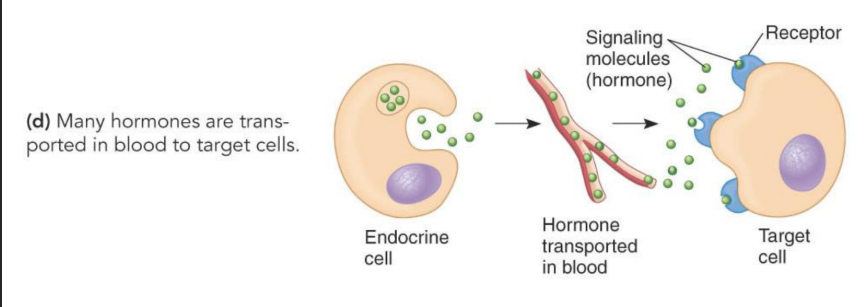
Hormones
Chemical messengers found in plants and animals. In animals they are secreted by endocrine glands and transported by blood to target cells.
What mechanisms make reception a highly specific process?
The specific shape of receptors — only matching signal molecules affect the cell.
Can the same cell have different receptors?
Yes — depending on the cell’s stage or condition.
What type of signaling molecules bind to receptors on the cell surface?
Hydrophilic (water-soluble) signaling molecules (cannot pass through the plasma membrane).
What type of signaling molecules bind to receptors inside the cell ?
Hydrophobic (lipid-soluble) signaling molecules pass through the plasma membrane and bind with receptors in the cytosol or nucleus.
How do cells regulate reception?
By increasing or decreasing the number of each type of receptor.
Depending on the needs of the cell, receptors are synthesized or
degraded.
What is receptor down-regulation?
When cells reduce receptor numbers in response to high hormone concentrations, decreasing sensitivity.
What is receptor up-regulation?
When cells increase receptor numbers in response to low hormone concentrations, amplifying the signal’s effect
What are the 4 types of receptors?
– ion channel–linked receptors ]
– G protein–linked receptors ]On the cell surface
– enzyme-linked receptors ]
– intracellular receptors
Ion Channel–Linked Receptor
Signaling molecule binds to ion channel– linked receptor causing ion channel to opens or close.
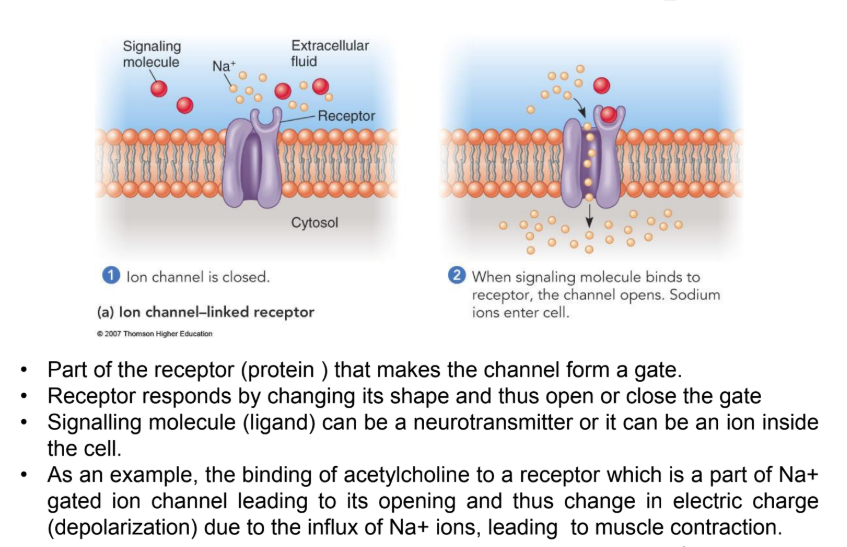
What do ion channel–linked receptors convert?
Chemical signals into electrical signals.
What keeps ion channel gates closed?
They remain closed until ligands bind.
What is another name for ion channel–linked receptors?
Ligand-gated channels.
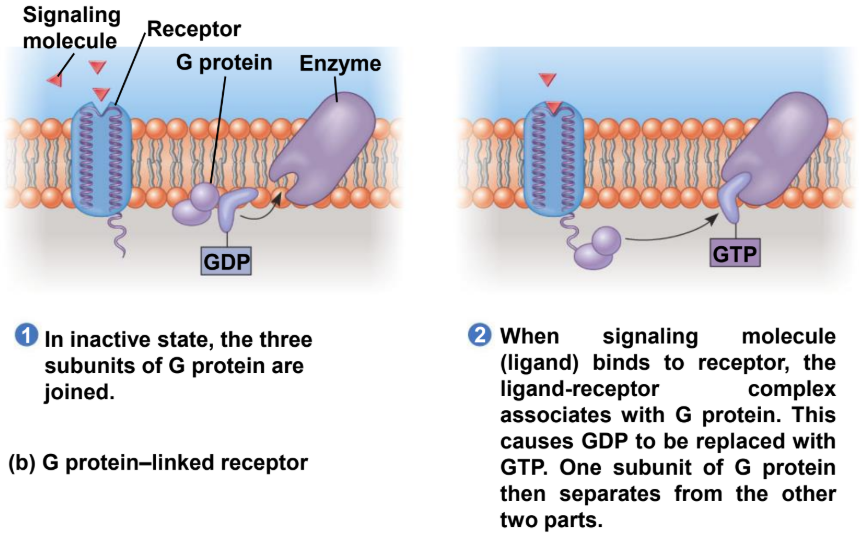
What are G protein–linked receptors?
Transmembrane proteins that couple signal molecules to signal transduction pathways.
Found in all eukaryotes.
What is the structure of G protein–linked receptors?
Seven transmembrane alpha helices connected by loops extending into the cytosol or outside the cell.
What does the receptor tail do?
Extends into the cytosol and provides a binding site for the G protein (binds to GTP).
What happens when a ligand binds to a G protein–linked receptor?
What critical processes depend on G protein–linked receptors?
Vision, sense of smell, mood and behavior regulation, and immune system regulation.
What are enzyme-linked receptors?
Transmembrane proteins that function directly as enzymes or are linked to enzymes.
Where are the binding sites on enzyme-linked receptors?
Outside for signal molecules, inside for enzymes.
What are tyrosine kinases?
Enzymes that phosphorylate proteins and activate IP3 and Ras pathways ; often part of the receptor.
What are Ras proteins?
Small G proteins that act as molecular switches; active when bound to GTP. Role: Trigger a cascade of rxns called the Ras pathway , and phosphorylate amino acid tyrosine
What is the role of scaffolding proteins?
Binds to the tyrosine kinase, after activation of the receptor, to organize kinases into a signaling complex for signal propagation.
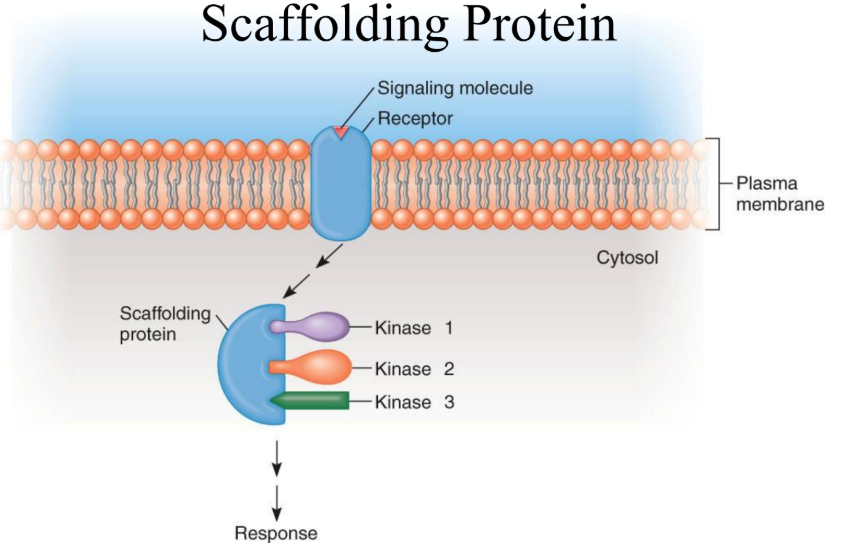
What happens when a ligand binds to an Enzyme–linked receptor?
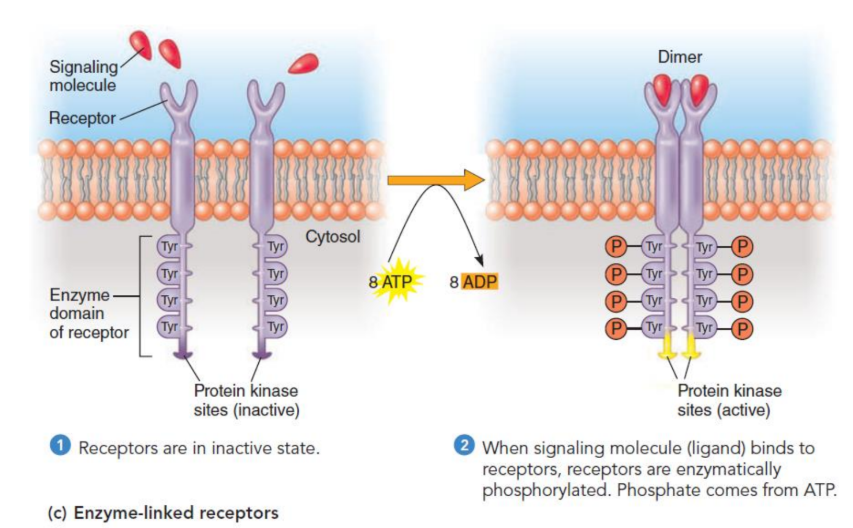
Which proteins make up a major group of enzyme-linked receptors.
Tyrosine kinases
What is a kinase?
An enzyme that transfers the terminal phosphate group from ATP to a substrate. This process is called phosphorylation.
What does a tyrosine kinase do?
catalyzes the transfer of phosphate groups from ATP to a specific tyrosine that is part of a protein.
Where are intracellular receptors located?
Cytosol or nucleus (inside the cell).
What types of ligands bind to intracellular receptors?
Small, hydrophobic molecules. They diffuse across the plasma membrane.
What type of hormone typically binds to intracellular receptors?
Steroid hormones (cortisol and sex hormone)
What other molecules bind intracellular receptors and move into the nucleus?
Vitamin A, Vitamin D, and nitric oxide.
Where do thyroid hormones bind their receptors?
To receptors already bound to DNA inside the nucleus.
Intracellular Signaling
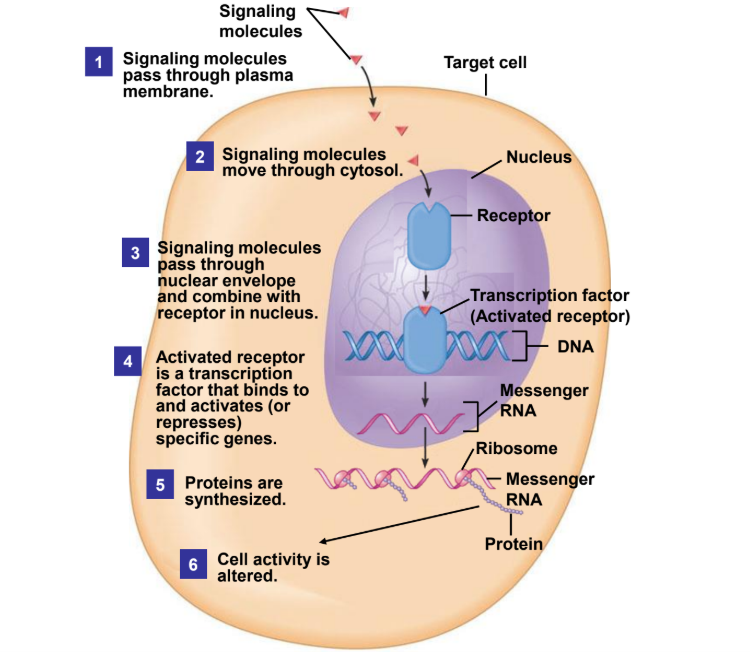
What do intracellular receptors act as after binding a ligand?
Transcription factors that activate or repress specific genes.
First messenger:
the signaling molecule
What role does the G protein play in signaling?
It transfer information from the receptor to the second messenger.
Second messengers are:
– cyclic AMP
– inositol trisphosphate
– diacylglycerol
– calcium ions
cAMP
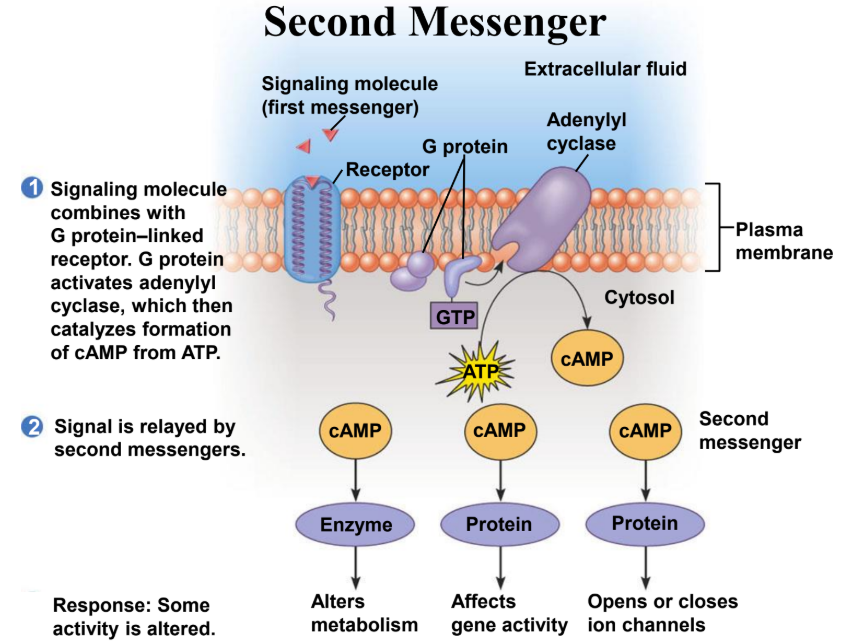
cyclic AMP activates protein kinase A which phosphorylates proteins, leading to cellular responses.
What second messengers are produced when PIP₂ is split?
IP₃ (inositol trisphosphate) and DAG (diacylglycerol).
What does IP₃ do?
Donates phosphate to proteins and binds to calcium channels in the ER.
What does DAG do?
Activates protein kinase C enzymes, which phosphorylates target proteins.
PIP₂ → IP₃ & DAG Pathway
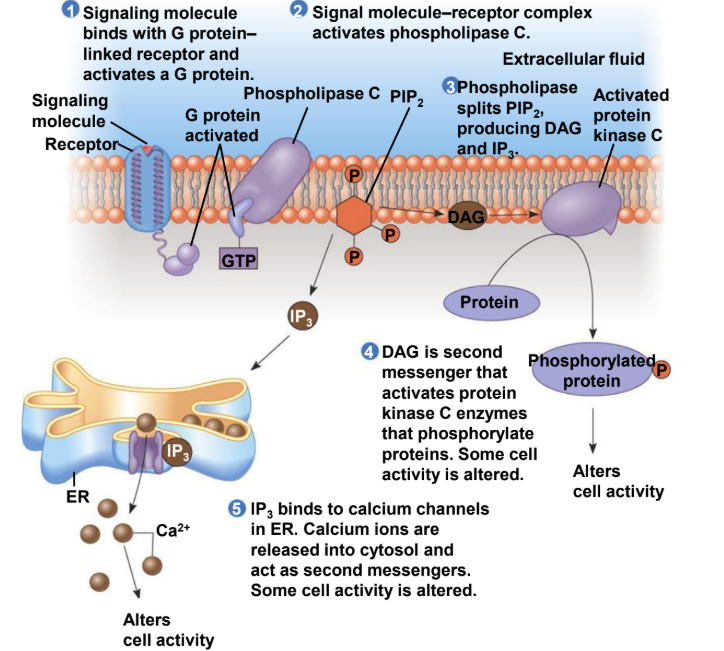
What protein do calcium ions combine with to influence cellular activity? effect of this combination?
Calmodulin
Effects activity of protein kinases and phosphatases (is an enzyme that removes a phosphate group from its substrate)
What key processes are regulated by calmodulin?
Metabolism, muscle contraction, inflammation, and apoptosis
What three types of responses do cells make to signals?
• Ion channels open or close.
• Enzyme activity changes which leads to metabolic changes.
• Specific genes are activated or repressed, affecting cell development and activity.
What is the difference between signal amplification and signal termination?
• Signal amplification: enhances signal strength in signal transduction
pathway
• Signal termination: inactivates the pathway after the signal and allows the system to respond to new signals.
Signal Amplification Cascade
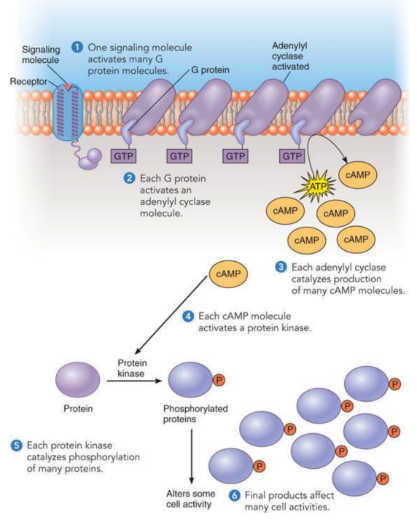
 Note
Note  Flashcards (31)