The psychodynamic approach
 Studied by 0 people
 Call Kai
 Learn
Learn Practice Test
 Spaced Repetition
 Match
Match Flashcards
 Knowt Play
1/5

There's no tags or description
Looks like no tags are added yet.
Name | Mastery | Learn | Test | Matching | Spaced | Call with Kai |
|---|
No analytics yet
Send a link to your students to track their progress
6 Terms
The role of the unconscious
Sigmund Freud Suggested that the part of our mind that we know about and aware of is the conscious mind, but it is nearly The tip of the iceberg
Most of our mind is made up of the unconscious - This is a part of our minds that we are unaware of but directs much of our behaviour
-The unconscious also contains threatening and disturbing memories that has been repressed or locked away and forgotten
-These can be assessed during Dreams or slips of the tongue
The preconscious sits between the two, it contains thoughts and memories which are not currently in conscious awareness but are still retrievable
The structure of personality
Freud describe Personality as ‘tripartite’:
The ID is the primitive part of our personality. It operates as the pleasure principle - It is a seething mass of unconscious drives and instincts. Only the ID is present at birth and throughout life, The ID is entirely selfish and demands instant gratification for its needs
The ego works on the reality principle and is the mediator between the other two parts of the personality - The ego develops around the age of 2 and it’s role is to reduce conflict between the ID and super ego using defence mechanisms
The superego is formed at the end of the Phallic stage (age 5). It is our internalised sense of Right and wrong - Based on the morality principle, it represents the moral standards of the child’s same gender parent and punishes the ego for wrongdoing through guilt
The defence mechanisms
They are unconscious and are used by the ego in order to cope with the conflicting demands of the ID and the super ego. The three mains:
Denial - Refusing to acknowledge some aspect of reality
Repression - Forcing a distressing memory out of the conscious mind
Displacement - Transferring feelings from a true source of distressing emotion onto a substitute target
Psychosexual stages
Freud claimed that child development occurred in five stages. The child must resolve each stage in order to progress onto the next one and have no consequences in adult life
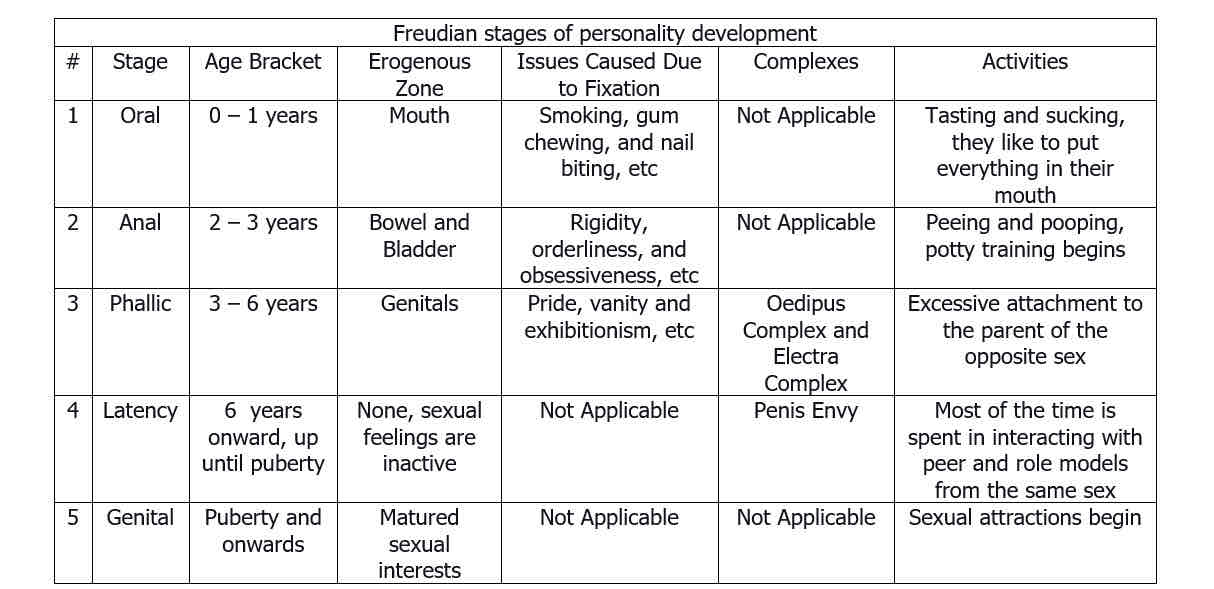
Strengths
One strength of the psychodynamic approach is that it introduced the idea of psychotherapy- Freud Brought to the world and new form of therapy, Psychoanalysis. This was the first attempt to treat medical disorder psychologically rather than physically. This therapy employed a range of techniques designed to access the unconscious mind such as dream analysis. Psychoanalysis claims to help clients by bringing their repressed emotions into the conscious mind so they can be dealt with
One strength of Freud’s theory Is its ability to explain human behaviour - Freud’s theory can Be controversial, but this had a huge influence on psychology and contemporary thought. This approach is significant in drawing attention to the connection between experiences and childhood such as our relationship with our parents and our later development
Limitations
One limitation is that much of it is Untestable - The philosopher of science , Karl Popper, Argued that the psychodynamic approach does not meet the scientific criterion of falsification. It is not open to empirical testing. Many of Freud’s Concepts such as the ID and the Oedipus complex all set to occur At an unconscious level, making them difficult to test. This suggests that Freud’s Siri was Psuedoscientific (Not a real science)
 Note
Note  Flashcards (22)