Chapter 19 - Plants
Plants have changed the world
Member of kindom are nearly everywhere.
Plants harness the energy that sustains ecosystems. They also release O2, which consumers use for respiration
Plants are essential for life
On land and in water, plants provide habitats and food to countless species of microbes, fungi, and animals
Plants share a lineage with protists
All plants are multicellular, autotropic eukaryotes that use photosynthesis to obtain energy
Green algae are the closest relatives of plants
are a group of modern green algae.
Biologists believe they are similar to the ancestors of plants.
Green algae share many molecular features with plants
DNA sequences reveal a close evolutionary relationship.
Green algae live in water, plants on land
The different environments select for different body types and reproductive strategies
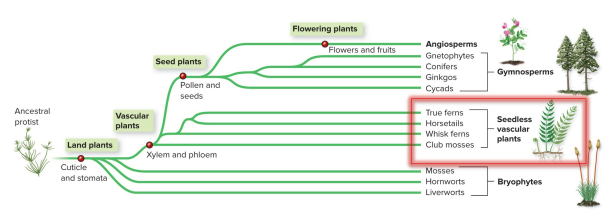
Plants are divided into four groups
Plants arose during the era and diversified into thousands of different species
Modern - day plants include:
- Nonvascular plants
- Seedless vascular plants
- Gymnosperms
- Angiosperms
Phyla of plants

Plants evolved key adaptations
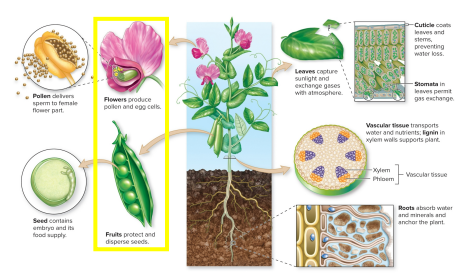
The four plant groups are defined by a series of features that plants developed over time, including having vascular tissue, seeds, and flowers/fruits
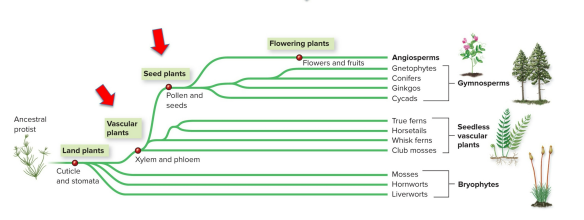
A leaf is an adaptation to life on land
Leaves capture sunlight and CO2 for photosynthesis. Plant leaves have evolved a to keep from drying out and to allow gas exchanges
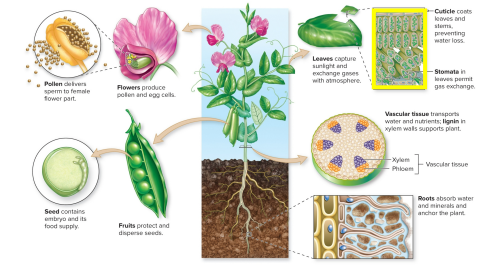
Vascular tissue is an adaptation to life on land
Plant is a bundle of tubes that transports water, minerals, and sugar throughout the plant
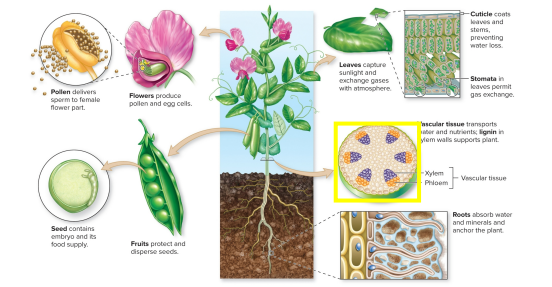
A root is an adaptation to life on land
Roots below the group absorb water and minerals while anchoring the plant in the soil

All plants have similar life cycles
The similarity among plant life cycles is evidence that all plants share a common ancestor
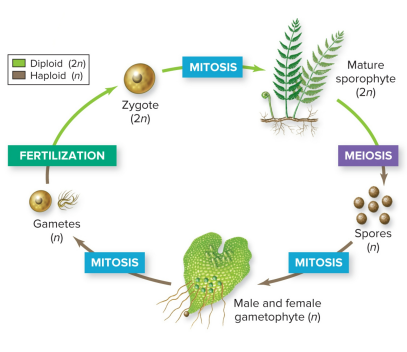
Plants alternate generations
The plant life cycle is called
A multicellular diploid stage alternates with a multicellular haploid stage
Sporophyte generation is diploid
A fertilized egg forms a diploid zygote, which develops by mitotic cell division into a multicellular, diploid plant called a
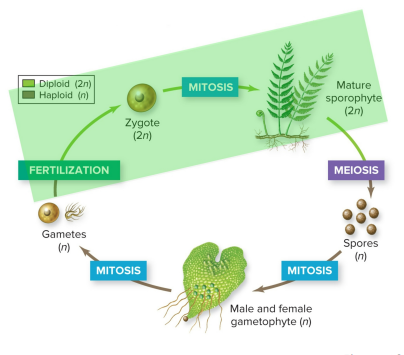
Sporophytes produce spores
The sporophyte plant produces haploid by meiosis

Gametophyte generation is haploid
Spores divide by mitosis into a multicellular, haploid
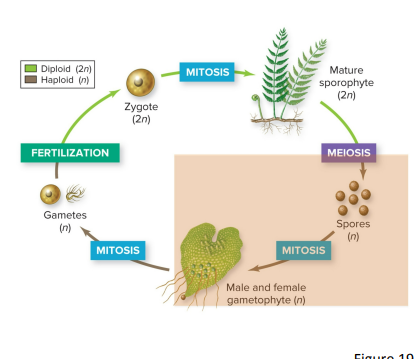
Gametophytes produce gametes
The haploid gametophytes produces by mitosis
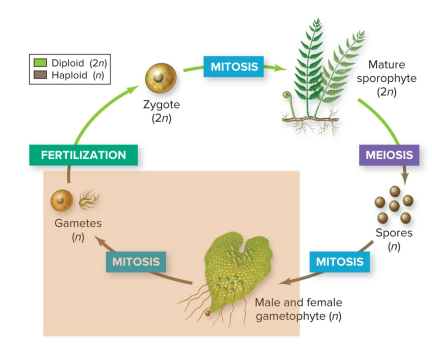
Fertilization forms a zygote
The gametes fuse at fertilization, forming a diploid zygotes and starting the cycle again

Pollen is an adaptation to life on land
Seed plants produce which contains the main gametophyte. Pollination can occur without water, and often animals help spread the pollen to new plants
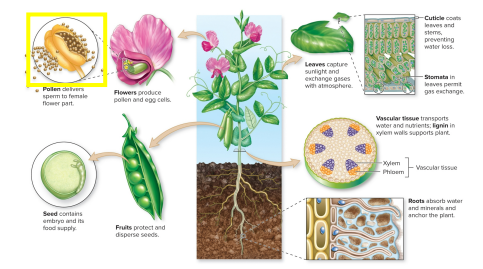
A seed is an adaption to life on land
carry dormant plant embryos packaged with a food supply and protected from drying out. They can be dispersed long distances and remain dormant until conditions are favorable.

Flowers and fruit are adaptations to life on land
produce pollen and egg cells. Fruits develop after fertilization, to protect and disperse the plant offspring.
 Bryophytes are the simplest plants
There are about 24,000 existing species of or “nonvascular” plants.
Mosses, hornworts, and liverworts are bryophytes
Bryophytes are nonvascular and seedless
The earliest plants probably resembled modern bryophytes. Bryophytes have
Bryophytes are small, compact plants
Without vascular tissue or lignin (which strengthens the cell well), bryophytes lack physical support
Materials move from cell to cell within the plant by diffusion and osmosis.
They live in moist shady habitats where they will not dry out
Bryophyte sexual reproduction requires water
Gametophytes have male and female structures that produce gametes (eggs and sperm). The sperm swim to the eggs.

Bryophytes also reproduce asexually
Mosses and liverworts produce structures called which are small pieces of tissue that detach from the gametophyte and grow into new plants
Seedless vascular plants have no seeds
There are about 12,700 existing species of plants with vascular tissue, but no seeds.
This phylum is composed of ferns and their close relatives.
Seedless vascular plants have true roots, stems, and leaves
Vascular tissue allowed these plants to grow much larger than bryophytes, which gave them an edge in competing for sunlight
Ferns and their relatives evolved later
Whisk ferns, horsetails, and true ferns make up a second phylum of seedless vascular plants that first appeared around 375 million years ago. Most, but not all, of these species live on land.
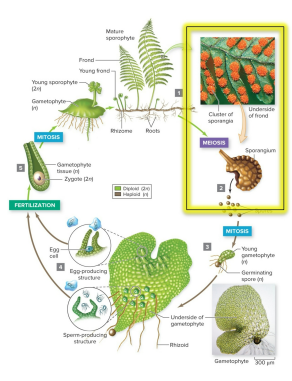
Spores form under the leaves of the sporophyte
Haploid spores grow on the underside of sporophyte leaves.
The spores form by meiosis and then develop into gametophytes
Seedless vascular plants require water for reproduction
Gametophytes produce male and female gametes. Sperm swim to the eggs in water

Gymnosperms have pollen and seeds
There are about 850 existing species of gymnosperms
They evolved about 300 million years ago
Gymnosperms are “naked seed” plants
New reproductive adaptations allowed gymnosperms to outcompete seedless vascular plants in many habitats. Gymnosperms produce seeds but do not enclose them in fruit

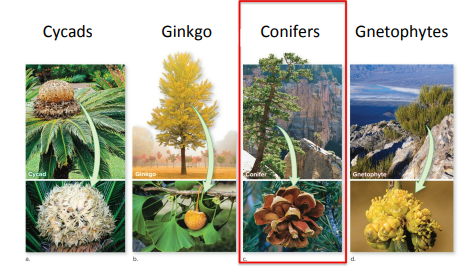
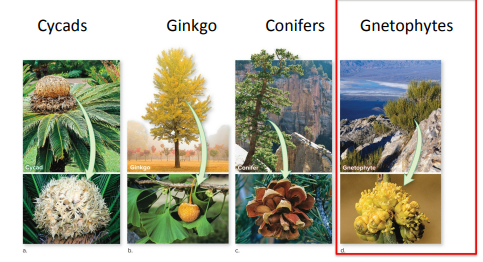
Gymnosperms include cycads
Cycads were prevalent in the Mesozoic era, but many species are near extinction in the wild today. They have palm like leaves and produce large cones.

Gymnosperms include the ginkgo
Only one species exists today, and it no longer grows wild in nature. The ginkgo tree have distinctive, fan - shaped leaves

Gymnosperms include conifers
Conifers such as pine trees are familiar gymnosperms. Their leaves are needlelike and they produce egg cells and pollen in cones
Gymnosperms include gnetophytes
These plants have a mixture of traits that make them difficult to classify. Ephedra, shown here, has cones that resemble tiny flowers.
Gymnosperm sporophytes are large and conspicuous
The sporophytes of most gymnosperms are woody trees or shrubs. Reproductive structures and leaf types are diverse.
Sporophytes produce both male and female cones, where spores form by meiosis
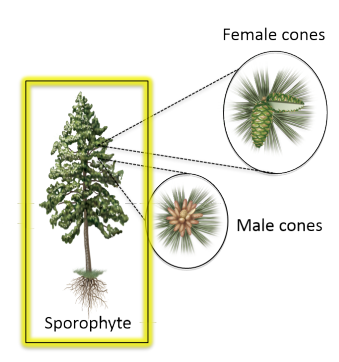
Gymnosperm sporophytes produce spores in cones
Male cones produce microscopes on cone scales
on female cone scales produce megaspores

Gymnosperm gametophytes are microscopic
Male gametophytes are enclosed inside grains of pollen. Pollen can be dispersed by wing to settle on new plants.
The tiny female gametophytes stay in the cone, enclosed inside the ovule.

Pollination gets male and female gametophytes together
The male gametophytes produces a pollen tube that grows through the ovule until it reaches the egg cells inside
Fertilization in gymnosperms does not require water
Sperm do not need to swim through water to eggs for fertilization

Gymnosperms zygotes stay inside seeds
The zygote is the first cell of the sporophyte
It grows mitotically into an embryo, inside a seed, on a female cone scale
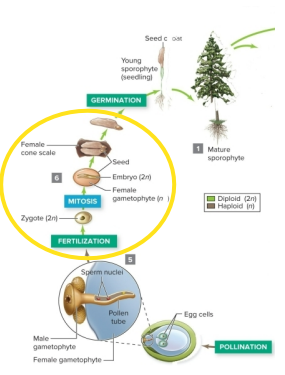
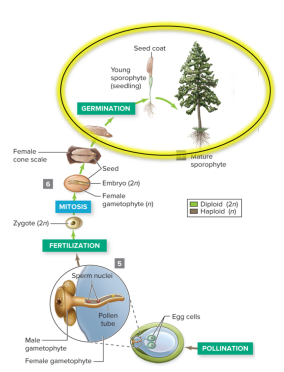
Seeds protect sporophyte embryos
Gymnosperm seeds have a tough outer coat and can be dispersed by wind or animals.
When conditions are favorable they will germinate into seedlings, which develop into mature sporophyte trees.
Angiosperms have flowers and fruit
95% of all living plant species are angiosperms
They evolved about 144 million years ago and rapidly diversified into over 260,000 different species.
Angiosperms produce seeds in fruits
Angiosperms produce pollen and egg cells in flowers, which develop into after fertilization
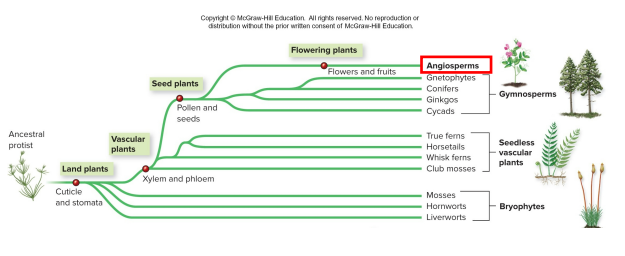
97% of angiosperms are either eudicots or monocots
Scientists classify the diverse angiosperms into several groups, notably
The other 3% of angiosperms are the paraphyletic group called
Difference between monocots and dicots

Parts of a flower
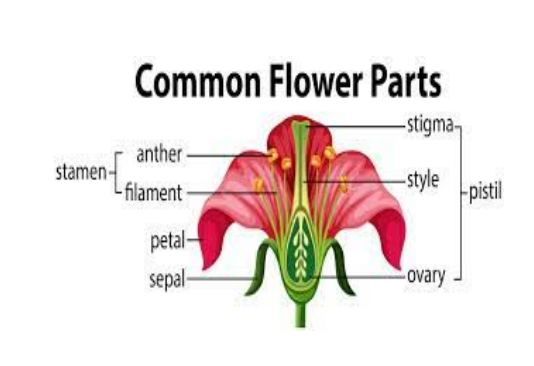
Parts of a typical angiosperm

Most angiosperms are dicots
Eudicots have two cotyledons, which are the first leaves to emerge during germination. Their pollen grains have
Examples include roses, daisies, sunflowers, oak trees, beans, and the model organism Arabidopsis
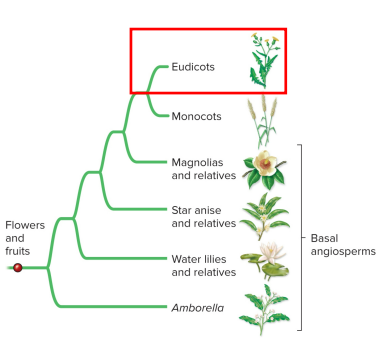
Many angiosperms are monocots
Monocots have one cotyledon. Their pollen grains have
Examples include orchids, lilies, grass, bananas, rice, wheat, and corn

Angiosperm sporophytes are large and conspicuous
Trees and other familiar angiosperms we see are the sporophytes
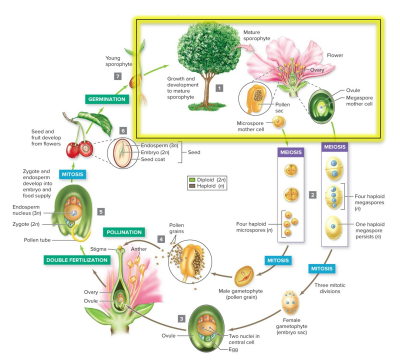
Microscopic gametophytes get together at pollination
During pollination, a grain of pollen (male gametophyte) produces a pollen tube to reach the female gametophyte

Angiosperms have double fertilization
Two sperm nuclei travel through the pollen tube.
One fertilizes the egg, forming a zygote. This is the first cell of the sporophyte.
The other sperm fertilizes the central cell’s polar nulcei. This will develop into the endosperm, which feeds the embryo inside the seed
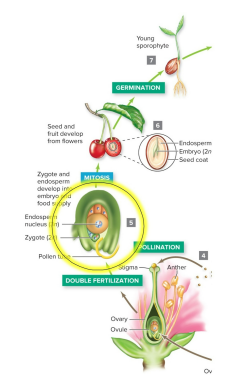
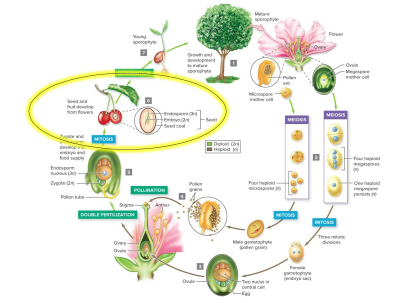
Seeds contain embryo and endosperm
In angiosperms, the ovule develops into a seed. At the same time, the ovary that surrounds the ovule develops into a fruit
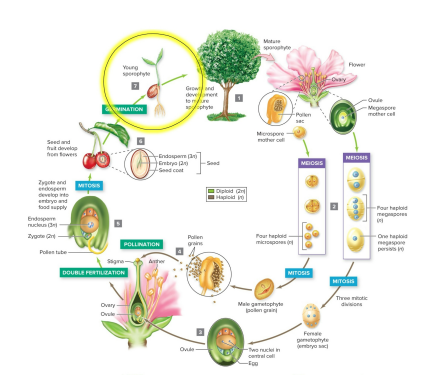
Angiosperm seeds germinate when conditions are favorable
Seeds germinate into young sporophytes
Wind and animals assist angiosperm reproduction
Pollen is transported great distances by wind
Plants with attractive nectar, petals, or bright colors co - evolved with animals that pollinate them