Food Systems
 Call Kai
 Learn
Learn Practice Test
 Spaced Repetition
 Match
Match Flashcards
 Knowt Play
1/139

There's no tags or description
Looks like no tags are added yet.
Name | Mastery | Learn | Test | Matching | Spaced | Call with Kai |
|---|
No analytics yet
Send a link to your students to track their progress
140 Terms
neophilia
need to eat
neophobia
will it kill me?
when did farm amounts decrease and farm sizes increase
around 1954-1974
what did the industrial agricultural revolution lead to
exploitation of the US great plains, decreased price of food for europe’s population, european farmers out of business, dependence on fossil fuels
what did the second agricultural revolution lead to (pre-industrial)
four course crop rotation, selective breeding of sheep
what four things are special about today’s industrialized food system?
use of chemical inputs, fossil fuel powered mechanisms, upstream/downstream consolidation, increased processing of foods
what are the pre-industrial sources of chemical inputs
crop rotation, animal manure, night soil
what is an example of a modern way of developing chemical inputs, and describe it
ammonia synthesis; turning gaseous nitrogen into solid nitrogen
what are examples of upstream consolidation in the industrialized food system
growing power of input providers, farm specialization
what are examples of downstream consolidation in the industrialized food system
retailers having power over what/where gets sold, consumer brands own other brands
what is the most broad impact of agriculture (relating to ecosystems)
takes natural systems out of equilibrium
what was the health impact of agriculture
increase in zoonotic diseases
what prompted the development of agriculture in general
the birth of cities
what were the downsides to being a sedentary society, and what were the responses?
vulnerability to weather changes; trade & storage
what was special about the roman empire?
largest importer of grain, nile provided stable yields to egypt
define regional interdependence, and give an example
countries within the same area depend on imports/exports from each other; NL depends on EU imports
define sectoral interdependence, and provide an example
different economic sectors relying on each other; 30% energy and 90% water used for food system
define cross-scale interdependence, and give an example
changes at one level impact things at another level; price based on supply & demand within markets
what happens when there are more steps in the supply chain (farmer’s fate)
less money for farmers
how much of the ice-free land is used for cropland
40%
what was the chimpanzee diet/lifestyle, and why would this not be sustainable for humans?
100+ plant species, mainly fruits, mild-moderate meat consumption (more meat than us), most of their day spent looking for food, shared meat, used objects as tools; our high population limits this diet
what was the gorilla diet/lifestyle, and why would this not be sustainable for humans?
vegetables/plants 68% of their diet; humans don’t have the body to support this, colons too small, microbiome couldn’t absorb enough nutrients to keep us alive
what was the ice age diet/lifestyle, and why is this not sustainable for humans?
hunting megafauna; would only work if hunted animals had high fat content, population size makes this impossible
what is the large herbivore diet/lifestyle, and why wouldn’t this be sustainable for humans?
hunting large herbivores like bison/deer; population too high, starvation diet (lack of fats and/or carbohydrates)
what was the arctic blubber diet/lifestyle, and why wouldn’t this be sustainable for humans?
hunting marine mammals; hard to locate/kill, only some marine mammals provide enough nutrients, too high population
why did humans switch from hunting/gathering to agriculture?
hunting/gathering didn’t support large number of people (only 20-30)
around how many years ago did the population kick off?
6,000 to 2,000 years ago
what percentage of our diet needs to be from carbohydrates?
45% - 65%
what percentage of our diet needs to be from fats?
20% - 35%
what percentage of our diet needs to be from protein?
10% - 35%
what is a starvation diet?
a diet that lacks a nutrient necessary for survival
how many grasses are edible? how many do we cultivate, and how much of the annual harvested crops do they account for?
12,000 edible; 20 species cultivated, 75% harvested crops
what two species are mainly produced, and how much of the food energy do they account for?
rice & wheat; 35% global food energy
in general, how have crops changed via domestication?
increase grain retention, yield larger amounts with larger grain sizes, reduce number of leaves, increase number of fruits, sweeter taste, increased size of edible parts
what makes a crop viable for mass production?
energy density and macronutrient content
what makes a crop viable to being a staple food
short mature time (90-120 days), ripen relatively quickly, fairly high yield, long shelf-life, easily digestible and palatable, critically attributable (nutrient-dense)
what are the founder crops?
emmer wheat, einkorn wheat, barley, lentils, peas, chickpeas, faba beans, flax
what are the upsides and downsides to grains compared to fruits and vegetables in terms of energy & nutrients?
energy dense (18x vegetables, 7x fruits), lots of carbohydrates & proteins; small amount of fats
what is compulsory fortification?
enrichment by minerals and vitamins
what are the most import cereals?
flours, rice, corn
what is the maximum amount of moisture grains can contain for short term and long term storage?
<15%; <13%
what percent of harvestable grain is available for human consumption?
<50%
what are the agricultural downsides to relying on grains?
diversity-reducing, restricted range, degradation of soil, fertilizers, greenhouse gas emissions
what was jared diamond’s opinion of agriculture, and what was smil’s counterargument?
agriculture at fault for bringing malnutrition, epidemic diseases, deep class division, and gender inequality; overlooking experiences of older societies
what was william davis’s opinion of agriculture, and what was smil’s counterargument?
wheat has killed more people than all wars combined; countries with high life expectancies also consume a lot of wheat
define agronomy
science of the relationship between crops and environment
what are photo-autotrophic organisms
make their own organic compounds from inorganic material
what are the three phases of the calvin cycle?
carbon fixation; reduction of ATP & NAHPH to produce G3P; generatemore RuBP & restart cycle
what is glucose converted into in plants, and what are their purposes?
starch; store energy, cellulose; build cells, respiration; get energy, fats; store energy
calculate the efficiency of photosynthesis
fraction of light energy converted into chemical energy
what is different between C3, C4, and CAM photosynthesis?
CO2 bonds to RuBP to produce 3-PGA; CO2 is fixed to a 4C compound; CO2 is fixed to compounds and stomata open at night
what is liebig’s law of the minimum?
growth and development of a plant is determined by the scarcest essential resource
what are the macronutrients for plants?
nitrogen, phosphorous, potassium, sunlight, water, CO2
what is water vapor deficit (WVD)?
difference in vapor pressure inside and outside leaf
what is water use efficiency (WUE)?
plant mass per unit volume of water used by plants; rate of biomass produced to rate of transpiration
what type of temperatures do plants grow faster in?
higher temperatures, but within their niches
what are the pros/cons of inorganic fertilizers?
solid/liquid forms, quick results, adapted to specific plant; high environmental impacts
what are the pros/cons of organic fertilizers?
takes longer to decompose
what are the two types of strategies for farming, and what are the pros/cons of them?
monocultures; high productivity & efficiency, lower cost for farmer, easier to manage
crop rotation; interrupts pest cycles, maintains soil composition, fewer inputs, higher biodiversity
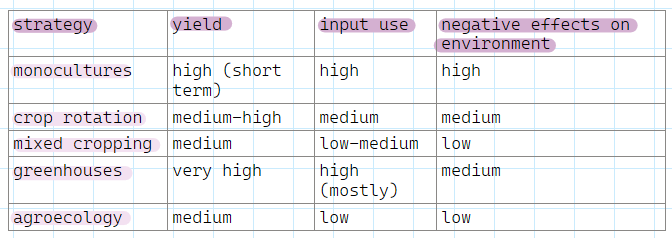
identify the yield, input use, and negative effects on the environment that monocultures, crop rotation, mixed cropping, greenhouses, and agroecology have:
high, high, high; medium-high, medium, medium; medium, low-medium, low; very high, high, medium; medium, low, low
what are the three pathways to domestication, and explain them?
directed; capture wild animals, taming/forced, selective breeding
commensal; animals attracted to humans
prey; animals hunted away from settlements, game management, extensive breeding
how long are cows pregnant for and how long do they produce milk for?
9 months; 7 months
rank vegan, low ecological cost, current diets in terms of which diet uses the least arable land, then which provides the least grams of protein (least to most)
low ecological, vegan, current; vegan, low ecological, current
define low cost livestock feeding
animals eat things humans don’t eat, use land not sustainable for humans or food production
what are the benefits of consuming blue foods
reduce nutrient deficiencies, reduce red meat overconsumption, reduce ghg emissions, contribute to employment, export revenue & nutrition
are the greenhouses atmospheres different from our atmosphere
they contain 2-3 times the current level of CO2
why is photosynthesis inefficient, and how efficient is it?
limited to visible radiation, reflect green, 37% solar irradiance available to energize, respiration further reduces; 4.6% max efficiency
what common crops does photorespiration occur?
wheat, rice, rye, oats, barley, all roots tubers legumes and oil crops
what common crops does photorespiration NOT occur in?
corn, sorghum, millet, sugarcane
what is the actual photosynthetic efficiency of C3 and C4 plants?
3.5% C3; 4.3% C4
rate the total photosynthetic efficiency of the following crops in order of most to least: wheat, corn, rice, rapeseed, potatoes, sugarcane
sugarcane, potatoes, corn, rapeseed, rice, wheat
are C3 or C4 plants more water efficient?
C4
define transpiration
stomata open to let water & oxygen out and CO2 in
what happens when plants experience low VPD (vapor pressure deficit) and define what VPD is
transpiration slows down; difference in vapor pressure inside and outside leaf
what is the most commonly deficient macronutrient in crops?
nitrogen
define photorespiration
rubisco binds to oxygen instead of carbon dioxide
what is mariculture and what are the costs/benefits?
harvesting marine organisms in natural habitat; lots of pollution
what is inland aquaculture and what are the costs/benefits?
growing marine life quickly in controlled conditions; more ownership-based, lots of pollution
what is low-trophic aquaculture and what are the costs/benefits?
utilizing primary & secondary producers to feed marine life; more sustainable, require limited freshwater & land inputs
what is integrated multi-trophic aquaculture and what are the costs/benefits?
utilizing more of the food cycle to feed marine life; self-feeding ecosystem, more sustainable
what do brown, red, and green seaweed colors represent in terms of richness?
iodine; protein; minerals
what are the environmental pressures of marine food?
illegal fishing, overfishing, pollution, climate change
what are the pros and cons of chemical, organic, and biodiversity-based inputs?
high specialization, capital-intensive; specialized, capital-intensive; lower risk when high diversity & minimal soil disturbance, relies natural processes
what is the one acre fund?
a company that guides smallholder farms in kenya to fill in ecological or socio-economic necessities preventing them from success
what are numerous animals, and why are they most commonly what humans have domesticated?
digest lignocellulosic phytomass (cell walls); convenient
what farm animal is the compromise animal, and what is this?
pigs; not too small, not too large
what does body mass have to do with basal metabolism (in warm-blooded animals)?
decreases with increasing size - smaller animals need more energy per unit of weight
what are the edible/live meat ratios of chicken, pork, and beef?
60%; 55%; 40%
what percent of harvested fish is used to feed other species
11%
how many kcals does 1g of protein, carbohydrates, and fats contain?
4 kcal; 4 kcal; 9 kcal
what are the differences between globalized commodity-based economy, circular/biobased economy, alternative food systems, and landscape approach?
interchangeable raw material, low prices require high efficiency/productivity; close material & energy cycles; value based on community, specialized, found in developed economies; optimize farming based on landscape, local & regional value retention
what foods have the highest environmental impact and relative risk of mortality?
unprocessed & processed red meats
what foods do the following countries eat more than the eat-lancet’s diet’s recommendations: global, sub-saharan africa, south asia, north america
beef, starchy vegetables; starchy vegetables; starchy vegetables; beef, starchy vegetables, eggs, chicken, dairy
how do you calculate energy requirements?
REE (resting) + TEF (total during day) + PA (physical activity)
how much fiber should you eat in a day?
25g
how much of the macrominerals do you need a day, and name some?
100mg; calcium, phosphorus, magnesium, sulfur, sodium, chloride, potassium
what are the differences between communicable and non-communicable diseases?
transferable; non-transferable, long-term, results of genes & environmental/behavioral factors
what are the five stages of nutrition transitions, and what stage has no country entered yet?
collecting food (hunter/gathering), famine (monocultures), receding famine (increased variety), transitioning economies (processed & animal foods), behavioral change (higher intake of fruit, vegetables, whole grains); stage 5
what are the four groups of foods increasing in level of processing, and provide examples?
unprocessed (fresh veggies), processed culinary ingredients (flour), processed foods (canned veggies), ultra-processed foods (pizza)
what are the medical differences between undernutrition, micronutrient deficiency, and obesity in terms of malnutrition?
low height/weight for age, marasmus-kwashlorkor (swelling); essential nutrients not present in adequate amounts; higher weight for height, unbalanced energy consumption/expenditure

