Discerning Life Questions: Spirituality, Self-Awareness, and Decision-Making
 Studied by 0 people
 Call with Kai
 Learn
Learn Practice Test
 Spaced Repetition
 Match
Match Flashcards
 Knowt Play
1/78

There's no tags or description
Looks like no tags are added yet.
Name | Mastery | Learn | Test | Matching | Spaced | Call with Kai |
|---|
No analytics yet
Send a link to your students to track their progress
79 Terms
Chasing Rabbits
People chase after things that aren’t theirs (not their rabbit to chase) so they fall out of commitment
Seeing the value and importance of the “rabbit” that you are committing to
What is the significance of understanding commitments?
Understanding why you are where you are
For one to grow in love with that commitment, one needs to mature
Only then can we have perseverance to keep chasing the commitmet
What are questions an expression of?
Curiosity, uncertainty, or a desire for understanding
Why do we ask questions?
To seek truth, learn and grow, discern decisions, connect with others, deepen faith, and live attentively.
How do questions help in decision-making?
They help slow down impulsive reactions and encourage careful consideration of choices.
What is self-awareness?
It is the conscious knowledge of one's own character, feelings, motives, and desires.
What role does self-awareness play in serving others?
It helps individuals recognize their needs and the needs of others, fostering humility and service.
What is mindfulness?
Mindfulness involves paying attention intentionally, in the present moment, and without judgment.
What are the four components of mindfulness?
1. Paying attention 2. On purpose 3. In the present moment 4. Non-judgmentally.
What does the metaphor of closed fists represent?
Closed fists symbolize a lack of love and openness, contrasting with the open hands of forgiveness.
What are helpful attitudes in relationships?
Openness, trust, and respect are essential for healthy interactions.
What does the elephant metaphor illustrate about mindsets?
It shows how conditioned beliefs can limit one's potential and willingness to try new things.
How can one gain perspective in discernment?
By stepping back to see the bigger picture rather than focusing too closely on details.
What is the difference between a pilgrim and a tourist?
A pilgrim seeks transformation and meaning in their journey, while a tourist seeks comfort and enjoyment.
What attitude does a pilgrim have towards hardship?
A pilgrim accepts hardship as integral to their journey, seeing it as a means of inner purification.
What does Thomas Bremer suggest about being a pilgrim or tourist?
He suggests that individuals can embody both roles and should recognize when to adopt each mindset.
What is the underlying worldview of a pilgrim?
It is rooted in religious logic and asceticism, focusing on spiritual growth.
What is the underlying worldview of a tourist?
It is shaped by modern capitalist values, seeking experiences that affirm the self.
How can one deepen relationships through questions?
By showing interest in others and fostering dialogue rather than monologue.
What does it mean to live more attentively?
It involves cultivating awareness of one's surroundings and experiences.
What is the importance of discernment in life-changing situations?
Discernment helps in making thoughtful choices rather than impulsive reactions.
What is the role of curiosity in learning?
Curiosity drives the desire to ask questions, leading to deeper understanding and growth.
What does it mean to live with humility?
Living with humility involves recognizing one's limitations and being open to the needs of others.
What is the significance of the journey in a pilgrim's life?
The journey is transformative, aimed at becoming worthy of the sacred presence.
How can one increase their interior space?
By practicing mindfulness and being present in the moment.
What is the 'tourist' approach to traveling?
It involves maximizing new experiences during travels.
What aspects of life are considered unchangeable?
Factors such as birthplace, socioeconomic status, appearance, genetic makeup, family origin, and health.
How can one feel about their current life situation?
By learning to accept unchangeable aspects and letting go of negative feelings.
What is the condition of the heart when beginning a personal journey?
It can feel lighter and less burdened by negative thoughts.
What does the 'inner landscape' refer to?
It pertains to understanding one's true self.
What are the three circles in self-discovery?
1. Where circle: things you cannot control; 2. How circle: what you do with what you've been handed; 3. Who circle: center of your being.
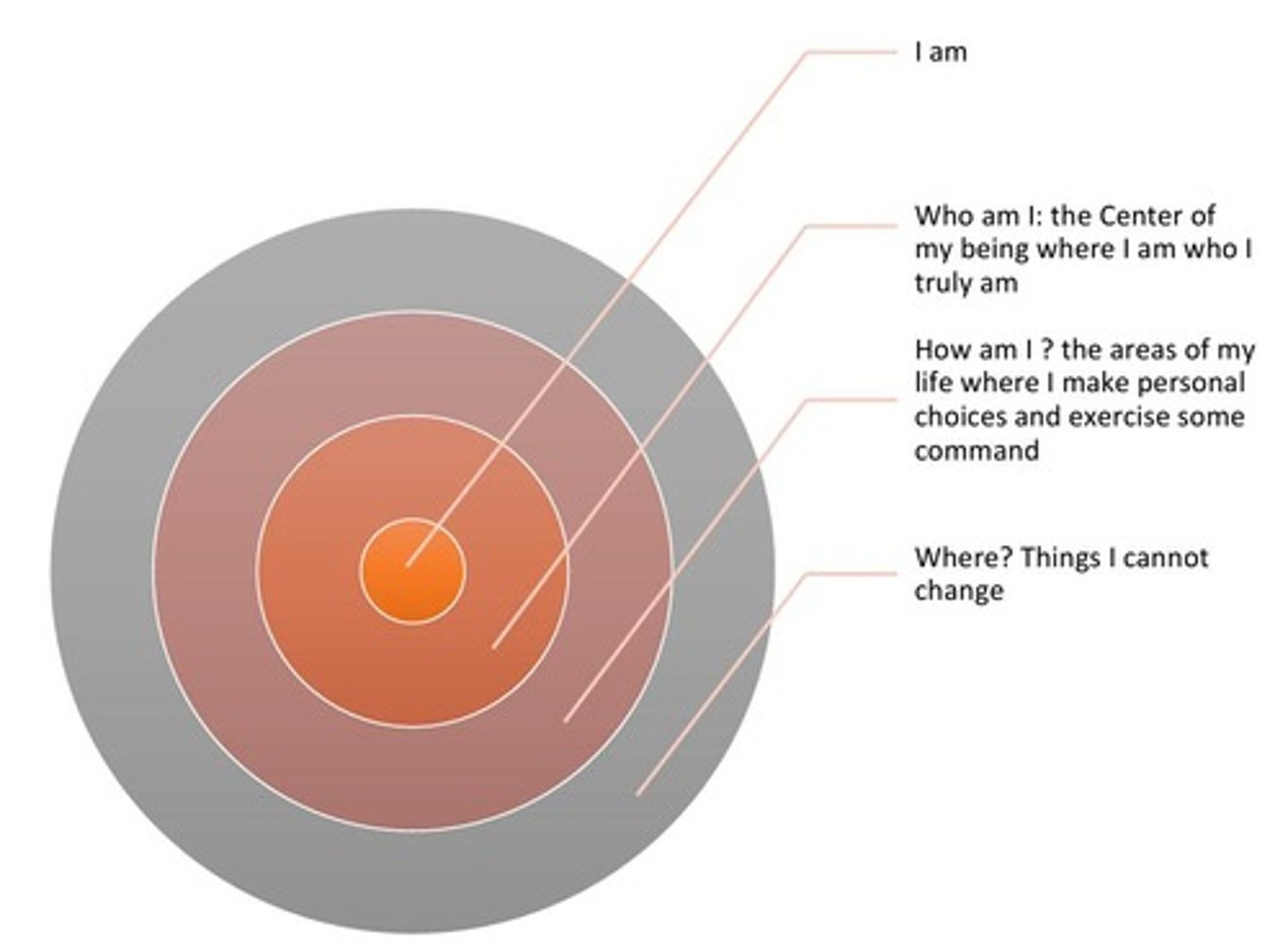
What does the journey to your center require?
Complete vulnerability and looking at oneself without excuses.
How is prayer described in the context of transformation?
As a radial journey that connects inward and outward to transform oneself.
What is true freedom according to the text?
Transforming who you are rather than changing your circumstances.
What is a common temptation regarding freedom?
Believing that freedom comes from changing one's circumstances.
What is the definition of spirituality according to Haight?
The logic, character, and consistent quality of living.
What does ultimate reality measure in a person's life?
It serves as an internalized criterion for assessing one's spirituality and personhood.
What are the two dimensions of ultimate reality?
Ethical: values guiding decisions; Metaphysical: the ultimate goal or purpose of life.
What does spirituality involve according to the text?
How we handle our longings, pain, and hope.
How is spirituality often misunderstood?
It is seen as exotic or optional rather than vital and non-negotiable.
What does the 'fire within' represent?
The innate desire that drives individuals to contemplate the divine.
What is the first path in the Six Paths of Belief?
The Path of Belief, characterized by faith in God present since childhood.
What is the significance of embracing inborn shortcomings?
It involves accepting aspects of oneself that were previously resented.
What does the phrase 'mosaic of the people I've met' imply?
It suggests that one's identity is shaped by relationships and experiences with others.
What does the journey inward require according to the text?
A willingness to confront oneself without excuses.
What is the ultimate goal of spirituality?
To channel the inner fire and desire into meaningful actions.
What does 'changing the who' refer to?
Transforming one's inner self rather than external circumstances.
How does the text describe the nature of human beings?
As beings with a fundamental dis-ease and an unquenchable fire for peace.
What is the role of spirituality in dealing with unrest?
It involves how we manage our inner desires and longings.
What does the text suggest about the nature of desire?
Desire is central to our lives and shapes our spirituality.
What is a misconception about spirituality?
That it is a choice or optional rather than an inherent aspect of being human.
What is the purpose of the 'fire that burns within us'?
To inspire contemplation of the divine and shape our spiritual journey.
What is a key characteristic of the 'Path of Independence'?
Conscious separation from organized religion while still believing in God.
What are some benefits of belonging to a worshipping community?
Provides support, identity, and a strong sense of being known and accompanied.
What challenge can arise from complacency in faith?
Faith can stagnate if not developed beyond childhood understanding.
What is a common characteristic of those on the 'Path of Disbelief'?
An intellectual conclusion that God may not exist or cannot be known.
What are some benefits of the 'Path of Disbelief'?
Authenticity, clear values, and serious engagement with hard questions.
What challenge do individuals on the 'Path of Disbelief' face?
Overreliance on intellectual proof can dismiss emotional or experiential encounters.
What defines the 'Path of Return'?
A reawakening of spiritual questions after a life event, leading to a mature faith.
What is a benefit of the 'Path of Return'?
Faith is relearned on one's own terms, leading to a deeper relationship with God.
What challenge might someone on the 'Path of Return' encounter?
Lingering disappointment with earlier religious experiences.
What characterizes the 'Path of Exploration'?
Openness to multiple religious traditions and 'trying on' beliefs.
What is a benefit of the 'Path of Exploration'?
Deep appreciation for diverse ways of encountering God.
What challenge does the 'Path of Exploration' present?
Risk of a lack of commitment or rootedness in any one tradition.
What defines the 'Path of Confusion'?
Fluctuating belief and doubt, with intermittent prayer and worship.
What is a benefit of being on the 'Path of Confusion'?
Ongoing refinement of beliefs and honest grappling with faith.
What challenge might arise from the 'Path of Confusion'?
Confusion can lead to spiritual laziness and avoidance of commitment.
What is a helpful attitude when considering different spiritual paths?
Introspection, openness, and curiosity without minimizing others' experiences.
What is the three-step process for making big life decisions according to the notes?
1. Look inward to understand yourself; 2. Look outward to see your place in the world; 3. View choices through a lens of unconditional love.
What is the significance of balancing images of God from the Old and New Testaments?
It prevents an incomplete understanding and promotes maturation in faith.
What are some unhealthy images of God mentioned in the notes?
God as a punishing figure, a strict parent, or a genie who grants wishes.
How can unhealthy images of God be undone?
Through determined effort and confronting unconscious images of God.
Why is it important to revisit and nuance our image of God?
Because God is a mystery and our understanding should mature over time.
What is the ultimate goal of the spiritual life according to the notes?
To choose what better leads to God's deepening life within oneself.
What is a common experience for those on the 'Path of Exploration'?
A tendency to take one's tradition for granted once a spiritual home is found.
What can be a fertile place for discernment in one's faith journey?
The 'Path of Confusion' with its honest grappling with belief and doubt.
What is a potential outcome of the 'Path of Return'?
A more mature and resilient faith that is personally owned.
What is a challenge faced by those who have left organized religion?
The search for a perfect religious community can set them up for failure.
What is a characteristic of individuals who are 'Lapsed' or 'Fallen away'?
They often find solace in childhood religious practices despite leaving organized religion.
 Note
Note  Flashcards (31)