Plant Kingdom
Algae:
- They are ^^chlorophyll-bearing, simple, thalloid, autotrophic and largely aquatic^^ (both fresh water and marine) organisms.
- They occur in a variety of other habitats: moist stones, soils and wood.
- Some of them also occur in association with %%fungi (lichen) and animals.%%
- The form and size of algae are highly variable, ranging from
- The algae reproduce by vegetative, asexual and sexual methods.
- Vegetative reproduction is by @@fragmentation@@@@.@@
- Each fragment develops into a @@thallus.@@
- Asexual reproduction is the production of different types of spores, the most common being the ==zoospores.==
- They are flagellated (motile) and on germination give rise to new plants.
- Sexual reproduction takes place through the fusion of two gametes.
- These gametes can be ^^flagellated and similar in size (as in Ulothrix)^^ or on-flagellated (non-motile) but similar in size (as in Spirogyra). Such reproduction is called ==isogamous.==
- Fusion of in size, as in species of
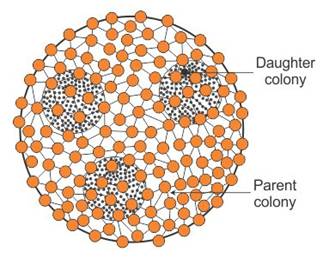
- Fusion between one large, nonmotile (static) female gamete and a smaller, motile male gamete is termed ==oogamous as in Volvox, Fucus.==
Importance of Algae:
- At least half of the total carbon dioxide fixation on earth is carried out by algae through photosynthesis.
- Being photosynthetic they increase the level of dissolved oxygen in their immediate environment.
- They function as primary producers of energy-rich compounds which form the basis of the food cycles of all aquatic animals.
- Certain marine brown and red algae produce large amounts of @@hydrocolloids (water-holding substances)@@ @@like@@ @@algin and carrageen@@@@.@@
- Porphyra, Laminaria and Sargassum are among the 70 species of marine algae ==used as food.==
- ^^Agar^^^^,^^ obtained from Gelidium and Gracilaria is used to grow microbes and ^^in preparations of ice creams and jellies.^^
- %%Chlorella%%, a unicellular alga rich in proteins is used as a food supplement even by space travellers.
Chlorophyceae:
- The members of Chlorophyceae are commonly called ^^green algae.^^
- The plant body may be ^^unicellular, colonial or filamentous.^^
- They are usually grass green due to the dominance of %%pigments chlorophyll a and b.%% %%The pigments are localised in%% %%definite chloroplasts.%%
- The chloroplasts may be in different species.
- Most of the members have one or more @@storage bodies called pyrenoids@@ located in the chloroplasts.
- @@Pyrenoids contain protein besides starch.@@
- Some algae may store food in the form of %%oil droplets.%%
- They have a rigid cell wall made of an
- Vegetative reproduction usually takes place by %%fragmentation%% or by the formation of different types of %%spores%%%%.%%
- Asexual reproduction is by ^^flagellated zoospores produced in zoosporangia.^^
- Sexual reproduction shows considerable variation in the type and formation of sex cells and it may be
Examples: ==Chlamydomonas, Volvox, Ulothrix, Spirogyra and Chara.==
 Phaeophyceae:
- They are @@brown algae@@ which are found primarily in
- They show great variation in size and form.
- They range from ^^simple branched, filamentous forms (Ectocarpus) to profusely branched forms as represented by kelps, which may reach a height of 100 metres.^^
- They possess
- They vary in colour from olive green to various shades of brown depending upon the amount of the @@xanthophyll pigment, and fucoxanthin@@ present in them.
- Food is stored as %%complex carbohydrates%%%%,%% which may be in the form of %%laminarin or mannitol.%%
- The vegetative cells have a cellulosic wall usually covered on the outside by a ^^gelatinous coating of algin.^^
- The protoplast contains plastids, a centrally located vacuole and a nucleus.
- The plant body is usually attached to the substratum by a @@holdfast@@ @@and has a@@ @@stalk, the stipe@@ @@and leaf-like@@ @@photosynthetic organ@@@@,@@ @@the frond.@@
- Vegetative reproduction takes place by @@fragmentation.@@
- Asexual reproduction in most brown algae is by biflagellate zoospores that are pear-shaped and have two %%unequal laterally attached flagella.%%
- Sexual reproduction may be ^^isogamous, anisogamous or oogamous.^^
- The union of gametes may take place in water or within the oogonium.
- The gametes are
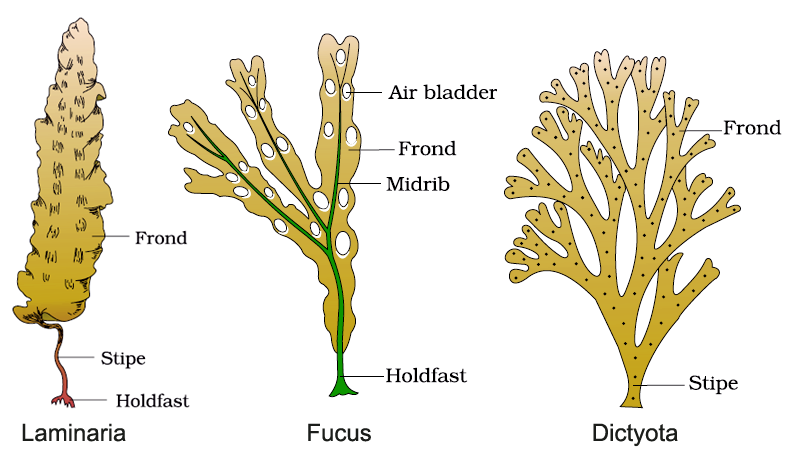 Examples: @@Ectocarpus, Dictyota, Laminaria, Sargassum and Fucus.@@
Rhodophyceae:
- They are red algae because of the predominance of the red pigment, %%r-phycoerythrin%% %%i%%n their body.
- The majority of the red algae are marine with greater concentrations found in the
- They occur in both well-lighted regions close to the surface of the water and also at great depths in oceans where relatively little light penetrates.
- The red thalli of most of the red algae are ^^multicellular.^^
- Some of them have complex body organisation.
- The food is stored as floridean starch which is very similar to @@amylopectin and glycogen@@ in structure.
- The red algae usually reproduce vegetatively by ==fragmentation====.==
- They reproduce asexually by non-motile spores.
- Sexually, they reproduce by non-motile gametes.
- Sexual reproduction is ==oogamous== and accompanied by complex post-fertilization developments.

Examples: %%Polysiphonia, Porphyra, Gracilaria and Gelidium.%%
Bryophytes:
- They are found commonly growing in ==moist shaded areas== ==in the hills. They usually occur in== ==damp, humid and shaded localities====.==
- They are also called ^^amphibians of the plant kingdom^^ because these plants can live in soil but are dependent on water for sexual reproduction.
- The plant body is and attached to the substratum by ==unicellular or multicellular rhizoids==.
- They structures.
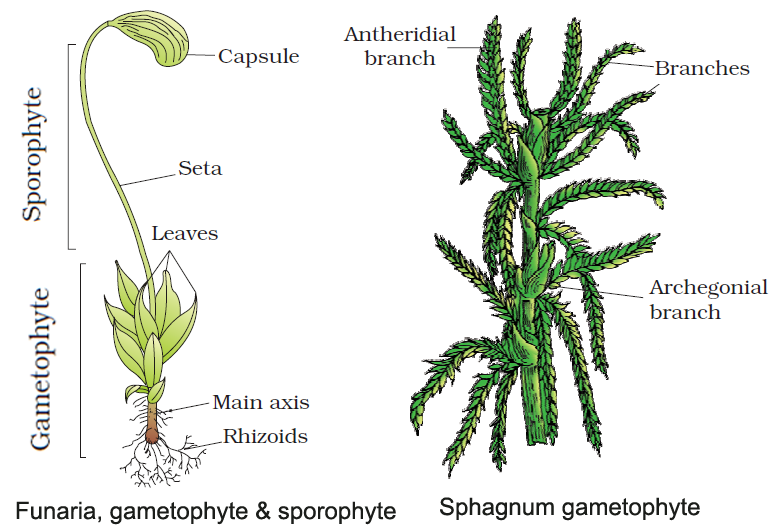
- The main plant body of the bryophyte is haploid. It produces gametes, hence is called a gametophyte.
- The sex organs in bryophytes are %%multicellular%%.
- The male sex organ is called ^^antheridium^^ ^^which produces^^ ^^biflagellate antherozoids.^^
- The female sex organ called
- The antherozoids are released into the water where they come in contact with archegonium.
- An antherozoid fuses with the egg to produce the zygote.
- Zygotes do not undergo reduction division immediately.
- They produce a ==multicellular body called a sporophyte.==
- The sporophyte is %%not free-living%% but attached to the photosynthetic gametophyte and derives nourishment from it.
- Some cells of the sporophyte undergo (meiosis) to produce haploid spores. These spores germinate to produce %%gametophytes.%%
Importance of Bryophytes:
- They play an important role in @@plant succession on bare rocks/soil.@@
- Some mosses provide @@food for herbaceous mammals@@, birds and other animals.
- Species of %%Sphagnum%%%%, a moss,%% %%provide peat%% %%that has long been used as%% %%fuel, and as packing material for trans-shipment%% %%of living material because of their%% %%capacity to hold water%%.
- ^^Mosses along with lichens are the first organisms to colonise rocks^^ and hence, are of great ecological importance.
- They decompose rocks making the substrate suitable for the growth of higher plants. Since mosses form dense mats on the soil, they
Liverworts:
- They grow usually in ==moist, shady habitats== such as banks of streams, marshy ground, damp soil, the bark of trees and deep in the woods.
- The plant body of a liverwort is . The thallus is dorsiventral and closely appressed to the substrate.
- The leafy members have tiny %%leaf-like appendages%% in two rows on the stem-like structures.
- Asexual reproduction in liverworts takes place by ^^fragmentation of thalli,^^ ^^or by the^^ ^^formation of specialised structures called gemmae^^
- %%Gemmae are green, multicellular, asexual buds%%%%, which develop in small receptacles called%% %%gemma cups%% %%located on the thalli.%%
- During sexual reproduction, male and female sex organs are produced either on the same or on different thalli.
- The sporophyte is differentiated into a %%foot, seta and capsule.%% After meiosis, spores are produced within the capsule.
- These spores germinate to form ^^free-living gametophytes.^^
Mosses:
- The predominant stage of the life cycle of a moss is the gametophyte which consists of two stages.
- The first stage is the which develops directly from a spore which is a
- The second stage is the @@leafy stage@@, which develops from the @@secondary protonema@@ as a lateral bud.
- They consist of upright, slender axes bearing %%spirally arranged leaves%%%%.%%
- They are attached to the soil through ^^multicellular^^ ^^and^^ ^^branched rhizoids.^^
- Vegetative reproduction in mosses is by ^^fragmentation and budding^^ in the secondary protonema.
- In sexual reproduction, the sex organs %%antheridia and archegonia%% %%are produced at the%% %%apex of the leafy shoots.%%
- After fertilization, the zygote develops into a sporophyte, consisting of a foot, seta and capsule.
- The ^^sporophyte in mosses is more elaborate than that in liverworts.^^
- The capsule contains spores which are formed after meiosis.
- The mosses have an elaborate mechanism of spore dispersal.
Examples: %%Funaria, Polytrichum and Sphagnum.%%
Pteridophytes:

@@They are the first terrestrial plants to possess vascular tissues – xylem and phloem.@@
- They are found in cool, damp, shady places though some may @@flourish well in sandy-soil conditions.@@
- Their main plant body is a sporophyte which is
- The ^^leaves are small^^ ^^(microphylls) as in^^ ^^Selaginella^^ ^^or^^ ^^large^^ ^^(macrophylls) as in^^ ^^ferns.^^
- The sporophytes bear sporangia that are subtended by %%leaf-like appendages called sporophylls.%%
- In some cases, sporophylls may form distinct @@compact structures called strobili or cones (Selaginella, Equisetum).@@
- The sporangia produce spores by meiosis in spore mother cells which germinate to give rise to inconspicuous, small but multicellular, free-living, mostly photosynthetic thalloid gametophytes called ^^prothallus.^^
- These gametophytes require cool, damp, shady places to grow because of which the spread of living pteridophytes is @@limited and restricted@@ to narrow geographical regions.
- The gametophytes bear male and female sex organs called antheridia and archegonia, respectively.
- %%Water is required for the transfer of%% %%antherozoids.%%
- Fusion of male gamete with the egg present in the archegonium results in the formation of zygote.
- Zygote thereafter produces a multicellular well-differentiated sporophyte which is the ^^dominant phase^^ ^^of the pteridophytes.^^
- In the majority of the pteridophytes, all the spores are of similar kinds; such plants are called %%homosporous.%%
- Genera like ^^Selaginella and Salvinia^^ which produce two kinds of spores, macro (large) and micro (small) spores, are known as %%heterosporous.%%
- The megaspores and microspores germinate and give rise to female and male gametophytes, respectively.
- The female gametophytes in these plants are retained on the parent sporophytes for @@variable periods.@@
- The %%development of the zygotes%% %%into young embryos takes place within the%% %%female gametophytes.%%
- This event is a precursor to the %%seed habit%% considered an important step in evolution.
- The pteridophytes are further classified into four classes:
- ^^Psilopsida (Psilotum);^^
- ^^Lycopsida (Selaginella, Lycopodium)^^
- ^^Sphenopsida (Equisetum)^^
- ^^Pteropsida (Dryopteris, Pteris, Adiantum).^^
Gymnosperms:
- These are plants in which the %%ovules are not enclosed by any ovary wall and remain exposed, both before and after fertilisation.%%
- ^^The^^ ^^seeds^^ ^^that develop post-fertilisation, are not covered, i.e., are^^ ^^naked^^^^.^^
- They include medium-sized trees or tall trees and shrubs, one of which is the ==giant redwood tree Sequoia== ==is one of the tallest tree species.==
- The roots are generally @@tap roots.@@
- Roots in some genera have a fungal association in the form of ^^mycorrhiza (Pinus)^^^^, while in some others^^ ^^(Cycas) small specialised roots called coralloid roots are associated with N2 - fixing cyanobacteria.^^
- The stems are %%unbranched (Cycas) or branched (Pinus, Cedrus).%%
- The leaves may be ==simple or compound.==
- In Cycas, the pinnate leaves persist for a few years.
- The leaves in gymnosperms are well-adapted to withstand extremes of temperature, humidity and wind.
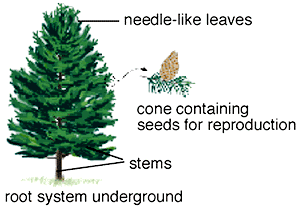
- In conifers, reduce the surface area. Their thick cuticle and sunken stomata also help to reduce water loss.
- The gymnosperms are heterosporous; they produce haploid microspores and megaspores.
- The two kinds of spores are produced within sporangia that are borne on sporophylls which are arranged spirally along an axis to form @@lax or compact strobili or cones.@@
- The strobili-bearing microsporophylls and microsporangia are called ^^microsporangiate or male strobili.^^
- The microspores develop into a male gametophytic generation which is @@highly reduced and is confined to only a limited number of cells.@@ This reduced gametophyte is called a @@pollen grain.@@
- The cones bearing megasporophylls with ovules or megasporangia are called %%macrosporangiate or female strobili.%%
- The male or female cones or strobili may be borne on the ^^same tree (Pinus).^^
- %%In%% %%cycas male cones and megasporophylls are borne on different trees.%%
- The megaspore mother cell is differentiated from one of the cells of the nucellus.
- The %%nucellus%% %%i%%s protected by envelopes and the composite structure is called an @@ovule@@.
- The ovules are borne on megasporophylls which may be clustered to form the female cones.
- The megaspore mother cell divides ==meiotically to form four megaspores.==
- One of the megaspores enclosed within the megasporangium develops into a multicellular female gametophyte that bears two or more archegonia or female sex organs.
- ^^The multicellular female gametophyte is also retained within the megasporangium^^.
- Unlike bryophytes and pteridophytes, in gymnosperms, the @@male and the female gametophytes do not have an independent free-living existence. They remain within the sporangia retained on the sporophytes.@@
- The pollen grain is released from the microsporangium and are carried in air currents and come in contact with the opening of the ovules borne on megasporophylls.
- The pollen tube carrying the male gametes grows towards archegonia in the ovules and discharges its contents ==near the mouth of the archegonia.==
- Following fertilization, the zygote develops into an embryo and the ovules into seeds which are not covered.
Angiosperms:

- The
- They are an exceptionally large group of plants occurring in a wide range of habitats.
- They range in size from the smallest %%Wolffia to tall trees of Eucalyptus (over 100 metres).%%
- The dicotyledons are characterised by seeds having ^^two cotyledons, reticulate venations in leaves, and tetramerous or pentamerous flowers^^, i.e., having four or five members in each floral whorls.
- The male sex organ in a flower is the %%stamen.%%
- Each stamen consists of a slender ^^filament with an anther at the tip.^^
- Within the anthers, the pollen mother cell divide by meiosis to produce microspores which mature into pollen grains.
- The female sex organ in a flower is the pistil which consists of a swollen ovary at its %%base, a long slender style and a stigma.%%
- Inside the ovary, ovules are present.
- Generally, each ovule has a ^^megaspore mother cell that undergoes meiosis to form four haploid megaspores.^^
- Three of them degenerate and %%one divides to form the embryo sac.%%
- Each embryo sac has a %%three-celled egg apparatus%% – one egg cell and two synergids, three antipodal cells and two polar nuclei.
- The polar nuclei eventually fuse to produce a %%diploid secondary nucleus.%%
- ^^Pollen grains, after dispersal from the anthers, are carried by wind or various other agencies to the stigma of a pistil. This is termed^^ ^^pollination.^^
- The pollen grains germinate on the stigma and the resulting %%pollen tubes grow through the tissues of the stigma and style and reach the ovule.%%
- The pollen tubes enter the embryo sac where two male gametes are discharged.
- One of the male gametes fuses with the egg cell (syngamy) to form a ^^zygote^^. The other male gamete fuses with the diploid secondary nucleus to produce the ^^triploid primary endosperm nucleus.^^
- This occurrence of two fusions i.e., syngamy and triple fusion, this event is termed %%double fertilisation, an event unique to angiosperms.%%
- The ^^zygote develops into an embryo^^ ^^(with one or two cotyledons) and the^^ ^^PEN develops into endosperm which provides nourishment to the developing embryo.^^
- The %%synergids and antipodals degenerate after fertilisation.%%
- During these events, the ovules develop into seeds and the ovaries develop into a fruit.