Robbers Cave Study
 Studied by 0 people
 Call with Kai
 Learn
Learn Practice Test
 Spaced Repetition
 Match
Match Flashcards
 Knowt Play
1/11

There's no tags or description
Looks like no tags are added yet.
Name | Mastery | Learn | Test | Matching | Spaced | Call with Kai |
|---|
No study sessions yet.
12 Terms
Aim
1) To find out what makes two groups develop hostile relationships
2) How can this be reduced
Sample
22 middle class 11-12 y/o American boys split into 2 equal groups (the Rattlers and the Eagles names were formed in stage 1/3 stages) depending on their intelligence and sporting ability.
Selected by opportunity sampling (selected based on availability)
Their parents (who were aware of the experiment) signed them up for ‘summer camp’.
What were the 3 stages?
Bonding, competitive and integration.
What is an intra and inter group referring to?
Intra- Amongst one group
Inter- Between 2 groups
Phase 1 (Bonding phase) procedure
Two groups of boys arrived separately and settled into cabins. For one week, they were given cooperative tasks (e.g., treasure hunt) and spent time bonding.
Phase 1 outcome
Each group developed its own identity (giving themselves names like "Eagles" and "Rattlers") and immediately requested to compete against the other group upon discovery of their existence.
Phase 2 (Competitive) procedure
The two groups participated in a competitive tournament involving physical sports (baseball, tug-of-war) and experimental tasks (bean counting).
The winning team received a trophy and coveted prizes (knives, medals).
Phase 2 outcome
The competition immediately led to hostility, negative stereotyping, and discrimination between the Eagles and the Rattlers.
e.g. the eagles burned down the rattlers’ flag and then the rattler’s raided the eagles’ camp
Phase 3 (integration)
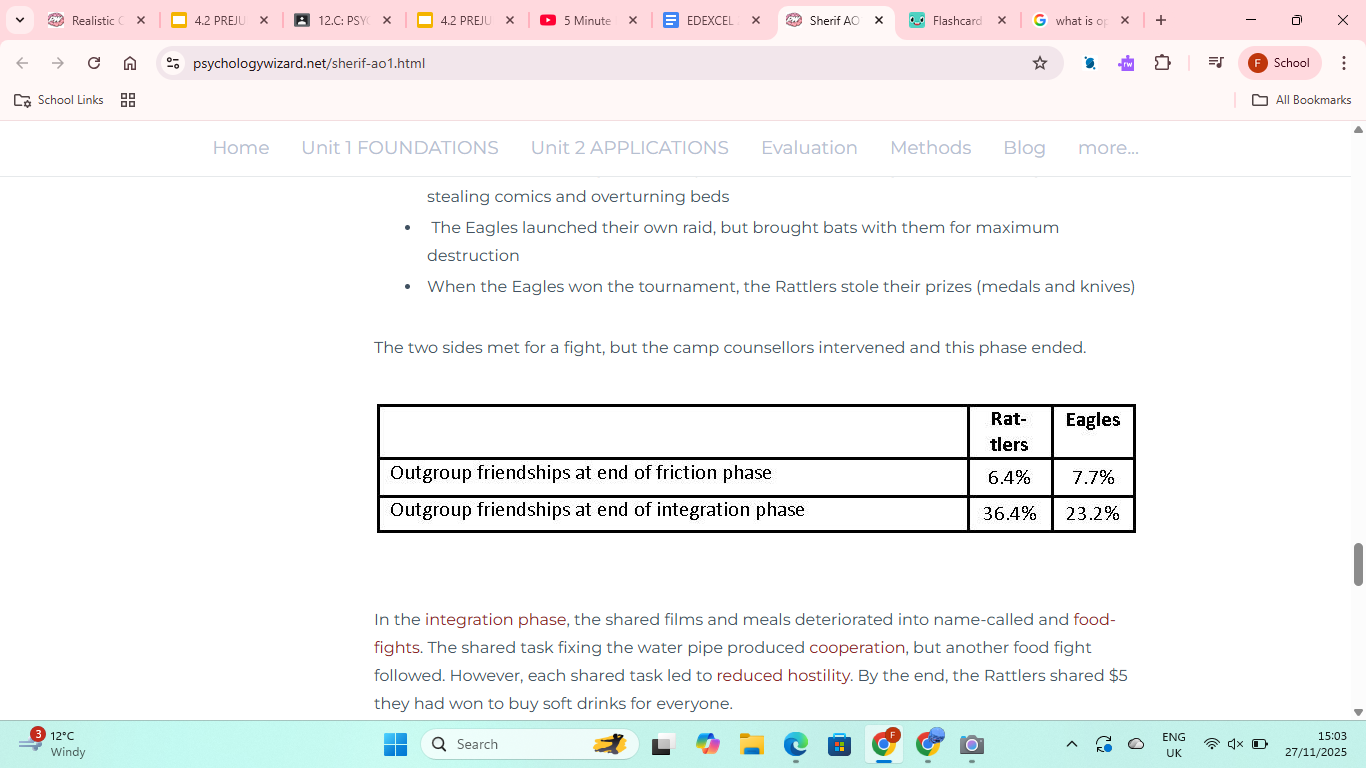
Sherif first tried "mere contact" (having the groups eat meals and watch films together). This failed to reduce the hostility.
Conflict was reduced only when the boys were forced to work together on superordinate goals—mutually desirable tasks that required cooperation to achieve (e.g., fixing the camp's blocked water pipe, choosing films, pooling efforts to pull a broken-down truck).
Phase 3 outcome
Working toward superordinate goals led to the groups' hostility leaving and the boys becoming friendly.
Findings
-Intra group/ ingroup solidarity grows during competition
-Inter group/ outgroup hostility is formed when fighting over limited resources
-This hostility can be reduced with superordinate goals
Conclusion
Used as evidence for Realistic Conflict Theory
 Note
Note  Flashcards (21)