Import Tariffs and Dumping: Economics of Imperfect Competition
 Call Kai
 Learn
Learn Practice Test
 Spaced Repetition
 Match
Match Flashcards
 Knowt Play
1/47

There's no tags or description
Looks like no tags are added yet.
Name | Mastery | Learn | Test | Matching | Spaced | Call with Kai |
|---|
No analytics yet
Send a link to your students to track their progress
48 Terms
What is dumping?
Selling a product at a lower price in a foreign market than in the domestic market.
What are the three ways dumping can occur?
1. Export price < Local price; 2. Export price < Price in a third market; 3. Export price < Average cost of production.
What is the primary condition for dumping?
Export price < Local price.
Give an example of primary dumping.
Samsung sells Galaxy for $800 in Korea and $600 in the US.
What is the secondary condition for dumping when local price is unavailable?
Export price < Price in a third market.
What is the third condition for dumping?
Export price < Average cost of production.
What model explains why firms dump?
The Discriminating Monopoly Model.
What is a discriminating monopoly?
A firm that can charge different prices in different markets due to varying demand elasticities.
What is the profit maximization rule for firms?
Produce until marginal revenue (MR) equals marginal cost (MC).
What happens if MR > MC?
The firm should produce more to increase profit.
What happens if MR < MC?
The firm should produce less to avoid losses.
How does a firm decide output and prices in the export market?
Produce until MC* = MR in the export market, then allocate units between markets.
What is the relationship between local price and export price in dumping?
Local price (P*) is always higher than export price (P_export).
What is the rationale behind exporting at a price lower than average cost?
To spread fixed costs over more units, lowering average cost and increasing total profit.
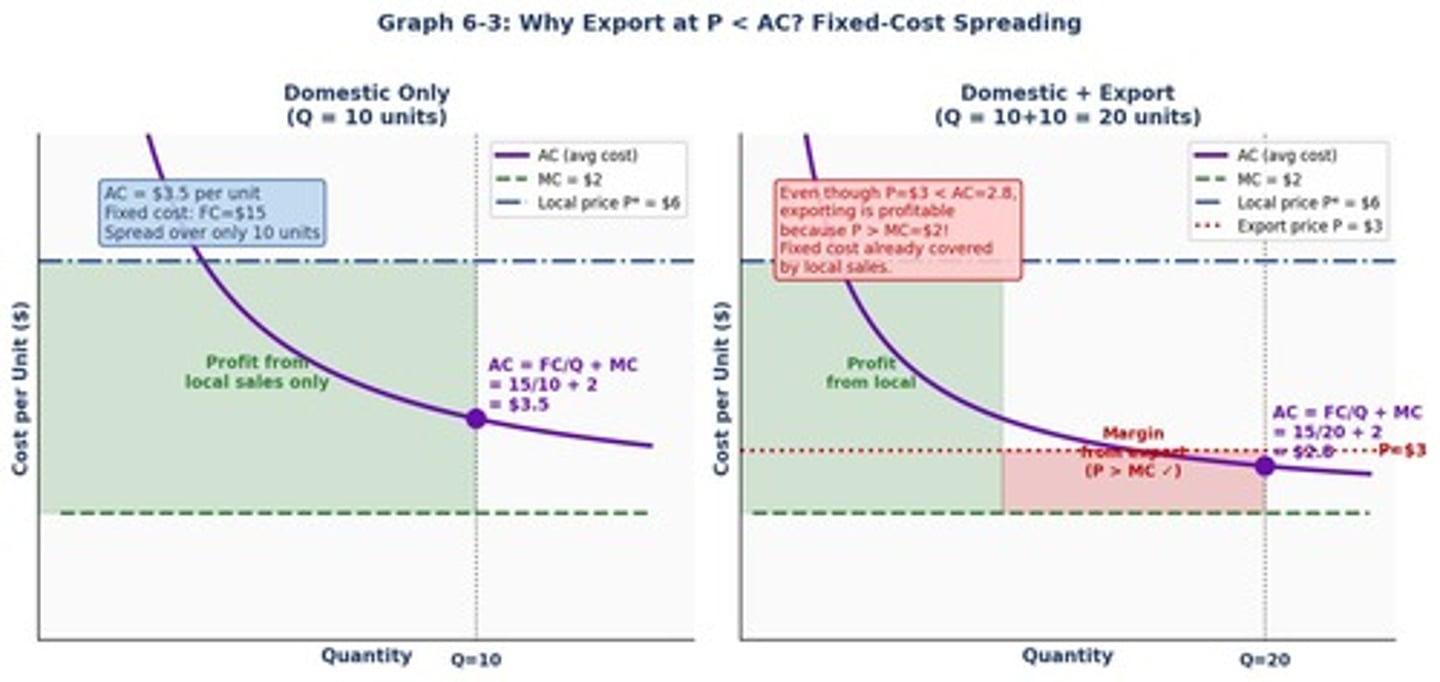
What does the fixed-cost logic explain?
Selling below average cost can be rational if fixed costs are covered by local sales.
What is the formula for total cost?
C(q) = Fixed Costs + Marginal Cost × Quantity.
What is the formula for average cost?
AC = Fixed Costs / Quantity + Marginal Cost.
What is the condition for exporting to be profitable?
Export price must be greater than marginal cost.
Why is dumping considered rational?
It can increase total profit even when the export price is below average cost.
What is the significance of the perfectly elastic demand curve in the export market?
It means the firm can sell as much as it wants at the export price without affecting that price.
What does the gap between the export price and local price indicate?
It indicates dumping, where P_export < P*.
What is the impact of fixed costs on average cost as quantity increases?
Average cost decreases as quantity increases due to fixed cost spreading.
What is the relationship between local demand and marginal revenue for a monopolist?
Marginal revenue is always below the demand curve for a monopolist.
What happens to total profits when a firm exports at a price lower than average cost?
Total profits can still rise as long as the export price covers marginal cost.
What are antidumping (AD) duties?
AD duties are tariffs imposed by importing countries when dumping is occurring.
How is the AD duty calculated?
AD Duty = Foreign firm's LOCAL price − Export price.
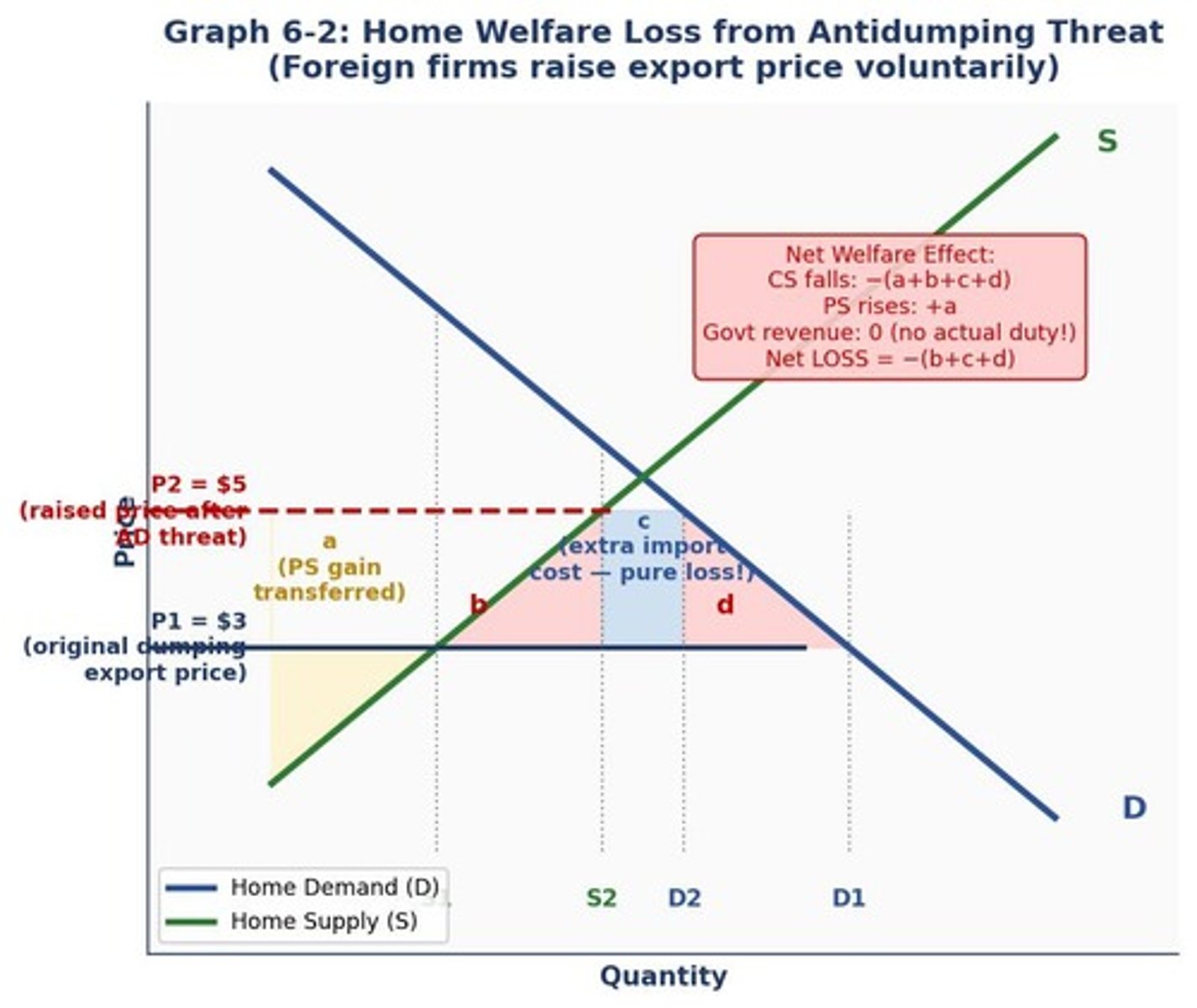
What happens when a foreign firm raises its export price after a threat of AD duty?
The AD duty decreases, and the importing country's consumers may lose even without a duty being applied.
What is the effect of the threat of an AD duty on foreign firms?
The threat incentivizes foreign firms to raise their export prices to avoid the duty.
What are countervailing duties (CVDs)?
CVDs are tariffs imposed to offset subsidies provided by foreign governments to their exporting firms.
What triggers the imposition of a countervailing duty?
A foreign government subsidizing its firms, which lowers their costs and export prices.
What is the difference between AD duties and CVDs?
AD duties address dumping by closing the price gap, while CVDs offset the price-depressing effects of subsidies.
What is the net welfare loss when only the threat of an AD duty is present?
Net welfare loss = −(b + c + d), which is worse than the actual duty.
What happens to home welfare when a foreign firm voluntarily raises prices to avoid an AD duty?
Home consumers face higher prices, leading to a loss in consumer surplus.
What is the impact of an actual AD duty on home welfare?
Home welfare loss is −(b + d), but the government retains revenue 'c'.
What is the optimal amount of export by a foreign monopolist?
The optimal export amount is determined where MC = MR_export.
What is the formula for calculating average cost (AC) of production?
AC = (FC + MC × Q_total) / Q_total.
What does it mean for exporting to be profitable?
Exporting is profitable when the export price is greater than the marginal cost (P_export > MC).
What is the significance of the area 'c' in the welfare effects graph?
Area 'c' represents government revenue that is lost to foreign firms when no duty is collected.
What is the primary definition of dumping?
Dumping is defined as when the export price is less than the local price.
What is the secondary definition of dumping?
Dumping also occurs when the export price is less than the average cost (AC).
What happens to consumer surplus (CS) when an AD duty is applied?
Consumer surplus decreases due to higher prices resulting from the duty.
What is the formula for calculating profit?
Profit = Revenue − Total Costs (TC).
What is the outcome when a firm only sells to the domestic market?
The optimal price is determined where MR* equals MC.
What is the effect of an actual AD duty on government revenue?
Government revenue increases by the amount of the duty collected.
How does a firm calculate its profit when exporting?
Profit from exporting is calculated by considering revenue from both local and export sales.
What is the key insight regarding the threat of an AD duty?
The threat can lead to a worse welfare outcome for the home country than the actual imposition of a duty.
What is the relationship between local price and export price in the context of dumping?
Dumping occurs when the export price is lower than the local price.
What happens to producer surplus (PS) when an AD duty is applied?
Producer surplus increases due to higher prices for domestic producers.

