Cellular Respiration
 Call Kai
 Learn
Learn Practice Test
 Spaced Repetition
 Match
Match Flashcards
 Knowt Play
1/32

There's no tags or description
Looks like no tags are added yet.
Name | Mastery | Learn | Test | Matching | Spaced | Call with Kai |
|---|
No analytics yet
Send a link to your students to track their progress
33 Terms
Cellular Respiration Equation
C6H12O6 + 6O2 + ADP + Pi → 6H2O + 6CO2 + ATP + heat
How can metabolic activity be measured?
energy food eaten - wastes excreted; ATP produced; heat produced; amount of H2O produced; amount of oxygen used up/carbon dioxide produced
What is the easiest way to measure metabolism?
gas exchange; amount of oxygen used up or carbon dioxide produced
Basal Metabolic rate (BMR)
rate at which an animal consumes oxygen while at rest, with an empty stomach, under normal temperature and moisture conditions
Metabolism is required for
a minimal resting lifestyle with no spontaneous activity, no digestion of food, and no physical thermal, or psychological stress
Maximum metabolic rate (MMR)
maximum rate at which oxygen can be transported from the environment to the tissue mitochondria; can be induced by activity/stress
Aerobic energy metabolism parameters
basal metabolic rate is the flood (lower) and maximum metabolic rate is the ceiling (higher)
Aerobic scope
capacity of an organism to increase its aerobic metabolic rate above maintenance level
Aerobic scope equation
MMR - BMR
Glucose
source of energy; produced from digestion of food; stored and oxidized to provide chemical energy
Site of cellular respiration or fermentation
cytoplasm & mitochondria
Mitochondria
organelles that are membrane-bound with two different membranes
Cristae
inner membrane highly folded
Glycolysis occurs in
cytoplasm
Glycolysis
glucose → pyruvate
Glycolysis products
2 pyruvate, 2 ATP, 2 NADH
If oxygen is present, pyruvate…
enters the mitochondria for citric acid cycle
If oxygen is not present, pyruvate …
undergoes fermentation
Fermentation
pyruvate → lactate
Fermentation products
lactic acid, 2 NAD+ (regenerates for glycolysis)
Link Reaction
pyruvate → Acetyl CoA; links the products of glycolysis with the aerobic processes of the mitochondria
Link Reaction Products
acetyl CoA, 2 NADH, 2 CO2
Krebs Cycle = Citric Acid Cycle = TCA Cycle
Acetyl CoA produces NADH and FADH2 molecules to feed electrons in Electron transport chain to generate cell’s ATP
Krebs Cycle = Citric Acid Cycle = TCA Cycle products
2 NADH, FADH2, GTP → ATP, 2 CO2
Electron Transport Chain (ETC)
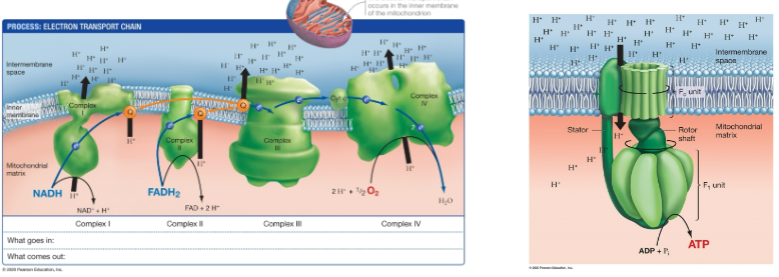
final stage of aerobic respiration; releases energy stored within reduced hydrogen carriers to synthesize ATP; drives transport of protons across inner membrane from the matrix to intermembrane space for a proton gradient & electrons reduce O2 to water; hydrogens pass through ATP synthase to produce ATP into the mitochondrial matrix
Where does link reaction occur?
mitochondria matrix
Where does Krebs cycle/Citric Acid Cycle/TCA Cycle occur?
mitochondrial matrix
Where does Electron Transport Chain occur?
inner mitochondrial membrane
Oxidative Phosphorylation
ETC releases energy stored within the reduced hydrogen carriers to synthesize ATP; derived from oxidation of hydrogen carriers (NADH, FADH2)
Proton Gradient
higher concentration of protons (H+) in intermembrane space than in mitochondrial matrix
Final Electron Acceptor
oxygen
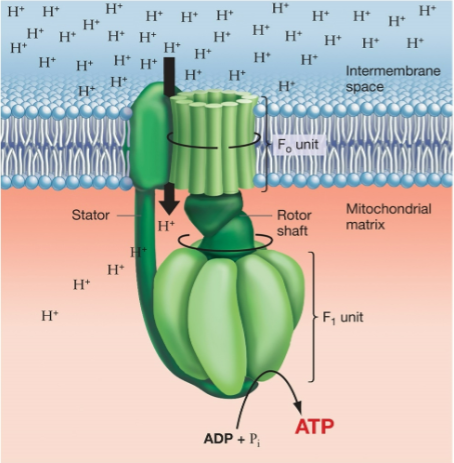
ATP Synthase
proton-driven rotor and ATP-generating enzyme; F0 unit spins as protons pass through; shaft transmits the rotation to the F1 unit, causing it to make ATP from ADP and Pi
Summary of Cellular Respiration
electrons carried by NADH & FADH2; products (~29-34)ATP and water; protons transported outside of inner membrane drive ATP synthase;

