Final - General Senses
 Studied by 0 people
 Call Kai
 Learn
Learn Practice Test
 Spaced Repetition
 Match
Match Flashcards
 Knowt Play
1/107

There's no tags or description
Looks like no tags are added yet.
Name | Mastery | Learn | Test | Matching | Spaced |
|---|
No study sessions yet.
108 Terms
What do the general senses consist of?
Touch, temperature, and pain
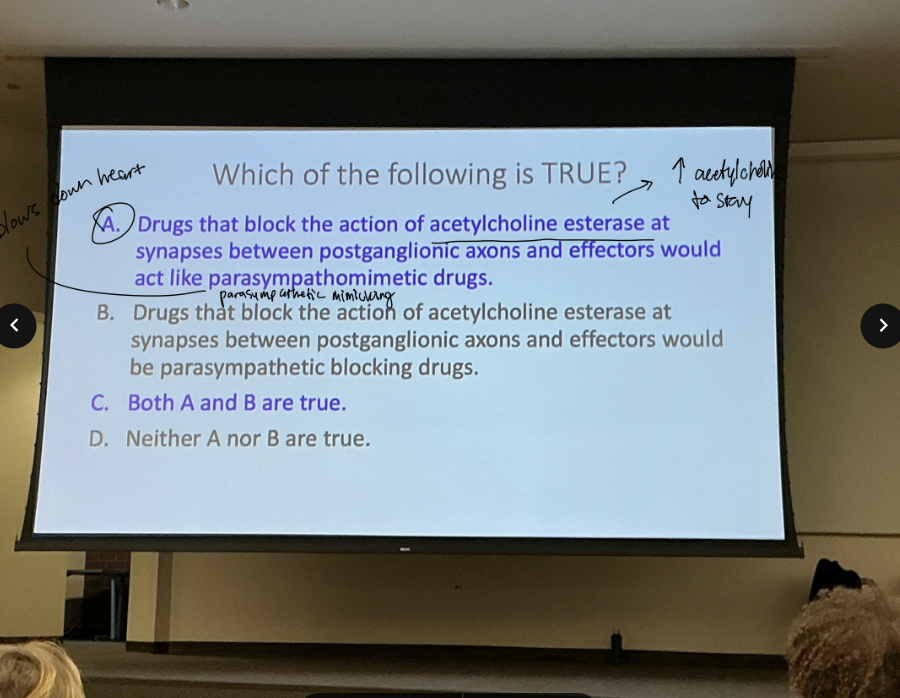
Which of the following is true?
A. Drugs that block the action of ACh esterase at synapses between postganglionic axons and effectors would act like parasympathomimetic (parasympathetic mimicking) drugs
B. Drugs that block the action of ACh esterase at synapse between postganglionic axons and effectors would be parasympathetic blocking drugs
C. Both A and B are true
D. Neither A nor B are true.
A. Blocking ACh esterase at postganglionic–effector synapses prolongs ACh action and therefore mimics parasympathetic stimulation.
ACh esterase breaks down acetylcholine (ACh) in the synaptic cleft.
Its job is to terminate the signal.
If you block ACh esterase:
ACh is not broken down
ACh sticks around longer
The effect of ACh is enhanced and prolonged
At postganglionic → effector synapses:
Parasympathetic postganglionic neurons release ACh
Sympathetic postganglionic neurons usually release NE (except sweat glands)
So blocking ACh esterase here will:
Increase parasympathetic signaling
Make organs behave as if parasympathetic activity is increased
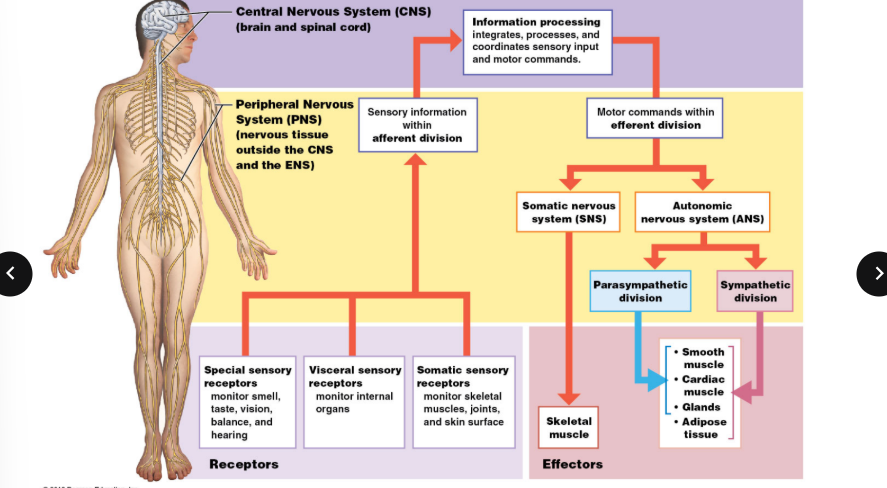
Describe afferent sensory pathways.
Sensory information comes into CNS from the sensory receptors via peripheral nerves
Synapse onto sensory processing interneurons in posterior horn of spinal cord or cranial nerve nuclei in brainstem
Only small percentage of sensory input reaches conscious awareness
Sensory response occurs only if receptors exist that are sensitive to the stimuli
e.g. humans can not “see” ultraviolet light
Why can’t humans see UV light?
Because only a small percentage of sensory input reaches conscious awareness, and sensory response occurs only if receptors exist that are sensitive to the stimuli

What does it mean for receptors to have specificity?
They respond to a specific thing and THAT’S IT!
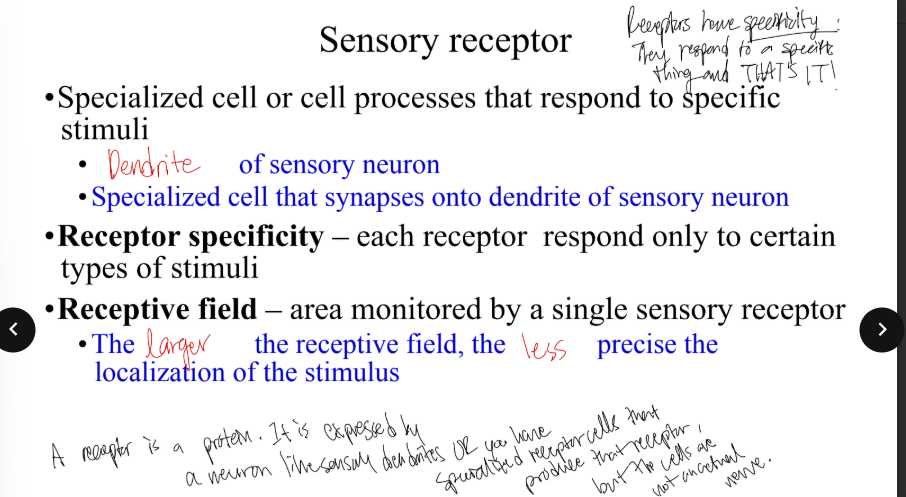
What is receptor specificity?
Each receptor responds only to certain types of stimuli
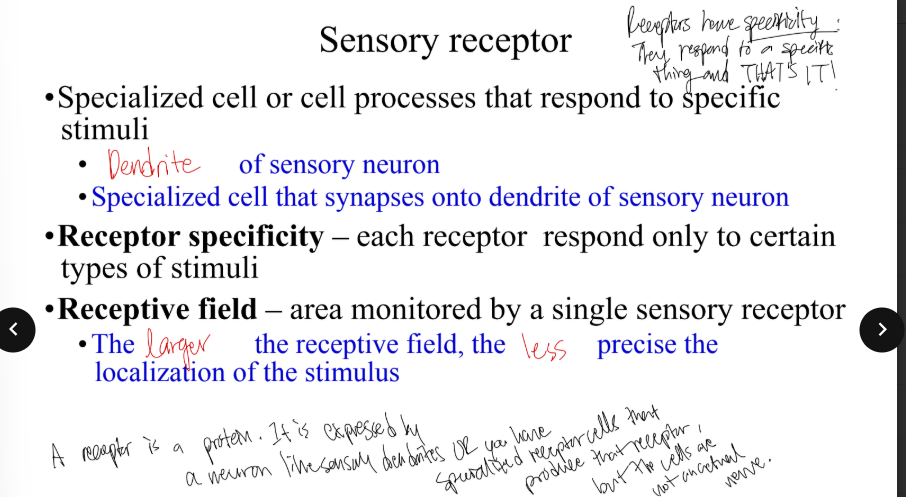
What is a receptive field? The larger the receptive field, the (more/less) precise the localization of the stimulus
The area monitored by a single sensory receptor.
The larger the receptive field, the less precise the localization of the stimulus
There are 2 ways sensory receptors are organized. What are they?
1. The dendrite is the receptor
The sensory neuron’s dendrite directly responds to the stimulus
Stimulus → graded potential → action potentials in same neuron
Examples:
Pain (nociceptors)
Temperature
Touch
2. A separate specialized cell is the receptor
A non-neuronal receptor cell detects the stimulus
That cell then synapses onto the dendrite of a sensory neuron
The neuron fires only after receiving neurotransmitter
Examples:
Taste buds
Hair cells (hearing, balance)
Photoreceptors (vision)
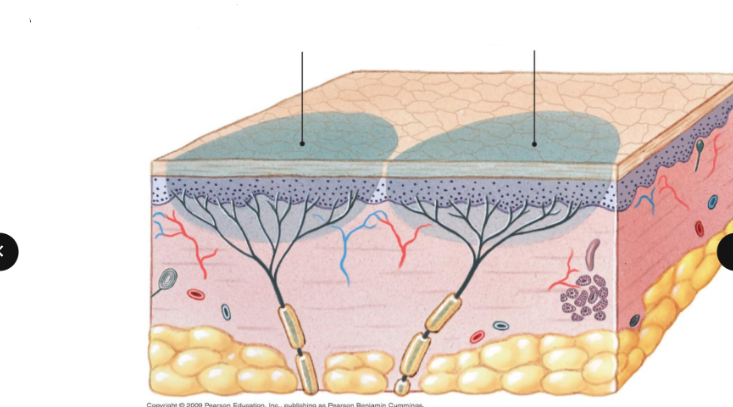
What are the things highlighted in blue called?
Receptive fields. The larger the receptive field, the less precise the localization of the stimulus
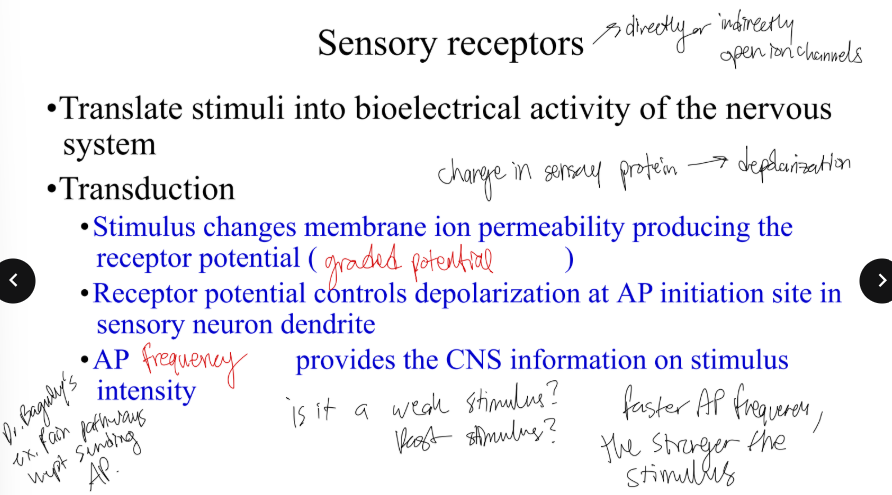
Sensory receptors translate _____ into ________ activity of the NS
stimuli into bioelectrical activity
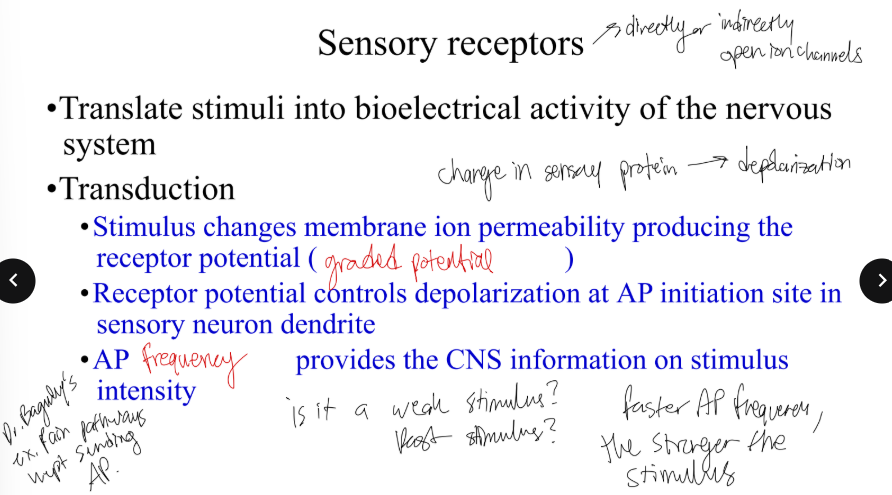
Sensory receptors can directly or indirectly open ___ channels because
ion; a change in sensory protein results in depolarization
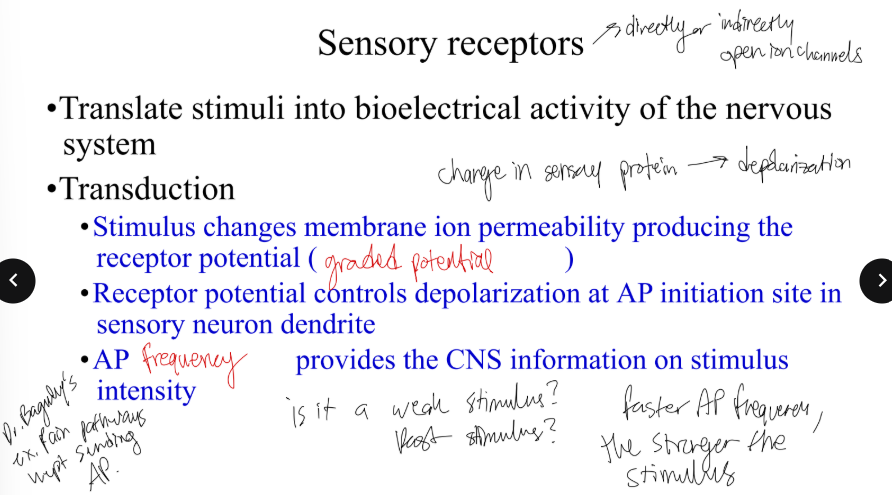
The faster the AP frequency, the (stronger/weaker) the stimulus.
stronger
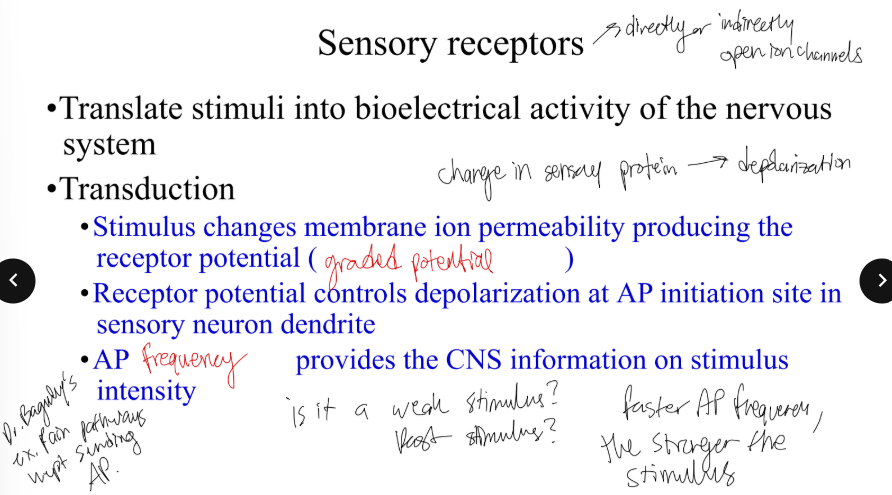
Sensory receptors translate stimuli into electrical signals the nervous system understands.
That translation process is called
transduction
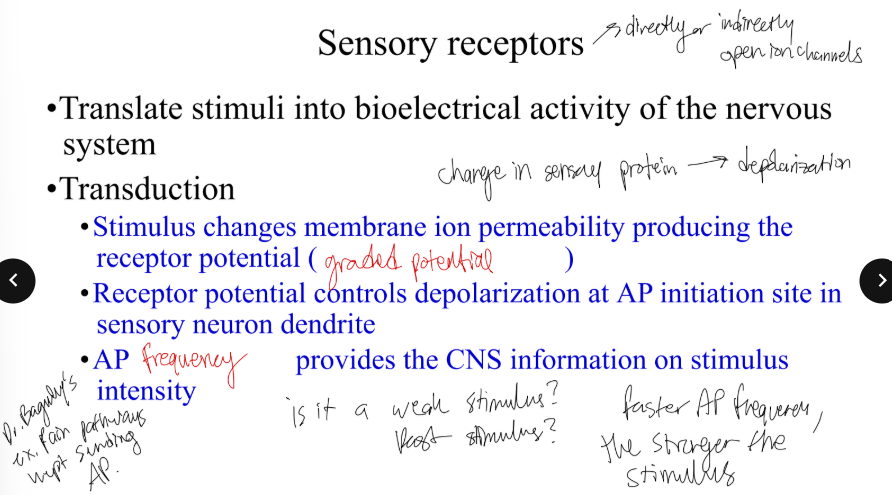
Sensory receptors translate stimuli into electrical signals the nervous system understands.
That translation process is called transduction (A physical stimulus → an electrical signal). What are the steps?
Stimulus changes membrane ion permeability producing the receptor potential (graded potential)
Receptor potential controls the depolarization at AP initiation site in the sensory neuron dendrite
AP Frequency provides the CNS information on stimulus intensity
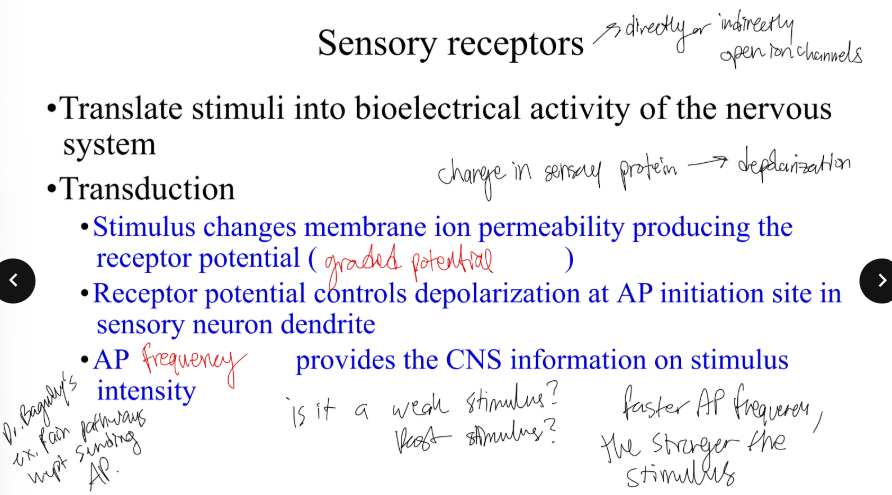
A physical stimulus getting converted to → an electrical signal is a process called
transduction
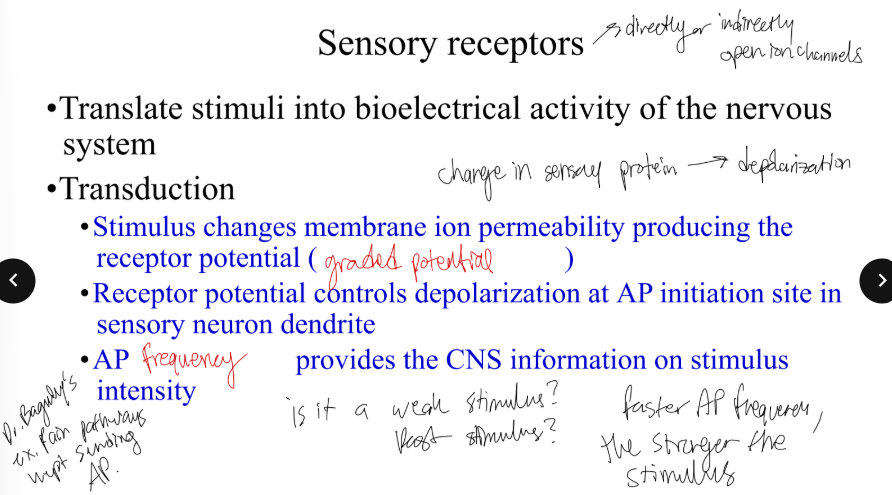
Sensory receptors translate stimuli into electrical signals the nervous system understands. If Dr. Baguely kept feeling pain, relate this to how transduction works, particularly with AP frequency
Dr. Baguely’s pain pathways kept sending action potentials rapidly, which provide the CNS information on stimulus intensity
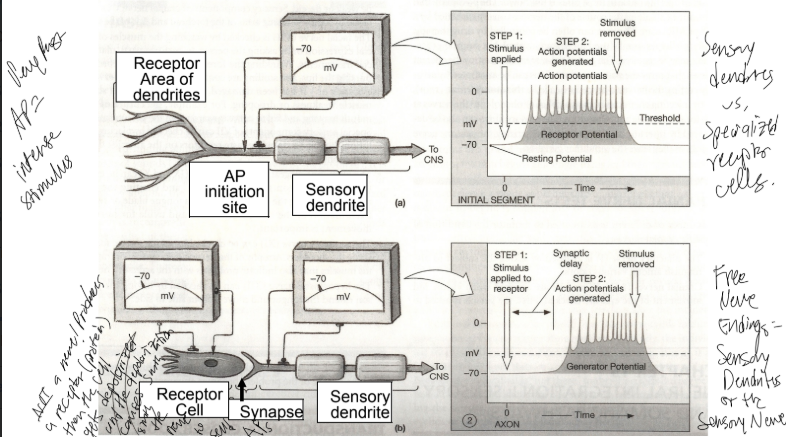
Very fast AP = what kind of stimulus?
very intense stimulus
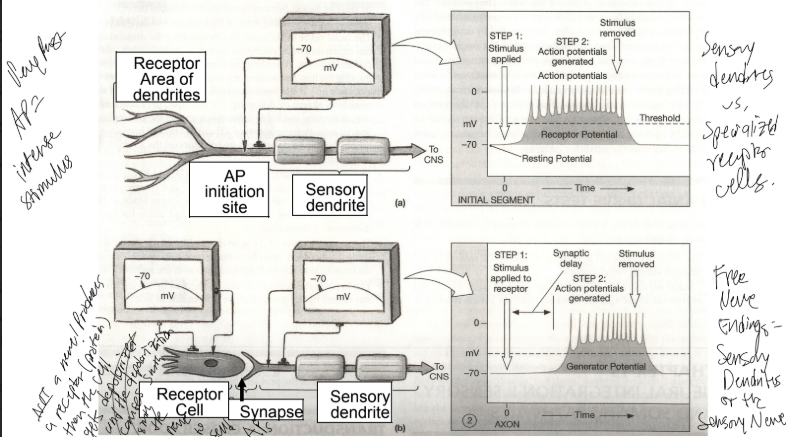
T/F: Specialized receptor cells are nerves.
F, they are a protein, not a nerve.
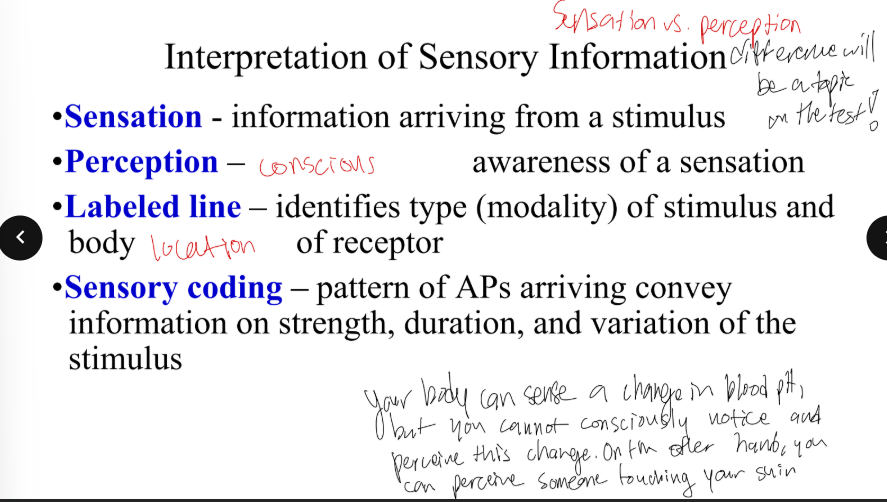
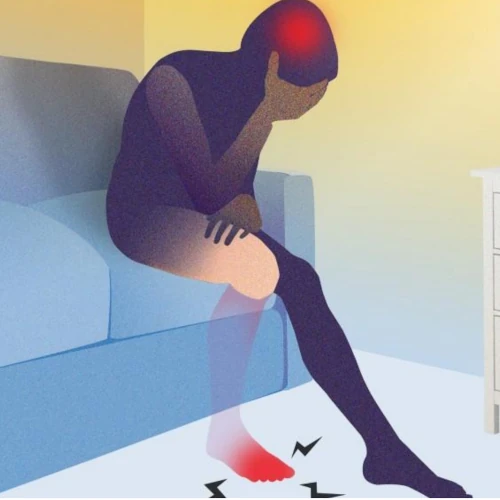
What is a sensation? How is it different from a perception?
Sensation: Information arriving from a stimulus
Perception: Conscious awareness of a sensation
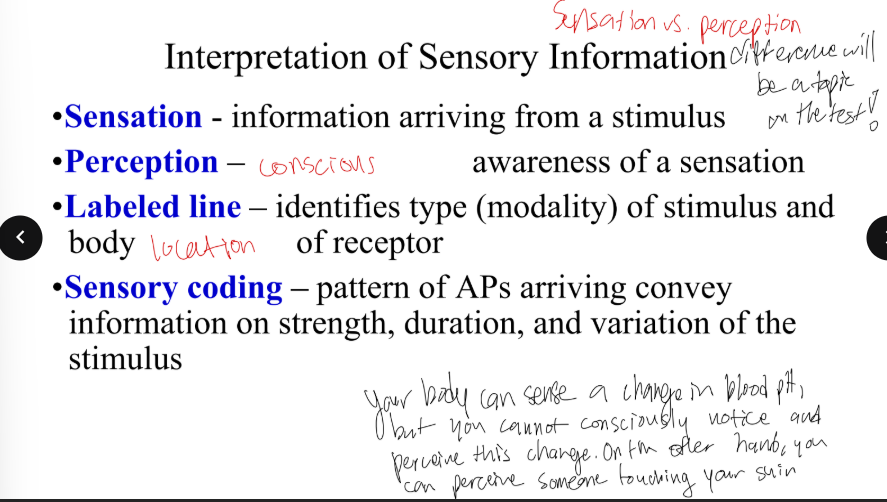
What is a labeled line?
identifies type (modality) of stimulus and body location of receptor
A labeled line is a specific sensory pathway whose activation signals a particular stimulus modality and the exact body location of the receptor to the brain.
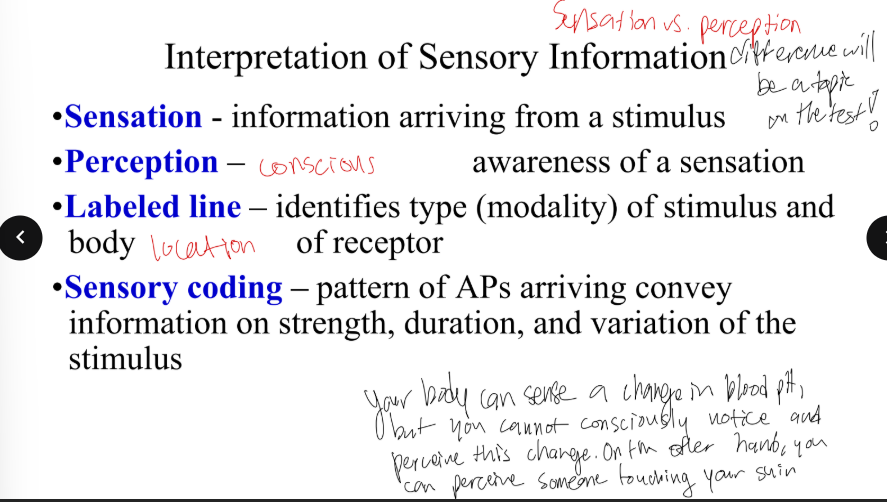
What is sensory coding?
pattern of APs arriving convey information on strength, duration, and variation of the stimulus
Your body can sense a change in blood pH, but you cannot consciously notice this change. Therefore, you are incapable of ______.
Perception: The conscious awareness of a sensation
Alexis touches Tessa’s arm. Tessa knows someone is touching her skin. Does this mean that she is:
Sensing Alexis’ touch OR
Perceiving Alexis’ touch?
2 - Perceiving Alexis’ touch
Perception: The conscious awareness of a sensation
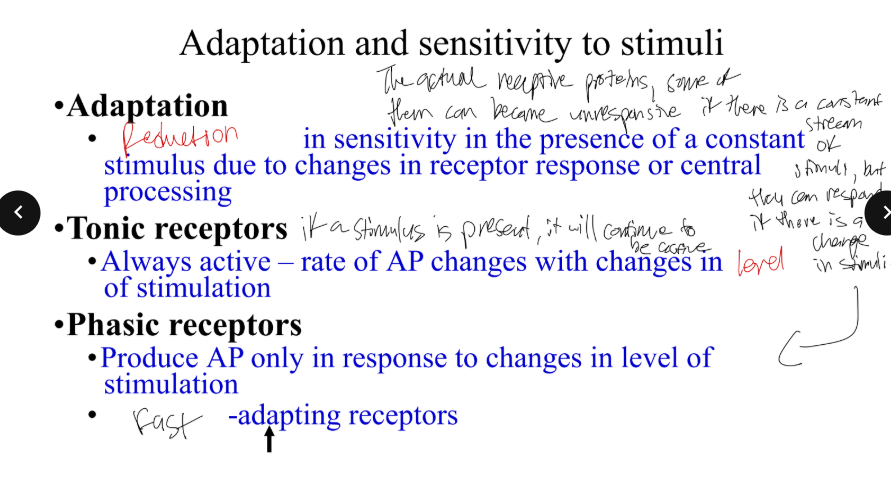
In context of adaptation and sensitivity to stimuli, what is adaptation?
A reduction in sensitivty in the presence of a constant stimulus due to changes in receptor response or central processing
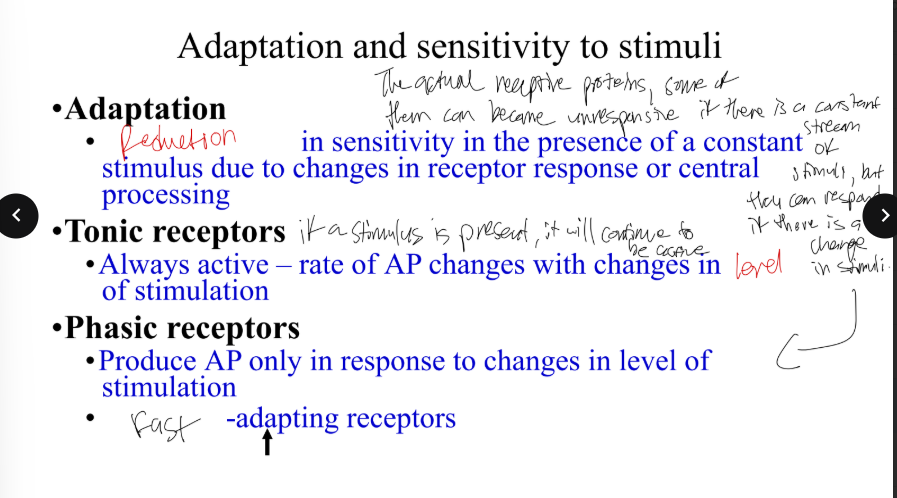
In context of adaptation and sensitivity to stimuli, what are the differences between tonic and phasic receptors?
Tonic receptors are always active, meaning the rate of AP changes with changes in level of stimulation. Therefore, if a stimulus is present, it will continue to be active.
Phasic receptors produce AP only in response to changes in level of stimulation. They are more fast-adapting receptors.
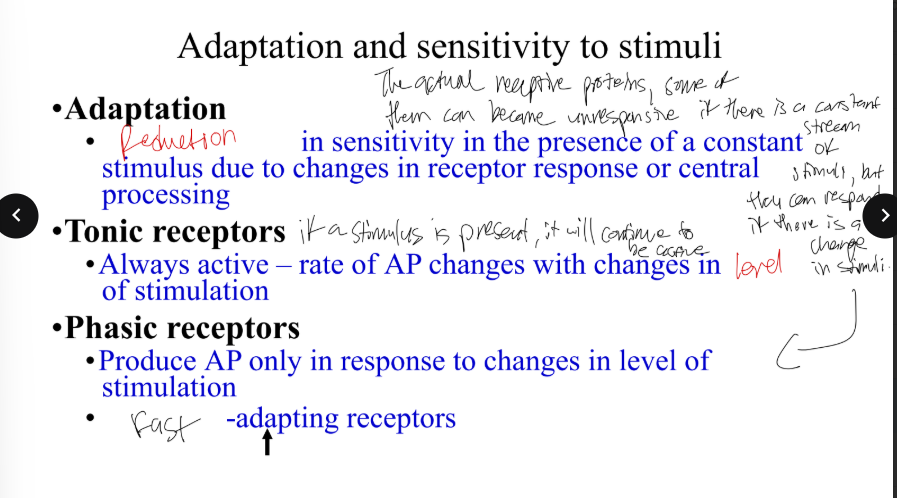
In context of adaptation and sensitivity to stimuli, what is a tonic receptor?
Tonic receptors are always active, meaning the rate of AP changes with changes in level of stimulation. Therefore, if a stimulus is present, it will continue to be active.
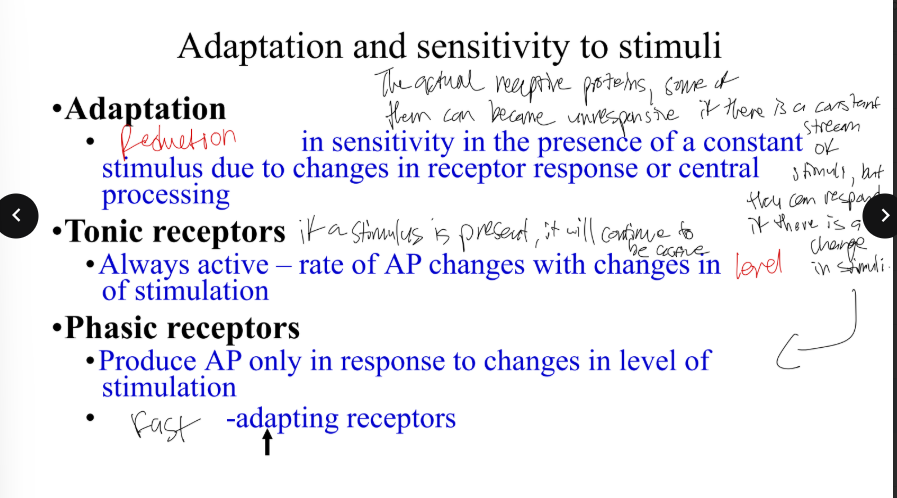
In context of adaptation and sensitivity to stimuli, what is a phasic receptor?
Phasic receptors produce AP only in response to changes in level of stimulation. They are more fast-adapting receptors.
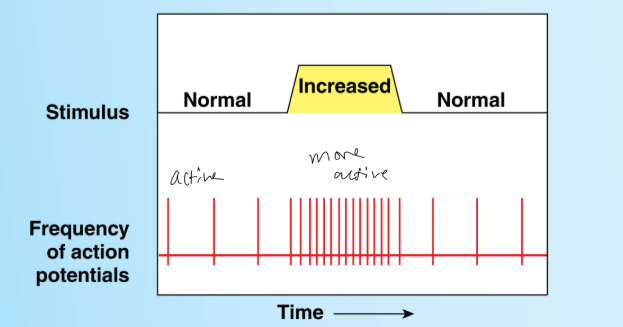
What type of receptor is this?
Tonic Receptors.
Tonic receptors are always active, meaning the rate of AP changes with changes in level of stimulation. Therefore, if a stimulus is present, it will continue to be active.
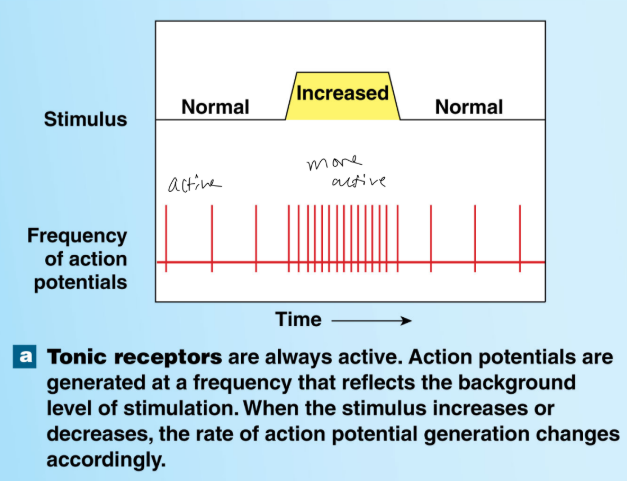
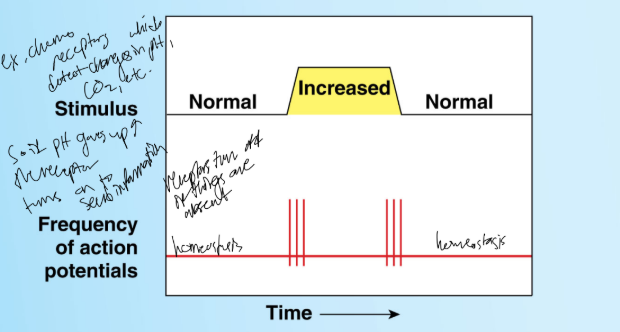
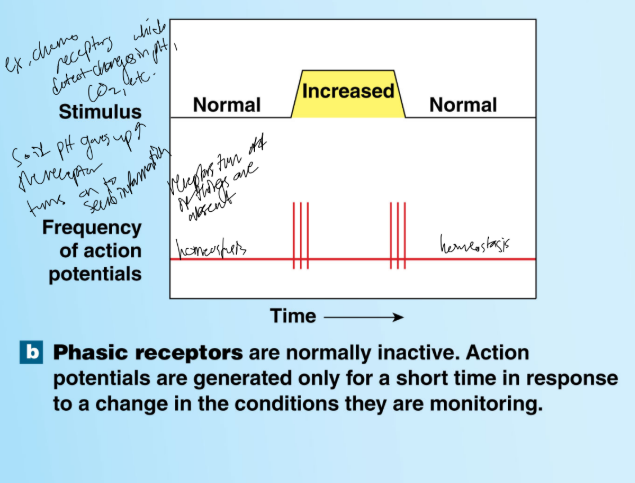
What type of receptor is this?
Phasic Receptors
Phasic receptors produce AP only in response to changes in level of stimulation. They are more fast-adapting receptors.
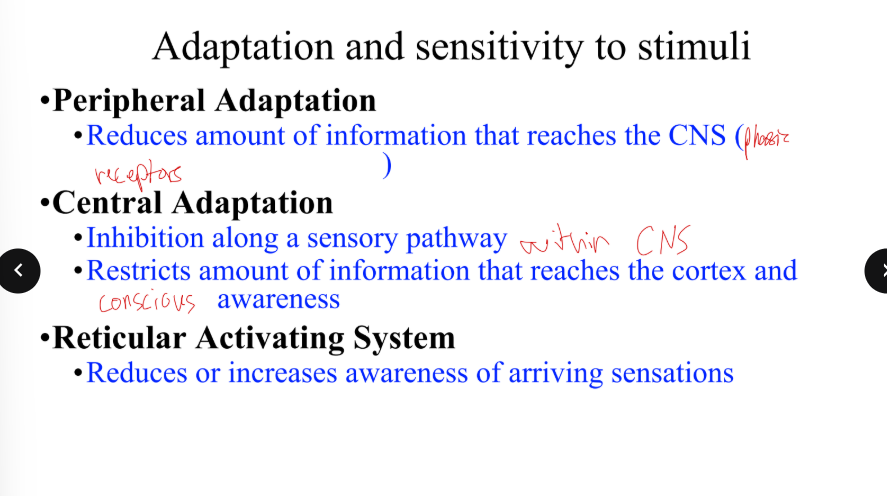
In context of adaptation and sensitivity to stimuli, what is peripheral adaptation? How is it different from central adaptation?
Peripheral adaptation reduces the amount of information that reaches the CNS (phasic receptors).
Central adaptation involves inhibition along a sensory pathway within the CNS> This restricts the amount of information that reaches the cortex and conscious awareness.
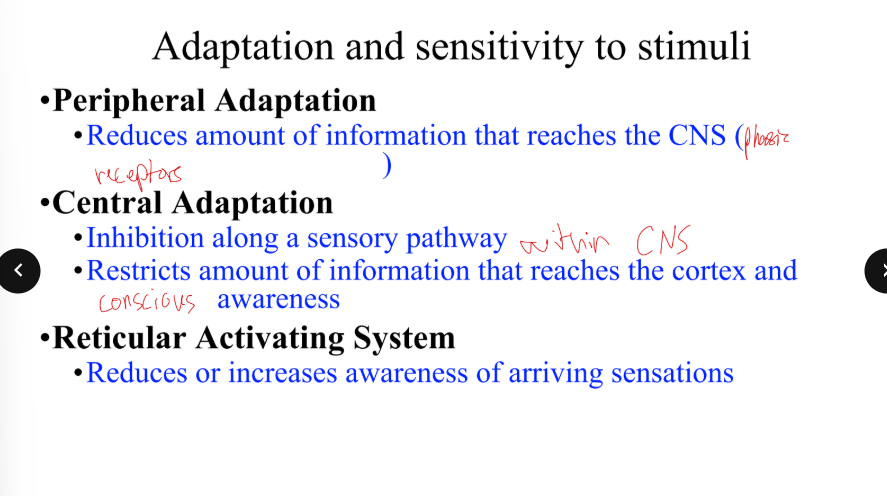
In context of adaptation and sensitivity to stimuli, what is peripheral adaptation?
Peripheral adaptation reduces the amount of information that reaches the CNS (phasic receptors).
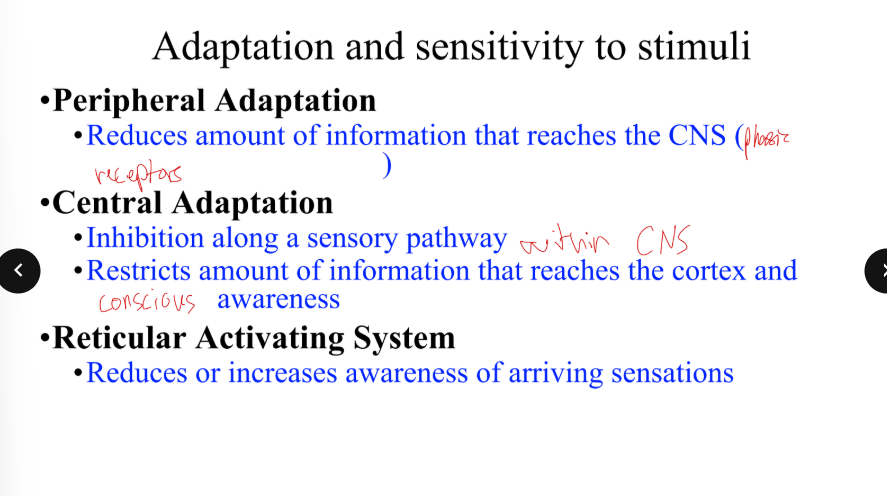
In context of adaptation and sensitivity to stimuli, what is central adaptation?
Central adaptation involves inhibition along a sensory pathway within the CNS> This restricts the amount of information that reaches the cortex and conscious awareness.
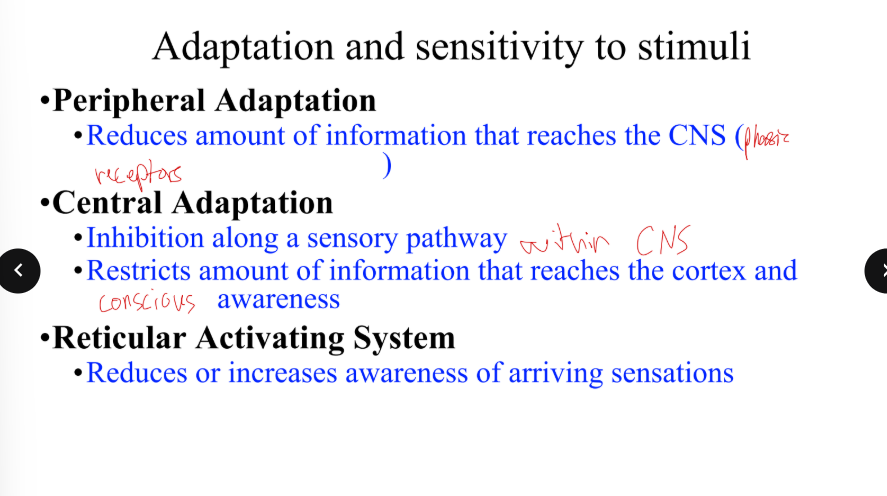
What is the role of the reticular activating system in terms of adaptation and sensitivity to stimuli?
Reduces or increases awareness of arriving sensations
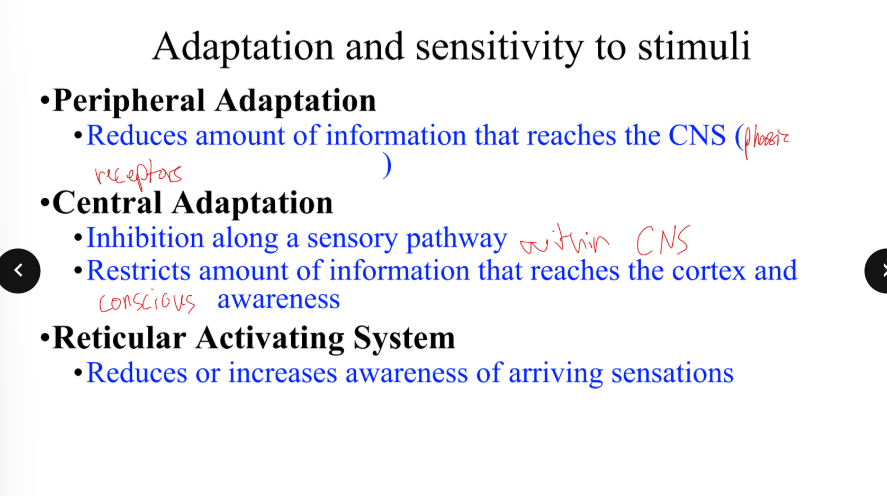
____ adaptation reduces the amount of info reaching the CNS, where as ___ adaptation restricts the amount of info that reaches the cortex and conscious awareness.
peripheral; central

What are the names of the receptors connected with all the general senses? Where are they all present in?
Pain = nocieptors
Temperature = thermoreceptors
Physical distortion = mechanoreceptors
Chemical detection = chemo receptors
Present in all spinal nerves and in CN V (trigeminal) and CN X (vagus)
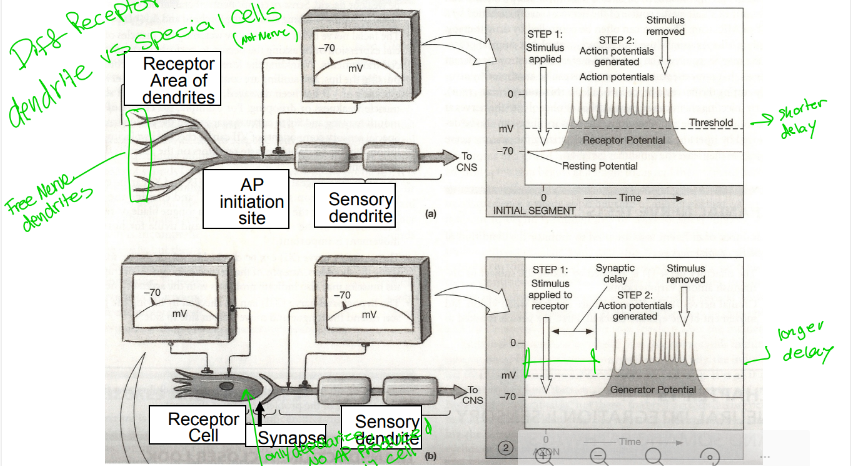
What are free nerve endings? What do they measure with nocieptors (pain)?
sensory neuron dendrites sensitive to various stimuli.
Extremes of temp (burning, etc)
Mechanical damage (impact wound, scrape)
Chemicals released by damaged cells
Converted to prostaglandins
Free nerve endings are unspecialized, microscopic nerve fibers found throughout body tissues that detect pain, temperature, and light touch, acting as our most basic sensory receptors by sending signals about chemical, mechanical, or thermal changes directly to the brain and spinal cord. They are the most common type of nerve endings, forming bare terminals in the skin and other areas, crucial for sensing noxious stimuli and sensations like itching and pressure.
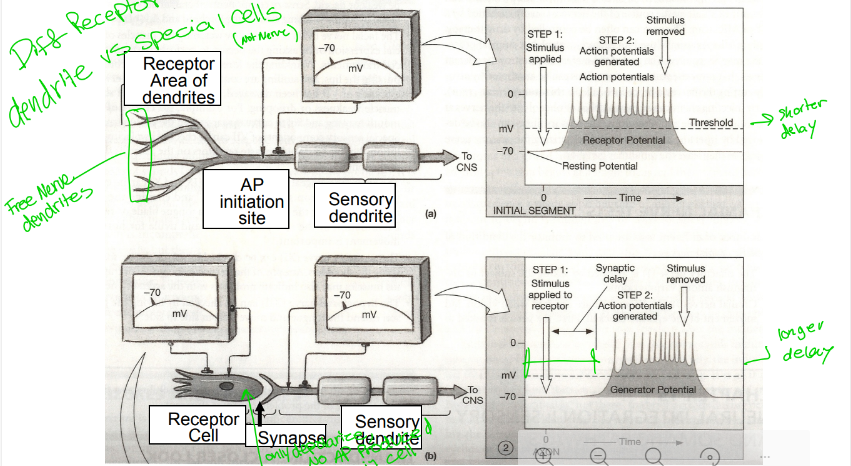
Do specialized sensory receptor cells have a shorter or longer delay?
specialized sensory receptor cells
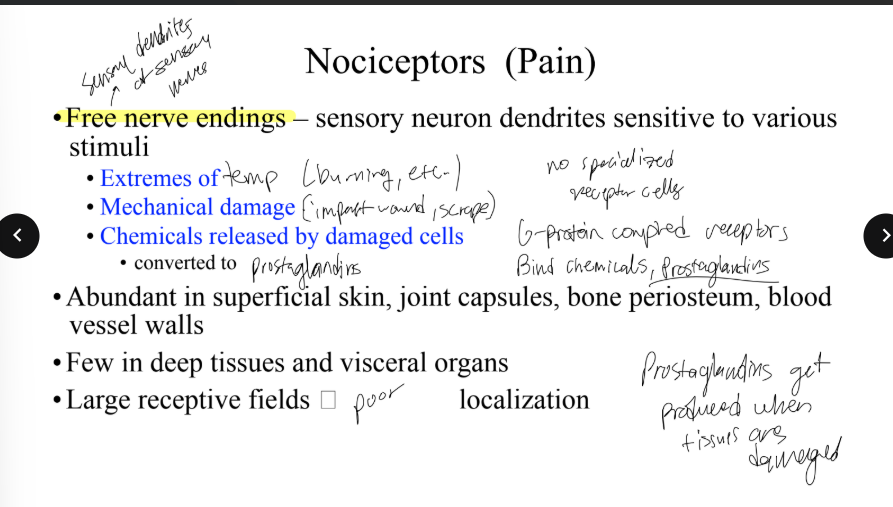
T/F: There are no specialized receptor cells in nociceptors (pain).
T, only free nerve endings

T/F: There are only free nerve endings in nociceptors (pain).
T
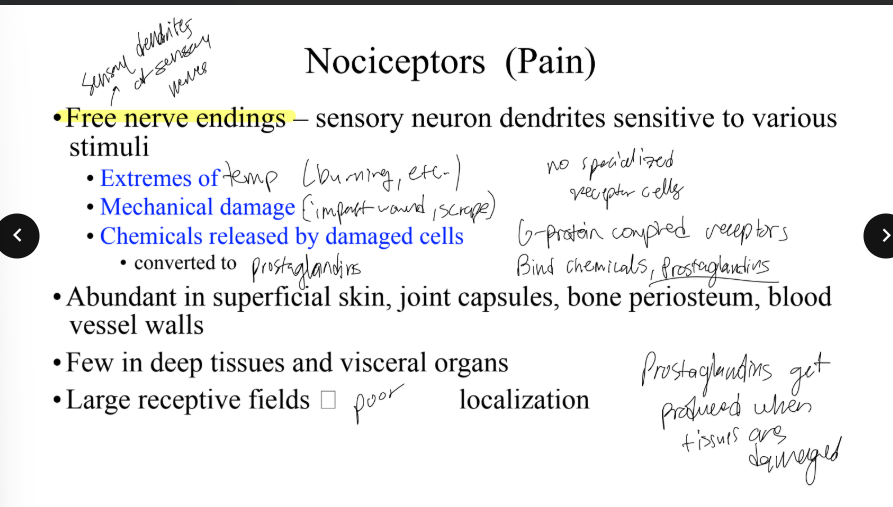
T/F: There are only specialized receptor cells for nociceptors (pain).
F, there are actually only free nerve endings and no specialized receptor cells exist for nociceptors.
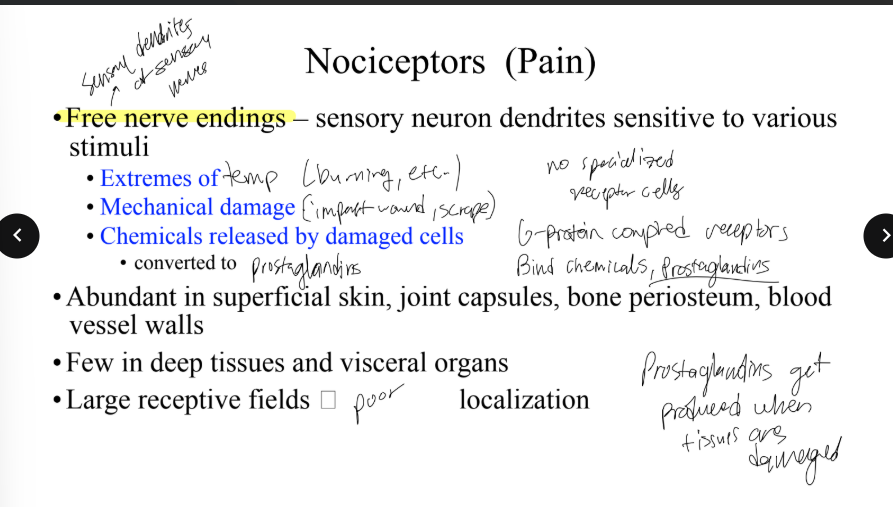
T/F: There are only free nerve endings for nociceptors (pain).
T
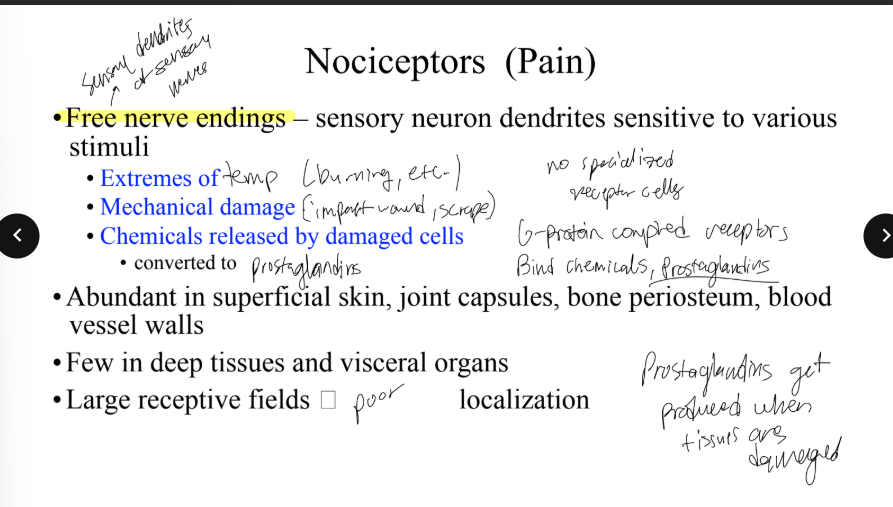
Where are nociceptors (pain sensory receptors) abundant in? Where are they few in?
Abundant in superficial skin, joint capsules, bone periosteum, blood vessel walls
Few in deep tissues and visceral organs
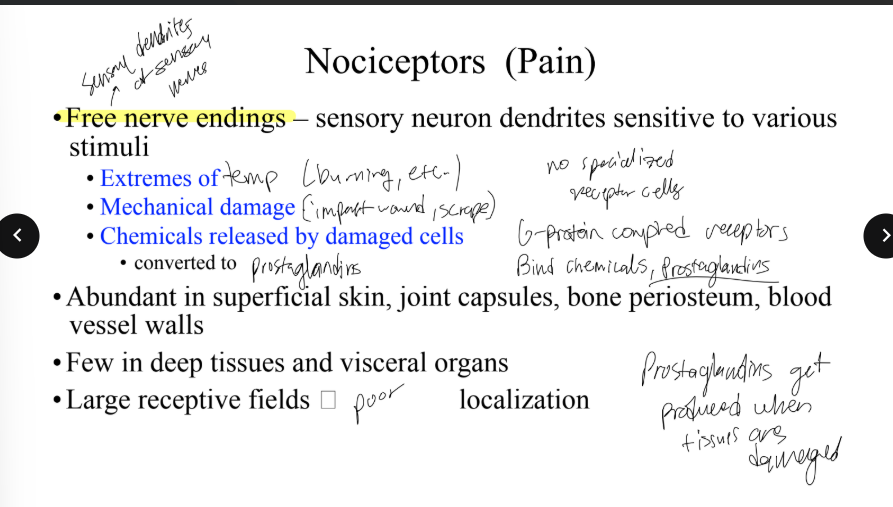
What are the general size of receptor fields with nocieptors? How does this relate to localization?
Large receptive fields means poor localization
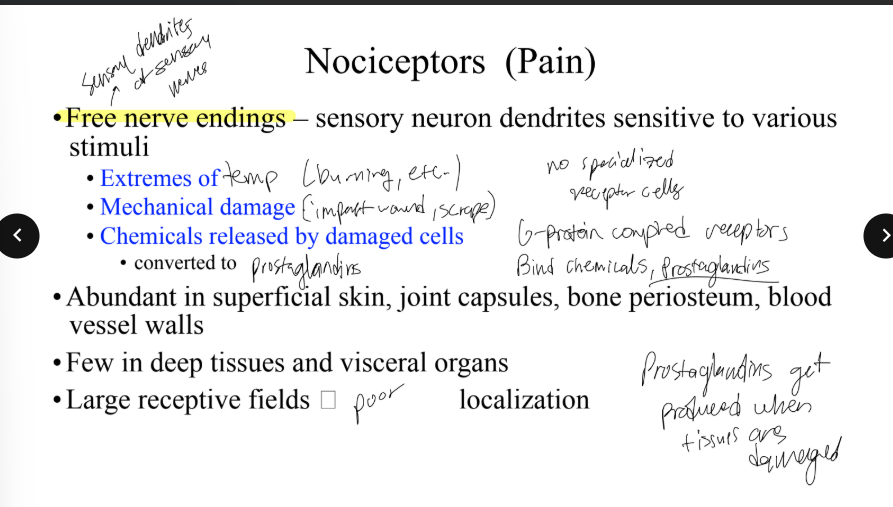
______ get produced when tissues are damaged
prostaglandins
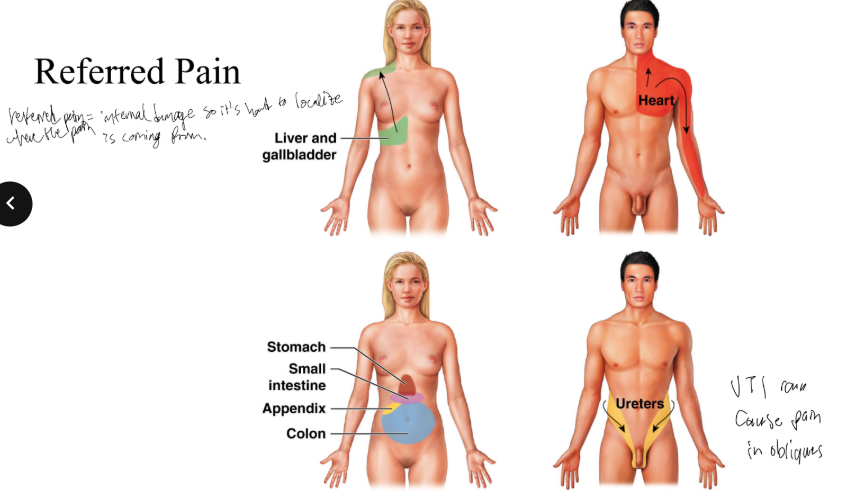
What is referred pain?
Internal damage, so it’s hard to localize where the pain is coming from

You just got stabbed by sussy among us character!!! What type of adaptation occurs when you have life threatening pain?
Central adaptation. This can block/slow info when you are in life threatening pain. Remember that central adaptation is inhibition along a sensory pathway within the CNS, and restricts the information that reaches the cortex and conscious awareness.
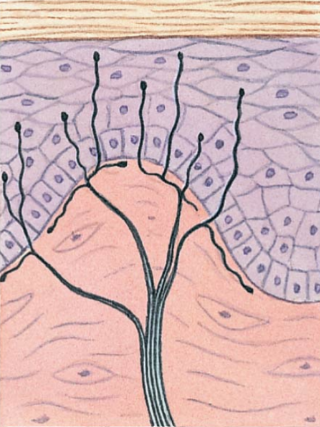
What is this a picture of?
Free nerve endings
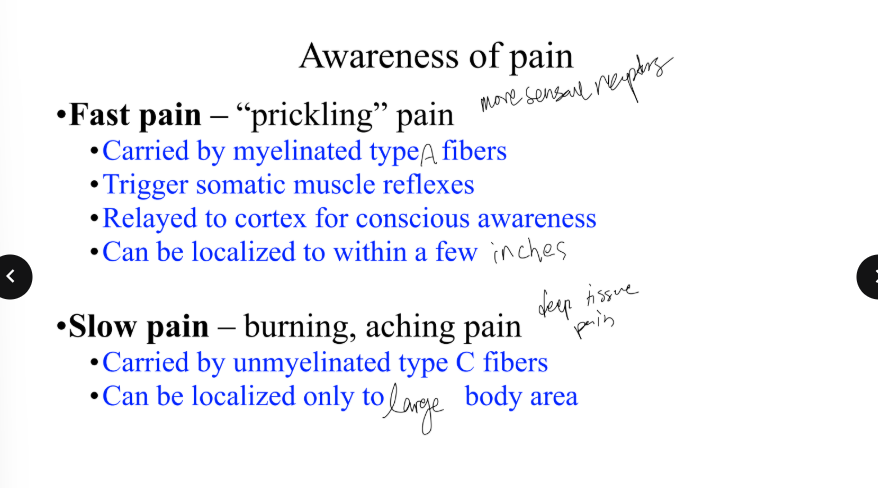
Fast pain can feel like “prickling” pain. What type of fibers is it carried by?
Myelinated Type A Fibers
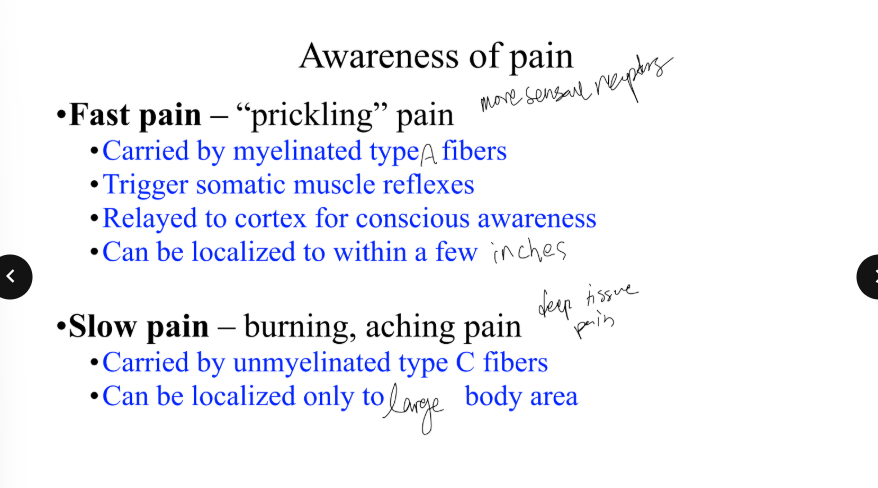
Slow pain can feel like “burning, aching” pain. What type of fibers is it carried by?
Unmyelinated type C fibers
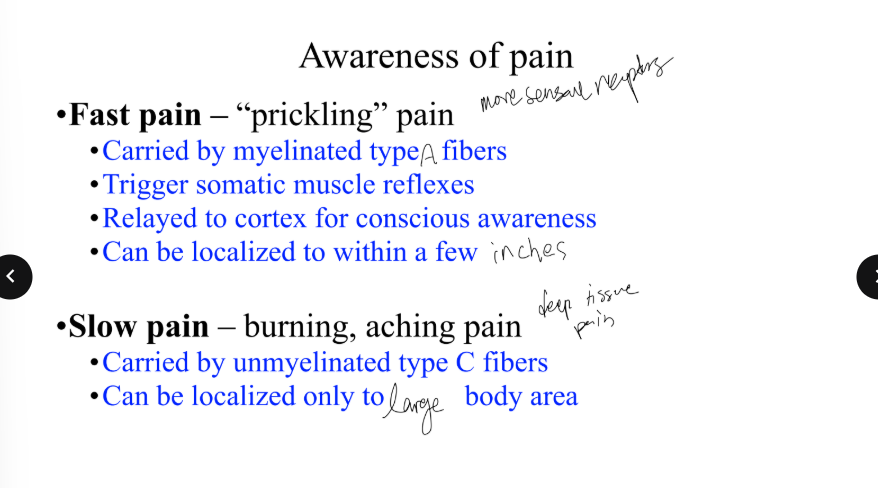
Slow pain can feel like “burning, aching” pain. Where is it localized?
Can be localized only to large body area.
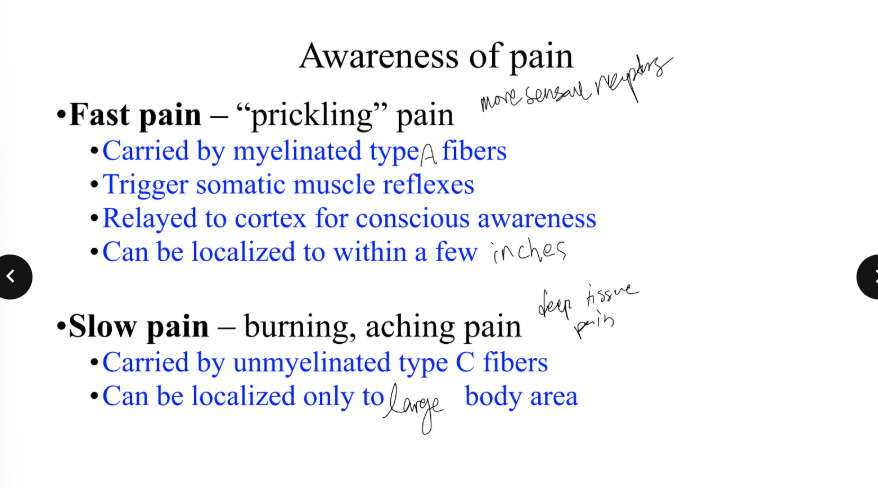
Fast pain can feel like “prickling” pain. Where is it localized?
It can be localized to within a few inches
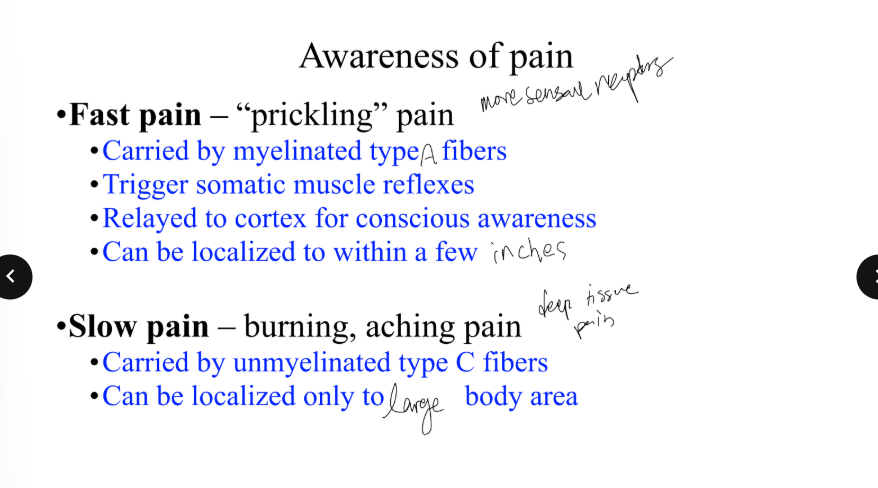
Fast pain can feel like “prickling” pain. What kind of reflexes does it trigger? Where is it related to for conscious awareness?
Trigger somatic muscle reflexes
Relayed to cortex for conscious awareness

Uhhh ohhhhh!!!! You just stepped on a nail, you intuitively bring your foot up, and yell OWWWWWWW!!!!!!!! FUCKK!!!!!!! And you felt exactly where the pain was, near your middle toe. What kind of pain did you experience and describe it
Fast pain - “pricking” pain
Carried by myelinated type A fibers
Trigger somatic muscle reflexes (bring foot up)
Relayed to cortex for conscious awareness (OWWWW!!!! FUCKKKK!!!)
Can be localized to within a few inches (Pain was in middle toe)
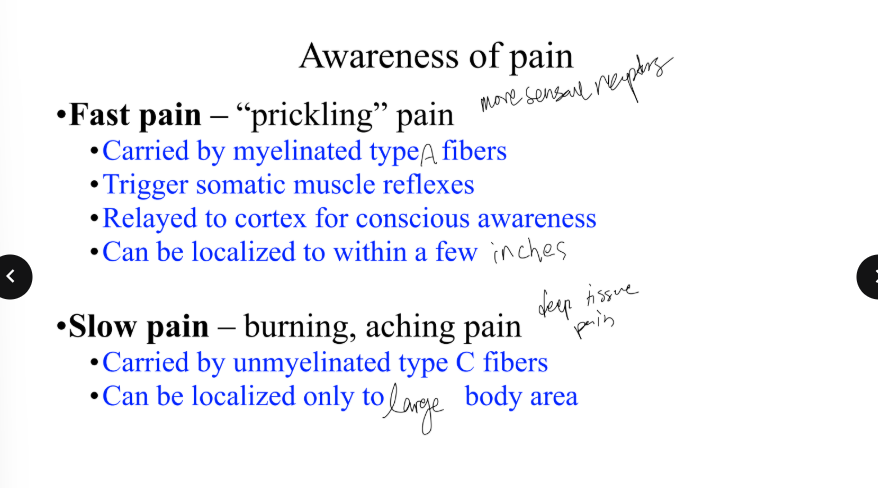

Unfortunately, even though drinking matcha and quarter zips became a trend, performative male feminism did not eliminate periods for women. This woman feels a type of pain across her stomach, but upon being asked by the doctor where exactly, she cannot pinpoint where it is. What type of pain is she feeling?
Slow pain - burning, aching pain
Carried by unmyelinated type C fibers
Can be localized only to a large body area
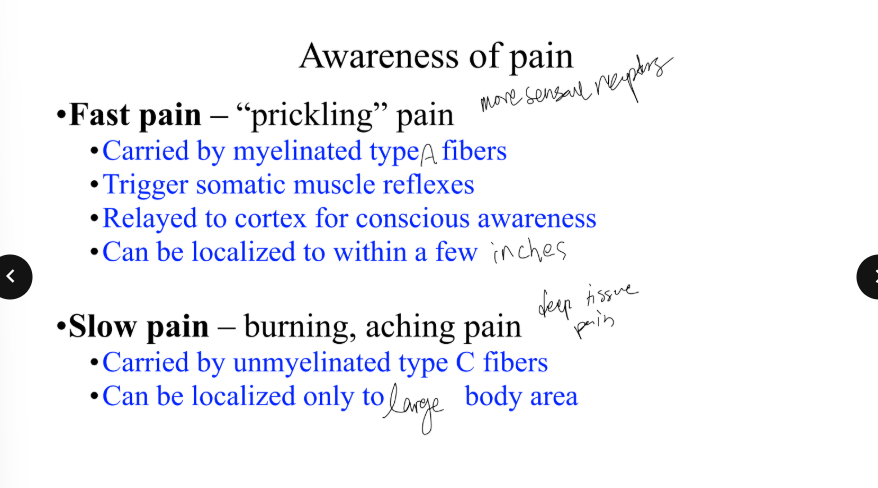
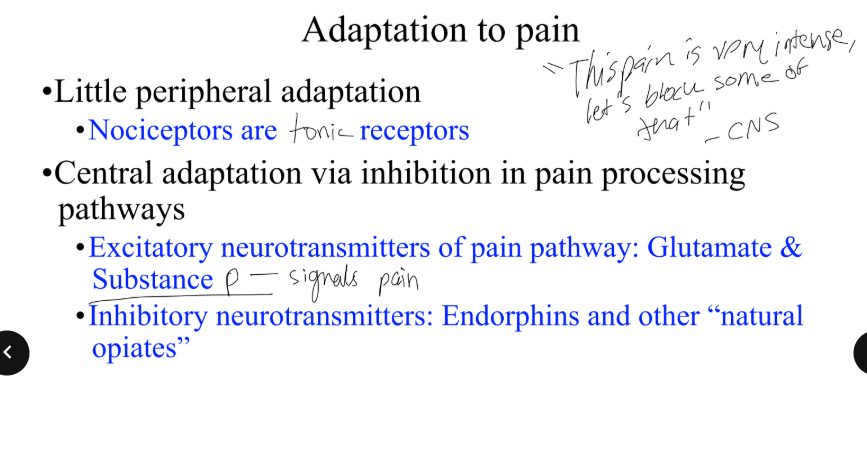
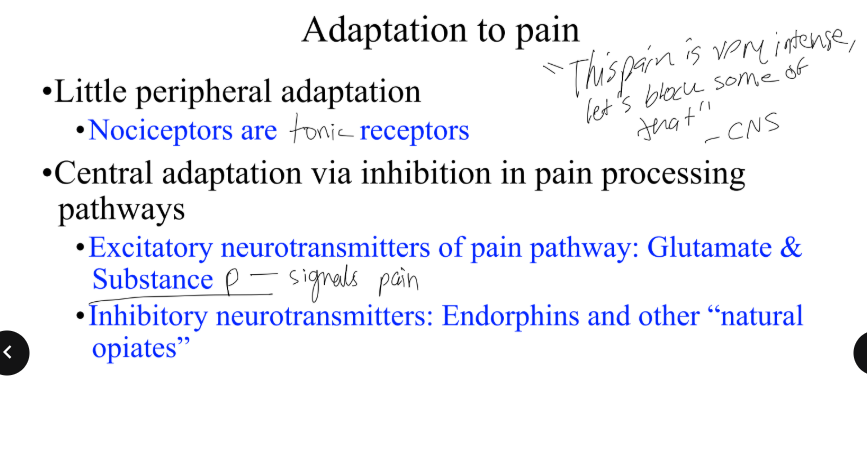
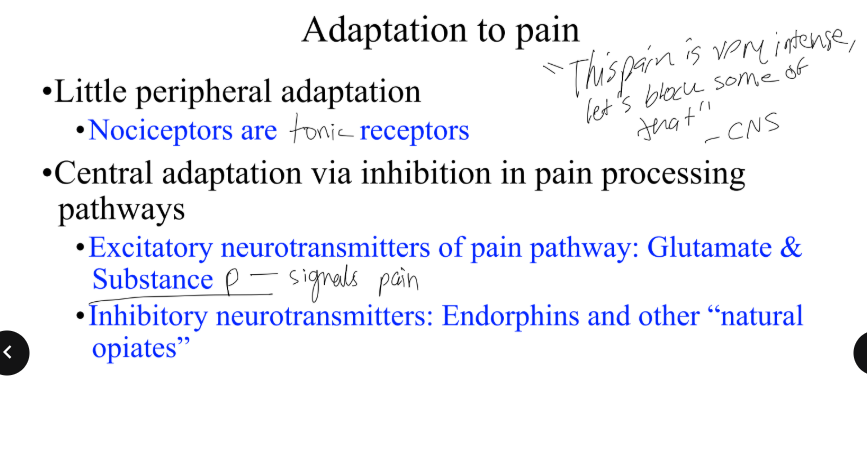
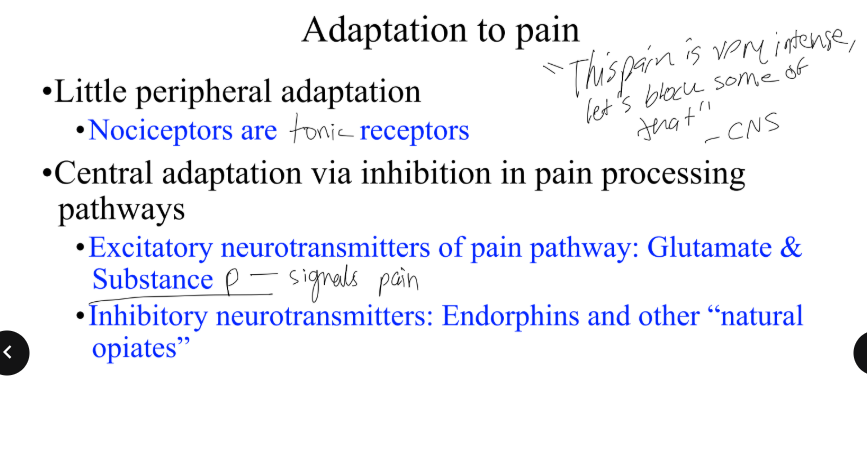
“This pain is very intense, let’s block some of that.” Who would likely say this?
The Central Nervous System when adapting to pain.
Pain does NOT adapt well at the receptor level, but it can be suppressed in the CNS.
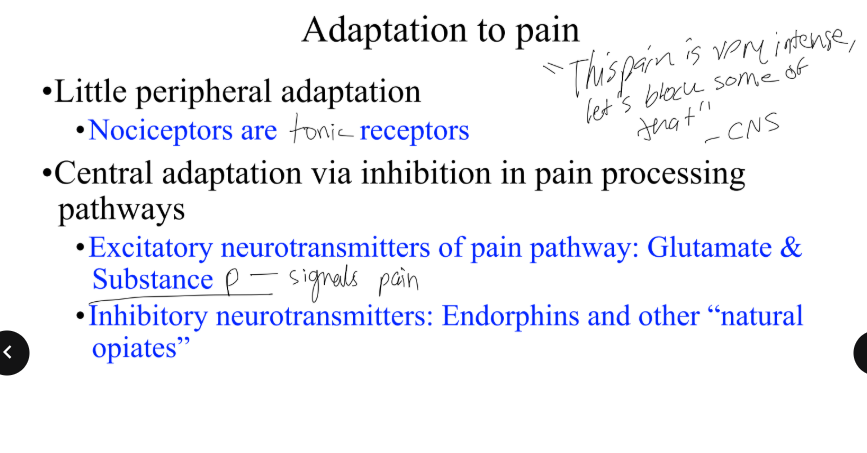
Pain does NOT adapt well at the receptor level, but it can be suppressed in the ___.
CNS
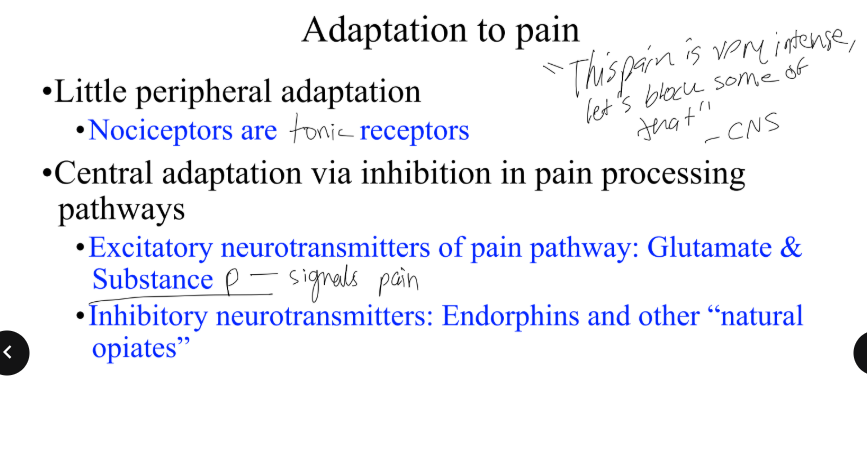
Pain does NOT adapt well at the receptor level, but it can be suppressed in the CNS. What is little peripheral adaptation? How do we adapt to pain?
Little peripheral adaptation: receptor becomes less responsive over time. Many senses adapt quickly, like smell and touch, but pain does not.
So, we use
Central adaptation via inhibition in pain processing pathways
Excitatory neurotransmitters of pain pathway are Glutamate and Substance P
Inhibitory neurotransmitters are Endorphins and other “natural opiates”.
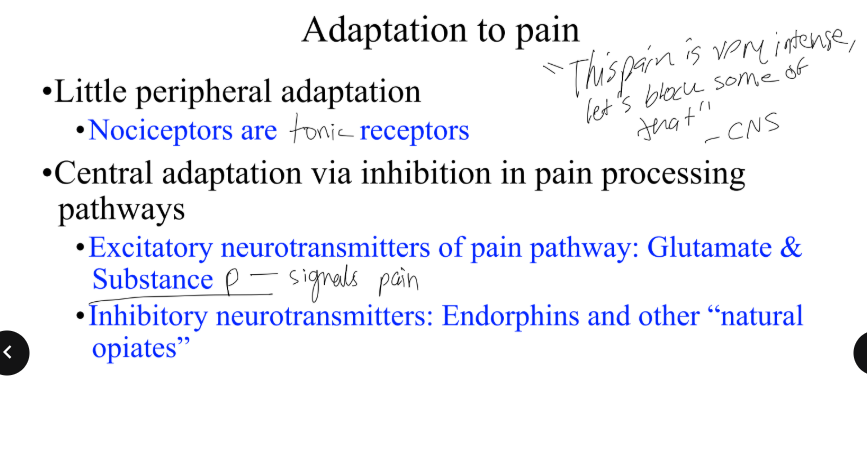
Excitatory neurotransmitters of pain pathway are
Glutamate and Substance P
Inhibitory neurotransmitters are
Endorphins and other “natural opiates”.
Dr. Baguely was in a lot of pain, so the medical team put him on opioids. Why?
Because endorphins and other “natural opiates” are inhibitory neurotransmitters of pain
A tonic receptor is a receptor that:
Continues firing as long as the stimulus is present
Shows little or no adaptation
Signals duration and intensity of a stimulus over time
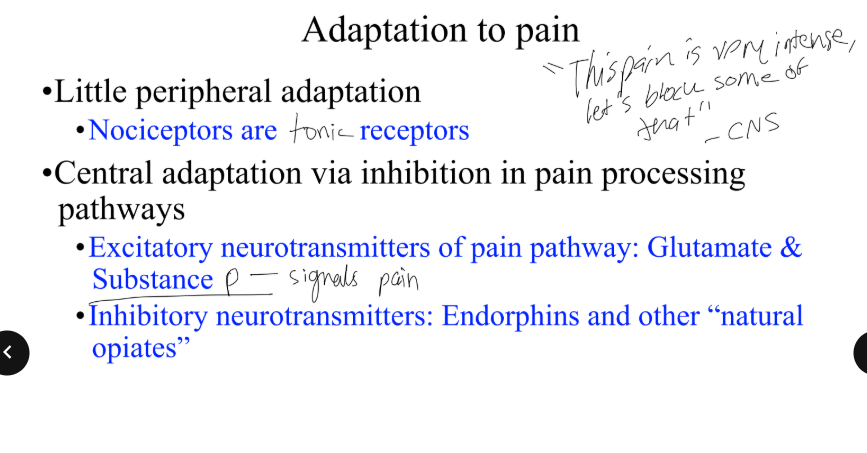
What does it mean when Nociceptors are tonic receptors?
It means:
Pain receptors do not shut off
They keep generating action potentials
As long as tissue damage or noxious stimulus exists
This is by design.
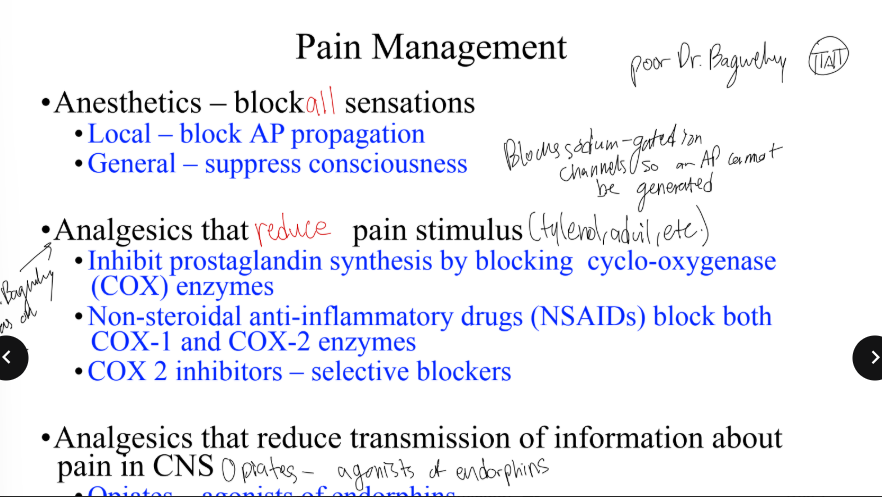
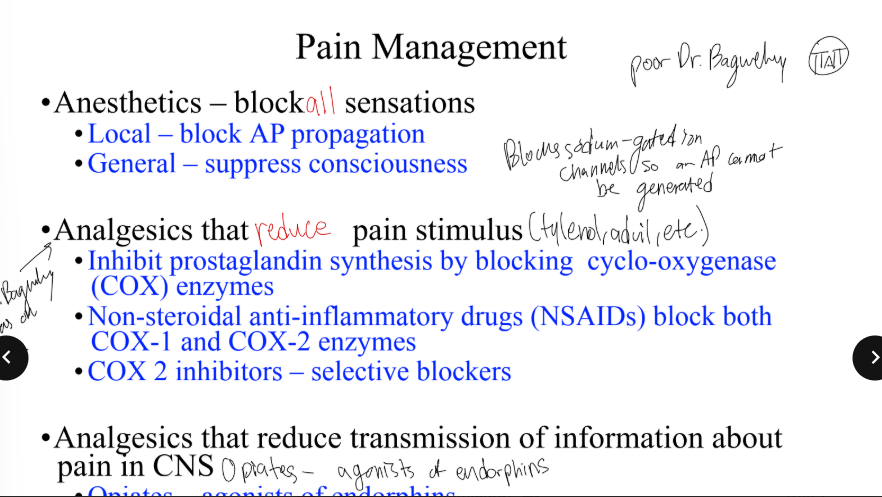
There are many ways to manage pain, one of them being anesthetics. How do they work? What is the difference between local and general anesthetic?
Anesthetics block all sensations.
Local Anesthetic — Block AP propagation
General Anesthetic — Suppress consciousness

This boy is slightly conscious but won’t feel any pain due to the blocking of AP propagation. What type of anesthetic is he under?
Local Anesthetic — Block AP propagation
General Anesthetic — Suppresses consciousness

What type of anesthetic are you under when you are knocked out unconscious?
Local Anesthetic — Block AP propagation
General Anesthetic — Suppresses consciousness
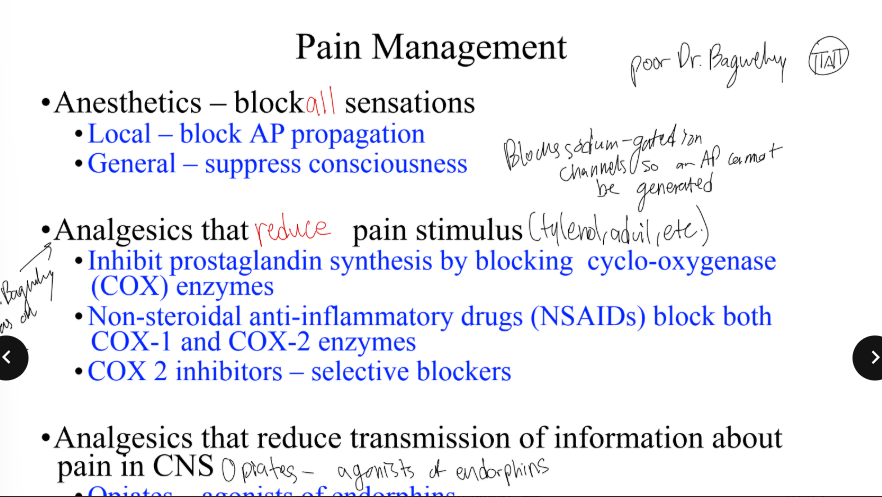
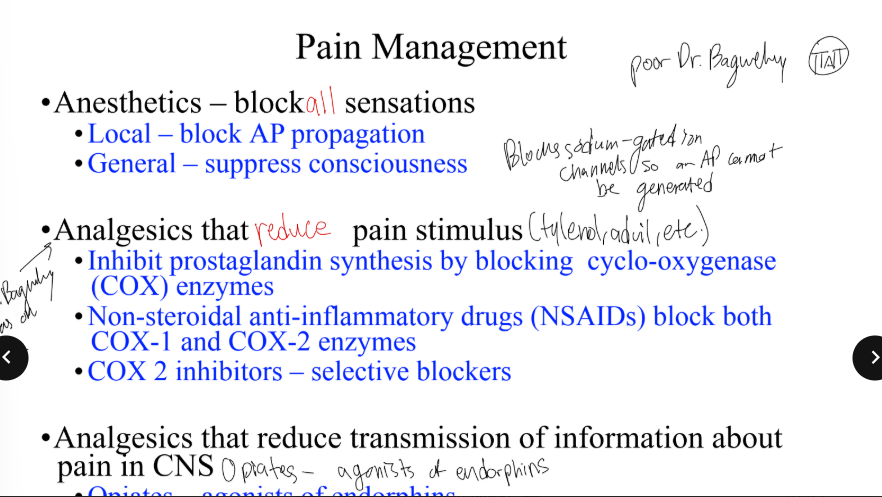
There are many ways to manage pain, one of them being analgesics. How do they work?
Analgesics reduce pain stimulus by:
Inhibiting prostaglandin synthesis by blocking cyco-oxygense (COX) enzymes
Non-steroidal inflammatory drugs (NSAIDS) block both COX-1 and COX-2 enzymes
COX 2 inhibitors — selective blockers
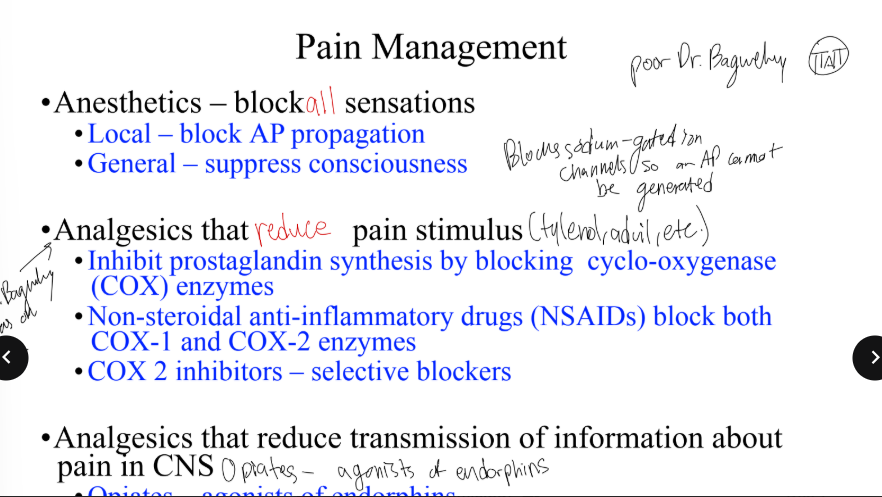
Tylenol, advil, etc., are examples of what type of pain management?
analgesics
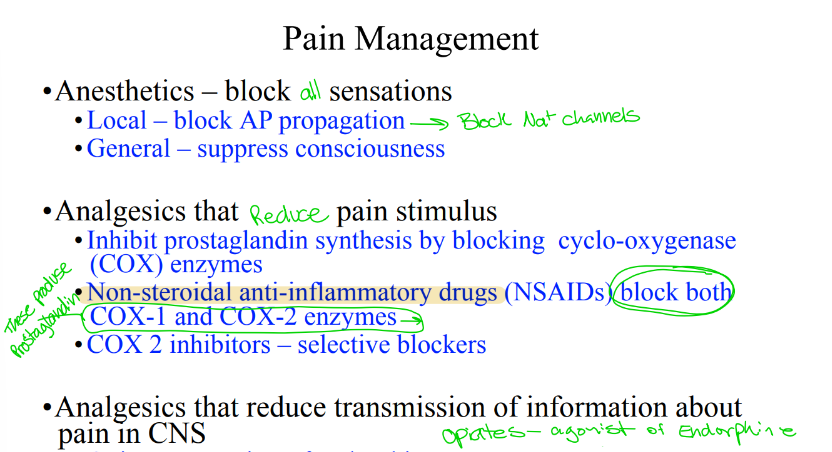
COX-1 and COX-2 enzymes produce what
prostaglandins

Analgesics that reduce transmission of information about pain the CNS are opiates, which are agonists of ______
endorphins
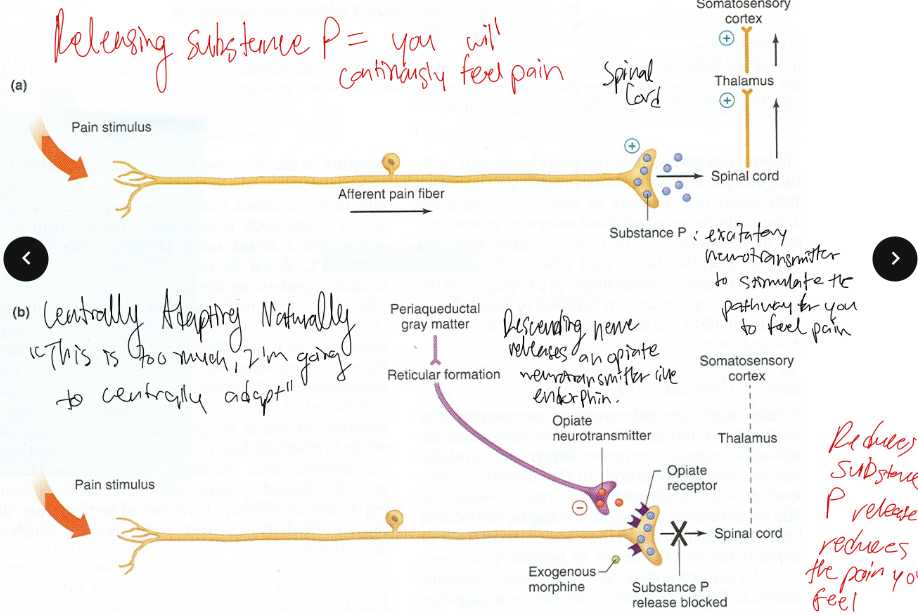
When you are releasing Substance P, you will continuously feel pain. What type of adaptation goes “Man fuck this shit, this is too much, I’m going to ____ adapt” and then the descending nerve releases an opiate neurotransmitter like endorphins?
central adaptation
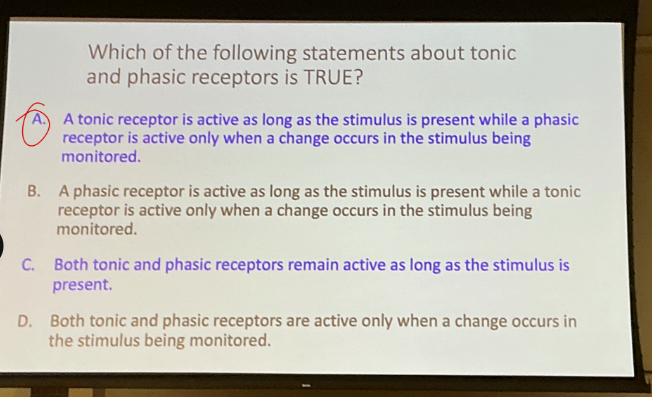
Which of the following statements about tonic and phasic receptors is TRUE?
A
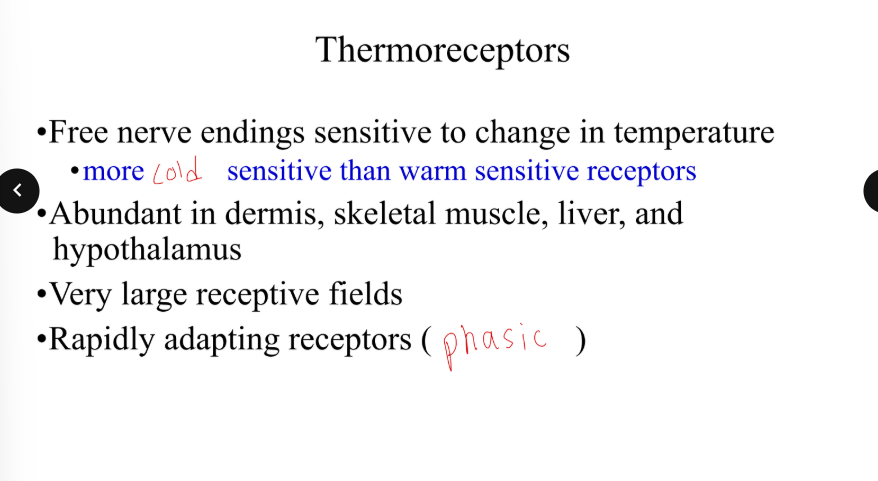
Free nerve endings are sensitive to change in temperature. Are they more sensitive to warm or cold?
more cold sensitive than warm sensitive receptors
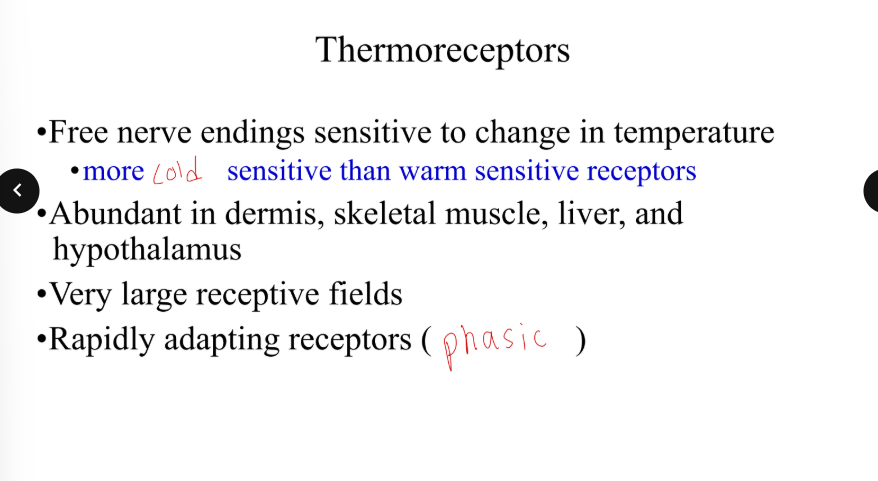
Where are thermoreceptors abundant in?
Abundant in dermis, skeletal muscle, liver, and hypothalamus
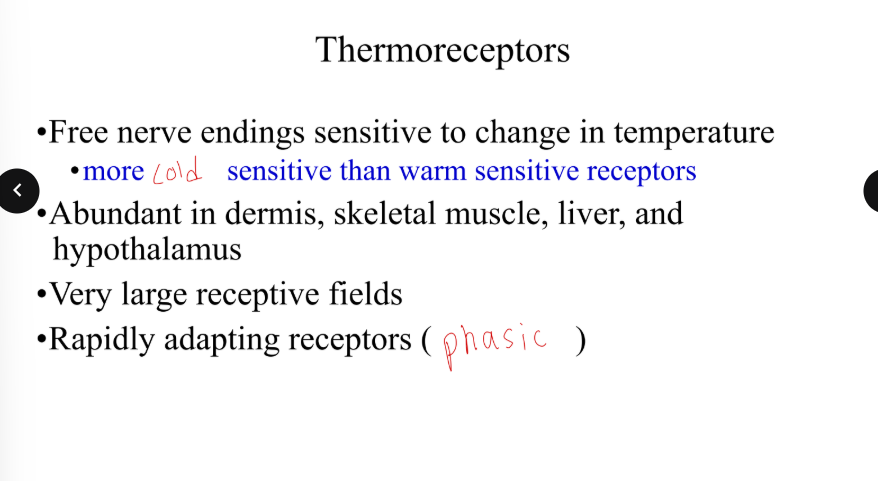
What are the size of receptive fields of thermoreceptors?
Very large receptive fields
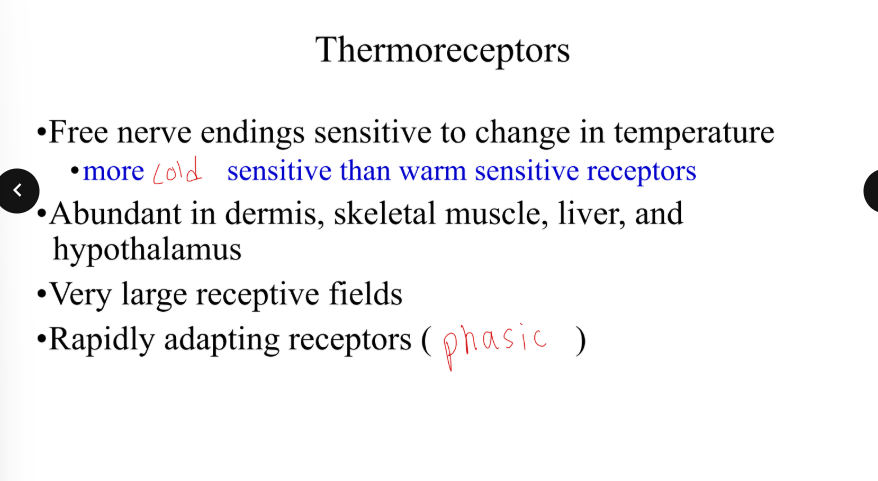
Thermoreceptors have rapidly adapting receptors, meaning they are (tonic/phasic).
phasic
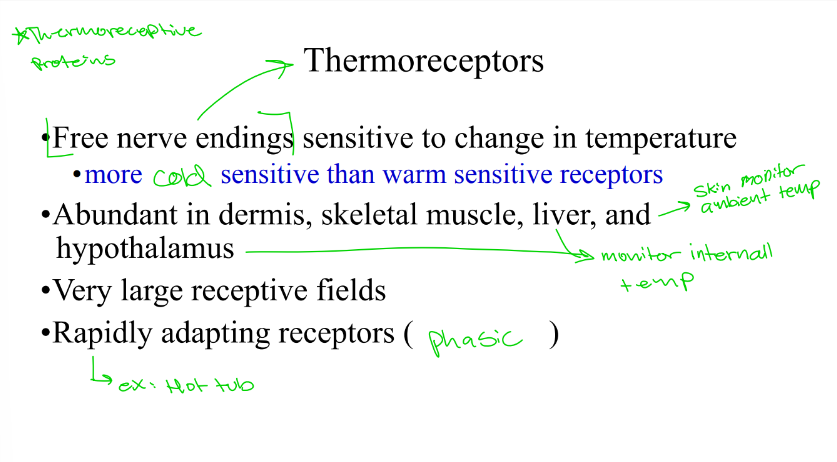
Entering a hot tub and adjusting to the hot temperature is an example of thermoreceptors having
rapidly adapting receptors, meaning they are phasic
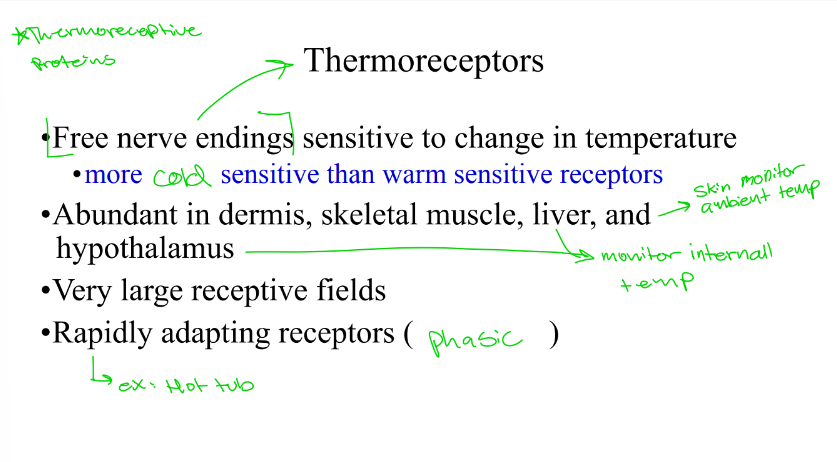
Receptors =
proteins!!
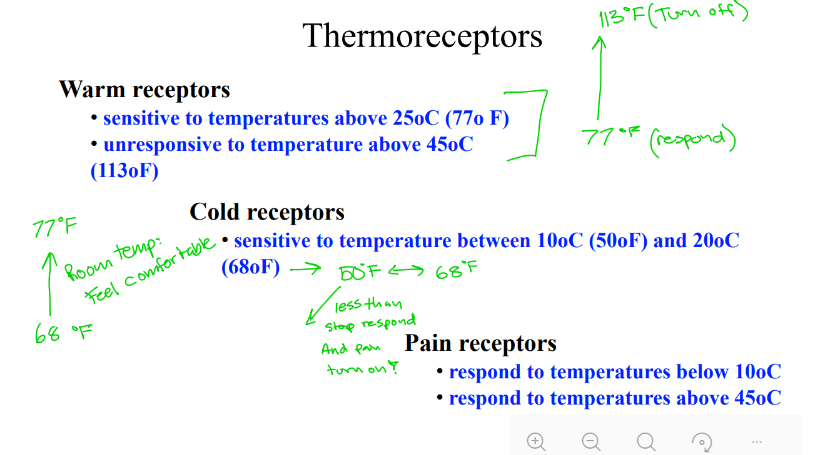
Warm receptors are sensitive to what temperatures and unresponsive to what temperatures?
Sensitive to temps above 25 C (77 F)
Unresponsive to temps above 45 C (113 F)
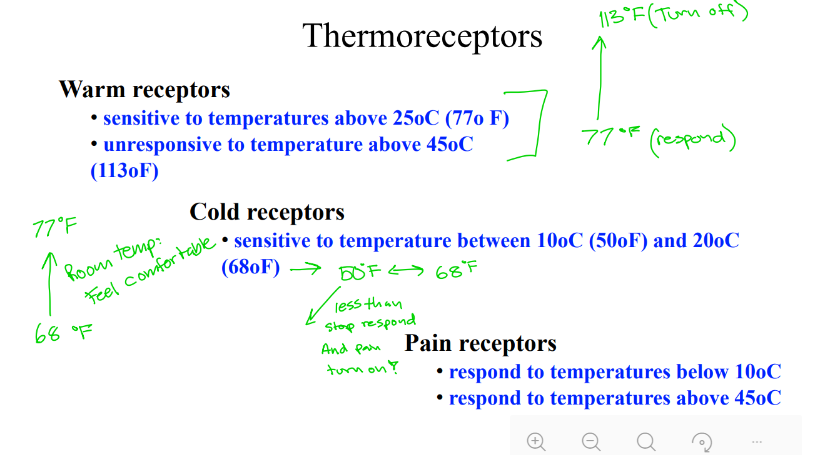
What temperatures are cold receptors sensitive to?
sensitive to temps between 10 degrees C (50 degrees F) and 20 degrees C (68 degrees F)
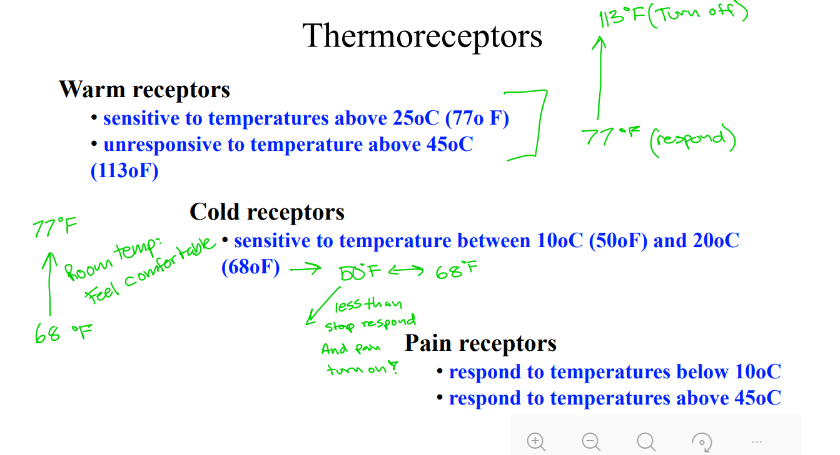
What temperatures do pain receptors respond to?
respond to temps below 10 degrees C (50 F)
respond to temps above 45 degrees C (113 F)
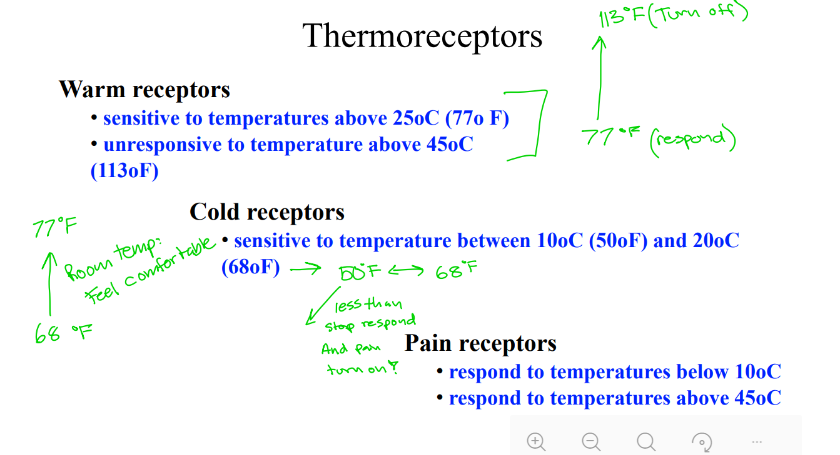
What temperatures are we comfortable at? (room temp)
68-77 F
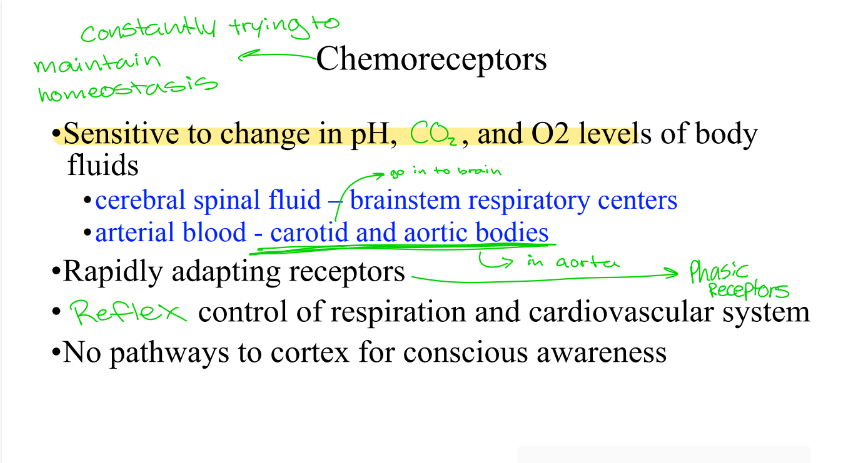
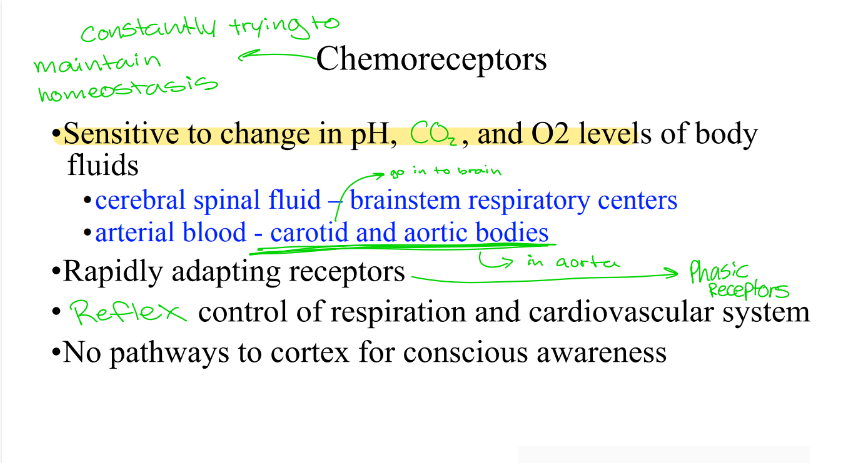
Chemoreceptors are constantly trying to do what?
maintain homeostasis
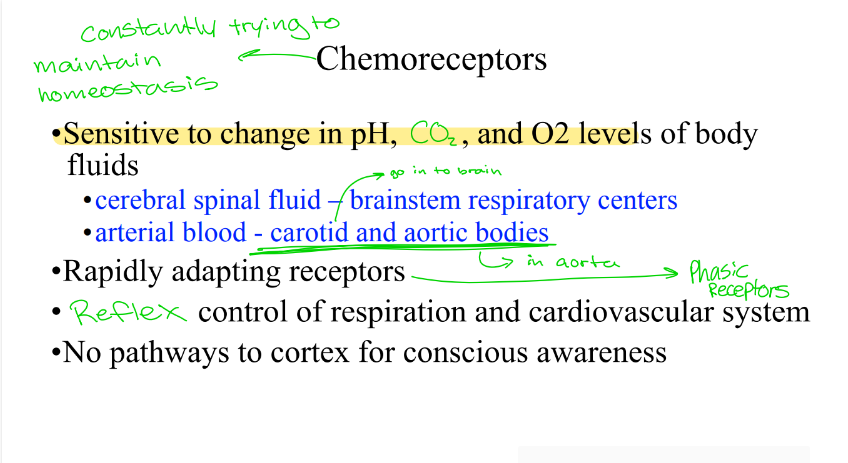
What are chemoreceptors sensitive to changes to?
in pH, CO2, and O2 levels of body fluids
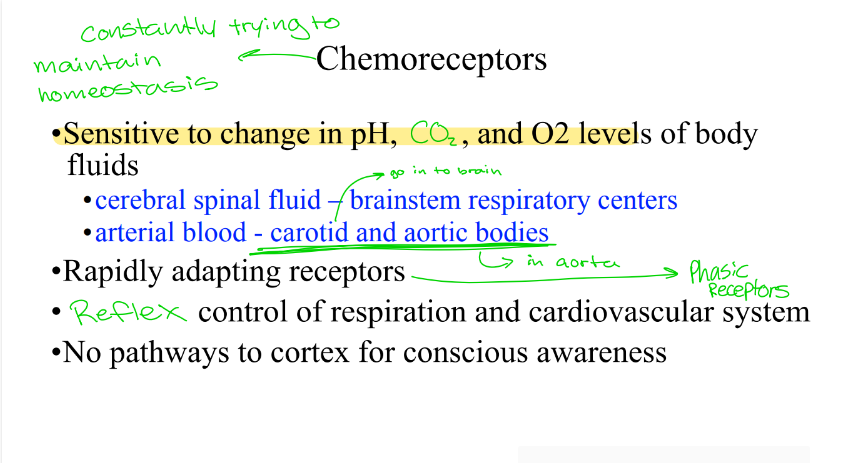
Chemoreceptors are rapidly adapting receptors, meaning they are what kind of receptors?
phasic receptors
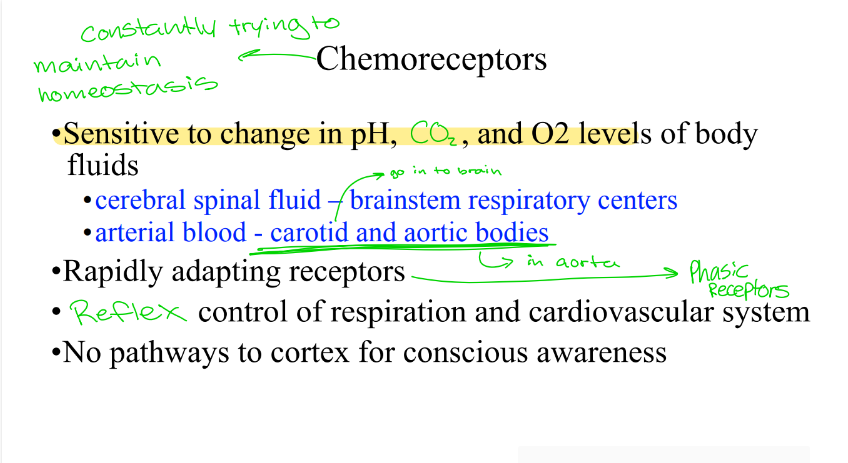
Chemoreceptors have reflex control of what systems in the body?
Respiration and CVD system
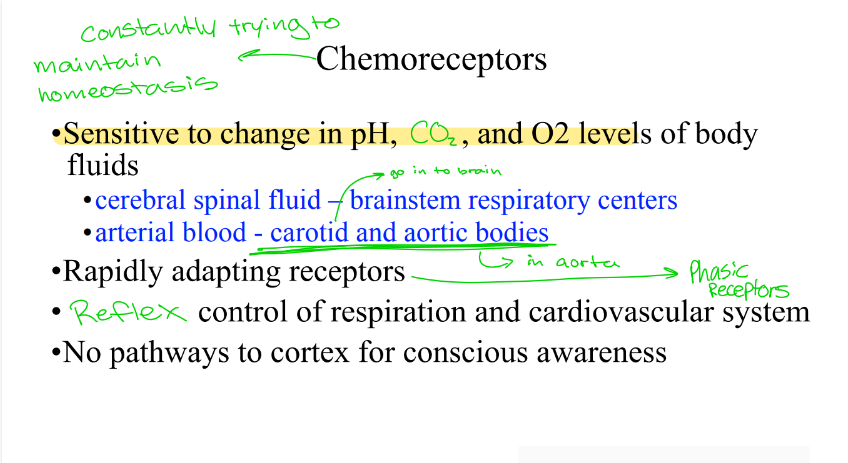
T/F: The chemoreceptors have no pathways to the cortex for conscious awareness.
T
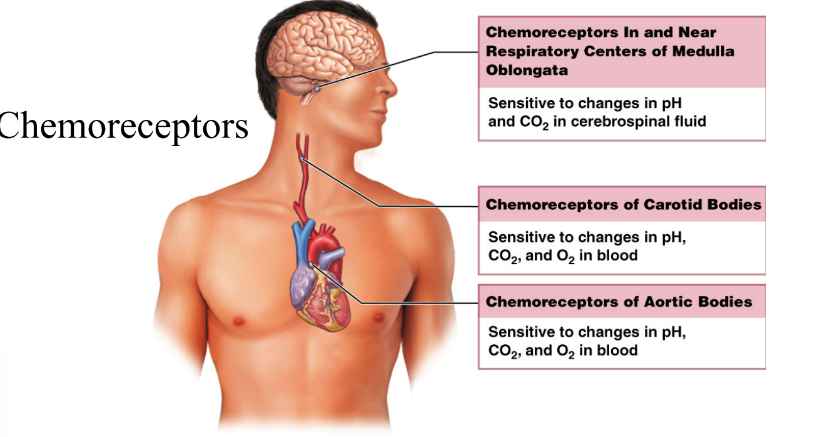
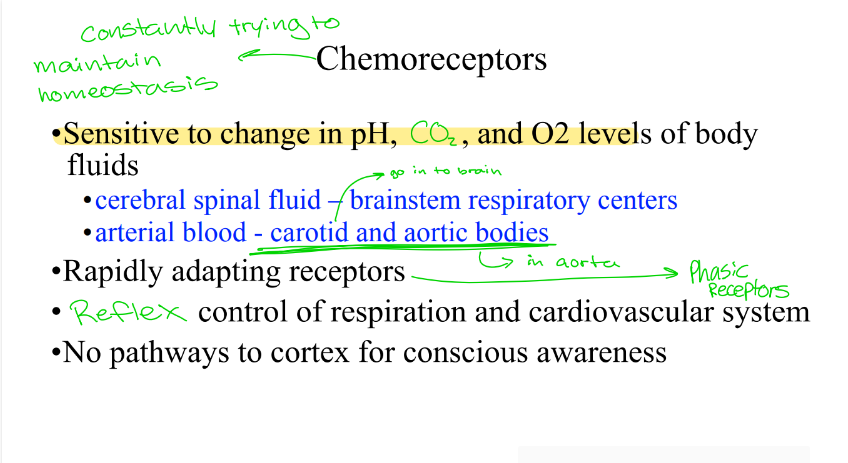
T/F: Chemoreceptors have a pathway to which they can reach the cortex for conscious awareness.
F, the chemoreceptors have no pathways to the cortex for conscious awareness.
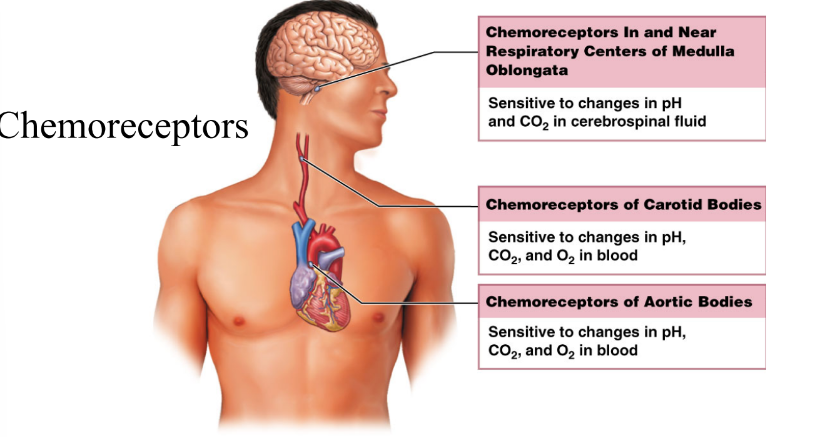
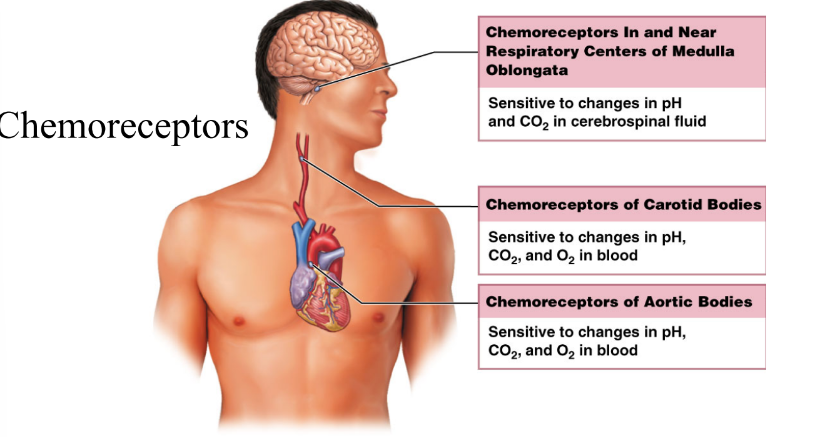
What are the two main locations of chemoreceptors?
Cerebral spinal fluid — brainstem respiratory centers (primary regulators of normal breathing)
Arterial blood — carotid and aortic bodies (especially important when oxygen drops)
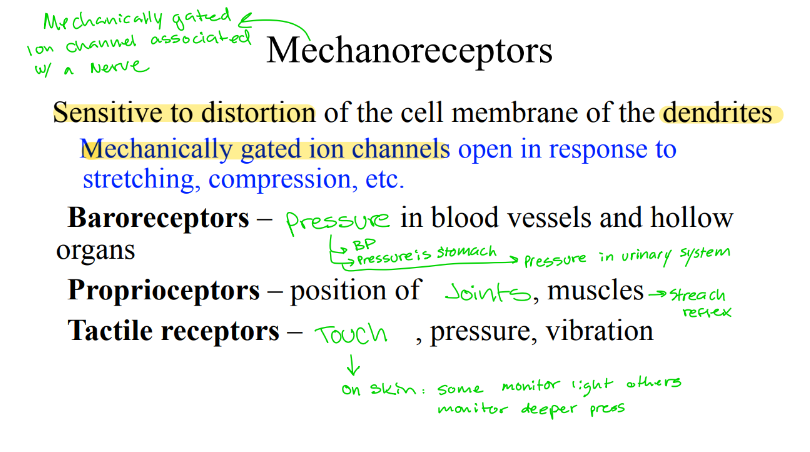
What are mechanoreceptors sensitive to?
Sensitive to distortion of the cell membrane of the dendrites.
Mechanically gated ion channels open in response to stretching, compression, etc.
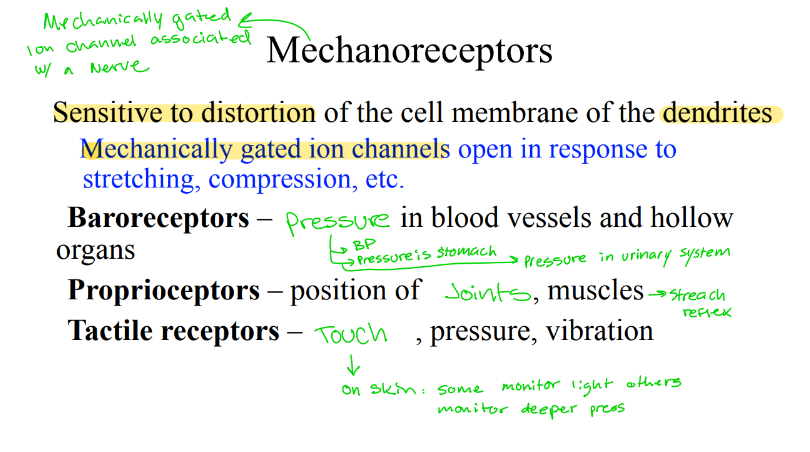
____ (type of receptor) are mechanically gated ion channels associated with a nerve.
Mechanoreceptors
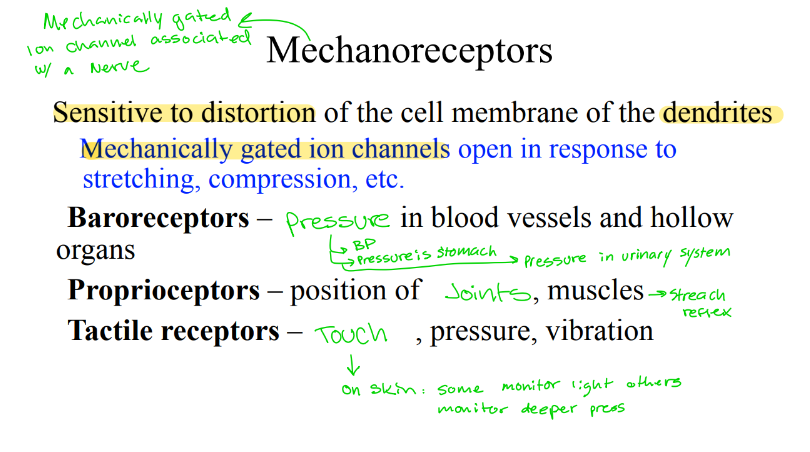
Mechanically gated ion channels open in response to
stretching, compression, etc.
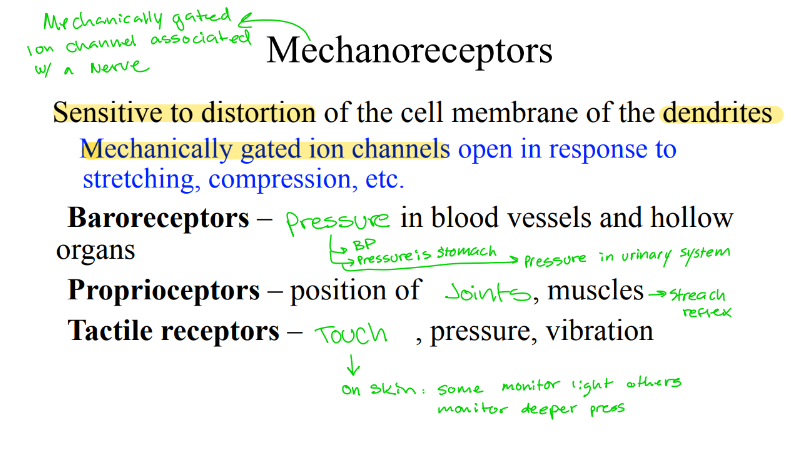
What are the different types of mechanoreceptors?
Baroreceptors: Pressure in blood vessels and hollow organs → BP, pressure in stomach, pressure in urinary system, etc
Proprioceptors: Position of joints, muscles → stretch reflex
Tactile receptors: touch, pressure, vibration
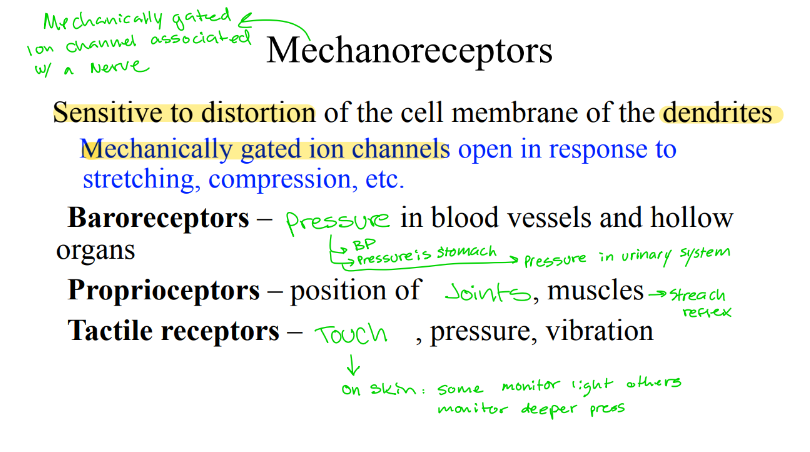
Pressure in blood vessels and hollow organs is a type of mechanoreceptor called
Baroreceptors: Pressure in blood vessels and hollow organs → BP, pressure in stomach, pressure in urinary system, etc
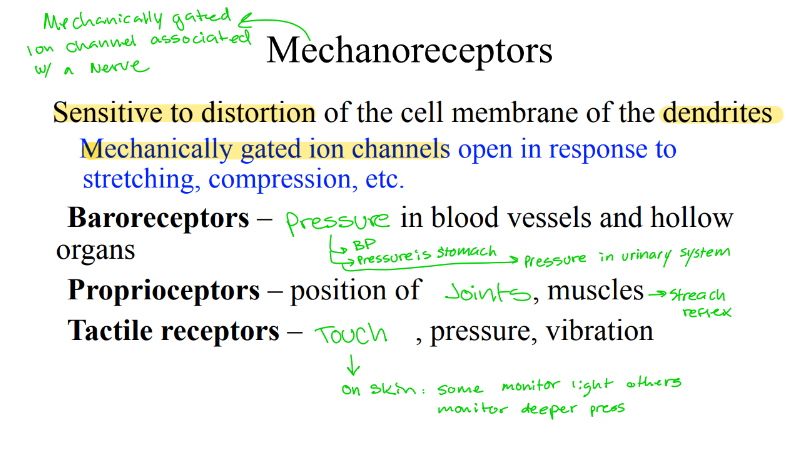
Position of joints and muscles (which result in a stretch reflex) is a type of mechanoreceptor called
Proprioceptors: Position of joints, muscles → stretch reflex
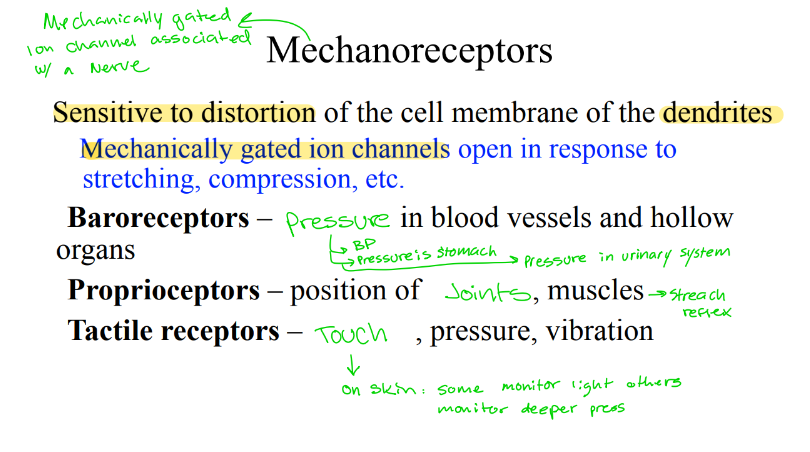
Touch, pressure, and vibration on skin is a type of mechanoreceptor called
Tactile receptors: touch, pressure, vibration

What tpye of receptor is a pressure monitor of internal organs?
Baroceptors
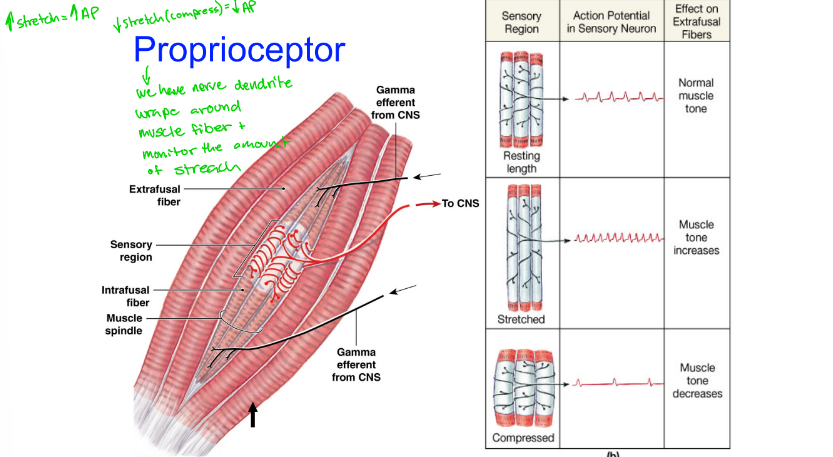
What type of receptor is shown?
Proprioceptor
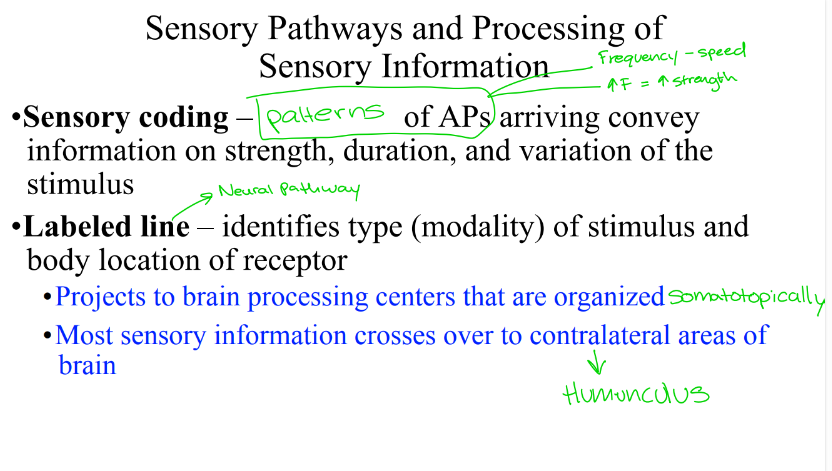
A labeled line is a neural pathway that
identifies type (modality) of stimulus and body location of receptor
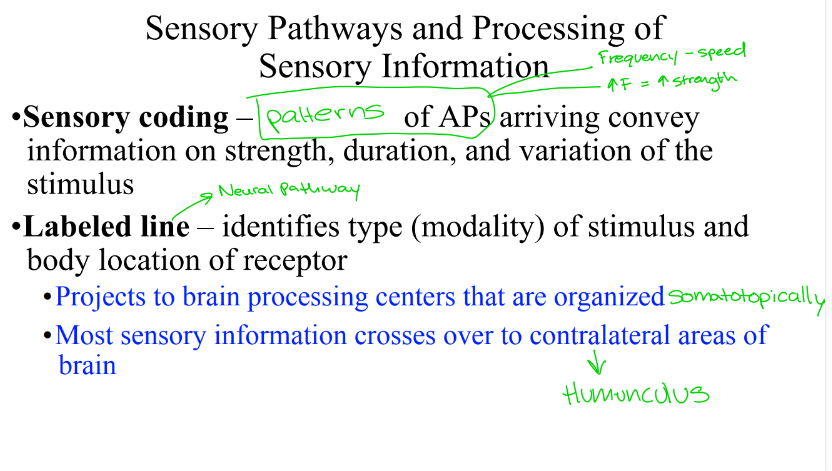
Sensory coding = how action potentials represent stimulus features. APs themselves are all-or-none, so information is encoded by _____, not size.
patterns
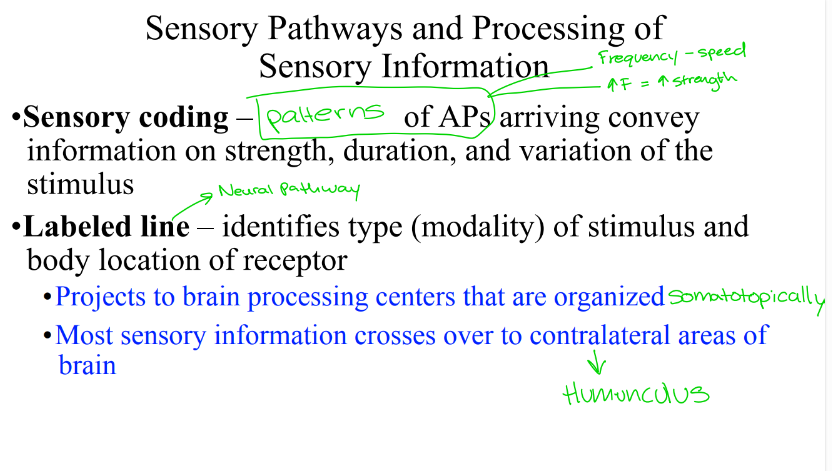
A ______ means:
Each sensory pathway is “labeled” for:
Modality (touch, pain, temperature, vision, etc.)
Location (which body part)
The brain doesn’t analyze the stimulus itself — it just asks:
Which pathway is active?
If the pain pathway from the hand fires:
The brain perceives pain in the hand
Even if the stimulus is artificial (electrical stimulation)
labeled line
 Note
Note  Flashcards (30)