P2.5 - Forces and Elasticity (Ai generated with instructions by me)
 Call Kai
 Learn
Learn Practice Test
 Spaced Repetition
 Match
Match Flashcards
 Knowt Play
1/15

There's no tags or description
Looks like no tags are added yet.
Name | Mastery | Learn | Test | Matching | Spaced | Call with Kai |
|---|
No analytics yet
Send a link to your students to track their progress
16 Terms
What happens to an object when two or more forces act on it?
Its shape changes (it deforms). The type of deformation depends on the direction of the forces
What is compression?
Two forces acting in opposite directions towards the object — e.g. compressing a spring
What is stretching?
Two forces acting in opposite directions away from the object — e.g. hanging masses on a spring. The two forces are a result of Newton's Third Law
What is bending?
Two forces acting at different points on an object but towards each other — e.g. weight and reaction force on a diving board. Can also be caused by two forces at an angle to each other
What is elastic deformation?
When an object returns to its original shape once the deforming force is removed — e.g. rubber bands, steel springs, sponge
What is plastic deformation?
When an object does not return to its original shape after the deforming force is removed — e.g. clay, putty, glass
What does Hooke's Law state?
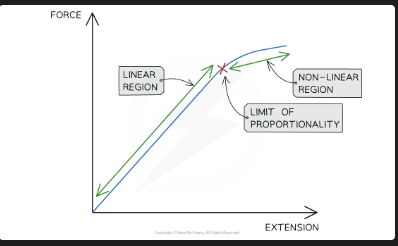
The extension of an elastic object is directly proportional to the force applied, up to the limit of proportionality. F = ke, where F = force (N), k = spring constant (N/m), e = extension (m)
What is the limit of proportionality?
The point beyond which force and extension are no longer directly proportional — Hooke's Law no longer applies and the graph becomes non-linear
What does the spring constant k tell you?
How stiff the spring is. A higher k = stiffer spring. Units: N/m
How is extension calculated?
Extension = final length − original length
What does a force-extension graph look like for a spring obeying Hooke's Law?
A straight line through the origin (linear region). Beyond the limit of proportionality the line curves (non-linear region). The gradient of the linear section = spring constant k
[HIGHER] What is the equation for elastic potential energy stored in a spring?
Ee = ½ke². Ee = elastic potential energy (J), k = spring constant (N/m), e = extension (m). Only valid within the limit of proportionality
[HIGHER] What does the area under a force-extension graph represent?
The work done on the spring / elastic potential energy stored
[PRACTICAL] PAG — Investigating Force & Extension: full method
Aim: investigate the relationship between force and extension for a spring. IV = force (N), DV = extension (m), CV = spring used.
1. Set up clamp and stand with spring hanging vertically.
2. Attach pointer/fiducial marker to bottom of spring to read ruler accurately.
3. Record the natural length of the spring.
4. Add 100g masses one at a time using a mass hanger.
5. Record the new length each time — repeat 3 times and average.
6. Calculate extension = final length − original length.
7. Plot a force-extension graph — straight line through origin = Hooke's Law obeyed.
8. Calculate k = gradient of the straight line
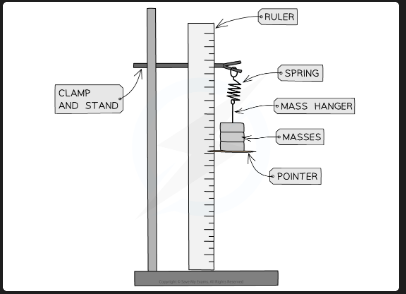
[PRACTICAL] How is force calculated in the spring PAG?
F = mg — the weight of the masses added to the hanger
[PRACTICAL] How do you evaluate the spring PAG?
Systematic error: parallax when reading ruler — use a pointer/fiducial marker. Random error: variation in readings — repeat and average. Safety: wear goggles; place a cushion under masses; do not lean over apparatus. Examiner tip: extension ≠ final length — if your values equal the final length you have made this mistake

