circuits 3
 Call Kai
 Learn
Learn Practice Test
 Spaced Repetition
 Match
Match Flashcards
 Knowt Play
1/22

There's no tags or description
Looks like no tags are added yet.
Name | Mastery | Learn | Test | Matching | Spaced | Call with Kai |
|---|
No analytics yet
Send a link to your students to track their progress
23 Terms
Some Animals have a blank Escape Response
Rhythmic
Tritonia Escape “Reflex”
Referred to as a reflex but it’s not, it’s rhythmicity
Rhythmicity
(1) Two or more processes that interact such that each process sequentially increases and decreases, and that,
(2) as a result of this interaction, the system repeatedly returns to its starting condition.
Episodic
Short sequences
Ex. Tritonia
Continuous
Animal running or walking
Ex. Horse running
What are some other behaviors that are rhythmic?
Heart beat breathing sleeping contractions chewing panting swallowing nursing gasping
Fixed Action Pattern
A behavior that goes from start to finish when evoked
Rhythmic motor patterns underlie many fixed action patterns
Blank Generate Rhythmic Motor Output
Reflex chains which are motor nervous system contained a series of reciprocally inhibitory reflexes that had a final common pathway: the motor neuron
Sherrington
The rhythm persists after removing the sensory input!!
Graham Brown removed the Dorsal Root Ganglion and still found rhythmic outputs, which he called “narcosis rhythms.” But cat was still able to walk after signal was removed but sensory input needed to avoid obstacles in path
Two “Half-Oscillators” with Reciprocal Inhibition
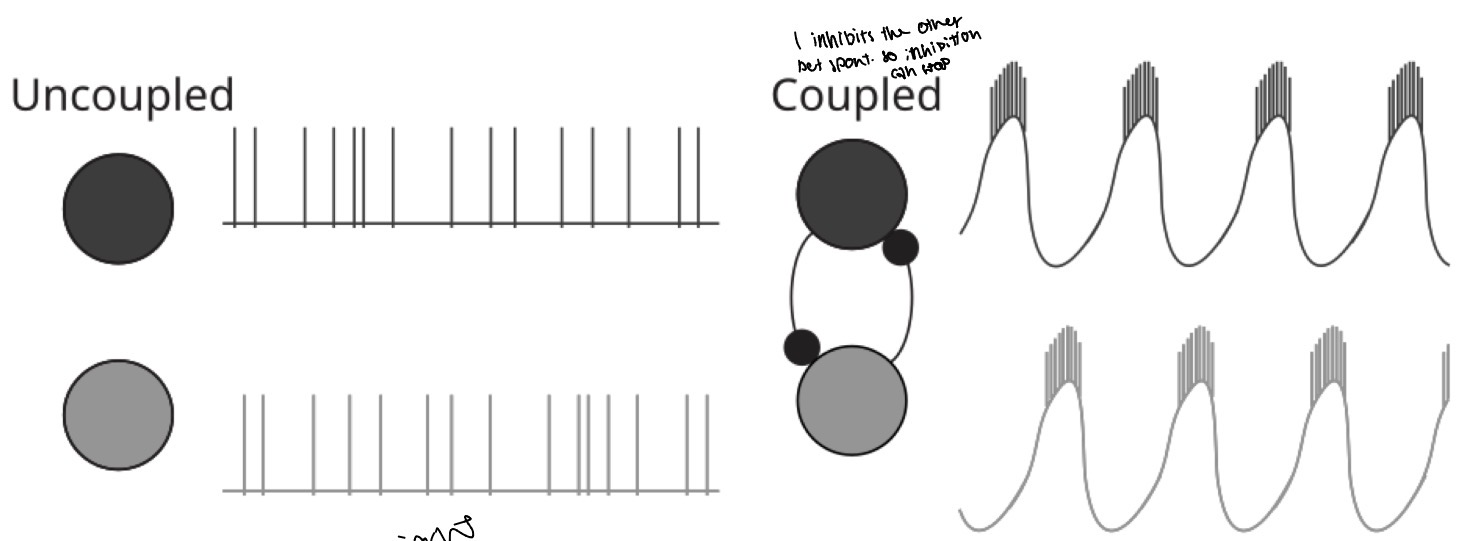
Reflex Chains vs. Central Pattern Generators
Reflex chain requires sensory input
Central pattern generators does not require sensory input
How Do you Test Central Origin of the Rhythm?
Remove the sensory inputs!!!
“Deafferenting” the central nervous system (CNS)!
“Fictive” Motor Programs:
Spontaneous CPG Activity in the Absence of Any Sensory Input
Dogfish locomotion: spontaneous with rhythmic output for swimming
Mammalian locomotion: requires neuromodulators To modulate rhythmic output
How might a CPG keep a rhythm?
1. Intrinsic Membrane Properties
2. Emergent Network Properties of neurons (e.g., “Half Oscillators”) this needs two neurons with reciepient inhibition for rhythmic output
Plateau Potentials:
Generated by Certain Types of Voltage-Gated Ion Channels
2) Emergent Properties:
How neurons are coupling for rhythmic output
Can be unconnected or rhythmically connected to inhibit each other and give rhythmic output this works reliably with electrical synapses in more complex CPGs
So, what, if anything, does sensory Input do?
sensory (proprioceptive) input is not necessary for generating the rhythmic output of the nervous system, but it plays a role in shaping the output like avoiding obstacles
This can be called: “reflex modulation”
Integration of CPG with Sensory Input
Transected dogfish:
- Physically and chemically immobilized
- Tail is moved by experimenter in a rhythmic way like swimming
Increase frequency for tail movement increases the rhythm
The Nervous System has Many Distinct blank
CPGs
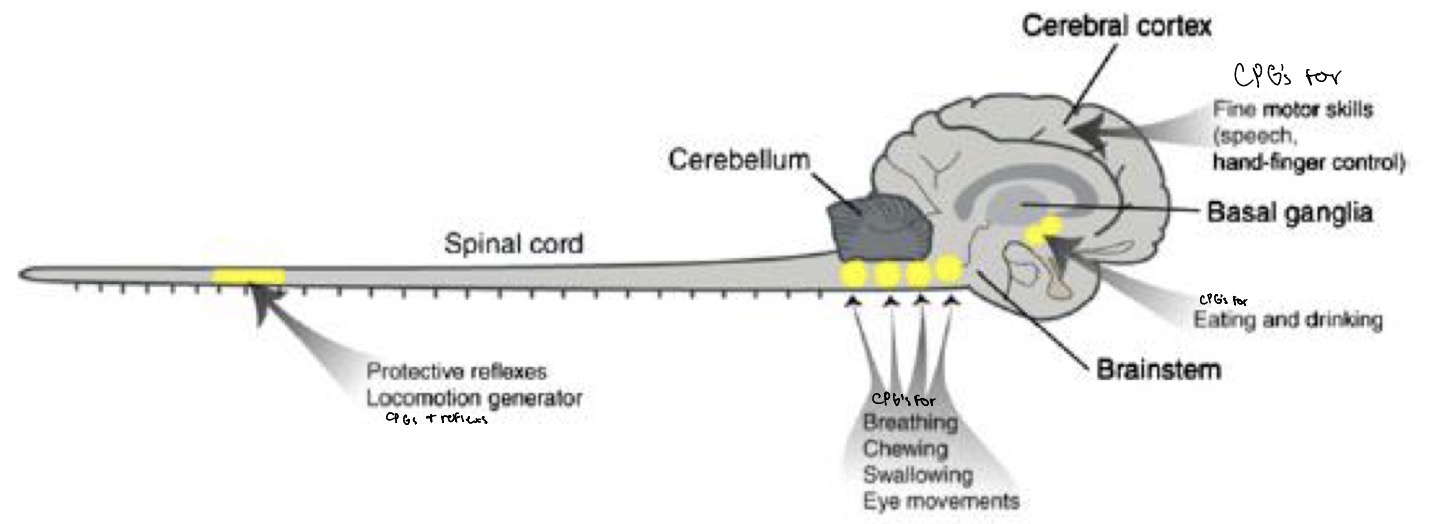
some CPGs can have more than one function
Often the same limbs, muscles, motor neurons, and even CPG interneurons are utilized for very different behaviors
Turtles using limbs for scratching and swimming and use the same CPGs in these limbs to do these actions they have four CPGS for each limb that change coordination with other limbs
CPGs often Show Plasticity: blank
Neuromodulation
Neuromodulators can activate, modulate, and terminate central pattern generators. Like changing speed, respiratory system with or without seratonin, the heart has its on CPG not in the brain
Why CPG Plasticity is Relevant
Research on it can help paraplegics to walk again
A CPG that Generates a 24-hour Rhythm!
~100 rhythmically active “basal retinal neurons” change their neuronal conductance over the course of ~24 hours, thereby creating a “clock” that measures time!
Neurons are coupled and fired together but what changes is the conductance

