Lecture 8: Extensive form games

0.0(0)
Studied by 0 people
call kaiCall Kai
learnLearn
examPractice Test
spaced repetitionSpaced Repetition
heart puzzleMatch
flashcardsFlashcards
GameKnowt Play
Card Sorting

1/16

encourage image

There's no tags or description

Looks like no tags are added yet.

Last updated 8:06 PM on 4/5/26
Name
Mastery
Learn
Test
Matching
Spaced
Call with Kai

No analytics yet

Send a link to your students to track their progress

17 Terms

1
New cards

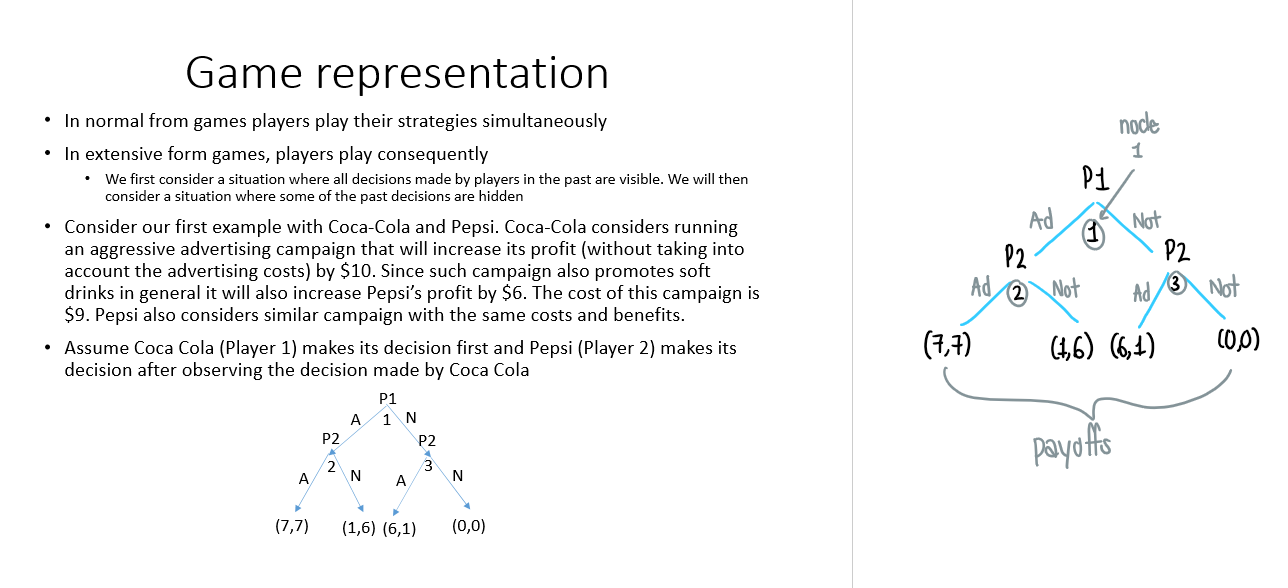
What is extensive form of games?

Normal game theory → decisions made simultaneously

  • When players make decisions sequentially

→ more realistic as you react to other players
<p>Normal game theory → decisions made simultaneously</p><ul><li><p>When players make decisions sequentially</p></li></ul><p>→ more realistic as you react to other players</p>
2
New cards

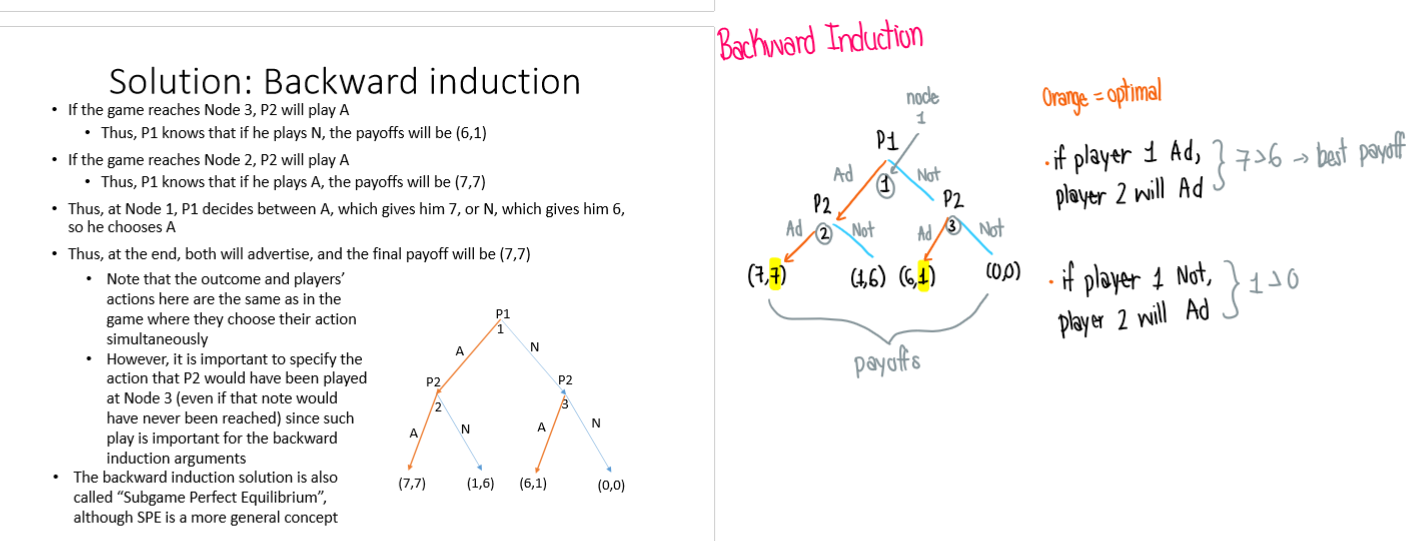
What is backward induction?

knowt flashcard image
3
New cards

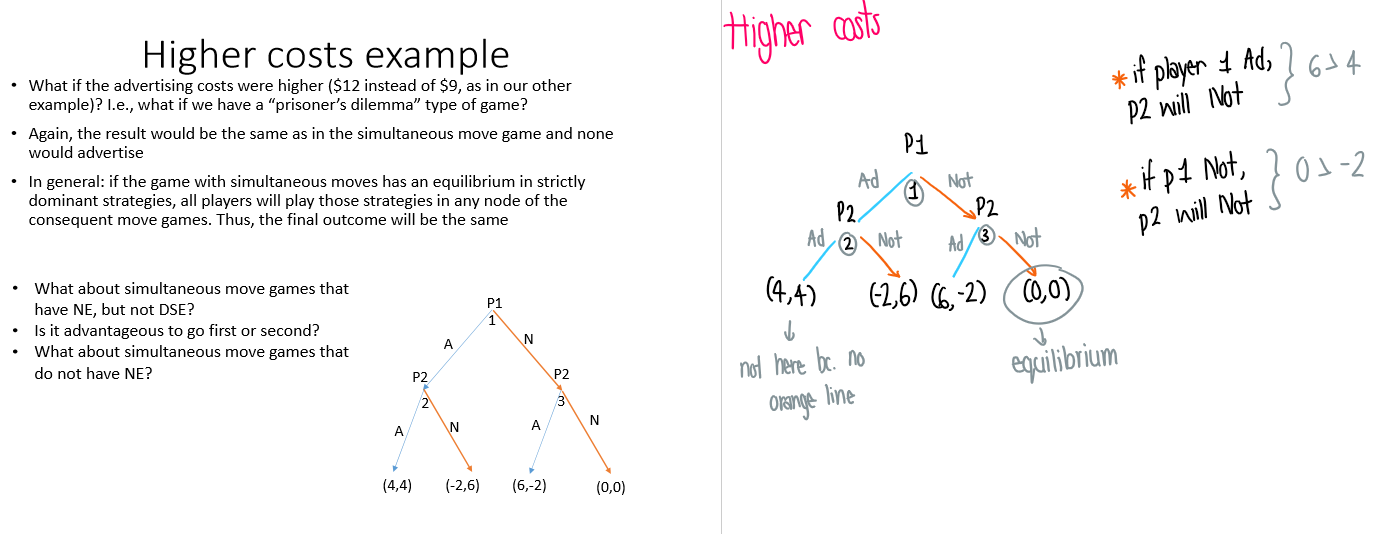
What are higher costs example?

knowt flashcard image
4
New cards

What is a coordination game with no focal point?
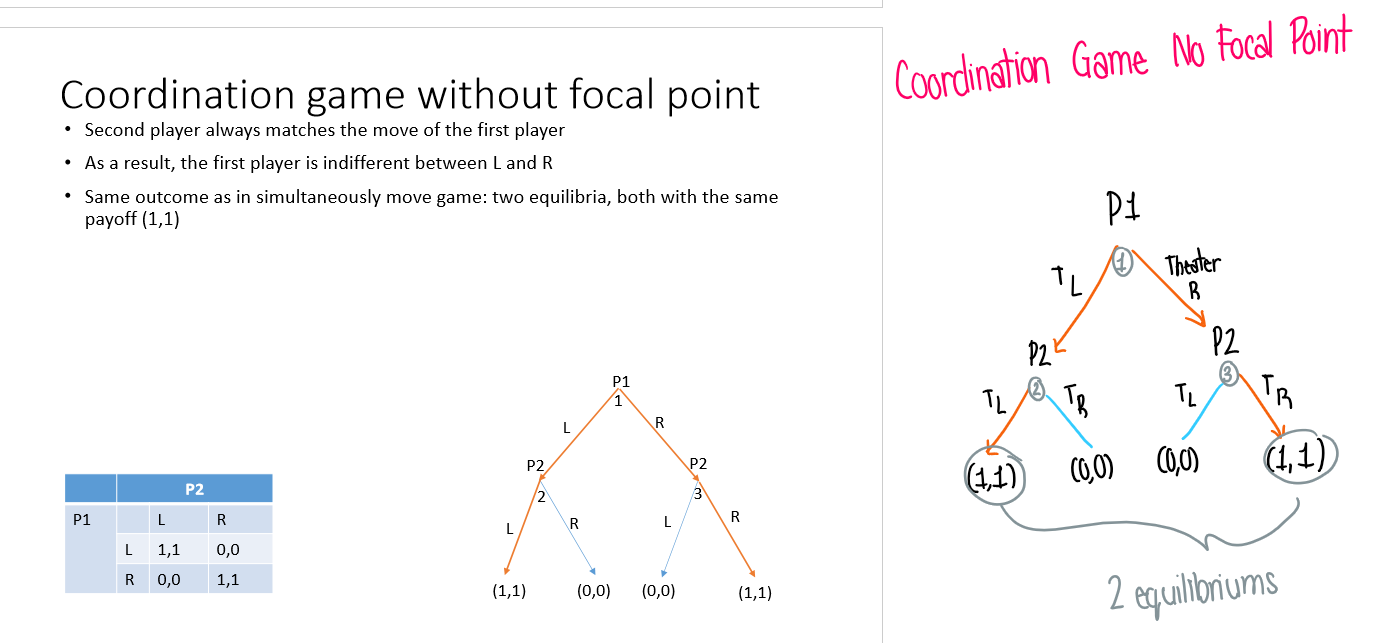
knowt flashcard image
5
New cards

What is the coordination game with a focal point?
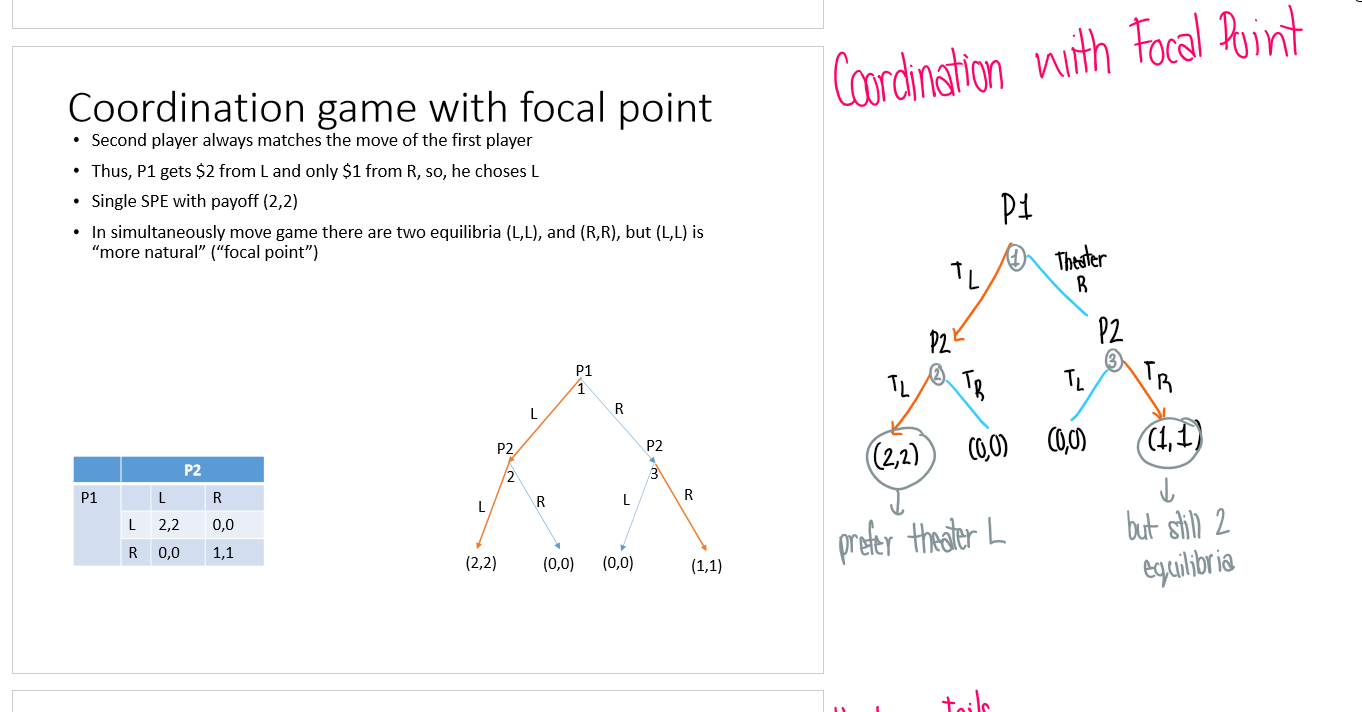
knowt flashcard image
6
New cards

What is heads or tails?

The player who moves first is at a disadvantage
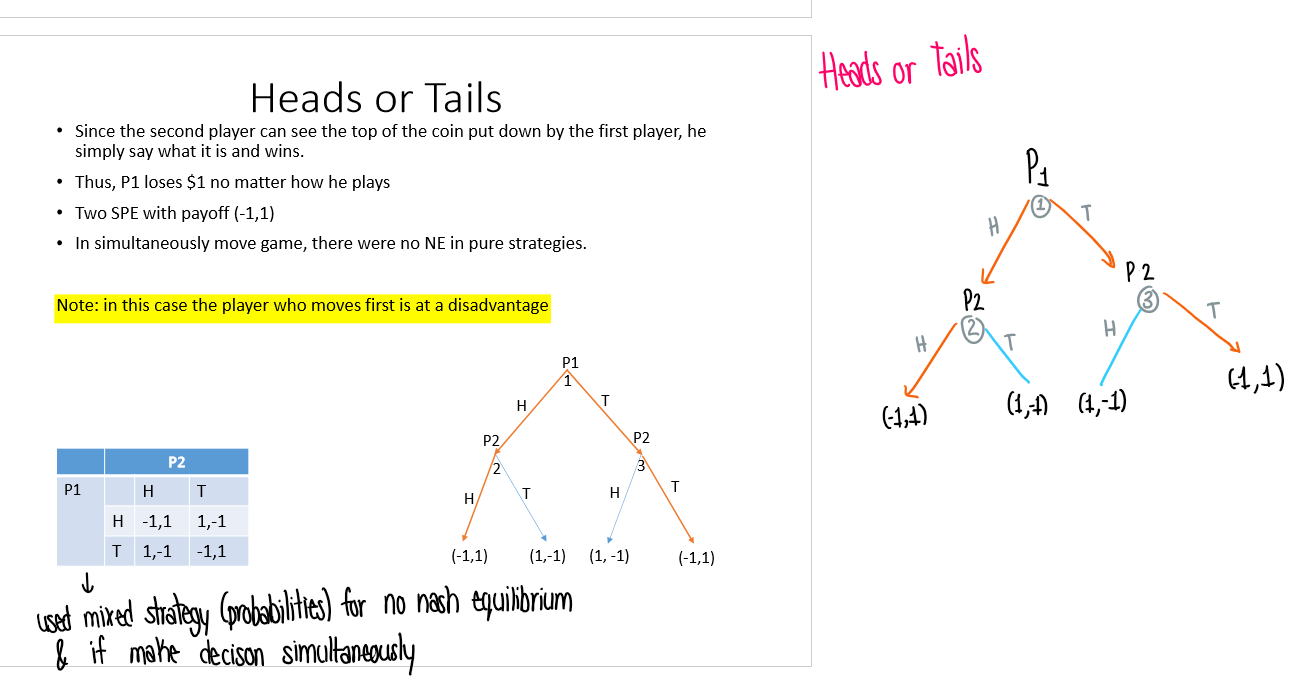
<p>The player who moves first is at a disadvantage</p>
7
New cards

What is the battle of sexes: husband moves first?

The player who moves first has an advantage → the second player has to play what is best for them given what was already committed
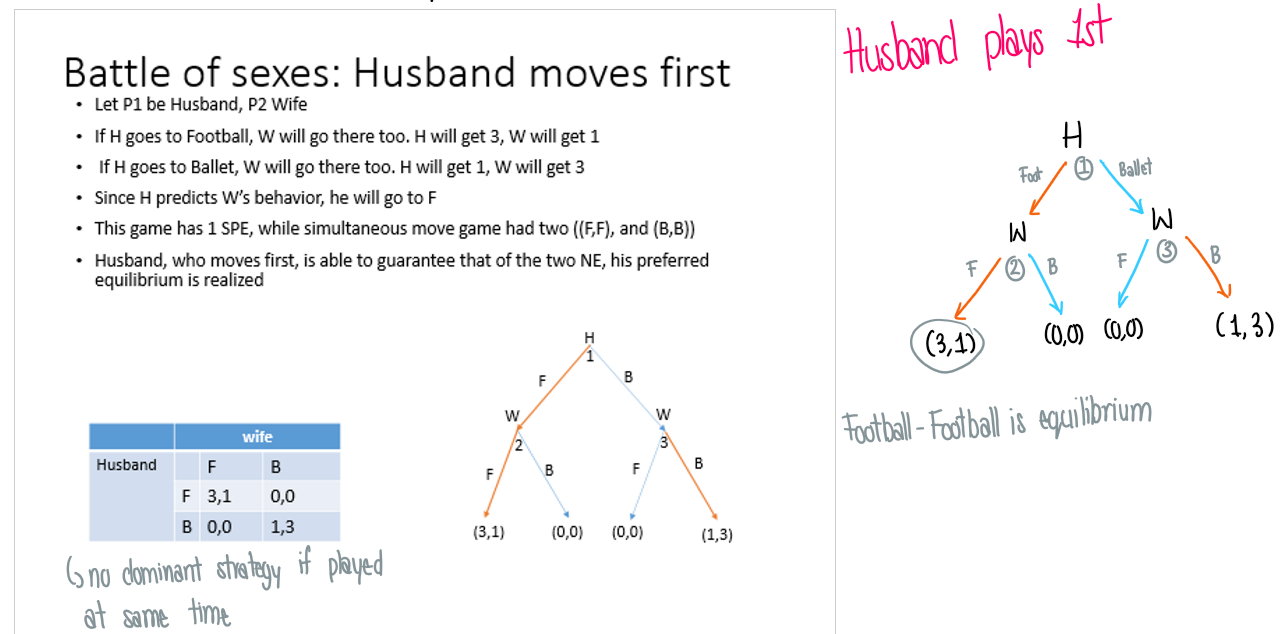
<p>The player who moves first has an advantage → the second player has to play what is best for them given what was already committed</p>
8
New cards

What is the battle of sexes: wife moves first?

The player who moves first has an advantage → the second player has to play what is best for them given what was already committed
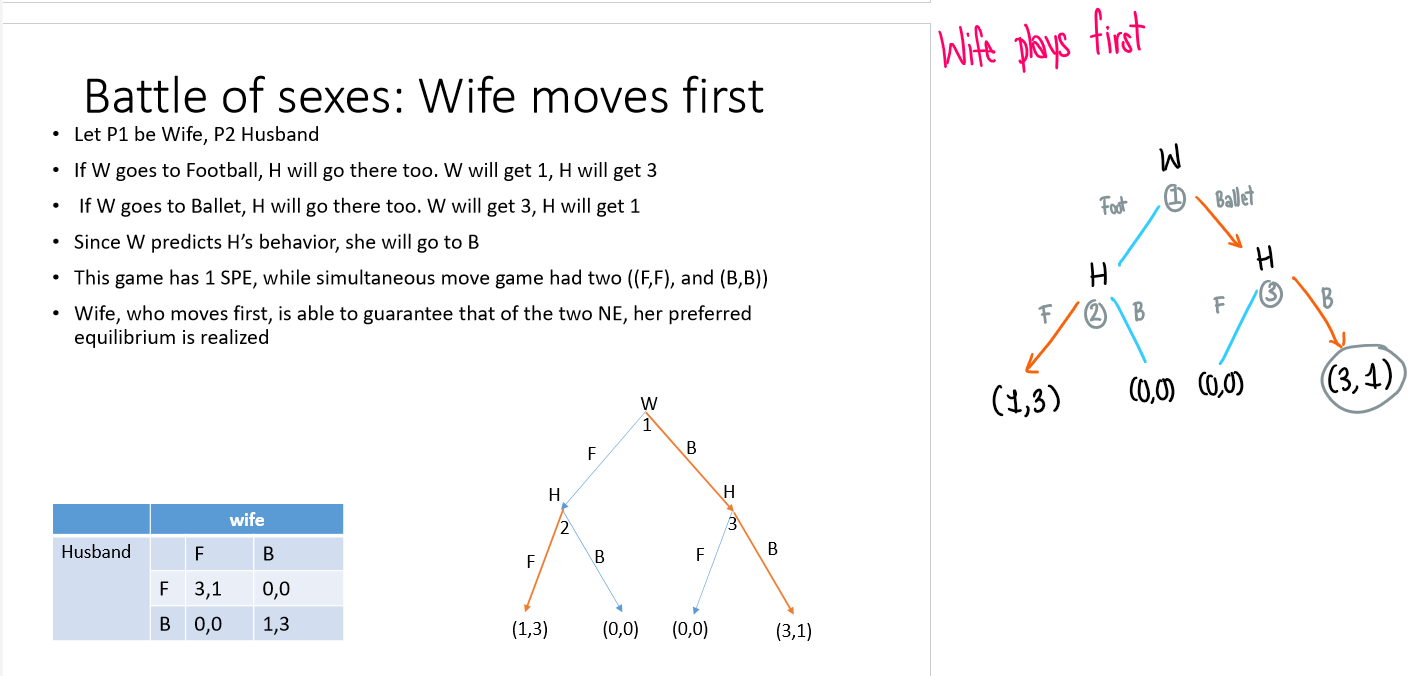
<p>The player who moves first has an advantage → the second player has to play what is best for them given what was already committed</p>
9
New cards

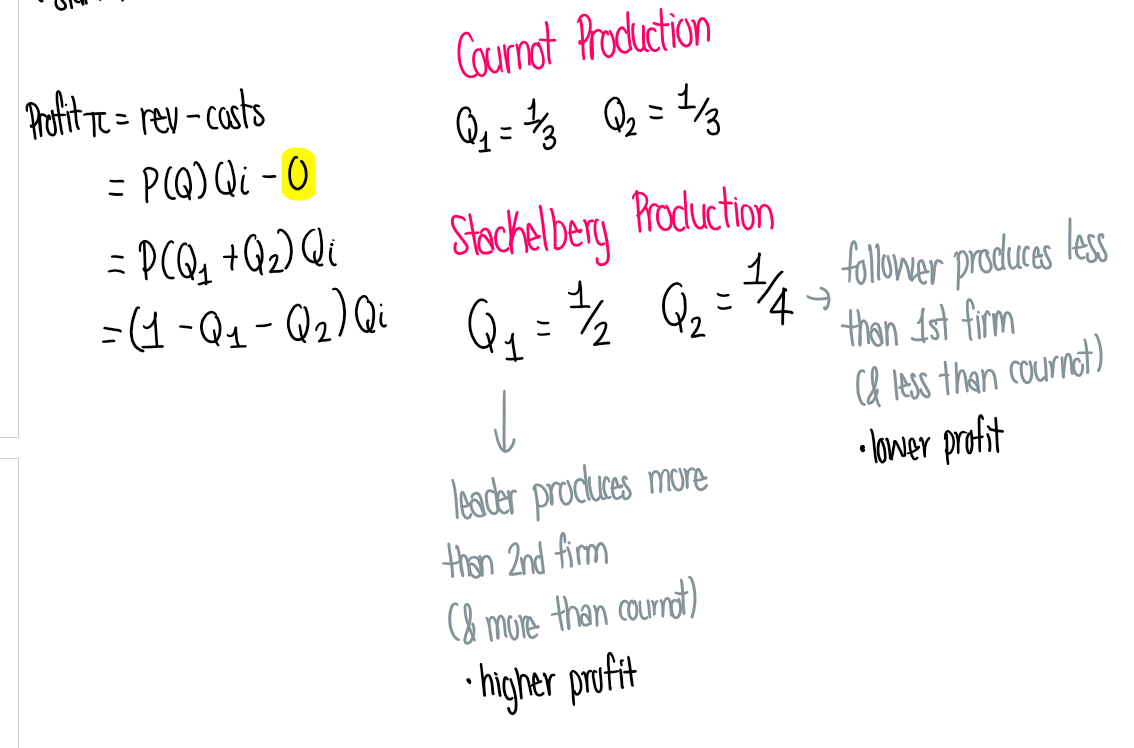
What is the stackelberg duopoly (how much do they produce)?

Finding the production level sequentially → if production decision is made at the same time, they produce the same

1st mover/leader has the advantage!

  • start with profit → want to maximize profit

The 1st Firm: the leader always produces more than the 2nd firm (more production than cournot → higher profit)

  • the firm that moves 1st knows the 2nd firm will produce less if the 1st firm produces more!

The 2nd Firm: the follower produces less than 1st firm (& less than cournot → lower profit)

  • the 2nd firm know sthe 1st firm will increase production → the drop in price makes it cost effective to decrease production
<p>Finding the production level sequentially → if production decision is made at the same time, they produce the same</p><p>1st mover/leader has the advantage!</p><ul><li><p>start with profit → want to maximize profit</p></li></ul><p><strong>The 1st Firm:</strong> the leader always produces more than the 2nd firm (more production than cournot → higher profit)</p><ul><li><p>the firm that moves 1st knows the 2nd firm will produce less if the 1st firm produces more!</p></li></ul><p><strong>The 2nd Firm:</strong> the follower produces less than 1st firm (&amp; less than cournot → lower profit)</p><ul><li><p>the 2nd firm know sthe 1st firm will increase production → the drop in price makes it cost effective to decrease production</p></li></ul><p></p>
10
New cards

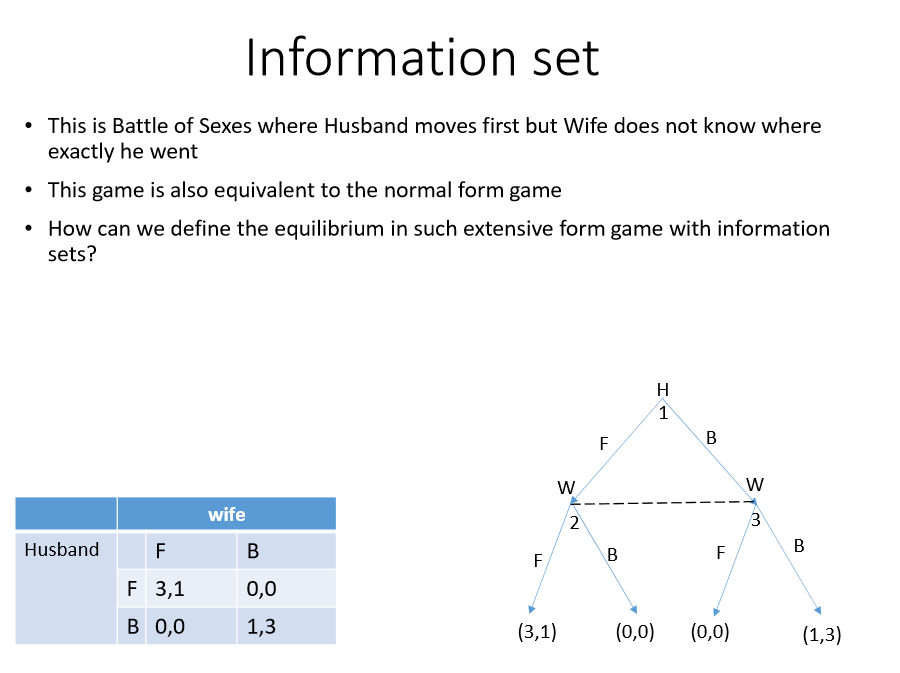
What are information sets?

Allow some past moves to be hidden

  • The extensive form of games is the same except → the 2nd player does know which node he is located
<p>Allow some past moves to be hidden</p><ul><li><p>The extensive form of games is the same except → the 2nd player does know which node he is located</p></li></ul><p></p>
11
New cards

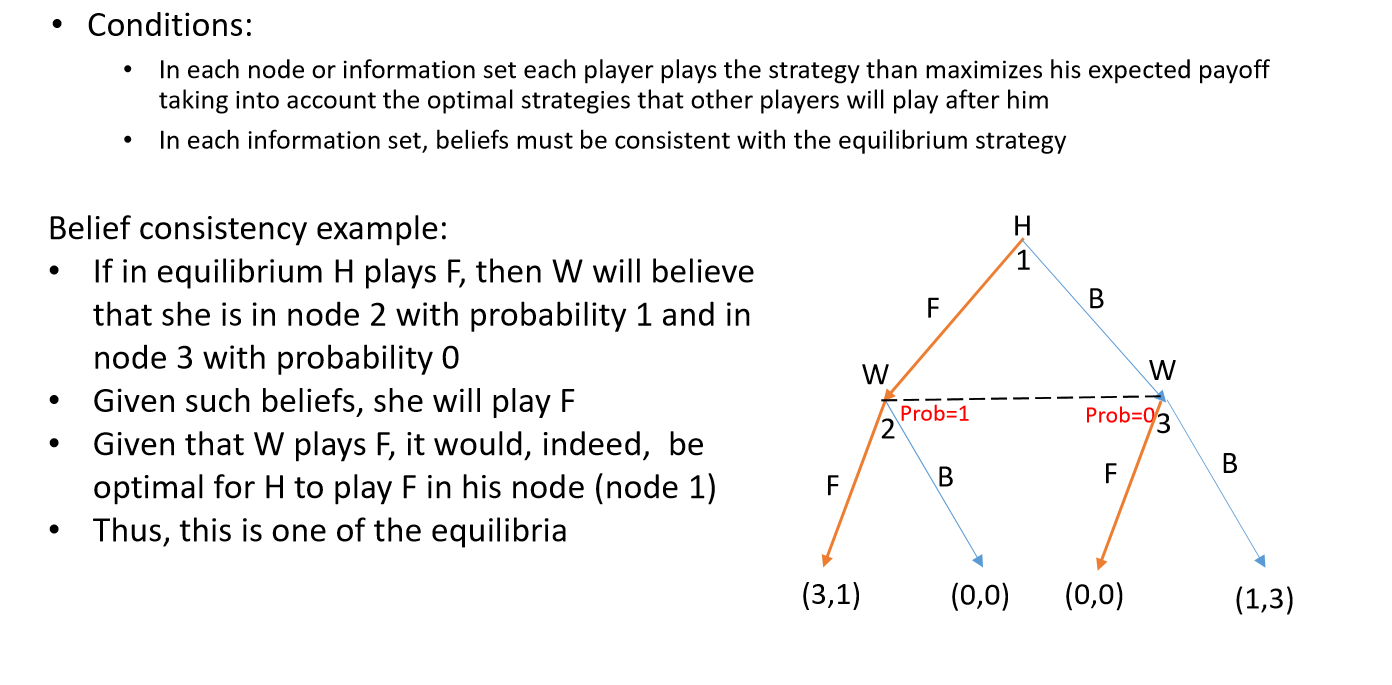
What is the perfect Bayesian equilibrium (PBE)?

2 Elements:

  1. Strategy for each player in each node of information sets where a move is made

  2. Each information set has assigned probabilities for each node in the set
<p>2 Elements:</p><ol><li><p>Strategy for each player in each node of information sets where a move is made</p></li><li><p>Each information set has assigned probabilities for each node in the set</p></li></ol><p></p>
12
New cards

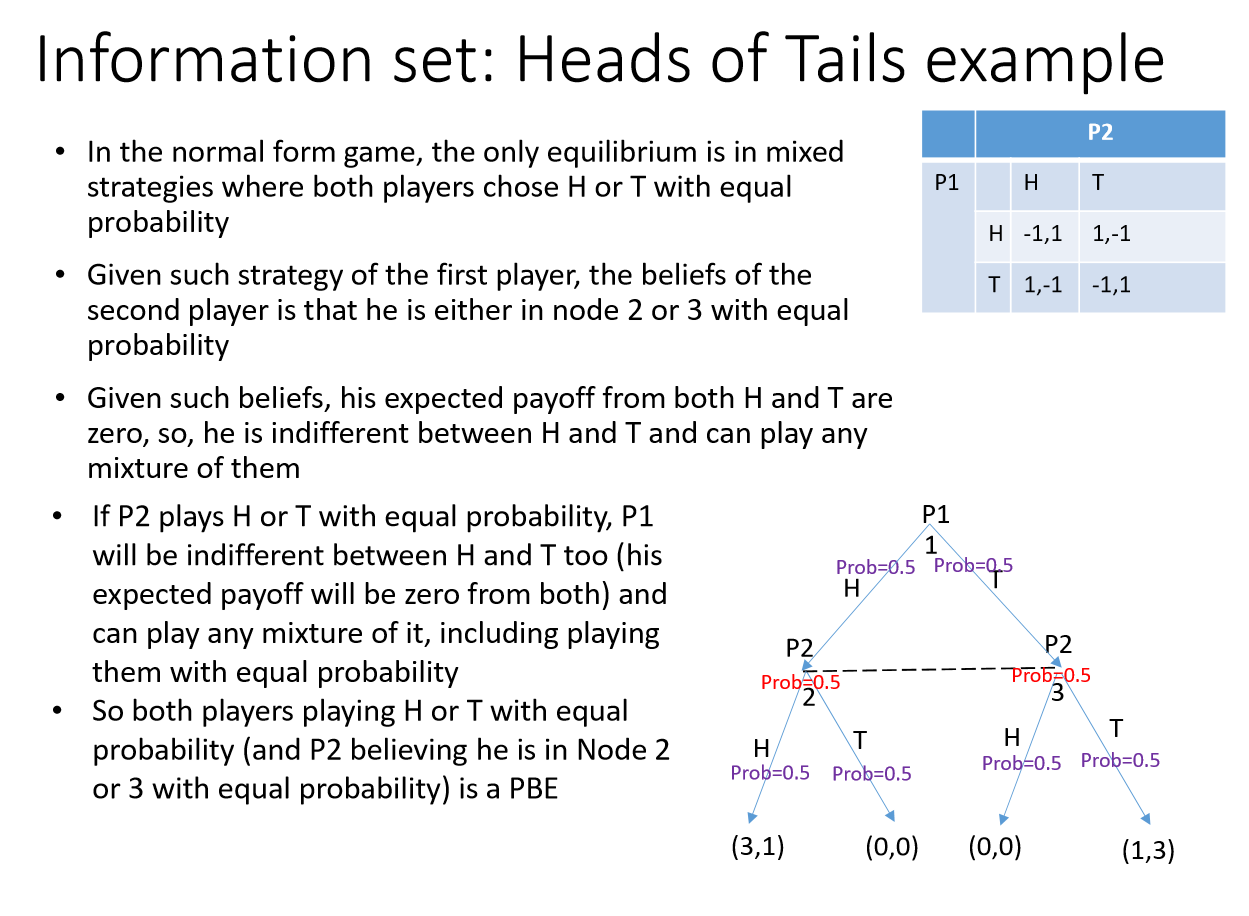
Information set heads or tails example
<p></p>
13
New cards

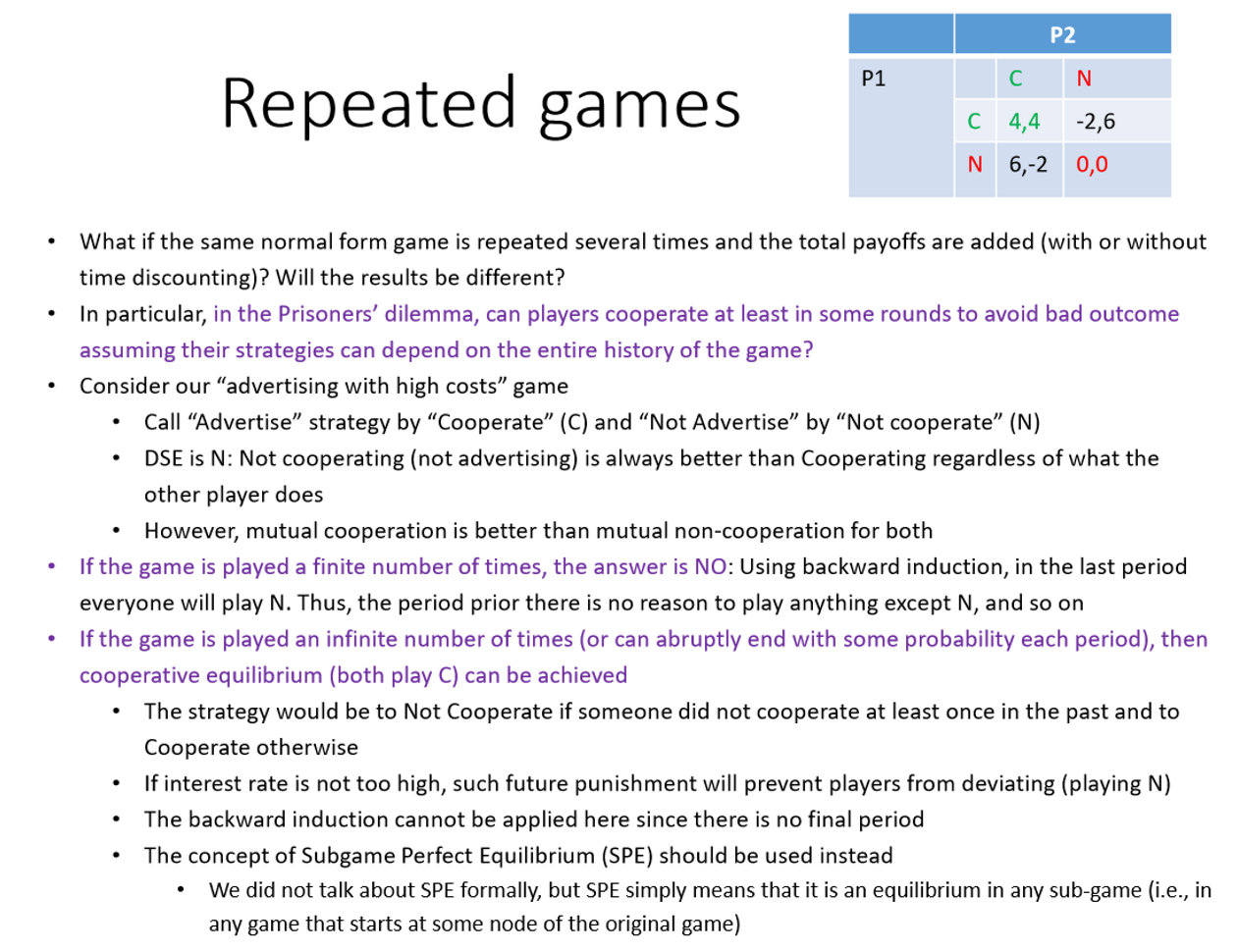
What are repeated games (cooperative equilibrium)?

Can players co-operate at least in some rounds to avoid bad outcomes assuming their strategies can depend on history?

If the game is played a finite number of times, the answer is NO

If the game is played an infinite number of times, then the cooperative equilibrium can be achieved (both play C)
<p>Can players co-operate at least in some rounds to avoid bad outcomes assuming their strategies can depend on history?</p><p>If the game is played a finite number of times, the answer is NO</p><p>If the game is played an infinite number of times, then the cooperative equilibrium can be achieved (both play C)</p>
14
New cards

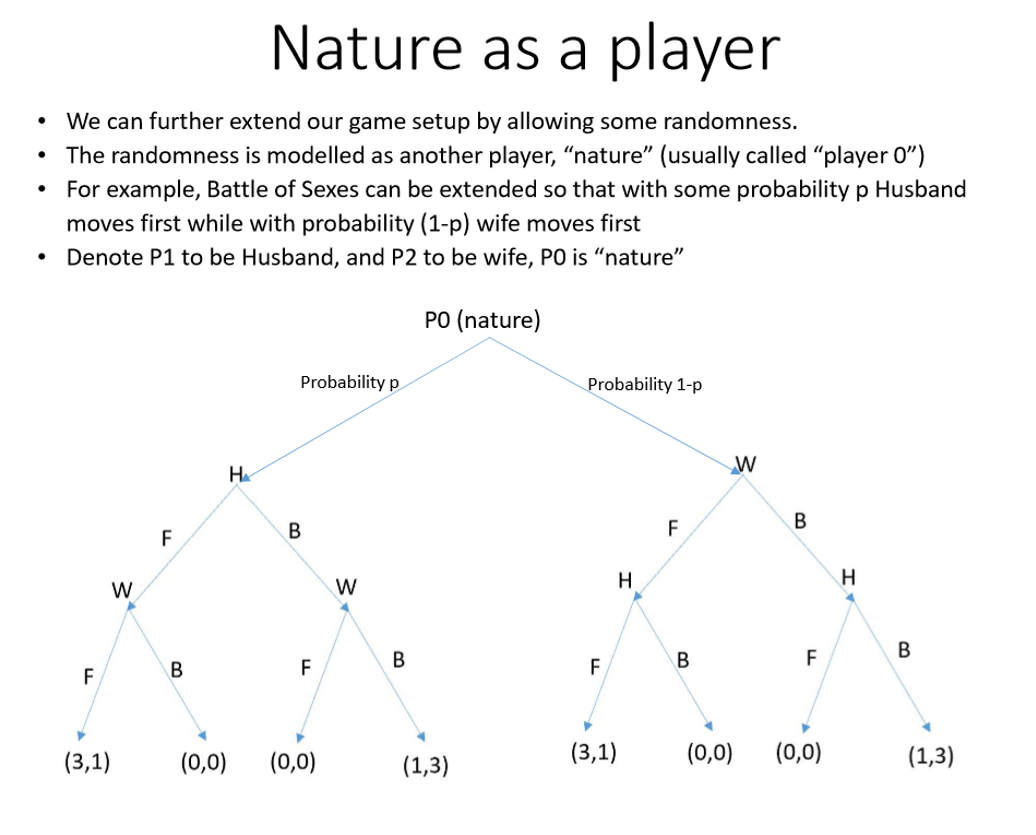
What is nature as a player?

Further extend the game setup by allowing some randomness

  • randomness is modelled as another player → Nature (player 0)
<p>Further extend the game setup by allowing some randomness</p><ul><li><p>randomness is modelled as another player → Nature (player 0)</p></li></ul><p></p>
15
New cards

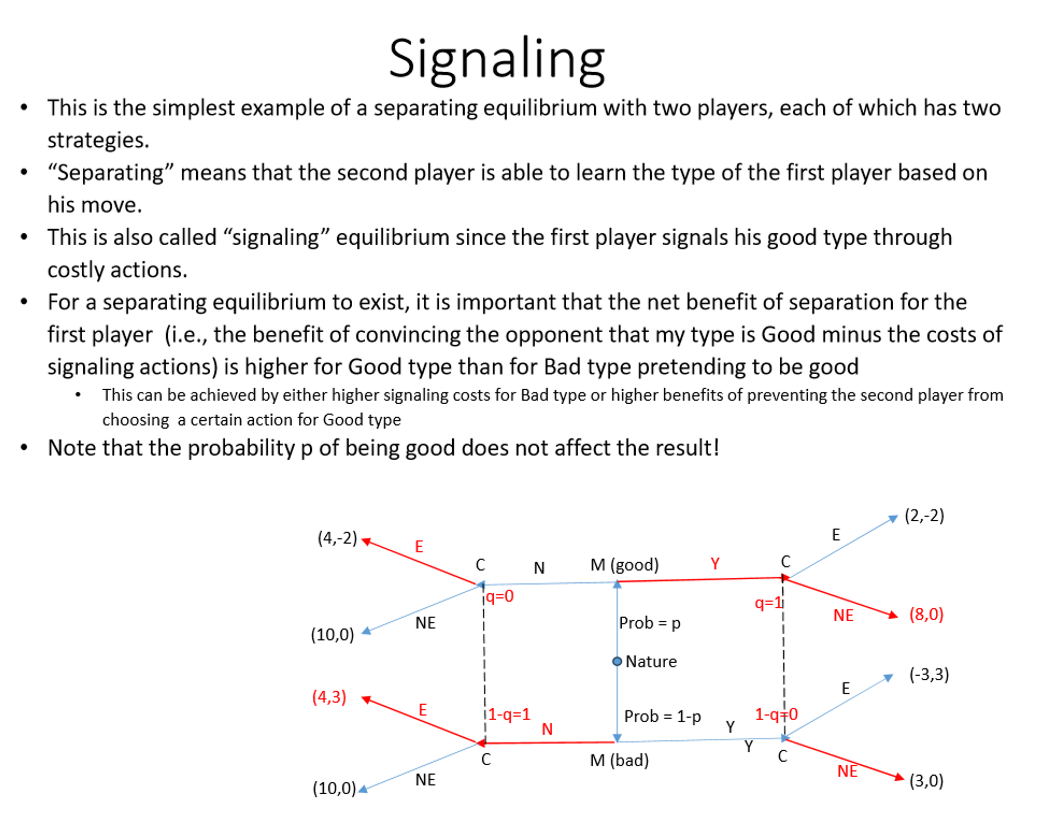
What is signaling, screening, & self-selection?

Signaling: the person with info wants to reveal his good type through actions

  • people drive carefully to avoid accidents & save on future car insurance

Screening: a player without info wants to learn about the type of other player

  • bank checks credit & financial info before giving a loan

Self-selection: player without info offers several types of contracts so players with diff info can choose different contracts

  • salesperson choosing fixed wage or commission percentage
<p>Signaling: the person with info wants to reveal his good type through actions</p><ul><li><p>people drive carefully to avoid accidents &amp; save on future car insurance</p></li></ul><p>Screening: a player without info wants to learn about the type of other player</p><ul><li><p>bank checks credit &amp; financial info before giving a loan</p></li></ul><p>Self-selection: player without info offers several types of contracts so players with diff info can choose different contracts</p><ul><li><p>salesperson choosing fixed wage or commission percentage</p></li></ul><p></p>
16
New cards

What is a moral hazard vs. adverse selection?

Moral hazard → no uncertainty, solved by backward induction:

  • occurs after transaction takes place → informed party changes behavior in a way that the uninformed party cannot observe or control

Adverse selection → uncertainty, find PBE:

  • occurs before transaction takes place → informed party has private info that leads to selecting a transaction that’s a disadvantage for the uninformed party

17
New cards

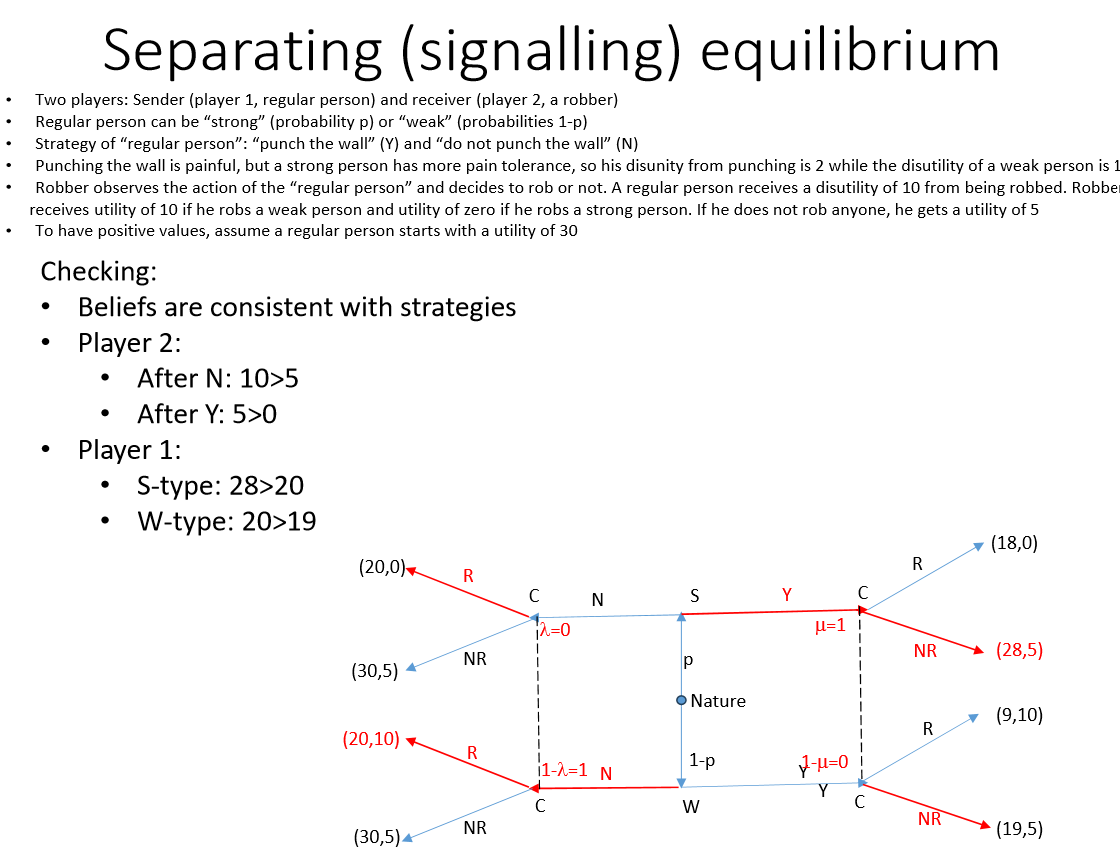
*What are signaling games?

2 Players → P1 (sender), P2 (receiver)

Equilibria:

  • signaling/separating equilibrium - different types of senders send different messages, by observing the message, the receiver can figure out the type of sender
<p>2 Players → P1 (sender), P2 (receiver)</p><p>Equilibria:</p><ul><li><p>signaling/separating equilibrium - different types of senders send different messages, by observing the message, the receiver can figure out the type of sender</p></li></ul><p></p>

Explore top notes

note
DIFFERENT ROCK DESCRIPTIONS
Updated 443d ago
0.0(0)
note
ELA Pronouns and Antecedents
Updated 1211d ago
0.0(0)
note
Wallerstein - World Systems Theory
Updated 1154d ago
0.0(0)
note
Social 20-1 Final Key terms
Updated 769d ago
0.0(0)
note
Chapter 16: Amines
Updated 1278d ago
0.0(0)
note
Pahoehoe to Mineral: 25 terms
Updated 677d ago
0.0(0)
note
DIFFERENT ROCK DESCRIPTIONS
Updated 443d ago
0.0(0)
note
ELA Pronouns and Antecedents
Updated 1211d ago
0.0(0)
note
Wallerstein - World Systems Theory
Updated 1154d ago
0.0(0)
note
Social 20-1 Final Key terms
Updated 769d ago
0.0(0)
note
Chapter 16: Amines
Updated 1278d ago
0.0(0)
note
Pahoehoe to Mineral: 25 terms
Updated 677d ago
0.0(0)