C4.2 Transfers of energy and matter
 Call Kai
 Learn
Learn Practice Test
 Spaced Repetition
 Match
Match Flashcards
 Knowt Play
1/24

There's no tags or description
Looks like no tags are added yet.
Name | Mastery | Learn | Test | Matching | Spaced | Call with Kai |
|---|
No analytics yet
Send a link to your students to track their progress
25 Terms
Definitions
Open system
A system in which both matters and energy are exchanged across the boundaries of the system (e.g. ecosystem)
Close system
A system in which energy is exchanged across the boundaries but matters are not.
Trophic level
is the energy level of an organism.
Autotrophs
An organism that uses external energy source to synthesize carbon compounds from simple inorganic substances
Heterotrophs
An organism that uses carbon compounds obtained from other organisms to synthesize carbon compounds
Consumer
An organism that ingests other organic matter that is living or recently killed
Primary consumer → secondary consumer
Flow of energy / trasnfer of energy
Decomposers
break down dead organisms and dead organic matter
Detritiviours & Saprotroph
photoautotroph: sunlight to make organic compounds via photosynthesis
chemoautotroph: uses energy from oxidation of inorganic compounds for anabolic reaction
Trophic level: the position of an organism in a food chain
Primary production: accumulation of carbon compounds in biomass by autotrophs
Secondary production: accumulation of carbon compounds in biomass by heterotrophs
Production: accumulation of carbon compounds in biomass. Autotrophs and heterotrophs produce biomass by growth and reproduction.
Carbon sinks in an ecosystem
organism that absorbs and holds more carbon than it release. (Photosynthesis > Respiration, e.g. producers)
Carbon sources in an ecosystem
organism that is a net producer of carbon dioxide. (Respiration > Photosynthesis, e.g. consumers)
Biomass
Renewaable organic matter from plants, animal and microorganism -> used as verssatile energy source (*RENEWABLE, so not fossil fuels)
Ecosystem
Ecosystem: A community and its abiotic environment
Econsystem are
Open system: A system in which both matters and energy can enter and exit across the boundaries of the system (e.g. ecosystem)
(closed systems: energy can enter , matters cannot)
Food chain terms - definitons
Trophic level: is the energy level of an organism.
Autotrophs: An organism that uses external energy source to synthesize carbon compounds from simple inorganic substances
Heterotrophs: An organism that uses carbon compounds obtained from other organisms to synthesize carbon compounds
Consumer: An organism that ingests other organic matter that is living or recently killedx
Principal source of energy that sustains most ecosystems
Sunlight
Producers convert light energy into chemical energy
cyanobacterium, algae, plants
Exceptions: Environments with limited/absent sunlight (caves and deep oceans)
open caves → primary energy source from dead tings that flow into cave
closed caves → chemosynthetic bacteira → harness energy from chemical reactons
Flow of chemical energy through food chains
Producer → Primary consumer → Secondary consumer → Tertiary consumer → Quaternary consumer
Arrow represents the flow of energy
Construction of food chains and food webs to represent feeding relationships in a community
Food webs are models that show many interconnected food chains
It is difficult to determine an organism’s trophic level in a food web because:
Organism eats at different trophic level.
The full diet of an organism is unknown
Diet may varies according to seasons.
Supply of energy to decomposers as carbon compounds in organic matter coming from dead organisms
Source of energy: breakdown of dead organic matter or organic waste materials → extract energy and nutrients from decaying materials
Products: inorganic molecules are made in the process which are returned to the environment; these molecules can be used by producers
extract energy and nutrients from decaying materials:
dead parts of organisms
dead whole organisms
faeces
Two types of decomposers (dead organic matter)
Saprotrophs
Secrete digestive enzymes, digesting dead organic matter externally, then absorb the products of digestion
Detritivores
Directly ingest and consume dead organic matter - digested internally using digestive enzymes
Autotrophs as organisms that use external energy sources to synthesize carbon compounds from simple inorganic substances
autotroph : organism that uses texternal energy tosynthesize inorganic substances → organic compounds
provide energy and nutrient source for other organisms
ex. Energy is required for anabolic reactions:
Carbon fixation
Synthesis of macromolecules
two types of autotroph
photoautotroph : sunlight to make organic compounds via photosynthesis
chemoautotroph : uses energy from oxidation of inorganic compounds (from anabolic reaction) → in caves or deep ocean.
Heterotrophs as organisms that use carbon compounds abstained from other organisms to synthesize the carbon compounds that they require
Heterotrophs : use carbon compounds obtained from other organisms to synthesise their required carbon compounds
use internal or external digestion to break down these compounds.
External digestion: release hydrolytic enzymes to digest organic molecules
Internal digestion: food is ingested, digested and broken down in specialised organs before absorption into the blood for assimilation.
Trophic levels
Trophic level: the position of an organism in a food chain
Producer: Base of food chain; provides energy and food for all other trophic levels
Primary consumer : Herbivores or ominivores that feed on producers for energy
Secondary consumer : Feed on primary consumers as source of energy
Tertiary : top level predators
Energy loss between trophic levels
Respiration: Energy lost as heat
Movement: Energy lost as muscle contracts
Egestion: Energy lost as undigested food
Excretion: Energy lost as metabolic waste
As the result, the pyramid of energy have a wide base and narrow top and most food chains only contain 4-5 trophic levels.
The unit for pyramid of energy kJ m-2 Year -1
Flow of energy in food chain
The initial energy is light energy from the sun. → photoautotrophs use sunlight as a principal source of energy → synthesize chemical energy → sustain the ecosystem.
except caves & deep ocean → chemoautotroph
Energy is transferred through feeding
Only about 10-20% of the energy is passed to the next trophic level
About 80-90% of the energy is lost as respiration, excretion, egestion, and movement
Restrictions on the number of trophic levels in ecosystems due to energy loses
Energy losses
between trophic levels restrict the length of food chains and the biomass of higher trophic levels due to inefficient energy transfer.
Primary production as accumulation of carbon compounds in biomass by autotrophs
Primary production: accumulation of carbon compounds in biomass by autotrophs
Secondary production: accumulation of carbon compounds in biomass by heterotrophs
Unit: gm-2yr-1
Different biomes will have different capacity to accumulate biomass.
Growth and Reproduction of autotrophs and heterotrophs → Biomass accumulates
Secondary production is lower than primary production in an ecosystem due to respiration and biomass is lost as carbon dioxide.
measure the production of food by primary producers
Production: accumulation of carbon compounds in biomass. Autotrophs and heterotrophs produce biomass by growth and reproduction.
Primary production: mass of carbon compounds by producers measured in grams of carbon accumulated per square meter of ecosystem per year
gm-2yr-1
Varies by season and region (i.e precipitation, soil nutrient availability, etc)
Net Primary Production (NPP) | Gross Primary Production (GPP) | Respiration losses |
Amount of biomass available to consumers | Total biomass of carbon compounds made by producers | Biomass loss due to respiration in plants |
NPP = GPP - R
measure the production of food by secondary producers
Secondary production is the accumulation of biomass from carbon compounds in heterotrophs (consumers)
Consumers obtain carbon compounds (i.e. amino acids, sugars) from organisms and use them in growth and reproduction. This increases their biomass via assimilation.
Net Secondary Production (NSP) | Gross Secondary Production (GSP) | Respiration losses |
Biomass that remains after accounting for respiratory losses | Total biomass assimilated by consumers (in an ecosystem) | Biomass loss due to respiration |
NSP = GSP - R
lost of energy via respiration - consequence
Respiration results in loss of carbon compounds (i.e. CO2) which decreases biomass at every trophic level.
Consequences for ecosystems:
Secondary production < primary production
NSP Net secondary production < GSP gross secondary production in every trophic level of consumers
Secondary production declines with each successive trophic level
Ecosystems as carbon sinks and carbon sources
Carbon sinks in an ecosystem is an organism that absorbs and holds more carbon than it release. (Photosynthesis > Respiration, e.g. producers)
ex. Forests, ocean, soil, waterlogged habitats,
Carbon sources in an ecosystem is an organism that is a net producer of carbon dioxide. (Respiration > Photosynthesis, e.g. consumers)
ex. Forest fires, respiration from organisms, volcanic eruptions
Carbon cycle
*All elements used by living organisms, are recycled by decomposers. (Detritivores, saprotroph)
Carbon being one of the element
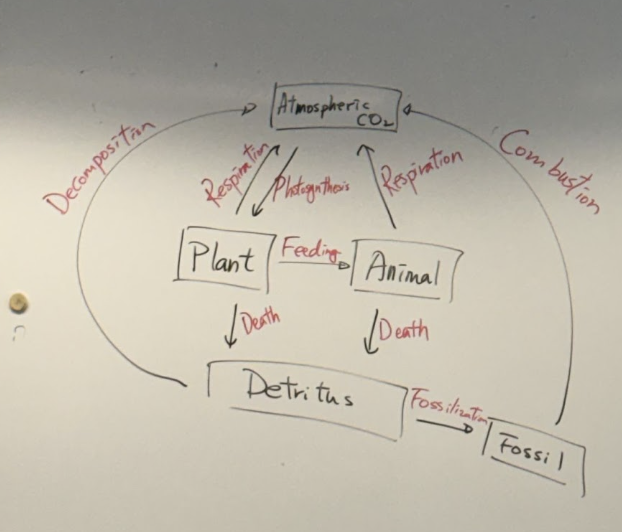
The effect of combustion on carbon cycle
Combusion :
the process of burning materials—such as wood, fossil fuels (coal, oil, natural gas), or biomass
which releases stored carbon back into the atmosphere in the form of carbon dioxide and other greenhouse gases.
Natural combustion: lightning
Human combustion: combustion of different substances as source of energy; releases significant amounts of CO2
Biomass
Peat
Natural gas
Oil
Coal
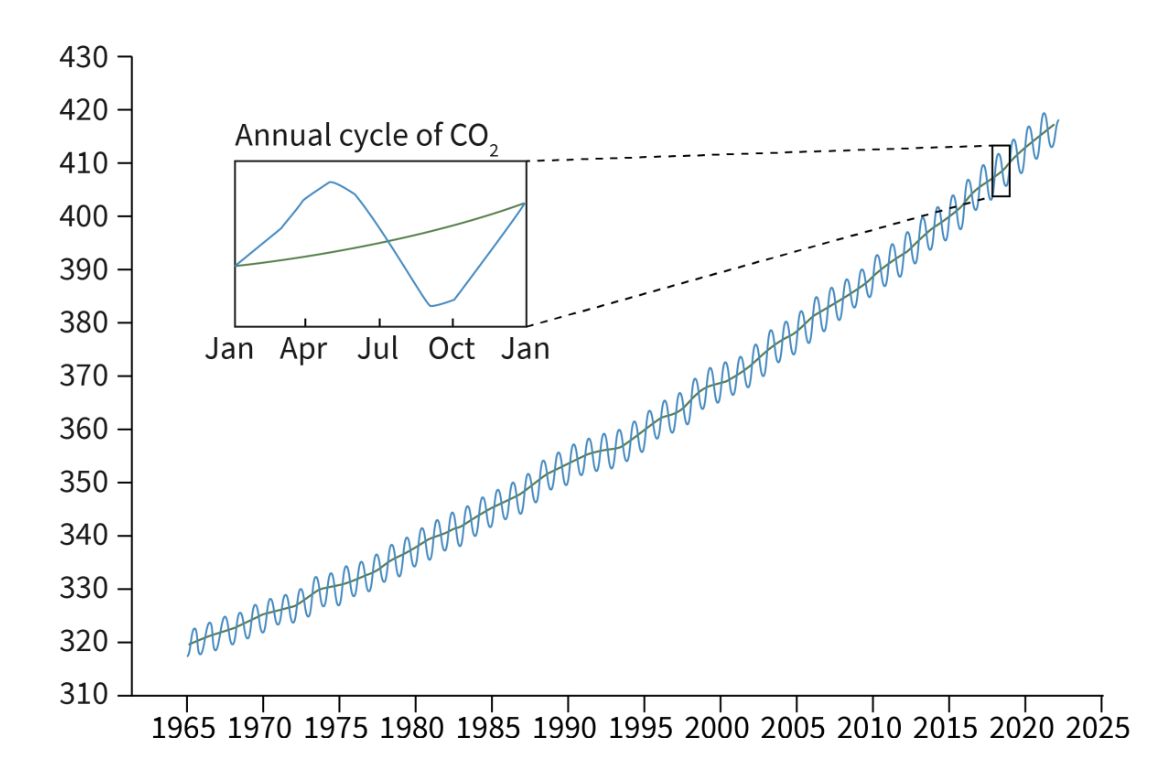
Analysis of the Keeling Curve in terms of photosynthesis, respiration and combustion
The Keeling Curve shows the concentration of CO2 in atmosphere over time
Annual fluctuations:
CO2 increases between Oct and May (dormant season, winter where photosynthesis decreases)
CO2 falls from May to Oct (growing season where photosynthesis increases)
Long- term trend:
Although there are annual variations, by the end of each year, the CO2 concentration is higher than beginning of each year, resulting in an upward trend.
Photosynthesis are aerobic respiration interdependent
Dependence of aerobic respiration on atmospheric oxygen produced by photosynthesis
and of photosynthesis on atmospheric carbon dioxide produced by respiration
(interdependent - need both )
Autotrophs and heterotrophs are interdependent as well.
Measured by gigatonnes (1015 grams)
Recycling of all chemical elements required by living organisms in ecosystems
Living organisms contain large amounts of C, H, O, N, and P + small elements
The quantities of these are finite
decomposers recycle them → cycled within an ecosystem.
Explore top notes

