piaget stages of intellectual development
 Studied by 0 people
 Call Kai
 Learn
Learn Practice Test
 Spaced Repetition
 Match
Match Flashcards
 Knowt Play
1/14

There's no tags or description
Looks like no tags are added yet.
Name | Mastery | Learn | Test | Matching | Spaced |
|---|
No study sessions yet.
15 Terms
Stages of intellectual development
Piaget identified how many stages of intellectual development?
Each stage is characterised by a different level of r_____ a____.
Although the exact ages vary from child to child, the key point is that all children develop through the same s____ of stages.
Stages of intellectual development
Piaget identified four stages of intellectual development.
Each stage is characterised by a different level of reasoning ability.
Although the exact ages vary from child to child, the key point is that all children develop through the same sequence of stages.
Piaget identified four stages of intellectual development.- what are the 4 stages and their ages?
Piaget identified four stages of intellectual development:
Sensorimotor stage (approximately 0-2 years)
Pre-operational stage (approximately 2-7 years)
Concrete operational stage (approximately 7-11 years)
Formal operational stage (approximately 11+)
Sensorimotor stage ( 0-2 years)
According to Piaget, a baby's early focus is on what? and on developing some basic p____ c___-o___.
Babies learn by trial and error that they can do what?
The baby also develops an understanding during the first two years about what?
Sensorimotor stage ( 0-2 years)
According to Piaget, a baby's early focus is on physical sensations and on developing some basic physical co-ordination.
Babies learn by trial and error that they can deliberately move their body in particular ways, and eventually that they can move other objects
The baby also develops an understanding during the first two years that other people are separate objects and they acquire some basic language.
Sensorimotor stage ( 0-2 years)
what is a key feature at around 8 months in this stage ?
object permeance
Sensorimotor stage ( 0-2 years)
By around e____ months the baby is capable of understanding object permanence - what is this?
Piaget o____ babies looking at o____ and watched as the objects were r___ from s___
He noted that before eight months, what happened?
However, from around eight months what happened?
This led Piaget to believe that it was from this age that what?
Sensorimotor stage ( 0-2 years)
By around eight months the baby is capable of understanding object permanence - the understanding that objects still exist when they are out of sight.
Piaget observed babies looking at objects and watched as the objects were removed from sight.
He noted that before eight months, babies immediately switched their attention away from the object once it was out of sight.
However, from around eight months they would continue to look for it.
This led Piaget to believe that it was from this age that babies understood that objects continue to exist when removed from view.
Pre-operational stage ( 2-7 years)
By the age of two a toddler is m____ and can use l___ but still lacks a___ r____ a____.
This means that they display some characteristic errors in r_
what are 3 key features in this stage?
conservation
egocentrism
class inclusion
Pre-operational stage ( 2-7 years)
By the age of two a toddler is mobile and can use language but still lacks adult reasoning ability.
This means that they display some characteristic errors in reasoning
3 key features in this stage are:
conservation
egocentrism
class inclusion
Pre-operational stage ( 2-7 years)→Conservation
what is the ability of conservation?
Piaget demonstrated this in a number of situations:
In his n___ conservation experiment:
Piaget placed t____ rows of e____ i____ counters s___ by s___.
young children correctly reasoned what
However, when the counters in one of the rows were p____ c___ together, pre-operational children struggled to c____ and usually said there were f____ c____ in that row.
In his l____ conservation experiment:
Piaget found that when two i____ c___ (A and B) were placed side by side with the contents at the same h___, most children spotted what?
However, if the l____ was poured into a t____, t____ vessel (C), younger children typically believed what?
Pre-operational stage ( 2-7 years)→Conservation
what is the ability of conservation?
Piaget demonstrated this in a number of situations:
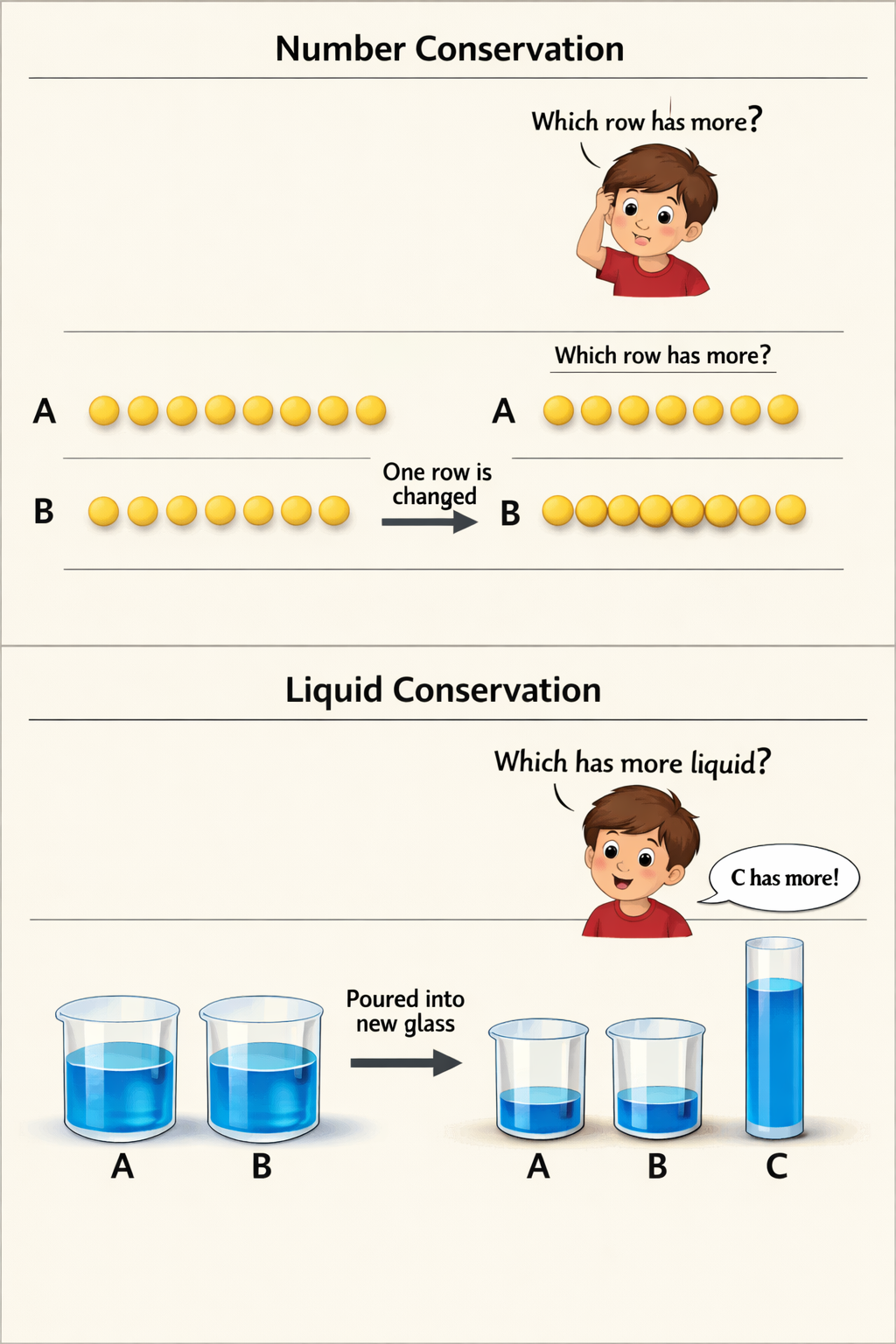
In his number conservation experiment:
Piaget placed two rows of eight identical counters side by side.
young children correctly reasoned that each row of counters had the same number.
However, when the counters in one of the rows were pushed closer together, pre-operational children struggled to conserve and usually said there were fewer counters in that row.
In his liquid conservation experiment:
Piaget found that when two identical containers (A and B) were placed side by side with the contents at the same height, most children spotted that they contained the same volume of liquid.
However, if the liquid was poured into a taller, thinner vessel (C), younger children typically believed there was more liquid in the taller vessel.
Pre-operational stage ( 2-7 years)→Egocentrism
This means to see the world only from one's own point of view.
Piaget, working with B____ I____ (1956), described how egocentrism was demonstrated in the three mountains task
in which children were shown what?
. A d___ was placed at the side of the model so that it faced the scene from a d____ a____ from the child.
The child was asked to choose what the d___ would 's___' from a range of pictures.
Pre-operational children tended to find this d____ and often chose the picture that m____ the s____ from their own p___ of v___
Pre-operational stage ( 2-7 years)→Egocentrism
what does egocentrism mean?
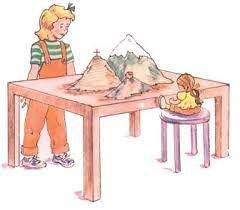
Piaget, working with Bärbel Inhelder (1956), described how egocentrism was demonstrated in the three mountains task
in which children were shown three model mountains, each with a different feature: a cross, a house or snow
. A doll was placed at the side of the model so that it faced the scene from a different angle from the child.
The child was asked to choose what the doll would 'see' from a range of pictures.
Pre-operational children tended to find this difficult and often chose the picture that matched the scene from their own point of view
Pre-operational stage ( 2-7 years)→Class inclusion
Early in the pre-operational stage children begin to understand classification - what is this?
However, P____ and I_____ (1964) found that children under which age? struggle with the more advanced skill of class inclusion- what is this?
So when they showed ___-___-year-old children pictures of what? and asked 'are there more d____ or a____?' children tended to respond how?.
He interpreted this as meaning that younger children cannot s____ see a dog as a m____ of the d____ c____ and of a l_____ s____ of the a___ c____
Pre-operational stage ( 2-7 years)→Class inclusion
Early in the pre-operational stage children begin to understand classification - the idea that objects fall into categories. e,g classifying pugs, chihuahuas and bull terriers into dogs
However, Piaget and Inhelder (1964) found that children under the age of seven struggle with the more advanced skill of class inclusion, the idea that classifications have subsets.
So when they showed 7-8-year-old children pictures of five dogs and two cats and asked 'are there more dogs or animals?' children tended to respond that there were more dogs.
He interpreted this as meaning that younger children cannot simultaneously see a dog as a member of the dog class and part of a larger subset of the animal class
Stage of concrete operations ( 7-11 years)
Piaget found that from the age of around 7 most children can do what?
However, although children now have better e____-v___ r___ a____ - what Piaget called o____ - these are strictly concrete operations,- what does this mean?
They still struggle to r____ about a____ i____ and to imagine objects or situations they cannot see.
Those more a______ abilities appear when?
Stage of concrete operations ( 7-11 years)
Piaget found that from the age of around 7 most children can conserve and perform much better on tasks of egocentrism and class inclusion.
However, although children now have better externally-verifiable reasoning abilities - what Piaget called operations - these are strictly concrete operations, i.e. they can be applied only to physical objects in the child's presence.
They still struggle to reason about abstract ideas and to imagine objects or situations they cannot see.
Those more advanced abilities appear in the final stage (next slide)
Stage of concrete operations ( 7-11 years)
Piaget believed that from about 11 years of age, children became capable of formal reasoning- what is this
Formal reasoning can be tested by using by s____.
For example: All y___ cats have t___ heads. I have a y___ cat called Charlie. How many h____ does Charlie have?' The correct answer is t___' (S____ et al. 1998).
Piaget found that younger children became distracted by what? and answered how?
Piaget believed that once children can reason formally they are capable of scientific what?
Stage of concrete operations ( 7-11 years)
Piaget believed that from about 11 years of age, children became capable of formal reasoning- This means that children become able to focus on the form of an argument and not be distracted by its content.
Formal reasoning can be tested by using by syllogisms.
For example: All yellow cats have two heads. I have a yellow cat called Charlie. How many heads does Charlie have?' The correct answer is 'two' (Smith et al. 1998).
Piaget found that younger children became distracted by the content and answered that cats do not really have two heads.
Piaget believed that once children can reason formally they are capable of scientific reasoning and become able to appreciate abstract ideas.
Evaluation of piaget stages of intellectual development - strengths
✓- A strength of Piaget’s work is that it has had an enormous impact on what?
what does his theory suggests? which has been applied in c____ settings.
As a result, teachers now structure l___ and learning activities to match what?, ensuring that the c____ of t____ is appropriate for the child’s developmental stage and reducing unrealistic expectations of younger learners.
EXTENSION:
why would reducing unrealistic expectations of younger learners help to protect pupils’ self-esteem?
Evaluation of piaget stages of intellectual development - strengths
✓- A strength of Piaget’s work is that it has had an enormous impact on modern day educational systems and the school curriculum.
His theory suggests that children are unable to perform certain cognitive tasks until they reach specific stages of development, which has been applied in classroom settings.
As a result, teachers now structure lessons to match pupils’ cognitive abilities, ensuring that the complexity of teaching is appropriate for the child’s developmental stage and reducing unrealistic expectations of younger learners.
EXTENSION:
By reducing unrealistic expectations of younger learners, Piaget’s theory also helps to protect pupils’ self-esteem. When tasks are matched to a child’s cognitive stage, pupils are less likely to experience repeated failure or confusion, which can make them feel insecure about their abilities.
Evaluation of piaget stages of intellectual development - limitations
✗- One limitation In Piaget’s conservation tasks, is that children may have been influenced by cues (demand characteristics) from the r_____’s actions.
When the experimenter d_____ c_____ the a_____ of the counters or liquid and then asked the same question again, children may have assumed what?
M______ and D______ (1974) n____ t____ s___ reduced d____ c____ by making the t_____ appear accidental, showing that children could conserve earlier than Piaget suggested with ___% correctly said there were the same number of c____ as before.
This means that children aged ____ could conserve, as long as they were not put off by the way they were q_____.
This in turn suggests that Piaget was wrong about the age at which c_____ a____.
Evaluation of piaget stages of intellectual development - limitations
✗- One limitation In Piaget’s conservation tasks, is that children may have been influenced by cues (demand characteristics) from the researcher’s actions.
When the experimenter deliberately changed the appearance of the counters or liquid and then asked the same question again, children may have assumed that the “correct” answer must have changed.
McGarrigle and Donaldson’s (1974) naughty teddy study reduced demand characteristics by making the transformation appear accidental, showing that children could conserve earlier than Piaget suggested with 72% correctly said there were the same number of counters as before.
This means that children aged 4-6 could conserve, as long as they were not put off by the way they were questioned.
This in turn suggests that Piaget was wrong about the age at which conservation appears.
Evaluation of piaget stages of intellectual development - limitations
✗- Another limitation is that findings on c____ i____ are c_____ by n___ research.
S______ and S_____ (2006) showed that children were in fact capable of understanding c____ i____.
S____ and S___ gave ___ f____-year-olds from S_____ t___ c___-i_____ tasks, receiving an e____ of the task after each s____.
In one condition they received f____ that there must be more a____ than d___ because there were n___ a____ but only six dogs.
A different group received feedback that there must be more a____ because d___ were a subset of animals (a true explanation of c___ i____).
The scores across the sessions improved more for the l____ g____, suggesting that the children had a____ a real u____ of c____ i____.
This means that children under seven can in fact understand c____ i____ - contrary to what Piaget believed. So Piaget underestimated what y_____ c____ could do.
Evaluation of piaget stages of intellectual development - limitations
✗- Another limitation is that findings on class inclusion are contradicted by newer research.
Siegler and Svetina (2006) showed that children were in fact capable of understanding class inclusion.
Siegler and Svetina gave 100 five-year-olds from Slovenia ten class-inclusion tasks, receiving an explanation of the task after each session.
In one condition they received feedback that there must be more animals than dogs because there were nine animals but only six dogs.
A different group received feedback that there must be more animals because dogs were a subset of animals (a true explanation of class inclusion).
The scores across the sessions improved more for the latter group, suggesting that the children had acquired a real understanding of class inclusion.
This means that children under seven can in fact understand class inclusion - contrary to what Piaget believed. So Piaget underestimated what younger children could do.
Evaluation of piaget stages of intellectual development - limitations
✗-A further limitation is lack of support for Piaget's view of e_____.
H_____ (1975) tested the a_____ of c_____ to see a situation from two people's viewpoints using a model with two i_____ w____ and three dolls, a boy and two police officers (similar to what task?).
Once f_____ with the task, c_____ as young as 3½ years were able to position the boy doll where one police officer could not 'see' him ___% of the time, and f___-y___-olds could do this ___% of the time when there were two police officers to hide from.
This means that, when tested with a scenario that makes more sense, children are able to d_____ and imagine other p____ much earlier than Piaget proposed.
This again suggests that Piaget underestimated what?
Evaluation of piaget stages of intellectual development - limitations
✗-A further limitation is lack of support for Piaget's view of egocentrism.
Hughes (1975) tested the ability of children to see a situation from two people's viewpoints using a model with two intersecting walls and three dolls, a boy and two police officers (similar to the three mountains task).
Once familiarised with the task, children as young as 3½ years were able to position the boy doll where one police officer could not 'see' him 90% of the time, and four-year-olds could do this 90% of the time when there were two police officers to hide from.
This means that, when tested with a scenario that makes more sense, children are able to decentre and imagine other perspectives much earlier than Piaget proposed.
This again suggests that Piaget underestimated the abilities of younger children and that his stages are incorrect.
 Note
Note  Flashcards (20)