Exam 2: Gene flow - Neutral Theory
 Call Kai
 Learn
Learn Practice Test
 Spaced Repetition
 Match
Match Flashcards
 Knowt Play
1/67

There's no tags or description
Looks like no tags are added yet.
Name | Mastery | Learn | Test | Matching | Spaced | Call with Kai |
|---|
No analytics yet
Send a link to your students to track their progress
68 Terms
Gene flow and migration
movement of individuals between populations
continent - island model
1 way migration from mainland to an island
Initially and island may have allele frequnies unique to that of the mainland, becuase of a small subset of colonizers
But over time, if it’s still a one way migration from the mainland, the island will resemble the mainlaind allele freqnces and homogonize
Gene flow does what…
It homogonizes, and by itself will cause all populations to have the same allele frequncies
Gene flow alone VS Gene flow with Selection
Gene flow alone:
Alleles move between populations and tend to homogenize allele frequencies, making populations more genetically similar.
Gene flow + selection:
Selection can favor or remove certain alleles, so the final allele frequencies depend on the balance between migration introducing alleles and selection removing or favoring them. If selection is strong, it can maintain differences between populations despite gene flow.
Genetic Drift definition
is the random change in allele frequencies in a population due to chance events, especially in small populations.
Genetic drift characterisitics
“sampling error” - random change in alleles not due to selection
Random change in allele frequency
Binary choice: Fixation (1) or Allele loss (0)
Drunkards walk
consequences of drift
random fixation of alleles
loss of heterozygosity / loss of alleles
Example of drift: Pingelap island
Massive typhoon hits island and kills a bunch of people
The king was one of few to survive. But he had a recessive allele for complete colorblindness
Now 1/20 people on the island are color blind
Effects of population size on drift
Small populations: drift is strong, so allele frequencies change quickly by chance, leading to faster fixation or loss.
Large populations: drift is weak, so allele frequencies change more slowly and are more stable.
Wright fisher model
Like HW but with a small population
1/2N
N = population size
Founder affect
new populations founded by a subgroup of the population
ex.) of ant colonizers all came from the same original population, so they don’t war will each other, and make them very affective unified colonizers of native ant species.
Motoo Kimura
BOOK: Neutral theory of molecular evolution
How does drift and mutation interact
Neutral
no affect on fitness
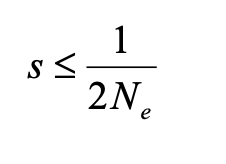
Neutral theory equation
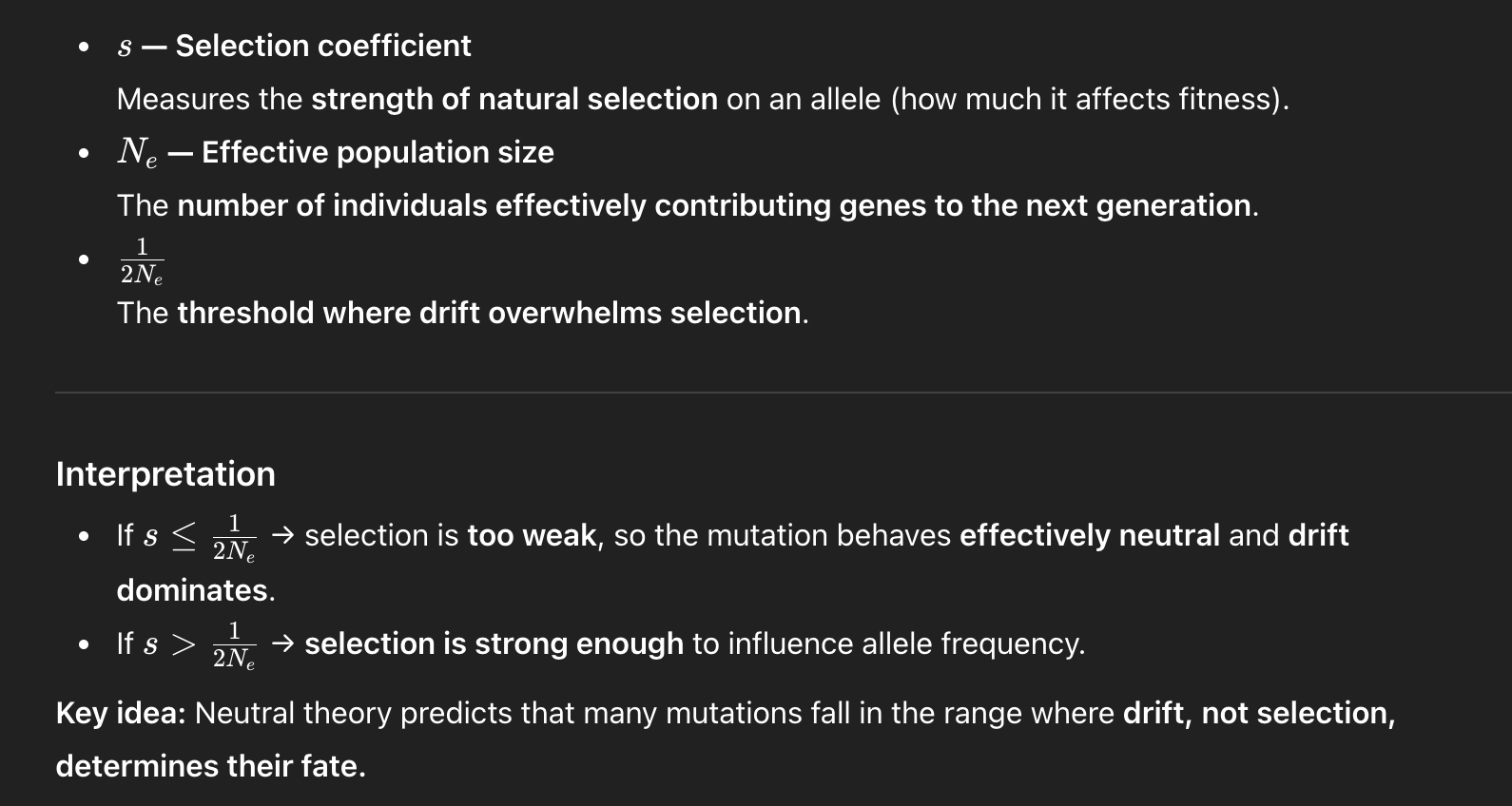
Neutral Theory
Most molecular variation is neutral
Most charges in DNA or amino acid sequences are due to drift
even differences between species
Advantageous mutations are very rare, and most evolution is neautral mutation
Selectionist theory
Advantageous mutations commonly contribute to evolutionary change
Counter argument to neutral theory
Observations of Neautral Theory
When looking at sequences differnces in proteins across species and the estimated substitution rate based on fossil records:
Replacement mutation rate requaled one every 2 years
This is VERY high rate
Molecular Clock
The molecular clock is the idea that genetic mutations accumulate at a roughly constant rate over time, so the number of DNA differences between species can be used to estimate how long ago they diverged.
Key idea:
Because many mutations are neutral (from neutral theory) and spread by genetic drift, they accumulate at a predictable average rate, allowing scientists to estimate evolutionary timelines.
A claim of neutral theory
Positive natural selection
leads to changedchanges
But is irrelevant for DNA differences
Supported by Psuedogenes as evidence
Supported by Sunomonous mutations
Major claims of neautral theory
Most molecular mutations are neutral — they do not affect an organism’s fitness.
Genetic drift is the main force changing allele frequencies at the molecular level, rather than natural selection.
The rate of molecular evolution equals the neutral mutation rate, producing a roughly constant molecular clock.
Most genetic variation within populations is due to the accumulation of neutral alleles maintained by mutation and drift.
Pseudogenes
Pseudogenes are nonfunctional copies of genes that no longer produce a working protein. Because they do not affect fitness, mutations in them are not removed by natural selection.
As a result:
Mutations in pseudogenes accumulate freely through genetic drift.
They evolve at a rate close to the neutral mutation rate.
Why this matters:
Since pseudogenes show rapid accumulation of neutral mutations, they provide clear evidence that many DNA changes occur without selection, which is a key prediction of neutral theory.
Synomonous mutations
Synonymous mutations are DNA mutations that do not change the amino acid produced because multiple codons code for the same amino acid.
In the context of neutral theory:
They are usually neutral because the protein sequence stays the same.
Since they typically do not affect fitness, they are mainly influenced by genetic drift.
Because of this, synonymous sites are often used to estimate neutral mutation rates and molecular clocks.
Why they matter:
Their high rate of accumulation compared to non-synonymous mutations supports the idea that many DNA changes occur neutrally, consistent with neutral theory.
Challenges to neautral theory
Saturation - mutations can only get so different from each other
Holes in molecular clock
Uses a concept of years, and not generations,
Substituion rates were the same in species with very different generation timelines
Ohta’s solution to Neutral theory challenges
Bad mutations behave like neutral mutations when
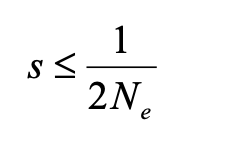
Effective population Size (Ne)
Ne < N ; It is always less than the normal population size because:
sex ratio is not always 1:1
variation in offpsring #
natural selection
overlapping genernations
Population sizes (N) flucuate over time.
Short lived creatures have:
Large populatoins
And slight bad mutations get selected against
Long lived creatures have:
small populations
small, bad mutations are neutral
The neuatral model…
is treated as a null hypothesis because it assumes DNA changes occur due to mutation and genetic drift, not natural selection.
Scientists first test whether observed genetic patterns fit what we would expect under neutrality. If the data match the neutral prediction, the null hypothesis is not rejected. If the data significantly deviate (e.g., too many advantageous mutations), it suggests natural selection is acting.
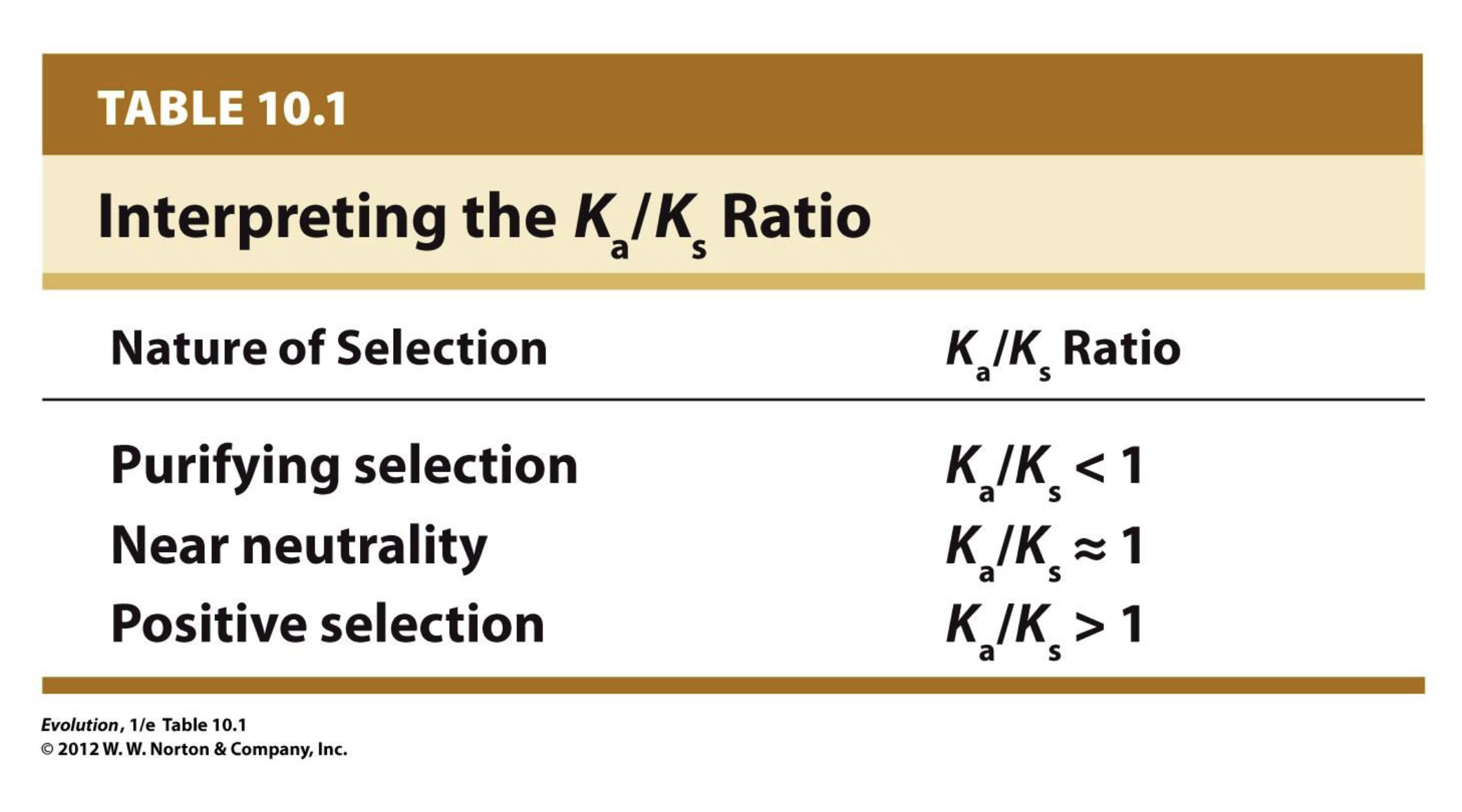
Detecting selection equation
Ka = rate of nonsynomonous substitions
Ks = rate of synomonous substitutions
Ka / Ks = ratio tells you if selection is present
McDonald - Kreitman (MK) Test
is used to test whether natural selection or neutral drift explains DNA evolution.
Idea:
It compares two types of mutations in a gene:
Synonymous (silent) — do not change the amino acid → usually neutral.
Nonsynonymous — change the amino acid → may affect fitness.
Then it compares these mutations in two contexts:
Within a species (polymorphisms)
Between species (fixed differences)
Prediction under neutral theory:
The ratio of nonsynonymous to synonymous mutations should be the same within and between species.
Interpretation:
More nonsynonymous fixed differences between species → evidence of positive selection.
Fewer nonsynonymous changes than expected → purifying selection removing harmful mutations.
Neautral theory breif summary
Most molecular variation is neutral
Most changes in DNA or amino acid sequence are due to drift
Even species differences
Modern ideas related to neautral theory
silent sites may not be complete nuetral =
Codon bias may exist
All codons may not be used equally
Hitchiking
Genetic Hitchhiking
(selective sweep) occurs when a neutral or even slightly harmful allele increases in frequency because it is physically linked to a beneficial allele under positive selection.
Key idea:
As the beneficial mutation spreads, nearby alleles on the same chromosome are “carried along”, reducing genetic variation in that region. Can become a fixated allele even if it’s not being selected for
Codon bias
preferential use of some codons by an amino acid
seemingly very common
ex.) E-Coli uses CUG codon combination far more frequently, even though other synomonous combinations exist.
In yeast, the UUG is favored
Indication variation in codon preferenes across speices
Neutral theory in light of today’s ideas:
It helps us explain the molecular clock
Helps explain the role of psuedogenes
However, differences across species seem to be more of a result of selection
So neutral theory serves as a good Null model
Biological speices concept
defines species based on reproductive isolation.
Criteria:
Can interbreed — individuals mate and produce offspring.
Produce viable, fertile offspring — offspring can survive and reproduce.
Reproductively isolated from other groups — no gene flow with other populations (due to prezygotic or postzygotic barriers).
Key idea:
A species is a group of populations that actually or potentially interbreed and are isolated from others.
Note this concept is only used for sexually reproducing organisms
Morphospecies concept
Original species concept
Based on appearance
Useful for fossils
Not good for sexual dimorphisms, mimicry, etc
Phenetic species concept
Species are defined based on overall similarity in observable traits (morphology, appearance, measurable characteristics).
Criteria:
Individuals are grouped by quantitative similarity in traits.
Uses many characteristics at once (not just one trait).
Species are clusters that are most similar to each other and distinct from other groups.
Key idea:
Species are identified by how similar they look/measure, not by reproductive isolation or evolutionary history.
Kinda quantifies the morphological species concept
Bacteria and Archea dilemma
Asexual species
Can’t use the Biological species concept
Horizontal gene transfer, gene flow
Gene flow may trigger speciation
Phylogenetic species concept
Can be applied to all organisms
Testable, quantifiable
Uses genetics
Can be difficult
And as a result, it drastically increases the number of defined, unique species
Classic view of speciation
Isolation of populations
divergence of traits
reproductive isolation
This is very simplified
Allopatric speciation
speciation is happening when populations are physically separated
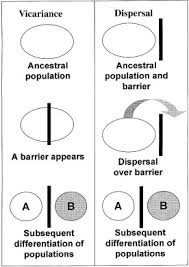
Dispersal (moving to isloation)
Vicarance (barrier forms between groups)
Dispersal vs Vicariance
Allopatric speciation
Panamanin isthmus
example of vicariance
land mass formed, separating two oceans and the species in them.
Allopatric speciation
Hawaii / islands
examples of dispersal from the mainland to an island
allopatric speciation
Founder affect
small group with a unique genetic makeup disperses to a new area
Type of genetic drift
allopatric speciation
Sympatric speciation
Same place speciation
physical separation isn’t required for speciation to occur
ex.) Insects, and plants (if a human brings a new plant into an environment, insects may shift their niche to fit that plant)
Rhagelois Fly example of sympatric speciation
Hawthorwn was original food source
Apples got introduced
They have different growing seasons, and some flys began specializing for one or the other
because of different temporal seasons, they no longer interact with each other naturally
example of disruptive speciation
Parasites within the flyes have also speciated
Incipient speciation
speciation in progress but not yet complete
Cichlids
fish that are like the post child for diverse speciation
variatoin in size, color, and food
Lake Tanganika
Lake Apayo
Hybridization
two species come back into contact and still interbreed in a geographic area called the hybrid zone
Fire bellied toads
Reinforcement
if hybrids are selected against
If both parents and unique specialist, a hybrid may not be equipped for that unique environment
If the hybrid is selected against, selection should eventually act to prevent mating between the two speices
Prezygotic isolation:
Barriers that prevent mating or fertilization before a zygote forms (e.g., temporal, behavioral, mechanical isolation).
Postzygotic isolation:
Barriers that occur after fertilization, where offspring are inviable, sterile, or have reduced fitness (e.g., hybrid sterility like mules).
examples of prezygotic isolation
different sexual organs
different mating seasons
different mating signals and behaviors
Physical isolation
Temporal isolation
No fertilization / no gamete recognition
examples of postzygotic isolation
sertilization of offpsring
zygote forms, but development doesn’t occur
hybrids aren’t viable
sterility
Differences in numbers of chromosomes across species
If you don’t have a matching number, more than lilkey the offspring will be streile
How does sexual selection preferences influence speciation?
ex.) Brids of paradise (very colorful)
Have more speciation, and different sexual selection preferences
ex.) Manudces (muted, normal coloring)
minimal speciation
Polyploidy
a condition where an organism has more than two complete sets of chromosomes (e.g., 3n, 4n instead of 2n).
changes in chromosome # = instant isolation
very common in plants
Three spine stickleback example
lots of speciation and specialization
Marine species - more armor
Freshwater species - less armor, different food source
EDA gene mutation - removes plated armor protection
Pit x1 locus - gene that produces hind limb, is detached in freshwater fish
structural change
change in strucutre / form of a protein usually through change in amino acid sequence
Regulatory
change in WHEN + WHERE proteins are expressed usually change in promoter or transcription factors
monophyletic group
common ancestor and all of its descendants
synapomorphy
is a shared derived trait that is present in a group of organisms and inherited from their most recent common ancestor, used to define evolutionary relationships.
parsimony
simplest solution is more likely to be correct
Fewest changes in a phylogeny will probably be right
Two things essential for Phylogenys
DNA data
Fast computers
Character data
phylogeny term that quantifies confidence in accuracy
Bootstrap replicates
phylogeny term that describes % of time you get a replication of a branch.
Explore top notes

