International economics- Ch.3
 Studied by 0 people
 Call with Kai
 Learn
Learn Practice Test
 Spaced Repetition
 Match
Match Flashcards
 Knowt Play
1/26

There's no tags or description
Looks like no tags are added yet.
Name | Mastery | Learn | Test | Matching | Spaced | Call with Kai |
|---|
No study sessions yet.
27 Terms
What key limitation of the Ricardian model does the Specific-Factors model address?
The Ricardian model only includes labor as a factor of production, implying all workers gain from trade. The Specific-Factors model adds land and capital to show unequal effects.
Why is the specific factor model often refered to as a short run model?
Because it assumes that some factors of production are stuck(mobile) in the short rund and cannot move between industrie.
Labor(mobile)- can move freely between sectors, since workers can switch jobs where the pay is the higest
Capital and land(immobile) - these are sometimes specific to each sector, they are tied to their current use and can’t move easily.
What are the main assumptions of the Specific-Factors model?
Two sectors: manufacturing (labor + capital) and agriculture (labor + land).
Labor is mobile between sectors.
Land and capital are sector-specific (immobile).
Diminishing return to labor - the more you add or worker to one sector, each new workers adds less extra output → decling marginal product of labor→effect wages: workers are paid based on production. The more workers the less valuable and wages fall for each new worker in the sector
In the specific-factors model, the specific factors (land and capital) are restricted to their own country.They cannot move across borders, even with free trade. Only goods move between countries, not production factors.
Difference between mobile and immobile
Mobile = flexible = labor → can move to where pay is higher.
Immobile = specific = land or capital → stuck in one industry.
What determines wages in the Specific-Factors model?
Firms hire workers until the value of the marginal product of labor (price × MPL) = the wage.
What happens when a country opens to trade in the Specific-Factors model?
Trade changes the relative prices of goods — one good becomes more valuable, and the other less valuable.
They change the earnings of landowners, capital owners, and workers, but not equally.
Who gains and who loses from trade?
Gainers: Owners of the factor specific to the export industry (the good whose price rises).
Losers: Owners of the factor specific to the import-competing industry (the good whose price falls).
What main question does the Specific-Factors model help answer?
It explains who gains and who loses from trade within a country.
What happens to relative prices when trade begins?

Explain this graf
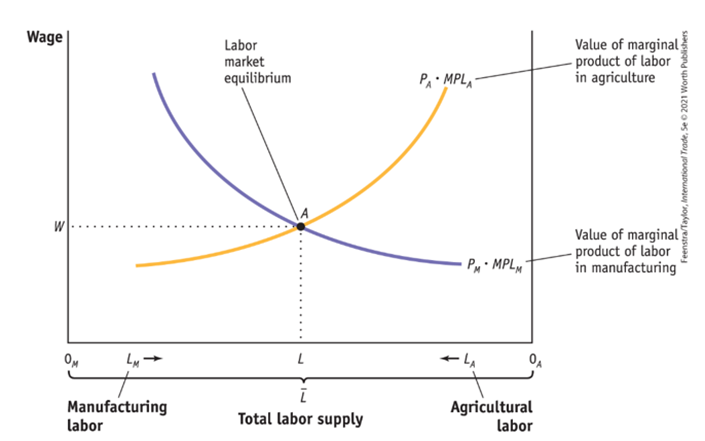
The blue curve represents the value of labour in manufaring: Pm * MPLm, which slopes downward
The organge curve represents the value of labor in agriculture: Pa * MPLa, which slopes downward.
Both graph are actually downward sloping, but there drawn mirrorred for clarity
The intersections point A - is where both sectors pay the same wage. This is because workers can move freely between sectors- they switch until no one can earn more elsewhere
Labour allocation = La + Lm = L. As labour increase in a sector, its MPL falls - diminshing return
The equilibirum shows the wage and allocation of labor between manufacturing and agriculture where the value of the marignal product is equal in both sectors.
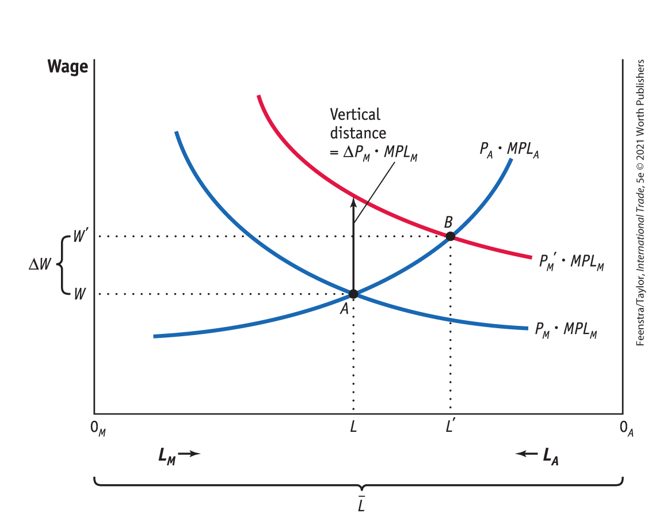
Explain the effects of price increase on manufacured goods
There are two sectors:
Manufacturing - uses labor + capital
Agriculture- uses labor + land
Labor can move between sectors, but capital and land are specific to each- they cant move.
1) Price of manufactured goods increase → they become more valauble than agriculture goods → more profitable
2) Firms adjust → manufacturing wiling to pay higher wages(w - w’) to attract labor(movement from l - l’)
3) Effect on wages
Wages rise, but not as much as price rises → CHECK REALWAGE
Agriculture: real wage increases, Pa stays the same, but W increase = workers can buy more food
Manufacture: real wage decrease, Pm faster than W increase= workers but fewer manufacutred goos
= workers can buy more food, but less manufacutred goods. The total effect on real income depends on what mix of goods they consume mixed outcome - ambigous outcome
4) Effect on capital owners and landowner
Capital owners - manufacturing → higher returns, given higher Pm and more labor= higher output of capital and profit
Lanowners - agriculture → lower return → given less labor, lower outputs of agriculture goods and prices unchanged and decrease in nominal wage
= Capitalists gain and landowners lose.
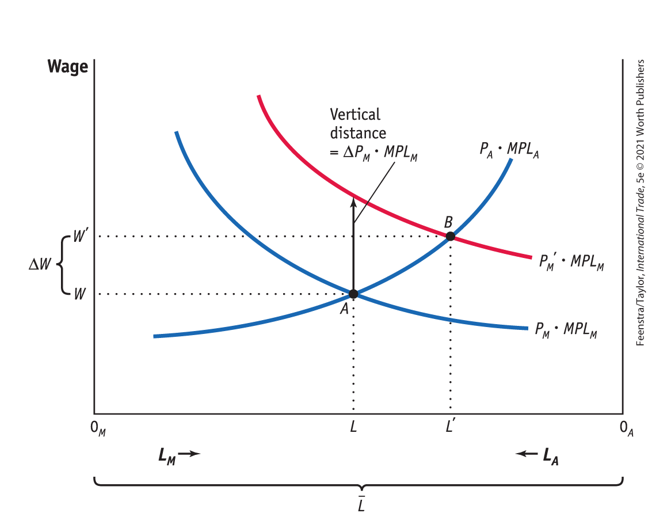
How is that when price of a good increases the marginal product of labor increases? For instance, how is it that when price of manufactured goods increase, the Pm * MPLm(marginal product in manufacturing) increases
Because Value of MPL = P * MPL, so when price of a good increase and the MPLm stays the same the value of each workers contribution increases
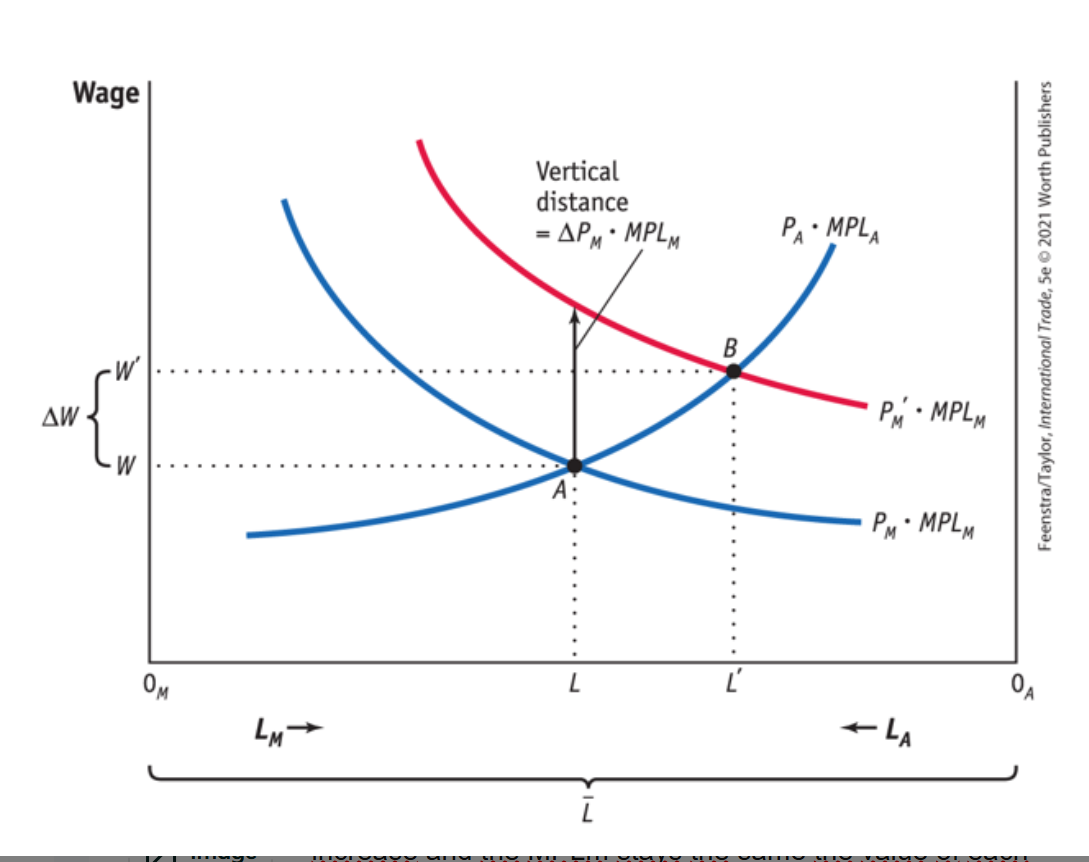
How is that Wages rise, but not as much as price rises?
1) The red line(Pm * MPLm) shofts up because Pm increased.
2) Workers move into manufacturing → shift from l → lm
3) As we add more workers into one sector, the rule of dimishing marginal returns apply. Because each addional worker adds less extra output than the previous one.
Rule
The veritikal distance between the old and new wage lines is smaller than the full vertical shift og the curve delta Pm *MPLm →

Difference between nominal and real wage
o Real wage = how much stuff you can actually buy with that paycheck
o Nominal wage = the number printed on your paycheck
Ambigous effect
Means the outcome is uncertain — it can go either way.
For instance: When price of manufactured goods rises, the effect on workers real wages is uncertain. Sometimes the workers may be better of, sometimes worse off
Different form richardian model, that says all workers gain from trade, however in specific model the effect is not guuranteed. Meaning all workers aren’t better off, some may benefit other may struggle.
Connection between selling a good, wages for worker and left over money
Firms earn money from selling goods. Then they pay workers their wages. Whatever is left goes to owners of machines(capital) and owners of land
What happens to labor when the price of manufactured goods rises and how does this affect capital in manufacturing and what happens to Rk
1) Labor moves from agriculture to manufacturing.
2) Each machine has more workers, so capital becomes more productive (higher marginal product of capital).
3) Rₖ rises — capital owners earn more and are better off.
Why are capital owners better off given that price of manufactured goods rises?
Because manufacturing becomes more valauble and more productive(higher MPL) making capital owners income rises even higher giving them a higher rental income and purchasing power
What happens to land in agriculture?
Each acre has fewer workers, so land becomes less productive (lower marginal product of land).
What happens to the rental on land (Rₜ) and landowners given increase in price of manufactured good?
Rₜ falls — landowners earn less and are worse off.It drops — they can buy fewer manufactured and agricultural goods.
What doeRₜ / Pₐ represent?
The real rental on land — landowners’ earnings measured in terms of agricultural goods.
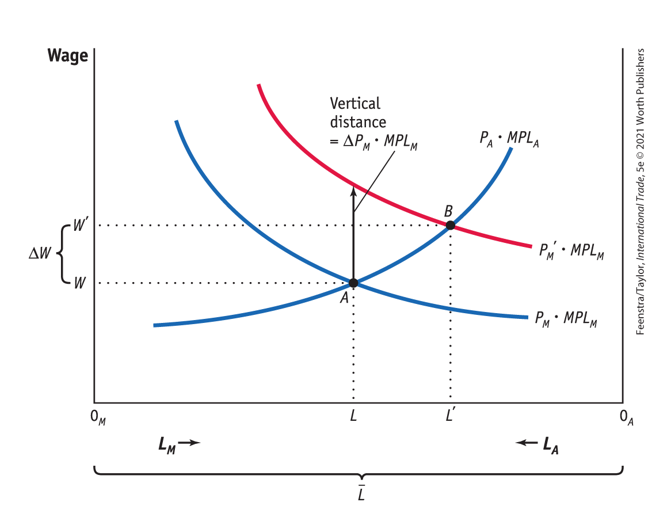
Given an increase of manufactured goods, what happens to wage in both sectors? - answers flashcard 4 too
The wage increase in both sectors, because labor is mobile and must recieve the same wage in both sectors. As labor shifts towards manfacturing, the wage rises for all workers. This is the endpoint. However to come to this point
Wheat price ↑ → wheat firms hire more workers → wheat production ↑.
More workers in wheat → marginal product of labour in wheat ↓ → wheat wage growth slows.
Fewer workers in steel → marginal product in steel ↑ → steel wage rises.
Movement stops when wages equalize again (at a higher level than before).
But if it is true that wage is the same in both sectors, even if labor moves to more attractive sector, why would they move at all if they earn the same?
Labour doesn’t move because wages are already equal, labor moves until wages are equal. Meaning the movement happens because of a temporary wage difference created by the price change. Once labor has fully reallocated, the economy reaches a new equilibirum, with hgiher wages overall, more labor in manufactuing and equal wages in both sectors. Meaning again: labor doesn’t move because wages are the same - it moves until they are
What is typical for the people that loose and gain from the factor specific model
The industry whose price increases, will gain and the other factor will price. For instance, if price of manufactured goods increase, they will be the one who gains and the agriculture industry are the ones how loose.
How can liberal immigration policies favor both capital owners and landowners
A liberal immigration policy brings more workers into the country.
In the specific-factors model, labour can move between both sectors, but land is stuck in wool and capital is stuck in manufacturing.
When more workers arrive:
The wage falls (labour becomes more plentiful- meaning marginal product of labor falls labor).
Each specific factor now has more workers to use, so land and capital become more productive.
Higher productivity of the specific factor means higher income for farm owners (land) and capitalists (capital).
Result: Both farm owners and capitalists benefit from immigration because it raises the return to their fixed factors. Therefore, both groups should support a liberal immigration policy.
Differnece betwen value of marginal product of labour in goodx and formula for wage
VMP = P × MPL
This shows what firms are willing to pay at each labor level.
Wage
This is the actual payment, found where the two VMP-curves (manufacturing and agriculture) intersect.
Why does MPL fall when labor increases, but MPL rise when land increases, even though more workers move onto the extra land?
More labor → MPL falls
Because each additional worker has less land/capital to work with.
→ Diminishing marginal returns to labor.More land → MPL rises
Because the same number of workers now have more land each, making them more productive.
→ MPL rises because land–labor ratio increases.
 Note
Note  Flashcards (59)