OCR Law- The legal system and Criminal law
 Studied by 0 people
 Call with Kai
 Learn
Learn Practice Test
 Spaced Repetition
 Match
Match Flashcards
 Knowt Play
1/319

There's no tags or description
Looks like no tags are added yet.
Name | Mastery | Learn | Test | Matching | Spaced | Call with Kai |
|---|
No study sessions yet.
320 Terms
What are the civil courts?
County court and high court
What is the role of the civil court?
To uphold the rights of the individual. Civil courts hear cases covering Tort law, Contract law, Family law, Employment law, and Company law
What cases are heard in the county court?
Cases are heard by circuit or district judges, they hear all tort and contract claims, all cases for recovery of land, and disputes over equitable matters such as trusts up to a value of £350,000
What punishments can the civil courts give?
Reimbursement/Punitive charges
How are decisions reached in the civil courts?
Preponderance (balance of liabilities)
What cases are heard in the high court?
Has 3 specialised divisions, all of which hear cases at first instance and appeal cases from the county court
What cases do the Queen's bench division of the high court hear?
Tort and contract cases with a value over £100,000 and any minor claim that involves an important point of law. Juries appear in cases of fraud, libel, slander, malicious prosecution, and false imprisonment
What cases do the chancery division of the high court hear?
Deals with all other civil cases (insolvency, mortgage, repossessions, trust property disputes, copyright, patents, probates, trademarks). Juries are never used.
What cases do the family division of the high court hear?
International cases involving The Hague Convention and disputes about which country's laws should apply are heard here. Since the Crime and Courts Act (2013), many less serious cases are now dealt with in the family court
How will a track system be allocated?
The district judge or the Master judge decide which track the case will be allocated to upon receipt of the allocation questionnaire (claimants give details of their case and the compensation they want to receive
What cases are allocated to a "small claims" track system?
Disputes under £10,000 and personal injury cases under £1,000. Clients represent themselves and cannot claim solicitor costs from the other side as it is a personal decision to use one
What cases are allocated to a "fast track" system?
Claims between £10,000 and £25,000. Court adheres strictly to ADR to ensure time is cut. The aim is to hear the case within 30 weeks. The cases are heard by circuit judges, on a hearing that lasts one day, with only 1 expert allowed.
What cases are allocated to a "multi-track" system?
Cases over £25,000 and complex cases. The judge deals with the procedural steps without the need for the parties to attend. Under the track system, the High Court will only hear claims under the multi-track and cases over £50,000 for personal injury (or £25,000 for damage to property)
What is the aim of case management (track systems)?
To reduce costs
What is pre-trial procedure?
To avoid overloading the courts, people are encouraged to attempt to reach a settlement outside of court using Alternate Dispute Resolution. Parties are encouraged to share all relevant information with each other before a claim is issued. If the other person denies liability/responsibility, the case can go ahead.
What are the limits on claims in the county court?
£100,000 or less (£50,000 or less for personal injury case)
What are the limits on claims in the high court?
£100,000 or more (£50,000 or more for personal injury cases)
What is the appeal route in the county court?
(Appeal on liability or compensation)
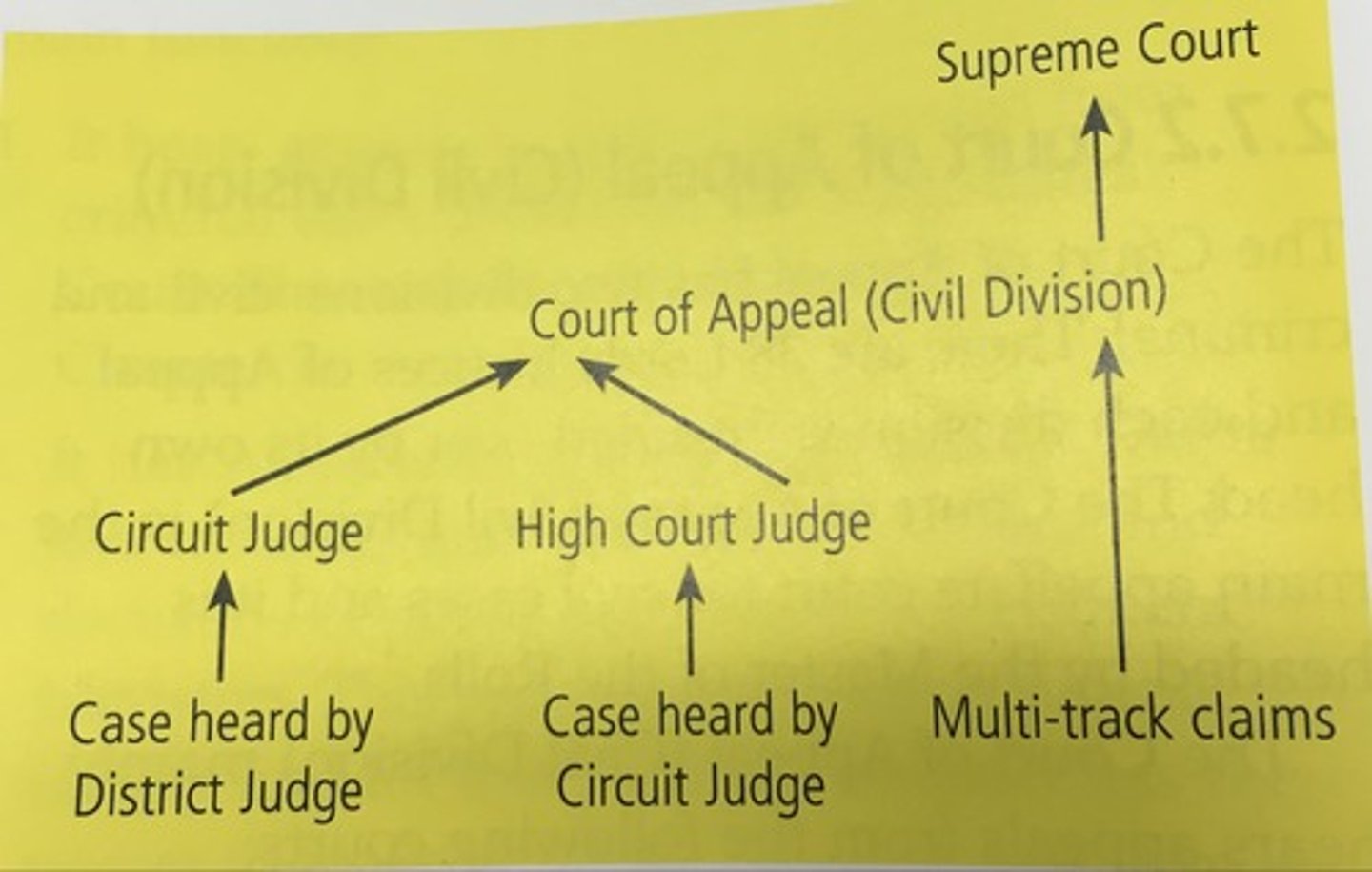
What is the appeal route in the high court?
(Can only appeal if permission is given)
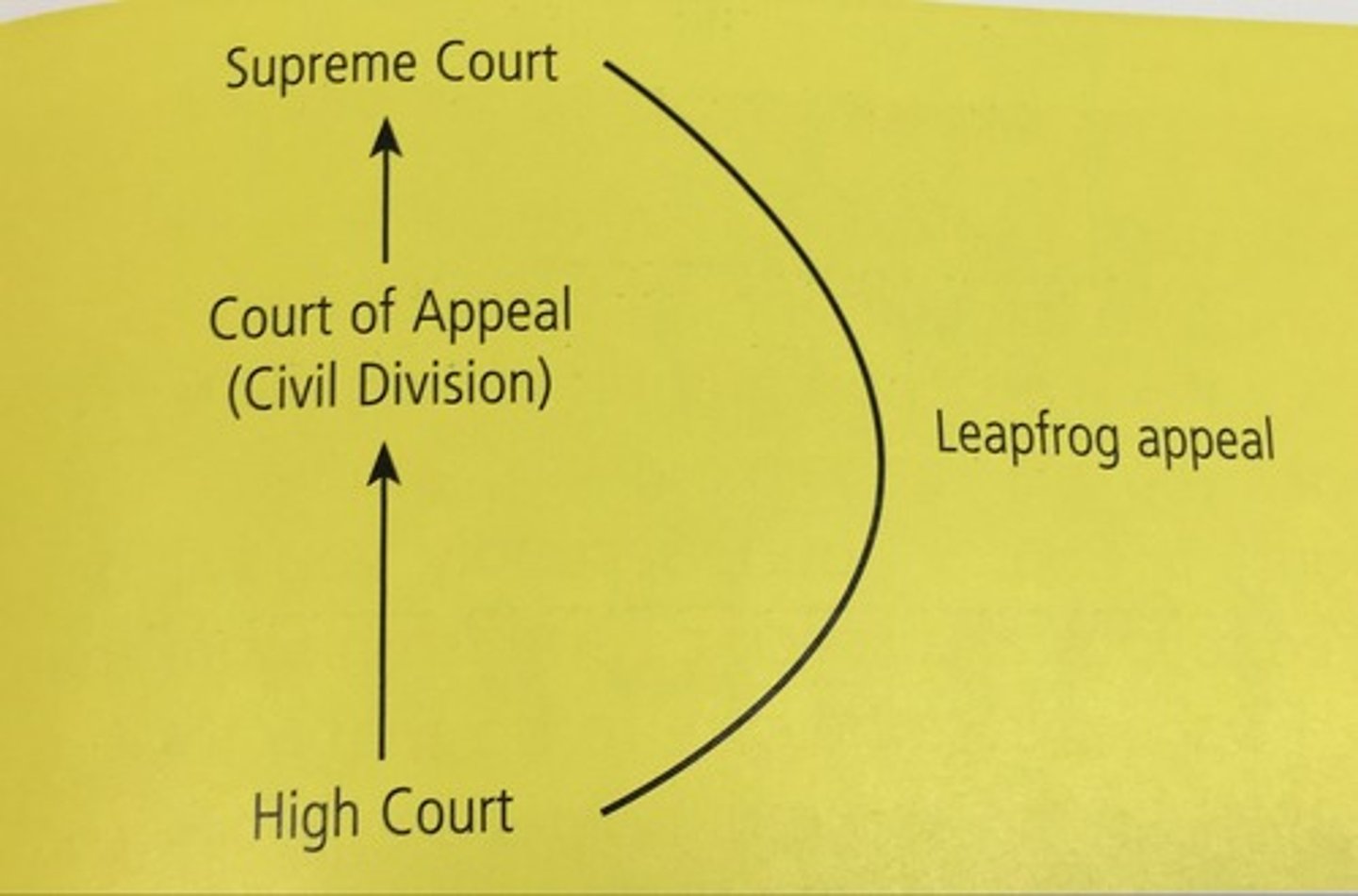
What are the advantages of civil courts?
Third party is impartial, Result is legally binding, Legal aid is available for low income clients, Legal experience means no exploitation, There's an appeal system if client is dissatisfied.
What are the disadvantages of civil courts?
Expensive, Time consuming, Complex, The court chooses the trial date, Intimidating
What are tribunals?
Tribunals run parallel to the court system and allow the public access to inexpensive and fast dispute resolution. The parties in tribunal cases cannot go to court to resolve their dispute. The tribunals enforce rights which have been granted through social and welfare legislation.
What are the chambers in the 1st tier tribunals?
Social entitlement chamber, Health, education, and social care chamber, War pensions and the armed forces chamber, General regulatory chamber, Taxation chamber, Land, property, and housing chamber, Asylum and immigration chamber, and the Employment chamber.
Who are tribunal cases heard by?
Cases are heard by tribunal judges. In some cases, two people with expertise in the field of the case will sit with the judge to help them reach a decision (in the Employment chamber, it's a member of the worker's union instead of the expert)
What are the chambers in the upper tribunals?
Administrative appeals chamber, Tax and chancery chamber, Land chamber, Asylum and Immigration chamber
What is the procedure in tribunals?
Both sides are given opportunity to put their case forward, funding is only available in a few tribunals so most applicants will not be represented. The decision of a tribunal is always binding. Appeals can only be made of a point of law (first tier, upper tier, court of appeal, supreme court)
What are the advantages of using tribunals?
They have more expertise than judges, Fast, Cheaper than court, Informal/Less intimidating
What are the disadvantages of using tribunals?
Lack of funding for the cases presented, More formal than ADR, There can be delays, Cannot pursue the case in court
What is negotiation?
Communication may be face to face, by letter, email, text, conference call, or other way that is convenient for both parties.
How is negotiation a good form of non-court dispute resolution?
Any agreement reached is final with no appeal available unless the case is taken to court, clients can instruct solicitors who would consult on their behalf should that happen.
What are the advantages of using negotiation?
Fast, Cheap, Can be used any time, Private
What are the disadvantages of using negotiation?
Lengthy delays, Lack of legal expertise, Uncertainty, Antagonistic.
What is mediation?
Involves a neutral third party, called a mediator, who carries offers to and fro from the parties whilst maintaining confidentiality.
When is mediation most commonly used?
Family cases (but never in those where domestic abuse is reported)- they are encouraged to show they have attended a Mediation Information and Assessment Meeting before they appear in court
What are the advantages of using mediation?
Fast, Cheap, Technical expertise, Private
What are the disadvantages of using mediation?
Power imbalance between parties (pressure to agree), No formal legal expertise, Uncertainty
What is conciliation?
Conciliation is like mediation except they play a more active role in the case, discussing the issues with both parties to prompt understanding. The conciliator has no authority to seek evidence or call witnesses
What are the advantages of using conciliation?
Parties are in control, Agreements can be tailored to suit the needs of both parties, No conflict (compromise)
What are the disadvantages of using conciliation?
Uncertainty, If the conciliator is inexperienced, weaker parties may be manipulated, Lower settlements
What is arbitration?
A third person (Arbitrator) acts as a judge of the case and gives a decision that's binding for both parties. They have specialist knowledge on the subject that the dispute covers and thus, there's usually no need for expert witnesses. Witnesses may sometimes be called to give evidence.
When can arbitration be used?
As of the Arbitration act (1996), it can only be used for written agreements
What is the cost of using an arbitrator?
The process is usually free but the arbitrator can charge for their services (rates are usually between £500-£1500)
When can arbitration be appealed?
There is no automatic right to appeal but under s68 of the act, a party can appeal to the high court if there is a "serious irregularity" and s69 allows an appeal on a point of law.
What are the advantages of using arbitration?
Choice of arbitrator, Technical expertise, Personalised schedule, Private, Cheaper than court, Fast, Binding result
What are the disadvantages of using arbitration?
No legal expertise, Limited appeals, One of the more expensive forms of ADR, Process can become complex, Prone to delay
What is online dispute resolution?
A service that would allow more people access to justice but it could only really function for paper-based claims. There would be 3 stages to the process:
What would be the first stage of online dispute resolution?
An automated, interactive process to identify the issue, with documented evidence provided
What would be the second stage of online dispute resolution?
Conciliation and case management carried out by appointed case managers
What would be the third stage of online dispute resolution?
(If the issue is not resolved by step 2) Resolution carried out by a judge over screen, telephone, or face to face meetings over skype, conference call, ext.
Why might online dispute resolution be an appropriate platform for justice?
People believe, if ran correctly, if would be a good solution to the overuse of the courts as it would be affordable, accessible, appropriate to the emerging audience, fast, consistent, trustworthy, fair, and final.
What act gives the Lord Chancellor the right to decide who receives government funded legal aid?
The LASPO 2012 Act
Upon what criterion does the Lord Chancellor decide whether to award legal aid or not?
The likely cost of providing the services and the benefit which would be obtained by them, The availability of resources to provide the services, The importance for the individual of the matters to which the service would be provided, The availability of other services, such as mediation, The prospect of success, The public interest of pursuing the case
For what type of cases is Government funded legal aid available for?
Childrens' rights cases and those involving the liberty of the individual
For what type of cases is Government funded legal aid unavailable for?
Breach of contract cases, Claims on tort (e.g. - personal injury), Trespass to the person, land, or property
Who is likely to receive legal aid?
A person applying for government advice or representation must show that they don't have enough money to pay for it themselves. So, generally, those who are in receipt of income support or income based job seekers allowance automatically qualify, providing their capital is at the set level. For others, their gross income is assessed first and if it's above the set amount they do not qualify.
How is disposable income used in means testing for Government funded legal aid?
The disposable income has to be calculated by starting with their gross income and taking away tax and national insurance, housing costs, childcare, and allowance for themselves and each dependant. If the amount left is below the set amount, the person is not expected to fund their own case. If it's above then the person doesn't qualify for legal aid. If it's between the higher and lower bands then they are expected to pay a contribution.
How is disposable capital used in means testing for Government funded legal aid?
This is the assets of the person applying (such as bank/saving accounts, stocks, shares and expensive jewellery) The maximum limit for disposable capital is £8,000. Once the assets have been spent (if over £8,000) then they can become eligible for legal funding but will have to pay a contribution. Only the first £100,000 from any mortgage is deducted from the value of the home.
What service was set up for the giving of Government funded legal aid in criminal cases?
In April 2013, the LLA was set up to administer legal aid and advice under the ministry of justice. They make contracts with law firms to provide legal services to people charged with criminal offences. Most service providers are solicitors who provide help with funding for representation at court in criminal cases
What is the interests in justice test?
A test used to assess whether a defendant qualifies for Government funded legal aid
What questions does the interests in justice test ask?
If the defendant risks losing their livelihood, if complex legal issues are involved, or if the defendant has language difficulties
If the case involves a considerable point of law
If the individual is unable to understand the proceedings in court/is unable to present their own case
If the case may involve the racing, interviewing, or expert cross-examination of witnesses
If it is in the interests of another person that the individual be represented in court (e.g. - cases of rape)
What is the means testing process for Government funded legal advice regarding criminal cases in the magistrates court?
In addition to the interests in justice test, there is a strict means test applied that is often known as the "in or out" scheme. Applicants either eligible for legal aid (because they pass the initial or full means test) or ineligible (because they do not) Those who qualify will either be on income support, defendants under the age of 16, and those under 18 and in full time education. For everyone else, the test starts with a first stage simple means test which is calculated on gross annual income. If their income is too high on this test, they do not qualify. Those in-between qualifying and the aforementioned are subject to a further means test to calculate their disposable income (if it is above a set level they will not get legal aid) The levels are quite low, only around ¼ of adults qualify for aid in the magistrates' court
What is the means testing process for Government funded legal advice regarding criminal cases in the crown court?
Most defendants can receive legal aid and its free for those with low incomes. Those on higher incomes but under £37,500 disposable income will have to pay towards their legal aid. If the disposable income is higher they will be ineligible for legal aid. In situations where the defendant has to pay, then the higher the income the higher the contribution to the case. The maximum amount that will have to be payed is dependent on the type of case it is. When the result is a guilty verdict, they will have to pay from their capital. When the verdict is not guilty, any contributions get returned.
What is meant by the 'advice desert' issue in Government funded legal advice?
There's evidence to suggest that not enough legal service providers have contracts. More and more solicitors have stopped doing government funded legal work, in Suffolk and Shropshire there are currently no solicitors' firms doing government funded housing work
What is the issue with the availability of Government funded legal advice?
Funding is not available for many civil claims. People with serious disabilities need all the help they can get in order to receive adequate compensation. In cases regarding employment, some people are disadvantaged due to having to present their own case, having been excluded by the criterion for legal aid. Middle income families do not qualify for legal aid even though they may also need it
How is insurance a form of private funding for legal aid?
One way of funding a legal case is through legal insurance, often nicknamed "before the event" insurance. "After the event" insurance is more common however and is taken out when someone is taking a case to court and insures against the loss of the case (and having to pay the winner's expenses) In most cases, the client will not have to pay anything to his lawyer if he loses his case but will have to pay the costs of the other side. To help people protect against this, people take out "after the event" insurance so the insurers will have to pay the expenses instead.
What is a conditional fee agreement?
CFAs were brought about in order to help those who are not eligible for government-funded legal aid. They're usually no win, no fee, but some solicitors are able to charge a lawyer level fee even if the case is lost.
How are conditional fee agreements made?
The solicitor and the client agree on the fee that would normally be charged for the case as well as the success fee to be applied. The success fees can be up to 100% of the normal fee however most CFAs will have a cap at around 25% of the damages. This protects the client from having to pay more than he won.
What is privately funded legal aid from solicitors and barristers?
Due to the costly nature of this, it is only really available to businesses or wealthy individuals. Some solicitors will offer a free half hour consultation and some will offer their services free of charge in some circumstances
What are the advantages of privately funded legal aid?
There is no cost to the state, no exclusion, and it discourages weaker cases being brought before court
What are the disadvantages of privately funded legal aid?
Solicitors will only take on cases they can confidently win so worthy claims may be rejected, Insurance premiums for cases can be high, and insurance is high (but success fees are not claimable)
What is the Citizens Advice Bureau?
Online service that deals with social welfare problems and debt (benefits, housing, employment)
What are law centres?
Non-for-profit practises which assist people who can't afford lawyers. They deal with civil problems (eviction, exploitation at work, discrimination) and mainly offer advice but occasionally offer representation. They receives some funding from the central government and the national lottery fund
What are trade unions?
An organisation of workers who come together to achieve a common goal (protection of workers' rights) They organise representation and free advice for their members. In the UK, the biggest union is Unite and its £3.25 a week for full time workers to be a member
What is the London Bar Pro Bono unit?
A group of volunteering barristers who offer free advice to those who can't pay and don't qualify for legal aid. They advise on many aspects of law and occasionally represent people in court.
What is the advantage to legal advice agencies?
They offer free advice
What are the disadvantages of legal advice agencies?
They have no money to offer you and due to their limited legal expertise, you may have to pursue a solicitor anyway
What is the advantage of law centres?
They target vulnerable people
What are the disadvantages of law centres?
Lack of funding, and they are not well distributed throughout the country
What are the advantages of trade unions?
Offer advice and representation
What is the disadvantage to trade unions?
Exclusive to members who may never use the service
What is the advantage of solicitors schemes?
Can offer free advice
What is the disadvantage of solicitors schemes?
Unhelpful for complex cases
What is the advantage of the London Bar Pro Bono unit?
Advise on all areas of law
What is the disadvantage of the London Bar Pro Bono unit?
Only available in London
What is the legal aid agency?
In April 2013, the Legal Aid Agency was set up to administer legal aid and advice (replacing the services provided by the Legal Services Commission) It provides legal help under which advice can be given, and legal representation which gives full legal services for the whole case. There are also services offered for specific types of cases (e.g. - family mediation)
What is the Civil Legal Advice service?
Civil Legal Advice (CLA) is a government-backed scheme which allows the individual to obtain telephone help from the CLA for problems such as-
Debt- if your home is at risk
Housing- if you're homeless or at risk of being evicted
Domestic abuse
Family issues- if your child is being taken into care
Special education needs
Discrimination
What legal advice is available in civil cases?
The Legal Aid Agency has contract with law firms and not-for-profit organisations such as Citizens Advice Centres. Under those contracts they can give advice to people with low income for free
What legal advice is available in criminal cases?
Anyone who is helpful as a suspect at a police station has the right to free legal advice. There is a duty solicitor scheme which makes solicitors available 2 hours a day. There is no means test for this service.
What did Lord Woolfe suggest should be the priorities of the legal justice system in 1999?
Be just in the way it delivers, Be fair in the way it treats litigants, Offer appropriate procedures of a reasonable cost, Deal with cases at a reasonable speed, Be understandable to those who use it
What happened following Lord Woolfe's assessment of the legal justice system?
As a result, the culture of litigation changed, promoting cooperation which in turn reduced the delay between issuing a claim and trial (there is still a delay in the fast track and multitrack paths)
What issues still remain in the legal justice system?
ADR is not used often enough
Costs of cases have continued to increase (e.g. - fees in fast track cases are often more than the amount claimed)
Courts are under-resourced (e.g. - IT systems are limited)
What reform was made to the track system in the legal justice system?
Financial limits for small claims and fast track cases have been increased to avoid expensive trials for lower value claims
What did Lord Briggs suggest as a potential reform of the legal justice system?
Lord Briggs proposed in 2016 that out-of-hours private mediation services be set up and an online court set up for claims up to £25,000
What are the qualifications of a magistrate?
Must be 18-65 upon appointment
Must live or work near the court they are applying to
Have 13 days/26 half days free a year
Must be- Of good character, understanding, good at communicating, have social awareness, mature, have a sound temperament, have a sound judgement, and be committed
Who cannot become magistrates?
People who have a previous criminal record
People involved with other aspects of the law (e.g. - RSPCA worker)
People who are on a refugee visa or a special case scheme
People who have family on the bench
What is stage one of magistrates training?
Initial Introductory Training
Understanding the organisation of the bench and the rules of the court
What is stage two of magistrates training?
Core Training
The opportunity to acquire and develop new skills, knowledge, and to understand what is required of a competent magistrate
What is stage three of magistrates training?
Activities
Involves observations of court sittings and visits to prisons and probation offices
What is stage four of magistrates training?
Appraisal
Within 2 years of cases, they undertake monitored sessions to make sure they are completing the job to the standard necessary
What is the role of the magistrate?
Deals with early administrative hearings
Hear applications for bail
Deal with requests from the police for search warrants, arrest warrants, and custody extensions up to 96 hours
Hold committal proceedings
Hear summary trials and triable-either-way trials
Sentence offenders up to 6 months or 12 months
 Note
Note  Flashcards (71)