Numerical Methods Test #2
 Call Kai
 Learn
Learn Practice Test
 Spaced Repetition
 Match
Match Flashcards
 Knowt Play
1/31

There's no tags or description
Looks like no tags are added yet.
Name | Mastery | Learn | Test | Matching | Spaced | Call with Kai |
|---|
No analytics yet
Send a link to your students to track their progress
32 Terms
From which mathematical concept is the Newton-Raphson iteration formula derived?
Fourier series
Taylor series
Maclaurin series
Binomial series
Taylor Series
In the Newton-Raphson iteration formula, what does represent?
The function value at x_n
The second-order derivative at x_n
The slope (first-order derivative) at x_n
The error at x_n
The slope (first-order derivative) at x_n
What is the intuition behind the correction f(xn)/f’(xn) term ?
If f(x_n) is large, take a small step
If slope is steep, take a large step
If f(x_n) is large, take a big step; if slope is steep, take a smaller step
The term is constant regardless of function values
If f(x_n) is large, take a big step; if slope is steep, take a smaller step
Which of the following is NOT a common stopping criterion for Newton-Raphson method?
Absolute error
Relative error
Residual
Number of function evaluations
Number of function evaluations
Why should a maximum iteration limit be included in the algorithm?
To speed up convergence
To prevent infinite loops
To improve accuracy
To reduce memory usage
To prevent infinite loops
In the geometric interpretation of Newton-Raphson, what does the next estimate xn+1 represent?
The point where the curve crosses the y-axis
The point where the tangent line at (x_n, f(x_n)) crosses the x-axis
The maximum point of the function
The minimum point of the function
The point where the tangent line at (x_n, f(x_n)) crosses the x-axis
Starting with x0=1.5 for x²-2=0, what is x1?
1.5
1.416666667
1.414215686
1.414213562
1.416666667
In the Python function newton_raphson_sqrt2(), how is the relative error calculated?
error = abs(x_next - xn) / abs(x_next)
error = abs(x_next - xn)
error = abs(f(x_next))
error = abs(x_next - xn) / abs(xn)
error = abs(x_next - xn) / abs(x_next)
What is the purpose of the max_iter parameter in the Newton-Raphson function?
To set the tolerance
To limit the number of iterations and prevent infinite loops
To determine the initial guess
To calculate the derivative
To limit the number of iterations and prevent infinite loops
What would happen if the initial guess for x²-2=0 was chosen as x0=0?
The method would converge to √2 quickly
The method would fail because f′(0) = 0 (division by zero)
The method would converge to −√2
The method would converge to 0
The method would fail because f′(0) = 0 (division by zero)
Starting with x0 = 3 for x³-20=0, what is x1?
3.00000
2.74074
2.71467
2.71442
2.74074
What is the relative error after the first iteration for x³-20=0 starting from x0=3?
0.96%
9.46%
0.009%
1.00
9.46%
What is the relative error after the third iteration for x³-20=0 starting from x0=3?
0.96%
9.46%
0.009%
0.0009%
0.009%
In the convergence analysis, what does εn = xn-x* represent?
The function value
The derivative value
The error or residual at iteration n
The step size
The error or residual at iteration n
What order of Taylor polynomial is used to establish quadratic convergence?
First-order
Second-order
Third-order
Zero-order
Second-order
For ,f(x) = x² - 2 what is the asymptotic error constant C?
0.5
0.3535
1.0
0.7071
0.3535
What does it mean if f’’(x*)=0?
The method fails
Convergence is slower
Convergence can be even faster than quadratic
The derivative is zero
Convergence can be even faster than quadratic
What determines the speed of convergence in Newton-Raphson method?
The initial point only
The asymptotic error constant C
The maximum number of iterations
The tolerance value
The asymptotic error constant C
If is small, what does that imply about convergence?
Convergence is slower
Convergence is faster
Convergence is not affected
The method will fail
Convergence is faster
What does the rate of convergence describe?
The initial guess
How fast the sequence approaches x*
The number of iterations
The function value
How fast the sequence approaches x*
What is the key advantage of quadratic convergence mentioned in the slides?
Digits decrease each iteration
Digits double each iteration
Digits remain constant
Digits triple each iteration
Digits double each iteration
For the equation (x-1)³ + 0.512 = 0, what is the root?
x = 1.0
x = 0.2
x = 0.512
x = -0.8
x = 0.2
Starting with for X0=5 for f(x)=(x-1)³, what happens to the Newton-Raphson iterations?
They converge immediately to the root
They diverge and move toward the inflection point
They oscillate between two values
They converge to x = 5
They diverge and move toward the inflection point
What happens when f’(xn) = 0 in the Newton-Raphson formula?
The method converges faster
The method becomes more accurate
The next iterate cannot be computed (division by zero)
The method automatically adjusts
The next iterate cannot be computed (division by zero)
Why can near-zero derivatives cause convergence problems?
They make the correction term very small
They make the correction term very large
They have no effect on convergence
They guarantee convergence
They make the correction term very large
What oscillation problem can occur when starting near a local extrema?
The method converges to the extrema
The method may oscillate between two points in an infinite cycle
The method always converges to the correct root
The method stops immediately
The method may oscillate between two points in an infinite cycle
For f(x) = x², what type of convergence does Newton-Raphson method exhibit?
Quadratic
Linear
Superlinear
No convergence
Linear
What is the matrix form of a system of linear equations?
x=Ab
Ax=b
A+x=b
A−x=b
Ax=b
In civil engineering, what does the equation represent?
Stress-strain relationship
Global stiffness matrix relationship where K is stiffness, u is displacement, F is load
Moment-curvature relationship
Force equilibrium
Global stiffness matrix relationship where K is stiffness, u is displacement, F is load
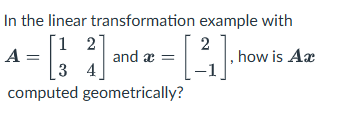
By multiplying A and x directly
By scaling the column vectors of A by the components of x and adding them
By scaling the row vectors of A
By taking the dot product of rows
By scaling the column vectors of A by the components of x and adding them
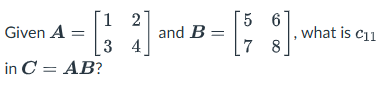
19
22
43
50
19

