theme 5 module 4

0.0(0)
Studied by 0 people
call kaiCall Kai
learnLearn
examPractice Test
spaced repetitionSpaced Repetition
heart puzzleMatch
flashcardsFlashcards
GameKnowt Play
Card Sorting

1/19

encourage image

There's no tags or description

Looks like no tags are added yet.

Last updated 2:56 PM on 3/28/26
Name
Mastery
Learn
Test
Matching
Spaced
Call with Kai

No analytics yet

Send a link to your students to track their progress

20 Terms

1
New cards

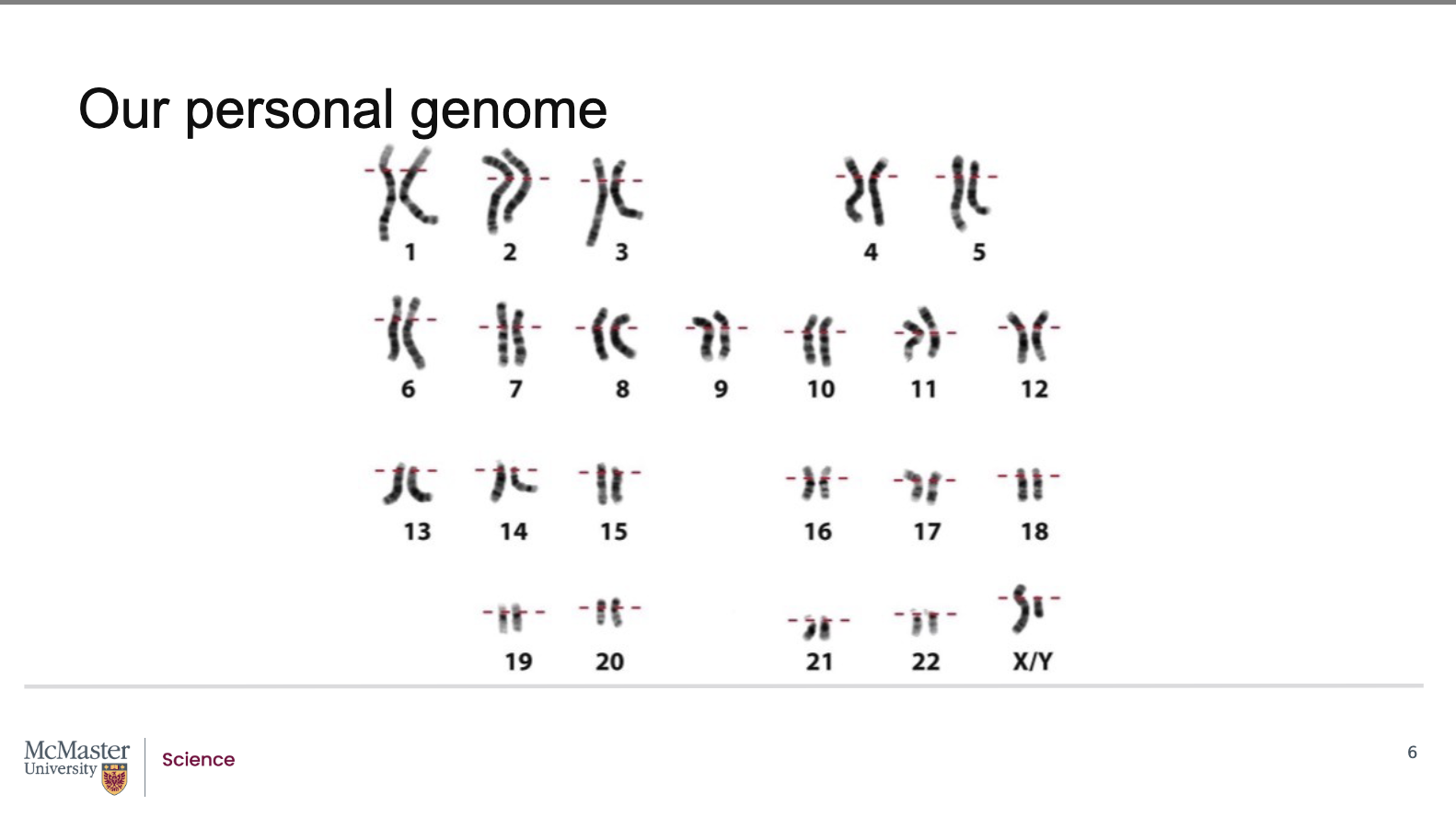
How does our genome create diversity even though all our cells have the same DNA?

A:

  • The human genome contains ~3 billion base pairs, but only ~2% actually codes for functional proteins or regulatory RNA molecules

  • Every cell in the human body has the same genome organized into 23 chromosome pairs

  • Despite sharing the same DNA, variation exists between individuals because genes come in different alleles

  • While each person has two alleles per gene, a population can have many different alleles or haplotypes

  • Genetic diversity arises across individuals and populations due to these variations

  • However, it is not just DNA differences that matter — differences in gene expression determine cell‑specific proteomes, which allow cells to perform specialized and vital functions

Memory tip:

Same DNA → different gene expression → different cell functions
2
New cards

Q: What key facts explain genetic variation and cell‑type specificity?

A:

  • The human genome has ~3 billion base pairs of DNA

  • Only ~2% of DNA codes for:

    • Functional proteins

    • Small regulatory RNA molecules

  • Alleles = different versions of the same gene

  • Each person carries 2 alleles per gene, but populations contain many alleles/haplotypes

  • These alleles arise due to evolutionary processes

  • Small DNA sequence differences contribute to genetic variation, but:

    • Gene expression patterns determine which proteins are made

    • This leads to cell type–specific proteomes

  • Cell‑specific proteomes are essential for vital cellular processes

Exam shortcut:

Variation = DNA differences
Function = gene expression
3
New cards

How do different cell types perform different functions in multicellular organisms?

A:

  • In multicellular organisms, different cell types have different proteomes

  • These proteomes are produced by different transcriptional programs, meaning:

    • Different sets of genes are turned on or off in different cells

  • These programs allow cells to:

    • Perform specific functions

    • Work with other cells

    • Function properly within tissues

  • Even though all cells have the same DNA blueprint, gene expression is:

    • Regulated differently in each cell type

  • This regulation is what allows cells to become specialized and essential for survival

Memory tip:

Same DNA → different transcription → different proteomes → different functions

there is a video in the module

4
New cards

How do white blood cells and red blood cells demonstrate cell‑specific gene expression?

A:

  • White blood cells (WBCs):

    • Migrate through blood vessels

    • Monitor for infection, inflammation, and pathogens

    • Can initiate immune responses

    • Use membrane‑bound surface proteins to interact with other cells

    • Interact with epithelial cells to:

      • Enter blood vessels

      • Exit blood vessels at target tissues

  • These white blood cells are able to interact with the epithelial cells to engage in this response. The information that is able to program all cells with their specific functions is written in our DNA blueprint, but it is of course regulated in specific ways across specific cell types in our bodies

  • Red blood cells (RBCs):

    • Are programmed mainly to carry oxygen

    • Deliver oxygen to tissues with high metabolic activity

  • These very different roles exist because:

    • Cells express different genes

    • This leads to different proteins on the cell surface and inside the cell

Exam shortcut:

WBCs = defense & movement
RBCs = oxygen transport

there is a video in the module

5
New cards

How can genetic variation affect cell function and the human body?

A:

  • Genetic variations can influence the differentiation (specialization) and proliferation (increase in number) of different cell types

  • These variations contribute to genetic variability, which can cause:

    • Negative effects

    • Positive effects

    • Or no noticeable effect in the body

  • Genes that code for important functional proteins require:

    • High fidelity replication

    • High fidelity transcription

    • High fidelity translation

  • Even small alterations in protein‑coding DNA can:

    • Change a protein’s shape

    • Alter its function inside the cell

  • Changes at the protein level can have broader effects throughout the body, not just in individual cells

Memory tip:

Small DNA change → protein shape changes → function changes → body‑wide effects
<p><strong>A:</strong></p><ul><li><p><strong>Genetic variations</strong> can influence the <strong>differentiation</strong> (specialization) and <strong>proliferation</strong> (increase in number) of different cell types</p></li><li><p>These variations contribute to <strong>genetic variability</strong>, which can cause:</p><ul><li><p><strong>Negative effects</strong></p></li><li><p><strong>Positive effects</strong></p></li><li><p>Or no noticeable effect in the body</p></li></ul></li><li><p>Genes that code for <strong>important functional proteins</strong> require:</p><ul><li><p><strong>High fidelity replication</strong></p></li><li><p><strong>High fidelity transcription</strong></p></li><li><p><strong>High fidelity translation</strong></p></li></ul></li><li><p>Even <strong>small alterations</strong> in protein‑coding DNA can:</p><ul><li><p>Change a protein’s <strong>shape</strong></p></li><li><p>Alter its <strong>function inside the cell</strong></p></li></ul></li><li><p>Changes at the protein level can have <strong>broader effects throughout the body</strong>, not just in individual cells</p></li></ul><p><span data-name="check_mark_button" data-type="emoji">✅</span> <strong>Memory tip:</strong></p><figure data-type="blockquoteFigure"><div><blockquote><p>Small DNA change → protein shape changes → function changes → body‑wide effects</p></blockquote><figcaption></figcaption></div></figure><p></p>
6
New cards

What is an example of how a small genetic change can strongly affect the body, and what question does this raise?

A:

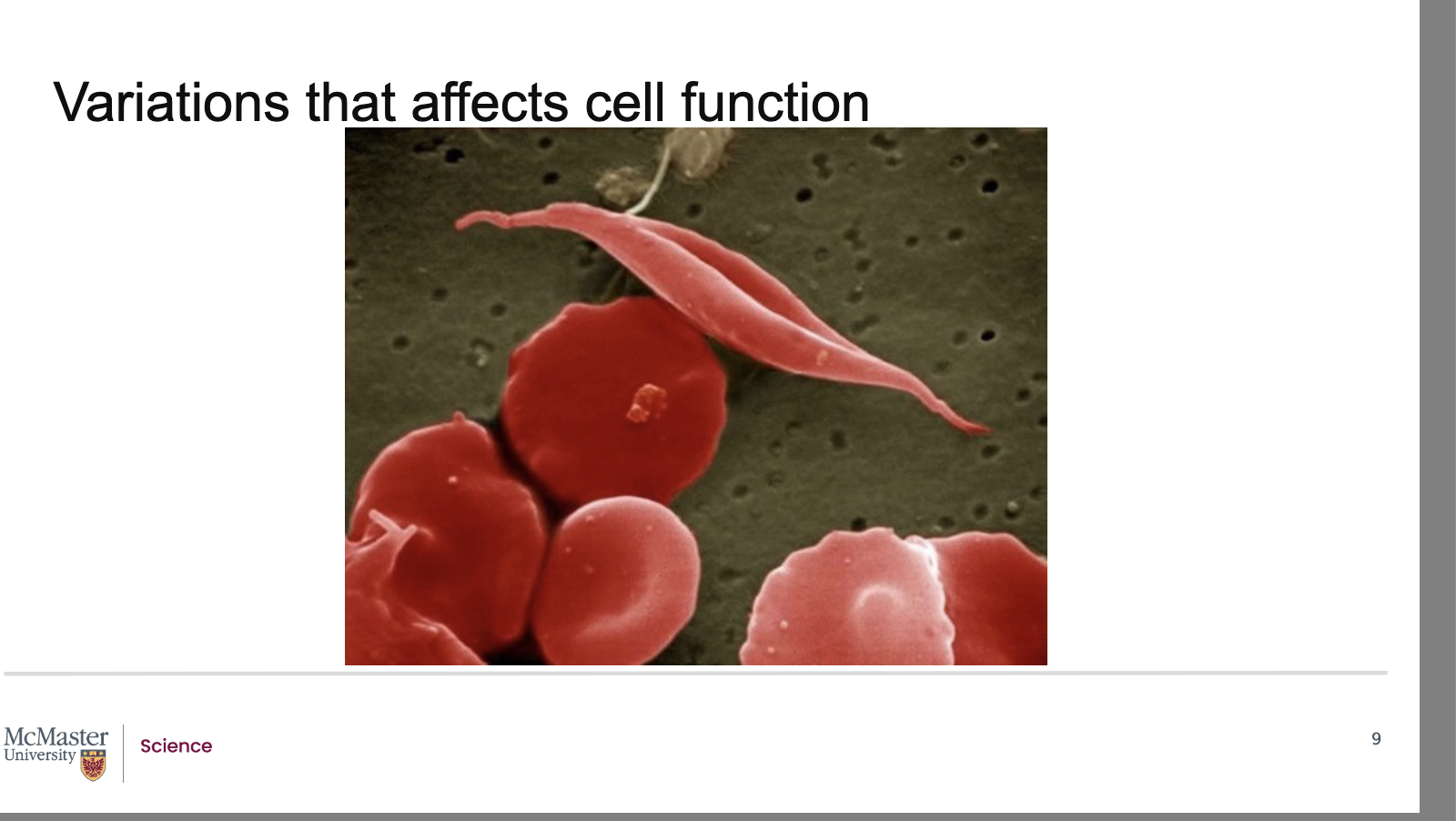
  • Sickle cell anemia is caused by a single nucleotide polymorphism (SNP)

  • This SNP occurs in a protein‑coding region and leads to:

    • A change in the red blood cell protein

    • An altered red blood cell shape

  • The altered shape causes:

    • Anemia

    • Severe pain throughout the body

    • Other systemic complications

  • This example shows that:

    • Even a single nucleotide change can have major physiological consequences

  • This leads to an important question:

    • Do all variations in protein‑coding regions of our genome affect cell function?

Exam highlight:

Not all mutations are harmful — but some, like sickle cell SNPs, have severe effects
<p><strong>A:</strong></p><ul><li><p><strong>Sickle cell anemia</strong> is caused by a <strong>single nucleotide polymorphism (SNP)</strong></p></li><li><p>This SNP occurs in a <strong>protein‑coding region</strong> and leads to:</p><ul><li><p>A change in the <strong>red blood cell protein</strong></p></li><li><p>An <strong>altered red blood cell shape</strong></p></li></ul></li><li><p>The altered shape causes:</p><ul><li><p><strong>Anemia</strong></p></li><li><p><strong>Severe pain throughout the body</strong></p></li><li><p>Other systemic complications</p></li></ul></li><li><p>This example shows that:</p><ul><li><p>Even a <strong>single nucleotide change</strong> can have <strong>major physiological consequences</strong></p></li></ul></li><li><p>This leads to an important question:</p><ul><li><p><strong>Do all variations in protein‑coding regions of our genome affect cell function?</strong></p></li></ul></li></ul><p><span data-name="check_mark_button" data-type="emoji">✅</span> <strong>Exam highlight:</strong></p><figure data-type="blockquoteFigure"><div><blockquote><p>Not all mutations are harmful — but some, like sickle cell SNPs, have severe effects</p></blockquote><figcaption></figcaption></div></figure><p></p>
7
New cards

Q: Do all genetic variations affect protein function and cell behavior?

A:

  • No, not all genetic variations affect function

  • Many genetic variations are:

    • Largely asymptomatic

    • Do not change how cells function

    • Still contribute to genetic diversity within a population

  • These neutral variations help explain why individuals can be genetically different while still functioning normally

  • Even when basic cellular functions remain unchanged, genetic variation plays a key role in biological diversity

Memory tip:

Variation ≠ dysfunction
8
New cards

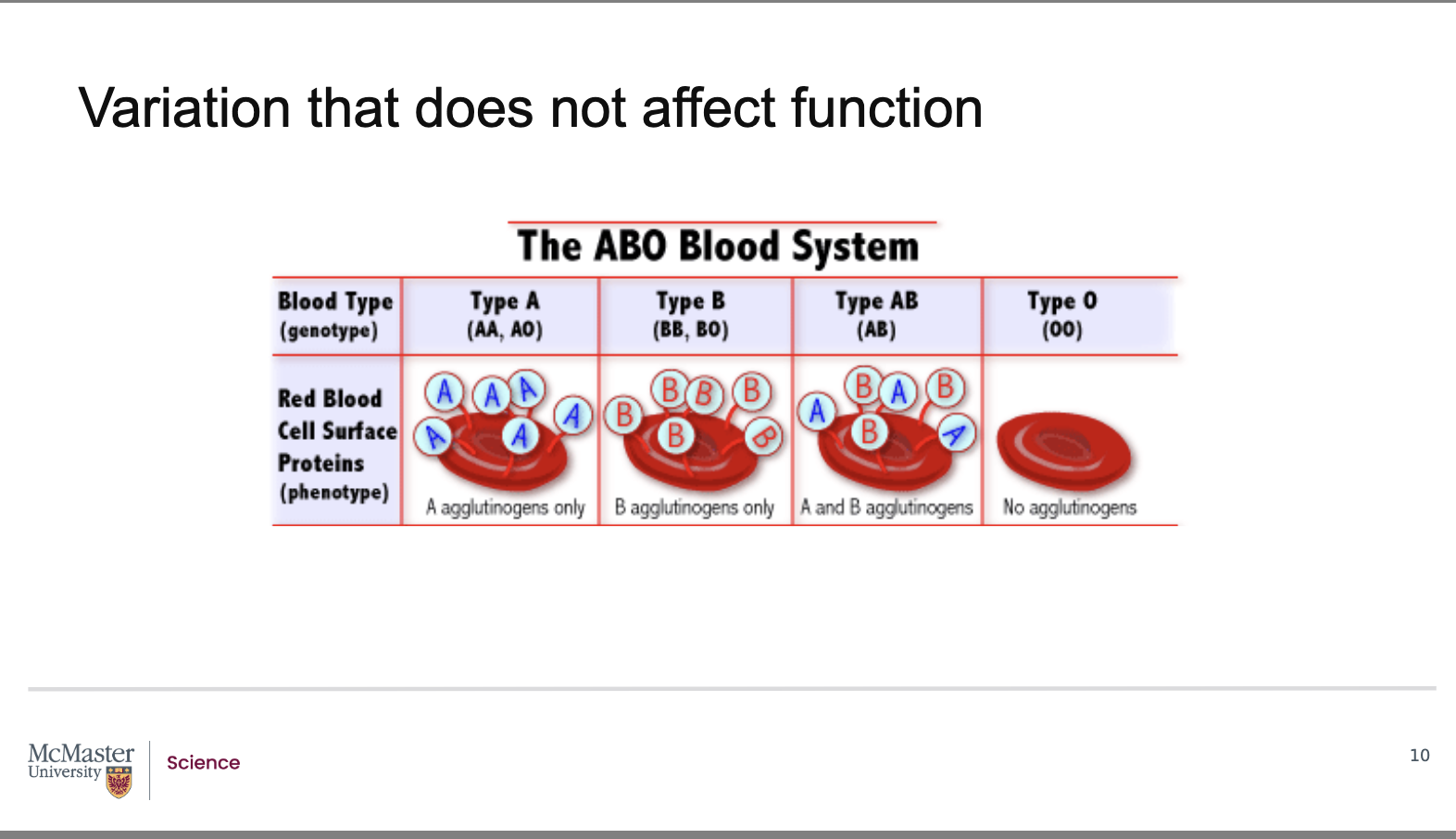
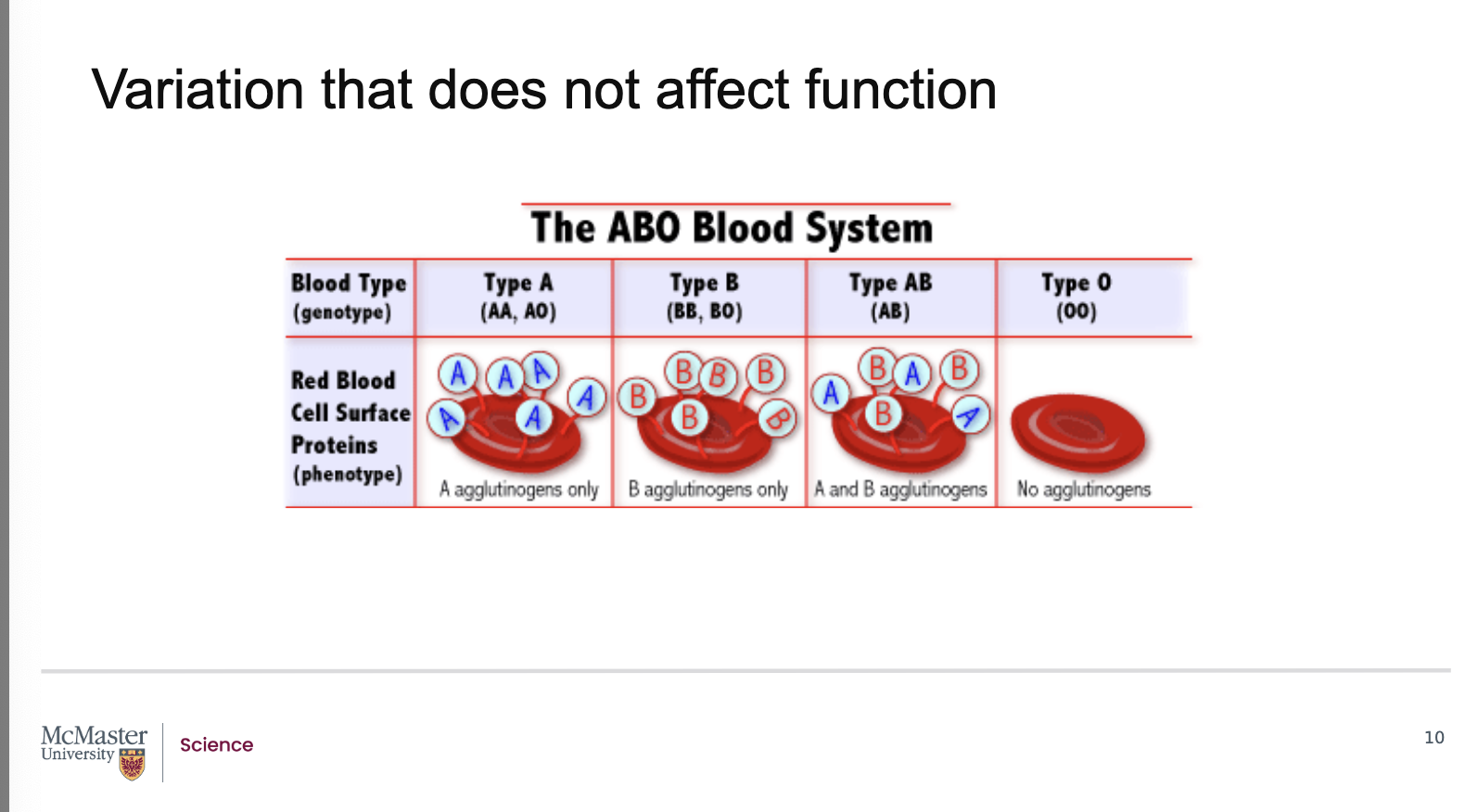
Q: How does the ABO blood typing system show that some genetic variation does not affect cell function?

A:

  • Everyone has red blood cells, and:

    • All red blood cells bind and carry oxygen in the same way

  • Because of this shared function, it was assumed up to ~100 years ago that all blood was the same

  • This assumption was incorrect because:

    • Different blood types exist among individuals

  • When non‑self blood of a different blood type was transfused:

    • It often led to tragic consequences for recipients

  • A blood type is defined as a classification of blood based on:

    • The presence or absence of specific inherited cell‑surface proteins

    • Or enzymes that catalyze the synthesis of:

      • Cell‑surface carbohydrates

      • Cell‑surface glycolipids

  • These differences affect blood compatibility, not the ability of red blood cells to carry oxygen

Exam shortcut:

ABO variation = surface markers, not oxygen transport
9
New cards

Q: How does the ABO gene determine an individual’s blood type?

A:

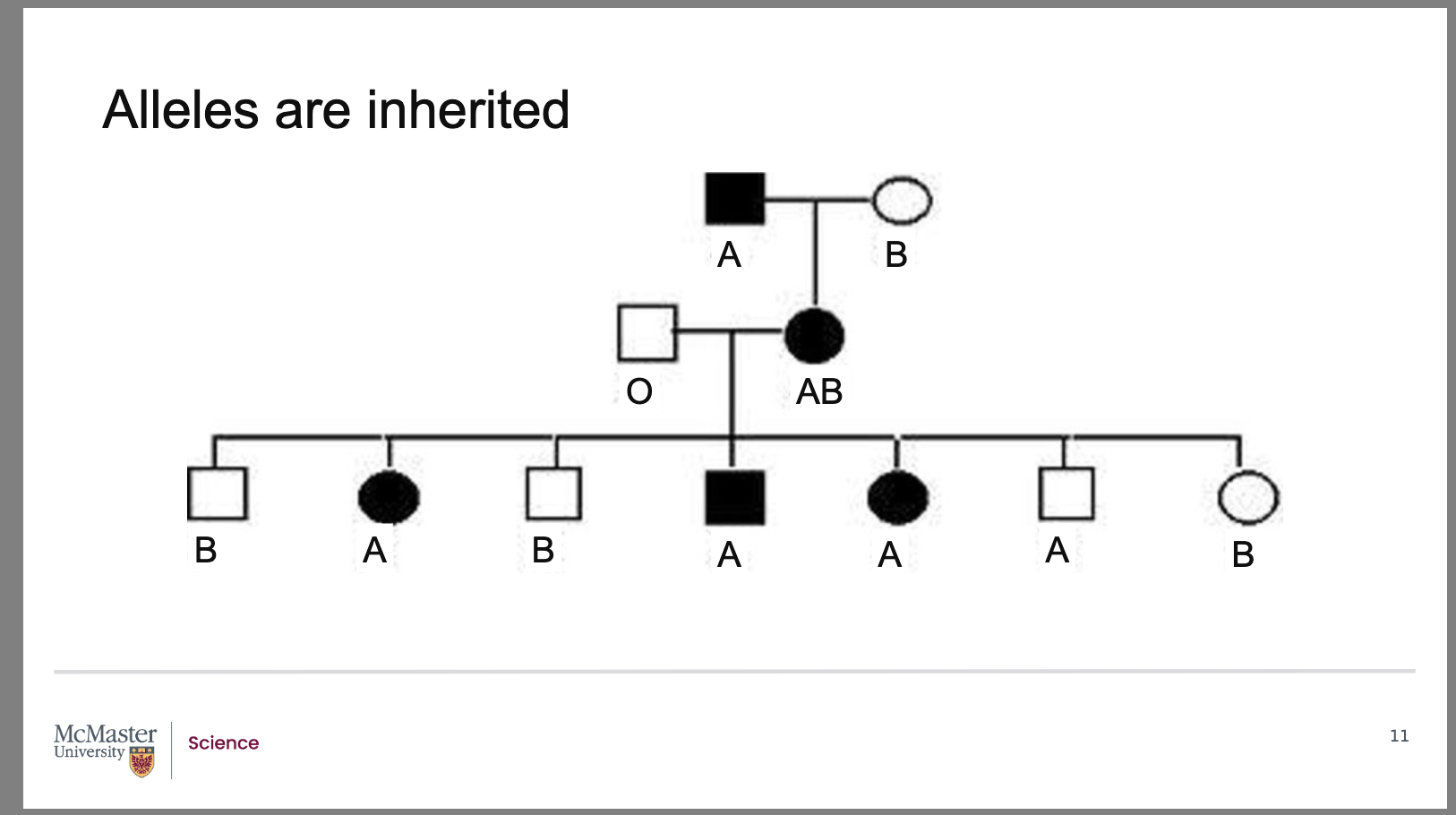
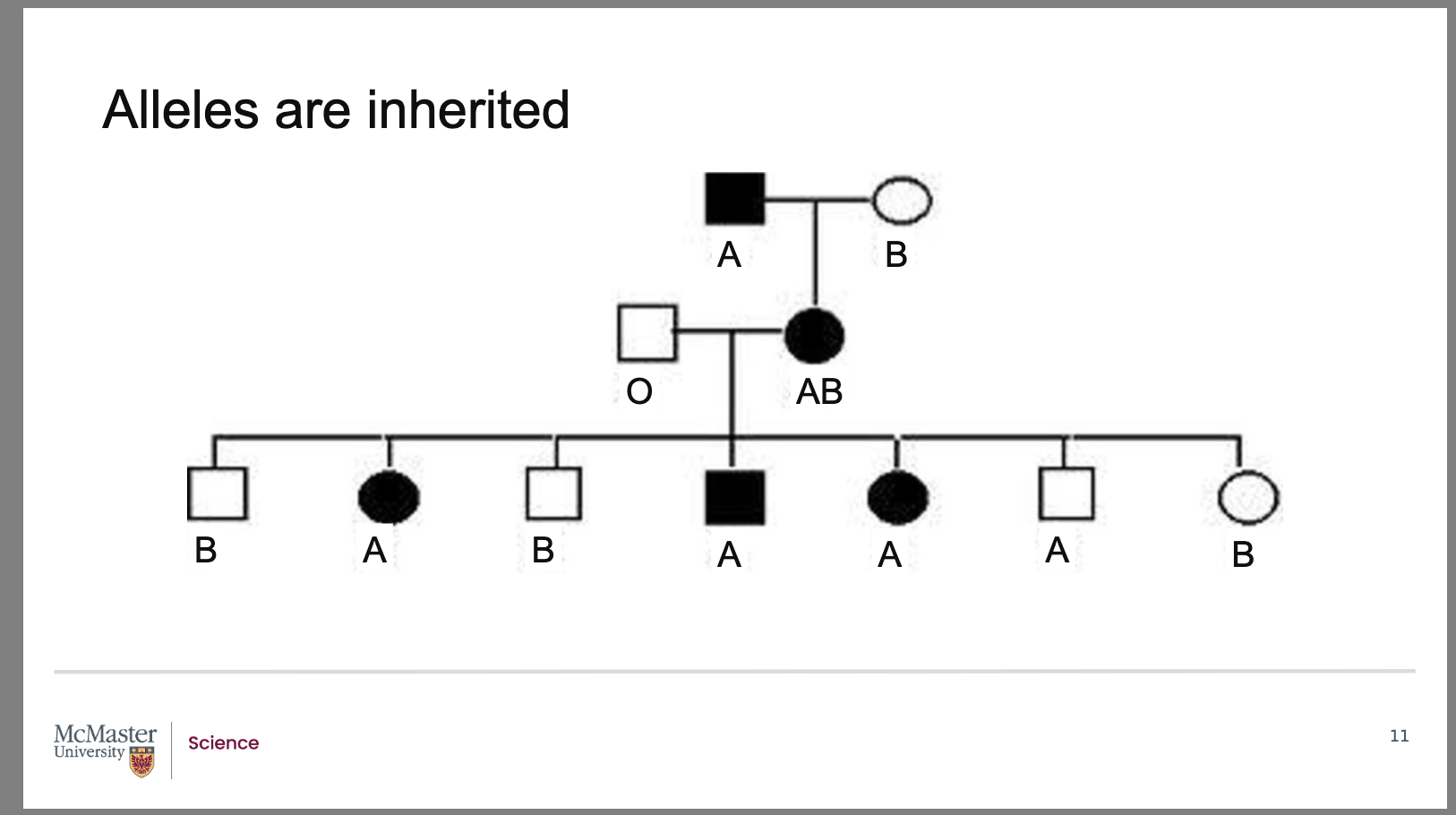
  • A person’s blood type is determined by the alleles they inherit for the ABO gene

  • The ABO locus has three main alleles:

    • A

    • B

    • O

  • Each person inherits:

    • One ABO allele from each parent

    • Resulting in two allele copies total

  • The combination of these two alleles determines an individual’s specific blood type

  • Blood type differences are therefore:

    • Genetically inherited

    • Based on allelic variation at a single gene locus

Memory tip:

ABO blood type = which 2 alleles you inherit at the ABO locus
<p><strong>A:</strong></p><ul><li><p>A person’s <strong>blood type</strong> is determined by the <strong>alleles they inherit</strong> for the <strong>ABO gene</strong></p></li><li><p>The <strong>ABO locus</strong> has <strong>three main alleles</strong>:</p><ul><li><p><strong>A</strong></p></li><li><p><strong>B</strong></p></li><li><p><strong>O</strong></p></li></ul></li><li><p>Each person inherits:</p><ul><li><p><strong>One ABO allele from each parent</strong></p></li><li><p>Resulting in <strong>two allele copies total</strong></p></li></ul></li><li><p>The <strong>combination of these two alleles</strong> determines an individual’s <strong>specific blood type</strong></p></li><li><p>Blood type differences are therefore:</p><ul><li><p><strong>Genetically inherited</strong></p></li><li><p>Based on <strong>allelic variation at a single gene locus</strong></p></li></ul></li></ul><p><span data-name="check_mark_button" data-type="emoji">✅</span> <strong>Memory tip:</strong></p><figure data-type="blockquoteFigure"><div><blockquote><p>ABO blood type = which 2 alleles you inherit at the ABO locus</p></blockquote><figcaption></figcaption></div></figure><p></p>
10
New cards

What proteins are produced by the A, B, and O alleles of the ABO gene?

A:

  • A and B alleles:

    • Code for functional glycosyltransferase enzymes

    • These enzymes:

      • Catalyze the formation of specific A or B agglutinogens

      • Agglutinogens are expressed on the cell surface

  • O allele:

    • Encodes an inactive glycosyltransferase

    • Does not produce functional agglutinogens on the cell surface

  • AB blood type:

    • Contains several SNP (single nucleotide polymorphism) variations

    • These SNPs result in:

      • The formation of slightly different glycosyltransferase enzymes

  • These molecular differences explain:

    • Why different blood types have different surface markers

    • Why blood compatibility varies between individuals

Exam shortcut:

A & B = active enzymes
O = inactive enzyme
AB = SNP variation in transferases
<p><strong>A:</strong></p><ul><li><p><strong>A and B alleles</strong>:</p><ul><li><p>Code for <strong>functional glycosyltransferase enzymes</strong></p></li><li><p>These enzymes:</p><ul><li><p>Catalyze the formation of <strong>specific A or B agglutinogens</strong></p></li><li><p><strong>Agglutinogens</strong> are expressed on the <strong>cell surface</strong></p></li></ul></li></ul></li><li><p><strong>O allele</strong>:</p><ul><li><p>Encodes an <strong>inactive glycosyltransferase</strong></p></li><li><p>Does <strong>not produce functional agglutinogens</strong> on the cell surface</p></li></ul></li><li><p><strong>AB blood type</strong>:</p><ul><li><p>Contains <strong>several SNP (single nucleotide polymorphism) variations</strong></p></li><li><p>These SNPs result in:</p><ul><li><p>The formation of <strong>slightly different glycosyltransferase enzymes</strong></p></li></ul></li></ul></li><li><p>These molecular differences explain:</p><ul><li><p>Why different blood types have <strong>different surface markers</strong></p></li><li><p>Why blood compatibility varies between individuals</p></li></ul></li></ul><p><span data-name="check_mark_button" data-type="emoji">✅</span> <strong>Exam shortcut:</strong></p><figure data-type="blockquoteFigure"><div><blockquote><p>A &amp; B = active enzymes<br>O = inactive enzyme<br>AB = SNP variation in transferases</p></blockquote><figcaption></figcaption></div></figure><p></p>
11
New cards

How does the ABO blood typing system work, and why is it important?

A:

  • Not all genetic variation affects cell function — many variations are asymptomatic but contribute to genetic diversity in populations

  • The ABO blood typing system is a key example of this neutral genetic variation

  • All people have red blood cells, and all red blood cells carry oxygen in the same way, regardless of blood type

  • Because oxygen transport is identical, it was believed up to ~100 years ago that all blood was the same

  • This was proven incorrect when blood transfusions using non‑self blood (different blood types) caused tragic outcomes

  • A blood type is defined by the presence or absence of inherited cell‑surface molecules, including:

    • Specific cell‑surface proteins

    • Or enzymes that synthesize cell‑surface carbohydrates or glycolipids

  • Blood type is determined by the ABO gene, which has three main alleles:

    • A, B, and O

  • Each person inherits one allele from each parent, giving two ABO alleles total

  • A and B alleles code for functional glycosyltransferase enzymes that create A or B agglutinogens on the red blood cell surface

  • The O allele codes for an inactive glycosyltransferase, producing no functional surface agglutinogens

  • The AB blood type contains SNP polymorphisms that result in slightly different glycosyltransferases

  • These surface differences affect blood compatibility, not oxygen‑carrying ability

One‑line exam summary:

ABO blood type differences come from inherited alleles that control cell‑surface molecules, not red blood cell function.
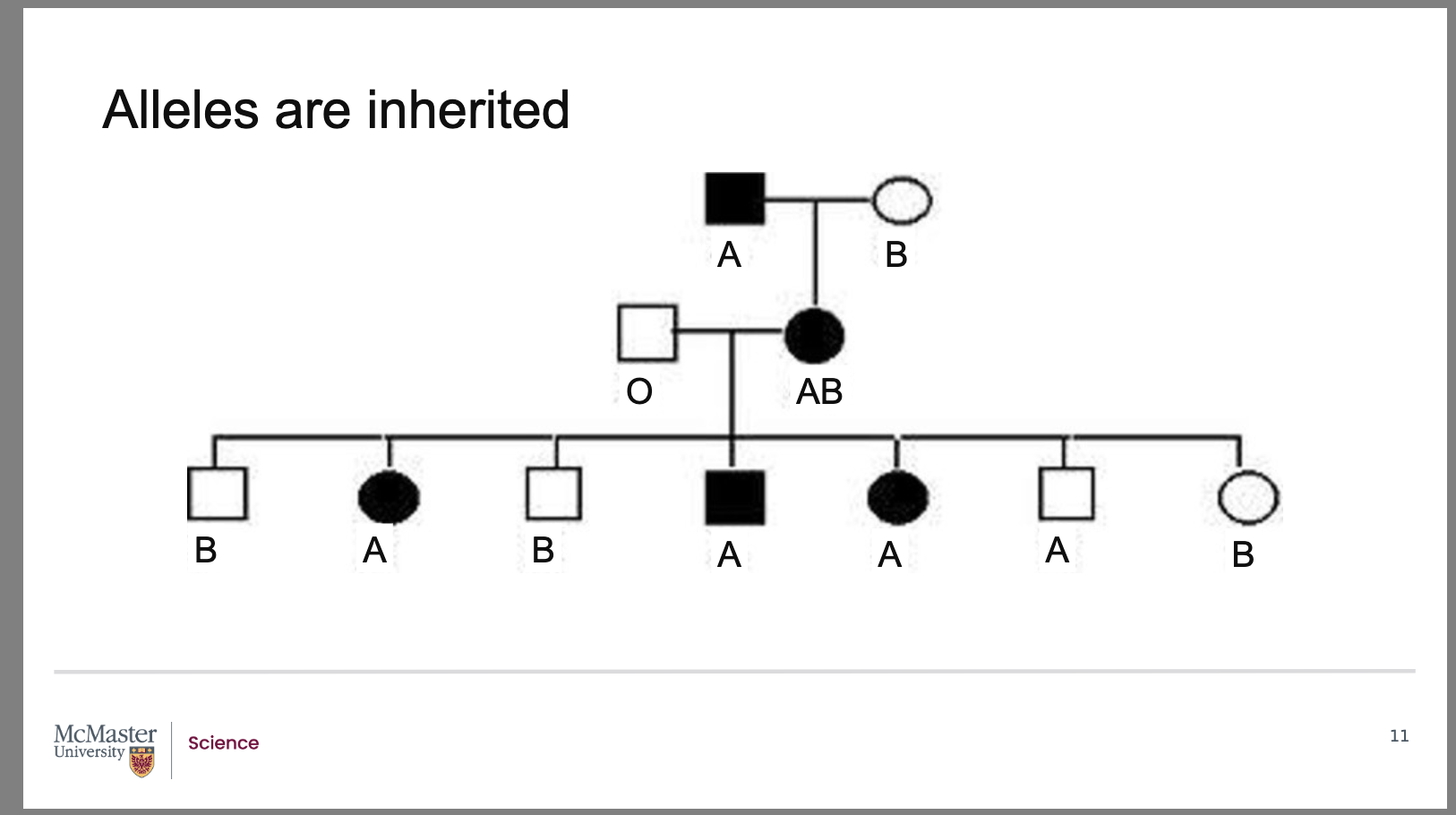

<p><strong>A:</strong></p><ul><li><p>Not all genetic variation affects cell function — many variations are <strong>asymptomatic</strong> but contribute to <strong>genetic diversity</strong> in populations</p></li><li><p>The <strong>ABO blood typing system</strong> is a key example of this neutral genetic variation</p></li><li><p><strong>All people have red blood cells</strong>, and all red blood cells <strong>carry oxygen in the same way</strong>, regardless of blood type</p></li><li><p>Because oxygen transport is identical, it was believed <strong>up to ~100 years ago</strong> that all blood was the same</p></li><li><p>This was proven incorrect when <strong>blood transfusions using non‑self blood</strong> (different blood types) caused <strong>tragic outcomes</strong></p></li><li><p>A <strong>blood type</strong> is defined by the <strong>presence or absence of inherited cell‑surface molecules</strong>, including:</p><ul><li><p>Specific <strong>cell‑surface proteins</strong></p></li><li><p>Or <strong>enzymes</strong> that synthesize cell‑surface <strong>carbohydrates or glycolipids</strong></p></li></ul></li><li><p>Blood type is determined by the <strong>ABO gene</strong>, which has <strong>three main alleles</strong>:</p><ul><li><p><strong>A, B, and O</strong></p></li></ul></li><li><p>Each person inherits <strong>one allele from each parent</strong>, giving <strong>two ABO alleles total</strong></p></li><li><p><strong>A and B alleles</strong> code for <strong>functional glycosyltransferase enzymes</strong> that create <strong>A or B agglutinogens</strong> on the red blood cell surface</p></li><li><p>The <strong>O allele</strong> codes for an <strong>inactive glycosyltransferase</strong>, producing <strong>no functional surface agglutinogens</strong></p></li><li><p>The <strong>AB blood type</strong> contains <strong>SNP polymorphisms</strong> that result in <strong>slightly different glycosyltransferases</strong></p></li><li><p>These surface differences affect <strong>blood compatibility</strong>, not <strong>oxygen‑carrying ability</strong></p></li></ul><p><span data-name="check_mark_button" data-type="emoji">✅</span> <strong>One‑line exam summary:</strong></p><figure data-type="blockquoteFigure"><div><blockquote><p>ABO blood type differences come from inherited alleles that control cell‑surface molecules, not red blood cell function.</p></blockquote><figcaption></figcaption></div></figure><div data-type="horizontalRule"><hr></div><p></p>
12
New cards

How can genetic variation sometimes become beneficial rather than harmful?

A:

  • Not all mutations that change protein sequences are harmful

  • Some mutations are:

    • Asymptomatic under normal conditions

    • Beneficial under specific environmental conditions

  • When environments change or impose stress (e.g. disease, pathogens):

    • Certain mutations can improve survival or function

    • Individuals with these mutations may handle environmental challenges better than those without them

  • This shows that the effect of a mutation depends on context, not just the mutation itself

  • This idea is the focus of Unit 2: When variation becomes beneficial

Memory tip:

Mutation effect = depends on environment
<p><strong>A:</strong></p><ul><li><p><strong>Not all mutations</strong> that change protein sequences are harmful</p></li><li><p>Some mutations are:</p><ul><li><p><strong>Asymptomatic</strong> under normal conditions</p></li><li><p><strong>Beneficial under specific environmental conditions</strong></p></li></ul></li><li><p>When environments change or impose stress (e.g. disease, pathogens):</p><ul><li><p>Certain mutations can <strong>improve survival or function</strong></p></li><li><p>Individuals with these mutations may handle <strong>environmental challenges better</strong> than those without them</p></li></ul></li><li><p>This shows that the effect of a mutation depends on <strong>context</strong>, not just the mutation itself</p></li><li><p>This idea is the focus of <strong>Unit 2: When variation becomes beneficial</strong></p></li></ul><p><span data-name="check_mark_button" data-type="emoji">✅</span> <strong>Memory tip:</strong></p><figure data-type="blockquoteFigure"><div><blockquote><p>Mutation effect = depends on environment</p></blockquote><figcaption></figcaption></div></figure><p></p>
13
New cards

How does HIV infection illustrate how mutations can be beneficial in certain situations?

A:

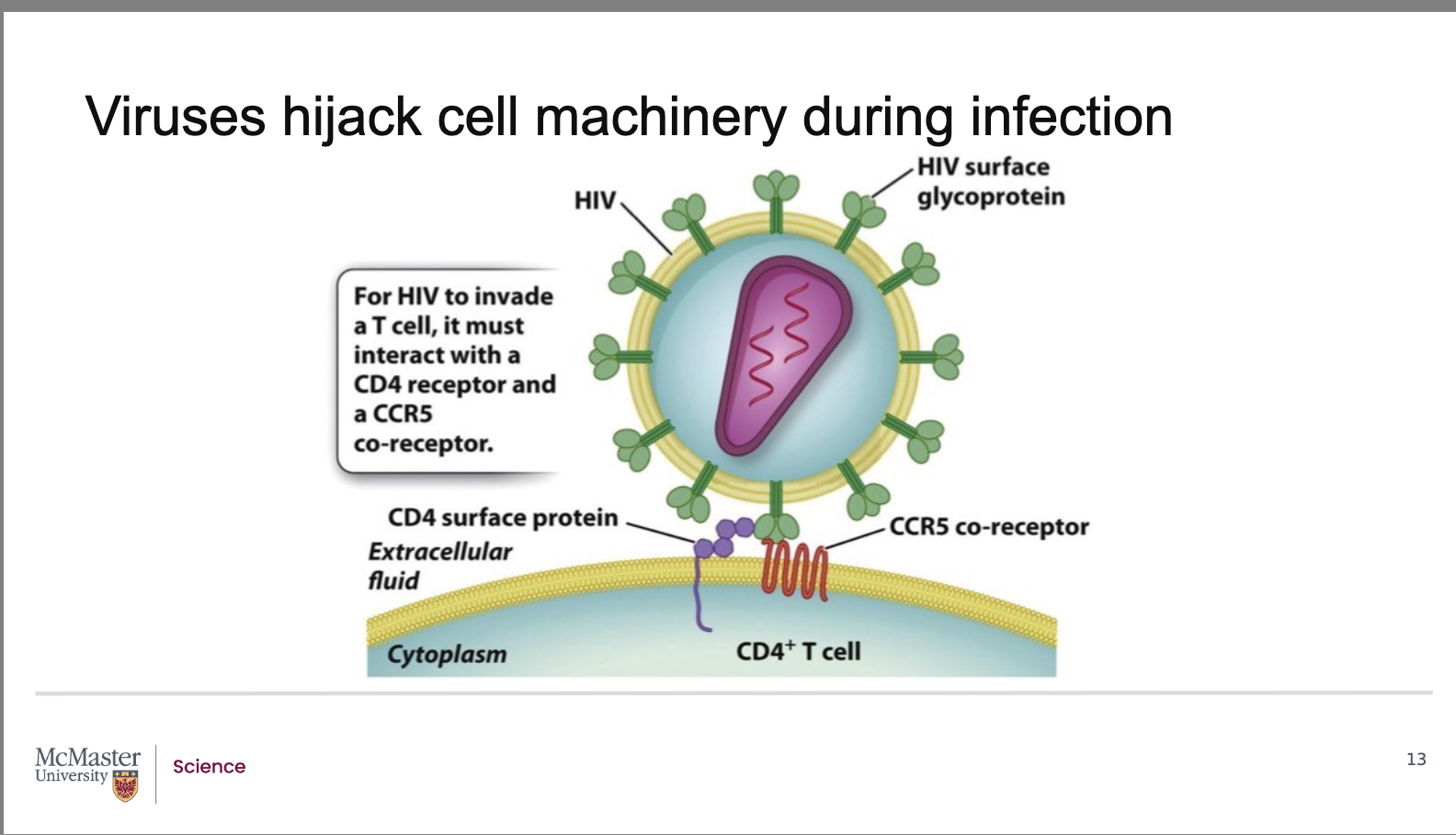
  • HIV (Human Immunodeficiency Virus) infects T cells, which are important immune cells

  • To enter a T cell, HIV must attach to two specific proteins on the cell surface:

    • CD4 receptor

    • CCR5 co‑receptor

  • Think of CD4 and CCR5 like two locks that HIV must unlock to get inside the cell

  • Once HIV attaches to both:

    • The virus is taken into the cell

    • Infection begins

  • Over time, HIV causes:

    • Death of T cells

    • A weakened (compromised) immune system

  • This example is important because:

    • If one of these proteins (like CCR5) is altered by a mutation,

    • HIV may not be able to enter the cell at all

Memory tip:

HIV needs CD4 + CCR5 to infect T cells
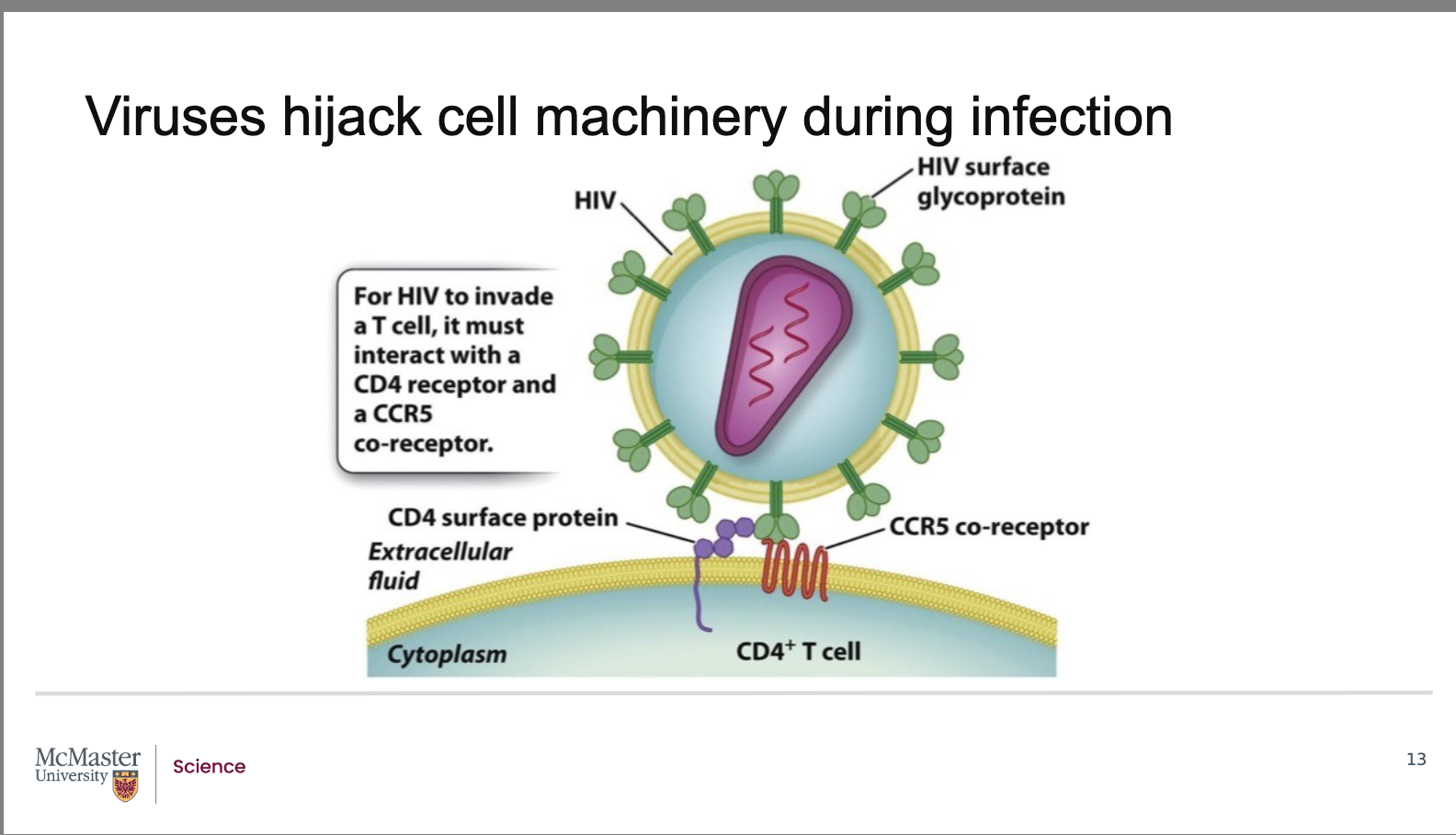
<p><strong>A:</strong></p><ul><li><p><strong>HIV</strong> (Human Immunodeficiency Virus) infects <strong>T cells</strong>, which are important immune cells</p></li><li><p>To enter a T cell, HIV must <strong>attach to two specific proteins</strong> on the cell surface:</p><ul><li><p><strong>CD4 receptor</strong></p></li><li><p><strong>CCR5 co‑receptor</strong></p></li></ul></li><li><p>Think of CD4 and CCR5 like <strong>two locks</strong> that HIV must unlock to get inside the cell</p></li><li><p>Once HIV attaches to both:</p><ul><li><p>The virus is <strong>taken into the cell</strong></p></li><li><p>Infection begins</p></li></ul></li><li><p>Over time, HIV causes:</p><ul><li><p><strong>Death of T cells</strong></p></li><li><p>A <strong>weakened (compromised) immune system</strong></p></li></ul></li><li><p>This example is important because:</p><ul><li><p>If one of these proteins (like CCR5) is altered by a mutation,</p></li><li><p>HIV may not be able to enter the cell at all</p></li></ul></li></ul><p><span data-name="check_mark_button" data-type="emoji">✅</span> <strong>Memory tip:</strong></p><figure data-type="blockquoteFigure"><div><blockquote><p>HIV needs <strong>CD4 + CCR5</strong> to infect T cells</p></blockquote><figcaption></figcaption></div></figure><p></p>
14
New cards

How can a mutation in the CCR5 gene protect against HIV infection?

A:

  • Some mutations are beneficial because they protect against infectious diseases

  • Certain individuals have a mutation in the CCR5 gene that gives them immunity to HIV infection

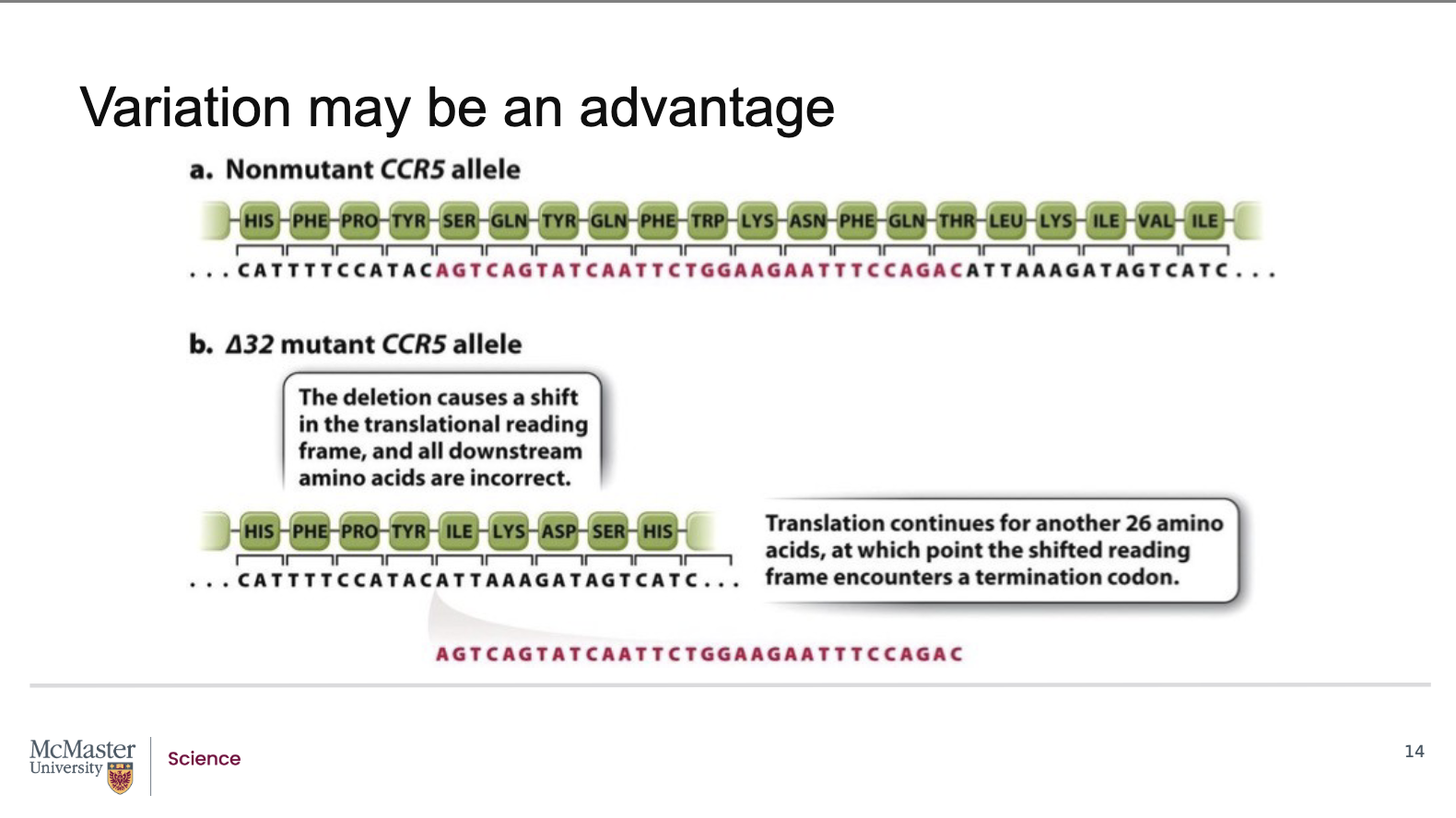
  • This mutation is a 32 base‑pair deletion in the CCR5 gene

  • Because 32 is not a multiple of three, the deletion:

    • Causes a frameshift mutation

    • Introduces a premature stop codon

  • Translation ends early, producing:

    • A shortened (partial)

    • Inactive CCR5 protein

  • Since HIV needs CCR5 to enter T cells:

    • An inactive CCR5 protein prevents HIV from entering the cell

Memory tip:

No CCR5 → HIV can’t get in
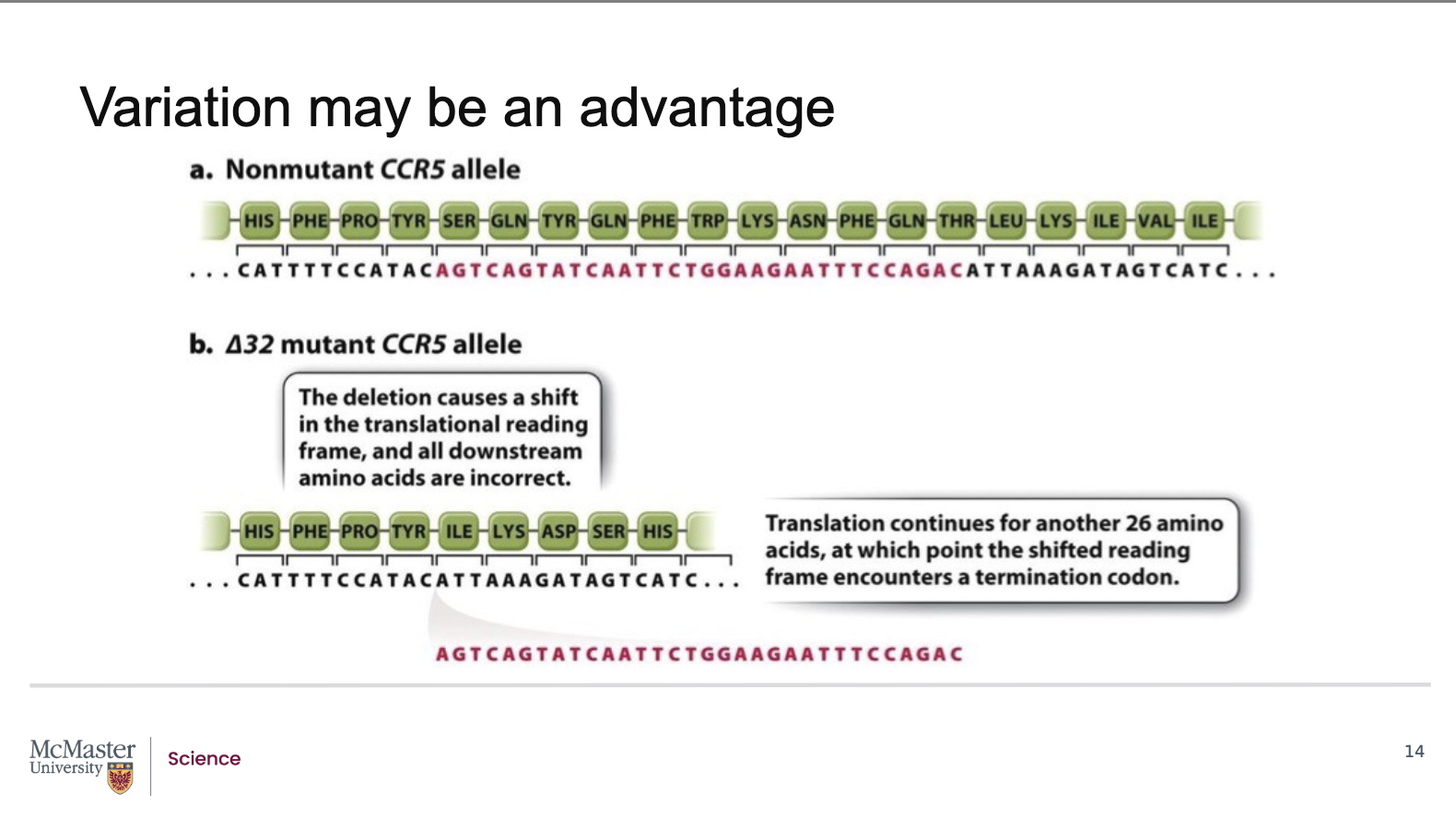
<p><strong>A:</strong></p><ul><li><p>Some mutations are beneficial because they <strong>protect against infectious diseases</strong></p></li><li><p>Certain individuals have a mutation in the <strong>CCR5 gene</strong> that gives them <strong>immunity to HIV infection</strong></p></li><li><p>This mutation is a <strong>32 base‑pair deletion</strong> in the CCR5 gene</p></li><li><p>Because 32 is <strong>not a multiple of three</strong>, the deletion:</p><ul><li><p>Causes a <strong>frameshift mutation</strong></p></li><li><p>Introduces a <strong>premature stop codon</strong></p></li></ul></li><li><p>Translation ends early, producing:</p><ul><li><p>A <strong>shortened (partial)</strong></p></li><li><p><strong>Inactive CCR5 protein</strong></p></li></ul></li><li><p>Since HIV needs <strong>CCR5</strong> to enter T cells:</p><ul><li><p>An inactive CCR5 protein prevents HIV from entering the cell</p></li></ul></li></ul><p><span data-name="check_mark_button" data-type="emoji">✅</span> <strong>Memory tip:</strong></p><figure data-type="blockquoteFigure"><div><blockquote><p>No CCR5 → HIV can’t get in</p></blockquote><figcaption></figcaption></div></figure><p></p>
15
New cards

Why is the CCR5 mutation prevalent if its benefit is mainly during HIV infection?

A:

  • The CCR5 mutation is relatively common in European populations

  • One theory suggests that:

    • The mutation provided resistance to the mid‑14th century bubonic plague

    • Individuals with the mutation were more likely to survive

    • This caused the mutation to be favored by natural selection

  • An alternative theory proposes that:

    • Smallpox created the selective pressure instead

    • The mutation increased survival during smallpox outbreaks

  • In both cases:

    • Survivors passed the mutation on to their offspring

    • The mutation became more common generation after generation

Exam shortcut:

Past diseases may explain why CCR5 mutation exists today
<p><strong>A:</strong></p><ul><li><p>The CCR5 mutation is relatively common in <strong>European populations</strong></p></li><li><p>One theory suggests that:</p><ul><li><p>The mutation provided resistance to the <strong>mid‑14th century bubonic plague</strong></p></li><li><p>Individuals with the mutation were <strong>more likely to survive</strong></p></li><li><p>This caused the mutation to be <strong>favored by natural selection</strong></p></li></ul></li><li><p>An alternative theory proposes that:</p><ul><li><p><strong>Smallpox</strong> created the selective pressure instead</p></li><li><p>The mutation increased survival during smallpox outbreaks</p></li></ul></li><li><p>In both cases:</p><ul><li><p>Survivors passed the mutation on to their offspring</p></li><li><p>The mutation became more common <strong>generation after generation</strong></p></li></ul></li></ul><p><span data-name="check_mark_button" data-type="emoji">✅</span> <strong>Exam shortcut:</strong></p><figure data-type="blockquoteFigure"><div><blockquote><p>Past diseases may explain why CCR5 mutation exists today</p></blockquote><figcaption></figcaption></div></figure><p></p>
16
New cards

What is the human microbiome, and how extensive is it in the body?

A:

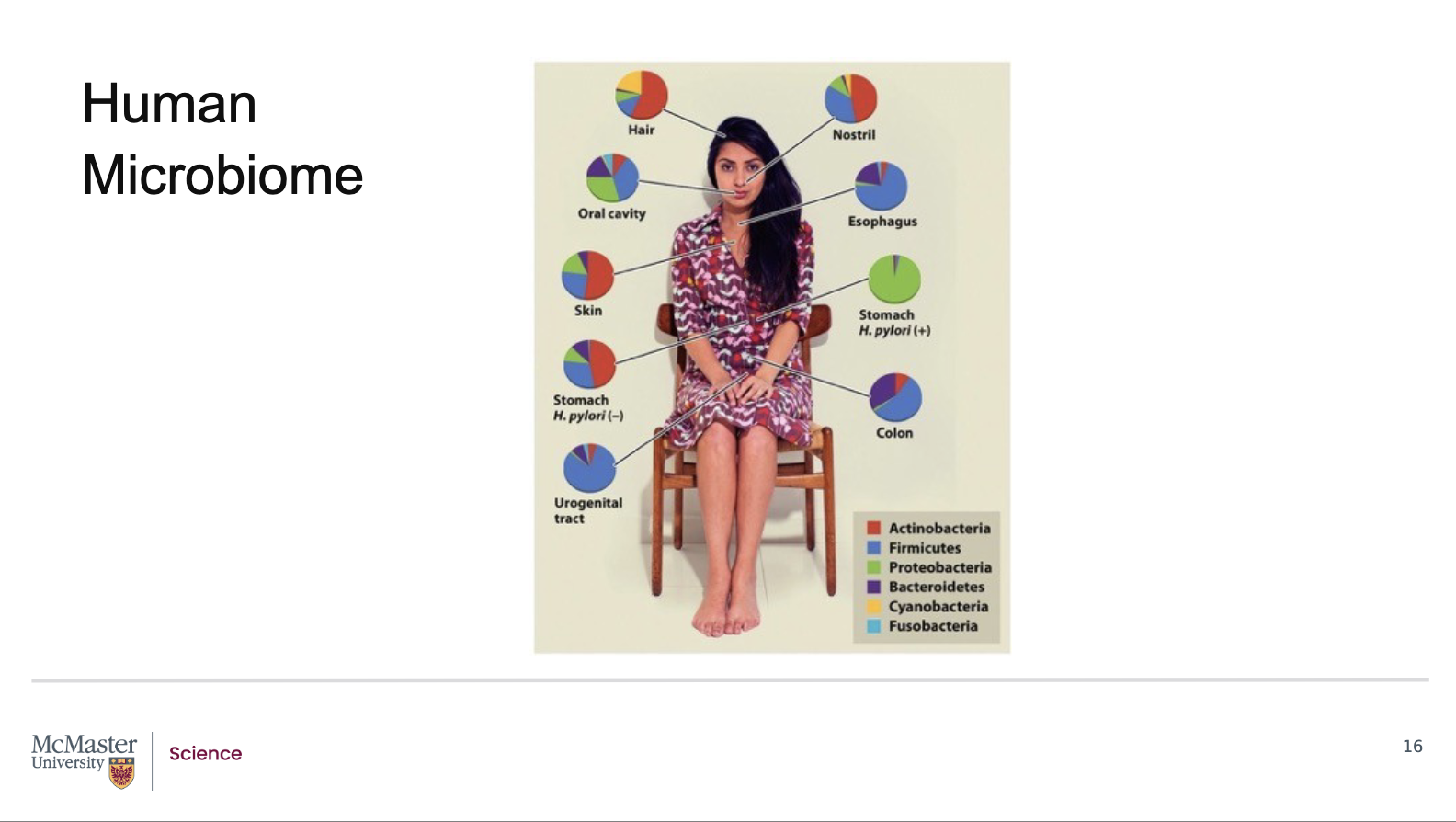
  • The human body contains ~10 times more bacterial cells than human cells

  • These bacteria are found throughout the body, including:

    • Skin

    • Mouth

    • Digestive tract (especially the gut)

  • Humans act as a host to billions of prokaryotic (bacterial) cells

  • We provide bacteria with:

    • Shelter

    • Nutrients

  • This relationship is not one‑sided — humans also gain important benefits from these bacteria

Memory tip:

You are more bacterial than human — and that’s a good thing
<p><strong>A:</strong></p><ul><li><p>The human body contains <strong>~10 times more bacterial cells than human cells</strong></p></li><li><p>These bacteria are found <strong>throughout the body</strong>, including:</p><ul><li><p><strong>Skin</strong></p></li><li><p><strong>Mouth</strong></p></li><li><p><strong>Digestive tract (especially the gut)</strong></p></li></ul></li><li><p>Humans act as a <strong>host</strong> to <strong>billions of prokaryotic (bacterial) cells</strong></p></li><li><p>We provide bacteria with:</p><ul><li><p><strong>Shelter</strong></p></li><li><p><strong>Nutrients</strong></p></li></ul></li><li><p>This relationship is <strong>not one‑sided</strong> — humans also gain important benefits from these bacteria</p></li></ul><p><span data-name="check_mark_button" data-type="emoji">✅</span> <strong>Memory tip:</strong></p><figure data-type="blockquoteFigure"><div><blockquote><p>You are more bacterial than human — and that’s a good thing</p></blockquote><figcaption></figcaption></div></figure><p></p>
17
New cards

How does the microbiome benefit human health, and why is it unique to each person?

A:

  • Many bacteria in the gut microbiome:

    • Help digest food

    • Produce essential vitamins

  • These bacteria contribute positively to overall health

  • Every person has a unique microbiome:

    • Your mix of bacterial species is different from:

      • Family members

      • Friends

  • Microbiome diversity depends on:

    • Past exposure to different bacteria

    • Antibiotic use

    • Interactions with the environment

  • This means the microbiome is:

    • Personal

    • Dynamic

    • Influenced by lifestyle and experiences

Exam shortcut:

Microbiome diversity depends on environment, exposure, and antibiotics
<p><strong>A:</strong></p><ul><li><p>Many bacteria in the <strong>gut microbiome</strong>:</p><ul><li><p>Help <strong>digest food</strong></p></li><li><p>Produce <strong>essential vitamins</strong></p></li></ul></li><li><p>These bacteria contribute positively to <strong>overall health</strong></p></li><li><p>Every person has a <strong>unique microbiome</strong>:</p><ul><li><p>Your mix of bacterial species is <strong>different</strong> from:</p><ul><li><p>Family members</p></li><li><p>Friends</p></li></ul></li></ul></li><li><p>Microbiome diversity depends on:</p><ul><li><p><strong>Past exposure</strong> to different bacteria</p></li><li><p><strong>Antibiotic use</strong></p></li><li><p><strong>Interactions with the environment</strong></p></li></ul></li><li><p>This means the microbiome is:</p><ul><li><p>Personal</p></li><li><p>Dynamic</p></li><li><p>Influenced by lifestyle and experiences</p></li></ul></li></ul><p><span data-name="check_mark_button" data-type="emoji">✅</span> <strong>Exam shortcut:</strong></p><figure data-type="blockquoteFigure"><div><blockquote><p>Microbiome diversity depends on environment, exposure, and antibiotics</p></blockquote><figcaption></figcaption></div></figure><p></p>
18
New cards

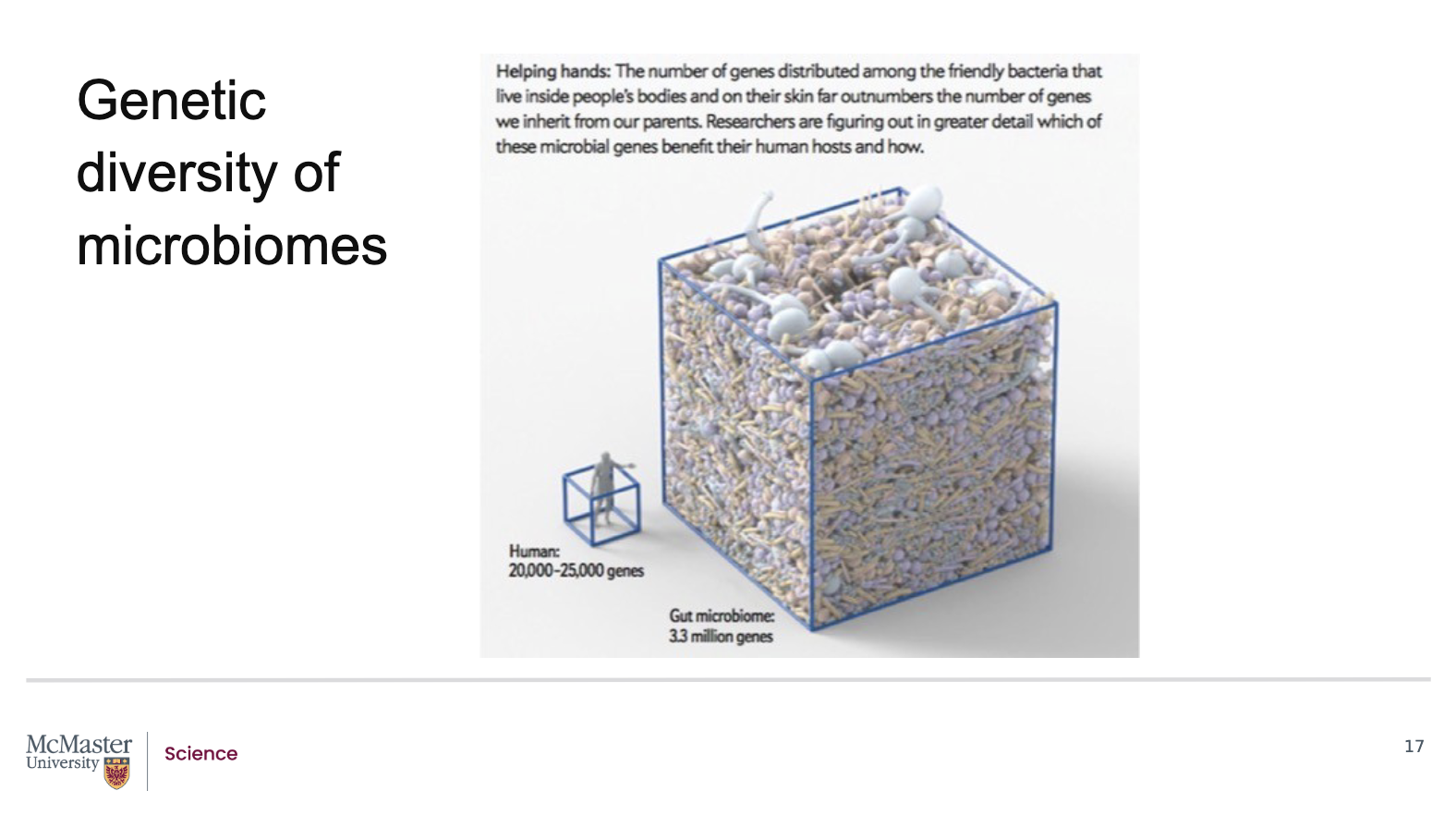
How genetically diverse is the human microbiome compared to the human genome?

A:

  • The personal microbiome contains a highly diverse collection of bacterial species

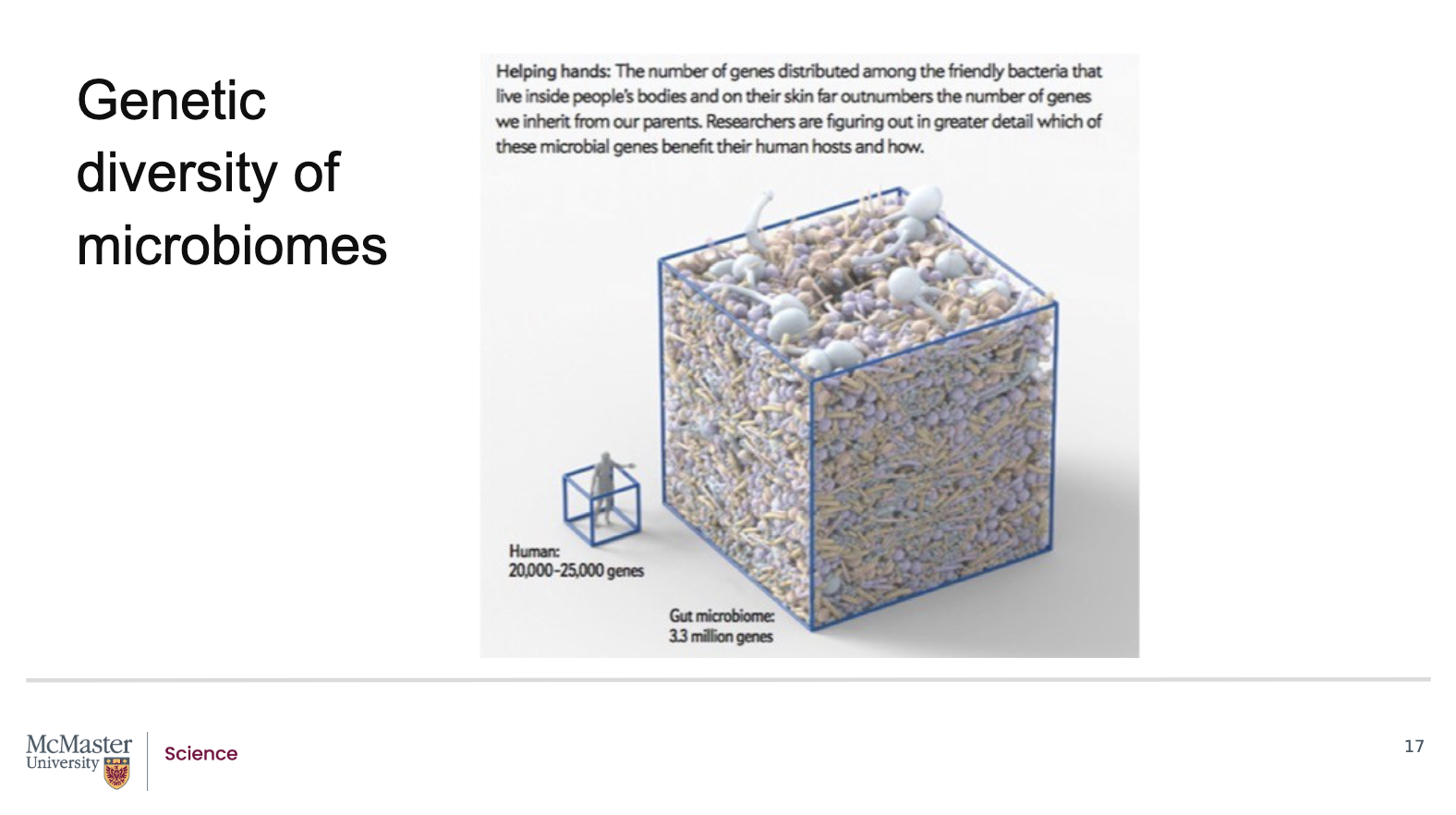
  • Across all microbiome species, there may be over 3 million distinct genes

  • This is much larger than the human genome, which has only ~20,000 protein‑coding genes

  • Because of this, the microbiome represents a rich source of genetic diversity

  • Humans can access this microbial genetic diversity daily, which may:

    • Help us adapt more quickly to a changing environment

  • This shows that the microbiome greatly expands our functional genetic capacity, beyond our own DNA

Memory tip:

Microbiome genes (millions) ≫ human genes (thousands)
<p><strong>A:</strong></p><ul><li><p>The <strong>personal microbiome</strong> contains a <strong>highly diverse collection of bacterial species</strong></p></li><li><p>Across all microbiome species, there may be <strong>over 3 million distinct genes</strong></p></li><li><p>This is much larger than the human genome, which has only <strong>~20,000 protein‑coding genes</strong></p></li><li><p>Because of this, the microbiome represents a <strong>rich source of genetic diversity</strong></p></li><li><p>Humans can access this microbial genetic diversity <strong>daily</strong>, which may:</p><ul><li><p>Help us <strong>adapt more quickly</strong> to a <strong>changing environment</strong></p></li></ul></li><li><p>This shows that the microbiome greatly expands our <strong>functional genetic capacity</strong>, beyond our own DNA</p></li></ul><p><span data-name="check_mark_button" data-type="emoji">✅</span> <strong>Memory tip:</strong></p><figure data-type="blockquoteFigure"><div><blockquote><p>Microbiome genes (millions) ≫ human genes (thousands)</p></blockquote><figcaption></figcaption></div></figure><p></p>
19
New cards

What factors influence microbiome variation across populations, and how does it differ from our genome?

A:

  • Scientists study variation in gut microbiomes to understand population differences

  • In 2011, researchers analyzed gut microbiome DNA from people in:

    • America

    • Japan

    • Europe

  • Each region had distinct mixtures of bacterial species

  • Different populations possessed different sets of microbial genes, which can:

    • Produce different vitamins

    • Produce different enzymes

    • Influence disease susceptibility

  • Microbiome variation does not correlate with ancestry

  • Instead, it is strongly associated with recent dietary patterns:

    • Diets high in animal proteins and fats → different microbiome

    • Diets high in plant‑based foods → different microbiome

  • Unlike the eukaryotic (human) genome, the microbiome can:

    • Respond rapidly to changes in:

      • Diet

      • Environment

      • Exposure to pathogens

Exam shortcut:

Microbiome = fast‑changing, diet‑dependent
Human genome = slow‑changing, inherited
<p><strong>A:</strong></p><ul><li><p>Scientists study variation in <strong>gut microbiomes</strong> to understand population differences</p></li><li><p>In <strong>2011</strong>, researchers analyzed gut microbiome DNA from people in:</p><ul><li><p><strong>America</strong></p></li><li><p><strong>Japan</strong></p></li><li><p><strong>Europe</strong></p></li></ul></li><li><p>Each region had <strong>distinct mixtures of bacterial species</strong></p></li><li><p>Different populations possessed <strong>different sets of microbial genes</strong>, which can:</p><ul><li><p>Produce different <strong>vitamins</strong></p></li><li><p>Produce different <strong>enzymes</strong></p></li><li><p>Influence <strong>disease susceptibility</strong></p></li></ul></li><li><p>Microbiome variation does <strong>not correlate with ancestry</strong></p></li><li><p>Instead, it is strongly associated with <strong>recent dietary patterns</strong>:</p><ul><li><p>Diets <strong>high in animal proteins and fats</strong> → different microbiome</p></li><li><p>Diets <strong>high in plant‑based foods</strong> → different microbiome</p></li></ul></li><li><p>Unlike the <strong>eukaryotic (human) genome</strong>, the microbiome can:</p><ul><li><p>Respond <strong>rapidly</strong> to changes in:</p><ul><li><p><strong>Diet</strong></p></li><li><p><strong>Environment</strong></p></li><li><p><strong>Exposure to pathogens</strong></p></li></ul></li></ul></li></ul><p><span data-name="check_mark_button" data-type="emoji">✅</span> <strong>Exam shortcut:</strong></p><figure data-type="blockquoteFigure"><div><blockquote><p>Microbiome = fast‑changing, diet‑dependent<br>Human genome = slow‑changing, inherited</p></blockquote><figcaption></figcaption></div></figure><p></p>
20
New cards

Explore top flashcards

flashcards
La maison
52
Updated 1177d ago
0.0(0)
flashcards
AP Biology - Unit 5
51
Updated 1159d ago
0.0(0)
flashcards
Unidad 4A Vocabulario - A Comer
32
Updated 758d ago
0.0(0)
flashcards
[ 2MID ] MIL - What is Media?
40
Updated 215d ago
0.0(0)
flashcards
African Civilization Test
65
Updated 1234d ago
0.0(0)
flashcards
Geometry 1.1-1.6
29
Updated 959d ago
0.0(0)
flashcards
¡Qué chévere! Unidad 6A
54
Updated 1044d ago
0.0(0)
flashcards
Comprehensive: Cardio
182
Updated 474d ago
0.0(0)
flashcards
La maison
52
Updated 1177d ago
0.0(0)
flashcards
AP Biology - Unit 5
51
Updated 1159d ago
0.0(0)
flashcards
Unidad 4A Vocabulario - A Comer
32
Updated 758d ago
0.0(0)
flashcards
[ 2MID ] MIL - What is Media?
40
Updated 215d ago
0.0(0)
flashcards
African Civilization Test
65
Updated 1234d ago
0.0(0)
flashcards
Geometry 1.1-1.6
29
Updated 959d ago
0.0(0)
flashcards
¡Qué chévere! Unidad 6A
54
Updated 1044d ago
0.0(0)
flashcards
Comprehensive: Cardio
182
Updated 474d ago
0.0(0)



